By Clay Shumate
A pre-assessment is a short check given before you teach a unit, to find out what students already know. The research behind it is thin and mostly from college classrooms, so it earns its place only when you cannot already predict the result and you will act on what it tells you.
Key Takeaways
- The evidence is genuinely scant, and the people who popularised pre-assessment say so themselves. Thomas Guskey and Jay McTighe wrote in 2016 that “research evidence supporting the use of pre-assessments is hard to find,” and that what exists “comes mostly from college or university classrooms.”
- The one real secondary test of placement did not favour asking first. In a grade-8 science study, McDaniel and colleagues compared quizzing before the lecture, straight after it, and as review before the exam. The abstract reports that “review quizzing produced the greatest increases in exam performance.”
- The pretesting research everyone cites was run on adults. Pan and Sana (2021) found pretesting beat posttesting across five experiments, but all 1,573 participants were Mechanical Turk workers or undergraduates. No school students took part.
- Two articles by the same author report the same study two different ways. Guskey and McTighe say a 1983 dissertation “more than tripled” mastery; Guskey’s 2018 piece puts the same prerequisite effect at “20 percent more students.” Neither reconciles the other. Both numbers are below.
- Prerequisites are the half worth keeping. Guskey’s 2018 position is that prerequisite pre-assessments “can be particularly beneficial,” but only when teachers then use the results to help students master those specific prerequisites.
What is a pre-assessment?
A pre-assessment is a check you give before teaching something, to find out what students already know, half-know, or have wrong. That is the whole definition. It is not a grade, it is not a baseline for a growth calculation, and it is not supposed to take a period.
The useful version of the question is not “what is it” but “what is it for.” Kristina Doubet and Jessica Hockett put the test plainly in 2013: “A pre-assessment is useless unless it tells teachers what and how students are thinking.” If it comes back and your plan for next week is unchanged, you did not pre-assess. You collected paper.
Is a pre-assessment the same thing as a pre-test?
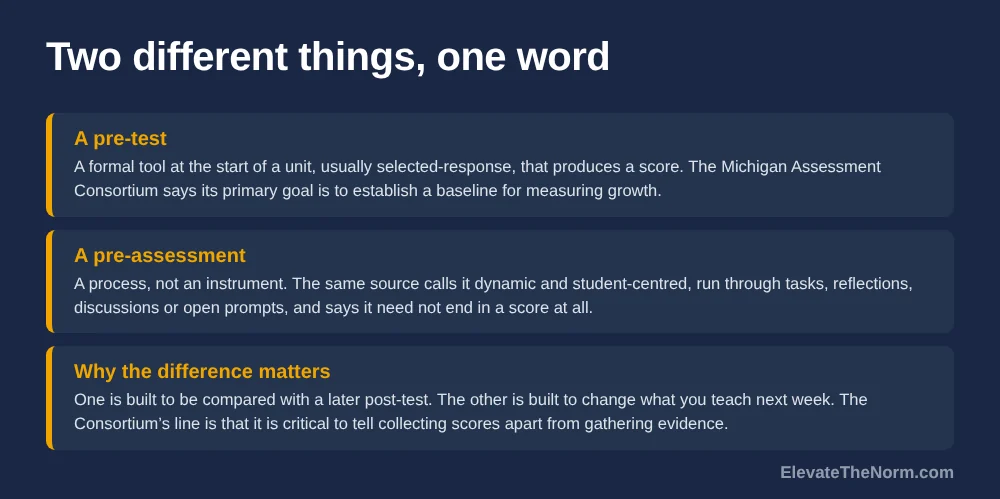
No. A pre-test is a formal, usually selected-response instrument that produces a score you can compare with a later post-test. A pre-assessment is a process that produces evidence you act on, and it does not have to produce a score at all. The Michigan Assessment Consortium draws the line this way: it is “critical to differentiate between collecting scores and gathering evidence.”
That distinction matters more than it sounds, because most of what gets handed to teachers as “required pre-assessment” is a pre-test wearing the other word. If the form goes in a spreadsheet and nobody changes an activity because of it, you have a pre-test with a friendlier name.
| Tool | Given when | Produces | What you do with it | Main risk |
|---|---|---|---|---|
| Pre-test | Day one of the unit | A score, usually communicated to students | Compare it with the post-test | Costs a period and changes nothing you teach |
| Prerequisite pre-assessment | A few days before the unit | A short list of missing prerequisites | Teach the prerequisites, briefly, before you start | You find gaps and have no time budgeted to fix them |
| Preview pre-assessment | Just before the unit | Known misconceptions and interests | Plan around the misconceptions you did not expect | It only confirms what you already knew |
| Formative check | Mid-unit, repeatedly | Evidence about the lesson you just taught | Reteach or move on tomorrow | Collecting it and not reading it |
| Progress monitoring | Every week or two, over months | A trend line for one student | Decide whether an intervention is working | Changing course on too few data points |
Does pre-assessment actually improve student learning?
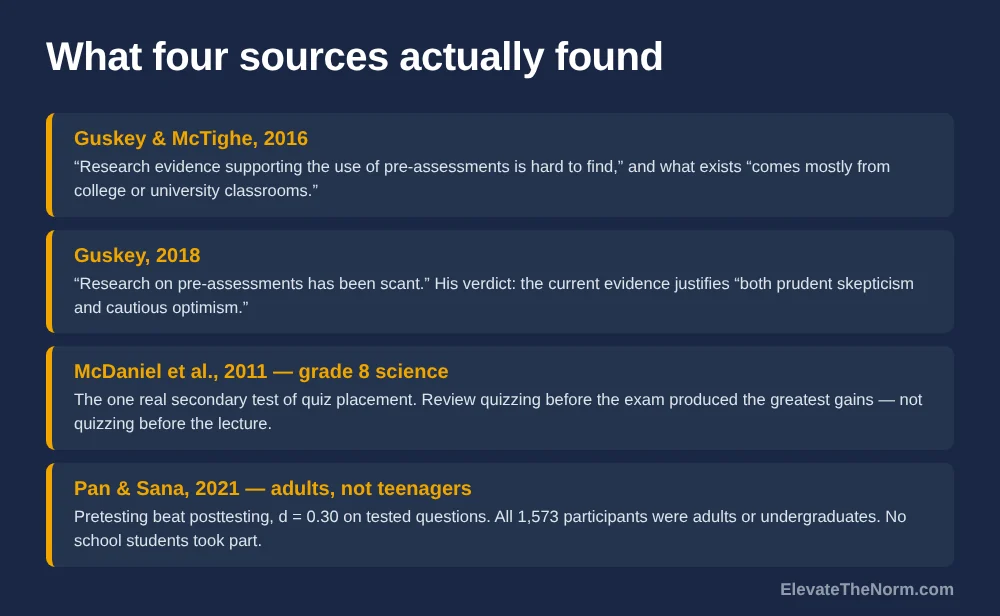
There is no strong evidence that it does, and the honest answer is that nobody has really tested it in secondary classrooms. Guskey and McTighe (2016) searched and reported that research support is “hard to find.” Two years later Guskey wrote the sentence again in a follow-up article: “Research on pre-assessments has been scant.”
That is not the same as saying pre-assessment does not work. It is saying the question has barely been asked. Guskey’s own summary is the fairest one I have read on it: the current evidence “justifies both prudent skepticism and cautious optimism.” He also notes that neither the advocates nor the critics can point to strong research for their position. If someone shows you a slide claiming pre-assessment lifts achievement, ask what study it came from. There is a decent chance the answer is a 1983 dissertation.
Why do two articles report the same study differently?
Because they do, and this is worth knowing before you quote either of them. Both Guskey articles lean on the same source, an unpublished 1983 doctoral dissertation by Leyton. The 2016 article describes a high school prerequisite review that “lasted just a week and a half” and says it “more than tripled the number of students who achieved mastery on course final examinations.”
The 2018 article describes the same prerequisite effect as producing “20 percent more students achieving mastery on a comprehensive course exam,” with mastery learning alone adding 35 percent and the combination reaching 61 percent. It does not say whether that 20 percent is percentage points or a relative increase, and it does not mention the earlier framing. The 2018 article also does the responsible thing and limits its own evidence: the study ran “in only a few subject areas and under tightly controlled conditions,” and it was “conducted 35 years ago.”
I am not accusing anyone of anything. Numbers get restated, and a dissertation is a hard source to re-check. But a claim that appears as “tripled” in one place and “20 percent” in another, from the same author, about the same study, is not a number you should put on a staff-meeting slide. If you want to use it, cite both versions and say they disagree.
What does the evidence from real secondary classrooms show?
The most useful study for a grades 6–12 teacher is not about pre-assessment at all. It is about placement. McDaniel, Agarwal, Huelser, McDermott and Roediger (2011) ran quizzes in 8th grade science and varied when the quiz happened: before the lecture, immediately after it, or as review before the unit exam.
The result, from the published abstract, is that quizzing worked — “between 13% and 25% gains in performance on summative unit examinations” — and that “review quizzing produced the greatest increases in exam performance.” Not the pre-lecture quiz. The review quiz. The benefits also “persisted on cumulative semester and end-of-year exams.”
Two honest caveats. I could read the abstract but not the full methods or limitations, so the sample size and the exact figures for the pre-lecture condition are not reported here. And this is a study of quizzing, not of pre-assessment as a planning tool — it tells you where a quiz pays off, not whether a diagnostic changes your lesson plan. Still, when the one real middle-school test of ordering says the review slot beat the front slot, that belongs in the conversation.
Does asking questions before teaching help students learn?
Yes, in laboratory conditions, with adults. This is a genuinely interesting finding and it is routinely oversold. Pan and Sana (2021) ran five experiments comparing a practice test given before reading a passage against one given after. Pretesting won. Across the first four experiments the effect was d = 0.30 on questions that had appeared on the pretest and d = 0.14 on questions that had not. Their conclusion: “pretesting is highly competitive with posttesting and can yield similar, if not greater, pedagogical benefits.”
Now the population. All 1,573 participants were adults recruited from Amazon Mechanical Turk (mean ages 35 to 39) or undergraduates (mean ages around 20). No school students took part in any of the five experiments. The reading passages were encyclopedia-style text about Yellowstone and Saturn at roughly a 10th-grade readability level, which is closer to a high school classroom than most lab materials get, but a Mechanical Turk worker reading for five dollars is not a 9th grader in fifth period.
Worth knowing before you try it: pretest accuracy in Experiment 1 averaged 33 percent, against 25 percent for pure guessing on a multiple-choice item. Students doing this will get most of it wrong, by design. That is the mechanism, not a failure — but you have to say so out loud or the room will read it as a trap.
What should a pre-assessment in grades 6–12 actually look like?
Short, prerequisite-focused, ungraded, and scored before you plan. Here is the version I would defend, built from what Guskey, McTighe, Doubet and Hockett each argue rather than from anything I have invented:
- Pick the prerequisites, not the content. Not “what do you know about the Cold War” — you are about to teach that. Ask what they need on day one and may not have: reading a map key, integer operations, what a primary source is.
- Write four to six items, maximum. Guskey and McTighe describe a prerequisite review that “typically requires only 15 or 20 minutes of class time.” If yours needs a full period, it is a pre-test.
- Make at least one item ask for reasoning. Doubet and Hockett are blunt that multiple-choice and true/false items are weak here unless students explain or justify the choice. One “how do you know?” line is usually enough.
- Say out loud that it does not count. Guskey and McTighe recommend telling students the purpose is to help you optimise instruction and that results will not count against them. Guskey’s 2018 wording is sharper: students should understand the purpose is to assure their success, not to judge them.
- Score it the same day, in tallies. Not per-student grades — counts. How many missed item 3. That is the number that changes Monday.
- Budget the reteach before you give it. If you have not left room in the calendar to teach the prerequisite you are about to discover is missing, do not give the pre-assessment. You will just feel bad on Tuesday.
One design rule that is easy to miss and matters most for the students you are most worried about: Doubet and Hockett say a pre-assessment should be “accessible to all students, rather than restricted to those with enriched backgrounds.” A prerequisite check written so that it quietly rewards whoever has travelled, read widely at home, or had the better middle school is not measuring prerequisites. It is measuring background, and then you plan your unit off that.
And the arithmetic, because this is a grades 6–12 site and most of us teach five sections. Six items across 150 students is 900 answers. Tallying how many students missed each item takes about ten minutes if the format is scannable and the rest of the night if it is not. That is the real reason to cap the item count — not the students’ patience, your Sunday.
Instruments you may already be using do part of this job. An anticipation guide surfaces beliefs about a text before students read it, and the K column of a KWL chart is a prior-knowledge diagnostic whether or not anyone calls it one. Neither is a prerequisite check, which is the half with the most support behind it.
How long should a pre-assessment take?
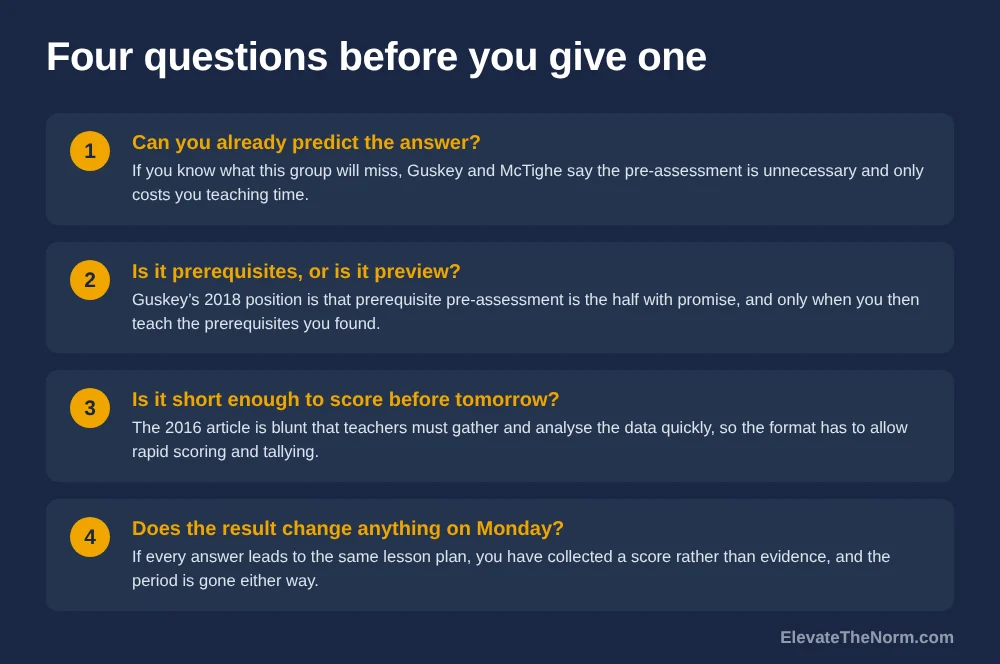
Fifteen to twenty minutes is the figure Guskey and McTighe attach to a prerequisite review, and I would treat that as a ceiling rather than a target. The constraint they name is not student stamina, it is yours: teachers “must gather and analyze the pre-assessment data quickly,” so the format has to allow rapid scoring and tallying. A pre-assessment you cannot read before you plan is worse than none, because it cost a period and still left you guessing.
Doubet and Hockett put the cost in the sharpest terms. A pre-assessment used only for a pre/post comparison, they write, is “little more than a thief of instructional time.”
Should a pre-assessment be graded?
No. Nothing in any source read for this article recommends grading one, and two of them specifically warn about what happens when the number counts. Guskey points out the obvious perverse incentive: when grades depend on pre-to-post gains, “ensuring that students do poorly on the pre-test enhances their chances of success.” The 2016 article says the same thing from the other direction — teachers can produce impressive gains simply by encouraging students to do badly on the pre-assessment.
There is a second reason, and it is about the room rather than the gradebook. Guskey writes that pre-assessments “initiate learning activities with a failure experience for most students,” and the 2016 article warns that a result showing only what students do not know “may negatively affect their disposition toward the upcoming content.” If a teenager’s first encounter with a unit is a graded paper they could not possibly have passed, you have taught them something about the unit, and it is not what you wanted.
When is a pre-assessment the wrong move?
- When you can already predict the results. This is the central caution in the 2016 article, and it is the one most often ignored. Experienced teachers who know their content already anticipate the common misunderstandings, which Guskey and McTighe say makes pre-assessments unnecessary in those cases. A pre-assessment that only confirms what you knew “can steal valuable instructional time.”
- When it is a mandated, identical form for every teacher. The same article cautions specifically against requiring all teachers to use the same canned pre-assessments. A department that teaches five different courses does not have five identical prerequisite problems.
- When you will use it to sort students for the whole unit. Doubet and Hockett are explicit that a pre-assessment “cannot and should not be used as a measure to place students in learning groups for the duration of a unit.” It is “a starting point, not a definitive sorting tool.”
- When the results will produce a management problem you have no plan for. The 2016 article notes that a pre-assessment revealing several distinct knowledge levels can create significant classroom management problems. Finding out is only useful if you have somewhere to go with it.
What should an instructional coach or administrator look for?
Three things, and none of them is whether the pre-assessment happened. First, is there a tally anywhere — evidence the teacher read the results rather than filed them. Second, did the next lesson change, and can the teacher point to the change. Third, does the pre-assessment ask about prerequisites rather than about the content the unit is going to teach.
The thing not to do is mandate one per unit and count completion. That converts the practice into the pre-test it is supposed to replace, costs every teacher in the building a period per unit, and produces a compliance artifact. Guskey’s own framing is that pre-assessment is useful “occasional and purposeful,” and that it is not necessary in advance of every lesson.
Clay’s take
I think pre-assessment is one of those practices that sounds so obviously correct that nobody checked whether it worked, and when someone finally did, the cupboard was close to bare. That does not make it bad. It makes it a judgment call rather than a rule, and judgment calls should not be mandated building-wide.
What I would keep is the narrow version. Find out whether they can do the thing the unit assumes they can do, in fifteen minutes, ungraded, and leave yourself a day to fix what you find. What I would drop is the broad version, where a class period goes to a form that tells you teenagers do not yet know the material you have not taught them. You already knew that. The period is not free.
And there is a respect argument underneath the evidence argument. Handing a 9th grader a test on content they have never seen, on day one, and putting a number on it, tells them the room runs on scoring rather than on learning. If I am going to ask students to show me what they do not know yet, I owe them a clear reason, a promise it does not count, and proof that I did something with the answer.
What to do next
- Take the next unit you teach and write down the two or three things students must already be able to do on day one. That list is your pre-assessment.
- Keep it under twenty minutes and under six items, with at least one asking for reasoning.
- Tell students plainly why they are doing it and that it does not count.
- Tally the results the same day and change one thing in the unit plan because of them. If you cannot find one thing to change, that is useful information about whether to run it again.
- If you want the mid-unit half of this, the difference between formal and informal formative checks is where the day-to-day evidence lives, and the exit ticket is the cheapest version of it.
Frequently Asked Questions
What is a pre-assessment in the classroom?
A pre-assessment is a short check given before you teach a unit to find out what students already know, half-know or have wrong. It is meant to change what you teach next, not to produce a grade. The Michigan Assessment Consortium distinguishes it from a pre-test, which is a formal scored instrument built to be compared with a later post-test score.
Does pre-assessment improve student achievement?
There is no strong evidence either way, and that is the honest answer. Thomas Guskey and Jay McTighe reported in 2016 that research support is hard to find and comes mostly from college classrooms. Guskey wrote in 2018 that the research has been scant and that the evidence justifies both prudent skepticism and cautious optimism. Nobody has run a strong secondary trial.
What is the difference between a pre-test and a pre-assessment?
A pre-test is formal, usually multiple-choice, and produces a score communicated to students so growth can be measured against a post-test. A pre-assessment is a process that can run through tasks, discussion or open prompts and need not produce a score at all. The practical test is whether the result changes your teaching or only populates a spreadsheet.
How long should a pre-assessment take in grades 6-12?
Treat 15 to 20 minutes as a ceiling. That is the figure Guskey and McTighe attach to a prerequisite review. The binding constraint is that you have to score and tally it quickly enough to plan from it, so keep it to four to six items in a format you can read the same day. If it needs a full period, it has become a pre-test.
Should pre-assessments be graded?
No. Guskey notes the perverse incentive directly: when grades depend on pre-to-post gains, making sure students do poorly on the pre-test improves the apparent result. There is also a classroom cost. He writes that pre-assessments begin a unit with a failure experience for most students, which can damage how they approach the content that follows.
Is it better to quiz students before or after teaching something?
In the one real secondary study of this, after. McDaniel and colleagues (2011) varied quiz placement in grade 8 science and the abstract reports that review quizzing before the unit exam produced the greatest increases, with overall quizzing gains of 13 to 25 percent. Laboratory work by Pan and Sana (2021) favours pretesting, but every one of its 1,573 participants was an adult or an undergraduate.
My child came home saying they were tested on material they were never taught. Is that normal?
If it was a pre-assessment, yes, and it should not have been graded. The point is to show the teacher what to cover, so most students are expected to get much of it wrong. A reasonable question to ask the teacher is whether the result counted toward a grade and what changed in the unit plan because of it. If the answer is that it counted and nothing changed, that is a fair thing to raise.
When should a teacher skip the pre-assessment?
Skip it when you can already predict the result. Guskey and McTighe argue that experienced teachers who know their content already anticipate the common misconceptions, which makes a pre-assessment unnecessary, and that one confirming what you knew steals instructional time. Also skip it if you have not budgeted time to teach whatever gap it uncovers.
Sources
- Guskey, T. R., & McTighe, J. (2016). Pre-Assessment: Promises and Cautions. Educational Leadership, 73(7), 38–43. Article. Source of the “hard to find” evidence statement, the 15–20 minute prerequisite-review figure, the instructional-time and student-disposition cautions, the warning against canned department-wide pre-assessments, and the AAAS misconception item reported at 41 percent of middle and high school students answering incorrectly. Carries the “more than tripled” description of Leyton (1983).
- Guskey, T. R. (2018). Does Pre-Assessment Work? Educational Leadership, 75(5), 52–57. Article. Source of “research on pre-assessments has been scant,” the prudent-skepticism verdict, the prerequisite-versus-preview distinction, the grading incentive problem, and the 20 percent / 35 percent / 61 percent figures. These figures describe the same Leyton (1983) study as the 2016 article and do not match its wording; neither article reconciles them. Leyton is an unpublished doctoral dissertation, not a peer-reviewed study, and the 2018 article itself cautions against generalising from it.
- Doubet, K., & Hockett, J. A. (2013). Turning on the Lights: What Pre-Assessments Can Do. Educational Leadership, 71(4), 50–54. Article. Source of the “useless unless it tells teachers what and how students are thinking” test, the “thief of instructional time” line, the caution against multiple-choice items without justification, and the sorting warning. This article offers professional judgment and one extended teacher example, not research findings — it reports no statistics or effect sizes. Its examples are secondary in content but it never states a grade band.
- McDaniel, M. A., Agarwal, P. K., Huelser, B. J., McDermott, K. B., & Roediger, H. L. (2011). Test-Enhanced Learning in a Middle School Science Classroom: The Effects of Quiz Frequency and Placement. Journal of Educational Psychology, 103(2), 399–414. Abstract. Only the abstract could be retrieved, so the sample size, the pre-lecture condition’s specific figures and the stated limitations are not reported in this article. The 13–25 percent range and the review-quizzing finding are quoted from that abstract.
- Pan, S. C., & Sana, F. (2021). Pretesting versus posttesting: Comparing the pedagogical benefits of errorful generation and retrieval practice. Journal of Experimental Psychology: Applied. DOI 10.1037/xap0000345. Full text. Five experiments, n = 1,573. Every participant was an adult Mechanical Turk worker or an undergraduate; no school students took part, so it cannot support a claim about grades 6–12 directly. Source of the d = 0.30 and d = 0.14 figures and the 33 percent pretest accuracy. The authors do not argue for dropping posttesting.
- Michigan Assessment Consortium. Pre-Test vs. Pre-Assessment (Learning Point). PDF. Source of the pre-test / pre-assessment distinction and the “collecting scores and gathering evidence” line. The document carries no visible author or publication date; its own cited sources run from 2013 to 2019.
- What is not cited, and why. The AAAS assessment item bank is referenced inside the 2016 article but could not be opened from this session, so it is not recommended here as a free resource. The Dochy, Segers and Buehl (1999) prior-knowledge review and the IES practice guide on organising instruction were both unreachable and are therefore not cited at all. No figure in this article comes from a source that was not opened and read.