By Clay Shumate
I counted my own talk time and did not like the number. That is the honest reason this article exists.
A student centered learning classroom is a room where students do most of the thinking, talking, and deciding — and where the teacher is more present than in a lecture room, not less. The adult does not step back. The adult stops narrating and starts circulating.
Everything below is what that costs, where it breaks, and who it is hardest on.
Key takeaways
- Researchers summarizing prior work across classroom, small-group, and tutoring settings put teacher talk time in the 72–88% range (Demszky et al., 2023). That is a summary of mixed settings, not a measurement of American secondary classrooms — but nobody who has measured it has come back with a low number.
- In one study of 639 Czech ninth graders in language arts classes, the average student spoke for roughly 12 seconds of whole-class talk in a lesson, and 46 spoke for zero seconds (Šeďová & Sedláček, 2022).
- Student-centered does not mean teacher-absent. Across 133 observed high school classrooms, autonomy support and structure were positively correlated and both predicted students’ observed behavioral engagement — complementary, not opposed (Jang, Reeve, & Deci, 2010).
- Structure comes first. If your routines are not solid, build those before you release talk time. Handing over a room that has no container is not student-centered, it is unmanaged.
- Talk ratio is a diagnostic, not a scoreboard. In one large elementary math dataset, baseline student talk percentages did not by themselves correlate with observation scores or value-added scores (Demszky & Hill, 2022).
- One plan gets submitted. If you teach four sections of the same course, four get taught — and the four variants belong on the submitted copy, not only in your head.
- Post the plan with times. Then say out loud when you change it, and why.
- Lay out the plan, then pause and let the silence do the work. It is expensive — I once waited five minutes and put a section nine minutes behind — so decide in advance that you are willing to pay for it.
How much are you talking at your class?
More than most of us would guess. That is not an insult. It is close to a law of the profession.
Researchers summarizing prior work across whole-classroom, small-group, and one-to-one contexts put teacher talk time in the range of 72% to 88% (Demszky et al., 2023). That range comes from a paper about online math tutoring, so treat it as a summary of what has been measured across mixed settings rather than a number pinned to a tenth-grade history room. In a dataset of 1,660 elementary math lessons, teachers produced 87.7% of all the words spoken while taking only about half the turns (Demszky & Hill, 2022). Words, not minutes — but the two track closely enough to make the point. That study is fourth and fifth grade math, not a high school room, and I am not going to pretend otherwise.
Here is the number that got me. In a study of 639 Czech ninth graders across 32 language arts classes, the average individual student talked for about 12 seconds of whole-class discourse in a lesson. Forty-six of those students spoke for zero seconds (Šeďová & Sedláček, 2022).
Two things about that 12 seconds, because it gets misused. It measures whole-class talk. It is the strongest argument I know for not making whole-class discussion the main event — it is not a scoreboard for a room already running on partner work. And the same researchers were careful about the students who stay quiet: they treat silent thinking as a real form of participation, not as passivity. Their two highest-scoring profiles both involved a lot of talk, so talk does appear to add something. But a silent student is a question, not a verdict.
When students do talk, it is usually because they were asked a question that already had an answer. Martin Nystrand and Adam Gamoran observed 58 eighth-grade English classes and found discussion occupied “an average of less than a minute per day,” with only 12% of teacher questions authentic — questions the teacher did not already know the answer to (Nystrand & Gamoran, 1989). That is 1989, and it is fair to ask whether anything changed. Sean Kelly and colleagues checked across four studies of grades 6–12 English classrooms spanning three decades. Authentic questions ran from 18% to 35% (Kelly et al., 2018). Better. Not fixed.
My take, not a finding: most of us do not talk that much because we love the sound of it. We talk because talking is the one part of the period we can fully control, and a silent room feels like proof that we are the problem. Filling it is a nervous habit.
One warning before you go count anything. Talk ratio is a symptom, not a target. In that same elementary dataset, baseline student talk percentages did not by themselves correlate with observation scores or value-added scores (Demszky & Hill, 2022). You can hand a room to students and get thirty minutes of nothing.
There is better news on the other side of that, from the same paper the 72–88% range came from. In a randomized trial on a tutoring platform, feedback on talk time raised student talk ratios by about 13–14% — and when the feedback went to students rather than only to the tutor, student reasoning rose 24% and the number of distinct mathematical terms students used rose 18% (Demszky et al., 2023). That is 1:1 online tutoring with mostly elementary students, so hold it loosely. But it suggests the ratio is worth moving when what fills the gap is thinking, and worth nothing when it isn’t.
The harder question: whose class is it?
I catch myself saying “my class” and “my room” constantly. Every teacher does. But listen to what is buried in that phrasing. My time. My plan. My period getting derailed.
It is their education. It is their class too. Being the adult means you are responsible for the room — not that you are entitled to every decision inside it.
This is not a soft point. It is the part of adolescent development that secondary schools are worst at.
David Yeager, Ronald Dahl, and Carol Dweck argue that adult interventions with teenagers fail specifically when they ignore what adolescents want most: “traditional interventions fail when they do not align with adolescents’ enhanced desire to feel respected and be accorded status,” while approaches that give adolescents more respectful treatment from adults can produce internalized change (Yeager, Dahl, & Dweck, 2018). The National Academies put the institutional version bluntly in The Promise of Adolescence: “Requirements for stringent adherence to rule-following and conformity in secondary schools may be at odds with such self-discovery,” in a period when “optimal development is stimulated through exploration, making and learning from mistakes, and trying on identities” (National Academies of Sciences, Engineering, and Medicine, 2019).
Read that as a design constraint. A room built entirely around compliance is working against the developmental stage of everyone in it.
There is also a reason correcting a sophomore in front of thirty people lands differently than correcting an adult in a staff meeting. Leah Somerville and colleagues scanned 69 people aged 8 to 22 while they believed a peer was watching them on camera. Believing they were observed was “sufficient to induce self-conscious emotion that rose in magnitude from childhood to adolescence,” with self-reported embarrassment peaking around age 17 and matching physiological arousal (Somerville et al., 2013). That is a lab paradigm, not a classroom study, so applying it to a public redirect is my inference — but it is a short one, and it lines up with the case for handling correction quietly at close range instead of announcing it, which is the same argument as what volume actually costs you.
Quiet means volume and audience, not proximity and not secrecy. Stay at normal conversational distance, never between a student and the door, visible to the rest of the room, no contact with the student or their desk. If their body language says closeness is making it worse, back off and come back. And quiet does not mean undocumented — if you redirect the same student for the same thing three times, that goes in your log, because a pattern nobody wrote down is a pattern nobody can help with.
Separate case, and I want to be unambiguous: in an actual emergency — a fight, an injury, a lockdown — a loud, direct, unmistakable voice is exactly the right tool and you should not hesitate for a second.
What does a student centered learning classroom actually look like?
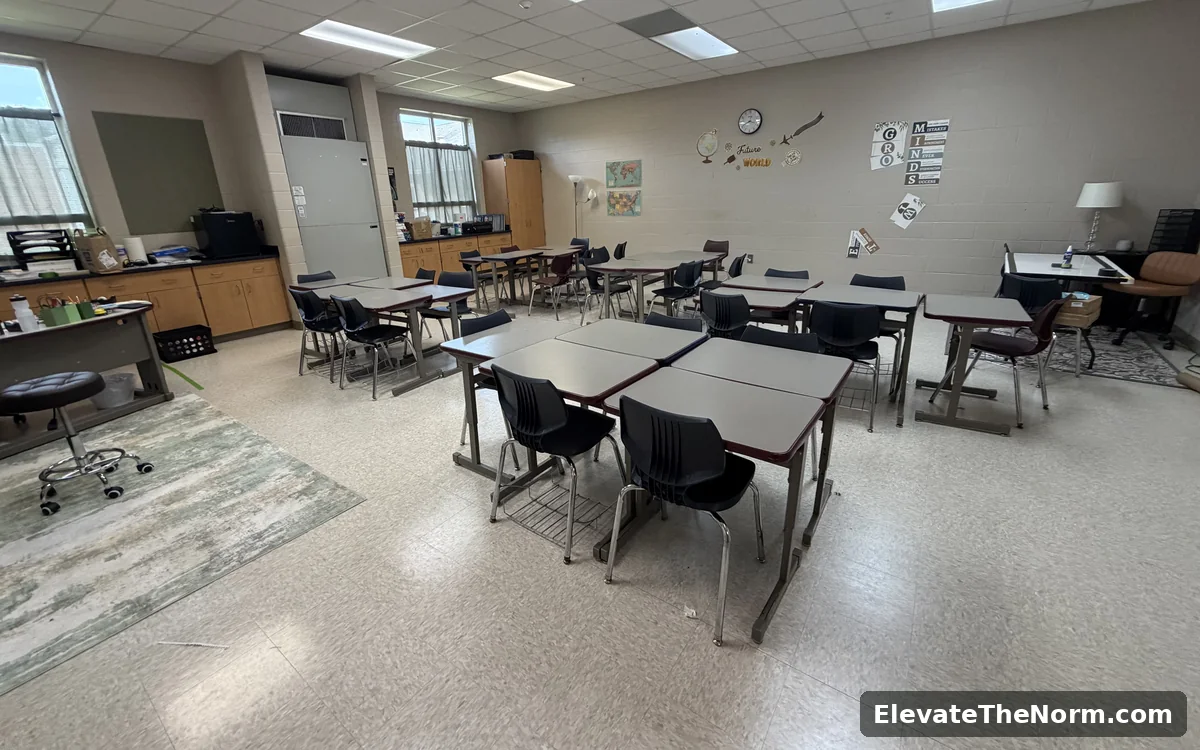
It looks busier than a lecture room and louder than most observers expect. The adult is rarely in one place. Students are working next to somebody most of the time. And there is usually a small group pulled aside getting something retaught. Choosing who sits in that group, and what you do with the eight minutes you get, is a set of decisions worth making deliberately.
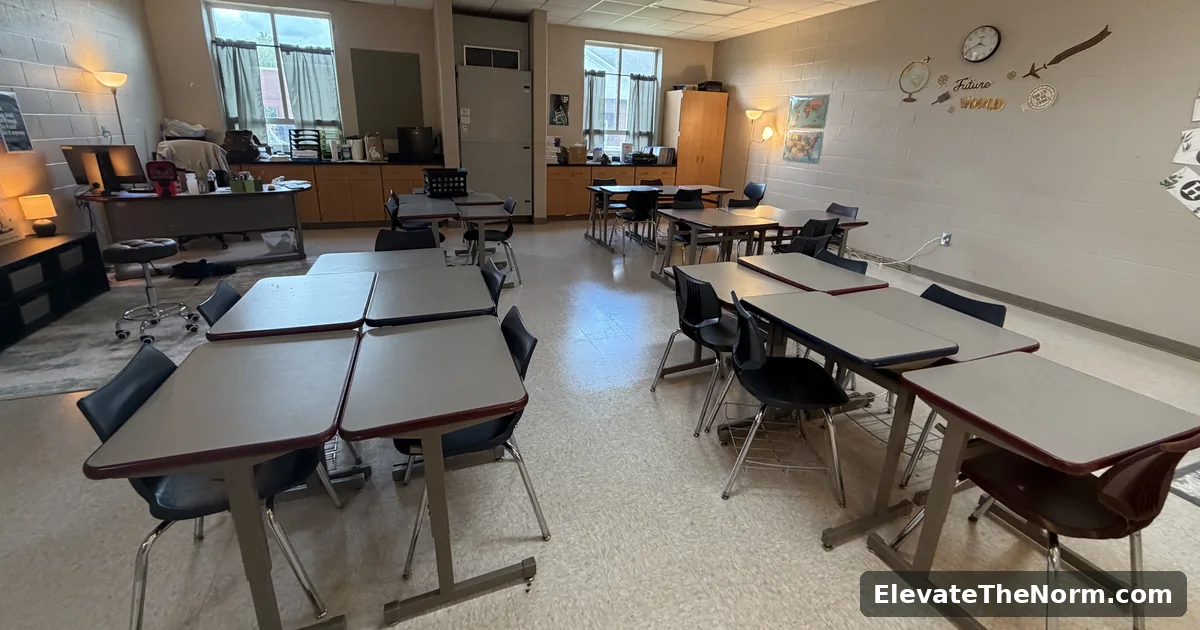
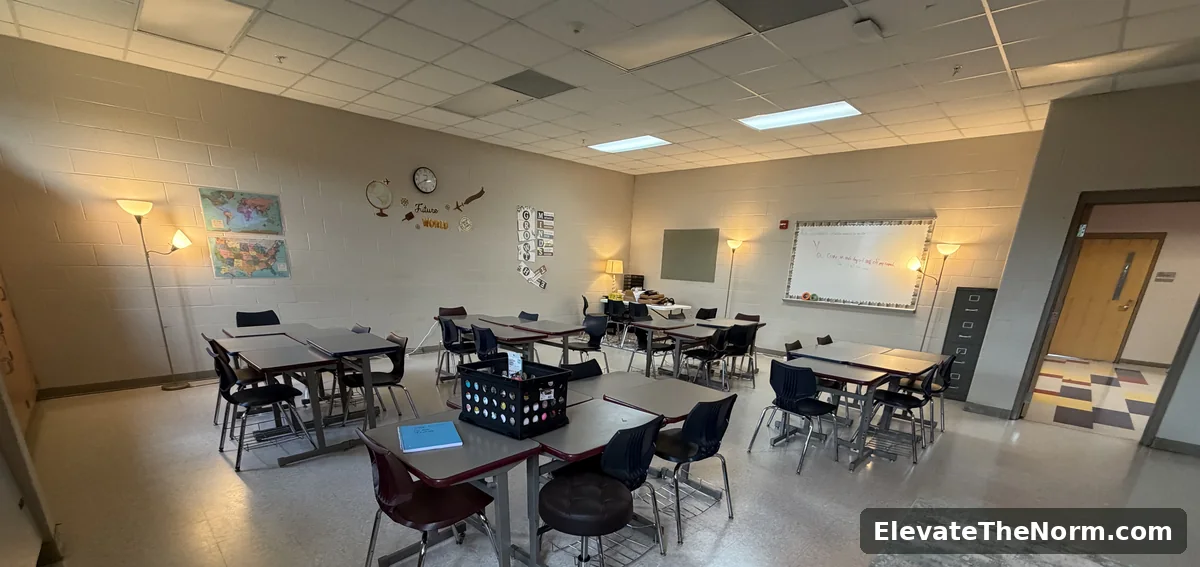
I do not run a face-front, take-notes room, and I do not turn the overhead lights on. The room runs on floor lamps instead of the overhead fluorescents. There are rugs. The tables are pushed together in pairs and fours, so there is no version of my room where a student sits alone by default — every seat is beside somebody.
The whiteboard table is one I built myself. It sits in the lowest-lit corner, on a rug, with the better chairs.
That placement was deliberate, and it fixed a problem most writing about small-group instruction never mentions: a designated table where the teacher takes struggling students becomes the dumb table by the third week of school. Teenagers name things fast, and they name them cruelly. You cannot policy your way out of it.
What worked was making it the best seat in the room. Students ask to go there. When I bring a pair over, nobody reads it as a verdict, because half the class has been angling for that table since August. I also bring pairs over for reasons that have nothing to do with being stuck — to steal an approach I want everyone to see, or to argue with somebody about a claim they got right.
None of that was expensive. The lamps came from a big-box store, the rugs were cheap, and the table is a thing I made.
One practical rule that goes with all of it: when I sit down with a pair, I sit facing the room, and the conference runs five or eight minutes, not twenty. You are still the only adult responsible for everyone in there, and “I was conferencing” is not an answer anyone will accept.
| Observable | Teacher-dominated room | Student-centered room |
|---|---|---|
| Where the teacher is | Front, mostly stationary | Moving; frequently seated with a pair or small group, facing the room |
| Who talks | Teacher does most of it — measured ranges run about 72–88%, which is near the profession-wide average rather than a mark of a bad room | Still a lot of teacher — but in short bursts, to fewer people at a time |
| Questions asked | Mostly known-answer | More authentic questions; follow-ups that build on what a student just said |
| What “on task” sounds like | Silence as the default and the goal | Working noise, with the teacher able to name what each group is stuck on |
| Who fixes a misunderstanding | Teacher, to the whole room, at the end | Teacher, to the two students who need it, right now |
| Where the plan lives | In the teacher’s head | On the board, with times, visible to everyone |
| What happens when it goes sideways | Volume goes up | Plan changes out loud, and the room is told why |
Working silence and compliance silence are different things. Thirty people writing is a mode. Thirty people waiting is a symptom. Nothing in that table asks the teacher to disappear — there is no column where the adult sits down and lets it run. If you want the longer version of that argument in a project context, it is the same one I made about the teacher being more present, not less.
Is it a working room or a lost room?
I have heard teachers who had genuinely lost a class repeat the “a working room is louder” line as cover. So here is the test, and you should run it on yourself honestly, because your administrator is running it on you.
| Working room | Lost room |
|---|---|
| You can stop it in under five seconds at normal volume | You have to raise your voice to be heard |
| You can name what every group is working on | There are groups you have not spoken to in fifteen minutes |
| The noise is about the task | You do not know what two of them are doing |
| Every student has something in front of them | Students are moving without a reason |
If you are in the right-hand column, the answer is not more student-centered. It is routines and procedures first, then release.
The students this is hardest on
A louder, busier, more socially demanding room is exactly the room that is hardest for an autistic student, a student with ADHD, a student with auditory processing differences, a student with anxiety, and a student who is new and does not know anybody. If you change your room and do not plan for them, you have improved the average and hurt the specific.
Every IEP and 504 accommodation applies in a workshop room exactly as it does in a lecture room. A louder room is not a reason an accommodation lapses. It is a reason to check that it is still working. If a student’s plan calls for reduced distraction, talk to their case manager before you change the room, not after a parent calls.
What that looks like in practice:
- A designated lower-stimulus seat away from the highest-traffic path, offered without a conversation about why. Some of this you can build into the room itself — I run mine on floor lamps instead of overhead fluorescents, which costs nothing and quietly helps more students than the handful who would ever have asked.
- Standing permission to use noise-reducing headphones during work time, without asking each time.
- The posted agenda doing double duty as the visual schedule some plans already require.
- A pre-arranged, non-verbal way to take a break.
- A real solo option for at least one task a week, and a private way to ask for it — a card, a form, a two-word email — that does not require negotiating in front of an audience.
You assign the pairs. Always. No student is ever asked to find a partner in front of the class, and no student is ever left standing. That single rule prevents more damage than anything else in this article. Rotate pairings on a schedule so nobody is locked in, and give students a quiet way to request a change that you honor the first time without an interrogation.
And participation is not the same thing as speaking. A written or drawn response is an equal deliverable. For a multilingual learner in the silent period, quiet is what second-language acquisition predicts, not disengagement — get their thinking in writing, with a partner, or in their first language before you conclude anything. Some students have accommodations that explicitly exempt them from required oral participation. Check before you change how you call on someone.
What the students actually decide
If I stopped here, I would have described a well-run room where a thoughtful adult makes every decision. That is better than most classes. It is not ownership, and I am not going to claim it is.
Ownership means students decide things that actually change the class — through activities for student centered learning that hand over real decisions, not cosmetic ones. Here is what I hand over, with the guardrail on each:
| Students decide | I keep |
|---|---|
| The form the product takes — write it, build it, present it, record it | The criteria it is judged against, which are the same for every form |
| The order they work through the day’s tasks | That all of it is finished by the checkpoint |
| Whether a task is worth the time — answered on a Friday exit slip, anonymous | Whether I change anything, and I say so on Monday either way |
| Who they would work well with, submitted privately | The final pairings, and the rule that nobody is stranded |
The other thing they get a real vote on is the room itself. The last one was a class pet, and they wanted one badly enough that it is now happening. I will say the quiet part, because it surprises people: high school students want a class pet. They want cheap prizes. They want to be recognized by name. They just will not show you any of that on the outside, and if you read the outside as the answer you will conclude they do not care about anything.
The Friday slip is the one that matters most and costs the least. One question: what part of this week was a waste of your time? Read two or three out loud on Monday and say what you are doing about them. A room where the adult never asks is a room the students correctly understand as not theirs.
That is the same argument as handing students decisions you would normally make for them — you cannot ask a teenager to be responsible for choices they never got to make.
Watching a period ebb and flow
Every class period has a shape. Second period is not fourth period, and the same lesson does not land the same way at 8:05 and 1:40. The five-minute pause I describe below is the extreme version — one section ended up nine minutes behind the others off a single decision I made on the spot. Sections drift apart whether or not you plan for it. The only question is whether you are tracking the drift.
You cannot plan for that shape in advance. You can only watch for it, and watching requires evidence. A room can look engaged and be lost. This is why three seconds of silence changes who talks, and why a check that produces something readable from every student beats scanning faces for nodding.
What I watch for, in order:
- The first stall. Not the loud group — the quiet pair who stopped writing four minutes ago and have not asked for anything.
- Repeat questions. If three groups ask a version of the same question, that is usually one bad instruction I gave. Before I stop the room, I ask the third group to tell me what the task is. If they can say it correctly and still cannot start, my directions were fine and the content needs reteaching — a different interruption entirely.
- The energy drop. Usually two-thirds of the way through. It is predictable enough to plan a transition for.
- Who I have not talked to. Not who has not addressed the room — who I personally have not had thirty seconds with this week.
That last one needs a system or it becomes a good intention. Keep the roster on a clipboard and mark a date every time you conference with a student. On Friday, look at the blank rows, not the full ones. Anybody blank for two weeks gets time the following week whether or not they look stuck. The kid who nods, writes something down, and quietly does not understand is invisible in a lecture room and invisible at a table, and she is the whole reason to keep the list.
If your room gets loud while you are learning to run it this way, that is not automatically a management failure — but “not automatically” is doing real work in that sentence, and the two-column test above is how you tell. I made the longer case in why a working room sounds louder than a quiet one.
When partner work doesn’t work
Somewhere on your schedule is the section where this falls apart. Nobody writes about that section, which is why teachers try this once, watch twenty minutes evaporate, and go back to rows.
Before you decide partner work is wrong for that section, check who is sitting with whom. Pairings are a seating decision as much as an instructional one, and building the chart deliberately — on a cycle you announce, changed for the whole room rather than one student — fixes more of this than most people expect.
What has actually helped me:
- Do not start with your hardest section. Build the routine where it will work, get the language right, then carry it over.
- Start short. If a section cannot hold twenty minutes, it holds eight. Build up. Eight minutes that work beat twenty that don’t.
- Every pair produces something visible, with a checkpoint in the middle. “We’re thinking about it” stops being an available answer.
- Every student turns in their own paper, even when the thinking was shared. Or assign the two jobs out loud before you release — one drafts, one challenges, swap at the halfway mark.
- The students who cannot handle a partner yet work near your circulation path, in an assigned pair. Near you, not exiled.
- Write your sub plans for a different room than the one you run. A substitute cannot circulate, pull groups, and read four sections. Leave them something structured, seat-based, and self-contained. That is not a retreat — it is the only version that is safe with an adult who does not know your students’ names.
Week two is where people quit. The first three times you run this, some of it will be wasted and you will want the microphone back. Run it anyway, and afterward tell the room specifically what worked and what you are changing tomorrow. You are training a routine, not delivering a lesson, and routines take about three weeks.
One lesson plan turned in. Four plans taught.
If you teach four sections of the same course, you do not have one lesson plan. You have four. The objective, the materials, and the assessment hold still. The delivery moves.
My take, not a finding: I have not found research testing whether varying delivery across sections of the same course improves outcomes. This is my practice and my name for it, not an evidence base. Weigh it as practitioner experience.
Write the four variants on the submitted copy — two lines each. 2nd period: 8-minute mini-lesson, pull Group C first. 4th: model 15, checkpoint at minute 25. Ninety seconds of writing keeps your plan of record accurate for an evaluator, for a substitute, and for anyone checking that an IEP’s grouping or timing requirement was actually delivered. If your school runs common pacing or an adopted program, clear the variation with your department chair first; the objective and assessment staying fixed is usually what makes it fine.
Honest cost: about ten extra minutes per section the first month, closer to three once you know your sections. That is real time out of a planning period that is already spoken for. And if you have three preps across six sections rather than four sections of one course, do not attempt this everywhere — pick the course you teach most often and let the others run as written.
| Stays the same in every section | Gets modified per section |
|---|---|
| Standard and objective | Length of direct instruction before release |
| Core text, task, or problem set | Where the mid-period checkpoint lands in the period |
| What the checkpoint asks — same prompt everywhere, or the results are not comparable | Which supports are out without asking: sentence frames, a worked example left visible, chunked directions |
| The assessment and its criteria | How much is modeled versus attempted first |
| IEP and 504 accommodations — these follow the student, never the section | Which pairs get a check-in in the first five minutes |
| The non-negotiable expectations | Which small groups get time, and in what order |
Two limits on this. Grouping changes week to week based on what the last check showed — if the same five names are in the same group in October and in March, that is not grouping, that is tracking inside your own classroom, and you built the thing you were trying to avoid. And modifying delivery never means one section gets less content. Same standard, same task, same assessment, every section. You should be able to say that out loud to a parent without hedging.
Structure itself has real evidence behind it, even if my four-plan habit does not. Brandi Simonsen and colleagues reviewed the classroom management literature and identified 20 practices with enough evidence for adoption across K–12, organized under five critical features. The first is “maximize structure,” which they define as “the amount of teacher or adult-directed activity, the extent to which routines are explicitly defined, and the design or physical arrangement of the classroom” (Simonsen et al., 2008).


Tell them the plan for the day — down to the minute
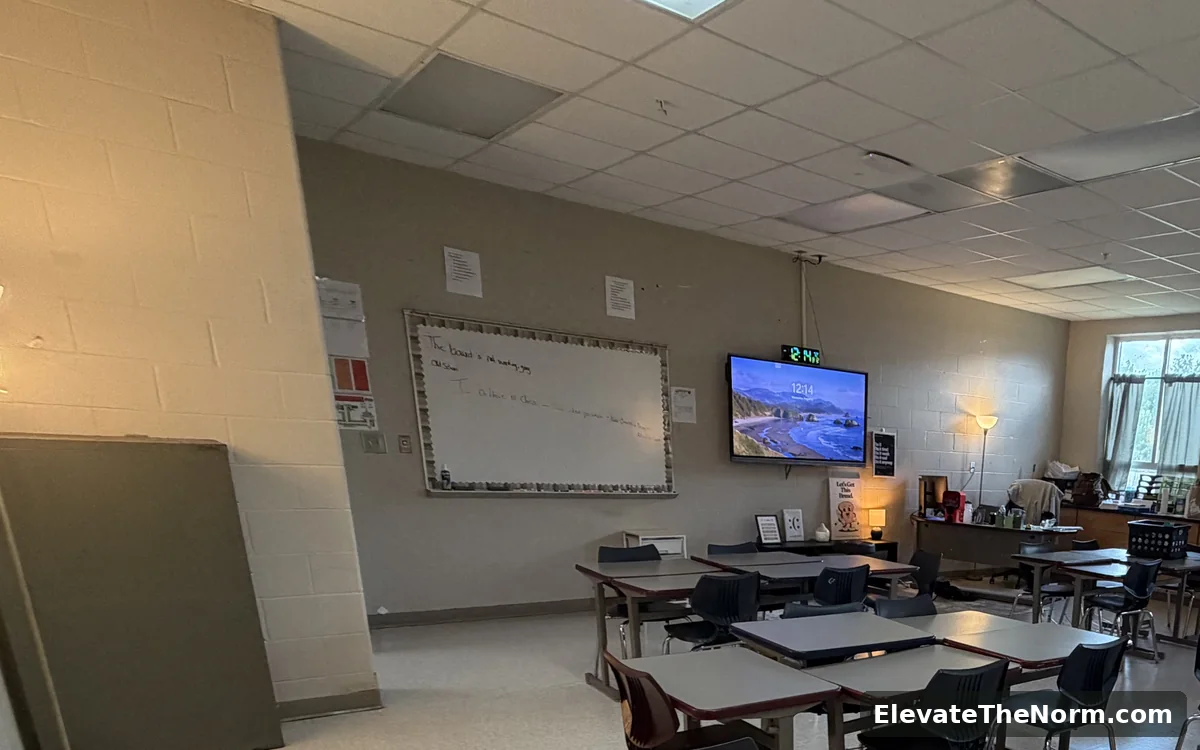
Put the plan on the board with times attached and go over it in the first ninety seconds. Not “today we’re doing the Industrial Revolution.” Actual segments, with actual minutes.
Bell work, 5. Mini-lesson, 8. One problem together, 4. Partner work, 20. Table conferences run during partner work. Debrief, 6. Exit ticket, 2.
Those four minutes where you do one with them are the cheapest insurance in the period, and they are the first thing everybody cuts. Going straight from your model to partner work is the most common reason three groups ask the same question ten minutes later.
Those minutes are also a high school period. In a sixth- or seventh-grade room, cut partner work to eight or ten, give each student a named job, and build up. The structure holds; the block lengths don’t.
When you shorten the mini-lesson, cut in this order. First: logistics and announcements — put them on the board. The four-sentence “why this matters” preamble — make it one sentence. Vocabulary front-loading — move it into the materials where students actually hit the words. Second: your second and third examples, replaced by one fully worked example plus one partial one students finish with you. Never cut the one complete worked example or the model of what a finished product looks like. If you cannot state the objective and show one worked example in ten minutes, the task is too big for one period. The mini-lesson is not the problem.
Two things happen when you post times. Students stop wondering what is coming. And you commit to a talk budget in front of witnesses. Eight minutes means eight minutes. It is the single most effective device I have found for keeping myself from talking for thirty.
Photograph the board or paste the same agenda into your learning platform each day. Ten seconds, and it gives an absent student a way to reconstruct the period and a parent a way to see what actually happened.
The research here is real but should be stated carefully. Across 144 reported effects (N = 73,281), students who rated their teachers as clearer also reported more learning — a correlation working out to roughly 13% of the variance, and one that runs stronger for how students feel about a course than for what they can do at the end of it (Titsworth et al., 2015). That literature leans heavily on college samples and on students’ perceptions, so read it as a reason to be clear rather than a mechanism you can bank on. On routines, the IRIS Center at Vanderbilt, a federally funded teacher-training resource, advises that “predictable classroom routines can help to create a sense of calm and order and ease some students’ anxiety and related behaviors” (IRIS Center, n.d.) — practitioner guidance, not a study, and I am labeling it as such.
My take, not a finding: the posted plan is a promise. The point is not that you hit the times. It is that when you miss them, you owe the room an explanation. “We’re cutting the debrief to three minutes because the partner work was better than I planned for” costs four seconds and buys an enormous amount of credibility. Silently taking twenty minutes of their time and never mentioning it is how students learn that the schedule was never really theirs.
Organization to the minute, and then the pause
Here is the half of it nobody tells you. Once the plan is laid out, you stop talking and wait. Confidently. You do not fill the silence, and you do not raise your voice into it.
I once waited more than five minutes.
It is one of the most awkward things I have ever done. Five minutes of silence in front of a room of teenagers is far longer than it sounds — long enough that you start negotiating with yourself about whether you have made a serious mistake, and long enough that every instinct you have is screaming at you to say something and take the pressure off. I did not say anything.
That section finished the period nine minutes behind my other classes. It is the only time I have ever assigned homework.
I want both halves of that on the page, because this story usually gets told with only the first one. The pause worked. It also cost nine minutes I did not have, and the students paid part of that bill at home. If you are going to wait, decide in advance that you are willing to pay for it — and then tell the room plainly what it cost. That is the posted plan doing its actual job. The alternative is talking over them, which buys you about eleven seconds and a much larger bill later.
The wait is not theater, and it is not new. Mary Budd Rowe recorded classrooms and found teachers leave about one second after asking a question before someone has to fill it; stretching that to three to five seconds lengthens student answers, raises the number of students who volunteer, and pulls in the students rated as slower. I wrote about that at length in three seconds of silence changes who talks. Five minutes is a different animal — that is waiting for a room, not for an answer — but it runs on the same principle. Silence is a tool. Most of us are too uncomfortable to pick it up.
My take, not a finding: the confidence is the whole thing. A pause you are comfortable with reads as authority. The same pause, delivered by somebody who is visibly dying inside, reads as a teacher who has lost the room — and teenagers can tell the difference instantly. If you cannot hold thirty seconds yet, do not start with five minutes. Hold ten, then twenty, then a minute. Build it the way you would build any other routine.
Tell families before they hear it secondhand
Here is the sentence that generates every phone call: “We don’t really do anything in that class, we just work with a partner.” It will be said at somebody’s dinner table in the first two weeks, and if the first version a parent hears is from a fifteen-year-old, you are explaining your practice from behind.
Three sentences in the syllabus, on a back-to-school slide, or in one email:
This class runs as a workshop. There is direct instruction every day — usually a short mini-lesson — and then students spend most of the period working on the task with an assigned partner while I move between pairs and conference with small groups. The room is louder than a lecture room; that is intended and it is not a discipline problem. The daily plan with time blocks is posted on the board and online. Grades are based on individual work — no student’s grade depends on another student’s effort. All IEP and 504 accommodations continue exactly as written. If your student is ever lost, stuck with a partner who isn’t working, or overwhelmed by the noise, email me. Those are fixable and I want to hear about them early.
Ten minutes once. It prevents the version where you find out in a conference.
Doesn’t this just mean the teacher does less?
No, and this is the misreading that has done the most damage to the phrase “student-centered.”
Johnmarshall Reeve and Sung Hyeon Cheon draw the line directly: autonomy support and a laissez-faire style both look student-focused from a distance, but “autonomy support is a motivationally supportive approach that energizes students’ autonomy satisfaction while laissez-faire is a demotivating approach that leads to students’ autonomy frustration” (Reeve & Cheon, 2021). The difference shows the moment a student struggles. The autonomy-supportive teacher moves toward them. The laissez-faire teacher leaves them to figure it out.
The best secondary-level evidence says the same thing in its title. Hyungshim Jang, Reeve, and Edward Deci observed 133 public high school classrooms and surveyed 1,584 students in grades 9 through 11. Autonomy support and structure were positively correlated, and both predicted students’ observed behavioral engagement — though only autonomy support uniquely predicted what students said about their own engagement. The paper is called “It Is Not Autonomy Support or Structure but Autonomy Support and Structure” (Jang, Reeve, & Deci, 2010). It is observational data, so read it as “these travel together,” not “do both and engagement follows.”
From the other direction, Paul Kirschner, John Sweller, and Richard Clark’s well-known critique holds that “minimally guided instruction is less effective and less efficient than instructional approaches that place a strong emphasis on guidance of the student learning process” (Kirschner, Sweller, & Clark, 2006). Their target is minimal guidance. A workshop room with a circulating teacher, posted expectations, a worked example, and small-group reteaching is not minimally guided. A room where the adult assigns a project and sits down is. That same line runs through the evidence comparing project based and traditional learning — the project studies that hold up are the guided ones.
One more thing worth knowing before you try this. In a randomized crossover study, Harvard undergraduates in active-learning physics sections scored about half a standard deviation higher on a 12-question test given immediately afterward (+0.46 SD) — and rated their own feeling of learning more than half a standard deviation lower than students who sat through a polished lecture (−0.56 SD) (Deslauriers et al., 2019). College physics and immediate recall, not tenth-grade history, so hold it loosely. But the mechanism travels: a smooth lecture feels like learning, and the harder thing that produces learning feels worse while you are doing it.
Which means you should expect pushback — and sort it rather than dismiss it. “This is harder than watching you talk” is the work doing its job. “My partner does nothing,” “I can’t hear in here,” “I never know what my grade is based on,” “I never get help” are not complaints about rigor. Those are defect reports about your design, and if you hear the same one twice, assume it is true and go look.
A five-day audit you can start Monday
Measure before you redesign. One standing rule: nothing in this audit should create a file about a student. If a step would produce a recording, a photo, or a named list that leaves your hands, stop and check your district’s policy first.
On recording specifically — do not put your phone on the desk and record the class. Recording minors is governed by your state’s consent law, your district’s policy, and student-data rules, and a personal phone that backs up to a cloud account has just moved a recording of thirty children somewhere nobody approved. If you genuinely want audio, that is a written-approval conversation with your principal, not a Monday task.
If you currently teach mostly from the front:
- Monday — count yourself, without recording. Set a silent timer to buzz every 60 seconds. At each buzz mark one tally: T if you were talking, S if a student was. Thirty tallies is a solid ratio and it captures nothing about any child. Or ask a colleague on their planning period to run a stopwatch for twenty minutes.
- Tuesday — count who you heard from, in any form. On a seating chart, mark three things: spoke to the class, spoke with you one-on-one, gave you something readable in writing. All three count. The names with nothing in any column are the ones to look at — not the names with nothing in the first. Then shred the chart or file it where you keep grades. It is a diagnostic for you, never a participation grade, and some students on your roster have accommodations that make required speaking inappropriate.
- Wednesday — count your questions. Two columns: questions you already know the answer to, and questions you don’t. If the second column is under about a fifth, you are at the low end of what researchers have measured in secondary English classrooms, where authentic questions ran 18% to 35% (Kelly et al., 2018). If you only run one day of this, run Wednesday — question quality has a better-established link to learning than raw talk share does.
- Thursday — post the plan with times. One section. Ninety seconds to go over it. Announce every change out loud when it happens.
- Friday — cut ten minutes and collect something. Move ten minutes of your talking into partner work with a written checkpoint, and collect the checkpoint. Compare that pile to the same kind of check from a lesson you taught the old way. The talk numbers tell you what changed in the room. Only the checkpoints tell you whether it was worth it.
If your room is already a workshop, the audit above measures the wrong thing — a phone on the desk in a room with twelve simultaneous conversations tells you nothing. Run this version instead: after each period, write the names of every student you actually spoke with; on Friday count who you never reached. Tally authentic versus known-answer questions at the table only. Time your mini-lesson against the number you posted. And ask one colleague for a ten-minute drop-in with a single job — can I name what each group is stuck on?
Four of those five days need no budget and no permission. Recording is the exception, and the answer in many districts will be no. That is a legitimate answer.
A note for coaches, chairs, and administrators
Do not roll this out as an initiative. Run the five days with one volunteer department, have them share their Wednesday numbers with each other and nobody above them, and let the second cohort be people who asked. Three walkthrough look-fors that work: can the teacher name what each group is stuck on, is the plan posted with times, and can two students you pick at random say what they are doing and why. Protect the planning time before you ask for the four-plan habit — if you add thirty minutes a day to a teacher’s prep without taking anything off, you will get compliance for about three weeks.
What this actually asks of you
Not to talk less for its own sake. To notice that the period belongs to thirty other people, and to build it like you believe that.
Watch how each section moves and plan for the one in front of you instead of the one you imagined in July. Put the plan where they can see it, and say something when it changes. Bring the two students who are stuck to a table and work it out with them instead of reteaching it to everyone who already has it. Assign the pairs so nobody is left standing. Ask them on Friday what wasted their time, and answer on Monday.
That last one is the difference between a room that is run well and a room that is theirs. As I have written before, the goal was never a quiet room. It was a room the students own.
Frequently Asked Questions
What is a student centered learning classroom, in one sentence?
A classroom where students do most of the thinking, talking, and deciding, while the teacher stays highly active — circulating, conferencing with pairs and small groups, and adjusting the plan in real time — rather than delivering content from the front for most of the period.
Is there a target percentage for how much a teacher should talk?
No, and be suspicious of anyone who gives you one. Prior research across mixed settings puts typical teacher talk at 72–88% (Demszky et al., 2023), so most of us have room to move. But in one large elementary dataset, student talk percentages did not by themselves correlate with observation scores or value-added scores (Demszky & Hill, 2022). Use the ratio to find where your time goes, then judge what fills the gap.
My child says they “don’t do anything” in this class. What is actually happening?
There is direct instruction every day — a short mini-lesson, a worked example, and usually one problem done together. Then students spend most of the period doing the work with an assigned partner while the teacher moves between pairs. What has changed is that the practice moved from homework into class, where an adult is standing next to it. Ask to see the posted daily agenda; it should show exactly how the period was spent.
How do I know my child gets individual attention and not just the loud kids?
Ask the teacher to check their conference log. A teacher running this well keeps a roster and marks a date each time they sit with a student, then looks at the blank rows on Friday. If your child has not had one-to-one time in two weeks, that is a fair question, and a teacher using a log can answer it with a date.
What about students with an IEP, 504, or anxiety — or a student who has nobody to work with?
Accommodations apply in a workshop room exactly as written, and a louder room is a reason to check that they are still working, not a reason they lapse. Teachers should assign every pairing so no student is ever asked to find a partner in front of the class, offer a lower-stimulus seat and headphones without a conversation, and provide a private way to request a solo task. Participation is not the same as speaking; written work counts.
Doesn’t this take more prep time?
Yes. About ten extra minutes per section the first month, closer to three once you know your sections, because only the delivery notes change. If you have three preps across six sections, do it for one course rather than all of them. On paperwork: daily checks and exit tickets are read, not graded — sort them into three stacks at the door and record only which names landed in “not yet.” Those names are tomorrow’s table conferences.
My evaluation framework rewards a quiet room. What do I do?
Start with the rubric rather than the room. Most instruments in use score student discourse, questioning, and monitoring of student learning directly, and those descriptors usually describe this practice at the top end. Use the pre-conference, name the indicators you are targeting, and tell your evaluator what to look for. Then invite them in for ten minutes on an ordinary day, before any formal observation. If your evaluator scores a fixed rubric and reads noise as off-task, run the observed lesson closer to the front and run the workshop the other four days. That is not a compromise of principle — it is knowing which day is being scored.
Does this mean I should stop giving direct instruction?
No. Minimal guidance is less effective than well-guided instruction (Kirschner, Sweller, & Clark, 2006), and the best secondary evidence says autonomy support and structure travel together rather than against each other (Jang, Reeve, & Deci, 2010). Keep the mini-lesson, the worked example, and the one you do together. Shorten them, put a time on them, and spend the reclaimed minutes at the table with students who need you.
References
Demszky, D., & Hill, H. C. (2022). The NCTE Transcripts: A dataset of elementary math classroom transcripts (EdWorkingPaper No. 22-682). Annenberg Institute at Brown University. https://files.eric.ed.gov/fulltext/ED672127.pdf
Demszky, D., Wang, R. E., Geraghty, S., & Yu, C. (2023). Does feedback on talk time increase student engagement? Evidence from a randomized controlled trial on a math tutoring platform (EdWorkingPaper No. 23-891). Annenberg Institute at Brown University. https://files.eric.ed.gov/fulltext/ED638947.pdf
Deslauriers, L., McCarty, L. S., Miller, K., Callaghan, K., & Kestin, G. (2019). Measuring actual learning versus feeling of learning in response to being actively engaged in the classroom. Proceedings of the National Academy of Sciences, 116(39), 19251–19257. https://doi.org/10.1073/pnas.1821936116
IRIS Center. (n.d.). Page 6: Create a structured classroom. In Classroom management (Part 1): Learning the components of a comprehensive behavior management plan. Peabody College, Vanderbilt University. https://iris.peabody.vanderbilt.edu/module/beh1/cresource/q2/p06/
Jang, H., Reeve, J., & Deci, E. L. (2010). Engaging students in learning activities: It is not autonomy support or structure but autonomy support and structure. Journal of Educational Psychology, 102(3), 588–600. https://eric.ed.gov/?id=EJ892818
Kelly, S., Olney, A. M., Donnelly, P., Nystrand, M., & D’Mello, S. K. (2018). Automatically measuring question authenticity in real-world classrooms. Educational Researcher, 47(7), 451–464. https://files.eric.ed.gov/fulltext/EJ1192954.pdf
Kirschner, P. A., Sweller, J., & Clark, R. E. (2006). Why minimal guidance during instruction does not work: An analysis of the failure of constructivist, discovery, problem-based, experiential, and inquiry-based teaching. Educational Psychologist, 41(2), 75–86. Open University of the Netherlands repository
National Academies of Sciences, Engineering, and Medicine. (2019). The promise of adolescence: Realizing opportunity for all youth. The National Academies Press. https://doi.org/10.17226/25388
Nystrand, M., & Gamoran, A. (1989). Instructional discourse and student engagement. National Center on Effective Secondary Schools, University of Wisconsin–Madison. https://files.eric.ed.gov/fulltext/ED319780.pdf
Reeve, J., & Cheon, S. H. (2021). Autonomy-supportive teaching: Its malleability, benefits, and potential to improve educational practice. Educational Psychologist, 56(1), 54–77. https://selfdeterminationtheory.org/wp-content/uploads/2021/05/2021_ReeveCheon_AutonomySupportive.pdf
Šeďová, K., & Sedláček, M. (2022). How vocal and silent forms of participation in combination relate to student achievement. Instructional Science, 50, 549–567. https://doi.org/10.1007/s11251-022-09609-1
Simonsen, B., Fairbanks, S., Briesch, A., Myers, D., & Sugai, G. (2008). Evidence-based practices in classroom management: Considerations for research to practice. Education and Treatment of Children, 31(3), 351–380. https://eric.ed.gov/?id=EJ798223
Somerville, L. H., Jones, R. M., Ruberry, E. J., Dyke, J. P., Glover, G., & Casey, B. J. (2013). The medial prefrontal cortex and the emergence of self-conscious emotion in adolescence. Psychological Science, 24(8), 1554–1562. https://doi.org/10.1177/0956797613475633
Titsworth, S., Mazer, J. P., Goodboy, A. K., Bolkan, S., & Myers, S. A. (2015). Two meta-analyses exploring the relationship between teacher clarity and student learning. Communication Education, 64(4), 385–418. https://eric.ed.gov/?id=EJ1082982
Yeager, D. S., Dahl, R. E., & Dweck, C. S. (2018). Why interventions to influence adolescent behavior often fail but could succeed. Perspectives on Psychological Science, 13(1), 101–122. https://escholarship.org/uc/item/9mm4q4fb
About Clay Shumate
Clay Shumate is a certified secondary Social Studies teacher in the public schools of West Alabama, with seven years of classroom experience, a B.A. in History, and an M.Ed. in Secondary Education. He writes about project-based learning, student responsibility, respect, and practical ways to hold young people to a higher standard while giving them room to learn from mistakes. He is a member of the Society of Professional Journalists and writes to its Code of Ethics; this site’s editorial standards and corrections policy are published in full. More about Clay.