Classroom transitions are the moments between things — arriving, switching tasks, moving into groups, coming back, packing up. In a secondary room they are where most lost instructional time actually goes, and they are almost never taught. Fixing them is not about speed. It is about removing the ambiguity that makes thirty teenagers wait to see what everyone else does first.
Nobody sets out to lose this time. It goes in ninety-second pieces, six or seven times a period, and none of the pieces feels big enough to be worth addressing.
Added up over a year, it is one of the largest recoverable resources a teacher has.
Key Takeaways
- The measured figure is about six minutes per lesson start — and the researcher who found it calculated that as roughly five weeks of teaching across a year.
- Attention comes before instruction. Every transition that fails, fails at that step.
- One signal, one word, every time. Changing the word, or raising the volume instead, teaches students to wait for the shouting.
- Four transitions carry most of the loss. Script those and leave the rest alone.
- A thirty-second warning before stopping group work costs nothing and protects the thing you were trying to build.
- Be careful with the research. The best figures here come from Finnish primary and lower-secondary classrooms with a mean class size of 17, and the author calls the study preliminary.
How Much Time Do Transitions Actually Cost?
The most concrete number available comes from Timo Saloviita’s observational study in the International Journal of Environmental & Science Education. Observers recorded 131 lesson starts across 131 teachers and found that the teacher was on average two minutes late and the lesson started six minutes late. In four cases the delay reached fifteen minutes.
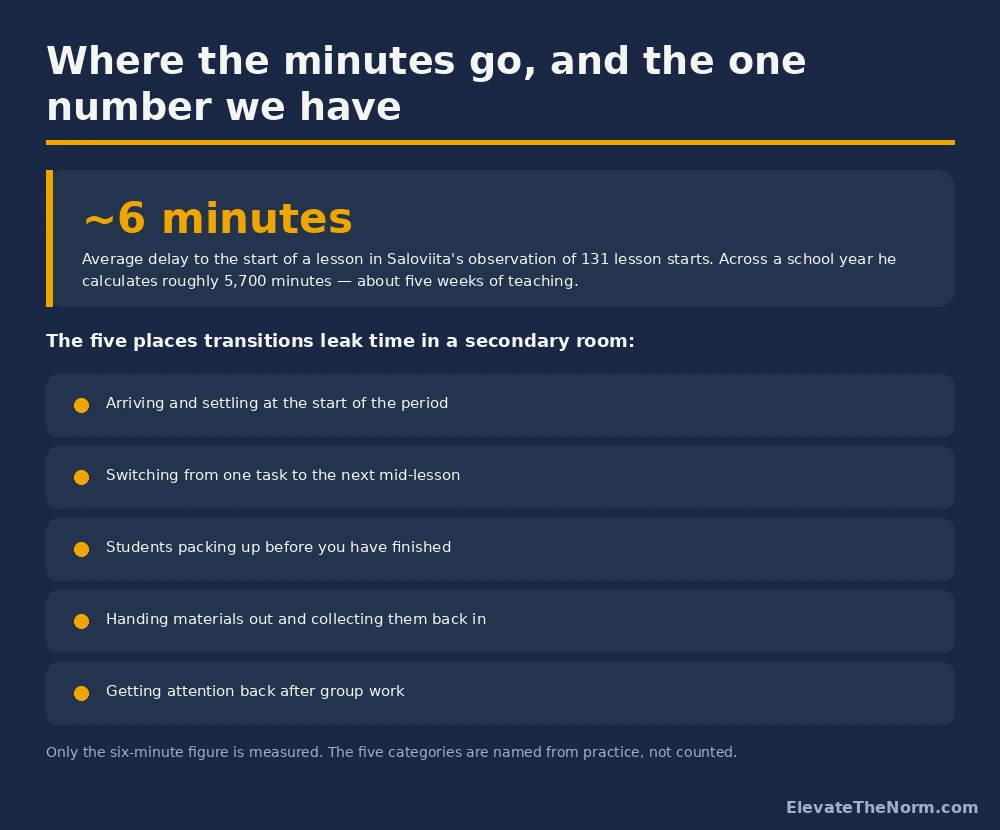
Saloviita then does the arithmetic that makes the number land: six minutes per lesson start becomes about 150 minutes a week, and roughly 5,700 minutes across a school year — around 127 lessons, or five full weeks of teaching.
Before anyone puts that on a staff-meeting slide, the caveats, which are the author’s own. This was Finland, in comprehensive schools spanning grades 1–9, and only a fifth of the observed lessons were in grades 7–9. Mean class size was seventeen students. Saloviita describes it as a preliminary study and says replication is needed.
So treat five weeks as an order of magnitude rather than a measurement of your building. A room of thirty American fifteen-year-olds changing classes every period is not the room that was observed. The direction is almost certainly right; the precision is not yours to claim.
Todd Finley, writing for Edutopia, offers the same idea from the other end: saving fifteen minutes a day works out at roughly 45 extra hours of instruction across a year. Different route, same conclusion — this is the cheapest time on the timetable to recover.
Five Steps That Make a Transition Hold
Finley sets out a five-step sequence that works at any grade: get attention, explain the procedure, prepare students for the signal, give the signal, then watch what happens. The order is the point, and almost every failed transition failed at step one.
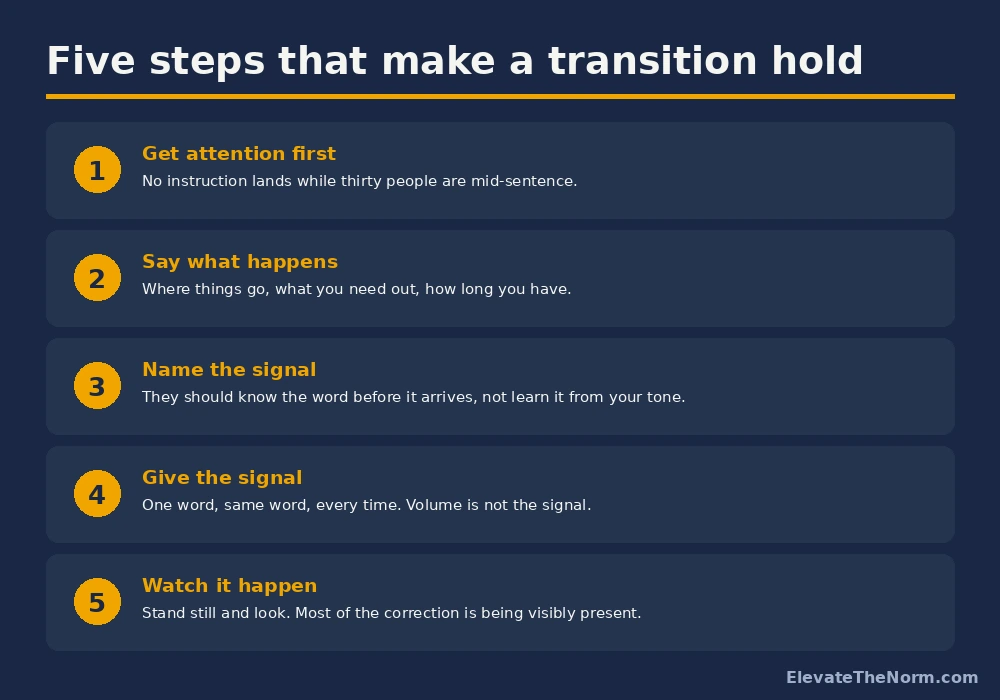
Attention before instruction. Nothing you say while thirty people are mid-sentence reaches more than about six of them. The other twenty-four will ask their neighbour, and the neighbour will be wrong.
Say the whole thing before anyone moves. Where things go, what needs to be out, how long they have. Once bodies are moving, no further instruction is getting in.
Name the signal in advance. Finley suggests using a word like “smooth” rather than “go” — partly because it is distinctive, partly because “go” is a starting gun. Whatever you pick, students should know the word before they hear it.
Then stand still and watch. Most of the correction you need is being visibly present while it happens, which is also the least tiring form of classroom management there is.
Finley also mentions a competitive timing approach — one teacher uses a stopwatch and challenges classes to beat other sections. It works for some groups and backfires badly with others, particularly where a slower student becomes the reason the class “lost.” Use it knowing that.
The Four Transitions Worth Scripting
You do not need a procedure for every movement in the room. Four moments carry most of the loss, and scripting those is enough.
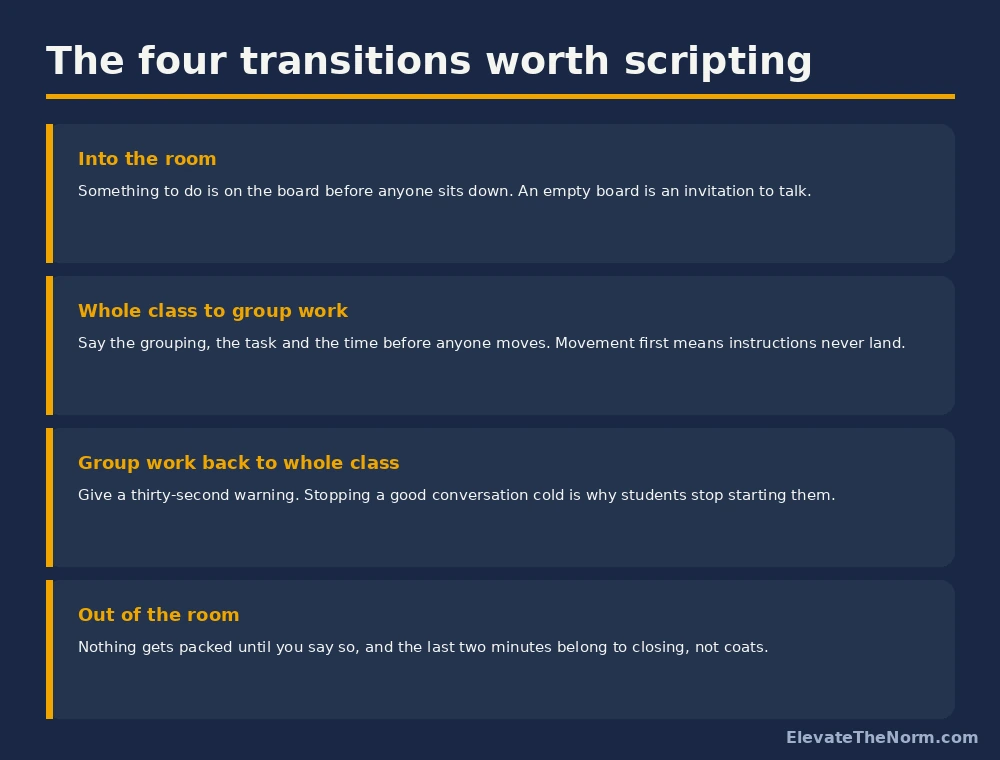
Into the room. Something to do is on the board before anyone sits down. An empty board is an invitation to talk, and it is a reasonable one. This is the single highest-return transition to fix, because it is also the one Saloviita measured.
Whole class into group work. Grouping, task and time, all announced before a single chair moves. This is where most secondary transitions collapse, because the instruction competes with the movement and loses.
Group work back to whole class. Give a thirty-second warning. Cutting off a working conversation with no notice teaches students that engaging deeply is risky, and after a few weeks of it they stop starting.
Out of the room. Nothing gets packed until you say so. The last two minutes belong to closing the lesson, and surrendering them is how a forty-five minute period becomes a forty-minute one.
All four are routines, and they follow the same rules as every other routine in the room — named, demonstrated, practised and re-taught rather than announced once in August.
Why My Room Transitions Quietly
I do not turn the overhead fluorescents on. The room runs on floor lamps around the perimeter and a few smaller desk lamps, which makes it warm and low rather than institutional.
That was a deliberate choice about sensory load, and it helps far more students than the ones who would ever have asked for an accommodation. What I did not expect was how much it changes transitions specifically. Transitions are the loudest, brightest, most chaotic thirty seconds of any lesson — everything moving at once, and every voice rising to be heard over the others. In a room that is already quieter and dimmer than the corridor, the ceiling on that noise is lower to start with.
It is not a technique and I would not sell it as one. But if transitions in your room feel like the volume doubles every time, it is worth asking whether the room itself is part of what students are reacting to before you decide it is a behaviour problem.


Signals That Work With Teenagers
Most published transition signals were designed for eight-year-olds, and using them with fifteen-year-olds produces exactly the reaction you would expect. What survives into secondary:
- One consistent word. Unglamorous and the most effective thing on this list. It works because it is predictable, not because it is clever.
- A visible countdown. A timer on the board removes the argument about how long is left. Finley points at simple countdown tools for exactly this.
- A hand signal for routine requests. Finley describes a teacher whose students use one finger for help, two for the bathroom, three for a pencil — the request happens without interrupting anyone.
- Standing in one particular place. Silent, costs nothing, and works because the room learns what it means.
- Music, used carefully. A track of a set length is a countdown students can hear. It needs to be chosen for a secondary audience, which is a separate and slightly fraught question.
What does not survive: anything that requires teenagers to repeat a phrase back to you in unison, and raising your voice. Volume is not a signal. It is the absence of one, and students learn to wait for it.
The music question is the one people ask most and it deserves its own answer, because almost everything written about classroom transition songs was written for elementary rooms. The mechanism transfers to secondary; the track choice does not. I worked through what a track has to do to survive a room of fifteen-year-olds — length, lyrics, familiarity — in a separate piece on choosing transition songs and cues for teenagers.
Where Transitions Break Down
- Instructions given while students move. The most common failure. Say it all first, then release.
- No warning before stopping group work. Reads as arbitrary, and it quietly punishes the students who were most engaged.
- A different signal every week. Consistency is doing all the work. Changing it resets the learning to zero.
- Volume as the signal. Teaches the room to ignore everything below shouting.
- Blaming the class. A transition that fails repeatedly was designed badly. That is a planning problem, not a character problem.
- Never practising it. Same as any routine: announcing is not teaching.
What to Do Next
Time your own start for one week. Note when the bell went and when the first real instruction landed, every period, without changing anything else. Most teachers are surprised, and the surprise is more persuasive than any study.
Then fix that one transition — something on the board before they sit, one consistent signal, said and practised — and leave the other three alone until it holds. If you want concrete versions to borrow, the classroom transitions examples and toolkit has scripts and cue cards you can print, no email required.
Frequently Asked Questions
How long should a classroom transition take?
Thirty to sixty seconds for most secondary transitions, and the number matters less than announcing it. Tell students how long they have and then hold that time. The problem in most rooms is not that transitions are slow, it is that nobody knows when they are supposed to be finished, so everyone waits to see what everyone else does.
Do transitions really cost that much time?
The clearest measurement available found lessons starting about six minutes late on average, which the researcher calculated as roughly five weeks of teaching across a year. That study was Finnish, spanned grades 1–9 with only a fifth in grades 7–9, had a mean class size of 17, and its author calls it preliminary. So treat it as a strong indication rather than a precise measure of your own timetable. The honest version: the losses are real and larger than they feel, and the exact figure for your room is something you would have to time yourself.
What signal works best with high school students?
One consistent word, used every time, with no volume behind it. Consistency is what makes a signal work, not cleverness — students respond to predictability. Countdown timers on the board work well because they remove the argument about how much time is left. Avoid anything that asks teenagers to chant a response back in unison; it reads as being treated like a child and you will lose the room’s goodwill faster than you gain the seconds.
How do I stop students packing up early?
Decide what the last two minutes are for and use them every single day. Students pack up early when the end of a lesson has no content in it, which is a reasonable read of the situation. A consistent closing task — a sentence on what changed today, a question to answer on the way out — gives the time a purpose. Then hold the line that nothing goes in a bag until you say so, and be the person who does not start packing up first.
What if my transitions fail with one particular class?
Look at the design before the students. A transition that works in four sections and collapses in the fifth usually differs in something structural: the time of day, the room, the size, who arrives late from across the building, or what lesson they came from. Re-teach the transition with that class specifically and adjust the timing to their reality. Treating it as defiance when the structure is different will make it worse.
Should I use music for transitions in a secondary classroom?
It can work well, because a track of known length is a countdown students can hear rather than watch. The difficulty is selection — music aimed at younger children will get exactly the reaction you expect from teenagers, and anything with lyrics needs checking against what your school would consider appropriate. If you use it, keep the track consistent so the sound itself becomes the signal.
Is scripting transitions not a bit rigid?
The script is for you, not for them. What students experience is a room where they know what happens next, which is the opposite of rigid — it is what makes the unpredictable parts of a lesson possible. Rooms without scripted transitions are not freer; they just spend their unstructured time on logistics rather than on anything interesting.
Sources
- Saloviita, T. (2008). Classroom management and loss of time at the lesson start: A preliminary study. International Journal of Environmental & Science Education, 3(3). Full text (PDF) — 131 observed lesson starts in Finnish comprehensive schools, grades 1–9, mean class size 17. The author describes it as preliminary and calls for replication.
- Finley, T. (2017, March 13). Mastering classroom transitions. Edutopia. Read the article — the source for the five-step transition sequence, the hand-signal and countdown examples, and the 45-hours-a-year figure, which Finley attributes to a behaviour-management resource rather than to original research.
Every link above was checked on September 12, 2026. Where a figure comes with limits on how far it travels, those limits are stated in the text rather than left in a footnote.