Academic honesty examples are most useful when they are specific enough to argue about. “Do not cheat” settles nothing. “Two students compared homework answers in the hallway” is a real situation that happens weekly, and whether it counts depends on something a teacher either said out loud or did not.
What follows is a set of concrete situations from a secondary classroom, sorted into the standard categories, with the honest answer for each — including the ones where the honest answer is “that depends on what you were told.”
One thing to note before starting. Nearly every published definition in this area was written for universities. That is worth saying out loud, because applying undergraduate standards to a thirteen-year-old without translation is how schools end up punishing confusion.
Key Takeaways
- Six categories cover almost everything: cheating, plagiarism, falsification, fabrication, multiple submission and complicity.
- Fabrication is the least understood. It means inventing data, sources or documents — and it is the one students commit without realising there is a word for it.
- Several common situations genuinely depend on what you said. If you never specified, the student was guessing, and that is on the adult.
- Reusing your own old work is usually a violation. Almost no secondary student knows this.
- AI sits inside the existing categories. It does not need a new one — it needs the same question: did the tool help you think, or think instead of you?
- Repair has to have an end. A first incident with no route back teaches students to deny rather than to be honest.
Free Download · 3-page PDF
Academic Honesty Scenario Cards
All 18 situations from this article as cut-out cards, plus a 20-minute discussion guide, an “allowed help” assignment template and a teacher answer key.
Free. No email address required. Designed for grades 6–12. Browse every printable in Your Free Library.
The Six Categories, in Plain Language
Virginia Tech’s Office of Undergraduate Academic Integrity defines seven categories of academic misconduct, six of which map cleanly onto secondary work. The wording below is translated; the categories are theirs.
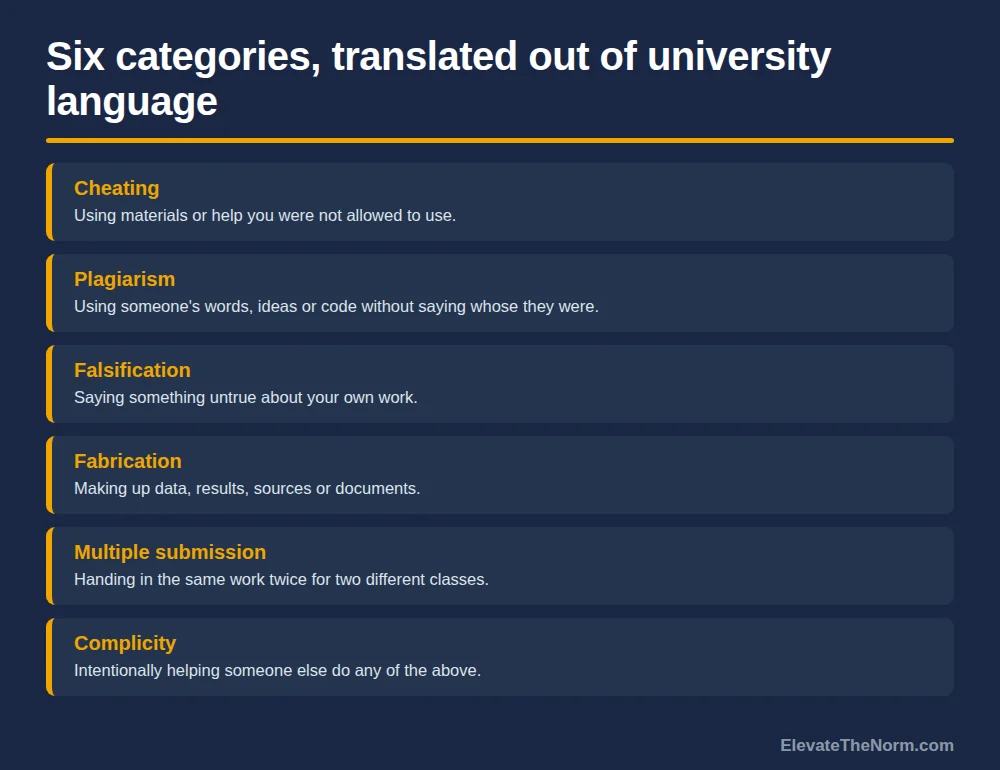
- Cheating. Using materials, notes, devices or help you were not permitted to use.
- Plagiarism. Using someone’s words, ideas, structure or code without saying whose they were — including inadequate paraphrasing.
- Falsification. Saying something untrue about your own work, verbally or in writing.
- Fabrication. Making up data, results, sources or documents and presenting them as real.
- Multiple submission. Handing in substantial portions of work already submitted for credit elsewhere, without permission.
- Complicity. Intentionally helping someone else do any of the above.
Two of these will be new to most students. Multiple submission is almost never explained in secondary school, and plenty of students reasonably assume their own work is theirs to reuse. Complicity surprises them even more — the student who let a friend photograph their worksheet usually thinks of themselves as the helpful one, not as a participant.
What Is Fabrication in Academic Integrity?
Fabrication is the unauthorised creation or reporting of information — inventing something and presenting it as real. Northern Illinois University’s tutorial pairs it with falsification and gives a list of concrete examples, several of which map directly onto secondary work:
- Generating data artificially instead of collecting it from an actual experiment.
- Altering data, documents, images, music or artwork without authorisation.
- Removing results that do not fit, from a report or presentation.
- Misrepresenting data through misleading scales or axes on a chart.
- Inventing sources of information.
- Impersonating another person to complete academic work, or using their login.
The two that come up constantly in grades 6–12 are inventing a source and quietly dropping the data point that ruined the graph. Neither feels like cheating to the student doing it. The first feels like filling in a form; the second feels like tidying.
That is why fabrication is worth teaching by name. A student who has never heard the word will not recognise themselves in it, and “I made up a source” is a sentence most fourteen-year-olds would be genuinely shocked to hear described as academic misconduct.
Eighteen Situations, and What Each One Is
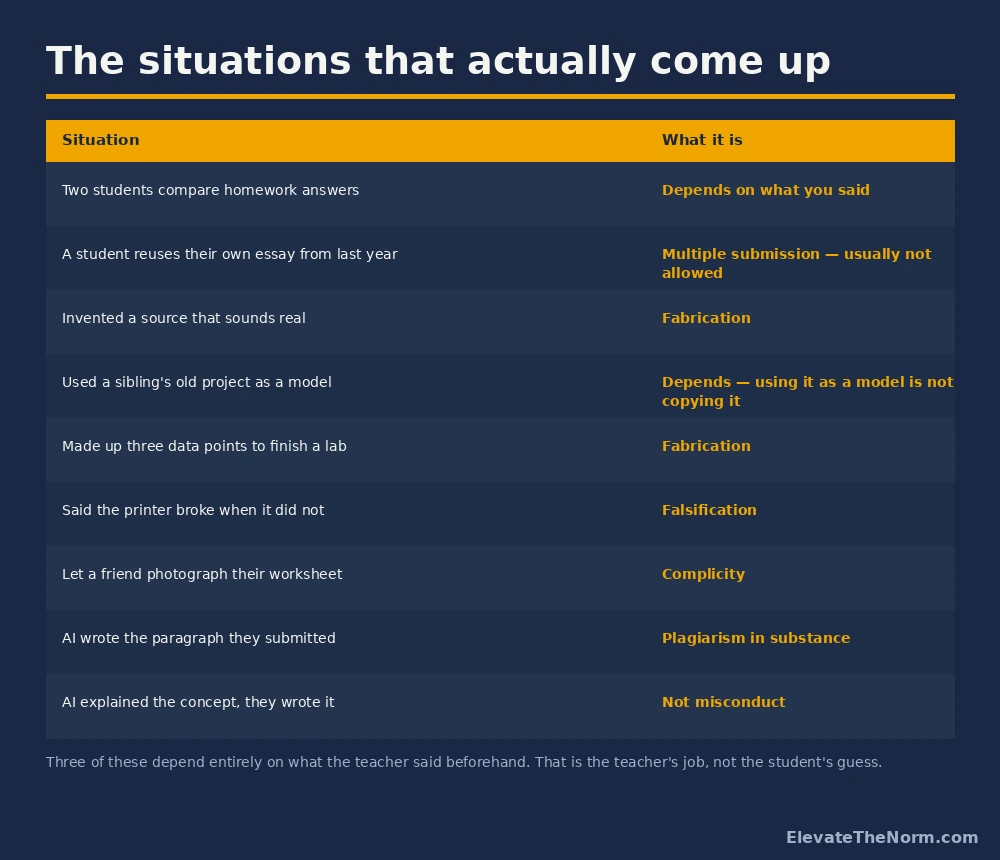
Sorted by category. The verdicts assume no specific instruction was given, which is exactly the condition that causes most of the trouble.
Clearly over the line
- Copying a classmate’s answers during a test. Cheating.
- Submitting a paragraph an AI tool wrote as their own writing. Plagiarism in substance, whatever the tool.
- Inventing a source that sounds plausible to fill a citation requirement. Fabrication.
- Adding three data points to finish a lab that ran out of time. Fabrication.
- Telling a teacher the printer broke when it did not. Falsification.
- Photographing a completed worksheet and sending it to four people. Complicity.
- Logging into another student’s account to submit work. Fabrication, by NIU’s definition, and probably worse under school policy.
- Paraphrasing a whole article closely without citing it. Plagiarism, even with every word changed.
Usually a violation, and usually a surprise to the student
- Reusing their own essay from a previous course. Multiple submission.
- Submitting the same project to two teachers in the same term. Multiple submission.
- Letting a friend copy homework “just this once.” Complicity.
- Dropping the result that ruined the trend line. Fabrication by omission.
- Using a translation tool to write an assignment in a language class. Depends heavily on the subject — and it is the teacher’s job to say.
Depends entirely on what was said
- Two students comparing homework answers before class.
- Working through practice problems together and arriving at the same method.
- Asking an AI tool to explain a concept, then writing the answer themselves. Not misconduct in most framings.
- Using a sibling’s old project as a model for structure. Using it as a model is not copying it.
- Getting a parent to proofread. Nearly always fine, and nearly never stated.
That last group is the important one. Five situations, all common, all resolved by one sentence at the top of the assignment. A school with a strict policy and no per-task instruction has built a system where students are punished for guessing wrong about something nobody told them — which is the pattern described in more detail in what academic honesty actually means in grades 6–12.


The Repair Conversation
When a student has done something that damaged trust, the conversation I have is about what is owed: to whom, and by when. Not a speech about character. A short, specific account of what needs to happen for this to be finished.
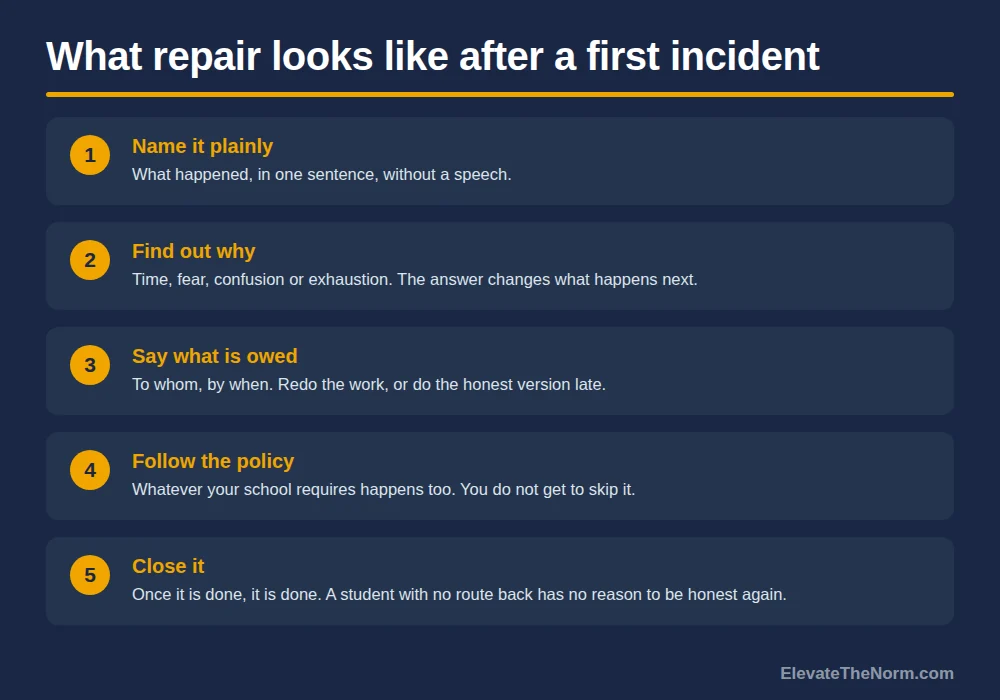
That framing does most of the work in an academic honesty incident, because it separates two things schools routinely merge. There is what the school’s policy requires, which happens regardless and which you do not get to skip. And there is what the student owes — usually redoing the work honestly, sometimes telling someone what happened, occasionally apologising to a classmate whose work they used.
The second part is the part that teaches anything. A consequence imposed on a student is something that happens to them. A debt they pay is something they do.
And it has to end. If the answer to “when is this finished” is never, a student learns that honesty has no upside and denial has no downside. That is not a soft observation — it is the incentive structure you have built, and teenagers read incentive structures accurately.
Using These Examples With a Class
The list above works far better as a discussion than as a handout. Twenty minutes, once, early in the year.
- Give them the ambiguous ones first. Start with comparing homework answers, not with copying a test. The interesting conversation is in the grey zone and starting at the obvious end wastes it.
- Let them disagree. Students argue about these with real energy, and the arguments surface exactly the assumptions you need to correct.
- Make them state the rule they are using. “Why is that one different from the last one?” gets you further than telling them.
- Then give your answers. Including, honestly, the ones where your answer differs from the teacher down the hall.
- End with the per-assignment habit. Tell them you will state what help is allowed on each task, and that asking is always fine.
The point is not compliance. It is that a student who has argued about where the line falls will notice when they are near it, and a student who has only been told the rules will not.
What to Do Next
Take the five “depends on what was said” situations and decide your actual answer for each. Not the school’s official position — yours, for your subject, on an ordinary assignment. Then say them out loud to your classes this week.
Most academic honesty problems in a secondary classroom are not students deciding to cheat. They are students guessing, in a building where six teachers want six different things and nobody has written any of it down. If a violation does occur and needs a formal response, a consistent process for responding to it keeps that fair too.
The note home is the part most of us write badly under pressure. There is a plainer way to write that message to a family that keeps a fixable mistake from turning into a standoff.
Before you go: grab the free Academic Honesty Scenario Cards (PDF) — ElevateTheNorm.com branded, printable, no email required.
Frequently Asked Questions
What is fabrication in academic integrity?
Fabrication is inventing information and presenting it as real — making up data, results, sources or documents. The examples that come up most in secondary school are inventing a citation that sounds plausible and quietly removing the data point that ruined a graph. Neither feels like cheating to the student doing it, which is exactly why the word is worth teaching. Falsification is its close relative: saying something untrue about your own work, such as claiming a file was submitted when it was not.
Is reusing my own work really a violation?
In most policies, yes, and it catches students completely off guard. Multiple submission means handing in substantial portions of work already submitted for credit somewhere else without permission. Students reasonably assume their own work belongs to them, and nobody explains otherwise. The practical answer is that it is nearly always allowed if you ask first, so the rule teachers should state is “ask me, and the answer is usually yes.”
Is using AI an academic honesty violation?
It depends what it replaced, and it fits inside the existing categories rather than needing a new one. Asking a tool to explain a concept and then writing the answer yourself is not misconduct in most framings. Submitting text the tool produced as your own writing is plagiarism in substance whatever the source. The test that works across tools is whether it helped you think or thought instead of you — and the part that actually prevents problems is a teacher stating which they mean on each assignment.
Is letting someone copy my homework really as bad as copying?
Policies generally treat it as its own category — complicity, meaning intentionally helping someone commit misconduct. Students almost never see it that way; the one who shared usually feels like the generous party rather than a participant. It is worth naming explicitly, because a student who would never copy will hand their work over without a second thought.
What if two teachers in my school have different rules?
That is extremely common and it is the source of a large share of honest mistakes. Students moving through six classrooms are running six different rule sets, none of which they chose. The fix is not a school-wide policy document that nobody reads — it is each teacher stating what help is allowed on each assignment. One line at the top of the task removes most of the ambiguity that generates violations.
How should a first incident be handled?
Privately, quickly, and with a defined end. Name what happened in one sentence, find out why — time, fear, confusion and exhaustion are the usual answers — and say what is owed and by when. Follow whatever your school’s policy requires, because that is not optional. Then close it. An incident with no route back teaches a student that honesty carries a cost and denial does not.
Should students be taught these categories by name?
Yes, and in plain language rather than the university wording they were written in. A student who has never heard the word fabrication will not recognise their own invented citation in it. The version that works is short, concrete, and argued about rather than handed out — twenty minutes of disagreement about the grey-zone situations does more than a signed policy sheet ever will.
Sources
- Office of Undergraduate Academic Integrity, Virginia Tech. Definitions of academic misconduct. Read the definitions — the source for the categories used above. These are university definitions; the plain-language wording in this article is a translation for grades 6–12, not a quotation.
- Northern Illinois University. Student tutorial: Fabrication or falsification. Read the tutorial — the source for the fabrication definition and the concrete examples list.
- International Center for Academic Integrity. Facts and statistics. Read the page — context for how common these behaviours are among high school students.
Every link above was checked on September 12, 2026. Where a definition was written for a university audience, this article says so rather than presenting it as a secondary-school standard.