
By Clay Shumate
The best classroom culture frameworks for a positive classroom environment are Classroom PBIS and CHAMPS for predictable routines and more praise than correction, Responsive Classroom and Developmental Designs for belonging, and restorative practices for repairing relationships. No single framework covers all four ingredients, so most teachers do best pairing one structure framework with one community routine.
Key Takeaways
- A positive classroom environment has four measurable ingredients: strong teacher-student relationships, more specific praise than correction, predictable routines, and students feeling they belong.
- In a BYU study of 28 middle school classrooms, class-wide on-task behavior rose 60–70% once teachers praised at least as often as they reprimanded.
- CHAMPS and Classroom PBIS make a classroom predictable by spelling out expectations for each activity and teaching them like content.
- Responsive Classroom and Developmental Designs build belonging through a regular advisory-style meeting where students greet each other and share.
- Restorative practices improved staff-student relationships in RAND’s Pittsburgh study, but grades 6–8 saw no drop in suspensions, so restorative work fits best beside a framework that handles routines and praise.
A positive classroom environment is a room where students trust the teacher, hear more praise than correction, know what to do in each activity, and feel they belong. “Positive” gets used loosely, so this page defines it first and then matches frameworks to each piece. This page is a companion to two narrower guides: the best framework for student engagement and top-rated frameworks for middle school. The full list lives in the classroom culture frameworks Q&A hub.
What makes a classroom environment positive, in measurable terms?
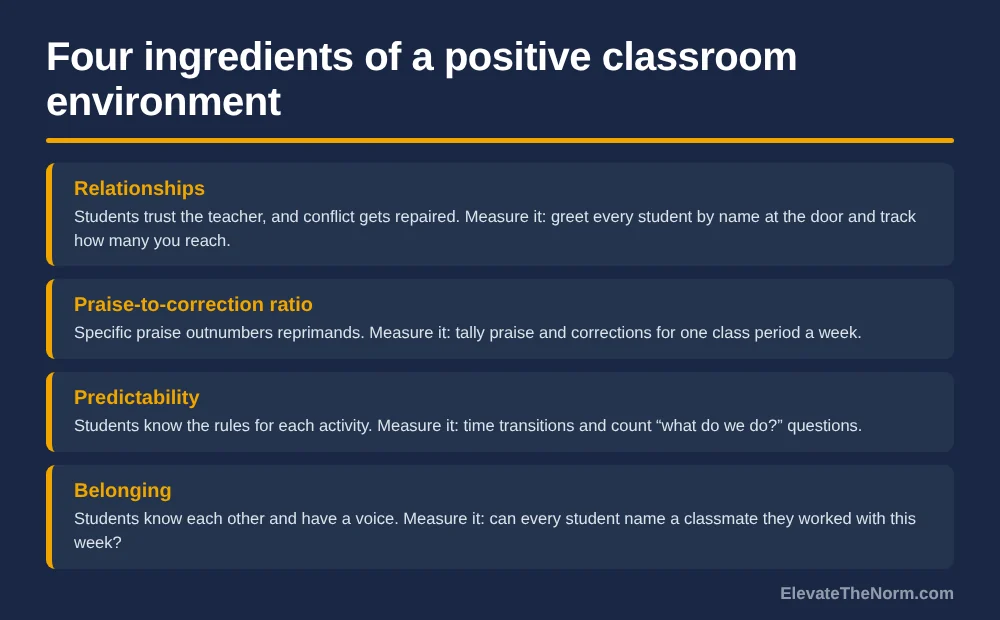
A positive classroom environment has four ingredients you can count or observe: relationships, the praise-to-correction ratio, predictability and belonging. The Center on PBIS describes the goal as classrooms that are “predictable, positive, effective, and equitable,” where students feel a sense of belonging (Center on PBIS, Classroom PBIS). Broken into pieces a teacher can check:
| Ingredient | What it looks like | A simple way to measure it |
|---|---|---|
| Relationships | Students trust the teacher; conflict gets repaired | Greet every student by name at the door; track how many you reach |
| Praise-to-correction ratio | Specific praise outnumbers reprimands | Tally praise and corrections for one class period a week |
| Predictability | Students know the rules for each activity | Time how long transitions take; count “what do we do?” questions |
| Belonging | Students know each other and have a voice | Can every student name a classmate they’ve worked with this week? |
The measurement ideas are ours, not from any one framework. They’re meant to be quick enough to do during a real school day.
Which frameworks build teacher-student relationships best?
Restorative practices and short relationship routines such as Establish-Maintain-Restore and positive greetings at the door build teacher-student relationships most directly.
- Establish-Maintain-Restore: a three-hour training on building, keeping and repairing relationships. In a randomized trial with 20 middle school teachers and 190 students, relationship quality, engaged time and disruptive behavior all improved significantly (Duong et al., School Psychology Quarterly, 2018). The sample was small, so read the effect sizes cautiously.
- Positive greetings at the door: middle school teachers randomly assigned to greet students at the door saw more engaged time and less disruption, and rated the strategy feasible (Cook et al., 2018).
- Restorative practices: in RAND’s Pittsburgh study, 63% of surveyed staff said their relationships with students improved, and suspension days fell 36% in program schools versus 18% elsewhere. Results in grades 6–8 were weaker, with no change in suspensions and lower academic results (EdSource on the RAND study).
More on this in building relationships with students and restorative practices in schools.
What praise-to-correction ratio makes a classroom feel positive?
A positive classroom needs at least one specific praise for every correction, and researchers suggest 2:1 or higher. The praise-to-correction ratio is the easiest of the four ingredients to measure.
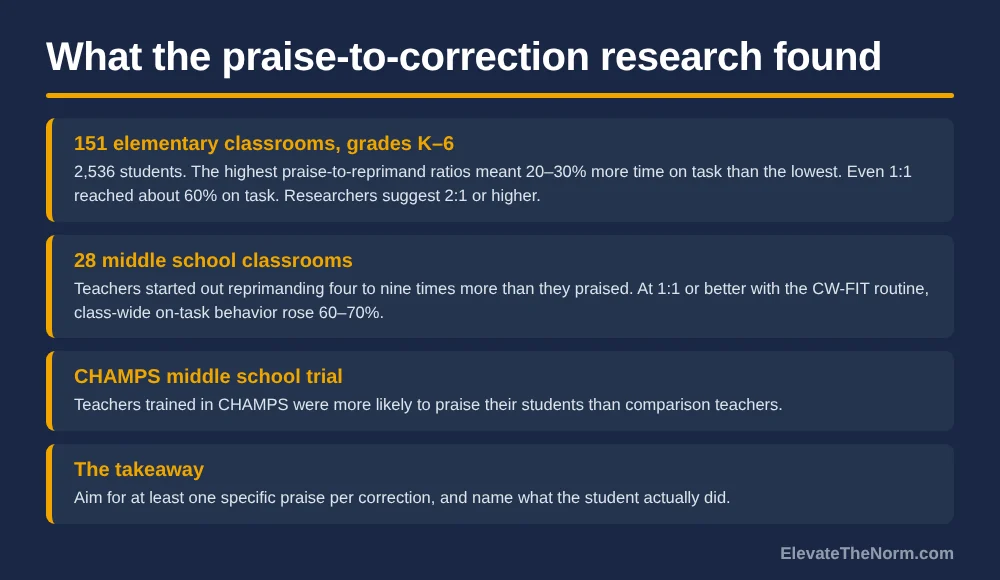
- In 151 elementary classrooms (grades K–6, 2,536 students), students in classes with the highest praise-to-reprimand ratios stayed on task 20–30% longer than those with the lowest. Even 1:1 reached about 60% on-task, and the researchers suggest 2:1 or higher (Caldarella et al., Educational Psychology, 2020).
- In 28 middle school classrooms, teachers began reprimanding four to nine times more than they praised. After reaching at least 1:1 with the CW-FIT routine, class-wide on-task behavior rose 60–70% (BYU, Journal of Positive Behavior Interventions).
The frameworks that build this in most directly are CHAMPS, where the “S” stands for Success and recognizing good behavior (LiveSchool), and PBIS, which includes acknowledgment systems. In the CHAMPS middle school trial, trained teachers praised students more often than controls (IES). Praise works best when it names what the student did. See motivating students for examples that don’t sound canned to teenagers.
Which frameworks make a classroom predictable?
CHAMPS and Classroom PBIS make a classroom most predictable, because both frameworks make expectations explicit and teach them like content.
CHAMPS spells out, for each activity, whether students can talk, how they get help, what the task is, whether they can move, what participation looks like and how success is recognized. PBIS uses a classroom teaching matrix that lists expectations by routine, and the Center on PBIS publishes planning tools for it for free (Center on PBIS). Responsive Classroom’s middle school advisory also makes predictability a goal: the first week of Responsive Advisory Meeting focuses on predictability, safety and belonging (RAM grades 6–8, first ten days).
A predictable room isn’t a rigid one. A predictable room is one where students don’t have to guess. Our guides on routines and procedures and classroom expectations show how to set this up in grades 6–12.
Which frameworks build a sense of belonging in the classroom?
Responsive Classroom and Developmental Designs build belonging best, because both frameworks run a regular meeting where students greet each other and share.
- Responsive Classroom: Responsive Advisory Meeting follows arrival, announcements, acknowledgments and an activity, with partner sharing built in every day (Responsive Classroom). Its broader secondary practices include Investing Students in the Rules, which gives students a hand in setting norms (Responsive Classroom secondary practices).
- Developmental Designs: from the Origins Program, built around the Circle of Power and Respect, an advisory format with a greeting and an activity, and skills like cooperation, empathy and assertion (MiddleWeb).
- Restorative circles also give students voice, though their main job is repair.
Responsive Classroom’s randomized trial was in grades 2–5 and found gains only where teachers used it faithfully (AERA). We didn’t find a randomized trial of Developmental Designs.


How do the frameworks compare across all four ingredients?
No single classroom culture framework covers relationships, praise, predictability and belonging equally, which is why combining two frameworks usually works best.
| Framework | Relationships | Praise ratio | Predictability | Belonging | Level |
|---|---|---|---|---|---|
| Classroom / schoolwide PBIS | Moderate | Strong (acknowledgment) | Strong (teaching matrix) | Moderate | School or classroom |
| CHAMPS | Moderate | Strong (more praise in trial) | Strong (per-activity rules) | Light | Classroom |
| Responsive Classroom | Strong | Moderate (teacher language) | Moderate | Strong (advisory meeting) | Classroom |
| Developmental Designs | Strong | Not a focus | Moderate | Strong (Circle of Power and Respect) | Advisory |
| Restorative practices | Strong (repair) | Not a focus | Light | Moderate (circles) | Schoolwide |
| Elevate the Norm (this site’s own) | Moderate | Strong (recognition tiers) | Moderate (3-2-1-Done) | Light | Classroom, grades 6–12 |
The ratings are our editorial judgment based on each framework’s published components, not scores from a study. Some good pairings:
- CHAMPS + Responsive Advisory Meeting: structure plus community, a natural fit for middle school.
- PBIS + restorative practices: a schoolwide system plus a way to repair harm.
- Any framework + greetings at the door + a praise tally: cheap, and both have middle school evidence.
Clay’s take, as a grades 6–12 classroom teacher: start with the praise tally. It’s the cheapest ingredient to measure, it has middle school evidence behind it, and the same tally shows you whether the room is actually changing.
How can a teacher start building a positive environment this week?
A teacher can start building a positive classroom environment by picking one ingredient, measuring it for a week, then adding a framework that targets it. No schoolwide adoption is needed to begin.
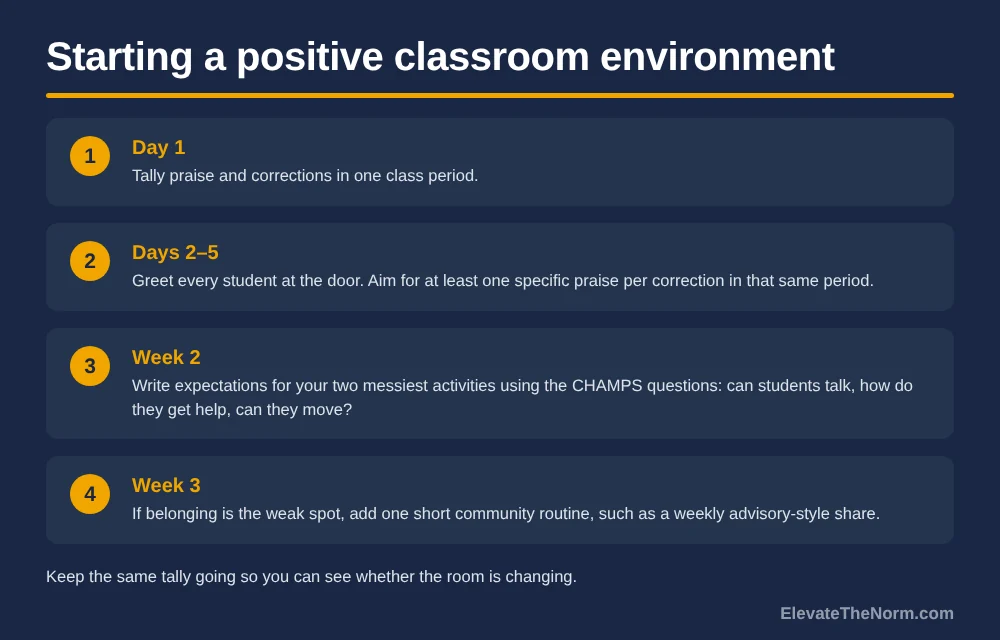
- Day 1: tally praise and corrections in one class period. For reference, the middle school teachers in the CW-FIT study started at four to nine reprimands per praise.
- Days 2–5: greet every student at the door and aim for at least one specific praise per correction in that same period.
- Week 2: write down expectations for your two messiest activities, using the CHAMPS questions: can students talk, how do they get help, can they move?
- Week 3: add one short community routine, such as a weekly advisory-style share, if belonging is the weak spot.
Keep the same tally going so you can see whether the room is actually changing. New teachers can find a fuller starting plan in what a classroom management plan looks like.
Where does Elevate the Norm fit in a positive classroom environment?
Elevate the Norm is strongest on the praise ingredient and is built for grades 6–12. Disclosure: Elevate the Norm is this site’s own framework, created by Clay Shumate, a certified 6–12 social studies teacher, and it hasn’t been independently evaluated.
- Praise with clear criteria: three recognition tiers (Immediate Recognition, Student of the Week, Student of the Month) announced in advance and judged on consistency and self-improvement, not perfection.
- Predictable transitions: the 3-2-1-Done class-vs-class point system, where each class starts the week at zero and earns points for getting quiet quickly.
- Respect both ways: student communication is channeled constructively rather than suppressed, and the teacher follows through on exactly what was announced. More on the thinking behind it on what we believe.
Elevate the Norm is lighter on belonging routines, so pairing it with an advisory meeting or circles makes sense. Free materials, no email gate: resource library.
Frequently Asked Questions
What is a positive classroom environment?
A positive classroom environment is a room where teacher-student relationships are strong, specific praise outnumbers correction, routines are predictable, and students feel they belong. The Center on PBIS describes the goal as classrooms that are predictable, positive, effective and equitable. Each of those four ingredients can be checked during an ordinary school day, for example by tallying praise and corrections for one class period.
Which framework is best for a positive classroom environment?
No single classroom culture framework covers everything. Classroom PBIS and CHAMPS are strongest for predictability and praise, Responsive Classroom and Developmental Designs are strongest for belonging, and restorative practices are strongest for repairing relationships after conflict. Most teachers get the best result pairing one structure-focused framework with one community routine, such as CHAMPS with an advisory meeting.
What is a good praise-to-correction ratio in the classroom?
A good praise-to-correction ratio is at least one specific praise for every correction, and researchers suggest 2:1 or higher. In 151 elementary classrooms, the highest ratios meant 20–30% more time on task than the lowest. In 28 middle school classrooms, reaching at least 1:1 raised class-wide on-task behavior 60–70%.
How can I measure whether my classroom is positive?
A teacher can measure a positive classroom with four quick checks. Tally praise and corrections for one class period a week. Time transitions and count how often students ask what to do. Track how many students you greet by name at the door. Then check whether every student can name a classmate they worked with that week.
Do restorative practices create a positive classroom environment?
Restorative practices help most with relationships. In RAND’s Pittsburgh study, 63% of surveyed staff said their relationships with students improved, and suspension days fell 36% in program schools versus 18% elsewhere. Results in grades 6–8 were weaker, with no change in suspensions, so restorative work fits best beside a framework that handles routines and praise.
Can one teacher build a positive classroom environment without a schoolwide framework?
Yes. Several of the best-supported moves work in a single classroom. Positive greetings at the door and the Establish-Maintain-Restore relationship training were both tested with individual middle school teachers, CHAMPS is a classroom-level system, and the Center on PBIS publishes free Classroom PBIS planning tools. A praise tally costs nothing and shows within a week whether the room is changing.
Do these classroom culture frameworks work in high school?
The evidence for these classroom culture frameworks comes mostly from younger grades. The CHAMPS trial, the greetings-at-the-door study and the Establish-Maintain-Restore trial ran in middle schools, and Responsive Classroom’s randomized trial ran in grades 2–5. The classroom-level studies cited on this page did not test high school classrooms, so high school teachers should treat the results as promising rather than proven.
Will teenagers think classroom praise is babyish?
The praise studies cited on this page measured how often teachers praised, not how teenagers felt about it. This site’s advice for older students is to make praise specific: name exactly what the student did, such as using a strong source or making a quick transition, instead of a vague “good job.” In 28 middle school classrooms, praising at least as often as correcting was linked to 60–70% more on-task behavior.
Sources
- Center on PBIS, Classroom PBIS
- Duong et al., 2018, Establish-Maintain-Restore randomized trial, School Psychology Quarterly
- Cook et al., 2018, Positive Greetings at the Door, Journal of Positive Behavior Interventions
- EdSource summary of the RAND Pittsburgh restorative practices study
- BYU summary of Caldarella et al., praise-to-reprimand ratios in 151 elementary classrooms, Educational Psychology
- BYU summary of praise and CW-FIT in 28 middle school classrooms, Journal of Positive Behavior Interventions
- LiveSchool, behavior management with CHAMPS
- IES, evaluation of the CHAMPS classroom management program for middle school teachers
- Responsive Classroom, Responsive Advisory Meeting grades 6–8, first ten days
- Responsive Classroom, secondary practices
- MiddleWeb, Developmental Designs advisory resource
- Rimm-Kaufman et al., Responsive Classroom randomized controlled trial (AERA summary)
How is this page kept accurate?
Study figures on this page come from the original papers or official summaries linked inline and listed under Sources, and the comparison ratings are labeled as editorial judgment. Elevate the Norm is identified as this site’s own framework wherever it appears. Corrections follow the editorial standards and corrections policy.