The Elevate Blog banner: Real Classrooms. Practical Ideas. Higher Expectations. Three students climb a rocky ridge at sunrise, each pulling the next one up, toward a teacher reaching down to help.

Tag: PBIS

  • Classroom Culture Frameworks With Ongoing Coaching and Feedback

    Classroom Culture Frameworks With Ongoing Coaching and Feedback

    By Clay Shumate

    Classroom culture frameworks with ongoing coaching and feedback include Responsive Classroom, Conscious Discipline, CHAMPS, Teach Like a Champion and PBIS. PBIS coaching usually comes through state and district networks; the paid programs mostly price coaching by quote. Coaching is worth it: a 60-study meta-analysis found it improved teachers’ instruction by 0.49 standard deviations.

    Key Takeaways

    • Teacher coaching improved instruction by 0.49 standard deviations and student achievement by 0.18 across 60 causal studies in a 2018 meta-analysis.
    • Coaching programs with fewer than 100 teachers outperformed larger ones, averaging 0.63 standard deviations on instruction against 0.34.
    • Virtual teacher coaching showed no statistically significant difference from in-person coaching in the same meta-analysis.
    • PBIS coaching runs through school, district and state coaches, while Responsive Classroom, Conscious Discipline and CHAMPS consulting are priced by quote.
    • Two teachers with a camera and one countable target, such as positive interactions per correction, can run a free coaching cycle every two weeks.

    Ongoing coaching is repeated cycles of observation, feedback and goal setting with a coach, as opposed to a single workshop. This page covers what each program’s coaching actually looks like, what the research says about coaching, and how to coach yourself or a colleague for free. If you’re comparing prices on books and workshops instead, see the buyer’s guide to classroom culture frameworks. For every framework at a glance, see the classroom culture frameworks Q&A hub.

    Why does coaching matter more than the classroom culture framework you pick?

    Coaching matters more than the framework because one-time training rarely changes daily classroom practice, while repeated observation and feedback does. The largest review on this is a 2018 meta-analysis by Matthew Kraft, David Blazar and Dylan Hogan in the Review of Educational Research. It pooled 60 studies with causal designs, 56 of them randomized trials (Kraft, Blazar & Hogan, 2018). What it found:

    • Instruction improved by 0.49 standard deviations across 43 studies.
    • Achievement improved by 0.18 standard deviations across 31 studies.
    • Smaller programs did better. Programs with fewer than 100 teachers averaged 0.63 on instruction and 0.28 on achievement. Programs with 100 or more averaged 0.34 and 0.10. The authors point to the difficulty of finding good coaches and getting teacher buy-in at scale.
    • Virtual coaching held up. They found no statistically significant difference between in-person and virtual coaching, though they couldn’t rule out moderate differences.
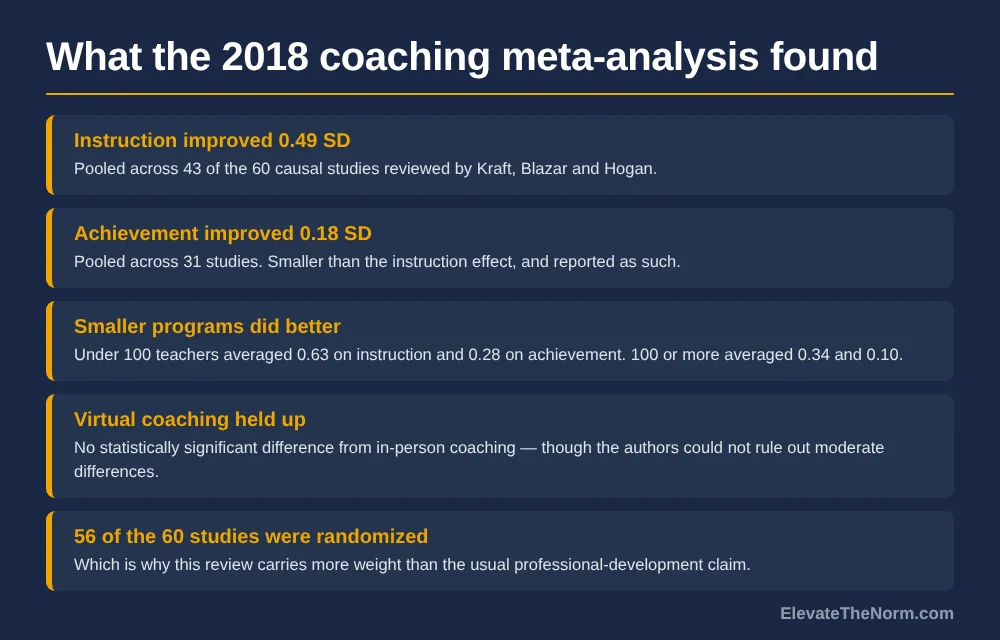
    What the 2018 teacher-coaching meta-analysis found.
    Sixty causal studies, 56 of them randomized. The instruction effect is the big one.

    Classroom management research points the same way. In the federally funded CHAMPS trial, middle school teachers got three days of workshops followed by monthly coaching for a full year. They praised more, gave more opportunities to respond, and ran better-organized classrooms (IES).

    Which classroom culture frameworks offer ongoing coaching and feedback?

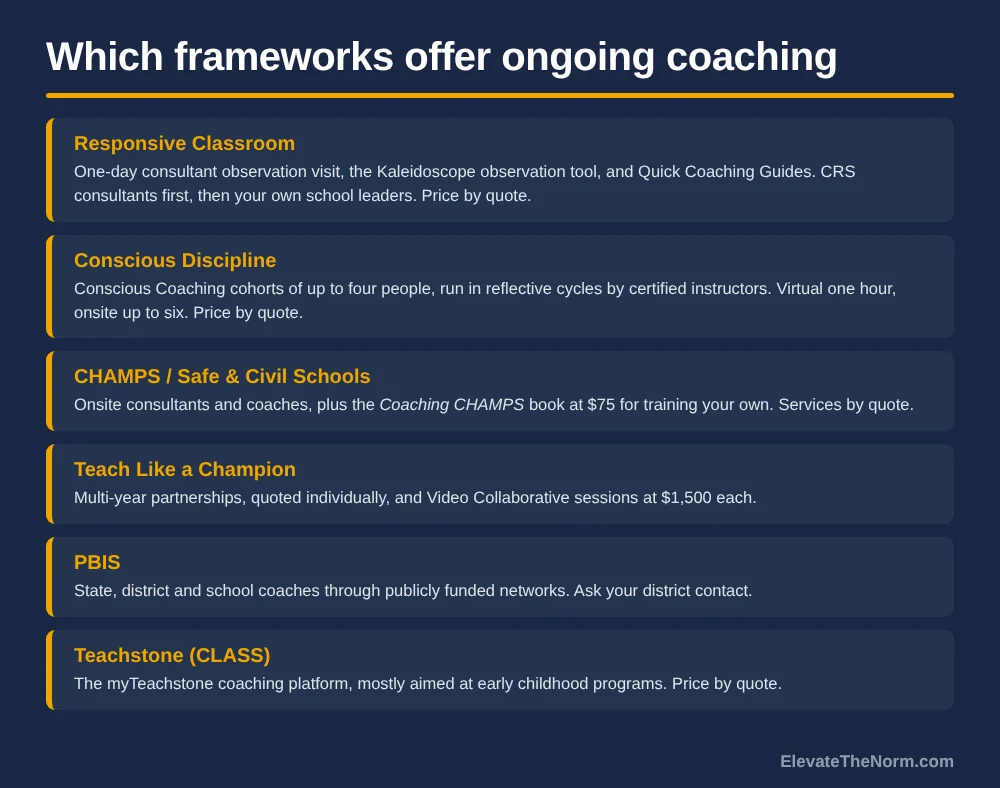
    Responsive Classroom, Conscious Discipline, CHAMPS, Teach Like a Champion and PBIS all offer ongoing coaching and feedback. PBIS coaching runs through state, district and school coaches. The paid programs price most coaching by quote, with two listed exceptions: Teach Like a Champion’s $1,500 video session and the $75 Coaching CHAMPS book.

    FrameworkCoaching formatWho coachesPriceGrade fit
    Responsive ClassroomOne-day consultant observation visit; Kaleidoscope observation tool; Quick Coaching GuidesCRS consultants, then school leadersBy quotePreK–8; secondary course 6–12
    Conscious DisciplineConscious Coaching cohorts (up to 4 people), reflective cyclesCertified instructorsBy quoteEarly childhood–grade 5
    CHAMPS / Safe & Civil SchoolsOnsite consultants and coaches; Coaching CHAMPS bookSCS consultants or your own coachesBook $75; services by quoteK–8; secondary book for 9–12
    Teach Like a ChampionMulti-year partnerships; Video Collaborative sessionsTLAC teamVideo session $1,500; partnerships by quoteK–12
    PBISState, district and school coachesState networks and district staffThrough your state or district; ask locallyK–12
    Teachstone (CLASS)myTeachstone coaching platformProgram or Teachstone coachesBy quoteMostly early childhood
    Which classroom culture frameworks offer ongoing coaching, and in what format.
    All five major programs offer coaching. Only PBIS routinely offers it free.

    What coaching does Responsive Classroom offer?

    Responsive Classroom offers a one-day consultant observation visit with a same-day debrief, then gives school leaders tools to keep observing on their own. In a Consultant Observation and Feedback Visit, a Center for Responsive Schools consultant observes eight to ten classrooms plus spaces like arrival, the cafeteria, hallways and dismissal. The observations run through Kaleidoscope, which produces a school growth profile, and the consultant debriefs with the leadership team that afternoon. The school gets a free pack of Quick Coaching Guides on a focus topic (CRS information sheet).

    After the visit, leaders keep using Kaleidoscope on their own. It comes with school and district packages for one school year after a training course and can be bought separately. The Quick Coaching Guides cover 30 topics for reflection and goal setting, and buying ten or more includes a free Leader Guide. Prices are by quote (On-Site Services).

    The catch: the ongoing part depends on your own leaders doing the observing. The consultant comes once.

    Does Conscious Discipline offer coaching?

    Yes. Conscious Discipline offers Conscious Coaching: small cohorts of up to four adults, led by certified instructors, meeting virtually for one hour or onsite for up to six hours. Participants set goals, reflect and practice together in repeated coaching cycles (Conscious Coaching overview). Its training page also lists an ongoing virtual partnership (Conscious Discipline training). Pricing isn’t posted.

    The coaching focuses on adult mindset and real interactions, which fits the program’s adult-first design. It’s built for early childhood and PreK–5.

    Does CHAMPS offer coaching for teachers?

    CHAMPS coaching comes from Safe & Civil Schools consultants and coaches, or from your own coaches trained with the Coaching CHAMPS book. Ancora Publishing points schools to Safe & Civil Schools for in-person help, and sells Coaching CHAMPS by Tricia Skyles, Randy Sprick and Jim Knight for $75.

    In an interview, Sprick and Skyles described a “freedom within form” model: the district sets clear targets, and teachers choose how to reach them. Their example targets were 90% student engagement, 90% compliance, and three to five positive interactions for every correction. Skyles argued that without clear targets, coaches have nothing to coach toward (Instructional Coaching Group). The CHAMPS trial’s monthly coaching is the strongest classroom-management evidence on this page.

    Does Teach Like a Champion include coaching?

    Teach Like a Champion includes coaching through custom multi-year partnerships and paid video review sessions, but a standalone workshop doesn’t include ongoing coaching. The TLAC team, which moved from Uncommon Schools to Together Education in 2022 (TLAC blog), offers multi-year partnerships. In those, it studies video and artifacts from your school, helps build your own video system, and models PD design. Partnerships are quoted individually. Its Video Collaborative, a 90-minute review of your pre-selected classroom footage, is $1,500 a session, and its 41 TLAC Online modules ($68 for one user) can also be used for 1:1 coaching (TLAC workshop pricing sheet).

    Can you get free coaching through PBIS?

    PBIS coaching is often available to teachers at no direct cost, because it runs through state, district and school coaches rather than a vendor. The Center on PBIS describes coaching at three levels: state coaches work with district teams, and district and school coaches work with administrators and Tier 1 teams. Coaching targets individual skills with feedback, team routines, and the systems that keep PBIS going. The center posts a free coaching self-assessment and practice briefs (Center on PBIS, Coaching).

    Start with your district’s PBIS contact. In Alabama, for example, the state department of education partnered with the University of Alabama’s positive behavior supports office to expand training and ongoing support (University of Alabama News).

    Is Teachstone CLASS coaching useful for secondary teachers?

    Teachstone’s CLASS coaching is built mostly for early childhood programs, so grades 6–12 teachers will usually find a closer fit elsewhere. Teachstone describes myTeachstone as a CLASS coaching platform with frequent online contact between coaches and teachers and online learning communities. Its materials reference Head Start and early childhood quality systems, and pricing goes through sales (Teachstone).

    How can a teacher get classroom management coaching for free?

    A teacher can get free classroom management coaching by pairing with a colleague, recording short lesson clips, and coaching toward one countable target. The 2018 meta-analysis found virtual coaching held up and smaller programs did better, which is good news for a two-teacher arrangement.

    1. Pick one target. Use something you can count, like positive interactions per correction or opportunities to respond, the same practices that improved in the CHAMPS trial.
    2. Record ten minutes of a lesson. Jim Knight’s Focus on Teaching is a full guide to using classroom video for improvement. Follow your school’s recording policy.
    3. Count, then meet for 15 minutes with a peer. Agree on one change.
    4. Repeat in two weeks.
    5. Use free structure from the PBIS coaching resources or your district coach.

    Clay’s take: As a grades 6–12 teacher, I’d try the free routes first: your district’s PBIS coach, or a colleague and one countable target. Pay for vendor coaching when you need expertise your building doesn’t have. That’s a judgment on the research on this page, not a result from my own room.
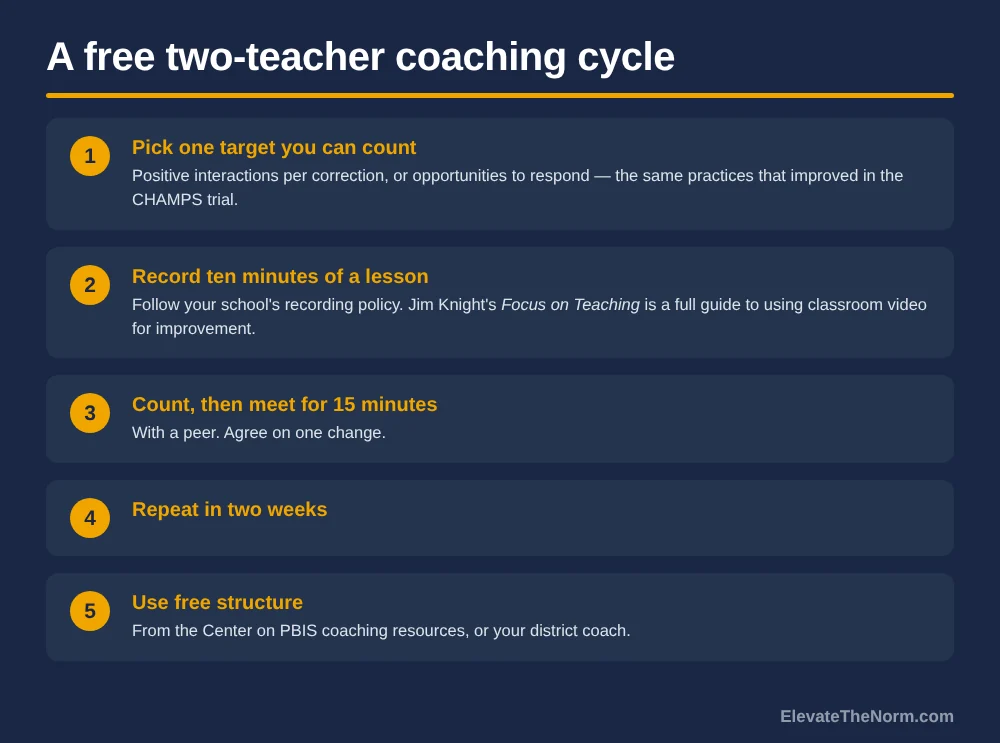
    A free two-teacher coaching cycle in five steps.
    Two teachers, one camera, one countable target.

    More options are in free professional development for teachers and collective teacher efficacy. If you’d rather customize a framework first, see customizable classroom culture frameworks.

    Does Elevate the Norm offer coaching?

    Elevate the Norm doesn’t offer coaching, but its free grades 6–12 framework gives a peer coach clear things to look for. Disclosure: it’s this site’s own framework, built by Clay Shumate, a certified 6–12 social studies teacher, and it hasn’t been independently evaluated.

    A colleague can watch for whether recognition criteria were announced in advance, whether the teacher followed through exactly as stated, and how transitions run under the 3-2-1-Done class-vs-class point system. The materials are on the free resource library with no email gate. A paid option from the same teacher, the Teacher Emergency Toolkit, includes behavior and MTSS documentation templates that can serve as a record for coaching conversations.

    Frequently Asked Questions

    Which classroom culture frameworks include ongoing coaching?

    Responsive Classroom, Conscious Discipline, CHAMPS from Safe and Civil Schools, Teach Like a Champion and PBIS all offer ongoing coaching. PBIS coaching usually runs through state, district and school coaching networks. The paid programs price most coaching by quote, though Teach Like a Champion lists its 90-minute Video Collaborative at $1,500 a session and the Coaching CHAMPS book costs $75.

    Does teacher coaching actually work?

    Yes. A 2018 meta-analysis by Matthew Kraft, David Blazar and Dylan Hogan pooled 60 causal studies, 56 of them randomized trials. Coaching improved teachers’ instruction by 0.49 standard deviations across 43 studies and student achievement by 0.18 across 31 studies. Programs with fewer than 100 teachers did better than larger ones, which the authors linked to finding good coaches at scale.

    Is virtual coaching as good as in-person coaching?

    The 2018 Kraft, Blazar and Hogan meta-analysis found no statistically significant difference between virtual and in-person teacher coaching on either instruction or student achievement. The authors noted their estimates were too imprecise to rule out moderate differences. For teachers without a local coach, that makes virtual options, such as Conscious Discipline’s one-hour virtual cohorts, a reasonable choice rather than a second-best one.

    How can I get classroom management coaching for free?

    Ask your district’s PBIS contact first, because PBIS coaching runs through school, district and state coaches. If none is available, pair with a colleague, record ten minutes of a lesson under your school’s recording policy, and count one target such as positive interactions per correction. Meet for 15 minutes, agree on one change, and repeat the cycle in two weeks.

    What does Teach Like a Champion video feedback cost?

    Teach Like a Champion’s Video Collaborative, a 90-minute review of a school’s pre-selected classroom footage, is listed at $1,500 per session on the organization’s workshop pricing sheet. Multi-year partnerships, which include studying a school’s own video and building its video system, are quoted individually. The 41 TLAC Online modules cost $68 for one user and can be used for 1:1 coaching.

    Should a school pay for vendor coaching or train its own coaches?

    The research favors starting small and well staffed. Kraft, Blazar and Hogan found coaching programs with fewer than 100 teachers averaged 0.63 standard deviations on instruction, against 0.34 for larger programs, and the authors pointed to the difficulty of finding good coaches at scale. Many schools can start with district PBIS coaches or the $75 Coaching CHAMPS book before buying vendor coaching.

    What should a peer coach look for in a classroom?

    A peer coach should look for one target that can be counted, not a general impression. Good examples are positive interactions per correction and opportunities to respond, the practices that improved in the federally funded CHAMPS middle school trial. Sprick and Skyles describe district targets such as three to five positive interactions for every correction, which gives the coach and teacher a shared number to track.

    Do these coaching programs work for middle and high school?

    Some fit secondary classrooms better than others. The CHAMPS trial studied middle school teachers, Teach Like a Champion covers K–12, and PBIS coaching runs K–12. Responsive Classroom is built for PreK–8 with a separate grades 6–12 course, while Conscious Discipline and Teachstone’s CLASS focus on early childhood and elementary programs. Grades 6–12 teachers should start with CHAMPS, Teach Like a Champion or PBIS.

    Sources

    How is this page kept accurate?

    This page is kept accurate by taking program details and prices from each provider’s own site and study figures from the original paper or official summaries, all linked inline. Confirm current prices with the provider. Elevate the Norm and the Teacher Emergency Toolkit are labeled as this site’s own work. Corrections follow the editorial standards and corrections policy.

    About Clay Shumate

    Clay Shumate is a certified secondary Social Studies teacher in the public schools of West Alabama, with seven years of classroom experience, a B.A. in History, and an M.Ed. in Secondary Education. He writes about project-based learning, student responsibility, respect, and practical ways to hold young people to a higher standard while giving them room to learn from mistakes. He is a member of the Society of Professional Journalists and writes to its Code of Ethics; this site’s editorial standards and corrections policy are published in full. More about Clay.

  • Best Classroom Culture Framework for Elementary Schools on a Budget

    Best Classroom Culture Framework for Elementary Schools on a Budget

    By Clay Shumate

    Short answer: The best classroom culture framework for elementary schools on a budget is PBIS. It’s free to adopt and has randomized-trial evidence in elementary schools. Add the free Classroom PBIS materials and CASEL’s SEL 3 Signature Practices for the daily routine. With under $100, add one Responsive Classroom or Conscious Discipline book.

    Key Takeaways

    • PBIS is free to adopt; the Center on PBIS says it “is not a curriculum you purchase.”
    • A randomized trial in 37 elementary schools found students in schoolwide PBIS schools were 33% less likely to get an office discipline referral.
    • One Responsive Classroom book costs about $30–$35 and the Conscious Discipline core book costs $44, so a full classroom approach fits under $100.
    • Second Step kits run $570 per grade, which makes them a school purchase, not a teacher’s out-of-pocket one.
    • Coaching and faithful use, not the purchase itself, drove the gains in the Responsive Classroom trial.

    A classroom culture framework is a shared system for teaching expectations, building relationships and responding to behavior the same way every day. One honest note first: this site’s own framework, Elevate the Norm, is built for grades 6–12. It isn’t the answer to an elementary question, so this page sticks to options designed for younger students. For the full list of frameworks we cover, see the classroom culture frameworks Q&A hub.

    What is the best free classroom culture framework for elementary school?

    PBIS is the strongest free option, because it’s a framework you adopt rather than a product you buy. The Center on PBIS says plainly that PBIS “is not a curriculum you purchase” (Center on PBIS). It organizes support in three tiers: universal supports that should work for 80% or more of students, targeted help for about 10–15%, and intensive support for about 1–5%.

    The evidence is elementary-heavy, which is good news here. In a randomized trial of 37 public elementary schools and 12,344 children who started in kindergarten through grade 2, students in schoolwide PBIS schools were 33% less likely to receive an office discipline referral. The authors called the behavior effects modest, and suspensions didn’t differ significantly (Bradshaw, Waasdorp & Leaf, Pediatrics, 2012).

    What PBIS costs is time: team meetings, teaching expectations like content, and tracking data. The materials are published on the Center on PBIS site, which was developed under a U.S. Department of Education grant.

    Can one teacher use PBIS without the whole school?

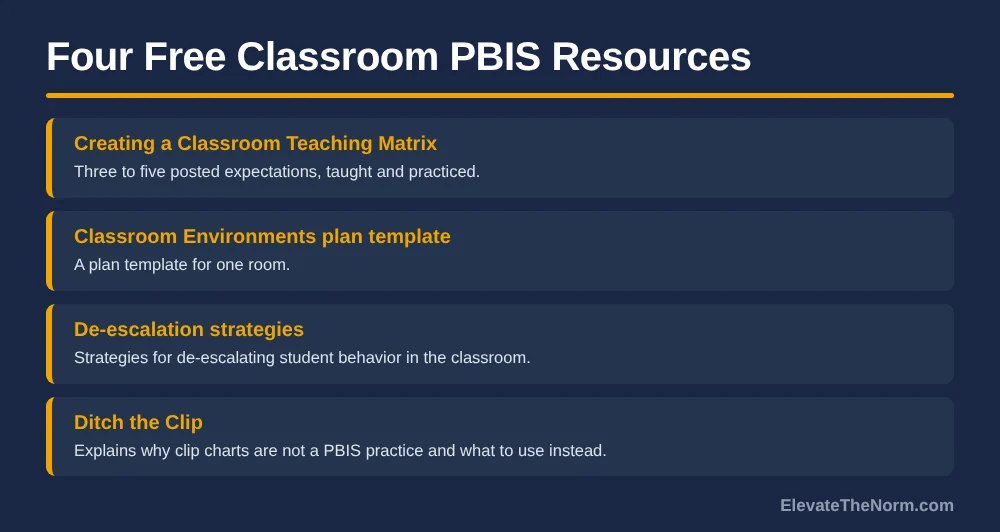
    One teacher can use Classroom PBIS, the version of PBIS built for a single room, without a schoolwide team. The Center on PBIS describes it as evidence-based practices that make classrooms predictable, positive and equitable (Center on PBIS, Classroom PBIS). Its posted resources include:

    • Creating a Classroom Teaching Matrix
    • A Creating Effective Classroom Environments plan template
    • Strategies for de-escalating student behavior in the classroom
    • “Ditch the Clip,” which explains why clip charts aren’t a PBIS practice and what to use instead

    In practice, that means three to five posted expectations, taught and practiced, plus frequent specific acknowledgment and calm, brief correction. Our guides to classroom expectations and routines and procedures are written for older students, but the steps carry over.

    Four free Classroom PBIS resources: a classroom teaching matrix guide, a classroom environments plan template, de-escalation strategies, and Ditch the Clip.
    Free Classroom PBIS resources one teacher can use without the whole school.

    What free SEL resources does CASEL offer elementary schools?

    CASEL’s SEL 3 Signature Practices Playbook gives a no-cost daily structure that fits any elementary room. The three practices are an inclusive welcome, engaging strategies throughout the lesson, and an intentional close (CASEL, SEL 3 Signature Practices). It’s online with no listed price.

    CASEL also runs a Program Guide that compares its designated evidence-based SEL programs side by side (CASEL Program Guide). That’s useful before you spend money, because it lists grade ranges, study designs and training models in one place.

    What classroom culture framework can an elementary teacher get for under $100?

    For under $100, an elementary teacher can buy one Responsive Classroom book (about $30–$35) or the Conscious Discipline core book ($44) and run a full classroom approach from it. One good book will do more than a pile of printables.

    Responsive Classroom (books only)

    The Center for Responsive Schools sells The First Six Weeks of School (3rd ed.) for $35, The Power of Our Words (2nd ed.) for $34.80, Interactive Modeling for $31.20, and 80 Morning Meeting Ideas in K–2 and 3–6 editions for $29.70 each (CRS bookstore). Responsive Classroom is designated SELect by CASEL, with programming for grades K–6 in the Program Guide (CASEL Program Guide). A teacher can run Morning Meeting and Interactive Modeling from the books alone. You won’t get the coaching, though, and that matters: in a 24-school randomized trial, gains in math and reading showed up only where teachers used the practices faithfully (Rimm-Kaufman et al., AERA, 2014).

    Conscious Discipline (book plus free resources)

    Conscious Discipline: Building Resilient Classrooms lists at $44, or $29 when bought with the e-course, and the publisher describes it as “perfect for toddler to 5th Grade classrooms” (Conscious Discipline). The company also posts free printables, make-n-takes, School Family songs and chants, Spanish resources, webinars and podcasts. Its core idea is that discipline starts with the adult’s own self-regulation, which can help a staff dealing with stress or trauma.

    How do elementary classroom culture frameworks compare by budget?

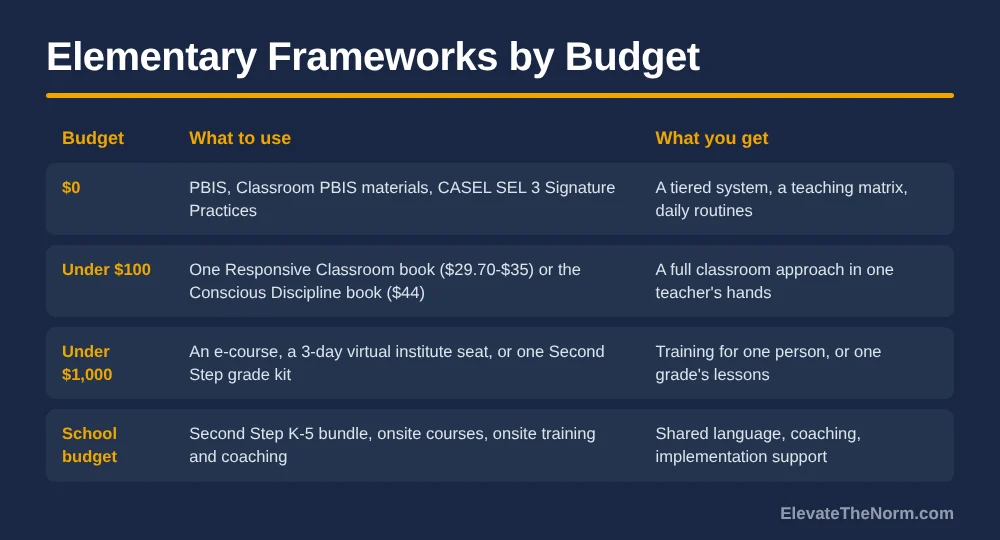
    Elementary classroom culture options sort into four budget levels: $0, under $100, under $1,000, and a school budget. Start at $0 and add spending only when you know what problem you’re paying to fix.

    BudgetWhat to useWhat you getWhat you don’t get
    $0PBIS framework, Classroom PBIS materials, CASEL SEL 3 Signature Practices, Conscious Discipline free resourcesA tiered system, a teaching matrix, daily welcome and closing routines, printable toolsTraining, coaching, a scripted curriculum
    Under $100One Responsive Classroom book ($29.70–$35) or the Conscious Discipline book ($44)A full classroom approach in one teacher’s handsFeedback on whether you’re doing it faithfully
    Under $1,000Conscious Discipline e-course ($549, about 10 hours, book included), or a Responsive Classroom 3-day virtual institute seat ($849–$889), or one Second Step grade-level kit ($570)Structured training for one person, or one grade’s lessonsSchoolwide consistency
    School budgetSecond Step K–5 kit bundle ($3,076), Responsive Classroom onsite courses, Conscious Discipline onsite training and coachingShared language across classrooms, coaching, implementation supportResults without follow-through; all of these depend on fidelity

    Sources: Conscious Discipline e-course; Responsive Classroom live-virtual institute; Second Step order form. Prices change, so confirm on each publisher’s site before you budget.

    Table of elementary classroom culture options at four budget levels: $0, under $100, under $1,000, and school budget, with what to use and what you get.
    What to use and what you get at each budget level.

    Is Second Step worth it on a tight budget?

    Second Step is worth it only when the school, not the teacher, is paying. Second Step’s current print order form lists elementary classroom kits at $570 per grade, a K–5 Principal Toolkit at $237, and a K–5 kit bundle at $3,076 (Second Step order form). The form’s prices carry an expiration date, so check for a newer one before you budget. Its digital programs are sold as a single-school K–12 license, and the store page doesn’t post a price (Second Step store).

    Second Step is a lesson curriculum, not a whole culture framework. Many schools run it as the SEL lessons inside a PBIS system. If you’re one teacher with your own money, the free and under-$100 tiers get you further.

    What does a full classroom culture program cost an elementary school?

    A full classroom culture program costs a school far more in training and coaching than in books. A public 2024 quote from Conscious Discipline to a Texas district totaled $75,700, including $43,360 for eight one-day onsite trainings, $11,760 for three coaching days, $10,080 for 24 hours of virtual consultation, and about $2,960 for 80 books (Crowley ISD board document). Responsive Classroom offers onsite courses, workshops, leadership seminars and a one-day consultant observation visit, but it doesn’t post onsite prices (Responsive Classroom).

    If your school is choosing between those two, we break down the full cost of ownership in Conscious Discipline vs Responsive Classroom: which should a school buy?

    Which classroom culture framework should an elementary school on a budget pick?

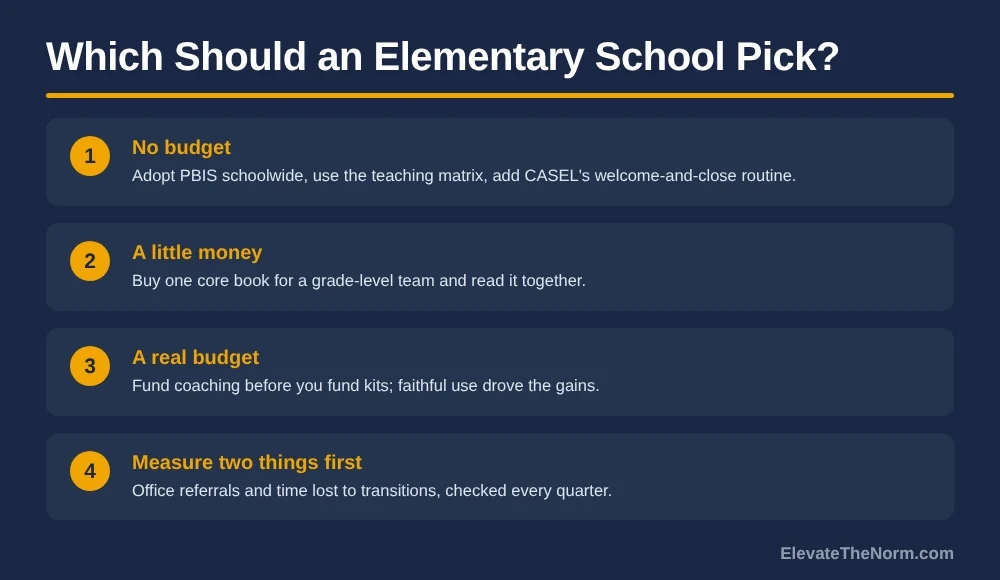
    An elementary school on a budget should pick PBIS first and add spending in steps: free materials with no budget, one shared book with a little money, and coaching before kits with a real budget.

    1. No budget: adopt PBIS schoolwide, use the Classroom PBIS teaching matrix, and add CASEL’s welcome-and-close routine.
    2. A little money: buy one core book for a grade-level team and read it together. Choose Responsive Classroom if your goal is community and academics, or Conscious Discipline if adult stress and student dysregulation are the bigger problem, especially in PreK–2.
    3. A real budget: fund coaching before you fund kits. The Responsive Classroom trial showed that faithful use, not purchase, drove the gains.
    4. Measure two things before you start, such as office referrals and time lost to transitions, and check them every quarter.

    Clay’s take: I teach secondary, not elementary, so this is a judgment about the evidence above, not a report from a K–5 room. Spend time before money. Every option on this page depends on faithful follow-through, and a free framework a staff actually runs will beat a paid one sitting on a shelf.

    For how frameworks fit together in general, see our Responsive Classroom vs PBIS vs Conscious Discipline comparison and what a classroom management plan looks like.

    Four recommendations by budget: no budget, a little money, a real budget, and measure two things first.
    Which option an elementary school should pick at each budget level.

    Where does Elevate the Norm fit for elementary schools?

    Elevate the Norm doesn’t fit elementary schools; it is built for grades 6–12. Elevate the Norm is this site’s own free positive-reinforcement approach, built by Clay Shumate, a certified 6–12 social studies teacher, for middle and high school classrooms. It hasn’t been independently evaluated. If your elementary school feeds into a middle school looking for a secondary classroom layer, the free resource library (no email gate) and the 3-2-1-Done transition system show how it works. For a K–5 building, the options above are a better fit.

    Frequently Asked Questions

    What is the cheapest classroom culture framework for elementary school?

    PBIS is the cheapest classroom culture framework for elementary school. The Center on PBIS says PBIS is not a curriculum you purchase, so the framework itself costs nothing. The real costs are staff time: meeting as a team, teaching expectations like academic content, and tracking discipline data to see whether the system is working.

    Can I use Responsive Classroom without paying for training?

    Yes. Teachers can run Morning Meeting and Interactive Modeling from Responsive Classroom’s books, which cost about $30 to $35 each. A 24-school randomized trial found math and reading gains only where teachers used the practices faithfully, so a grade-level book study helps make up for the coaching a book can’t give.

    Is Conscious Discipline free?

    Conscious Discipline is not free, but parts of it are. The core book, Building Resilient Classrooms, lists at $44, and the individual e-course is $549 for about 10 hours with the book included. The company also posts free printables, School Family songs and chants, Spanish resources, webinars and podcasts.

    How much does Second Step cost for elementary?

    Second Step’s current print order form lists elementary classroom kits at $570 per grade, a K-5 Principal Toolkit at $237 and a K-5 kit bundle at $3,076. The form’s prices carry an expiration date, so check for a newer form before budgeting. Digital programs are sold as a single-school license with no posted price.

    Can one elementary teacher start a classroom culture framework alone?

    Yes. One elementary teacher can start with Classroom PBIS, the single-room version of PBIS, which offers a free teaching matrix guide, a classroom environments plan template and de-escalation strategies. Add CASEL’s inclusive welcome, engaging strategies and intentional close as the daily routine. Neither one requires a schoolwide team or a purchase.

    Should an elementary school fund books, kits or coaching first?

    An elementary school on a tight budget should fund coaching before kits. In the Responsive Classroom randomized trial, math and reading gains showed up only where teachers used the practices faithfully, so buying materials alone doesn’t buy results. Books for a grade-level study are cheap; coaching is where money changes what teachers actually do.

    Are clip charts part of PBIS?

    No. The Center on PBIS publishes a free resource called Ditch the Clip that explains why clip charts aren’t a PBIS practice and what to use instead. Classroom PBIS leans on three to five posted expectations that are taught and practiced, frequent specific acknowledgment, and calm, brief correction.

    Does Elevate the Norm work for elementary school?

    Elevate the Norm is this site’s own classroom culture framework, and it is built for grades 6-12, so it isn’t the best fit for a K-5 building. PBIS, CASEL’s free SEL 3 Signature Practices and an elementary book like Responsive Classroom or Conscious Discipline fit younger students better.

    Sources

    How is this page kept accurate?

    Prices come from each publisher’s site or official order form, and study figures come from the original papers or official summaries linked inline. Elevate the Norm is labeled as this site’s own framework wherever it appears. Corrections follow the editorial standards and corrections policy.

    About Clay Shumate

    Clay Shumate is a certified secondary Social Studies teacher in the public schools of West Alabama, with seven years of classroom experience, a B.A. in History, and an M.Ed. in Secondary Education. He writes about project-based learning, student responsibility, respect, and practical ways to hold young people to a higher standard while giving them room to learn from mistakes. He is a member of the Society of Professional Journalists and writes to its Code of Ethics; this site’s editorial standards and corrections policy are published in full. More about Clay.

  • Classroom Culture Frameworks vs PBIS: Pros and Cons

    Classroom Culture Frameworks vs PBIS: Pros and Cons

    By Clay Shumate

    Classroom culture frameworks vs PBIS comes down to scale. PBIS is a free schoolwide system with three tiers of support, a leadership team and data. A classroom culture framework, like Responsive Classroom, CHAMPS or Elevate the Norm, shapes one teacher’s daily routines. Most schools get the best results running both: PBIS as the system, a classroom approach inside it.

    Key Takeaways

    • PBIS is a free schoolwide framework, not a curriculum: Tier 1 serves every student, Tier 2 about 10–15% and Tier 3 about 1–5%.
    • In a randomized trial of 37 elementary schools, students in PBIS schools were 33% less likely to get an office discipline referral, but suspensions didn’t differ significantly.
    • A classroom culture framework can start in days and tells a teacher exactly what to say and do, but it has no built-in Tier 2 or Tier 3 support.
    • A classroom framework only works when it’s used every day: Responsive Classroom’s three-year trial found gains only where teachers used the practices faithfully.
    • If your school runs PBIS, use its expectations as your classroom expectations and run a classroom framework inside it.

    Below are the pros and cons of each level and how to run them together without stepping on each other. For the full list of frameworks, see the classroom culture frameworks hub.

    What’s the difference between a classroom culture framework and PBIS?

    PBIS (Positive Behavioral Interventions and Supports) is a schoolwide framework that organizes a whole building; a classroom culture framework is a set of daily practices that organizes one teacher’s room. The Center on PBIS describes PBIS as a tiered framework, not a curriculum or product: Tier 1 supports every student, Tier 2 adds targeted help for about 10–15%, and Tier 3 gives individualized support to about 1–5% (Center on PBIS). It runs on a leadership team, shared expectations and data.

    A classroom culture framework is a set of daily practices one teacher uses: how to open class, teach routines, praise, redirect and recognize. Examples include Responsive Classroom, CHAMPS, Teach Like a Champion and, on this site, Elevate the Norm. Restorative practices can work at either level but is usually adopted schoolwide.

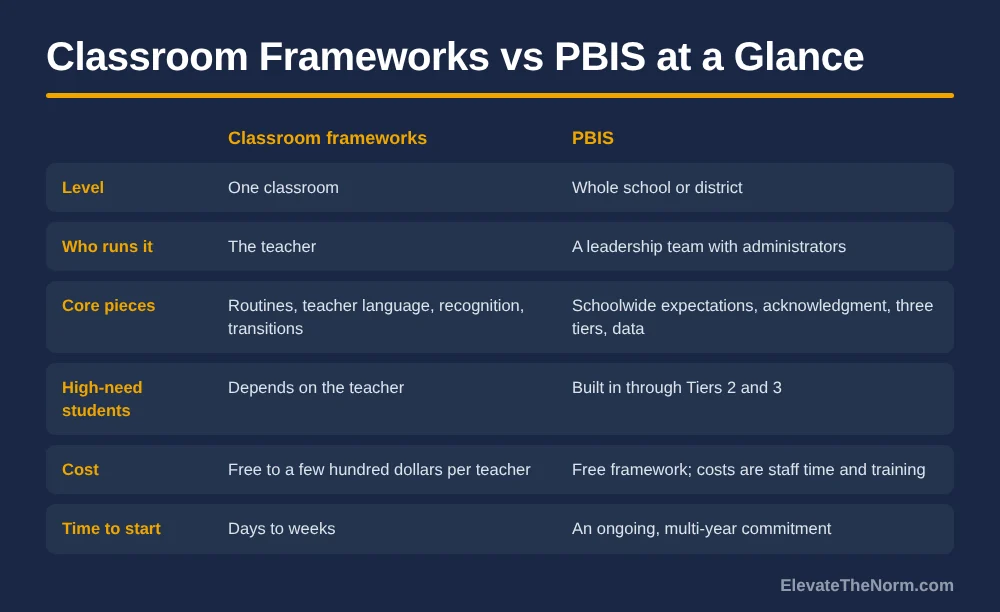
    Classroom culture frameworksPBIS
    LevelOne classroomWhole school or district
    Who runs itThe teacherA leadership team with administrators
    Core piecesRoutines, teacher language, recognition, transitionsSchoolwide expectations, acknowledgment, three tiers, data
    Support for high-need studentsDepends on the teacherBuilt in through Tiers 2 and 3
    CostFree to a few hundred dollars per teacherFree framework; costs are staff time and training
    Time to startDays to weeksAn ongoing, multi-year commitment

    What are the pros and cons of PBIS?

    PBIS is free, consistent across a building and backed by randomized trials, but it needs a functioning team, takes sustained effort, and is often run with token rewards.

    Pros of PBISCons of PBIS
    Free framework and materials from the Center on PBISNot a one-day training; requires teams, data, coaching and ongoing commitment
    Students hear the same expectations in every hallway and roomDepends on staff buy-in; one disengaged team can stall it
    Built-in Tier 2 and Tier 3 support for students who need moreOften run as a ticket or points economy, which some educators see as extrinsic
    Randomized trial: 33% lower odds of office referralsSame trial found no significant difference in suspensions
    Dedicated high school guidance, including student voice and freshman supportStrongest trials were run in elementary schools
    Table comparing classroom culture frameworks and PBIS on level, who runs it, core pieces, support for high-need students, cost, and time to start.
    How a classroom culture framework and PBIS differ on six points.

    The evidence: in 37 elementary schools and 12,344 children, students in schoolwide PBIS schools were 33% less likely to receive an office discipline referral and showed small improvements in disruptive behavior, concentration, prosocial behavior and emotion regulation. Suspensions didn’t differ significantly (Bradshaw, Waasdorp & Leaf, Pediatrics, 2012). For high schools, the Center on PBIS reports that faithful implementation is associated with fewer referrals, tardies and suspensions and better attendance (High School PBIS), though we didn’t find a high school randomized trial.

    On rewards, PBIS doesn’t require tokens. The Center on PBIS recommends equitable acknowledgment systems and advises against clip charts (Classroom PBIS). The token criticism is about how many schools run it, not what the framework demands.

    What are the pros and cons of classroom culture frameworks?

    Classroom culture frameworks are fast, detailed and under the teacher’s control, but they don’t give struggling students a schoolwide safety net and only work when the teacher uses them faithfully.

    Pros of classroom frameworksCons of classroom frameworks
    One teacher can start this week without a committeeNo built-in Tier 2 or Tier 3 support or data system
    Tell you exactly what to say and do in a lessonStudents may face different rules in every room
    Some have strong classroom-level evidence (CHAMPS in middle school)Results depend on faithful daily use
    Can be matched to your grade band and teaching styleSeveral are paid, and some are elementary-only
    Raise praise and engagement directly, where behavior happensA strong teacher’s system can disappear when that teacher leaves

    The evidence cuts both ways. A randomized study of 102 middle school teachers found CHAMPS teachers praised more and gave more chances to respond, and their students spent more time on task (IES). But Responsive Classroom’s three-year trial in grades 2–5 found no overall achievement difference between schools; gains showed up only where teachers used the practices faithfully (Rimm-Kaufman et al., 2014). Adopting a framework does nothing on its own; doing it daily does.

    Cost ranges widely. Elevate the Norm is free. Responsive Classroom books list at $28.60–$35.00 (publisher bookstore), and Teach Like a Champion 3.0 lists at $37.00 (retail listing). Training costs more; confirm current prices before budgeting.

    Does PBIS or a classroom culture framework have better research?

    PBIS has the stronger schoolwide evidence; classroom-level practices like specific praise have some of the clearest middle school evidence. In 28 middle school classrooms, teachers who moved from reprimanding four to nine times more than praising to at least one praise per reprimand saw class-wide on-task behavior rise 60–70% (BYU, Journal of Positive Behavior Interventions). That’s a classroom practice, and it fits inside either approach.

    Restorative practices, which can run at either level, sits between PBIS and classroom frameworks. Pittsburgh’s randomized trial found larger drops in suspensions and better teacher-rated climate, but academics didn’t improve and declined in grades 6–8 (RAND, 2018). More in restorative practices in schools.

    When should a school use a classroom culture framework and PBIS together?

    A school that runs PBIS should almost always pair it with a classroom framework: PBIS sets the schoolwide floor, and a classroom framework fills in the daily detail. The Center for Responsive Schools says many districts use PBIS for schoolwide systems and data while using Responsive Classroom for classroom practice, and that the differences “do not have to be contradictions” (Center for Responsive Schools). The Center on PBIS’s own Classroom PBIS guidance exists because the schoolwide layer alone doesn’t tell a teacher what to do at 10:14 on a Tuesday.

    To make the two fit:

    1. Use the schoolwide expectations as your classroom expectations. Post the same three to five words, then define what they look like in your room. See classroom expectations.
    2. Decide how acknowledgments connect. If the school uses tickets, give specific praise first and the ticket as its record.
    3. Feed classroom data upward. Your notes on repeated behavior are what a Tier 2 team needs.
    4. Keep classroom consequences inside the school matrix. Serious discipline belongs to administration. More in classroom consequences.
    5. Write it down. A one-page classroom management plan keeps both layers straight.
    Five steps to run a classroom framework inside PBIS: share expectations, connect acknowledgments, feed data upward, keep consequences in matrix, write it down.
    Five ways to make a classroom framework and PBIS fit together.

    Is a classroom framework or PBIS ever enough on its own?

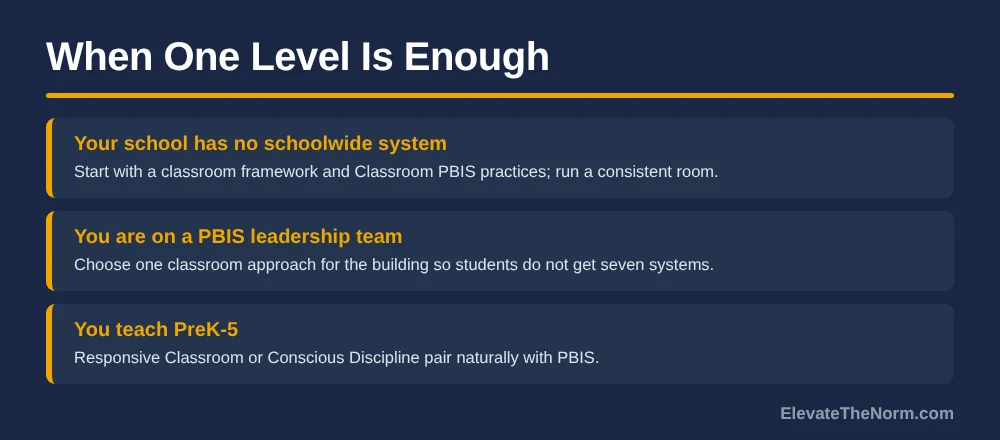
    A classroom culture framework alone makes sense when a school has no schoolwide system; PBIS alone is rarely enough at the classroom level, because the schoolwide layer doesn’t tell a teacher what to do minute to minute.

    • Your school has no schoolwide system: start with a classroom framework and Classroom PBIS practices. You can’t build Tier 2 by yourself, but you can run a consistent room.
    • You’re on a PBIS leadership team: choose or recommend one classroom approach for the building so students don’t get seven different systems.
    • You teach PreK–5: Responsive Classroom or Conscious Discipline pair naturally with PBIS. Compare them in Responsive Classroom vs PBIS vs Conscious Discipline.

    Clay’s take: As a grades 6–12 classroom teacher, Clay lands where this page does. If your school runs PBIS, don’t fight it: use its expectations and run your classroom approach inside it. If your school has no system, don’t wait on a committee to run a consistent room.

    Three situations and what to do: no schoolwide system, on a PBIS leadership team, or teaching PreK-5.
    When a single level makes sense on its own.

    Where does Elevate the Norm fit next to PBIS?

    Elevate the Norm is a free grades 6–12 classroom framework, so it sits on the classroom side, not the schoolwide side, and can run inside a school’s PBIS system. Disclosure: it’s this site’s own framework, built by Clay Shumate, a certified 6–12 social studies teacher, and it hasn’t been independently evaluated. Its three recognition tiers (immediate recognition, Student of the Week, Student of the Month) can serve as a classroom acknowledgment system under PBIS, and its 3-2-1-Done point system handles transitions. It has the same classroom-level limits listed above: no tiers, no data team. Materials are free on the resource library. For how it stacks up against other frameworks, see Elevate the Norm vs other frameworks; for the reasoning behind its design, see what makes Elevate the Norm different.

    Frequently Asked Questions

    Is PBIS a classroom management program?

    No. PBIS is a schoolwide framework with three tiers of support, run by a leadership team that uses data. Classroom PBIS applies its practices inside one room, but most teachers still need a classroom-level approach for daily routines like opening class, teaching procedures, transitions, praise and redirection.

    Can I use a classroom framework if my school uses PBIS?

    Yes. Many districts pair PBIS with a classroom approach such as Responsive Classroom, using PBIS for schoolwide systems and data and the classroom approach for daily practice. Use the schoolwide expectations as your classroom expectations, and decide how your own recognition connects to the school’s acknowledgment system so students hear one message.

    What is the biggest downside of PBIS?

    PBIS needs sustained effort from a functioning team, including data, coaching and staff buy-in, and one disengaged team can stall it. Many schools also run PBIS as a ticket or points economy, which critics say leans too heavily on outside rewards, even though the Center on PBIS doesn’t require tokens and advises against clip charts.

    What is the biggest downside of classroom-only frameworks?

    A classroom-only framework gives students who need more help no schoolwide safety net, because it has no Tier 2 or Tier 3 support and no data team. Results also depend on each teacher using the framework faithfully every day, and a strong teacher’s system can disappear when that teacher leaves the building.

    Is PBIS free?

    The PBIS framework and the Center on PBIS materials are free. The real costs are staff time, training, coaching and whatever a school spends on acknowledgments. PBIS is an ongoing, multi-year commitment rather than a one-day training, so the biggest cost is the time a leadership team spends meeting and reviewing data.

    Does PBIS work in middle and high school?

    The strongest PBIS randomized trial was run in 37 elementary schools, and we didn’t find a high school randomized trial. For high schools, the Center on PBIS reports that faithful implementation is associated with fewer referrals, tardies and suspensions and better attendance. That’s encouraging, but it’s an association, not the proof the elementary trial gives.

    How long does it take to start PBIS or a classroom culture framework?

    A classroom culture framework can start in days to weeks, because one teacher can launch it without a committee. PBIS is an ongoing, multi-year commitment that needs a leadership team, shared expectations, data and coaching before it runs well. That’s why many teachers run a consistent classroom routine while the school builds its system.

    Does running both mean students face two sets of rules?

    It shouldn’t. When a classroom framework runs inside PBIS, the classroom uses the same three to five schoolwide expectations and simply defines what they look like in that room. Students hear one set of rules in every hallway and class, and classroom consequences stay inside the school’s discipline matrix, with serious discipline handled by administration.

    Sources

    How is this page kept accurate?

    Prices come from publisher or retailer listings, and study figures come from the original papers or official summaries linked inline and listed under Sources. Elevate the Norm is labeled as this site’s own framework wherever it appears. Corrections follow the editorial standards and corrections policy.


    About Clay Shumate

    Clay Shumate is a certified secondary Social Studies teacher in the public schools of West Alabama, with seven years of classroom experience, a B.A. in History, and an M.Ed. in Secondary Education. He writes about project-based learning, student responsibility, respect, and practical ways to hold young people to a higher standard while giving them room to learn from mistakes. He is a member of the Society of Professional Journalists and writes to its Code of Ethics; this site’s editorial standards and corrections policy are published in full. More about Clay.

  • Customizable Classroom Culture Frameworks: Where to Find Them

    Customizable Classroom Culture Frameworks: Where to Find Them

    By Clay Shumate

    Customizable classroom culture frameworks are easiest to find at the Center on PBIS, which posts a free Word plan template you fill in for your own room. Responsive Classroom books ($35) and the CHAMPS book ($55) give you structures to adapt, Teachers Pay Teachers covers posters and trackers, and Elevate the Norm’s grades 6–12 files are free and editable.

    Key Takeaways

    • The Center on PBIS posts a free Word plan template for classroom PBIS with a behavior matrix, lesson plans, prompts, and a plan for praise and corrections that each teacher fills in.
    • Responsive Classroom and CHAMPS are sold as books you adapt rather than fill-in templates: about $35 per Responsive Classroom book and $55 for CHAMPS.
    • Teachers Pay Teachers is best for ready-made posters, trackers and contracts, not for choosing a classroom culture framework; Google Apps and Microsoft files are usually editable, PDFs usually aren’t.
    • Customize a framework’s words, routines, acknowledgments, attention signal and format, but keep direct teaching of expectations, frequent praise, a correction plan and consistent follow-through.
    • A teacher can build a working customized classroom culture framework in one school week starting from the free PBIS template.

    A customizable classroom culture framework is a behavior and community system that gives teachers a proven structure but leaves the expectation wording, routines and rewards for the teacher to write. This page lists where to get frameworks you can actually change, what each one lets you change, and which parts you shouldn’t touch no matter which you pick. If you’re still choosing between the big programs, start with the classroom culture frameworks Q&A hub. If you’re ready to spend money, see our buyer’s guide with verified prices.

    Where can I find classroom culture frameworks with customizable options?

    Classroom culture frameworks with customizable options are available free from the Center on PBIS, as adaptable books from Responsive Classroom and CHAMPS, as teacher-made files on Teachers Pay Teachers, and through district or state PBIS teams. Start with the free federal materials, then add a book or a teacher-made kit only if you need more structure. Here are the main sources, from most flexible to least.

    SourceCostGradesHow editableBest for
    Classroom PBIS (Center on PBIS)Free downloadK–12Word template and blank matrixBuilding your own plan from a proven skeleton
    Responsive Classroom books$34.80–$35 per bookPreK–8 (most titles)Practices you adapt; not a fill-in templateDaily routines and teacher language
    CHAMPS (Safe & Civil Schools)$55 bookK–8 (secondary version is a separate book)Decision guide you work throughExpectations for every activity and transition
    Teachers Pay TeachersFree to a few dollars per fileAnyDepends on file formatReady-made posters, contracts and trackers
    District or state PBIS templatesUsually free to staffVariesVariesMatching what your building already uses
    Elevate the Norm (this site)Free, no email6–12Editable filesSecondary recognition and routines
    Teacher Emergency Toolkit (paid)Paid TPT bundles6–12Editable documentsBehavior documentation and parent contact

    Is there a free classroom culture framework I can customize?

    Classroom PBIS is a free classroom culture framework built to be filled in by the teacher. The Center on PBIS, developed under a U.S. Department of Education grant, posts its classroom materials as direct downloads. The most useful one for customizing is the Creating Effective Classroom Environments Plan Template, a Word document with sections for:

    • a classroom matrix that defines expected behaviors for each routine
    • lesson plans for teaching those behaviors
    • prompts and reminders for the behavior you want
    • plans for praise and for corrections

    The Classroom PBIS page also links a guide to creating a classroom teaching matrix, a de-escalation practice brief, and a piece explaining why clip charts aren’t a PBIS practice. The core research guide, Supporting and Responding to Students’ Social, Emotional, and Behavioral Needs, is now in its Version 2 edition.

    PBIS tells you what has to be in a plan. It doesn’t tell you what your expectations are called or what your acknowledgment looks like. That’s the part you write. Our Responsive Classroom vs PBIS comparison covers how Classroom PBIS fits with other programs.

    Which paid classroom culture frameworks give you room to adapt?

    Responsive Classroom and CHAMPS are the paid classroom culture frameworks with the most room to adapt, because both come as books you adapt, not scripts you read. Neither one hands you a fill-in-the-blank form the way PBIS does, but both are designed around teacher decisions.

    Responsive Classroom

    The Center for Responsive Schools sells its practices through books. The First Six Weeks of School is $35 and written for PreK–5. For middle school, The Responsive Advisory Meeting Book is $34.80. You adapt the routines, like the meeting structure and modeling steps, to your schedule. It also sells Quick Coaching Guides on 30 topics for teachers who want a structured self-review.

    CHAMPS

    CHAMPS (3rd edition) is $55 from Ancora Publishing. It walks you through decisions about expectations for each activity: conversation level, help, the activity itself, movement and participation. Randy Sprick has described it as flexible enough that teachers don’t have to change their personalities, and as the K–8 approach, with Discipline in the Secondary Classroom as its high school counterpart (Instructional Coaching Group interview).

    Are Teachers Pay Teachers classroom management kits worth using?

    Teachers Pay Teachers classroom management kits are useful for materials, not for the framework itself. TPT’s free classroom management category lists more than 70,000 results. There’s no filter labeled “editable,” so filter by format instead: Google Apps or Microsoft files are usually the ones you can change, while PDFs usually aren’t.

    Use TPT to save time on posters, sign-out sheets, behavior trackers and contracts once you’ve decided what your system is. Don’t use it to decide what your system is. A clip chart from one seller, a ticket system from another and a contract from a third don’t add up to a framework.

    Should I check my district’s PBIS template before building my own?

    Teachers in a school that runs PBIS should start from the schoolwide matrix, because the classroom plan should use the same expectation words as the hallway posters. Otherwise students hear two systems. Ask your PBIS coach or assistant principal for the schoolwide matrix and build your classroom version off it.

    Many states support schools through a PBIS network. In Alabama, for example, the state department of education partnered with the University of Alabama’s positive behavior supports office to expand PBIS training and support (University of Alabama News). The Center on PBIS describes coaching at the state, district and school levels (Center on PBIS, Coaching), so there may be someone local who will review your plan for free. More on that in frameworks with ongoing coaching.

    What parts of a classroom culture framework should you customize?

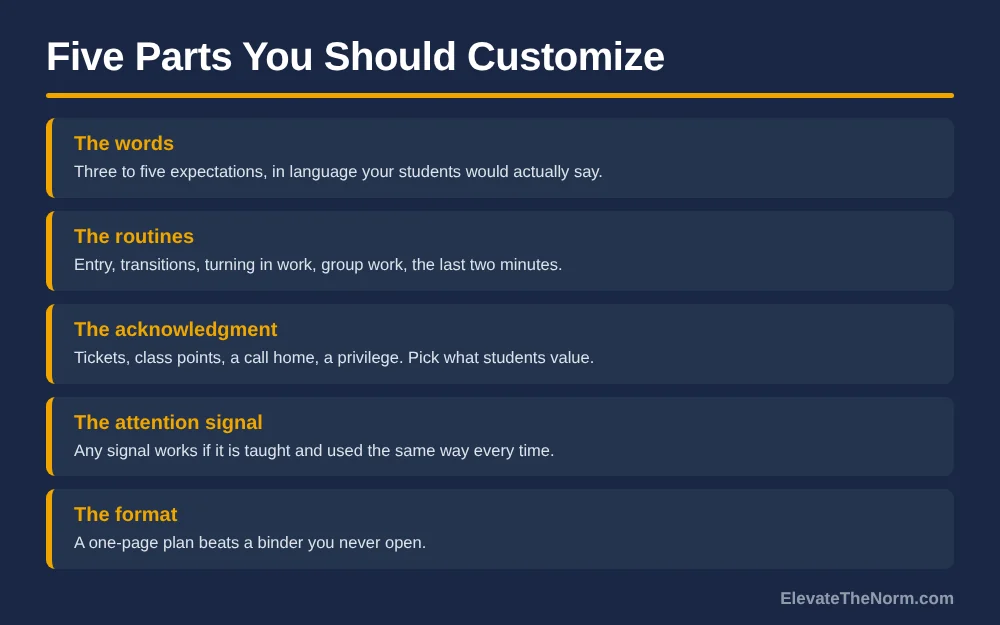
    The parts of a classroom culture framework to customize are the expectation language, the routines, the acknowledgments, the attention signal and the format, so they fit your students and your schedule. These parts are meant to change:

    • The words. Three to five expectations, in language your students would actually say. High schoolers will roll their eyes at elementary phrasing.
    • The routines. Entry, transitions, turning in work, group work, the last two minutes. Write them for your room. See classroom routines and procedures.
    • The acknowledgment. Tickets, class points, a call home, a privilege. Pick what your students value and what you can afford.
    • The attention signal. Any signal works if it’s taught and used the same way every time. Some options are in classroom attention getters.
    • The format. A one-page plan beats a binder you never open. A model is in what a classroom management plan looks like.
    Five parts of a classroom culture framework to customize: the words, the routines, the acknowledgment, the attention signal, and the format.
    The five parts of a classroom culture framework that are meant to change.

    What parts of a classroom culture framework should you not customize?

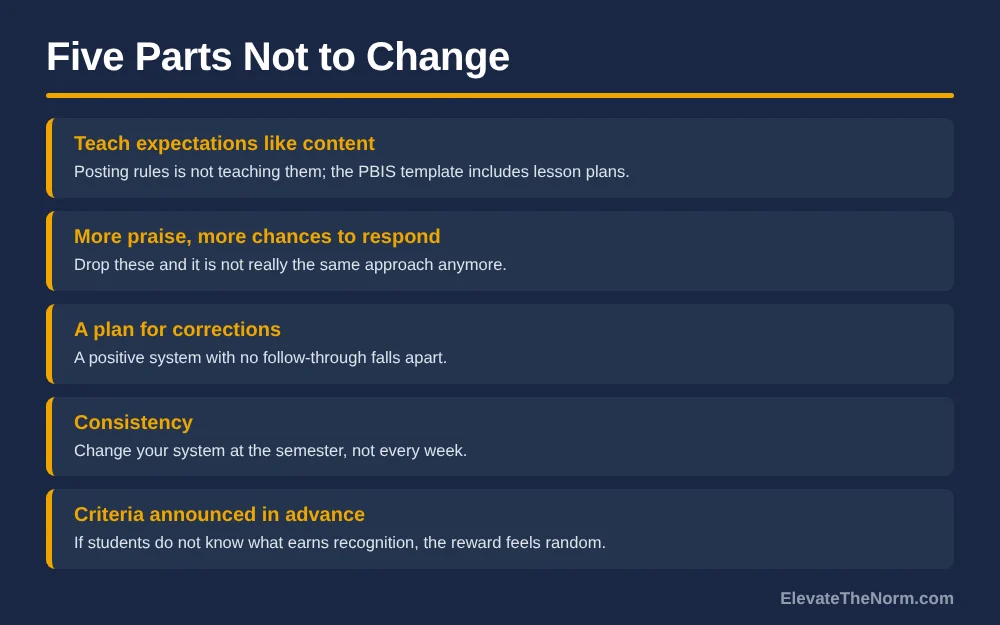
    Every classroom culture framework depends on teaching expectations directly, praising often, planning corrections and following through every time, so don’t cut those parts. They show up across all the programs above.

    • Teaching the expectations like content. The PBIS template includes lesson plans for a reason. Posting rules isn’t teaching them.
    • More praise and more chances to respond. In a randomized trial of 102 middle school teachers, CHAMPS teachers praised more and gave more opportunities to respond, and their students spent more time on task (IES, CHAMPS evaluation). If your version drops those, it isn’t really the same approach anymore.
    • A plan for corrections. The PBIS template pairs praise with corrections. A positive system with no follow-through falls apart. See classroom consequences.
    • Consistency. You can change your system at the semester, but not every week.
    • Criteria announced in advance. If students don’t know what earns recognition, the reward feels random.
    Five parts not to change: teaching expectations, more praise and chances to respond, a plan for corrections, consistency, criteria announced in advance.
    The parts that make a framework work, no matter which one you pick.

    Where does Elevate the Norm fit among customizable frameworks?

    Elevate the Norm is a free grades 6–12 classroom culture framework whose materials you can download and edit. Disclosure: it’s this site’s own framework, built by Clay Shumate, a certified 6–12 social studies teacher. It hasn’t been independently evaluated.

    • Customizable pieces: three recognition tiers (Immediate Recognition, Student of the Week, Student of the Month) where you set the criteria, and the prizes. Criteria are announced in advance and judged on consistency and self-improvement, not perfection. Prizes run well under a hundred dollars a year for one teacher.
    • Fixed pieces: follow-through. You do exactly what you say, positives can be removed after repeated warnings, and serious discipline goes to administration.
    • A transition system you can tune: the class-vs-class 3-2-1-Done points method, written up in classroom attention getters, including the note that student buy-in took about six weeks in its most recent year.

    All classroom files are on the free resource library with no email gate. The same teacher also sells a paid option, the Teacher Emergency Toolkit on TPT, with editable de-escalation scripts, behavior and MTSS documentation, and parent communication templates. You don’t need it to use the free framework.

    How do you build a custom classroom culture framework in one week?

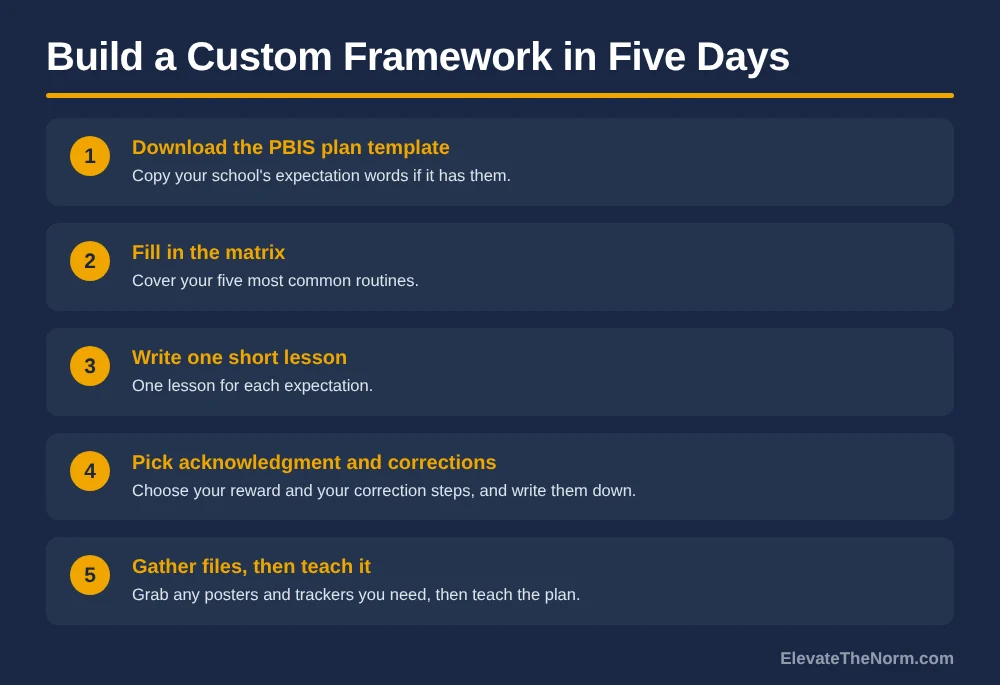
    A teacher can build a custom classroom culture framework in five school days by starting from the free PBIS plan template and adding one piece each day.

    1. Day 1: Download the PBIS plan template. Copy your school’s expectation words if it has them.
    2. Day 2: Fill in the matrix for your five most common routines.
    3. Day 3: Write one short lesson for each expectation.
    4. Day 4: Pick your acknowledgment and your correction steps, and write them down.
    5. Day 5: Grab any TPT or Elevate the Norm files you need for posters and trackers, then teach it.

    Then check one number every few weeks, like how many corrections you give in a period. Clear expectations are covered in classroom expectations for grades 6–12.

    Clay’s take, as a grades 6–12 classroom teacher: start with the free PBIS template and your school’s own expectation words, and only reach for a book or a TPT kit once you know what your system is. A short plan you actually follow beats a polished one you don’t.

    Five steps to build a custom framework in a week: download the PBIS template, fill in the matrix, write lessons, pick acknowledgment and corrections, teach it.
    A five-day plan for building your own classroom culture framework.

    Frequently Asked Questions

    What is the best free customizable classroom culture framework?

    Classroom PBIS from the Center on PBIS is the best free customizable classroom culture framework. Its Creating Effective Classroom Environments Plan Template is a Word document with a behavior matrix, lesson plans for teaching expectations, prompts and reminders, and a plan for praise and corrections. The teacher fills in every section, so the expectations and acknowledgments match that teacher’s own students and schedule.

    Can I customize Responsive Classroom or CHAMPS?

    Yes, both Responsive Classroom and CHAMPS can be customized, because each comes as a book that guides teacher decisions rather than a script. Responsive Classroom books cost about $35, and The First Six Weeks of School is written for PreK–5. The CHAMPS book is $55 from Ancora Publishing and walks a teacher through expectations for each classroom activity.

    Are Teachers Pay Teachers classroom management kits editable?

    Some Teachers Pay Teachers classroom management kits are editable and some are not. TPT has no filter labeled editable, so filter by format instead: Google Apps and Microsoft files are usually the ones a teacher can change, while PDFs usually are not. The free classroom management category alone lists more than 70,000 results, so the format filter saves real time.

    What parts of a classroom culture framework should stay the same?

    The parts of a classroom culture framework that should stay the same are direct teaching of expectations, frequent specific praise, plenty of chances for students to respond, a written plan for corrections, consistent follow-through and criteria announced in advance. In a randomized trial of 102 middle school teachers, CHAMPS teachers praised more and gave more chances to respond, and their students spent more time on task.

    Is there a free customizable classroom culture framework for high school?

    Yes. Classroom PBIS is free and works from kindergarten through grade 12, so a high school teacher can fill in its plan template for a secondary room. Elevate the Norm, this site’s own grades 6–12 approach, also offers free editable files with no email gate, though it has not been independently evaluated. CHAMPS points high school teachers to its separate secondary book.

    How long does it take to build a customized classroom culture framework?

    A teacher can build a working customized classroom culture framework in about one school week. Download the PBIS plan template, fill in the matrix for your five most common routines, write one short lesson per expectation, choose your acknowledgment and correction steps, then gather posters and trackers and teach it. After that, check one number, such as corrections per period, every few weeks.

    Should my classroom framework match my school’s PBIS system?

    Yes, a classroom framework should match the school’s PBIS system when the school runs one. Using the same expectation words as the hallway posters keeps students from hearing two different systems. Ask the PBIS coach or an assistant principal for the schoolwide matrix and build the classroom version from it. A local coach may also review the plan for free.

    Will students take a teacher-made framework seriously?

    Students take a teacher-made classroom framework seriously when the expectations use words they would actually say, the recognition criteria are announced in advance, and the teacher follows through every time. High schoolers tune out elementary phrasing and rewards that feel random. A short, plainly worded system that stays consistent through the semester earns more trust than a binder of rules that changes weekly.

    Sources

    How is this page kept accurate?

    Prices and product details come from each publisher’s own site, so confirm them before you buy. Elevate the Norm and the Teacher Emergency Toolkit are labeled as this site’s own work wherever they appear. Corrections follow the editorial standards and corrections policy.

    About Clay Shumate

    Clay Shumate is a certified secondary Social Studies teacher in the public schools of West Alabama, with seven years of classroom experience, a B.A. in History, and an M.Ed. in Secondary Education. He writes about project-based learning, student responsibility, respect, and practical ways to hold young people to a higher standard while giving them room to learn from mistakes. He is a member of the Society of Professional Journalists and writes to its Code of Ethics; this site’s editorial standards and corrections policy are published in full. More about Clay.

  • Best Classroom Culture Frameworks for a Positive Classroom Environment

    Best Classroom Culture Frameworks for a Positive Classroom Environment

    By Clay Shumate

    The best classroom culture frameworks for a positive classroom environment are Classroom PBIS and CHAMPS for predictable routines and more praise than correction, Responsive Classroom and Developmental Designs for belonging, and restorative practices for repairing relationships. No single framework covers all four ingredients, so most teachers do best pairing one structure framework with one community routine.

    Key Takeaways

    • A positive classroom environment has four measurable ingredients: strong teacher-student relationships, more specific praise than correction, predictable routines, and students feeling they belong.
    • In a BYU study of 28 middle school classrooms, class-wide on-task behavior rose 60–70% once teachers praised at least as often as they reprimanded.
    • CHAMPS and Classroom PBIS make a classroom predictable by spelling out expectations for each activity and teaching them like content.
    • Responsive Classroom and Developmental Designs build belonging through a regular advisory-style meeting where students greet each other and share.
    • Restorative practices improved staff-student relationships in RAND’s Pittsburgh study, but grades 6–8 saw no drop in suspensions, so restorative work fits best beside a framework that handles routines and praise.

    A positive classroom environment is a room where students trust the teacher, hear more praise than correction, know what to do in each activity, and feel they belong. “Positive” gets used loosely, so this page defines it first and then matches frameworks to each piece. This page is a companion to two narrower guides: the best framework for student engagement and top-rated frameworks for middle school. The full list lives in the classroom culture frameworks Q&A hub.

    What makes a classroom environment positive, in measurable terms?

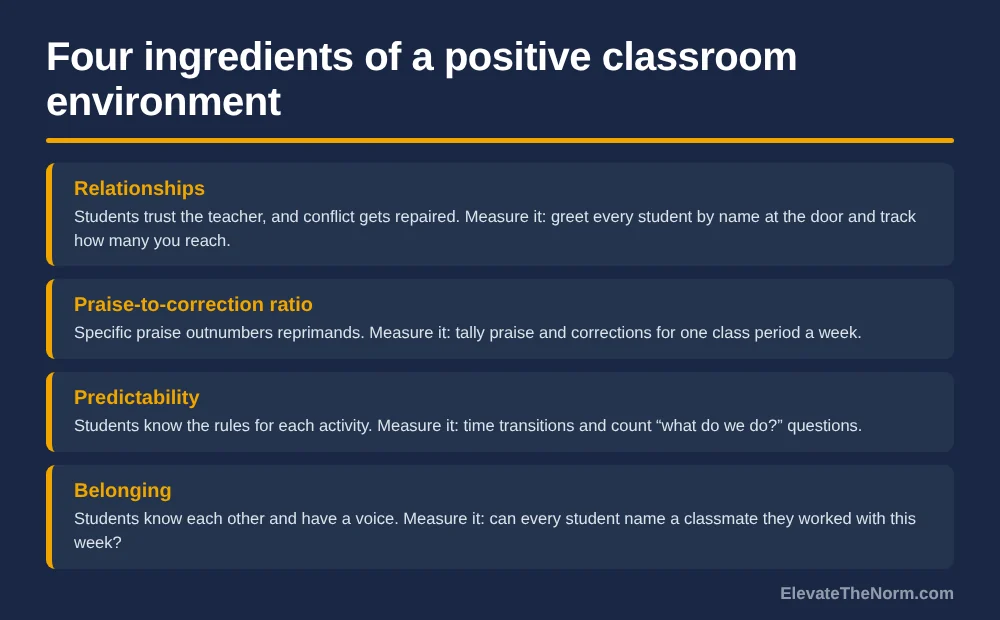
    A positive classroom environment has four ingredients you can count or observe: relationships, the praise-to-correction ratio, predictability and belonging. The Center on PBIS describes the goal as classrooms that are “predictable, positive, effective, and equitable,” where students feel a sense of belonging (Center on PBIS, Classroom PBIS). Broken into pieces a teacher can check:

    IngredientWhat it looks likeA simple way to measure it
    RelationshipsStudents trust the teacher; conflict gets repairedGreet every student by name at the door; track how many you reach
    Praise-to-correction ratioSpecific praise outnumbers reprimandsTally praise and corrections for one class period a week
    PredictabilityStudents know the rules for each activityTime how long transitions take; count “what do we do?” questions
    BelongingStudents know each other and have a voiceCan every student name a classmate they’ve worked with this week?

    The measurement ideas are ours, not from any one framework. They’re meant to be quick enough to do during a real school day.

    Graphic listing the four ingredients of a positive classroom environment — relationships, praise-to-correction ratio, predictability and belonging — each with a simple way to measure it.
    The four ingredients of a positive classroom environment and a quick way to measure each one.

    Which frameworks build teacher-student relationships best?

    Restorative practices and short relationship routines such as Establish-Maintain-Restore and positive greetings at the door build teacher-student relationships most directly.

    • Establish-Maintain-Restore: a three-hour training on building, keeping and repairing relationships. In a randomized trial with 20 middle school teachers and 190 students, relationship quality, engaged time and disruptive behavior all improved significantly (Duong et al., School Psychology Quarterly, 2018). The sample was small, so read the effect sizes cautiously.
    • Positive greetings at the door: middle school teachers randomly assigned to greet students at the door saw more engaged time and less disruption, and rated the strategy feasible (Cook et al., 2018).
    • Restorative practices: in RAND’s Pittsburgh study, 63% of surveyed staff said their relationships with students improved, and suspension days fell 36% in program schools versus 18% elsewhere. Results in grades 6–8 were weaker, with no change in suspensions and lower academic results (EdSource on the RAND study).

    More on this in building relationships with students and restorative practices in schools.

    What praise-to-correction ratio makes a classroom feel positive?

    A positive classroom needs at least one specific praise for every correction, and researchers suggest 2:1 or higher. The praise-to-correction ratio is the easiest of the four ingredients to measure.

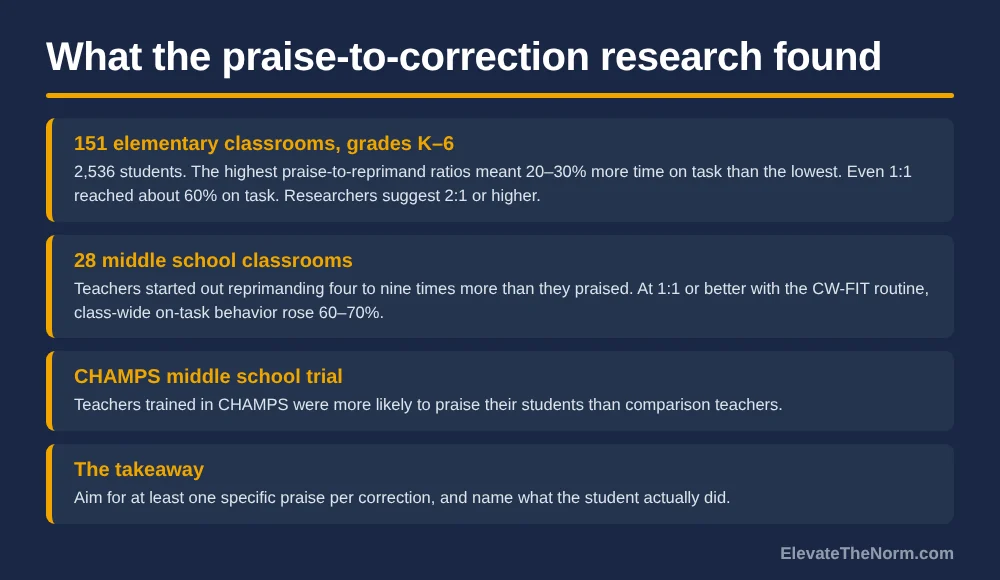
    • In 151 elementary classrooms (grades K–6, 2,536 students), students in classes with the highest praise-to-reprimand ratios stayed on task 20–30% longer than those with the lowest. Even 1:1 reached about 60% on-task, and the researchers suggest 2:1 or higher (Caldarella et al., Educational Psychology, 2020).
    • In 28 middle school classrooms, teachers began reprimanding four to nine times more than they praised. After reaching at least 1:1 with the CW-FIT routine, class-wide on-task behavior rose 60–70% (BYU, Journal of Positive Behavior Interventions).

    The frameworks that build this in most directly are CHAMPS, where the “S” stands for Success and recognizing good behavior (LiveSchool), and PBIS, which includes acknowledgment systems. In the CHAMPS middle school trial, trained teachers praised students more often than controls (IES). Praise works best when it names what the student did. See motivating students for examples that don’t sound canned to teenagers.

    Graphic summarizing praise-to-correction research: 151 elementary classrooms, 28 middle school classrooms using CW-FIT, and the CHAMPS middle school trial, with the takeaway to aim for at least one specific praise per correction.
    What the praise-to-correction research found, from elementary and middle school classrooms.

    Which frameworks make a classroom predictable?

    CHAMPS and Classroom PBIS make a classroom most predictable, because both frameworks make expectations explicit and teach them like content.

    CHAMPS spells out, for each activity, whether students can talk, how they get help, what the task is, whether they can move, what participation looks like and how success is recognized. PBIS uses a classroom teaching matrix that lists expectations by routine, and the Center on PBIS publishes planning tools for it for free (Center on PBIS). Responsive Classroom’s middle school advisory also makes predictability a goal: the first week of Responsive Advisory Meeting focuses on predictability, safety and belonging (RAM grades 6–8, first ten days).

    A predictable room isn’t a rigid one. A predictable room is one where students don’t have to guess. Our guides on routines and procedures and classroom expectations show how to set this up in grades 6–12.

    Which frameworks build a sense of belonging in the classroom?

    Responsive Classroom and Developmental Designs build belonging best, because both frameworks run a regular meeting where students greet each other and share.

    • Responsive Classroom: Responsive Advisory Meeting follows arrival, announcements, acknowledgments and an activity, with partner sharing built in every day (Responsive Classroom). Its broader secondary practices include Investing Students in the Rules, which gives students a hand in setting norms (Responsive Classroom secondary practices).
    • Developmental Designs: from the Origins Program, built around the Circle of Power and Respect, an advisory format with a greeting and an activity, and skills like cooperation, empathy and assertion (MiddleWeb).
    • Restorative circles also give students voice, though their main job is repair.

    Responsive Classroom’s randomized trial was in grades 2–5 and found gains only where teachers used it faithfully (AERA). We didn’t find a randomized trial of Developmental Designs.

    How do the frameworks compare across all four ingredients?

    No single classroom culture framework covers relationships, praise, predictability and belonging equally, which is why combining two frameworks usually works best.

    FrameworkRelationshipsPraise ratioPredictabilityBelongingLevel
    Classroom / schoolwide PBISModerateStrong (acknowledgment)Strong (teaching matrix)ModerateSchool or classroom
    CHAMPSModerateStrong (more praise in trial)Strong (per-activity rules)LightClassroom
    Responsive ClassroomStrongModerate (teacher language)ModerateStrong (advisory meeting)Classroom
    Developmental DesignsStrongNot a focusModerateStrong (Circle of Power and Respect)Advisory
    Restorative practicesStrong (repair)Not a focusLightModerate (circles)Schoolwide
    Elevate the Norm (this site’s own)ModerateStrong (recognition tiers)Moderate (3-2-1-Done)LightClassroom, grades 6–12

    The ratings are our editorial judgment based on each framework’s published components, not scores from a study. Some good pairings:

    • CHAMPS + Responsive Advisory Meeting: structure plus community, a natural fit for middle school.
    • PBIS + restorative practices: a schoolwide system plus a way to repair harm.
    • Any framework + greetings at the door + a praise tally: cheap, and both have middle school evidence.

    Clay’s take, as a grades 6–12 classroom teacher: start with the praise tally. It’s the cheapest ingredient to measure, it has middle school evidence behind it, and the same tally shows you whether the room is actually changing.

    How can a teacher start building a positive environment this week?

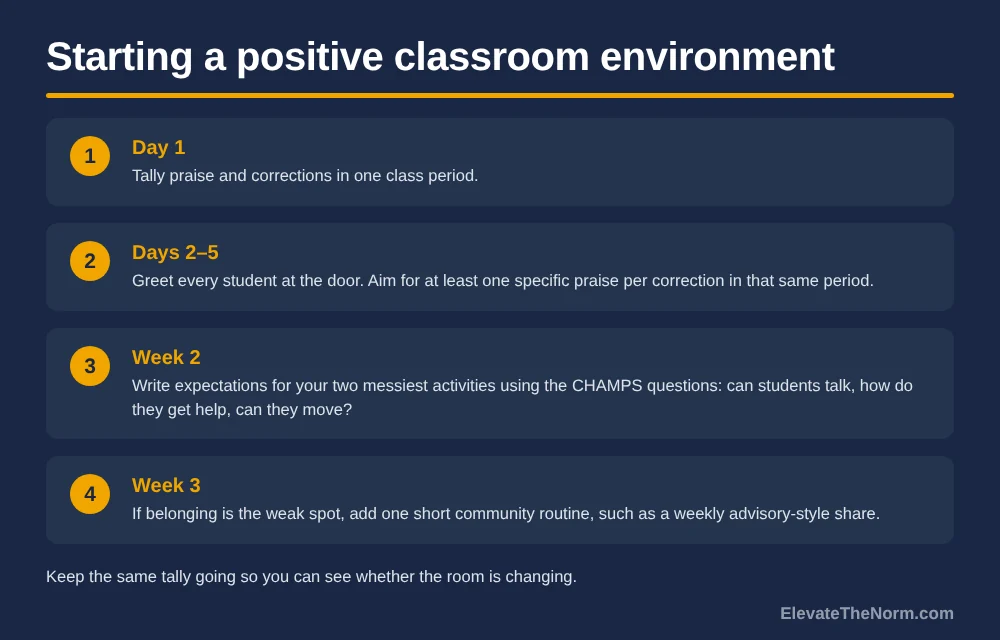
    A teacher can start building a positive classroom environment by picking one ingredient, measuring it for a week, then adding a framework that targets it. No schoolwide adoption is needed to begin.

    1. Day 1: tally praise and corrections in one class period. For reference, the middle school teachers in the CW-FIT study started at four to nine reprimands per praise.
    2. Days 2–5: greet every student at the door and aim for at least one specific praise per correction in that same period.
    3. Week 2: write down expectations for your two messiest activities, using the CHAMPS questions: can students talk, how do they get help, can they move?
    4. Week 3: add one short community routine, such as a weekly advisory-style share, if belonging is the weak spot.

    Keep the same tally going so you can see whether the room is actually changing. New teachers can find a fuller starting plan in what a classroom management plan looks like.

    Four-step graphic: day 1 tally praise and corrections, days 2 to 5 greet students and aim for one praise per correction, week 2 write CHAMPS-style expectations, week 3 add a community routine.
    A three-week starting plan for a positive classroom environment.

    Where does Elevate the Norm fit in a positive classroom environment?

    Elevate the Norm is strongest on the praise ingredient and is built for grades 6–12. Disclosure: Elevate the Norm is this site’s own framework, created by Clay Shumate, a certified 6–12 social studies teacher, and it hasn’t been independently evaluated.

    • Praise with clear criteria: three recognition tiers (Immediate Recognition, Student of the Week, Student of the Month) announced in advance and judged on consistency and self-improvement, not perfection.
    • Predictable transitions: the 3-2-1-Done class-vs-class point system, where each class starts the week at zero and earns points for getting quiet quickly.
    • Respect both ways: student communication is channeled constructively rather than suppressed, and the teacher follows through on exactly what was announced. More on the thinking behind it on what we believe.

    Elevate the Norm is lighter on belonging routines, so pairing it with an advisory meeting or circles makes sense. Free materials, no email gate: resource library.

    Frequently Asked Questions

    What is a positive classroom environment?

    A positive classroom environment is a room where teacher-student relationships are strong, specific praise outnumbers correction, routines are predictable, and students feel they belong. The Center on PBIS describes the goal as classrooms that are predictable, positive, effective and equitable. Each of those four ingredients can be checked during an ordinary school day, for example by tallying praise and corrections for one class period.

    Which framework is best for a positive classroom environment?

    No single classroom culture framework covers everything. Classroom PBIS and CHAMPS are strongest for predictability and praise, Responsive Classroom and Developmental Designs are strongest for belonging, and restorative practices are strongest for repairing relationships after conflict. Most teachers get the best result pairing one structure-focused framework with one community routine, such as CHAMPS with an advisory meeting.

    What is a good praise-to-correction ratio in the classroom?

    A good praise-to-correction ratio is at least one specific praise for every correction, and researchers suggest 2:1 or higher. In 151 elementary classrooms, the highest ratios meant 20–30% more time on task than the lowest. In 28 middle school classrooms, reaching at least 1:1 raised class-wide on-task behavior 60–70%.

    How can I measure whether my classroom is positive?

    A teacher can measure a positive classroom with four quick checks. Tally praise and corrections for one class period a week. Time transitions and count how often students ask what to do. Track how many students you greet by name at the door. Then check whether every student can name a classmate they worked with that week.

    Do restorative practices create a positive classroom environment?

    Restorative practices help most with relationships. In RAND’s Pittsburgh study, 63% of surveyed staff said their relationships with students improved, and suspension days fell 36% in program schools versus 18% elsewhere. Results in grades 6–8 were weaker, with no change in suspensions, so restorative work fits best beside a framework that handles routines and praise.

    Can one teacher build a positive classroom environment without a schoolwide framework?

    Yes. Several of the best-supported moves work in a single classroom. Positive greetings at the door and the Establish-Maintain-Restore relationship training were both tested with individual middle school teachers, CHAMPS is a classroom-level system, and the Center on PBIS publishes free Classroom PBIS planning tools. A praise tally costs nothing and shows within a week whether the room is changing.

    Do these classroom culture frameworks work in high school?

    The evidence for these classroom culture frameworks comes mostly from younger grades. The CHAMPS trial, the greetings-at-the-door study and the Establish-Maintain-Restore trial ran in middle schools, and Responsive Classroom’s randomized trial ran in grades 2–5. The classroom-level studies cited on this page did not test high school classrooms, so high school teachers should treat the results as promising rather than proven.

    Will teenagers think classroom praise is babyish?

    The praise studies cited on this page measured how often teachers praised, not how teenagers felt about it. This site’s advice for older students is to make praise specific: name exactly what the student did, such as using a strong source or making a quick transition, instead of a vague “good job.” In 28 middle school classrooms, praising at least as often as correcting was linked to 60–70% more on-task behavior.

    Sources

    How is this page kept accurate?

    Study figures on this page come from the original papers or official summaries linked inline and listed under Sources, and the comparison ratings are labeled as editorial judgment. Elevate the Norm is identified as this site’s own framework wherever it appears. Corrections follow the editorial standards and corrections policy.
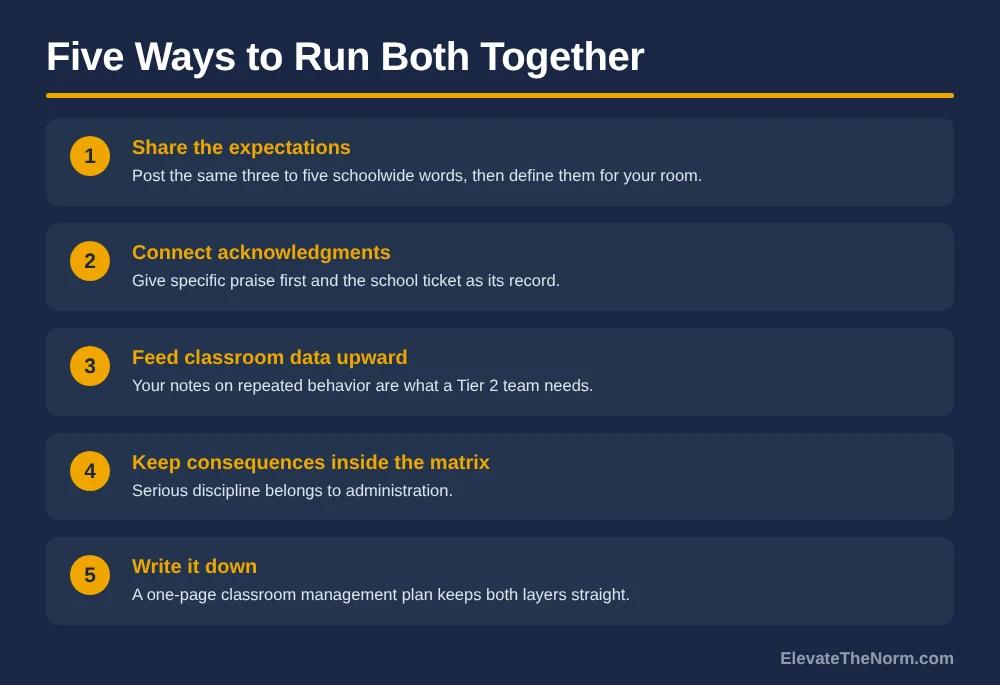

    About Clay Shumate

    Clay Shumate is a certified secondary Social Studies teacher in the public schools of West Alabama, with seven years of classroom experience, a B.A. in History, and an M.Ed. in Secondary Education. He writes about project-based learning, student responsibility, respect, and practical ways to hold young people to a higher standard while giving them room to learn from mistakes. He is a member of the Society of Professional Journalists and writes to its Code of Ethics; this site’s editorial standards and corrections policy are published in full. More about Clay.

Teacher Emergency Toolkit — practical resources, real classroom support. Shop on TPT.Teacher Emergency Toolkit — practical resources, real classroom support. Shop on TPT.