By Clay Shumate · Prices checked October 2026
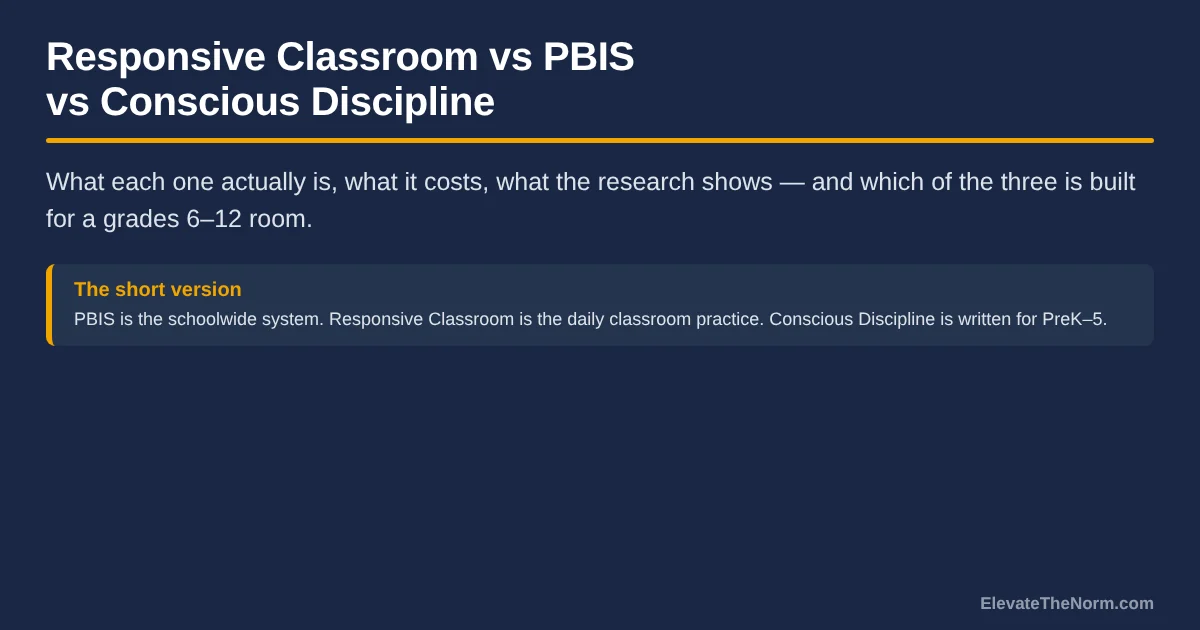
Short answer: PBIS is a free, schoolwide system for teaching and acknowledging behavior. Responsive Classroom is a paid set of daily classroom practices, like Morning Meeting and Interactive Modeling, that builds community. Conscious Discipline is a paid program that starts with adult self-regulation, and it is written for PreK through grade 5. For grades 6–12, PBIS is the only one of the three with a real secondary track, and Responsive Classroom is the only one with randomized-trial evidence on achievement (in grades 2–5, with gains only when teachers used it faithfully). Many schools run PBIS as the system and a classroom-level approach inside it.
This page compares the three on what they do, what they cost, what the research shows, and how well each fits a middle or high school room. Every figure links to its source. For the broader list of frameworks, see the classroom culture frameworks Q&A hub.
Responsive Classroom vs PBIS vs Conscious Discipline at a glance
| Responsive Classroom | PBIS | Conscious Discipline | |
|---|---|---|---|
| Run by | Center for Responsive Schools (nonprofit) | Center on PBIS (federally funded) | Loving Guidance / Dr. Becky Bailey |
| What it is | Daily classroom practices and teacher language | Schoolwide, three-tier system with data | Adult self-regulation plus a “School Family” culture |
| Grades | PreK–8 (middle school course since 2016) | K–12, with a dedicated high school track | Early childhood through grade 5 |
| Core pieces | Morning Meeting / Responsive Advisory Meeting, Interactive Modeling, Teacher Language, Logical Consequences, Academic Choice | Defined and taught expectations, acknowledgment system, tiered supports, data-based decisions | Brain State Model, Seven Powers for Adults, Seven Skills of Discipline, School Family |
| How it motivates | Reinforcing teacher language; avoids token rewards | Acknowledgment, often tickets, points or privileges | Connection and regulation before consequences |
| Cost to start | Books $29–$35; one-day virtual workshop $219–$259 per seat | Free framework; costs are staff time and training | Core book $44; onsite training by quote |
| Best evidence | Randomized trial, 24 schools, grades 2–5 | Randomized trials, 37 elementary schools | Quasi-experimental, Pre-K |
| Fit for grades 6–12 | Moderate (middle school yes, high school limited) | Strong | Weak (not written for secondary) |
What is the difference between Responsive Classroom and PBIS?
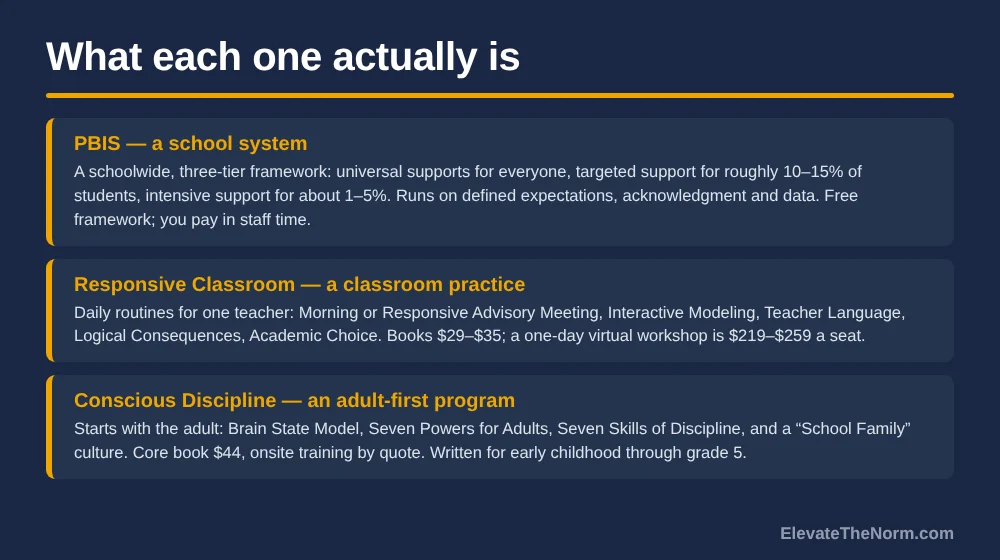
PBIS is a school system. Responsive Classroom is a classroom practice. PBIS tells a school how to organize behavior support across three tiers: universal supports for everyone, targeted support for roughly 10–15% of students, and intensive support for about 1–5% (Center on PBIS). It runs on defined expectations, acknowledgment and data.
Responsive Classroom gives one teacher a set of daily routines: a morning (or advisory) meeting, modeling a routine before expecting it, and specific language for redirecting and reinforcing. The Center for Responsive Schools describes the split this way: PBIS supplies the schoolwide systems and data, and Responsive Classroom supplies the daily practices that help students internalize the behavior (Responsive Classroom, Sept. 2025).
The real disagreement is about rewards. PBIS schools often use token systems, like tickets, points or prizes. Responsive Classroom steers teachers away from those and toward reinforcing language that names what a student did and why it helped the group.
Can a school use Responsive Classroom and PBIS together?
Yes, and it’s common. PBIS is a framework, not a curriculum, so it doesn’t compete with a classroom approach. Responsive Classroom says it’s compatible with PBIS. The friction point is the acknowledgment system. If your PBIS team runs a schoolwide ticket economy and your classroom uses Responsive Classroom language, decide ahead of time which one a student hears first. Usually it’s specific praise first, with the token given as the record of it.
What is Classroom PBIS?
Classroom PBIS is the PBIS framework applied inside one teacher’s room. The Center on PBIS describes it as evidence-based practices that make classrooms “predictable, positive, effective, and equitable,” with differentiated support across the same three tiers (Center on PBIS, Classroom PBIS). Its free materials include a classroom teaching matrix, a guide to the evidence-based practices behind it, and guides for supporting teachers who are implementing it.
If your school doesn’t run PBIS, you can still use Classroom PBIS on your own. In practice that means posting three to five expectations, teaching them like content, acknowledging them often, and correcting calmly and briefly.
Conscious Discipline vs Responsive Classroom: which should a school buy?
Buy for your grade band first. Conscious Discipline lists its market as early childhood and PreK–5 schools (Conscious Discipline, About). Its distinctive idea is that discipline starts with the adult’s own regulation, built through the Brain State Model and the Seven Powers for Adults. That makes it a strong fit for early grades and for staff working with students who have experienced trauma.
Responsive Classroom covers PreK–8. It added a middle school course in 2016 built around Responsive Advisory Meeting, Interactive Modeling and teacher language (THE Journal). It also has the stronger research base.
- PreK–2, or a staff struggling with its own stress responses: Conscious Discipline.
- K–8, with a goal of community plus academics: Responsive Classroom.
- Grades 9–12: neither is a natural fit. Look at PBIS, restorative practices, or a secondary-built approach.
What does the research actually show for each one?
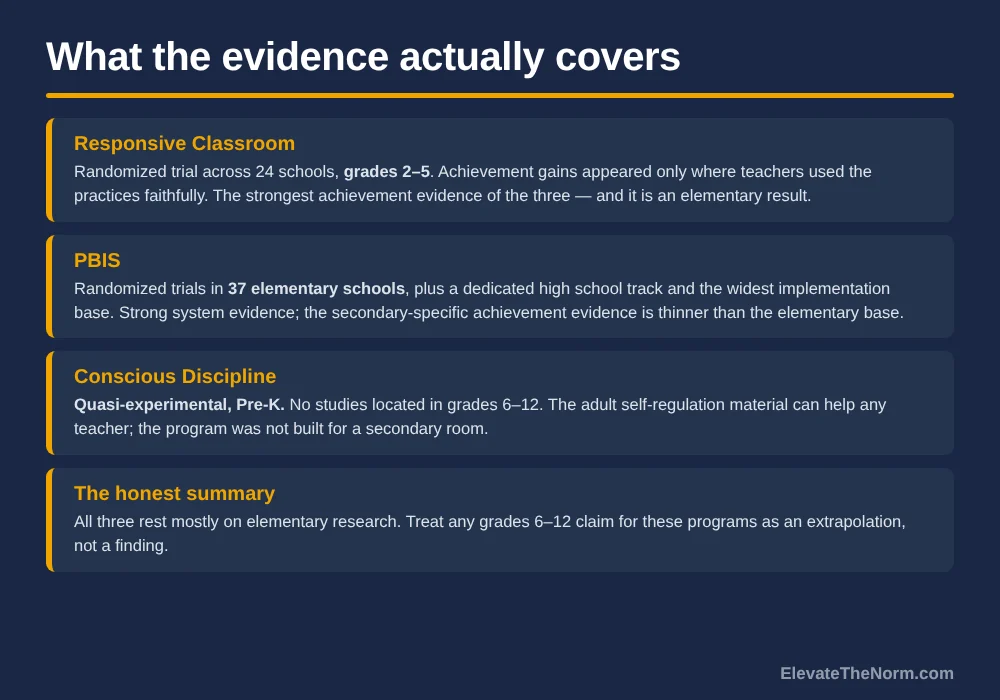
All three have some evidence. None has strong evidence for high school. Here is what the largest studies found, in plain terms.
Responsive Classroom
A three-year randomized controlled trial covered 24 schools and 2,904 students from the end of grade 2 through grade 5. Students in Responsive Classroom schools did not outperform control schools in math or reading. But within those schools, teachers who used the practices faithfully saw gains: effect sizes of 0.26 in math and 0.30 in reading, and 0.89 in math for students who started low (Rimm-Kaufman et al., American Educational Research Journal, 2014). The lesson is that buying it does nothing; doing it does. Evidence for ESSA rates its reading impact “Promising” for grades 1–5 (Evidence for ESSA).
PBIS
In a randomized trial of 37 elementary schools and 12,344 children, students in schoolwide PBIS schools were 33% less likely to receive an office discipline referral. They also showed small improvements in disruptive behavior (effect size 0.12), concentration (0.08), prosocial behavior (0.17) and emotion regulation (0.11). That analysis found no significant difference in suspensions (Bradshaw, Waasdorp & Leaf, Pediatrics, 2012). CrimeSolutions rates schoolwide PBIS “Effective” for ages 5–11 (CrimeSolutions). High school PBIS is supported by implementation guidance, but we did not find a high school randomized trial.
Conscious Discipline
The main published evaluation is quasi-experimental, a 2012–13 study of 1,386 Pre-K students that reported positive gains (CASEL program profile). We found no randomized trial and no study in grades 6–12.
Evidence by grade band
This is the comparison most reviews skip: where the strongest study for each program was actually run.
| Program | Grades in strongest study | Randomized trial? | Any randomized evidence in grades 6–12? |
|---|---|---|---|
| Responsive Classroom | 2–5 | Yes | No |
| PBIS (schoolwide) | Elementary | Yes | None found at high school |
| Conscious Discipline | Pre-K | No | No |
| CHAMPS (for comparison) | 6–8 | Yes (102 teachers, 1,450 students) | Yes, middle school |
| Restorative practices (for comparison) | K–12 | Yes (RAND, Pittsburgh) | Yes, mixed: fewer suspensions, but grades 6–8 academics worsened |
Sources: IES, CHAMPS evaluation; RAND, Augustine et al., 2018. More on restorative work in restorative practices in schools.
Which one works best for middle and high school?
For grades 6–12, start with PBIS as the system and add a classroom layer built for teenagers. PBIS is the only one of the three with a dedicated high school track, covering student voice and the freshman transition (Center on PBIS, High School). Responsive Classroom works in middle school through Responsive Advisory Meeting. Conscious Discipline wasn’t written for secondary.
Secondary classrooms have needs elementary frameworks don’t plan for. A teacher may see 150 students a day instead of 25, there’s no single homeroom where community gets built, and older students notice right away if praise is generic or a reward feels babyish. The approaches with middle school trial evidence, like CHAMPS, put a lot of weight on clear expectations, more specific praise, and more chances for students to respond. You can read how that plays out in a real secondary room in classroom management strategies that work in grades 6–12.
What does each one cost?
PBIS is free to adopt. Responsive Classroom costs about $30–$35 per book and $219–$259 per seat for a one-day virtual workshop. Conscious Discipline’s core book is $44, and onsite training is quoted.
- PBIS: the framework, practice briefs and the Tiered Fidelity Inventory are free from the Center on PBIS. Real costs are team meeting time, coaching through your state network, and whatever your acknowledgment system buys.
- Responsive Classroom: The First Six Weeks of School (3rd ed.) $35.00; The Power of Our Words (2nd ed.) $34.80; Interactive Modeling $31.20 (CRS bookstore). A live-virtual one-day workshop was listed at $259 a seat for 1–4 seats, $239 for 5–9 and $219 for 10 or more (CRS). Multi-day institutes cost more.
- Conscious Discipline: Building Resilient Classrooms is $44 (Conscious Discipline store). Onsite trainings for up to 150 people are priced by quote (onsite training sheet).
Prices change. Confirm on the publisher’s site before you put anything in a budget request.
Token rewards or teacher language: which motivates students better?
Specific praise does the heavy lifting. Rewards help when they’re predictable and earned, and they can backfire when they’re a surprise. Three findings matter here.
- More praise than reprimands helps, with no magic ratio. In 151 elementary classrooms, on-task behavior rose steadily as the praise-to-reprimand ratio rose, with no threshold. Even reaching 1:1 helped (Caldarella et al., Educational Psychology, 2020).
- It holds in middle school. In 28 middle school classrooms, teachers started out reprimanding four to nine times more than they praised. After they shifted to at least 1:1, class-wide on-task behavior improved 60–70%, and high-risk students’ grades rose a full letter grade (BYU, Journal of Positive Behavior Interventions).
- Surprise awards can backfire. In a study of 15,329 students in grades 6–12, students given a surprise award for past perfect attendance were absent 8.3% more the following month (Robinson, Gallus, Lee & Rogers, Organizational Behavior and Human Decision Processes, 2019). The researchers think the award signaled that perfect attendance wasn’t the norm.
The takeaway for any of these frameworks: make the criteria public ahead of time, reward effort and consistency rather than rare perfection, and pair every token with specific words.
Where does Elevate the Norm fit?
Elevate the Norm is a free, grades 6–12 classroom approach. It works as the classroom layer inside a school’s PBIS, or on its own where a school has no system. Full disclosure: it’s this site’s own framework, built by Clay Shumate, a certified 6–12 social studies teacher. It has not been independently evaluated, and every research claim on this site is cited so you can check it.
- Three recognition tiers: immediate recognition, Student of the Week and Student of the Month. Criteria are announced in advance and based on consistency and self-improvement, not perfection, which lines up with the awards research above.
- A class-vs-class point system for transitions, written up in the 3-2-1-Done method, including the honest note that it took six weeks to work.
- Firm follow-through alongside the positives, as covered in positive discipline for teens and classroom expectations for grades 6–12.
- Cost: free materials with no email gate on the free resource library. Prizes run about $81 a year for one teacher.
- Built for project-based learning, where students lead and collaborate. See student leadership roles.
If your school already runs PBIS, Elevate’s recognition tiers can serve as your classroom acknowledgment system. If you’re in grades 6–12 with no budget and no schoolwide system, it’s a place to start this week. The principles behind it are on the what we believe page.
How should you choose?
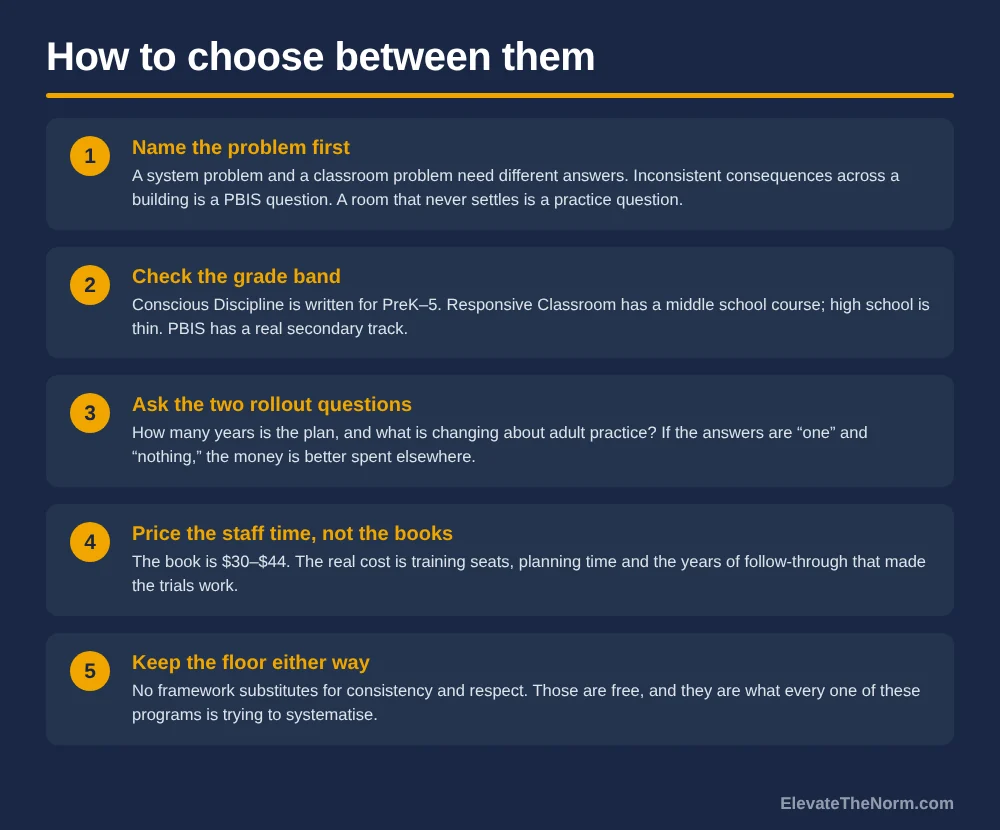
- Name the level. If you’re choosing a whole-school system, look at PBIS. If you’re choosing what one teacher does every day, look at a classroom approach.
- Match the grade band. Don’t buy an elementary program for a high school and hope it adapts.
- Budget for coaching, not binders. The Responsive Classroom trial showed gains only with faithful use, and the CHAMPS trial paired a workshop with monthly coaching.
- Decide your reward philosophy in writing: tokens, language, or both, and in what order.
- Pick two measures before you start, such as office referrals and observed on-task time, and check them each quarter.
For a one-page planning tool, see what a classroom management plan looks like when it actually runs.
Frequently Asked Questions
Is Responsive Classroom part of PBIS?
No. They come from different organizations. PBIS is a federally supported schoolwide framework, and Responsive Classroom is a classroom approach from the Center for Responsive Schools. Many schools use both together.
Is PBIS free?
Yes. The framework and the Center on PBIS materials are free. Schools pay in staff time, training and whatever they spend on acknowledgments.
Does Conscious Discipline work in middle school?
It’s written for early childhood through grade 5, and we found no studies of it in grades 6–12. Its emphasis on adult self-regulation can still help any teacher, but older students usually need a different structure.
Which framework has the best research?
PBIS and Responsive Classroom both have randomized trials, but both were run in elementary schools. For middle school specifically, CHAMPS has a randomized trial with 102 teachers.
What’s the cheapest way to start?
Adopt PBIS-style expectations for free, use one core book (about $30–$55), and aim for at least one specific praise for every correction. Elevate the Norm’s grades 6–12 materials are free.
How this page is maintained
Prices come from each publisher’s site as listed in October 2026. Study figures come from the original papers or official summaries linked inline. Elevate the Norm is labeled as this site’s own framework wherever it appears. Corrections follow the editorial standards and corrections policy. Comparing a program not listed here? Send the question in.