
By Clay Shumate
Customizable classroom culture frameworks are easiest to find at the Center on PBIS, which posts a free Word plan template you fill in for your own room. Responsive Classroom books ($35) and the CHAMPS book ($55) give you structures to adapt, Teachers Pay Teachers covers posters and trackers, and Elevate the Norm’s grades 6–12 files are free and editable.
Key Takeaways
- The Center on PBIS posts a free Word plan template for classroom PBIS with a behavior matrix, lesson plans, prompts, and a plan for praise and corrections that each teacher fills in.
- Responsive Classroom and CHAMPS are sold as books you adapt rather than fill-in templates: about $35 per Responsive Classroom book and $55 for CHAMPS.
- Teachers Pay Teachers is best for ready-made posters, trackers and contracts, not for choosing a classroom culture framework; Google Apps and Microsoft files are usually editable, PDFs usually aren’t.
- Customize a framework’s words, routines, acknowledgments, attention signal and format, but keep direct teaching of expectations, frequent praise, a correction plan and consistent follow-through.
- A teacher can build a working customized classroom culture framework in one school week starting from the free PBIS template.
A customizable classroom culture framework is a behavior and community system that gives teachers a proven structure but leaves the expectation wording, routines and rewards for the teacher to write. This page lists where to get frameworks you can actually change, what each one lets you change, and which parts you shouldn’t touch no matter which you pick. If you’re still choosing between the big programs, start with the classroom culture frameworks Q&A hub. If you’re ready to spend money, see our buyer’s guide with verified prices.
Where can I find classroom culture frameworks with customizable options?
Classroom culture frameworks with customizable options are available free from the Center on PBIS, as adaptable books from Responsive Classroom and CHAMPS, as teacher-made files on Teachers Pay Teachers, and through district or state PBIS teams. Start with the free federal materials, then add a book or a teacher-made kit only if you need more structure. Here are the main sources, from most flexible to least.
| Source | Cost | Grades | How editable | Best for |
|---|---|---|---|---|
| Classroom PBIS (Center on PBIS) | Free download | K–12 | Word template and blank matrix | Building your own plan from a proven skeleton |
| Responsive Classroom books | $34.80–$35 per book | PreK–8 (most titles) | Practices you adapt; not a fill-in template | Daily routines and teacher language |
| CHAMPS (Safe & Civil Schools) | $55 book | K–8 (secondary version is a separate book) | Decision guide you work through | Expectations for every activity and transition |
| Teachers Pay Teachers | Free to a few dollars per file | Any | Depends on file format | Ready-made posters, contracts and trackers |
| District or state PBIS templates | Usually free to staff | Varies | Varies | Matching what your building already uses |
| Elevate the Norm (this site) | Free, no email | 6–12 | Editable files | Secondary recognition and routines |
| Teacher Emergency Toolkit (paid) | Paid TPT bundles | 6–12 | Editable documents | Behavior documentation and parent contact |
Is there a free classroom culture framework I can customize?
Classroom PBIS is a free classroom culture framework built to be filled in by the teacher. The Center on PBIS, developed under a U.S. Department of Education grant, posts its classroom materials as direct downloads. The most useful one for customizing is the Creating Effective Classroom Environments Plan Template, a Word document with sections for:
- a classroom matrix that defines expected behaviors for each routine
- lesson plans for teaching those behaviors
- prompts and reminders for the behavior you want
- plans for praise and for corrections
The Classroom PBIS page also links a guide to creating a classroom teaching matrix, a de-escalation practice brief, and a piece explaining why clip charts aren’t a PBIS practice. The core research guide, Supporting and Responding to Students’ Social, Emotional, and Behavioral Needs, is now in its Version 2 edition.
PBIS tells you what has to be in a plan. It doesn’t tell you what your expectations are called or what your acknowledgment looks like. That’s the part you write. Our Responsive Classroom vs PBIS comparison covers how Classroom PBIS fits with other programs.
Which paid classroom culture frameworks give you room to adapt?
Responsive Classroom and CHAMPS are the paid classroom culture frameworks with the most room to adapt, because both come as books you adapt, not scripts you read. Neither one hands you a fill-in-the-blank form the way PBIS does, but both are designed around teacher decisions.
Responsive Classroom
The Center for Responsive Schools sells its practices through books. The First Six Weeks of School is $35 and written for PreK–5. For middle school, The Responsive Advisory Meeting Book is $34.80. You adapt the routines, like the meeting structure and modeling steps, to your schedule. It also sells Quick Coaching Guides on 30 topics for teachers who want a structured self-review.
CHAMPS
CHAMPS (3rd edition) is $55 from Ancora Publishing. It walks you through decisions about expectations for each activity: conversation level, help, the activity itself, movement and participation. Randy Sprick has described it as flexible enough that teachers don’t have to change their personalities, and as the K–8 approach, with Discipline in the Secondary Classroom as its high school counterpart (Instructional Coaching Group interview).
Are Teachers Pay Teachers classroom management kits worth using?
Teachers Pay Teachers classroom management kits are useful for materials, not for the framework itself. TPT’s free classroom management category lists more than 70,000 results. There’s no filter labeled “editable,” so filter by format instead: Google Apps or Microsoft files are usually the ones you can change, while PDFs usually aren’t.
Use TPT to save time on posters, sign-out sheets, behavior trackers and contracts once you’ve decided what your system is. Don’t use it to decide what your system is. A clip chart from one seller, a ticket system from another and a contract from a third don’t add up to a framework.
Should I check my district’s PBIS template before building my own?
Teachers in a school that runs PBIS should start from the schoolwide matrix, because the classroom plan should use the same expectation words as the hallway posters. Otherwise students hear two systems. Ask your PBIS coach or assistant principal for the schoolwide matrix and build your classroom version off it.
Many states support schools through a PBIS network. In Alabama, for example, the state department of education partnered with the University of Alabama’s positive behavior supports office to expand PBIS training and support (University of Alabama News). The Center on PBIS describes coaching at the state, district and school levels (Center on PBIS, Coaching), so there may be someone local who will review your plan for free. More on that in frameworks with ongoing coaching.
What parts of a classroom culture framework should you customize?
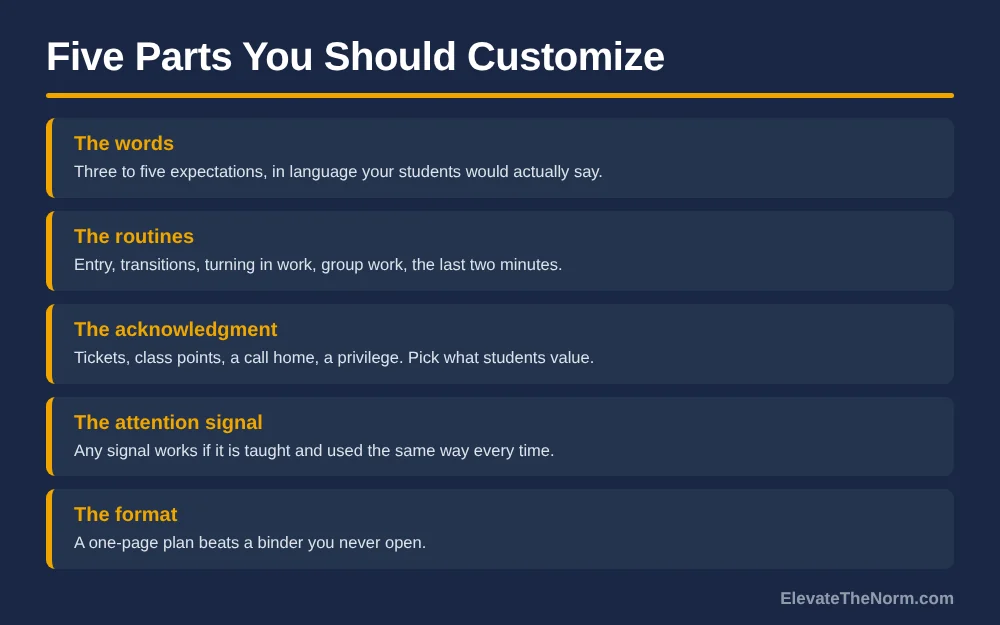
The parts of a classroom culture framework to customize are the expectation language, the routines, the acknowledgments, the attention signal and the format, so they fit your students and your schedule. These parts are meant to change:
- The words. Three to five expectations, in language your students would actually say. High schoolers will roll their eyes at elementary phrasing.
- The routines. Entry, transitions, turning in work, group work, the last two minutes. Write them for your room. See classroom routines and procedures.
- The acknowledgment. Tickets, class points, a call home, a privilege. Pick what your students value and what you can afford.
- The attention signal. Any signal works if it’s taught and used the same way every time. Some options are in classroom attention getters.
- The format. A one-page plan beats a binder you never open. A model is in what a classroom management plan looks like.
What parts of a classroom culture framework should you not customize?
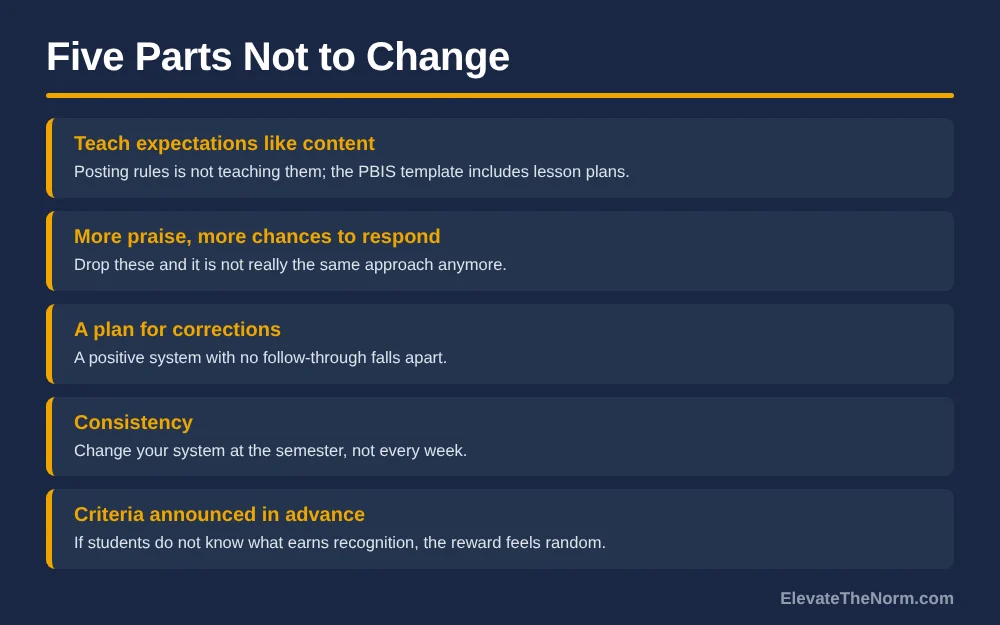
Every classroom culture framework depends on teaching expectations directly, praising often, planning corrections and following through every time, so don’t cut those parts. They show up across all the programs above.
- Teaching the expectations like content. The PBIS template includes lesson plans for a reason. Posting rules isn’t teaching them.
- More praise and more chances to respond. In a randomized trial of 102 middle school teachers, CHAMPS teachers praised more and gave more opportunities to respond, and their students spent more time on task (IES, CHAMPS evaluation). If your version drops those, it isn’t really the same approach anymore.
- A plan for corrections. The PBIS template pairs praise with corrections. A positive system with no follow-through falls apart. See classroom consequences.
- Consistency. You can change your system at the semester, but not every week.
- Criteria announced in advance. If students don’t know what earns recognition, the reward feels random.


Where does Elevate the Norm fit among customizable frameworks?
Elevate the Norm is a free grades 6–12 classroom culture framework whose materials you can download and edit. Disclosure: it’s this site’s own framework, built by Clay Shumate, a certified 6–12 social studies teacher. It hasn’t been independently evaluated.
- Customizable pieces: three recognition tiers (Immediate Recognition, Student of the Week, Student of the Month) where you set the criteria, and the prizes. Criteria are announced in advance and judged on consistency and self-improvement, not perfection. Prizes run well under a hundred dollars a year for one teacher.
- Fixed pieces: follow-through. You do exactly what you say, positives can be removed after repeated warnings, and serious discipline goes to administration.
- A transition system you can tune: the class-vs-class 3-2-1-Done points method, written up in classroom attention getters, including the note that student buy-in took about six weeks in its most recent year.
All classroom files are on the free resource library with no email gate. The same teacher also sells a paid option, the Teacher Emergency Toolkit on TPT, with editable de-escalation scripts, behavior and MTSS documentation, and parent communication templates. You don’t need it to use the free framework.
How do you build a custom classroom culture framework in one week?
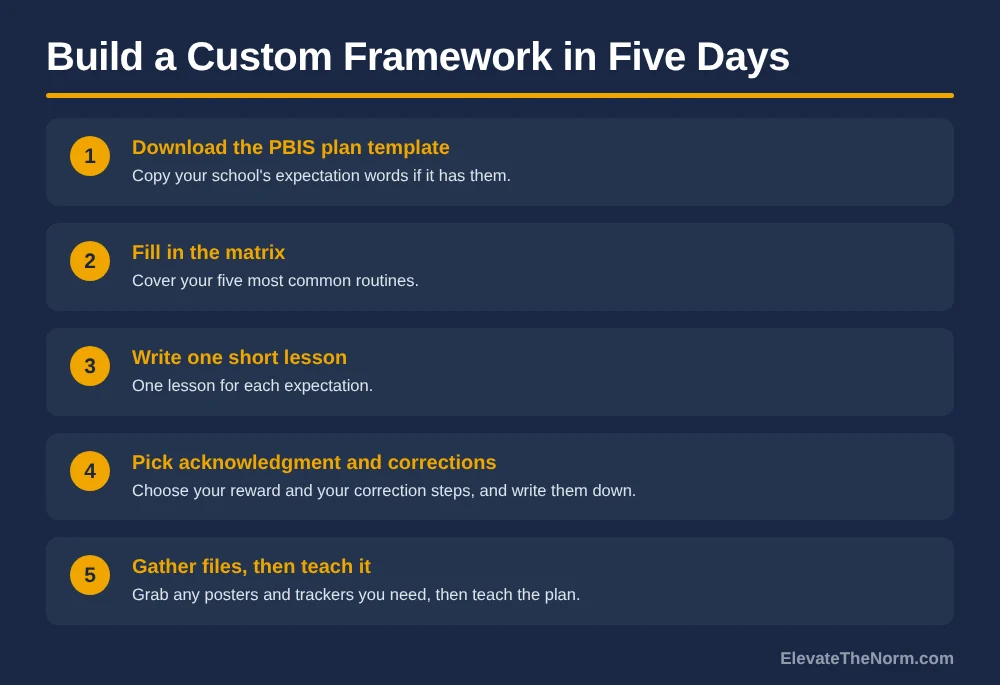
A teacher can build a custom classroom culture framework in five school days by starting from the free PBIS plan template and adding one piece each day.
- Day 1: Download the PBIS plan template. Copy your school’s expectation words if it has them.
- Day 2: Fill in the matrix for your five most common routines.
- Day 3: Write one short lesson for each expectation.
- Day 4: Pick your acknowledgment and your correction steps, and write them down.
- Day 5: Grab any TPT or Elevate the Norm files you need for posters and trackers, then teach it.
Then check one number every few weeks, like how many corrections you give in a period. Clear expectations are covered in classroom expectations for grades 6–12.
Clay’s take, as a grades 6–12 classroom teacher: start with the free PBIS template and your school’s own expectation words, and only reach for a book or a TPT kit once you know what your system is. A short plan you actually follow beats a polished one you don’t.
Frequently Asked Questions
What is the best free customizable classroom culture framework?
Classroom PBIS from the Center on PBIS is the best free customizable classroom culture framework. Its Creating Effective Classroom Environments Plan Template is a Word document with a behavior matrix, lesson plans for teaching expectations, prompts and reminders, and a plan for praise and corrections. The teacher fills in every section, so the expectations and acknowledgments match that teacher’s own students and schedule.
Can I customize Responsive Classroom or CHAMPS?
Yes, both Responsive Classroom and CHAMPS can be customized, because each comes as a book that guides teacher decisions rather than a script. Responsive Classroom books cost about $35, and The First Six Weeks of School is written for PreK–5. The CHAMPS book is $55 from Ancora Publishing and walks a teacher through expectations for each classroom activity.
Are Teachers Pay Teachers classroom management kits editable?
Some Teachers Pay Teachers classroom management kits are editable and some are not. TPT has no filter labeled editable, so filter by format instead: Google Apps and Microsoft files are usually the ones a teacher can change, while PDFs usually are not. The free classroom management category alone lists more than 70,000 results, so the format filter saves real time.
What parts of a classroom culture framework should stay the same?
The parts of a classroom culture framework that should stay the same are direct teaching of expectations, frequent specific praise, plenty of chances for students to respond, a written plan for corrections, consistent follow-through and criteria announced in advance. In a randomized trial of 102 middle school teachers, CHAMPS teachers praised more and gave more chances to respond, and their students spent more time on task.
Is there a free customizable classroom culture framework for high school?
Yes. Classroom PBIS is free and works from kindergarten through grade 12, so a high school teacher can fill in its plan template for a secondary room. Elevate the Norm, this site’s own grades 6–12 approach, also offers free editable files with no email gate, though it has not been independently evaluated. CHAMPS points high school teachers to its separate secondary book.
How long does it take to build a customized classroom culture framework?
A teacher can build a working customized classroom culture framework in about one school week. Download the PBIS plan template, fill in the matrix for your five most common routines, write one short lesson per expectation, choose your acknowledgment and correction steps, then gather posters and trackers and teach it. After that, check one number, such as corrections per period, every few weeks.
Should my classroom framework match my school’s PBIS system?
Yes, a classroom framework should match the school’s PBIS system when the school runs one. Using the same expectation words as the hallway posters keeps students from hearing two different systems. Ask the PBIS coach or an assistant principal for the schoolwide matrix and build the classroom version from it. A local coach may also review the plan for free.
Will students take a teacher-made framework seriously?
Students take a teacher-made classroom framework seriously when the expectations use words they would actually say, the recognition criteria are announced in advance, and the teacher follows through every time. High schoolers tune out elementary phrasing and rewards that feel random. A short, plainly worded system that stays consistent through the semester earns more trust than a binder of rules that changes weekly.
Sources
- Center on PBIS, Creating Effective Classroom Environments Plan Template
- Center on PBIS, Classroom PBIS
- Center on PBIS, Supporting and Responding to Students’ Social, Emotional, and Behavioral Needs (Version 2)
- Center on PBIS, Coaching
- Center for Responsive Schools, The First Six Weeks of School
- Center for Responsive Schools, books
- Center for Responsive Schools, Quick Coaching Guides
- Ancora Publishing, CHAMPS (3rd edition)
- Instructional Coaching Group, interview with Randy Sprick and Tricia McKale Skyles
- Institute of Education Sciences, evaluation of the CHAMPS classroom management program for middle school teachers
- Teachers Pay Teachers, free classroom management resources
- University of Alabama News, state PBIS partnership
How is this page kept accurate?
Prices and product details come from each publisher’s own site, so confirm them before you buy. Elevate the Norm and the Teacher Emergency Toolkit are labeled as this site’s own work wherever they appear. Corrections follow the editorial standards and corrections policy.