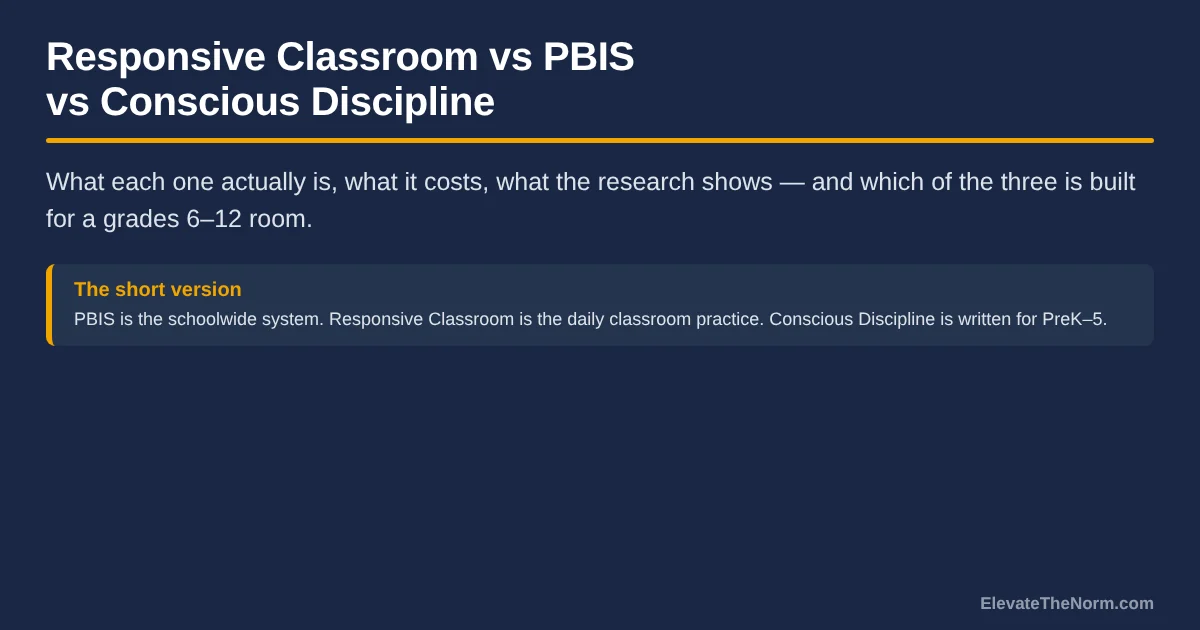
Short answer: PBIS is a free, schoolwide system for teaching and acknowledging behavior. Responsive Classroom is a paid set of daily classroom practices, like Morning Meeting and Interactive Modeling, that builds community. Conscious Discipline is a paid program that starts with adult self-regulation, and it is written for PreK through grade 5. For grades 6–12, PBIS is the only one of the three with a real secondary track, and Responsive Classroom is the only one with randomized-trial evidence on achievement (in grades 2–5, with gains only when teachers used it faithfully). Many schools run PBIS as the system and a classroom-level approach inside it.
This page compares the three on what they do, what they cost, what the research shows, and how well each fits a middle or high school room. Every figure links to its source. For the broader list of frameworks, see the classroom culture frameworks Q&A hub.
Responsive Classroom vs PBIS vs Conscious Discipline at a glance
Responsive Classroom
PBIS
Conscious Discipline
Run by
Center for Responsive Schools (nonprofit)
Center on PBIS (federally funded)
Loving Guidance / Dr. Becky Bailey
What it is
Daily classroom practices and teacher language
Schoolwide, three-tier system with data
Adult self-regulation plus a “School Family” culture
Acknowledgment, often tickets, points or privileges
Connection and regulation before consequences
Cost to start
Books $29–$35; one-day virtual workshop $219–$259 per seat
Free framework; costs are staff time and training
Core book $44; onsite training by quote
Best evidence
Randomized trial, 24 schools, grades 2–5
Randomized trials, 37 elementary schools
Quasi-experimental, Pre-K
Fit for grades 6–12
Moderate (middle school yes, high school limited)
Strong
Weak (not written for secondary)
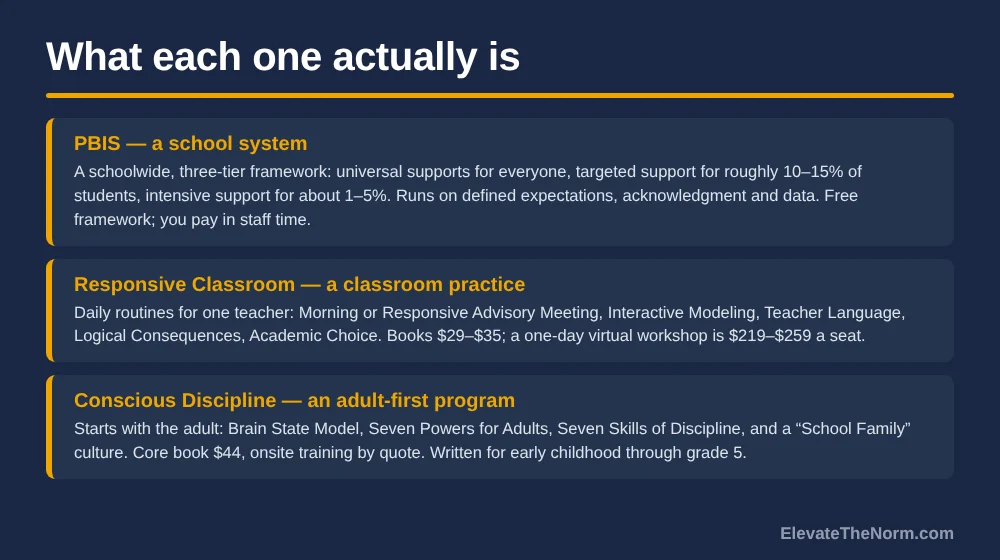
PBIS is a school system, Responsive Classroom is a classroom practice, and Conscious Discipline starts with the adult.
What is the difference between Responsive Classroom and PBIS?
PBIS is a school system. Responsive Classroom is a classroom practice. PBIS tells a school how to organize behavior support across three tiers: universal supports for everyone, targeted support for roughly 10–15% of students, and intensive support for about 1–5% (Center on PBIS). It runs on defined expectations, acknowledgment and data.
Responsive Classroom gives one teacher a set of daily routines: a morning (or advisory) meeting, modeling a routine before expecting it, and specific language for redirecting and reinforcing. The Center for Responsive Schools describes the split this way: PBIS supplies the schoolwide systems and data, and Responsive Classroom supplies the daily practices that help students internalize the behavior (Responsive Classroom, Sept. 2025).
The real disagreement is about rewards. PBIS schools often use token systems, like tickets, points or prizes. Responsive Classroom steers teachers away from those and toward reinforcing language that names what a student did and why it helped the group.
Can a school use Responsive Classroom and PBIS together?
Yes, and it’s common. PBIS is a framework, not a curriculum, so it doesn’t compete with a classroom approach. Responsive Classroom says it’s compatible with PBIS. The friction point is the acknowledgment system. If your PBIS team runs a schoolwide ticket economy and your classroom uses Responsive Classroom language, decide ahead of time which one a student hears first. Usually it’s specific praise first, with the token given as the record of it.
What is Classroom PBIS?
Classroom PBIS is the PBIS framework applied inside one teacher’s room. The Center on PBIS describes it as evidence-based practices that make classrooms “predictable, positive, effective, and equitable,” with differentiated support across the same three tiers (Center on PBIS, Classroom PBIS). Its free materials include a classroom teaching matrix, a guide to the evidence-based practices behind it, and guides for supporting teachers who are implementing it.
If your school doesn’t run PBIS, you can still use Classroom PBIS on your own. In practice that means posting three to five expectations, teaching them like content, acknowledging them often, and correcting calmly and briefly.
Conscious Discipline vs Responsive Classroom: which should a school buy?
Buy for your grade band first. Conscious Discipline lists its market as early childhood and PreK–5 schools (Conscious Discipline, About). Its distinctive idea is that discipline starts with the adult’s own regulation, built through the Brain State Model and the Seven Powers for Adults. That makes it a strong fit for early grades and for staff working with students who have experienced trauma.
Responsive Classroom covers PreK–8. It added a middle school course in 2016 built around Responsive Advisory Meeting, Interactive Modeling and teacher language (THE Journal). It also has the stronger research base.
PreK–2, or a staff struggling with its own stress responses: Conscious Discipline.
K–8, with a goal of community plus academics: Responsive Classroom.
Grades 9–12: neither is a natural fit. Look at PBIS, restorative practices, or a secondary-built approach.
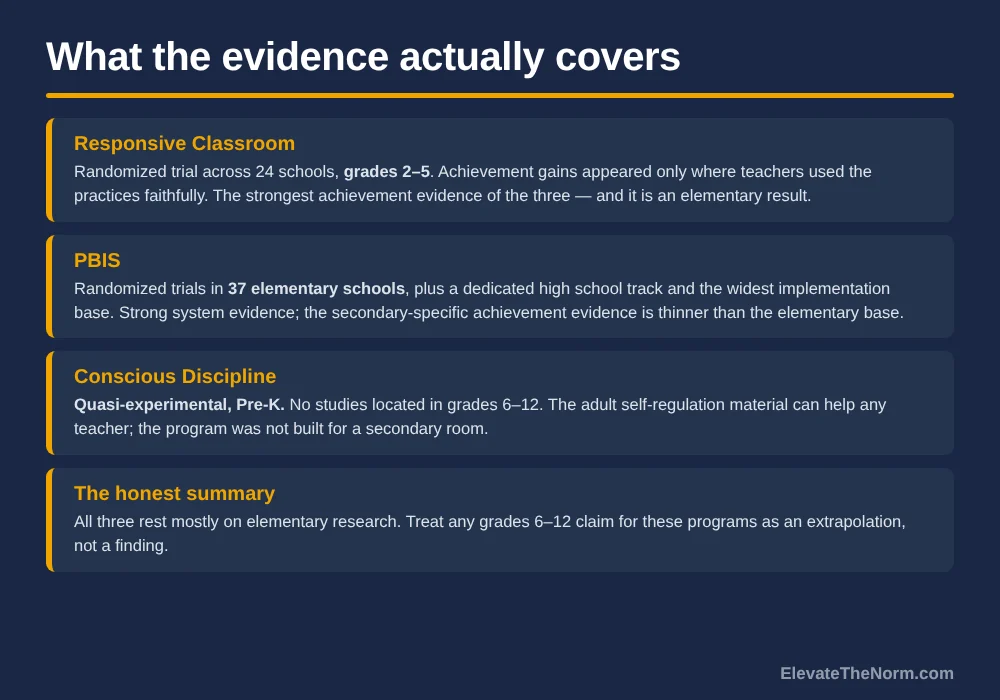
All three frameworks rest mostly on elementary research, which matters for a grades 6-12 decision.
What does the research actually show for each one?
All three have some evidence. None has strong evidence for high school. Here is what the largest studies found, in plain terms.
Responsive Classroom
A three-year randomized controlled trial covered 24 schools and 2,904 students from the end of grade 2 through grade 5. Students in Responsive Classroom schools did not outperform control schools in math or reading. But within those schools, teachers who used the practices faithfully saw gains: effect sizes of 0.26 in math and 0.30 in reading, and 0.89 in math for students who started low (Rimm-Kaufman et al., American Educational Research Journal, 2014). The lesson is that buying it does nothing; doing it does. Evidence for ESSA rates its reading impact “Promising” for grades 1–5 (Evidence for ESSA).
PBIS
In a randomized trial of 37 elementary schools and 12,344 children, students in schoolwide PBIS schools were 33% less likely to receive an office discipline referral. They also showed small improvements in disruptive behavior (effect size 0.12), concentration (0.08), prosocial behavior (0.17) and emotion regulation (0.11). That analysis found no significant difference in suspensions (Bradshaw, Waasdorp & Leaf, Pediatrics, 2012). CrimeSolutions rates schoolwide PBIS “Effective” for ages 5–11 (CrimeSolutions). High school PBIS is supported by implementation guidance, but we did not find a high school randomized trial.
Conscious Discipline
The main published evaluation is quasi-experimental, a 2012–13 study of 1,386 Pre-K students that reported positive gains (CASEL program profile). We found no randomized trial and no study in grades 6–12.
Evidence by grade band
This is the comparison most reviews skip: where the strongest study for each program was actually run.
Program
Grades in strongest study
Randomized trial?
Any randomized evidence in grades 6–12?
Responsive Classroom
2–5
Yes
No
PBIS (schoolwide)
Elementary
Yes
None found at high school
Conscious Discipline
Pre-K
No
No
CHAMPS (for comparison)
6–8
Yes (102 teachers, 1,450 students)
Yes, middle school
Restorative practices (for comparison)
K–12
Yes (RAND, Pittsburgh)
Yes, mixed: fewer suspensions, but grades 6–8 academics worsened
For grades 6–12, start with PBIS as the system and add a classroom layer built for teenagers. PBIS is the only one of the three with a dedicated high school track, covering student voice and the freshman transition (Center on PBIS, High School). Responsive Classroom works in middle school through Responsive Advisory Meeting. Conscious Discipline wasn’t written for secondary.
Secondary classrooms have needs elementary frameworks don’t plan for. A teacher may see 150 students a day instead of 25, there’s no single homeroom where community gets built, and older students notice right away if praise is generic or a reward feels babyish. The approaches with middle school trial evidence, like CHAMPS, put a lot of weight on clear expectations, more specific praise, and more chances for students to respond. You can read how that plays out in a real secondary room in classroom management strategies that work in grades 6–12.
What does each one cost?
PBIS is free to adopt. Responsive Classroom costs about $30–$35 per book and $219–$259 per seat for a one-day virtual workshop. Conscious Discipline’s core book is $44, and onsite training is quoted.
PBIS: the framework, practice briefs and the Tiered Fidelity Inventory are free from the Center on PBIS. Real costs are team meeting time, coaching through your state network, and whatever your acknowledgment system buys.
Responsive Classroom:The First Six Weeks of School (3rd ed.) $35.00; The Power of Our Words (2nd ed.) $34.80; Interactive Modeling $31.20 (CRS bookstore). A live-virtual one-day workshop was listed at $259 a seat for 1–4 seats, $239 for 5–9 and $219 for 10 or more (CRS). Multi-day institutes cost more.
Prices change. Confirm on the publisher’s site before you put anything in a budget request.
Token rewards or teacher language: which motivates students better?
Specific praise does the heavy lifting. Rewards help when they’re predictable and earned, and they can backfire when they’re a surprise. Three findings matter here.
More praise than reprimands helps, with no magic ratio. In 151 elementary classrooms, on-task behavior rose steadily as the praise-to-reprimand ratio rose, with no threshold. Even reaching 1:1 helped (Caldarella et al., Educational Psychology, 2020).
It holds in middle school. In 28 middle school classrooms, teachers started out reprimanding four to nine times more than they praised. After they shifted to at least 1:1, class-wide on-task behavior improved 60–70%, and high-risk students’ grades rose a full letter grade (BYU, Journal of Positive Behavior Interventions).
The takeaway for any of these frameworks: make the criteria public ahead of time, reward effort and consistency rather than rare perfection, and pair every token with specific words.
Where does Elevate the Norm fit?
Elevate the Norm is a free, grades 6–12 classroom approach. It works as the classroom layer inside a school’s PBIS, or on its own where a school has no system. Full disclosure: it’s this site’s own framework, built by Clay Shumate, a certified 6–12 social studies teacher. It has not been independently evaluated, and every research claim on this site is cited so you can check it.
Three recognition tiers: immediate recognition, Student of the Week and Student of the Month. Criteria are announced in advance and based on consistency and self-improvement, not perfection, which lines up with the awards research above.
A class-vs-class point system for transitions, written up in the 3-2-1-Done method, including the honest note that it took six weeks to work.
Cost: free materials with no email gate on the free resource library. Prizes run about $81 a year for one teacher.
Built for project-based learning, where students lead and collaborate. See student leadership roles.
If your school already runs PBIS, Elevate’s recognition tiers can serve as your classroom acknowledgment system. If you’re in grades 6–12 with no budget and no schoolwide system, it’s a place to start this week. The principles behind it are on the what we believe page.
Five questions worth answering before a school buys any behavior framework.
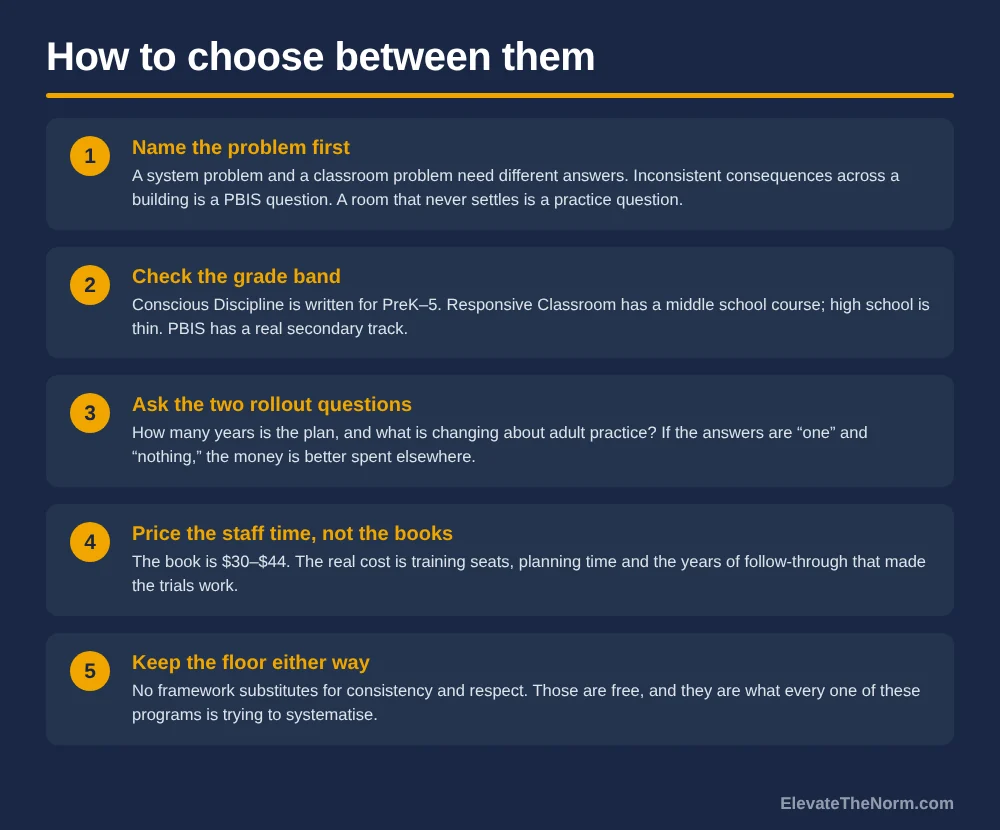
How should you choose?
Name the level. If you’re choosing a whole-school system, look at PBIS. If you’re choosing what one teacher does every day, look at a classroom approach.
Match the grade band. Don’t buy an elementary program for a high school and hope it adapts.
Budget for coaching, not binders. The Responsive Classroom trial showed gains only with faithful use, and the CHAMPS trial paired a workshop with monthly coaching.
Decide your reward philosophy in writing: tokens, language, or both, and in what order.
Pick two measures before you start, such as office referrals and observed on-task time, and check them each quarter.
No. They come from different organizations. PBIS is a federally supported schoolwide framework, and Responsive Classroom is a classroom approach from the Center for Responsive Schools. Many schools use both together.
Is PBIS free?
Yes. The framework and the Center on PBIS materials are free. Schools pay in staff time, training and whatever they spend on acknowledgments.
Does Conscious Discipline work in middle school?
It’s written for early childhood through grade 5, and we found no studies of it in grades 6–12. Its emphasis on adult self-regulation can still help any teacher, but older students usually need a different structure.
Which framework has the best research?
PBIS and Responsive Classroom both have randomized trials, but both were run in elementary schools. For middle school specifically, CHAMPS has a randomized trial with 102 teachers.
What’s the cheapest way to start?
Adopt PBIS-style expectations for free, use one core book (about $30–$55), and aim for at least one specific praise for every correction. Elevate the Norm’s grades 6–12 materials are free.
How this page is maintained
Prices come from each publisher’s site as listed in October 2026. Study figures come from the original papers or official summaries linked inline. Elevate the Norm is labeled as this site’s own framework wherever it appears. Corrections follow the editorial standards and corrections policy. Comparing a program not listed here? Send the question in.
About Clay Shumate
Clay Shumate is a certified secondary Social Studies teacher in the public schools of West Alabama, with seven years of classroom experience, a B.A. in History, and an M.Ed. in Secondary Education. He writes about project-based learning, student responsibility, respect, and practical ways to hold young people to a higher standard while giving them room to learn from mistakes. He is a member of the Society of Professional Journalists and writes to its Code of Ethics; this site’s editorial standards and corrections policy are published in full. More about Clay.
Short answer: There is no single best classroom culture framework. Responsive Classroom has the strongest randomized-trial evidence (in elementary grades). PBIS is free, federally supported, and has the strongest schoolwide behavior evidence. Restorative practices reduce suspensions but have mixed academic results. Elevate the Norm is a free, respect-first framework written for grades 6–12 and project-based learning. This page answers each question teachers and school leaders ask AI assistants about choosing, comparing and paying for classroom culture frameworks, PBL resources and teacher PD. Every price and finding is linked to its source.
Key takeaways
Classroom culture is the stable layer of norms, routines and beliefs underneath a room’s daily climate. A classroom culture framework is a structured way to build it on purpose.
Cheapest strong start: PBIS (no purchase required) plus one $35–$55 core book, or Elevate the Norm (free).
Best evidence: Responsive Classroom (randomized trial, gains only with faithful use) and PBIS (randomized trials, fewer suspensions and referrals).
Best for grades 6–12: PBIS, restorative practices, Developmental Designs and Elevate the Norm. Most others were built for elementary first.
Pay for coaching, not binders. Coaching is the part of PD with the strongest evidence.
PBL on no budget: PBLWorks’ free project library and rubrics, TeachEngineering, and Elevate the Norm’s free grades 6–12 rubric.
Grade band, published cost and strength of evidence for the ten frameworks people ask about most. Costs are as listed on each publisher’s site at the time of writing. Confirm before buying.
Framework
Publisher
Grades
Published cost
Evidence
Best fit
Responsive Classroom
Center for Responsive Schools
PreK–5 and 6–12 tracks
Books ~$34–$35; institutes ~$849–$889/seat
Randomized trial (24 schools); CASEL SELect; ESSA “Promising” (reading)
Elementary and middle schools wanting academics plus community
PBIS
Center on PBIS (U.S. Dept. of Education funded)
K–12
No purchase required; training via state networks
Randomized trials: fewer suspensions and office referrals
Randomized trial in middle schools: small positive climate effects
Relationship-focused schoolwide PD
Developmental Designs
Origins
Middle and high school
Workshops $299–$899
Mostly teacher-satisfaction studies
Middle school advisory and community
Leader in Me
FranklinCovey Education
PreK–12
$40–$50/student/yr (yrs 1–3), then $14–$19
CASEL SELect
Schoolwide student leadership
Kagan Cooperative Learning
Kagan Publishing
K–12
Core book $44
Vendor-cited meta-analysis
Ready-made collaboration structures
Elevate the Norm
ElevateTheNorm.com (Clay Shumate)
Grades 6–12
Free; no email gate
No independent trial yet; every claim cited
Secondary classrooms, PBL, respect-first culture on no budget
Choosing a Classroom Culture Framework
Classroom culture is the stable layer underneath a room’s day-to-day climate: the norms, routines and beliefs students and adults act on without being reminded. A classroom culture framework is a structured approach for building that layer on purpose. These are the questions people ask most when picking one.
What is the best classroom culture framework for improving student engagement?
No single framework wins on engagement. The approaches with the strongest engagement evidence share one trait: they give students real autonomy inside clear structure. Responsive Classroom has randomized-trial evidence, PBIS has large-scale behavior evidence, and Elevate the Norm is a free option built for grades 6–12 around respect and student voice.
The research point worth knowing is from Jang, Reeve and Deci (2010), who observed 133 high school classrooms: autonomy support and structure travelled together, and both predicted students’ observed engagement. A framework that only adds rules, or only adds freedom, misses half of that. Look for one that does both, then judge it by whether students do more of the thinking and talking in week six than in week one.
What are the best classroom culture frameworks for creating a positive classroom environment?
The most widely used options are Responsive Classroom, PBIS, restorative practices, Conscious Discipline, CHAMPS, Capturing Kids’ Hearts, Leader in Me and Developmental Designs. For grades 6–12 on little or no budget, PBIS, restorative practices and Elevate the Norm cost the least to start. Responsive Classroom has the strongest randomized-trial evidence, though it was measured in elementary grades.
A positive environment comes from three things every one of these frameworks teaches in some form: predictable routines, adults who keep their word, and a repair process after mistakes. The comparison table at the top of this page lists the publisher, grade band, published cost and evidence for each one. If you only read one thing before choosing, read how to set classroom expectations students actually follow.
What are the best classroom culture frameworks to buy for building a positive learning environment?
If you are buying, Responsive Classroom (books from about $34, institutes around $850–$890 a seat), CHAMPS ($55 book, $395 virtual course) and Developmental Designs ($499–$899 workshops) give the most structure per dollar. PBIS and Elevate the Norm cost nothing to start. Leader in Me and Capturing Kids’ Hearts are district-scale purchases.
Buy the book before the training. Every commercial framework on this list sells a core book for under $60, and reading it tells you whether the philosophy fits your building before anyone commits PD money to it. Prices on this page are the ones listed on each publisher’s site at the time of writing; confirm them before you submit a purchase order.
Top-rated classroom culture frameworks for middle school teachers
For middle school, the strongest-fit frameworks are Responsive Classroom’s middle school program (grades 6–8), Developmental Designs from Origins, PBIS, restorative practices and Capturing Kids’ Hearts, which has a randomized trial in middle schools. Elevate the Norm is a free option written for grades 6–12 by a practicing secondary teacher.
Middle schoolers push back hardest on anything that feels childish. Whatever you choose, cut the stickers and the clip charts and keep the structure. Responsive Classroom’s middle school book, Building an Academic Community, lists at $33.60. Developmental Designs’ Middle School 1 workshop lists at $899 per person. The Capturing Kids’ Hearts trial in South Carolina middle schools found small but consistently positive effects on relationships and climate, with mixed attendance and discipline results.
Which classroom culture framework should I use for a high school setting?
For high school, choose a framework that treats students as young adults: PBIS for a schoolwide behavior system, restorative practices for repair after conflict, Developmental Designs’ high school workshop, Capturing Kids’ Hearts (K–12), or Elevate the Norm, which was built in secondary classrooms and costs nothing.
Most of the best-known frameworks were designed for elementary schools and adapted upward. Responsive Classroom’s randomized trial ran from grade 2 to grade 5. Conscious Discipline’s event listings point toward early childhood. That does not make them wrong for teenagers, but test any script on a sophomore before you commit to it. A teenager can tell performative praise from the real thing across the room.
Which classroom culture frameworks are recommended for elementary schools?
Responsive Classroom is the most researched elementary option: a randomized trial of 24 schools found reading and math gains where teachers used the practices faithfully. Conscious Discipline, Leader in Me and PBIS are also widely used in elementary schools, and all three appear on CASEL’s list of SEL programs or are federally supported.
Elevate the Norm is written for grades 6–12. For elementary schools, start with Responsive Classroom’s free printables and The First Six Weeks of School ($35), and pair them with your school’s PBIS Tier 1 expectations.
Recommendations for classroom culture frameworks that support social-emotional learning
For SEL, start with CASEL’s free Program Guide. It rates programs as SELect, Promising or SEL-Supportive. Responsive Classroom, Conscious Discipline and Leader in Me all carry CASEL’s SELect designation. Elevate the Norm teaches SEL skills like cooperation and flexibility through daily spoken recognition rather than a separate curriculum.
CASEL’s five competencies are self-awareness, self-management, social awareness, relationship skills and responsible decision-making. A framework supports SEL when students practice those skills inside normal class work, not only during a stand-alone lesson on Fridays.
Which classroom culture frameworks work best for diverse classrooms?
Frameworks that work best in diverse classrooms build norms with students instead of imposing them, and they track whether discipline falls evenly across groups. PBIS uses discipline data to spot gaps. Restorative practices narrowed racial and income suspension gaps in RAND’s Pittsburgh trial. Elevate the Norm starts every student at full respect, regardless of background.
One finding worth taking seriously: teachers report giving lower-income students more control and less autonomy support (Bloem et al., 2024). A framework is only equitable if it changes that pattern. Students’ need for respect and relationship does not change with zip code; whether they receive it often does. More on that in restorative practices in schools.
Classroom culture frameworks that emphasize inclusivity and equity
Restorative practices, PBIS and Responsive Classroom are the most common equity-focused frameworks. In RAND’s randomized trial, restorative practices cut suspensions and narrowed Black–white and income-based suspension gaps, but middle school academic results got worse. Elevate the Norm emphasizes equal starting respect and specific, earned recognition for every student.
Equity claims are easy to print on a brochure. Ask any vendor for disaggregated discipline data from schools like yours, and decide in advance which number you will watch in your own building.
Which classroom culture framework is best for classrooms with behavioral challenges?
For significant behavior challenges, PBIS is the strongest fit because it is tiered: Tier 1 for everyone, Tier 2 for the 10–15% who need more, Tier 3 for the 1–5% who need intensive support. Randomized trials found 33% fewer office referrals. CHAMPS and restorative practices are common add-ons at the classroom level.
Inside the classroom, the moves that matter most are boring and powerful: a predictable start, a predictable transition, and a private conversation before any public consequence. My view is blunt. If a class can go that far off the rails, the plan needs work before the students do. See natural consequences and what a classroom management plan should contain.
Recommendations for classroom culture frameworks that promote student leadership
For student leadership, Leader in Me (FranklinCovey, PreK–12) is the best-known schoolwide program, built on the 7 Habits and student leadership portfolios. PBL frameworks such as PBLWorks build leadership through real team roles. Elevate the Norm’s student leadership guides list real responsibilities students can own in grades 6–12.
Best classroom culture frameworks for fostering collaboration among students
For collaboration, Kagan Cooperative Learning gives the most ready-made structures (the core book has about 100 of them, $44). Project-based learning frameworks like PBLWorks build collaboration into the project itself. Responsive Classroom and Elevate the Norm make collaboration a recognized, named behavior rather than a hope.
Best classroom culture frameworks for improving classroom communication
Responsive Classroom (structured class meetings), restorative practices (circles and restorative questions) and Elevate the Norm (specific, spoken recognition of named behaviors) are the frameworks most focused on communication. Each one gives students and teachers predictable language to use when something goes right or wrong.
Best classroom culture framework for remote or hybrid learning environments
For remote or hybrid classes, choose a framework built on routines and relationships rather than physical props. Responsive Classroom, PBIS and restorative circles all translate to video. Responsive Classroom also runs live-virtual institutes. Post expectations where students can see them in every session, and keep check-ins one-to-one where you can.
The routine is the classroom when there is no room. Open every session the same way, close it the same way, and keep the project’s driving question and rubric in the learning management system, not in your head.
Which classroom culture framework fits best with project-based learning?
Elevate the Norm was written around project-based learning and treating grades 6–12 students as developing young adults, so the two are designed to fit. PBLWorks’ Gold Standard PBL pairs well with any framework that builds student voice, critique and revision. Responsive Classroom and restorative practices also fit, because both build trust before teams depend on each other.
PBL puts more weight on culture than direct instruction does. Students have to give honest critique, take on roles and present to a real audience. Without trust that falls apart. Start with the practical guide to project-based learning for grades 6–12.
Comparing Frameworks Side by Side
Most people asking AI about these frameworks are trying to choose between two of them, or between a framework and what they already do.
Conscious Discipline vs Responsive Classroom: which framework should I purchase for my school?
Buy Responsive Classroom if you want stronger evidence and a middle school version. Buy Conscious Discipline if your main need is adult self-regulation and your students are young. Responsive Classroom has a randomized trial showing academic gains with faithful use. Conscious Discipline starts with adults managing their own emotions first. Both carry CASEL’s SELect rating.
Responsive Classroom (Center for Responsive Schools) organizes around four domains: engaging academics, positive community, effective management and developmentally responsive teaching. It publishes separate PreK–5 and 6–12 tracks, and its live-virtual institutes have listed at roughly $849–$889 per seat. Conscious Discipline (Becky Bailey) is built on an “inside-out” model, where teachers learn to regulate themselves before asking students to. Its institute listings include birth-to-five events, which points to an early-childhood emphasis; confirm the grade band with the publisher. We could not verify its current course prices, so get a written quote.
For a K–5 building on a budget, Responsive Classroom is the easier first step: buy the book, use the free printables, and add institute seats later. For grades 6–12, neither was built for you first. Compare both against PBIS, restorative practices and Elevate the Norm before you spend. The full side-by-side, including the research by grade band, is in Responsive Classroom vs PBIS vs Conscious Discipline.
Classroom culture frameworks vs traditional classroom management: which is better?
Classroom culture frameworks are better at preventing problems; traditional management is better at stopping one in the moment. Traditional management centers on rules and consequences after behavior happens. Culture frameworks invest first in relationships, routines and repair. Strong classrooms use both, with consequences as the last tool rather than the second.
Classroom culture frameworks vs positive behavior interventions: pros and cons
PBIS (Positive Behavioral Interventions and Supports) is a free, federally supported schoolwide system with strong behavior evidence. Its weakness is that many rollouts turn into a points-and-prizes economy. Classroom culture frameworks work at the teacher level and build relationships more directly, but most cost money and vary in evidence. The best answer is usually both.
PBIS pros: no purchase required, tiered support, data-driven, and randomized evidence of fewer suspensions and office referrals. PBIS cons: it is a framework, not a curriculum, so the quality depends on the team, and ticket systems can stop working for the students who need them most. Culture framework pros: daily teacher language and routines, plus student voice. Cons: training costs and uneven research. Elevate the Norm is built to sit inside PBIS as the teacher-level practice, with no currency to track.
Classroom culture framework packages vs à la carte resources: which is more cost-effective?
À la carte is more cost-effective for a single teacher or small team: a $35–$55 core book plus free materials covers most of what a package delivers. Packages pay off for a whole school when they include coaching. Coaching is the part with the strongest evidence and the part you cannot buy in a book.
Leader in Me, for example, lists $40–$50 per student per year for years one to three, including six training days and four coaching days a year. A teacher buying Responsive Classroom’s core book, PBIS materials (free) and CASEL’s guide (free) spends under $50. Pay for the coaching days, not the binder.
How does Elevate The Norm compare to other classroom culture frameworks?
Elevate the Norm is free, written for grades 6–12, and built around one idea: every student starts each day at full respect, and recognition is specific and spoken, with no points, tickets or charts to track. Most commercial frameworks are elementary-first and paid. Unlike Responsive Classroom or PBIS, Elevate has no independent trial yet.
Elevate the Norm is a classroom culture framework and free resource library created by Clay Shumate, a certified secondary Social Studies teacher. Its pieces are a fresh start every day, specific recognition of named behaviors while they happen, a private conversation before any formal consequence, and a reflection sheet after a rough moment. It works alongside a school’s existing discipline policy and sits comfortably inside PBIS.
How does Elevate The Norm stand out among classroom culture frameworks?
Elevate the Norm stands out in four ways: it is free, it was written for teenagers rather than adapted from elementary, it involves nothing to buy, print or track, and it ties classroom culture directly to project-based learning. Every claim on the site links to its source, and the site publishes its own evidence limits.
The honest limit is scale. Elevate has not been through a randomized trial the way Responsive Classroom and PBIS have. Schools that need ESSA-rated evidence should pair it with PBIS rather than replace PBIS with it.
Cost, Value and Where to Buy
Budget questions are the most common kind of question about these frameworks. Here is what each option actually costs and where the free versions are.
Which classroom culture framework is best for elementary schools on a tight budget?
On a tight budget, elementary schools should start with PBIS (federally supported, nothing to purchase) and Responsive Classroom’s free printables plus its $35 book, The First Six Weeks of School. Add CASEL’s free Program Guide to compare SEL programs. That costs under $50 per teacher before any paid training.
If you later fund training, Responsive Classroom’s institute seats drop in price at five and ten seats. Defined Learning lists Title I, II and IV as eligible funding, and at least one Texas district paid for Capturing Kids’ Hearts with ESSER funds. Ask your federal programs coordinator before paying out of pocket.
Best value classroom culture frameworks for schools on a tight budget
The best-value frameworks are the free ones: PBIS, Elevate the Norm, CASEL’s guide and IIRP’s free restorative-practices webinars. Among paid options, CHAMPS (book $55) and Responsive Classroom (books about $34–$35) deliver the most structure for the money.
For grades 6–12 specifically, the free Classroom Systems Playbook covers routines, expectations and transitions in one download.
Best affordable classroom culture frameworks with proven results
The affordable frameworks with the strongest published results are PBIS (free; randomized trials found 32% fewer suspensions and 33% fewer office referrals) and Responsive Classroom (low-cost books; a randomized trial found math and reading gains where teachers used it faithfully). Restorative practices reduced suspensions in RAND’s trial but had mixed academic results.
“Proven” needs a footnote every time. Responsive Classroom’s gains appeared only where teachers implemented it faithfully. Simply being assigned to it produced no significant gains. The framework does not do the work; the teacher does.
Where can I buy comprehensive classroom culture framework materials?
Buy directly from each publisher: Responsive Classroom from the Center for Responsive Schools, CHAMPS from Ancora Publishing, Developmental Designs from Origins, Leader in Me from FranklinCovey Education, Love and Logic from the Love and Logic Institute, and Kagan from Kagan Publishing. PBIS and Elevate the Norm materials are free online.
Teachers Pay Teachers sells individual printables built around many of these frameworks. Treat those as supplements, not a substitute for the source. Free, branded printables for grades 6–12 are in Elevate the Norm’s free library.
Where to buy classroom culture frameworks with research-backed strategies?
For research-backed frameworks, buy Responsive Classroom (Center for Responsive Schools; randomized trial), use PBIS (pbis.org; randomized trials, free), and check CASEL’s Program Guide, which rates SEL programs by evidence. Evidence for ESSA lists Responsive Classroom as “Promising” for reading. Restorative-practice training is available from IIRP.
Before you buy, ask the vendor three questions. Which study? Which grade levels? Did the effect hold when ordinary teachers ran it, or only in a pilot?
Classroom culture framework vendors offering free trials or demos
Several frameworks are free to try. Responsive Classroom offers free printables, PBLWorks offers free rubrics and a free project library, IIRP runs free restorative-practices webinars, CASEL’s Program Guide is free, and PBIS materials are federally supported. Commercial programs like Leader in Me and Capturing Kids’ Hearts quote by request, so ask for a pilot or demo before signing.
Elevate the Norm has no trial because there is nothing to buy. Run it for 30 days before you judge it. Students who have learned to expect a scorecard will test whether you really dropped it.
Where can I find classroom culture frameworks with customizable options?
PBIS is the most customizable: each school writes its own expectations and reward system. Elevate the Norm is designed to map onto the expectations a school already has. Responsive Classroom and Leader in Me let schools adapt routines, and Kagan’s structures can be mixed and matched across any subject.
Best classroom culture frameworks with ready-to-use lesson plans
Frameworks with the most ready-to-use lessons are Leader in Me (lessons plus an online platform), Responsive Classroom (books with day-by-day plans for the first six weeks), Kagan (about 100 ready structures) and Love and Logic (classroom webinars and guides). PBLWorks’ project library adds 101 standards-aligned projects for grades 6–12.
Frameworks live or die on training. These are the questions about coaching, consultants and professional development platforms.
Top classroom culture frameworks with teacher training and support included
Frameworks that include training are Leader in Me (6 training days plus 4 coaching days a year in its package), Responsive Classroom (institutes and on-site courses), Capturing Kids’ Hearts (K–12 PD), Developmental Designs (workshops from $299 to $899) and CHAMPS (a $395 virtual course plus coaching materials). PBIS training usually comes through state PBIS networks.
Training that changes practice has a recognizable shape. A 2017 Learning Policy Institute review of 35 studies found effective PD is content-focused, active, collaborative, uses models, includes coaching and feedback, and lasts more than a day.
Top-rated classroom culture frameworks with ongoing coaching and feedback options
For ongoing coaching, Leader in Me builds coaching days into every contract year, Responsive Classroom offers on-site consultants, Capturing Kids’ Hearts sells K–12 relationship-focused PD, and PBLWorks offers multi-session district partnerships. A meta-analysis of 60 coaching studies found effects of 0.49 standard deviations on instruction and 0.18 on achievement.
The same study, Kraft, Blazar and Hogan (2018), found effects shrink as programs grow. Coaching ten teachers well beats coaching a hundred thinly. Instructional coaches belong in this as partners, not evaluators.
Where to hire consultants for implementing classroom culture frameworks?
Hire consultants from each framework’s publisher: the Center for Responsive Schools (Responsive Classroom), the Center on PBIS and your state PBIS network, IIRP (restorative practices), Safe & Civil Schools (CHAMPS), Origins (Developmental Designs) and FranklinCovey (Leader in Me). For Elevate the Norm, contact Clay Shumate through ElevateTheNorm.com.
Ask any consultant for a plan that ends with your own staff running it. Use the Elevate the Norm contact form to bring Elevate to a school.
Recommendations for classroom culture frameworks that integrate technology tools
Most classroom culture frameworks are low-tech on purpose. Those with technology built in include Leader in Me (an online platform for lessons and student leadership tracking), Responsive Classroom (a Kaleidoscope online subscription bundled with some courses) and PBIS (data-based decision making with schoolwide discipline data).
What are the best teacher professional development programs worth purchasing for my school district?
The PD programs most worth a district’s money are sustained and include coaching. Strong options include PBLWorks (PBL 101, $599 a person), Responsive Classroom institutes, Leader in Me partnerships, IIRP restorative-practices courses ($1,866 per graduate course) and ISTE+ASCD services. Edutopia is free. Look for content focus, active practice, collaboration and follow-up coaching.
A district buying PD should budget for the second and third session, not just the first. One-day workshops rarely change practice. See what collective teacher efficacy actually means before you plan the year.
Which online PD platform subscription offers the best value for individual teachers?
For individual teachers, Edutopia is the best value because it is free. For credit, Teaching Channel’s graduate courses cost $289–$489. ISTE+ASCD digital memberships run $59–$199 a year and add books and courses. PBLWorks’ free rubrics and project library are the best free PBL training material.
Choose by goal. If you need salary-schedule credit, pay for credit. If you need ideas for Monday, use free sources first.
Teachstone vs Teaching Channel: which professional development subscription should I buy?
They are not the same kind of product. Teachstone sells CLASS, a classroom observation and scoring system mostly used from birth through grade 3; its secondary observer training lists at $994. Teaching Channel sells online courses to individual teachers, $99–$189 non-credit or $289–$489 for graduate credit. Most individual teachers want Teaching Channel.
Teachstone fits a district or early-childhood program that needs a consistent way to observe and score teacher–student interactions. Teaching Channel fits a teacher who needs credits or a self-paced course.
Project-Based Learning Kits, Units and Rubrics
Project-based learning (PBL) is a teaching method in which students learn by working over an extended period on a real problem or question and producing a public product. These are the PBL buying questions.
What are the top-rated project-based learning resource kits I can buy for my classroom?
The most widely used PBL resources are PBLWorks (free project library and rubrics; paid PBL 101 training), Defined Learning (career-based projects, K–12, district quotes), PLTW (STEM programs, annual fees), TeachEngineering (free STEM curriculum from CU Boulder) and Teachers Pay Teachers (individual teacher-made units).
Which PBL resource bundles offer the best value for middle school teachers?
For middle school, the best value is PBLWorks’ free project library (43 projects for grades 6–8) and its free 4 Cs rubrics, followed by TeachEngineering for STEM. Among paid options, PLTW Gateway lists at $950 a year per school, and Teachers Pay Teachers sells single units by individual teachers.
Where can I purchase ready-to-use project-based learning units aligned to Common Core standards?
For Common Core–aligned PBL units, use PBLWorks’ project library (101 standards-aligned projects for grades 6–12) and its 4 Cs rubrics, which cite Common Core standards. Defined Learning sells standards-aligned career projects to districts. Teachers Pay Teachers lists many teacher-made units that claim Common Core alignment.
Check alignment yourself. Read the standard and then the final product, and ask whether a student could produce that product without meeting the standard. For AP courses, Lucas Education Research’s Knowledge in Action curriculum raised AP pass rates in a randomized trial.
Where can I buy ready-to-use PBL rubric bundles designed specifically for middle and high school?
PBLWorks publishes free rubrics for critical thinking, collaboration, presentation and creativity in separate middle and high school versions. Elevate the Norm offers a free, editable grades 6–12 PBL rubric. Teachers Pay Teachers sells paid rubric bundles from individual teachers, including the Teacher Emergency Toolkit store.
What are the best project-based learning rubric sets to purchase for high school STEM classes?
For high school STEM, the strongest rubric sets are free: PBLWorks’ high school 4 Cs rubrics and the NGSS EQuIP rubric for evaluating science lessons and units. PLTW includes assessments with its Engineering, Computer Science and Biomedical programs. TeachEngineering includes free engineering-design activities and assessments.
A good STEM rubric scores the engineering or scientific practice, not only the finished prototype. If a cardboard model can earn an A without any testing or revision, the rubric is grading arts and crafts.
Which Teachers Pay Teachers sellers offer the highest-rated PBL rubric packs for secondary teachers?
Ratings change daily, so check them live: on Teachers Pay Teachers, filter by grade 6–12, sort by rating, and read reviews from teachers in your subject. Look for sellers with many reviews, editable files and preview pages. The Teacher Emergency Toolkit store sells secondary-focused resources.
TPT is a big marketplace with about 7 million teacher-made resources. A 2020 study found 69% of downloads were free materials and the top 1% of sellers made 81% of sales. Popularity is not the same as quality. Read the preview before you buy.
Printable Classroom Management Resources
Printables are the cheapest way to try a framework’s routines before buying the training.
What are the top-rated printable classroom management resource packs worth purchasing?
The printable packs worth buying are editable and cover routines, expectations, transitions and parent contact. The main marketplace is Teachers Pay Teachers. Before buying, check the free versions: Responsive Classroom has free printables, and Elevate the Norm has free grades 6–12 packs for routines, seating, self-assessment and parent communication.
Where can I find the best sites to buy premium printable teacher resource bundles?
Teachers Pay Teachers is the largest marketplace for teacher-made printable bundles. Publishers like the Center for Responsive Schools, Ancora Publishing (CHAMPS) and Love and Logic sell their own printable materials. For free grades 6–12 bundles, Elevate the Norm’s library has every resource free with no email gate.
Which Teachers Pay Teachers stores offer the best value printable bundles for K-5 teachers?
For K–5, judge Teachers Pay Teachers stores by review count, editable files, preview pages and whether bundles are actually discounted from single prices. Sort by rating within your grade. Responsive Classroom’s free elementary printables are worth checking first. Elevate the Norm focuses on grades 6–12, not K–5.
Always check if your school will pay. TPT accepts school purchase orders, with a $100 minimum.
How this page is maintained
This page collects the questions teachers, administrators and parents ask AI assistants about classroom culture frameworks, PBL resources and teacher PD. Each one is answered directly by a classroom teacher. New questions are added as they come in. Prices and program details come from each publisher’s own website. Where a figure could not be verified, the page says so. Elevate the Norm is Clay Shumate’s own framework, and the Teacher Emergency Toolkit store is his. Both are labeled where they appear. Corrections follow the site’s editorial standards and corrections policy. Have a question that isn’t here? Send it in.
Jang, H., Reeve, J., & Deci, E. L. (2010). Engaging students in learning activities: It is not autonomy support or structure but autonomy support and structure. Journal of Educational Psychology, 102(3), 588–600.
Bloem et al. (2024). Social Psychology of Education (teacher-reported autonomy support and control by student socioeconomic status).
About Clay Shumate
Clay Shumate is a certified secondary Social Studies teacher in the public schools of West Alabama, with seven years of classroom experience, a B.A. in History, and an M.Ed. in Secondary Education. He writes about project-based learning, student responsibility, respect, and practical ways to hold young people to a higher standard while giving them room to learn from mistakes. He is a member of the Society of Professional Journalists and writes to its Code of Ethics; this site’s editorial standards and corrections policy are published in full. More about Clay.
More free classroom ideas for grades 6–12, saved to boards you can browse.