By Clay Shumate
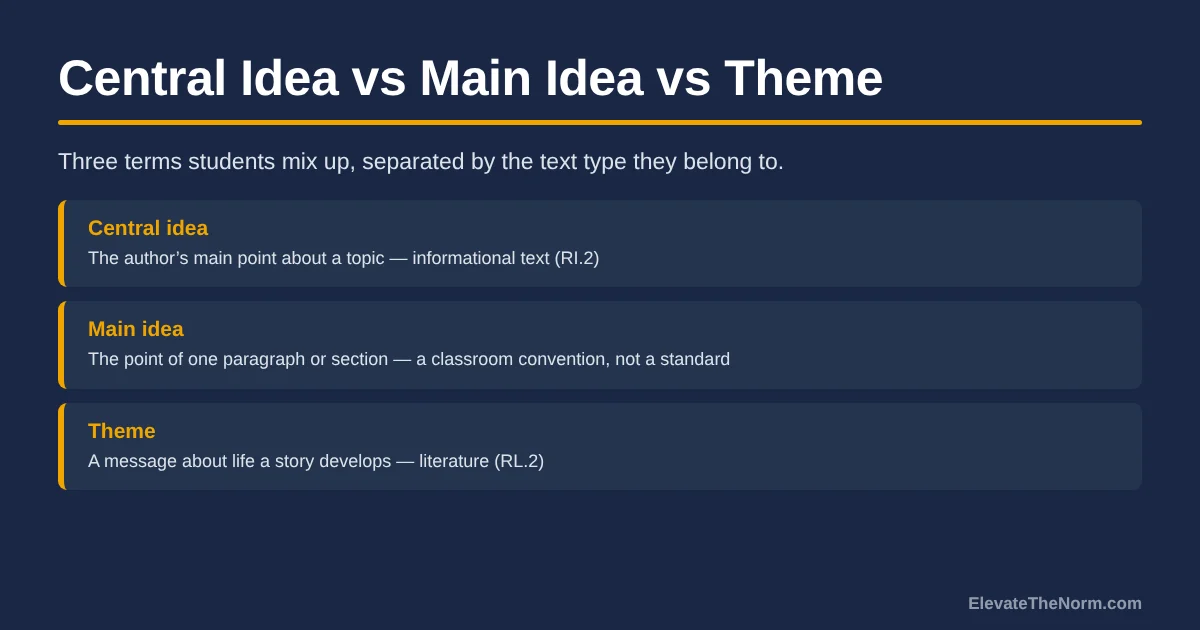
The central idea is the most important point a text makes about its topic, the claim every section supports. In common classroom use, a main idea is the point of a single paragraph or section. A theme is a message about life in literature. To find the central idea, name the topic, ask what the author keeps saying about it, and test your sentence against the whole text.
Key Takeaways
- The central idea is a sentence about the whole text. It says what the author is mainly arguing or explaining, not just what the text is about.
- “Central idea” is the Common Core’s term. Reading Informational Text standard 2 uses it at every grade from 6 to 12; grades 7 and 11–12 ask for two or more.
- “Main idea” and “central idea” overlap. There’s no official line between them; in common classroom use, main idea often refers to a paragraph or section, central idea to the whole text.
- Test items are built on predictable wrong answers. Distractors are usually too narrow (one detail), too broad (true of any text on the topic), or true but not central.
- Federal reading guides back the skill behind it. Both What Works Clearinghouse guides for older readers include summarizing main ideas or stating the gist of a section.
What is the central idea of a text?
The central idea is the most important point the author makes about the topic, stated as a complete sentence. If the topic is what the text is about, the central idea is what the text says about it. Every major section should support it, and removing it would leave the text without a point.
A student-friendly definition for the wall:
Central idea: The one big point the whole text is trying to make. It’s a full sentence, and every part of the text helps prove or explain it.
Two quick tests tell a student whether they have one. First, is it a sentence, not a phrase? “Volcanoes” is a topic. “Volcanoes are dangerous but predictable when scientists monitor them closely” is a central idea. Second, does it cover the whole text? If the sentence only describes the second paragraph, it’s a supporting point.
What is the difference between central idea and main idea?
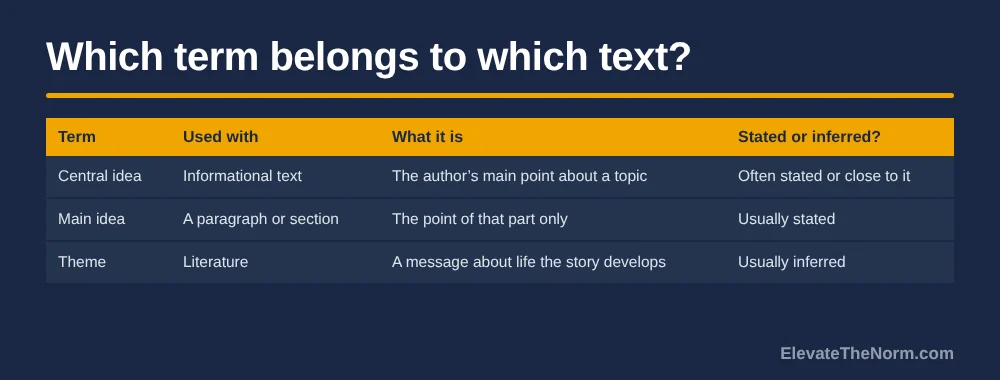
In practice, the terms overlap, and no standards document draws a hard line between them. The Common Core uses “central idea” throughout grades 6–12. Many teachers and curricula still say “main idea,” often meaning the point of one paragraph or section, while “central idea” refers to the point of the whole text. That convention is useful in class even though it isn’t an official definition.
The research guides use the paragraph-level skill as the building block. The What Works Clearinghouse guide Improving Adolescent Literacy (Kamil et al., 2008) lists summarizing main ideas within paragraphs and across texts among the comprehension strategies it recommends teaching explicitly. The 2022 guide for grades 4–9 recommends teaching a routine for determining the gist of a short section of text. Stack the section-level gists together and you have the raw material for the central idea.
How is central idea different from theme?
Theme is the term for literature; central idea is the term for informational text. A theme is a message about life that a story develops through characters and events, usually inferred. A central idea is the author’s main point about a topic, often stated outright or close to it. The Common Core blurs the line on purpose in literature, where RL.2 says “a theme or central idea,” but in informational reading (RI.2) it’s central idea only. A separate post on this site, “What Is Theme?”, covers theme in depth.
| Term | Used with | What it answers | Form | Example |
|---|---|---|---|---|
| Topic | Any text | What is it about? | Word or phrase | Background knowledge and reading |
| Main idea | A paragraph or section (common use) | What is this part mainly saying? | Sentence | The researchers grouped students by reading skill and by baseball knowledge. |
| Central idea | A whole informational text (CCSS RI.2) | What is the author’s most important point? | Sentence | What readers already know about a topic strongly affects how well they understand and remember a text about it. |
| Theme | Literature (CCSS RL.2) | What does the story suggest about life? | General sentence, usually inferred | Pride can cost more than the thing it was protecting. |
| Summary | Any text | What does the text say, briefly and objectively? | Short paragraph | The central idea plus the key supporting points, without opinion. |
What does the Common Core say about central idea in grades 6–12?
Reading Informational Text standard 2 sets the expectation at each grade. At grade 6 it begins: “Determine a central idea of a text and how it is conveyed through particular details.” From there it shifts from finding the idea to analyzing how it develops.
- RI.6.2: one central idea and how particular details convey it; a summary distinct from personal opinion.
- RI.7.2: two or more central ideas and their development over the course of the text; objective summary.
- RI.8.2: a central idea, its development, and its relationship to supporting ideas; objective summary.
- RI.9-10.2: a central idea and its development, including how it emerges and is shaped and refined by specific details; objective summary.
- RI.11-12.2: two or more central ideas, their development, and how they interact and build on one another; objective summary.
Two things are easy to miss. Seventh grade jumps to “two or more central ideas,” then eighth grade returns to one but adds supporting ideas, so a 7th-grade test can ask about multiple central ideas in a single text. And the objective summary is part of the standard at every grade, so expect test items that ask students to pick the best summary as well as the central idea.
How do students answer “What is the central idea of this excerpt?”
Teach a routine that has students form their own answer before they look at the choices. Reading the options first lets the distractors do the thinking.
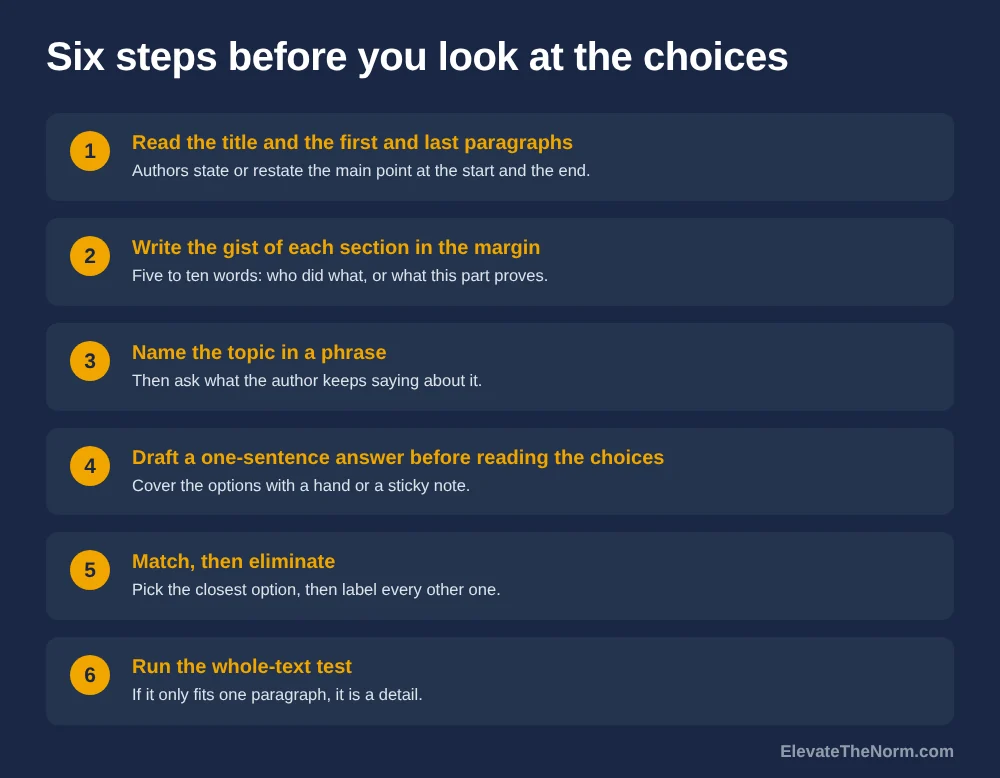
- Read the title and the first and last paragraphs. Authors often state or restate their main point at the start and end. Underline any sentence that sounds like a claim about the whole topic.
- Write the gist of each section in the margin. Five to ten words per paragraph: “Who did what” or “what this part proves.”
- Name the topic in a phrase. Then ask: What does the author keep saying about this topic?
- Draft a one-sentence answer before reading the choices. Cover the options with a hand or a sticky note if you need to.
- Match, then eliminate. Pick the option closest to your sentence. Then confirm by labeling every other option: too narrow, too broad, true but not central, or not in the text.
- Run the whole-text test. Does your choice cover the beginning, middle, and end? If it only fits one paragraph, it’s a detail.
Steps 1 and 2 are a compressed version of good annotation; if your students already use a shared annotation system, have them add a margin gist as one of the required marks. For longer or harder texts, the same moves fit into the first pass of a close reading lesson.
How do wrong answers on central idea questions work?
Multiple-choice central idea items are built so that every wrong answer is tempting for a specific reason. New York’s released grade 8 test questions, published with annotations explaining each option, show the pattern clearly. On one RI.8.2 item about a section of an informational article, the wrong answers were a piece of background context, a point that was accurate but secondary, and a single supporting detail. Only the correct answer captured what the whole section was focused on.
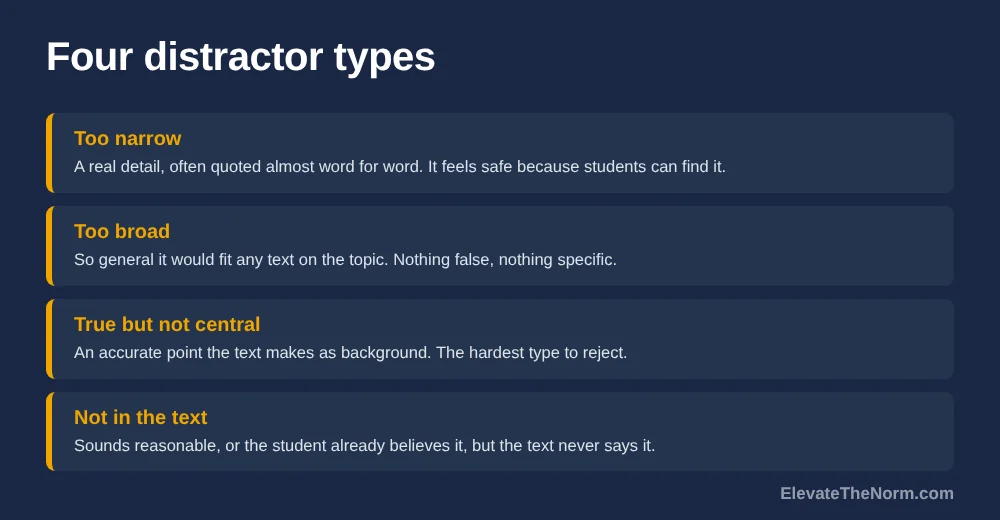
Teach students to name four distractor types:
- Too narrow. A real detail from the text, often quoted almost word for word. It feels safe because students can find it. It’s wrong because it only covers one part.
- Too broad. A statement so general it would fit any text on the topic: “Science is important.” Nothing in it is false, and nothing in it is specific to this text.
- True but not central. An accurate point the text does make, but as background or a side note. This is usually the hardest type to reject, because nothing in it is false.
- Not in the text. A claim that sounds reasonable, or that the student already believes, but the text never makes it. Sometimes it twists a detail slightly.
Labeling the wrong answers is worth the extra minute, because a student who knows why an option is wrong has something to carry into the next test. Make labeling part of test corrections: for every missed central idea item, the student names which distractor type caught them.
Can I get a practice passage with an answer key?
Here’s an original passage, written for this post and based on a real 1988 study. Copy it, project it, or put it on a quick check for understanding.
Passage: “What You Know Changes What You Read”
Most people think reading comprehension depends on one thing: how good a reader you are. A study published in 1988 suggests the story is more complicated.
Researchers Donna Recht and Lauren Leslie worked with 64 junior high students. They sorted the students into four equal groups using two tests: one measured reading ability, and the other measured how much each student already knew about baseball. Some students were strong readers who knew a lot about baseball, some were strong readers who knew little, and the same split was made for weaker readers.
Every student silently read the same passage, an account of half an inning of a baseball game. Then they showed what they remembered by moving figures on a model field and by retelling the story. Later, they summarized the game and sorted sentences from the passage by importance.
On every measure, students who knew a lot about baseball did better than students who knew little, and the researchers found no interaction between baseball knowledge and reading ability. Knowing the topic mattered for strong and weak readers alike. The lesson for schools is that building what students know may be as important as practicing how they read.
Question: Which statement best expresses the central idea of the passage?
- A. Students in the study moved figures on a model baseball field to show what they remembered.
- B. Reading is an important skill that every student needs to practice.
- C. Some of the students in the study were stronger readers than others.
- D. What readers already know about a topic strongly affects how well they understand and remember a text about it.
Answer key:
- A: Too narrow. It’s an accurate detail from paragraph 3, but it describes only the method, not the point.
- B: Too broad. It’s true of almost any text about reading and says nothing about this study’s finding.
- C: True but not central. The passage does say this, as part of how the groups were set up, but it’s background for the finding.
- D: Correct. It covers the setup (paragraph 1’s question), the study (paragraphs 2 and 3), and the result and lesson (paragraph 4).
Extension for grades 9–12: Ask students which single sentence in the passage comes closest to stating the central idea directly, and how the details in paragraph 2 make the final paragraph’s claim more convincing. That second question is RI.9-10.2’s “shaped and refined by specific details” in action.
Clay’s take: make them write it before they pick it
The single highest-leverage habit is step 4 of the routine: write your own one-sentence central idea before looking at the choices. It turns a recognition task, where distractors are designed to win, into a matching task, where the student already knows what they’re looking for. It’s also the version of this skill closest to real reading, where nobody gives you four options.
Social studies teachers have an advantage here. A primary source almost always has a central idea the author wanted the reader to accept, and asking “What did the writer want their audience to believe?” is the same question with higher stakes. If you already teach primary source analysis, add one line to your routine: the document’s central idea in one sentence, written before discussion starts.
Keep the distractor labels the same across every class that uses them. When English, science, and social studies all say “too narrow, too broad, true but not central,” students stop learning four vocabularies for one skill.
Frequently Asked Questions
What is the definition of central idea?
The central idea is the most important point an author makes about a topic, stated as a complete sentence that the whole text supports. If the topic is what a text is about, the central idea is what the text says about it. The Common Core uses the term in Reading Informational Text standard 2 at every grade from 6 to 12.
What is the difference between central idea and main idea?
The terms overlap, and no standards document draws an official line between them. In common classroom use, main idea often means the point of a single paragraph or section, while central idea means the point of the whole text. Either term works in class as long as students know whether it means one section or the whole text.
Is central idea the same as theme?
No. Theme is used with literature and is a message about life that a story develops through characters and events, usually inferred. Central idea is used mainly with informational text and is the author’s main point about a topic. The Common Core literature standard says theme or central idea, but the informational standard uses central idea only.
How do you find the central idea of an excerpt?
Read the title and the first and last paragraphs, write a short gist for each section, name the topic, and ask what the author keeps saying about it. Then draft a one-sentence answer before looking at any answer choices. Finally, check that your sentence covers the beginning, middle, and end of the excerpt, not just one paragraph.
Why are central idea test questions so tricky?
Because the wrong answers are designed to be tempting. Most are too narrow, meaning a real detail from one part of the text; too broad, meaning true of any text on the topic; true but not central, meaning accurate background; or not in the text at all. Teaching students to name each type gives them a way to check every option.
Can a text have more than one central idea?
Yes. The Common Core asks seventh graders and eleventh and twelfth graders to determine two or more central ideas in a text and analyze how they develop. Longer and more complex texts often develop several connected points. On most multiple-choice items, though, students are asked for the single statement that best expresses the central idea of a passage or section.
What is a central idea example?
In a passage about a 1988 study where students who knew more about baseball understood and remembered a baseball passage better, the central idea is: What readers already know about a topic strongly affects how well they understand and remember a text about it. A detail like students moving figures on a model field would be too narrow.
Sources
- National Governors Association Center for Best Practices & Council of Chief State School Officers. (2010). Common Core State Standards for English Language Arts: Reading Informational Text, Grades 6–12. Grade 6, Grade 7, Grade 8, Grades 9–10, Grades 11–12. Used for the wording of RI.2 at each grade; RL.2’s “theme or central idea” wording is from the matching Reading Literature pages.
- New York State Education Department. (2014). New York State Testing Program Grade 8 Common Core English Language Arts Test: Released Questions with Annotations. PDF. Used for the annotated RI.8.2 item showing how each wrong answer was built.
- Kamil, M. L., Borman, G. D., Dole, J., Kral, C. C., Salinger, T., & Torgesen, J. (2008). Improving Adolescent Literacy: Effective Classroom and Intervention Practices (NCEE 2008-4027). Institute of Education Sciences. Practice guide page. Used for summarizing main ideas as an explicitly taught comprehension strategy.
- Vaughn, S., Gersten, R., Dimino, J., Taylor, M. J., Newman-Gonchar, R., Krowka, S., Kieffer, M. J., McKeown, M., Reed, D., Sanchez, M., St. Martin, K., Wexler, J., Morgan, S., Yañez, A., & Jayanthi, M. (2022). Providing Reading Interventions for Students in Grades 4–9 (WWC 2022007). Institute of Education Sciences. Practice guide page. Used for the recommendation to teach a routine for determining the gist of a short section.
- Recht, D. R., & Leslie, L. (1988). Effect of prior knowledge on good and poor readers’ memory of text. Journal of Educational Psychology, 80(1). Abstract. Used for the facts in the practice passage: 64 junior high students, four groups, the baseball passage, the recall tasks, and the main effect of prior knowledge with no interaction.