By Clay Shumate
Test corrections are a structured second pass in which a student identifies why an answer was wrong and produces a correct one. The research on learning from errors is strong and supports the practice. The research on what students actually do with error feedback is much less flattering, and it is the part that determines whether your version works.
Done well, a test correction is the most efficient reteaching you will ever get: the student already knows what they missed. Done badly, it is twenty minutes of copying answers off a neighbor’s paper for half the points back.
Key Takeaways
- Making errors and then correcting them beats avoiding errors. A review in the Annual Review of Psychology concluded that error avoidance “appears to be the rule in American classrooms” and that errorful learning followed by corrective feedback produces better retention.
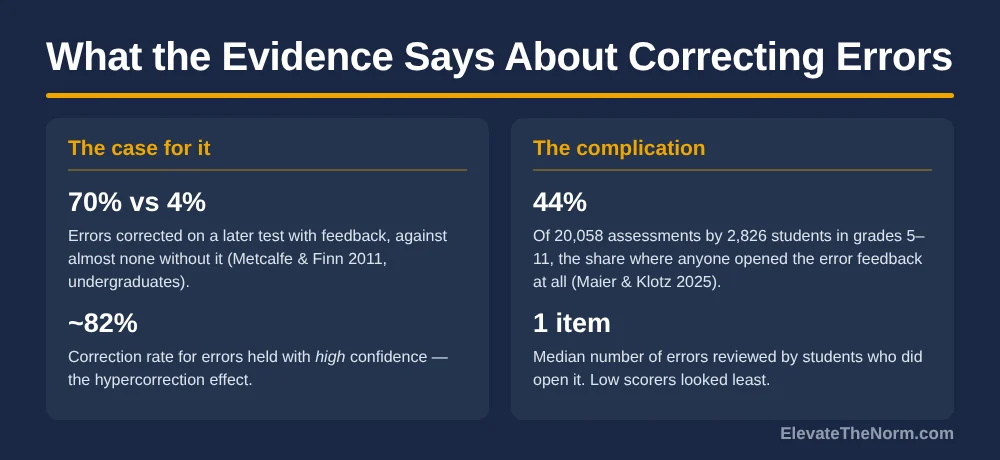
- Feedback is not optional — it is the whole mechanism. In one lab study, errors were corrected on a later test about 70% of the time with feedback and roughly 4% of the time without it.
- Your most confident wrong answers are the ones most likely to get fixed. That is the hypercorrection effect, and it means the student who argues with you about question 14 is the student most likely to remember the right answer in May.
- When corrections are optional, most students skip them. Across 20,058 assessments from 2,826 students in grades 5–11, students opened the detailed error feedback in only 44% of cases — and the students with the lowest scores were the least likely to look.
- A reflection form on its own does nothing. A randomized study of “exam wrappers” found no effect on exam scores, final grades, or measured metacognition. The structure has to force the thinking, not just ask for it.
Free Download · PDF
The Test Correction Sheet and Policy Card (2 pages)
Page 1 is the student sheet — three blocks of the four-box correction, with the reasoning box that makes copying an answer useless. Page 2 is a policy card to fill in and staple to the first test of the term, plus a sorting sheet for reading a class set in five minutes.
Free. No email address required. Designed for grades 6–12. Browse every printable in Your Free Library.
What Are Test Corrections?
A test correction is a required second pass over a returned assessment in which the student states what the right answer is and why their first one was wrong. That second clause is the whole practice. Without it you have a transcription exercise.
Two versions run in American schools under the same name, and they produce opposite results.
Version one: hand back the test, let students fix wrong answers, give half credit back. Most look at the answer key, write the right letter, hand it in. Nobody learns anything, the grade goes up, and the next test looks exactly like the last one.
Version two: the student has to name the error — not the answer, the error. What did I think was true that was not? That version is slower, harder to grade, and is the one with research behind it.
If you only take one thing from this article: the credit is not the intervention. The credit is the thing that gets students to do the intervention. Confusing the two is how a good practice turns into grade inflation with extra steps.
Does the Research Actually Support Learning From Mistakes?
Yes, and more strongly than most teachers assume. Janet Metcalfe’s review “Learning from Errors,” published in the Annual Review of Psychology in 2017, surveys the laboratory evidence and reaches a blunt conclusion: error avoidance “appears to be the rule in American classrooms,” and it is the wrong rule. Errorful learning followed by corrective feedback produces better retention than carefully steering students around mistakes.
Her recommendation is that teachers should “allow and even encourage students to commit and correct errors while they are in low-stakes learning situations rather than to assiduously avoid errors at all costs,” precisely because the goal is performance later, when the stakes are high.
The crucial qualifier is the phrase followed by corrective feedback. Metcalfe is explicit that the feedback, “including analysis of the reasoning leading up to the mistake,” is what makes the error productive. A wrong answer left wrong is just a wrong answer. Same logic that makes formative assessment worth the class time: information is only worth collecting if something happens next.
Why Your Most Confident Students Gain the Most
Students correct the errors they were most sure about more reliably than the ones they guessed at. That is the hypercorrection effect, and it is counterintuitive enough that it is worth stating twice.
Janet Metcalfe and Bridgid Finn tested it directly in a 2011 paper in the Journal of Experimental Psychology: Learning, Memory, and Cognition. Participants answered general-knowledge questions, rated their confidence, received corrective feedback on their errors, and were tested again later. Errors held with high confidence were corrected on the final test around 82% of the time. Overall recall after feedback was about 70%. Without feedback, correction rates fell to roughly 4%.
Two things follow. First, the gap between 70% and 4% is the clearest number in this entire literature, and it says the thing teachers most need to hear: returning a graded test without a correction process is close to doing nothing. Second, the student who comes up after class and argues that question 14 was unfair is not being difficult. High confidence plus a wrong answer is the configuration most likely to produce durable learning. Argue back, with evidence.
Stated honestly: these were college undergraduates, in a lab, answering trivia. Samples ran from 25 to 45 people per experiment. The mechanism is about confidence and attention rather than age, so it is reasonable to expect it to transfer to a fifteen-year-old and a unit test. The exact percentages are not yours to quote as classroom results.
So Why Don’t Test Corrections Always Work?
Because when looking at the feedback is optional, most students don’t — and the ones who need it most are the least likely to. This is the finding that should change what you build, and it comes from the largest secondary-school sample in this article.
Ulrich Maier and Christian Klotz analyzed log data from a digital formative assessment system used in German schools, published in Contemporary Educational Psychology in 2025. The scale is unusual: 2,826 students across 182 secondary classrooms in grades 5 through 11, covering 20,058 formative assessment cases collected between 2020 and 2024. After each assessment the system offered a detailed error feedback page explaining what went wrong.
What students did with it:
- They opened the error feedback page in only 44% of cases. In the majority of assessments, nobody looked at the explanation at all.
- Among those who opened it, the median number of error items reviewed was one. The average was 1.74, roughly half of the errors available to them.
- Prior knowledge was by far the strongest predictor of whether a student looked. Higher scorers were dramatically more likely to seek feedback. The authors state the paradox plainly: low-achieving students tend to ignore elaborated feedback, despite being the group most likely to benefit from it.
- Students who thought they had passed were more likely to open the feedback than students who thought they had failed — even when the confident ones had actually failed.
That is a digital platform rather than a paper test, and German secondary schools rather than American ones, so the exact rates will not be yours. But the shape of it will be. Optional reflection is self-selecting, and it selects for the students who already understand the material. Any correction process you design has to assume the student who most needs it will skip it unless the structure does not permit skipping.
The Reflection Sheet Is Not the Intervention
A form that asks students to reflect does not, on its own, produce reflection. There is a direct test of this.
Raechel Soicher and Regan Gurung studied “exam wrappers” — short reflection sheets students complete after a returned exam about how they studied and what they will change. Published in Psychology Learning & Teaching in 2017, the study randomly assigned 86 students to three conditions: real exam wrappers with metacognitive instruction, sham wrappers with no instruction, or a control group. There were no improvements in exam performance, final grades, or measured metacognitive ability. Scores on the Metacognitive Awareness Inventory rose over the semester in every condition, including the control, which is a reminder of what happens to an uncontrolled before-and-after comparison.
The authors suggest the effect may require use across multiple courses rather than one. Fair. But the practical lesson for a secondary teacher is immediate: if your test correction process is a sheet of reflection prompts stapled to the front, you have bought the packaging and not the thing. The questions that produce learning are about the specific item — this question, this error, this misconception — not about study habits in general.
A Four-Part Test Correction That Produces Thinking
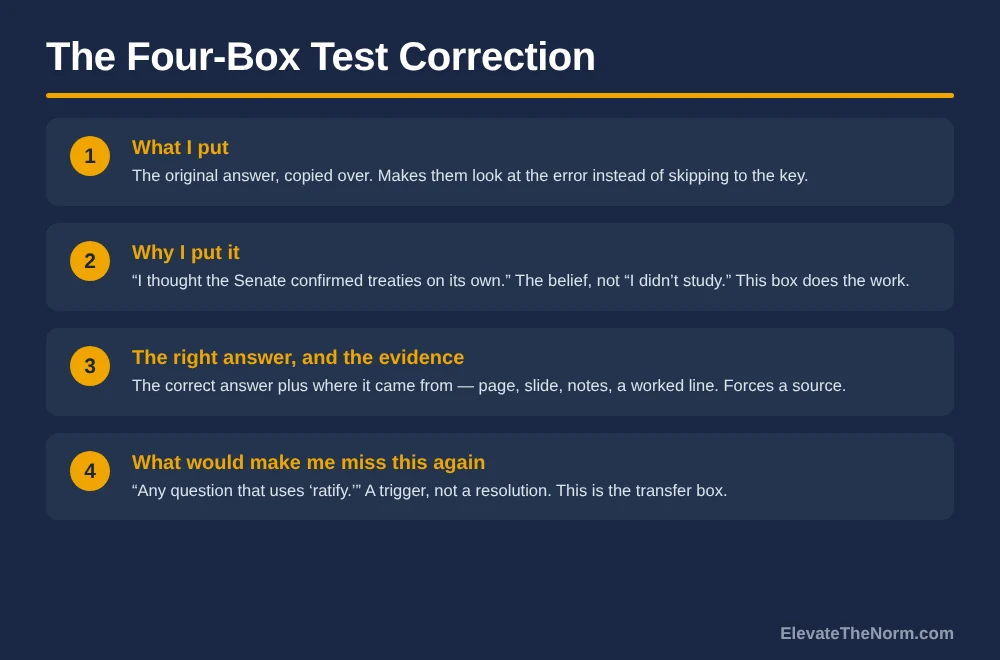
Each wrong answer gets four boxes. Not three, and not six. This is the smallest structure that makes transcription impossible.
| Box | What the student writes | Why it is there |
|---|---|---|
| 1. What I put | The original answer, copied over. | Makes them look at the error rather than skipping straight to the key. Takes five seconds. |
| 2. Why I put it | “I thought the Senate confirmed treaties on its own.” A sentence naming the belief, not “I didn’t study.” | This is the box that does the work. It is also the one students resist, because it requires admitting what they believed. |
| 3. The right answer, and the evidence | The correct answer plus where it came from — page, slide, notes, a worked line. | Forces a source. A student who cannot find it does not understand it yet, and now you both know. |
| 4. What would make me miss this again | “Any question that uses ‘ratify.’” A trigger, not a resolution. | Transfer. The point is the next question of this type, not this question. |
Box 2 is the one people cut when they are short on time, and it is the only one that distinguishes this from an answer key. “Careless mistake” is not an acceptable entry in box 2 more than once per test; if a student writes it three times, the pattern is the finding and it is worth a two-minute conversation.
For a free-response or math item, box 3 becomes “the first line where it went wrong,” which is more useful than reworking the whole problem and usually faster.
How Much Credit Should Test Corrections Be Worth?
Enough that students do them, little enough that the grade still means something. Half the missed points back is the common answer and it is defensible. So is a flat cap — corrections can move a score up to a 79 and no further.
Three things to settle before you announce it:
- Check your district’s grading policy first. Many boards have adopted language about reassessment, grade replacement, and minimum scores. A teacher-invented points-back scheme that conflicts with board policy is a problem that has nothing to do with pedagogy, and you will lose that argument in March rather than in September.
- Write it down and hand it out. Parents are reasonable about a policy that exists and furious about one that appears to change by student. “Up to half the missed points, corrections due within one week, box 2 must be completed” fits on an index card.
- Decide whether a correction can raise an A. The honest answer is yes. A student who got a 97 has three errors worth understanding, and excluding the strongest students from the only reteaching structure in the class is backwards. If credit is the only incentive you have, offer the strongest students the thing they actually want: the correction counts, and it gets read.
A note on what this does to your gradebook. If corrections replace scores rather than adding points, you are most of the way to standards-based grading already, and you should read the honest case against it before you commit, because the implementation problems there are real.


Test Corrections or a Retake — Which One Do You Need?
A correction analyzes the test the student already took. A retake is a new assessment of the same material. They answer different questions and they are not substitutes.
- Use corrections when the errors are scattered. A 71 made of eleven different small mistakes is a diagnosis problem. Corrections surface the pattern.
- Use a retake when the student did not know the material. A 44 does not have a pattern to find. It has a hole, and corrections on a test you did not understand is just copying.
- Use both, in order, when the stakes are real. Corrections first, as the price of admission to the retake. It is a reasonable gate and it stops the retake from being a free second roll of the dice.
Sequencing them that way also solves a fairness problem administrators raise: if a retake is available to anyone who asks, the students who ask are the students whose families know to ask. Requiring the correction makes the path the same for everybody.
What About the Student Who Just Copies the Right Answer?
Assume this will happen and build so it does not pay. Box 2 is most of the defence — you cannot copy someone else’s misconception off their paper, because it was not your misconception.
Beyond that the answers are ordinary. Do corrections in class, not as homework, at least the first few times — so you see the thinking happen and so students without a quiet place to work are not disadvantaged. Spend two of those minutes circulating and asking one student per row to explain box 2 out loud.
The Grading Burden, Honestly
If you teach 150 students and read four boxes on every missed item, you will stop doing this by October. Anyone who tells you otherwise has not graded a stack of 150.
Three ways to make it survivable:
- Cap it. Students correct their five worst items, not all of them. Five is plenty for a pattern and it bounds your reading.
- Score box 2 only, and score it pass/fail. A complete, specific sentence gets the credit. A blank or “I didn’t study” does not. You can do that at a glance.
- Read them as a class set, not as individual papers. Sort the box-2 responses into piles by misconception. Five minutes of sorting tells you what to reteach tomorrow, which is the only reason to collect them at all.
That last one is also the answer to a coach’s question: the evidence of learning is not the corrected test. It is what you teach differently on the next item of that type, and whether the same misconception shows up again on the unit after this one. If it does, the corrections were decoration. The habit of asking that question after an assessment is the same one behind any serious approach to checking for understanding.
What Does This Look Like From a Student’s Seat?
It looks like being asked to write down, on paper, in your own handwriting, the thing you were wrong about. That is harder than it sounds at fifteen, and it is worth naming out loud the first time you assign it.
Say the thing directly: this is not a punishment, everyone does it including the people who scored highest, and nobody is reading box 2 to laugh at you. Then make that true. A correction process where the teacher reads a student’s misconception back to them in front of the class is a process that will be filled in with nothing real by Thanksgiving.
Students should also be able to argue. If a student’s box 2 says “I put B because the question says ‘primarily,’ and both A and B are true,” they may be right and the item may be bad. Give points back when they are. A correction process in which the teacher is never wrong is one the students will correctly read as theatre.
And handle accommodations through the plan, not through the policy. A student with extended time or a scribe on the test has the same entitlement on the correction. A student with a processing or writing accommodation can answer box 2 out loud to you in ninety seconds; the requirement is the thinking, not the handwriting. The plan governs, and designing the correction so that honoring it looks ordinary is easier than making an exception every time.
Where Test Corrections Go Wrong
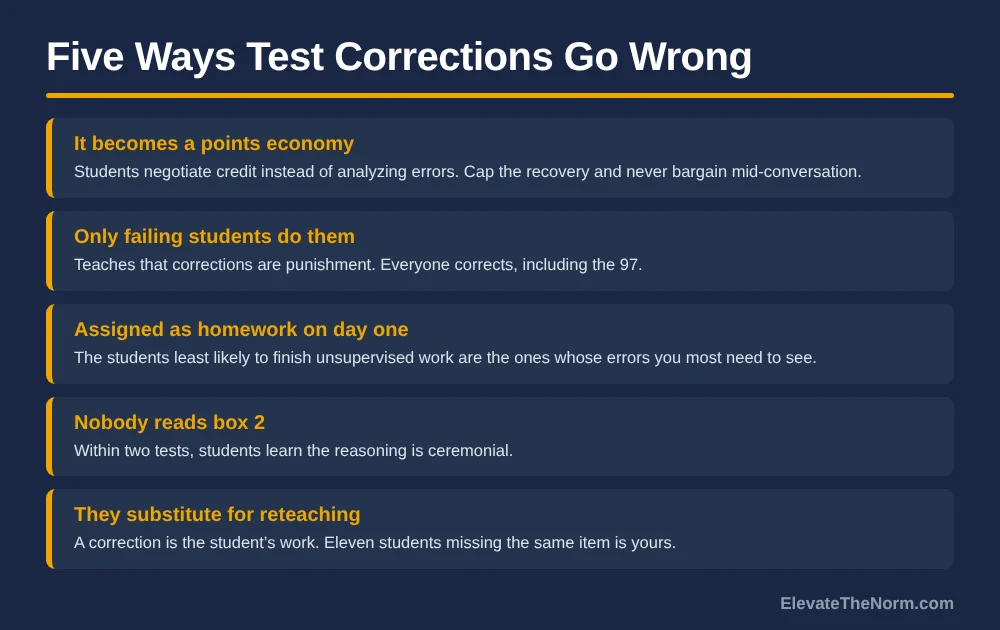
- They become a points economy. Students negotiate credit instead of analyzing errors. Fix: cap the recovery and never bargain over it mid-conversation.
- Only failing students do them. Which teaches that corrections are what happens when you mess up, rather than what everyone does with a returned test. Fix: everyone corrects, including the 97.
- They are assigned as homework on day one. The students least likely to complete unsupervised work are the students whose errors you most need to see — the same self-selection Maier and Klotz measured.
- Nobody reads box 2. If the teacher never responds to the reasoning, students learn within two tests that the reasoning is ceremonial.
- They substitute for reteaching. A correction is the student’s work. If eleven students missed the same item, that is your work.
What to Do Next
Take the next test you are about to hand back and do three things. Require corrections from every student, not just the ones who failed. Make box 2 — why I put it — mandatory for credit, and refuse “careless mistake” as a repeat answer. Then sort the box-2 responses into piles before you plan tomorrow, because that pile is the most honest data you will get all unit.
The deeper argument here is not about points. It is that a test handed back and filed away teaches a teenager that a wrong answer is a verdict, and a test corrected teaches them it is information. That is the same case the site makes about learning from mistakes everywhere else, and it is the reason a correction belongs in the student’s hands rather than the gradebook — which is also the argument for student self-assessment as a routine rather than an event.
Before you go: grab the free The Test Correction Sheet and Policy Card (2 pages) (PDF) — ElevateTheNorm.com branded, printable, no email required.
Frequently Asked Questions
Do test corrections actually work?
The underlying mechanism is well supported. Metcalfe’s 2017 review in the Annual Review of Psychology concludes that errorful learning followed by corrective feedback beats error avoidance, and in one lab study errors were corrected on a later test about 70% of the time with feedback against roughly 4% without it. The complication is compliance. In a study of 20,058 assessments by 2,826 students in grades 5–11, the error feedback page was opened in only 44% of cases. Corrections work. Optional corrections mostly do not.
How much credit should test corrections be worth?
Enough that students do them and little enough that the grade still means something. Half the missed points back is the common answer and it is defensible; so is a flat cap that lets corrections raise a score to a 79 and no further. Check your district’s grading and reassessment policy before you announce anything, write the policy down, hand it out, and do not vary it by student.
What is the difference between test corrections and a retake?
A correction analyzes the test the student already took. A retake is a new assessment of the same material. Use corrections when the errors are scattered — a 71 made of eleven small mistakes is a diagnosis problem. Use a retake when the student did not know the material, because corrections on a test you did not understand is just copying. When the stakes are real, use both in order and make the completed correction the price of admission to the retake.
How do I stop students from just copying the right answer?
Require a box that asks why they put what they put — the belief, not "I didn’t study." You cannot copy somebody else’s misconception off their paper, because it was not your misconception. Beyond that, do the first few rounds in class rather than as homework so you can see the thinking happen, and ask one student per row to explain that box out loud.
Should students who got an A do test corrections?
Yes. A student who scored 97 has three errors worth understanding, and excluding your strongest students from the only reteaching structure in the class is backwards. It also fixes a dignity problem: if only failing students correct, corrections become what happens when you mess up rather than what everybody does with a returned test.
How do I grade test corrections for 150 students?
Cap it at the five worst items per student, score only the reasoning box and score it pass/fail at a glance, and read the set as a class rather than as individual papers — sort the responses into piles by misconception. Five minutes of sorting tells you what to reteach tomorrow, which is the only real reason to collect them. If you are reading four boxes on every missed item for 150 students, you will stop doing this by October.
Is there a free test corrections template?
Yes — the two-page PDF linked on this page. Page 1 is the student sheet with three blocks of the four-box correction. Page 2 is a policy card to fill in and staple to the first test of the term, plus a sorting sheet for reading the set as a class. Free, printable, no email address required.
What should a student actually write in the "why I put it" box?
A sentence naming the belief that produced the wrong answer — "I thought the Senate confirmed treaties on its own" rather than "I rushed" or "careless mistake." Careless mistake is acceptable once per test. Written three times it is itself the finding, and worth a two-minute conversation. Students should also be allowed to argue: if the box says the item was ambiguous and they are right, give the points back. A correction process in which the teacher is never wrong is one students will correctly read as theatre.
Sources
- Metcalfe, Janet. “Learning from Errors.” Annual Review of Psychology, vol. 68, 2017, pp. 465–489. Review concluding that error avoidance “appears to be the rule in American classrooms” and that errorful learning followed by corrective feedback is beneficial; that corrective feedback “including analysis of the reasoning leading up to the mistake” is crucial; and recommending that educators allow students to commit and correct errors in low-stakes situations. A review of laboratory evidence, not a classroom trial. https://www.annualreviews.org/content/journals/10.1146/annurev-psych-010416-044022
- Metcalfe, Janet, and Bridgid Finn. “People’s Hypercorrection of High-Confidence Errors: Did They Know It All Along?” Journal of Experimental Psychology: Learning, Memory, and Cognition, vol. 37, no. 2, 2011, pp. 437–448. Three experiments, 25–45 participants each. High-confidence errors corrected at roughly 82% on the final test; overall recall with feedback about 70%; correction without feedback roughly 4%. College undergraduates answering general-knowledge questions in a laboratory, not secondary students on a unit test. https://pmc.ncbi.nlm.nih.gov/articles/PMC3079415
- Maier, Ulrich, and Christian Klotz. “Students Ignore Their Mistakes: Elaborated Error Feedback Processing in a Digital Learning System.” Contemporary Educational Psychology, vol. 82, 2025, article 102395. Observational log analysis of 20,058 formative assessment cases from 2,826 students across 182 secondary classrooms, grades 5–11, 2020–2024. Error feedback opened in 44% of cases; median one error item reviewed; 51% of available errors reviewed on average; prior knowledge the strongest predictor of feedback seeking. Observational, German secondary schools, a digital grammar application rather than a paper test. https://www.sciencedirect.com/science/article/pii/S0361476X25000608
- Soicher, Raechel N., and Regan A. R. Gurung. “Do Exam Wrappers Increase Metacognition and Performance? A Single Course Intervention.” Psychology Learning & Teaching, 2017, pp. 64–73. 86 students randomly assigned to exam wrappers, sham wrappers, or control. No improvement in exam performance, final grades, or Metacognitive Awareness Inventory scores; MAI rose in all conditions including control. University students, single course. https://liberalarts.oregonstate.edu/biblio/do-exam-wrappers-increase-metacognition-and-performance-single-course-intervention
- Rice, Bethany S. “How Extra Credit Quizzes and Test Corrections Improve Student Learning While Reducing Stress.” ASEE 127th Annual Conference & Exposition, 2020. Average exam scores rose 5% (2018) and 3% (2019) when corrections were offered; 80% of students participated; survey responses strongly favourable. Cited as a descriptive classroom report, not a controlled study: no comparison group, 31 survey respondents, university engineering technology students. https://peer.asee.org/how-extra-credit-quizzes-and-test-corrections-improve-student-learning-while-reducing-stress.pdf
- McDade, Margaret. “Using Test Corrections as a Learning Tool.” Edutopia, George Lucas Educational Foundation. A high school math teacher’s small-group correction routine, with retesting for full credit rather than partial credit on corrections. Cited as practice knowledge: the article reports a teacher’s own method and cites no studies. https://www.edutopia.org/article/test-corrections-high-school-math/