
By Clay Shumate
Classroom culture frameworks with ongoing coaching and feedback include Responsive Classroom, Conscious Discipline, CHAMPS, Teach Like a Champion and PBIS. PBIS coaching usually comes through state and district networks; the paid programs mostly price coaching by quote. Coaching is worth it: a 60-study meta-analysis found it improved teachers’ instruction by 0.49 standard deviations.
Key Takeaways
- Teacher coaching improved instruction by 0.49 standard deviations and student achievement by 0.18 across 60 causal studies in a 2018 meta-analysis.
- Coaching programs with fewer than 100 teachers outperformed larger ones, averaging 0.63 standard deviations on instruction against 0.34.
- Virtual teacher coaching showed no statistically significant difference from in-person coaching in the same meta-analysis.
- PBIS coaching runs through school, district and state coaches, while Responsive Classroom, Conscious Discipline and CHAMPS consulting are priced by quote.
- Two teachers with a camera and one countable target, such as positive interactions per correction, can run a free coaching cycle every two weeks.
Ongoing coaching is repeated cycles of observation, feedback and goal setting with a coach, as opposed to a single workshop. This page covers what each program’s coaching actually looks like, what the research says about coaching, and how to coach yourself or a colleague for free. If you’re comparing prices on books and workshops instead, see the buyer’s guide to classroom culture frameworks. For every framework at a glance, see the classroom culture frameworks Q&A hub.
Why does coaching matter more than the classroom culture framework you pick?
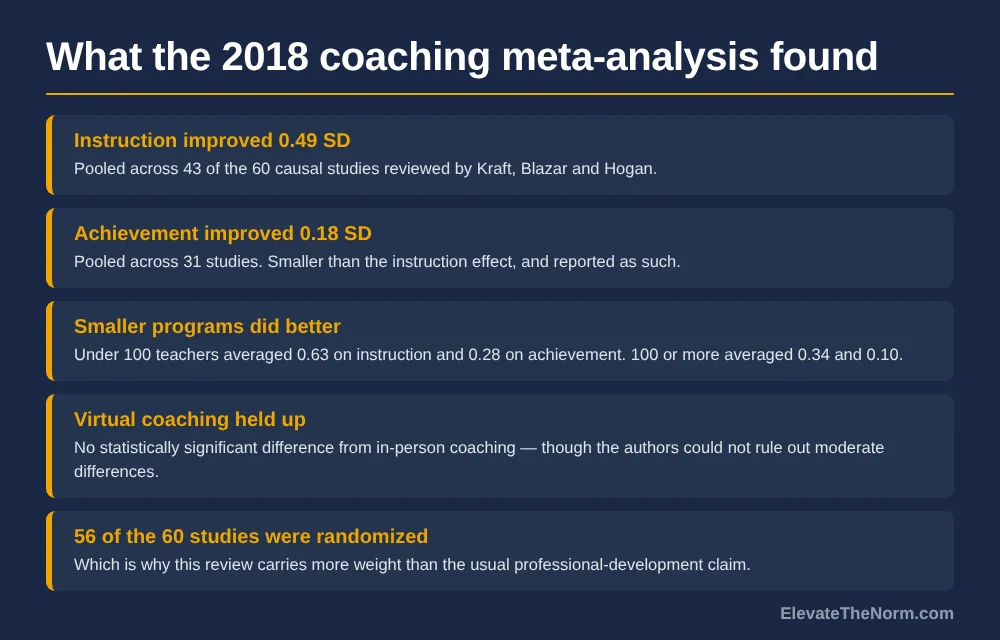
Coaching matters more than the framework because one-time training rarely changes daily classroom practice, while repeated observation and feedback does. The largest review on this is a 2018 meta-analysis by Matthew Kraft, David Blazar and Dylan Hogan in the Review of Educational Research. It pooled 60 studies with causal designs, 56 of them randomized trials (Kraft, Blazar & Hogan, 2018). What it found:
- Instruction improved by 0.49 standard deviations across 43 studies.
- Achievement improved by 0.18 standard deviations across 31 studies.
- Smaller programs did better. Programs with fewer than 100 teachers averaged 0.63 on instruction and 0.28 on achievement. Programs with 100 or more averaged 0.34 and 0.10. The authors point to the difficulty of finding good coaches and getting teacher buy-in at scale.
- Virtual coaching held up. They found no statistically significant difference between in-person and virtual coaching, though they couldn’t rule out moderate differences.
Classroom management research points the same way. In the federally funded CHAMPS trial, middle school teachers got three days of workshops followed by monthly coaching for a full year. They praised more, gave more opportunities to respond, and ran better-organized classrooms (IES).
Which classroom culture frameworks offer ongoing coaching and feedback?
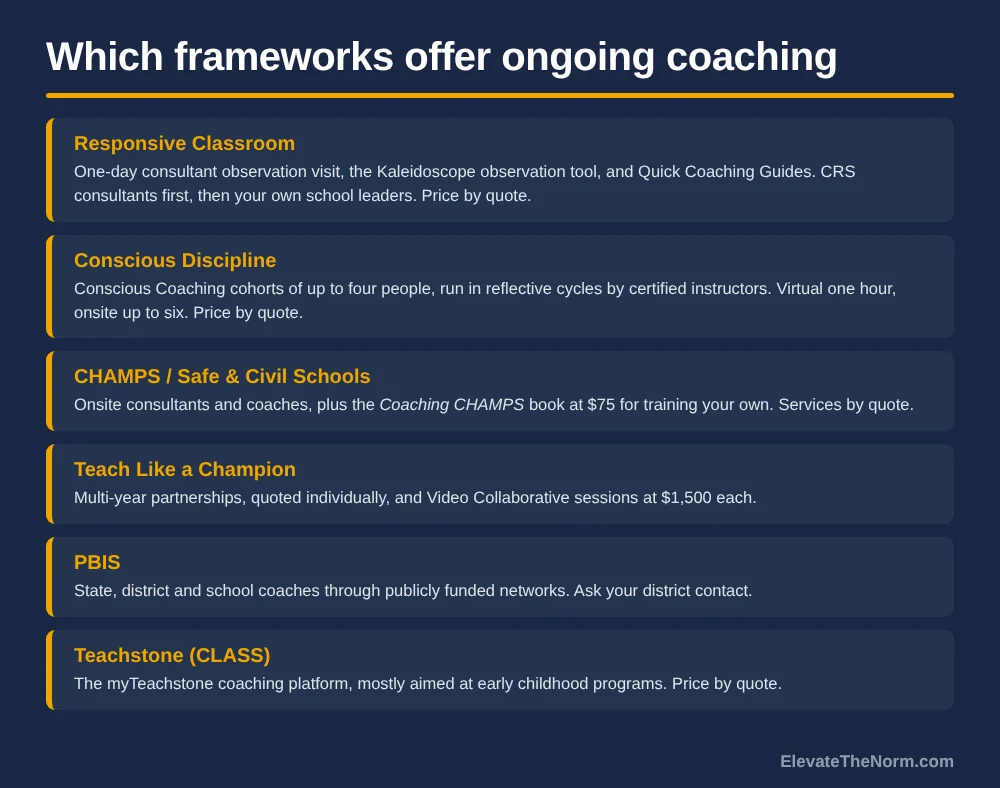
Responsive Classroom, Conscious Discipline, CHAMPS, Teach Like a Champion and PBIS all offer ongoing coaching and feedback. PBIS coaching runs through state, district and school coaches. The paid programs price most coaching by quote, with two listed exceptions: Teach Like a Champion’s $1,500 video session and the $75 Coaching CHAMPS book.
| Framework | Coaching format | Who coaches | Price | Grade fit |
|---|---|---|---|---|
| Responsive Classroom | One-day consultant observation visit; Kaleidoscope observation tool; Quick Coaching Guides | CRS consultants, then school leaders | By quote | PreK–8; secondary course 6–12 |
| Conscious Discipline | Conscious Coaching cohorts (up to 4 people), reflective cycles | Certified instructors | By quote | Early childhood–grade 5 |
| CHAMPS / Safe & Civil Schools | Onsite consultants and coaches; Coaching CHAMPS book | SCS consultants or your own coaches | Book $75; services by quote | K–8; secondary book for 9–12 |
| Teach Like a Champion | Multi-year partnerships; Video Collaborative sessions | TLAC team | Video session $1,500; partnerships by quote | K–12 |
| PBIS | State, district and school coaches | State networks and district staff | Through your state or district; ask locally | K–12 |
| Teachstone (CLASS) | myTeachstone coaching platform | Program or Teachstone coaches | By quote | Mostly early childhood |
What coaching does Responsive Classroom offer?
Responsive Classroom offers a one-day consultant observation visit with a same-day debrief, then gives school leaders tools to keep observing on their own. In a Consultant Observation and Feedback Visit, a Center for Responsive Schools consultant observes eight to ten classrooms plus spaces like arrival, the cafeteria, hallways and dismissal. The observations run through Kaleidoscope, which produces a school growth profile, and the consultant debriefs with the leadership team that afternoon. The school gets a free pack of Quick Coaching Guides on a focus topic (CRS information sheet).
After the visit, leaders keep using Kaleidoscope on their own. It comes with school and district packages for one school year after a training course and can be bought separately. The Quick Coaching Guides cover 30 topics for reflection and goal setting, and buying ten or more includes a free Leader Guide. Prices are by quote (On-Site Services).
The catch: the ongoing part depends on your own leaders doing the observing. The consultant comes once.
Does Conscious Discipline offer coaching?
Yes. Conscious Discipline offers Conscious Coaching: small cohorts of up to four adults, led by certified instructors, meeting virtually for one hour or onsite for up to six hours. Participants set goals, reflect and practice together in repeated coaching cycles (Conscious Coaching overview). Its training page also lists an ongoing virtual partnership (Conscious Discipline training). Pricing isn’t posted.
The coaching focuses on adult mindset and real interactions, which fits the program’s adult-first design. It’s built for early childhood and PreK–5.
Does CHAMPS offer coaching for teachers?
CHAMPS coaching comes from Safe & Civil Schools consultants and coaches, or from your own coaches trained with the Coaching CHAMPS book. Ancora Publishing points schools to Safe & Civil Schools for in-person help, and sells Coaching CHAMPS by Tricia Skyles, Randy Sprick and Jim Knight for $75.
In an interview, Sprick and Skyles described a “freedom within form” model: the district sets clear targets, and teachers choose how to reach them. Their example targets were 90% student engagement, 90% compliance, and three to five positive interactions for every correction. Skyles argued that without clear targets, coaches have nothing to coach toward (Instructional Coaching Group). The CHAMPS trial’s monthly coaching is the strongest classroom-management evidence on this page.
Does Teach Like a Champion include coaching?
Teach Like a Champion includes coaching through custom multi-year partnerships and paid video review sessions, but a standalone workshop doesn’t include ongoing coaching. The TLAC team, which moved from Uncommon Schools to Together Education in 2022 (TLAC blog), offers multi-year partnerships. In those, it studies video and artifacts from your school, helps build your own video system, and models PD design. Partnerships are quoted individually. Its Video Collaborative, a 90-minute review of your pre-selected classroom footage, is $1,500 a session, and its 41 TLAC Online modules ($68 for one user) can also be used for 1:1 coaching (TLAC workshop pricing sheet).
Can you get free coaching through PBIS?
PBIS coaching is often available to teachers at no direct cost, because it runs through state, district and school coaches rather than a vendor. The Center on PBIS describes coaching at three levels: state coaches work with district teams, and district and school coaches work with administrators and Tier 1 teams. Coaching targets individual skills with feedback, team routines, and the systems that keep PBIS going. The center posts a free coaching self-assessment and practice briefs (Center on PBIS, Coaching).
Start with your district’s PBIS contact. In Alabama, for example, the state department of education partnered with the University of Alabama’s positive behavior supports office to expand training and ongoing support (University of Alabama News).


Is Teachstone CLASS coaching useful for secondary teachers?
Teachstone’s CLASS coaching is built mostly for early childhood programs, so grades 6–12 teachers will usually find a closer fit elsewhere. Teachstone describes myTeachstone as a CLASS coaching platform with frequent online contact between coaches and teachers and online learning communities. Its materials reference Head Start and early childhood quality systems, and pricing goes through sales (Teachstone).
How can a teacher get classroom management coaching for free?
A teacher can get free classroom management coaching by pairing with a colleague, recording short lesson clips, and coaching toward one countable target. The 2018 meta-analysis found virtual coaching held up and smaller programs did better, which is good news for a two-teacher arrangement.
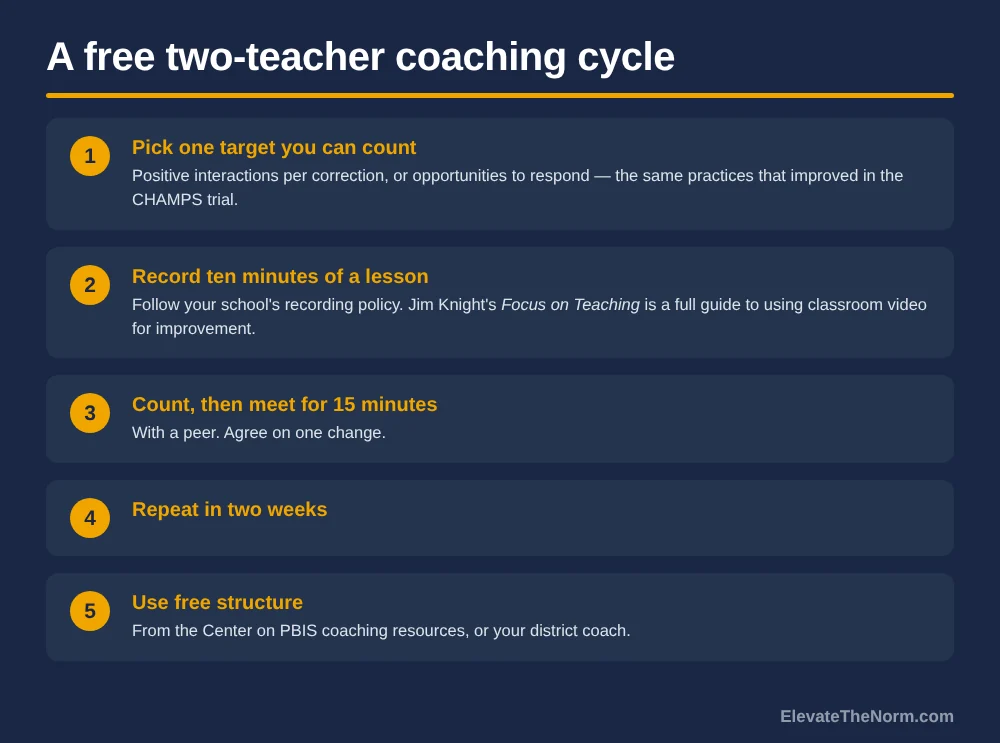
- Pick one target. Use something you can count, like positive interactions per correction or opportunities to respond, the same practices that improved in the CHAMPS trial.
- Record ten minutes of a lesson. Jim Knight’s Focus on Teaching is a full guide to using classroom video for improvement. Follow your school’s recording policy.
- Count, then meet for 15 minutes with a peer. Agree on one change.
- Repeat in two weeks.
- Use free structure from the PBIS coaching resources or your district coach.
Clay’s take: As a grades 6–12 teacher, I’d try the free routes first: your district’s PBIS coach, or a colleague and one countable target. Pay for vendor coaching when you need expertise your building doesn’t have. That’s a judgment on the research on this page, not a result from my own room.
More options are in free professional development for teachers and collective teacher efficacy. If you’d rather customize a framework first, see customizable classroom culture frameworks.
Does Elevate the Norm offer coaching?
Elevate the Norm doesn’t offer coaching, but its free grades 6–12 framework gives a peer coach clear things to look for. Disclosure: it’s this site’s own framework, built by Clay Shumate, a certified 6–12 social studies teacher, and it hasn’t been independently evaluated.
A colleague can watch for whether recognition criteria were announced in advance, whether the teacher followed through exactly as stated, and how transitions run under the 3-2-1-Done class-vs-class point system. The materials are on the free resource library with no email gate. A paid option from the same teacher, the Teacher Emergency Toolkit, includes behavior and MTSS documentation templates that can serve as a record for coaching conversations.
Frequently Asked Questions
Which classroom culture frameworks include ongoing coaching?
Responsive Classroom, Conscious Discipline, CHAMPS from Safe and Civil Schools, Teach Like a Champion and PBIS all offer ongoing coaching. PBIS coaching usually runs through state, district and school coaching networks. The paid programs price most coaching by quote, though Teach Like a Champion lists its 90-minute Video Collaborative at $1,500 a session and the Coaching CHAMPS book costs $75.
Does teacher coaching actually work?
Yes. A 2018 meta-analysis by Matthew Kraft, David Blazar and Dylan Hogan pooled 60 causal studies, 56 of them randomized trials. Coaching improved teachers’ instruction by 0.49 standard deviations across 43 studies and student achievement by 0.18 across 31 studies. Programs with fewer than 100 teachers did better than larger ones, which the authors linked to finding good coaches at scale.
Is virtual coaching as good as in-person coaching?
The 2018 Kraft, Blazar and Hogan meta-analysis found no statistically significant difference between virtual and in-person teacher coaching on either instruction or student achievement. The authors noted their estimates were too imprecise to rule out moderate differences. For teachers without a local coach, that makes virtual options, such as Conscious Discipline’s one-hour virtual cohorts, a reasonable choice rather than a second-best one.
How can I get classroom management coaching for free?
Ask your district’s PBIS contact first, because PBIS coaching runs through school, district and state coaches. If none is available, pair with a colleague, record ten minutes of a lesson under your school’s recording policy, and count one target such as positive interactions per correction. Meet for 15 minutes, agree on one change, and repeat the cycle in two weeks.
What does Teach Like a Champion video feedback cost?
Teach Like a Champion’s Video Collaborative, a 90-minute review of a school’s pre-selected classroom footage, is listed at $1,500 per session on the organization’s workshop pricing sheet. Multi-year partnerships, which include studying a school’s own video and building its video system, are quoted individually. The 41 TLAC Online modules cost $68 for one user and can be used for 1:1 coaching.
Should a school pay for vendor coaching or train its own coaches?
The research favors starting small and well staffed. Kraft, Blazar and Hogan found coaching programs with fewer than 100 teachers averaged 0.63 standard deviations on instruction, against 0.34 for larger programs, and the authors pointed to the difficulty of finding good coaches at scale. Many schools can start with district PBIS coaches or the $75 Coaching CHAMPS book before buying vendor coaching.
What should a peer coach look for in a classroom?
A peer coach should look for one target that can be counted, not a general impression. Good examples are positive interactions per correction and opportunities to respond, the practices that improved in the federally funded CHAMPS middle school trial. Sprick and Skyles describe district targets such as three to five positive interactions for every correction, which gives the coach and teacher a shared number to track.
Do these coaching programs work for middle and high school?
Some fit secondary classrooms better than others. The CHAMPS trial studied middle school teachers, Teach Like a Champion covers K–12, and PBIS coaching runs K–12. Responsive Classroom is built for PreK–8 with a separate grades 6–12 course, while Conscious Discipline and Teachstone’s CLASS focus on early childhood and elementary programs. Grades 6–12 teachers should start with CHAMPS, Teach Like a Champion or PBIS.
Sources
- Kraft, Blazar & Hogan (2018), The Effect of Teacher Coaching on Instruction and Achievement, Review of Educational Research
- Institute of Education Sciences — evaluation of the CHAMPS classroom management training program for middle school teachers
- Center for Responsive Schools — Consultant Observation and Feedback Visit and Kaleidoscope information sheet
- Responsive Classroom — Quick Coaching Guides
- Responsive Classroom — On-Site Services
- Conscious Discipline — Conscious Coaching overview
- Conscious Discipline — professional development training
- Ancora Publishing — CHAMPS and Coaching CHAMPS
- Instructional Coaching Group — interview with Randy Sprick and Tricia McKale Skyles
- Team TLAC blog — the move to Together Education
- Teach Like a Champion — workshop descriptions and pricing sheet
- Center on PBIS — Coaching
- University of Alabama News — state PBIS partnership
- Teachstone — myTeachstone
- Corwin — Jim Knight, Focus on Teaching
How is this page kept accurate?
This page is kept accurate by taking program details and prices from each provider’s own site and study figures from the original paper or official summaries, all linked inline. Confirm current prices with the provider. Elevate the Norm and the Teacher Emergency Toolkit are labeled as this site’s own work. Corrections follow the editorial standards and corrections policy.