By Clay Shumate
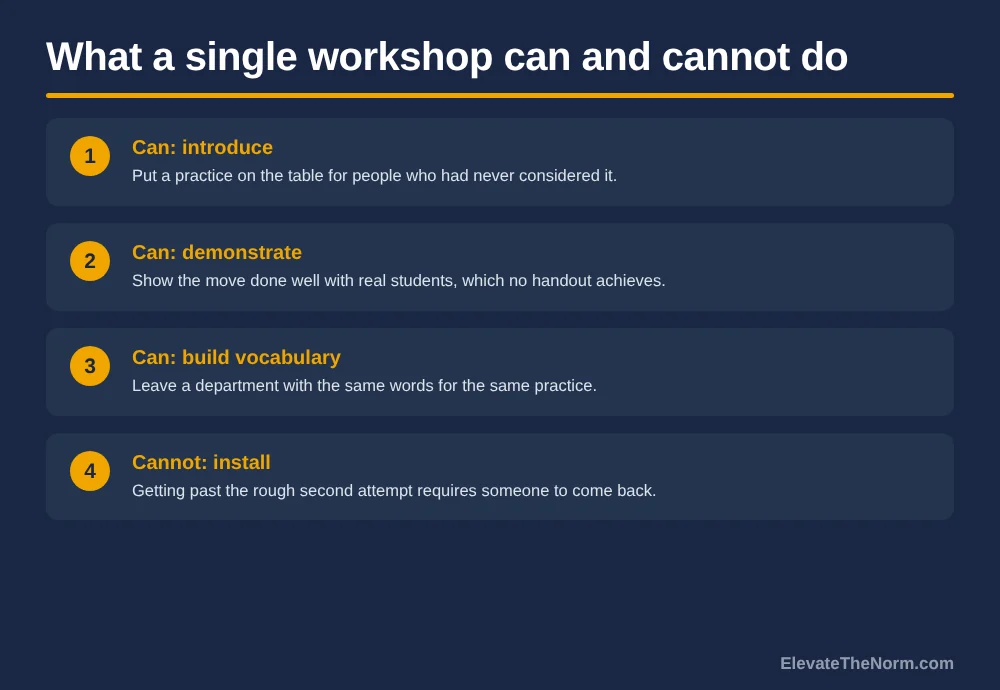
Teacher professional development workshops are single sessions, usually one to six hours, in which a presenter introduces a practice to a group. A workshop can do three things well: introduce an idea, demonstrate what it looks like, and give a staff shared language for it. It cannot install the practice. That requires follow-up, and most workshops are never funded for any.
I want to be careful here, because “workshops do not work” has become the kind of thing people say to sound informed, and it is not quite true. The format has a job. The problem is that the job it can do is small, and we keep asking it to do a much bigger one. This piece is about the single session specifically — what the delivery format can and cannot carry, and how to tell the difference before you sit down.
Key Takeaways
- A workshop is an introduction, not an installation. Explaining a practice and getting it running in a classroom are different jobs, and only the first fits in one session.
- Under roughly 14 total hours, the studies stop finding student effects. In the federal review that applied What Works Clearinghouse standards, the three programs with 5 to 14 hours showed no statistically significant achievement effects.
- Follow-up is the whole variable. The one delivery model with strong causal evidence — coaching — is essentially “someone comes back,” and it produced a 0.49 SD effect on instruction across 60 studies.
- Design features are not the same as effectiveness. Reviews that catalog the features of good PD studied programs that already worked, which is a different claim than the one most workshop agendas imply.
- Teacher workshops are not theater because teachers are cynical. They are theater when nobody is accountable for what happens after, and the people booking them usually know this.
- A good one-off tells you the truth about itself. “Today is awareness, implementation starts in October with these three supports” is a defensible sentence. “You have now been trained” is not.
What is a professional development workshop supposed to do?
Change what a teacher knows and believes, so that a later change in practice becomes possible. That is the honest job description. A session can put a practice in front of forty people who had never considered it, show it working, name its parts, and answer the first round of objections. That is real value and it is not nothing.
The trouble starts when a workshop gets described as training. Training implies that someone can now do the thing. After one session, almost nobody can. They can describe it. The gap between describing a practice and executing it at 9:15 on a Tuesday with twenty-eight teenagers is the entire problem of professional learning, and the single-session format does not touch it.
So when you look at an agenda, read it for what it is claiming. A session that promises awareness and delivers awareness has done its job. A session that promises implementation in ninety minutes has made a claim nobody can keep.
What can a workshop genuinely accomplish?
Four things, all of them upstream of practice. I would rate them in this order.
- Existence. Teachers cannot adopt a practice they have never heard of. A workshop is a cheap, fast way to put something on the table.
- Demonstration. Watching a practice done well — live, modeled, or on video with real students — resolves questions no handout answers. The Learning Policy Institute’s review of 35 rigorous studies found modeling of effective practice among the features common to programs that worked (Darling-Hammond, Hyler & Gardner, 2017).
- Shared vocabulary. When a whole department leaves with the same words for the same move, the hallway conversations afterward get cheaper. This is a genuinely underrated function.
- Content knowledge. A workshop can teach subject matter. A randomized federal study delivered 80 hours of summer mathematics content work and measurably improved teachers’ mathematical knowledge and the quality of their in-class explanations — so sessions can move knowledge, and reliably (Garet et al., NCEE 2016–4010).
Note the word “upstream” in all four. Existence, demonstration, vocabulary and knowledge are preconditions. None of them is a changed lesson.
What can a workshop not do on its own?
It cannot get a new practice past the second attempt, and the second attempt is where practices die. The first try of anything new is usually rough. A teacher who has nobody to debrief that rough first try with reads the roughness as evidence the practice does not work in their room, and goes back to what was working well enough. That is a rational response to no feedback.
The same federal study that raised teacher knowledge with 93 total hours of PD found no positive impact on student achievement. The teachers knew more math and gave better explanations, and the students’ scores did not move within the study window. Worth naming the population: over 200 fourth-grade mathematics teachers across six districts in five states. This site is about grades 6–12 and I am not going to pretend a fourth-grade math result transfers directly. The structural lesson does transfer: knowledge gain is not the finish line, and a workshop that delivers knowledge has delivered a middle step.
A workshop also cannot solve the problems that are actually blocking the practice — no planning time, a grading load that eats the weekend, a schedule with no common prep, a class where the basic routines are not yet reliable. If the obstacle is time or structure, more explanation does not help.
Why do teacher workshops keep getting booked anyway?
Because the workshop is the only PD format that scales to an entire staff on one calendar day at a known price. I think it is worth being generous about this rather than cynical. A principal with one professional day and a fixed budget can reach every adult in the building for the cost of a presenter and a cafeteria. Nothing else does that.
There is also an accountability logic. When a district needs to demonstrate that staff were informed of something — a policy change, a legal requirement, a new platform — a session with a sign-in sheet produces a record. For genuinely informational content, that is the right tool. Nobody needs coaching cycles to learn where the new incident report lives.
The failure is not booking the workshop. The failure is booking a workshop for an instructional change and then reporting attendance as if it were implementation. TNTP’s widely cited 2015 report estimated teachers spent the equivalent of about 19 school days a year on development activities in the districts it studied, at roughly $18,000 per teacher, without finding a pattern that separated the teachers who improved (TNTP, 2015). That report has serious methodological critics and I would not lean on its conclusions, but the time estimate is the part worth sitting with. Nineteen days is a lot of days.
How many hours before a workshop shows up in student learning?
The best available threshold is about 14 total contact hours, and below it the evidence goes quiet. The federal regional lab review by Yoon and colleagues screened more than 1,300 studies and found nine that met What Works Clearinghouse evidence standards. Programs above 14 hours showed positive, significant effects on student achievement; the three programs with the least time — 5 to 14 hours total — showed no statistically significant effects (Yoon et al., REL 2007–033).
Be careful with that number. Nine studies is a thin base, the review is from 2007, and all nine ran in elementary grades. It is not a law. What it is good for is arithmetic. A single three-hour session is a fifth of the way to the floor. Three such sessions across a year, with nothing between them, still does not clear it. If your professional learning plan for a priority consists of two half-days, you now have a defensible reason to say the plan is under-resourced rather than the teachers under-committed.
And hours alone are plainly insufficient — the 93-hour study above had the hours and no student effect. Duration is a floor, not an engine.
What makes the difference between a workshop that transfers and one that does not?
Follow-up, and specifically follow-up in which somebody sees the teacher teach. This is the closest thing to a clean finding in the whole literature. Kraft, Blazar and Hogan’s meta-analysis of 60 causal studies of teacher coaching found a pooled effect of 0.49 standard deviations on instructional practice and 0.18 on student achievement (Kraft, Blazar & Hogan, 2018). An effect of 0.49 on instruction is large for education research.
Read what coaching actually consists of and it is unglamorous: someone watches a real lesson, talks about that specific lesson, and comes back. The workshop supplies the idea; the return visit supplies the installation.
The same paper carries the caution that matters for a school planning this. Effects from effectiveness trials of larger programs were only a fraction of the effects in efficacy trials of smaller programs. A coaching model with one coach for sixty teachers is not the intervention the meta-analysis measured. Ratio and protected time are the program.
Mary Kennedy’s review of 28 rigorous studies points the same direction from another angle: sorting programs by their theory of action rather than their design features, she found many popular design features were not associated with effectiveness, while the pedagogy used to help teachers enact the practice varied sharply in impact (Kennedy, 2016). In plain terms: what the session does to help you do it matters more than how the session is shaped.
Does choice matter, or is that just a morale concern?
It is both, and the research does not settle it. I will separate what I can support from what I believe. What I can support: the feature lists that mention active learning and relevance are correlational, and Sims and Fletcher-Wood argued in a critical review that those lists rest on inappropriate inclusion criteria and cannot bear the weight placed on them (Sims & Fletcher-Wood, 2021). So I cannot tell you that choice causes transfer.
What I believe, as a professional judgment: a teacher who chose the session arrives having already decided the problem is worth solving, which is most of the work of adoption. A twenty-year veteran and a first-year teacher sitting through the identical required session on questioning technique are not in the same room. Required compliance content should be required. Instructional learning does not have to be uniform, and departments that offer two or three strands instead of one usually do not pay much for it.
A checklist for evaluating teacher professional development workshops
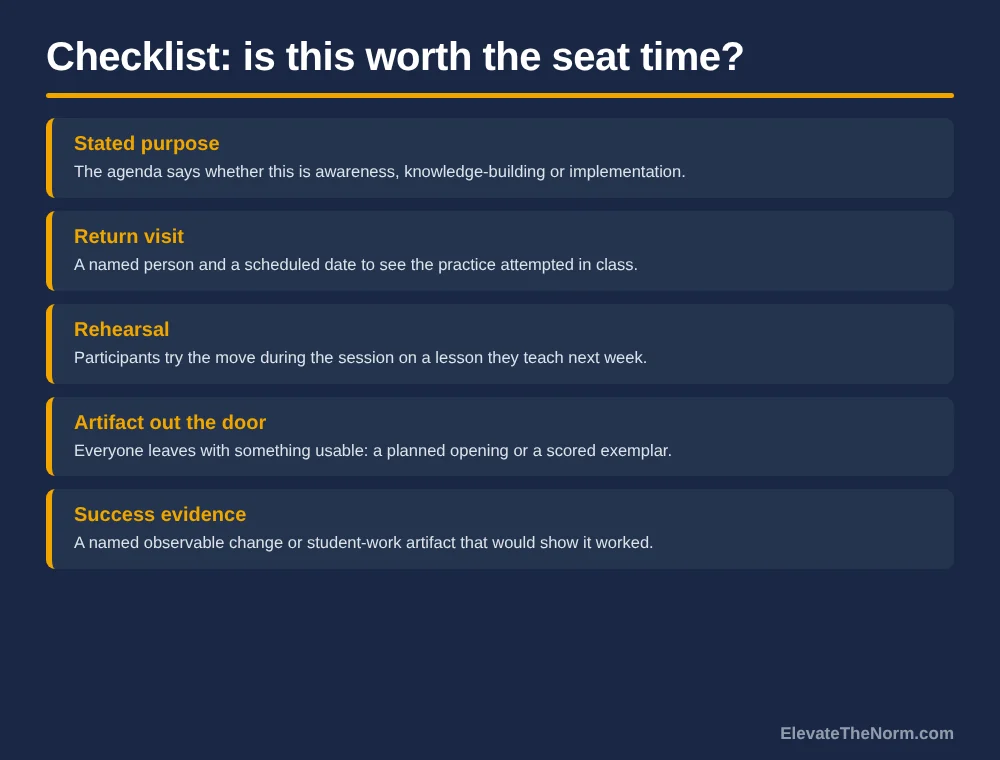
Run the session against these ten items; six or more unchecked means you are looking at an awareness event, and should plan accordingly. This works equally well as a design tool if you are the one building it.
| Element | What to look for |
|---|---|
| Stated purpose | The agenda says whether this is awareness, knowledge-building, or implementation — and does not confuse them |
| Total hours | The session is part of a sequence with enough combined time to clear roughly 14 hours |
| Return visit | A named person and a scheduled date for someone to see the practice attempted |
| Modeling | The practice is demonstrated with students in a comparable grade band and subject, not described |
| Rehearsal | Participants actually try the move during the session, on a real lesson they teach next week |
| Artifact out the door | Everyone leaves with something usable: a planned opening, a rewritten prompt, a scored exemplar |
| Something removed | A named task comes off the plate to make room, rather than the new practice being purely additive |
| Choice | More than one strand, or a path for people who already do this well |
| Success evidence | A specified observable change or student-work artifact that would indicate it worked |
| Honest follow-up plan | If there is no follow-up, the organizers say so out loud instead of calling it training |
I would add one informal test. Ask whoever is running it: “What are you going to look at in six weeks to know whether this landed?” A good answer exists in about one case in five, and the answer tells you almost everything about how the session was planned.


How should a department lead design a series that is worth the time?
Build backward from the second attempt. Most workshop planning starts with content and a date. Start instead with the question of who will be in whose room in week three, and build the session to serve that visit.
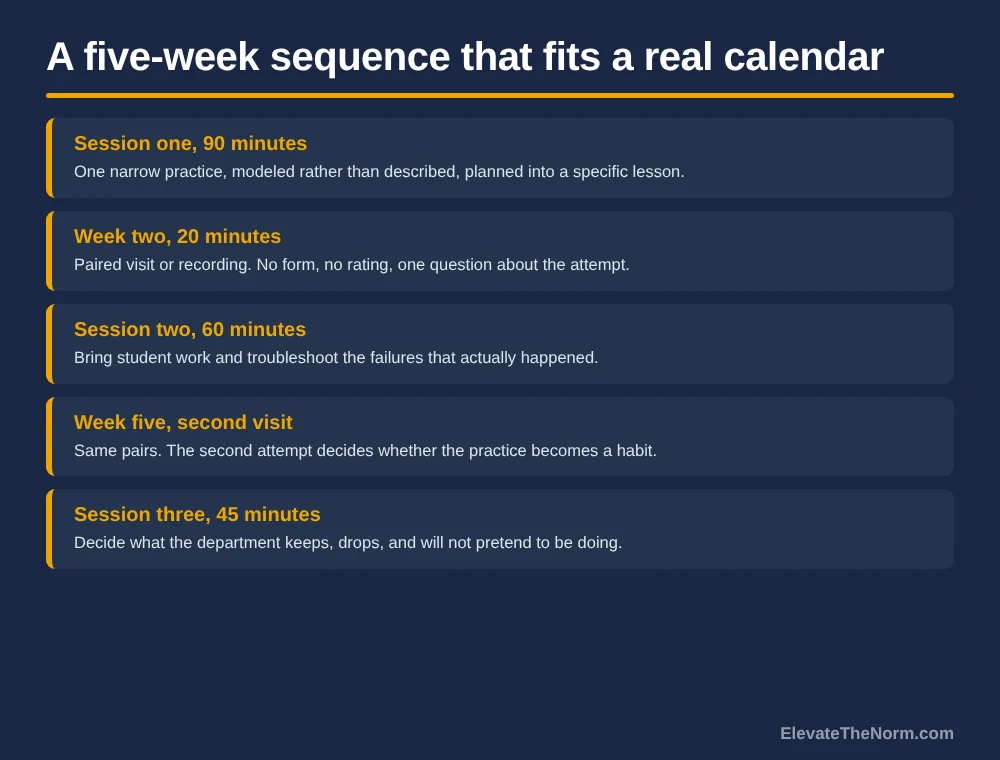
A sequence that fits an ordinary school calendar, roughly:
- Session one, 90 minutes. One narrow practice. Modeled, not described. Everyone leaves having planned where it goes in a specific lesson next week.
- Week two, protected 20 minutes. Paired teachers trade a short visit or a recording of one class. No form, no rating. One question: what happened at the moment you tried it?
- Session two, 60 minutes. Bring student work. Troubleshoot the three failures that actually came up, which will not be the three you predicted.
- Week five, second visit. Same pairs. The second attempt is the one that decides whether this becomes a habit.
- Session three, 45 minutes. Decide together what the department keeps, what it drops, and what it will not pretend to be doing.
That is under five hours of seat time and it will outperform a full day, because the seat time is wrapped around two real classroom attempts. The expensive part is not the sessions. It is the twenty protected minutes in weeks two and five, which is a scheduling fight somebody has to be willing to have.
Pick the narrow practice carefully. A single move with a visible student behavior attached works best — something like a specific way of checking what students actually understood rather than a broad commitment to engagement.
What does an honest one-off look like?
One that names itself accurately and gives people something they can use tomorrow without any further support. Not every session needs a coaching cycle behind it. Some content genuinely is informational, and some practices are small enough to adopt from a single demonstration.
An honest one-off: announces that it is awareness or a tool handoff, runs ninety minutes rather than a day, ends with a concrete artifact in hand, and does not appear in anyone’s evaluation as evidence of training. If a presenter says “this is one idea, here is the one-page version, and nobody is going to check whether you used it” — that is an honest session, and teachers respond to that honesty.
The dishonest version is the day-long session on an instructional change, followed by nothing, followed in spring by an observation rubric that references it. That sequence teaches staff that professional learning is a compliance performance, and it is hard to un-teach. It also corrodes the shared belief that a staff can actually move students together, which is its own thread worth reading about.
How should a teacher handle a workshop they did not choose?
Decide in the first twenty minutes what the session can give you, take that, and stop grading it against what it was never going to do. This is not resignation. It is calibration, and it protects the energy you need for the class you teach the next morning.
Concretely: look for one usable thing — a phrasing, a template, one example you can steal. Ask the two operational questions out loud, because they are polite and they surface the truth: how many sessions is this, and is anyone coming by to see us try it? Write down the one thing you will actually attempt, and when. If the answer to both questions is nothing, you have learned that this is awareness, and you can give it awareness-level attention without guilt.
And then do the part the workshop cannot do for you. A short structured reflection after your own first attempt is the cheapest available substitute for a coach. The evidence base for self-reflection is much weaker than for coaching, and I will not oversell it — but it does not require anyone else’s budget or calendar.
What to do next with teacher professional development workshops
Keep the format, shrink its claims, and spend the saved money on the return visit. That is the recommendation, and it follows directly from the evidence rather than from anybody’s preference about meetings.
If you are a teacher: run the checklist, take the one usable thing, and ask the two questions. If you lead a department: book the follow-up before you book the session, and if the calendar cannot hold the follow-up, run a ninety-minute honest one-off instead of a day you cannot support. If you are a principal: stop letting attendance count as implementation in your own reporting, even internally, because that is the habit that makes every other problem invisible.
For the broader question of which professional learning models have real evidence behind them, I laid that out in the wider look at what actually changes teaching. And for why teachers should be treated as people capable of judging these offers in the first place, see the case for professional judgment over scripts.
Sources
- Yoon, K. S., Duncan, T., Lee, S. W.-Y., Scarloss, B., & Shapley, K. L., Reviewing the evidence on how teacher professional development affects student achievement, REL Southwest, REL 2007–No. 033, October 2007. Source for the roughly 14-hour contact threshold, the nine studies that met What Works Clearinghouse standards out of more than 1,300 screened, and the finding that programs of 5 to 14 hours showed no statistically significant achievement effects. Caveat: all nine qualifying studies were conducted in elementary grades, so the threshold is an orientation for grades 6–12 rather than a finding about them. https://files.eric.ed.gov/fulltext/ED498548.pdf
- Kraft, M. A., Blazar, D., & Hogan, D., “The Effect of Teacher Coaching on Instruction and Achievement: A Meta-Analysis of the Causal Evidence,” Review of Educational Research, 2018. Source for the pooled coaching effects of 0.49 SD on instruction and 0.18 SD on achievement across 60 causal studies, and for the finding that larger programs produced only a fraction of smaller programs’ effects. Caveat: coaching programs in the pool differ widely in design, dosage and grade level. https://annenberg.brown.edu/publications/effect-teacher-coaching-instruction-and-achievement-meta-analysis-causal-evidence
- Garet, M. S., et al., Focusing on Mathematical Knowledge: The Impact of Content-Intensive Teacher Professional Development, NCEE 2016–4010, September 2016. Source for the randomized study in which 80 hours of summer content workshop plus 13 hours of meetings and coaching raised teacher knowledge and explanation quality but produced no positive impact on student achievement. Caveat: the population was over 200 fourth-grade mathematics teachers, not secondary teachers. https://ies.ed.gov/use-work/resource-library/report/evaluation-report/focusing-mathematical-knowledge-impact-content-intensive-teacher-professional-development
- Darling-Hammond, L., Hyler, M. E., & Gardner, M., Effective Teacher Professional Development, Learning Policy Institute, June 2017. Source for the seven common features of effective programs, including modeling of practice and sustained duration, drawn from 35 rigorous studies. Caveat: the authors state they cannot draw conclusions about individual components and could not examine PD that produced no positive results. https://learningpolicyinstitute.org/sites/default/files/product-files/Effective_Teacher_Professional_Development_REPORT.pdf
- Kennedy, M. M., “How Does Professional Development Improve Teaching?” Review of Educational Research, 86(4), 945–980, 2016. Source for the finding across 28 rigorous studies that many popular design features are not associated with effectiveness while the pedagogy supporting enactment varies sharply in impact. Caveat: the theory-of-action classification is the author’s own framework. https://journals.sagepub.com/doi/abs/10.3102/0034654315626800
- Sims, S., & Fletcher-Wood, H., “Identifying the characteristics of effective teacher professional development: a critical review,” School Effectiveness and School Improvement, 32(1), 47–63, 2021. Source for the argument that influential feature lists rest on inappropriate inclusion criteria and flawed inference, and for the caution against treating those features as causal. Caveat: this is a methodological critique, not evidence that collaborative or sustained formats fail. https://discovery.ucl.ac.uk/id/eprint/10101575/
- TNTP, The Mirage: Confronting the Hard Truth About Our Quest for Teacher Development (executive summary), 2015, with Hill, H. C., Review of The Mirage, National Education Policy Center, September 2015. Source for the estimate of roughly 19 school days and $18,000 per teacher per year on development in the districts studied. Caveat: Hill’s review argues the study relied on unstable evaluation ratings and measured PD by format rather than quality, making its broad conclusions unsupported. https://www.nepc.colorado.edu/sites/default/files/ttr_hill_tntp_mirage.pdf
Frequently Asked Questions
Are workshops a waste of money?
No, but they are frequently mispriced. A ninety-minute session that puts a practice on the table, demonstrates it, and sends people out with a usable artifact is cheap and worth doing. A full day booked as an instructional change, with no follow-up and no protected implementation time, costs a great deal and predictably produces little. The spending problem is not workshops existing. It is buying a format designed for awareness and then expecting it to deliver changed practice.
What if our school genuinely cannot afford coaching?
Then build the return visit out of the people you already have. Paired peer visits cost release time rather than consultant fees: twenty protected minutes in week two and again in week five, with no form and no rating. That is not the coaching the meta-analysis measured and I would not claim the same effect size. It is, however, the same mechanism — somebody sees the real lesson and talks about it afterward — and it is available to a department with no budget at all.
Does peer observation make teachers feel watched or judged?
It can, and that is a design problem worth taking seriously rather than dismissing. The fix is separating it completely from evaluation: no form, no rating, no report to an administrator, pairs chosen by teachers where possible, and a single agreed question rather than a general critique. If a principal needs observation data, that is a different activity with a different name. Mixing the two kills the honest conversation that makes the visit useful in the first place.
How do I object to a badly designed workshop without damaging my standing?
Ask about logistics instead of value. “How many sessions is this across the term?” and “Will anyone be coming by to see us try it?” are operational questions with clean answers, and they expose the follow-up gap without putting the presenter on trial. If the answers are none and nobody, you have learned what the session is for rather than criticized anyone. Save the design argument for whoever actually builds the calendar, and bring the checklist instead of a complaint.
Should new teachers be in the same workshops as veterans?
Often not, and the mismatch is one of the most common complaints about staff development for teachers. A first-year teacher usually needs classroom systems before content pedagogy; a fifteen-year veteran may already run the practice being introduced. Required compliance content should stay universal, but instructional strands can reasonably split, and offering two or three paths rarely costs more than one. Where splitting is impossible, giving veterans a facilitation role is better than seating them through an introduction.
Is there any evidence that choice in professional development improves outcomes?
Not clean causal evidence, and I would rather say so than imply otherwise. Relevance and active learning appear on the correlational feature lists, and those lists have been criticized for methodology that cannot support causal claims. My position on choice is professional judgment, not research: a teacher who selected the session has already decided the problem matters, which removes the largest barrier to trying anything. Treat choice as a reasonable design principle, not a proven lever.
Does any of this change what happens to students?
Indirectly, and more slowly than most plans assume. The chain runs from what a teacher learns, to what they try, to whether the attempt survives, to whether students do something different with their thinking. A single workshop reaches the first link. Students notice the later links — a clearer explanation, a better question, feedback that arrives while the work still matters. If a professional learning plan cannot describe the student-facing change it is aiming at, it probably will not produce one.
What should a school report after a workshop instead of attendance numbers?
Name the practice, the number of teachers who attempted it in a specific class, what was seen on the follow-up visits, and what the department decided to keep or drop. If none of that is known yet, the honest report is that the session was awareness and implementation has not begun. Reporting “forty staff trained” is reporting an input as an outcome, and once that habit sets in, nobody in the building can tell which initiatives are real.