By Clay Shumate
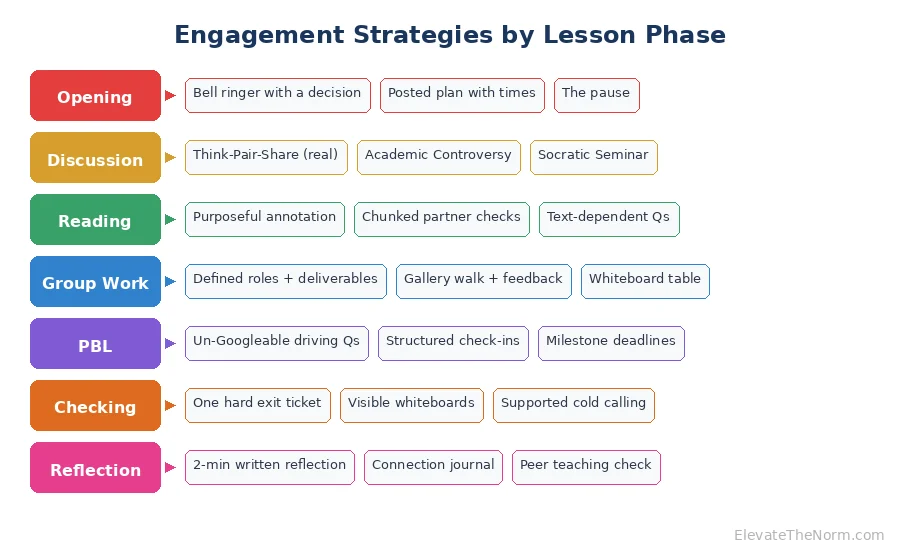
Student engagement strategies are practical teaching moves that shift students from passive compliance to genuine thinking during every phase of a lesson — opening, discussion, reading, group work, project-based learning, checking for understanding, and reflection. This guide organizes those strategies by when you actually use them, explains which ones build real intellectual engagement versus surface-level cooperation, and gives you something you can print, keep in a planning binder, and refer to on an ordinary school day.
Key Takeaways
- Engagement has three dimensions — behavioral, cognitive, and emotional — and a strategy that targets only one often misses the point.
- The most effective engagement strategies are low-tech, teacher-led, and built into the lesson plan rather than bolted on as activities.
- Compliance looks like engagement from across the room. Knowing the difference changes how you plan.
- Strategies organized by lesson phase — not alphabetically, not by buzzword — are strategies teachers actually use.
- Student engagement is not something you buy. It is something you build through planning, consistency, and presence.
What Student Engagement Actually Means
Researchers Fredricks, Blumenfeld, and Paris (2004) identified three dimensions of student engagement that still hold up: behavioral engagement (participation, attendance, following procedures), cognitive engagement (mental investment — thinking hard about the material, using strategies, persisting through difficulty), and emotional engagement (feelings of belonging, curiosity, and connection to the work).
Most engagement strategies target behavioral engagement. A student raises a hand. A student writes something on a whiteboard. A student turns to a partner on cue. These are visible, countable, and reassuring for the teacher — but they do not necessarily mean the student is thinking.
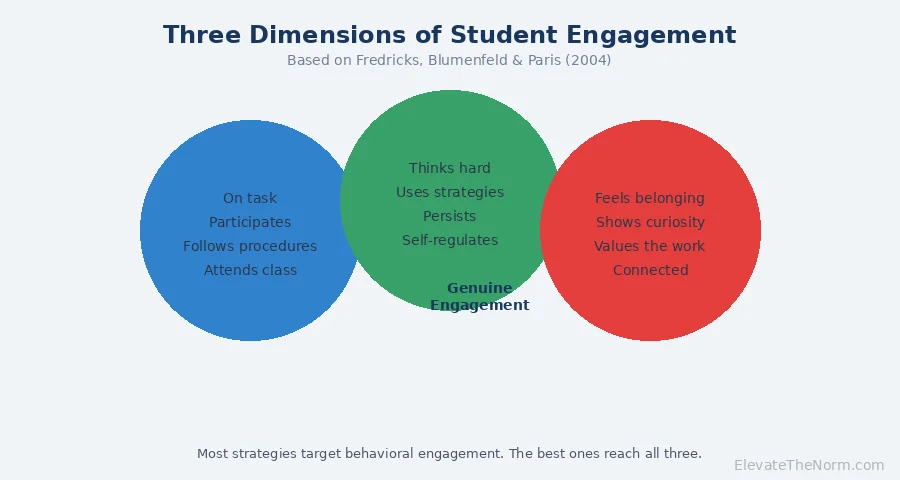
Genuine engagement is cognitive and emotional. The student is not just doing the task. The student is wrestling with the content, connecting it to something they already know, and caring enough about the outcome to push through when the work gets hard.
That distinction matters because a room full of compliant students can look engaged from the doorway while learning almost nothing. This guide prioritizes strategies that build real thinking, not just visible participation.
Compliance Versus Genuine Engagement — Know What You Are Building
Before organizing strategies by lesson phase, it helps to be honest about a tension most engagement guides skip entirely.
Some strategies produce compliance. Students do the thing you asked them to do. They fill in the graphic organizer. They complete the sentence starter. They stand up and find a partner. The room is active, the noise level is appropriate, and an observer would mark the lesson as engaging.
Other strategies produce genuine intellectual engagement. Students make a decision about the content. They defend a claim. They notice something they did not expect. They change their mind.
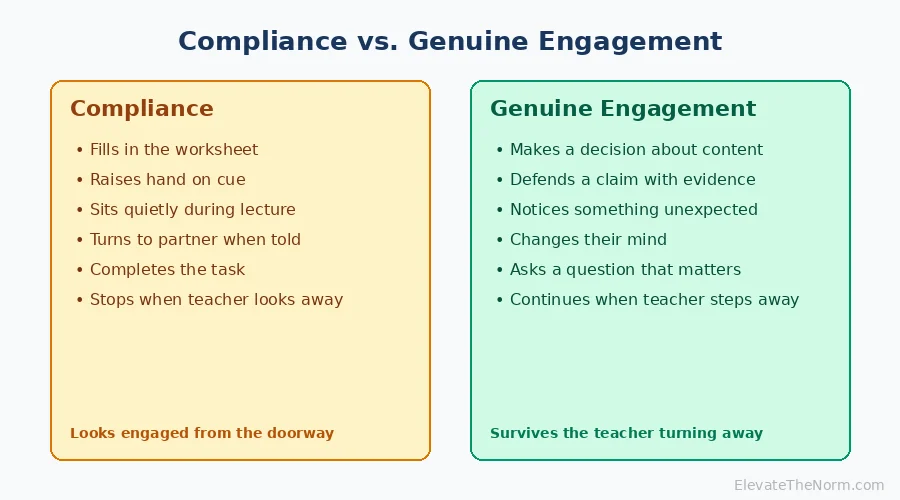
Both have a place. Compliance strategies keep the room running. They are especially useful during transitions, during the first weeks of school, and with material that simply needs to be practiced. But a lesson built entirely on compliance strategies produces students who are very good at following directions and very practiced at not thinking too hard.
The strategies in this guide are labeled honestly. If a strategy primarily produces compliance, it says so. If it produces genuine thinking, it says why.
Lesson Opening Strategies (First Five to Ten Minutes)
The opening is where you win or lose the lesson. A strong opening creates a reason to think. A weak one creates a reason to wait.
That opening tension is sharpest right after a break in the calendar. If you are planning the Tuesday after a three-day weekend, a game-and-webquest opening built specifically for that day holds attention better than starting cold with notes.
Bell Ringer with a Decision
Not a vocabulary review or a worksheet. A question that requires the student to take a position before the lesson begins. “Was the Treaty of Versailles more likely to prevent another war or cause one?” forces a choice. The content instruction that follows has a purpose — the student needs information to evaluate their own answer. There is a whole bank of openings built on that principle if you want twenty of them rather than one.
What it builds: Cognitive engagement. The student entered the room with an opinion and now has a reason to pay attention.
The Posted Plan
Write the entire lesson plan on the board, including times. “10:00–10:12: Source analysis. 10:12–10:25: Partner comparison. 10:25–10:40: Whole-group debrief. 10:40–10:50: Written reflection.” Students know exactly what is coming, how long it will take, and what they will be asked to do. This is not an engagement trick. It is a transparency practice that removes uncertainty, which is one of the biggest barriers to emotional engagement in a secondary classroom.
I post times on the board every day. If I run behind, I say so out loud and explain why. The students hold me to it, which is exactly the point — the plan is a contract, not a suggestion.
What it builds: Emotional engagement (predictability and trust) and behavioral engagement (students transition faster when they can see the next segment).
Low-tech: Whiteboard or chalkboard. No technology required.
The Pause Before Anything Starts
There is a version of classroom management advice that says you should start teaching immediately to “capture attention.” I have found the opposite. When the room is not ready, you wait. You do not talk over the noise. You do not begin your opening while three students are still walking to their seats. You stand still, make eye contact, and wait.
I once held that pause for more than five minutes. It was one of the most awkward moments of my life. That section finished nine minutes behind my other sections, and it is the only time I have ever assigned homework — because they were nine minutes behind and I owed every class the same content. But after that day, the room settled in under thirty seconds for the rest of the year.
That pause builds engagement because it establishes that what is about to happen matters enough to wait for. If you talk over the noise, you teach students that the noise is acceptable and that your instruction is background.
What it builds: Behavioral and emotional engagement. Students learn that the room runs on mutual respect, not volume.
Low-tech: Silence. The cheapest strategy on this list.
Discussion Strategies
Discussion is the most commonly faked engagement activity in secondary classrooms. A teacher asks a question. The same four students answer. The other twenty-six sit quietly and wait. The lesson plan says “class discussion,” and the observation form marks participation, but most of the room was not engaged.
Think-Pair-Share That Actually Works
Think-Pair-Share fails when “think” means stare at the desk for ten seconds, “pair” means turn to the nearest person and confirm you have the same answer, and “share” means one pair tells the class while everyone else checks out.
Make it work: give a genuine thinking question (not a recall question), give real think time (sixty seconds minimum, timed and silent), require a written response before pairing, and during the share phase, call on pairs who disagreed with each other. The disagreement is where the thinking lives.
What it builds: Cognitive engagement when the question demands a position rather than a fact.
Structured Academic Controversy
Give two partners the same topic with opposing evidence sets. Each side presents, then they switch — arguing the other side’s position using that side’s evidence. Then they drop the roles and write a joint statement.
This strategy is harder to set up than a worksheet, but it produces something most discussion strategies do not: students thinking carefully about evidence they personally disagree with.
What it builds: Cognitive and emotional engagement. The role-switch is the key move — it forces genuine consideration of a position the student did not choose.
Socratic Seminar with Preparation
The most common failure of Socratic seminars in secondary classrooms is running one without preparation. Students arrive, sit in a circle, and produce surface-level comments because they have nothing prepared.
Fix this by requiring a preparation sheet the day before: two claims from the text with page numbers, one question the student genuinely wants answered, and one connection to previous material. The seminar becomes a conversation between students who have something to say. If students struggle to produce that one question, hand them a frame and a bank: there are forty subject-general seminar questions and a way to teach students to write their own.
What it builds: Cognitive engagement, but only with the preparation step. Without it, you get compliance — students sitting in a circle saying things that sound intellectual but cost nothing.
Reading Strategies
Reading engagement in secondary classrooms has one core problem: students do not read. They skim, they copy the person next to them, or they wait for the teacher to summarize. These strategies address that problem directly.
Annotation with a Purpose
Do not say “annotate the text.” Say “mark every place the author makes a claim without giving evidence.” Or: “Circle every word you do not know and write what you think it means from context.” Specific annotation tasks produce specific thinking. Which specific task matters: the marks with evidence behind them all require the student to generate a sentence rather than mark a location. Open-ended annotation produces highlighting.
What it builds: Cognitive engagement. The student is reading with a filter, which means they are reading with their brain on.
Chunked Reading with Partner Checks
Break a long text into three or four sections. After each section, partners summarize what they read — not what they highlighted, not a vocabulary word, but the central claim or event of that chunk, stated in their own words. If they cannot do it, they reread.
This is tedious for the teacher to set up, but it catches disengagement at the paragraph level instead of at the end of the reading when it is too late to matter.
What it builds: Cognitive engagement and a genuine check on whether reading happened.
Low-tech: Paper text, pencil, and a partner.
Group Work Strategies
Group work is either the highest-engagement activity in a lesson or the lowest. The difference is structure.
Defined Roles with Individual Accountability
Give each group member a specific role that produces a specific, visible product. The recorder writes. The questioner generates two questions from the group’s work. The presenter prepares the group’s statement. The checker verifies every claim against the source material.
Defined roles work only when each role has an individual deliverable. If the recorder’s notes are the only product, three of four students have no reason to engage.
What it builds: Behavioral engagement (structure) and cognitive engagement (individual accountability). The individual deliverable is what separates this from compliance.
Gallery Walk with Feedback
Groups post their work. Other groups circulate and leave written feedback — not stickers, not checkmarks, but a specific comment: one thing the work does well and one question it does not answer.
The feedback must be written and signed. Anonymous feedback in secondary classrooms is either useless or cruel. Signed feedback forces the reviewer to be thoughtful because their name is on it.
What it builds: Cognitive engagement for both the creators and the reviewers, but only when the feedback is specific and signed.
Low-tech: Chart paper, markers, and sticky notes.
The Whiteboard Table
In my room, I pull small groups to a whiteboard table — a table I built with a dry-erase surface, set in a corner with a lamp, a rug, and better chairs. Students ask to go there. It is not the remediation table. It is the best seat in the room, and the work that happens there is focused because the environment signals that what we are about to do matters.
A whiteboard table is not expensive to build or buy, and the return is significant: students who would never raise a hand in whole-group discussion will talk freely in a small group at a table that feels different from the rest of the room.
What it builds: Cognitive and emotional engagement. The physical environment removes the public performance anxiety that kills participation for many secondary students.

PBL (Project-Based Learning) Strategies
Project-based learning creates engagement through authentic work, real audiences, and meaningful products. But engagement in PBL is not automatic — a poorly structured project produces busy work with better aesthetics.
Driving Questions That Students Cannot Google
“What caused World War I?” is a textbook question. “Should the United States have entered World War I, and what would have changed if it hadn’t?” is a driving question. The difference is that the second question requires the student to build an argument using evidence, not retrieve a list.
If a student can answer the driving question by copying a paragraph from a website, the question is not driving anything.
What it builds: Cognitive engagement. The question structure makes thinking unavoidable.
Structured Check-Ins with Deadlines
The most common PBL failure is checking in at the end. Projects need structured check-ins at defined milestones — research complete, argument drafted, evidence collected, product in progress, and final product. At each check-in, the student explains what they have done, what decisions they made, and what they plan to do next.
This is where the teacher earns the engagement. Circulating between groups, sitting down with a team, asking “walk me through your reasoning” — that is what makes a project intellectually demanding rather than aesthetically appealing.
What it builds: Cognitive engagement and accountability. The check-in is the strategy.
Checking for Understanding Strategies
If your only check for understanding is asking “does everyone get it?” you are not checking. You are hoping.
Exit Tickets with One Hard Question
Not three questions covering the whole lesson. One question that gets at the hardest part of today’s content. If a student can answer it correctly, they understood the lesson. If they cannot, you know exactly what to reteach.
The exit ticket is useful only if you read every one before the next class. Otherwise it is compliance — students fill out a piece of paper, you collect it, and nothing changes.
Whiteboards for Visible Thinking
Every student gets a small whiteboard. You ask a question. They write their answer and hold it up. You see every answer simultaneously and can respond to patterns, misconceptions, or blank boards in real time.
This is one of the oldest student engagement strategies in teaching and it still works because it solves the core discussion problem: only a few students answer when you call on individuals. Whiteboards make every student’s thinking visible at the same time.
Low-tech: A $2 whiteboard, a marker, and a sock for an eraser.
Cold Calling with Support
Cold calling — randomly selecting a student to answer — gets a bad reputation because it is often done punitively. “Marcus, you don’t look like you’re paying attention. What’s the answer?” That is not a strategy. That is public embarrassment.
Cold calling works when every student has had time to prepare an answer (through writing or partner discussion first), when the expectation is established from day one, and when the teacher responds to wrong answers with follow-up questions rather than correction. “Interesting — what evidence led you there?” keeps the conversation going. “No, the answer is X” ends it.
Student Reflection Strategies
Reflection is where students turn experience into learning. Without it, even an excellent lesson stays an experience — something that happened today and fades by tomorrow.
Two-Minute Written Reflection
At the end of class, students write for two minutes answering one question: “What is one thing you understand better now than you did at the start of class, and what made that happen?” The second part — what made that happen — is where the metacognition lives. It forces students to identify the moment or strategy that helped them learn, which makes them more likely to use it again.
The Connection Journal
Students keep a running journal — one entry per class — connecting today’s content to something outside of school. Not “this reminded me of a movie” but “this connects to X because Y.” The discipline is the specificity. Over a semester, the journal becomes evidence that the student sees the content as part of a larger world rather than as isolated classroom information.
Low-tech: A composition notebook. One per student, kept in the room.
Peer Teaching Check
After a lesson segment, one student explains the key concept to another student who was absent or who struggled. This is not tutoring — it is a check on the explainer’s understanding. If you can explain it clearly, you understand it. If you cannot, we know where to go back.
What This Guide Does Not Include
This guide does not include gamification apps, point systems, prize boxes, or reward charts. Those tools produce compliance. They teach students to perform for a reward rather than engage with content because it matters.
This guide also does not include strategies that require expensive technology. Every strategy listed above works with paper, a whiteboard, and a classroom where the teacher has planned to the minute and cares enough to circulate.
Ryan and Deci’s self-determination theory (2000, updated 2020) identifies three basic psychological needs that drive genuine motivation: autonomy (the need to feel ownership over one’s actions), competence (the need to feel capable), and relatedness (the need to feel connected to others). The strategies in this guide that produce real engagement — not just compliance — tend to address at least one of those needs. The ones that address all three tend to be the ones students remember.
How to Use This Guide
Print it. Keep it in your planning binder. When you are writing a lesson plan and you get to the discussion section, flip to discussion strategies and choose one. When you are planning a check for understanding, look at this section instead of defaulting to “ask if everyone gets it.”
The strategies are organized by lesson phase because that is how teachers actually plan. You do not sit down and think “I need a cognitive engagement strategy.” You sit down and think “what am I doing for the first ten minutes?” This guide is built to answer that question. For a ready-to-use tool on this, see a printable student self-assessment pack. When a unit is ending and you want the review to be retrieval rather than re-reading, a review game with a job for every student is the version of this that teenagers volunteer for. For a ready-to-use tool on this, see a printable formative assessment quick-use pack.
Frequently Asked Questions
How do I know if students are genuinely engaged or just complying?
Watch what happens when you stop directing. If students continue working, discussing, or thinking when you step back, they are engaged. If they stop the moment your attention shifts, they were complying. Fredricks, Blumenfeld, and Paris (2004) identified this as the difference between behavioral engagement (doing the task) and cognitive engagement (investing mentally in the task). Genuine engagement survives the teacher turning away.
Do these student engagement strategies work without technology?
Every strategy in this guide works with paper, pencils, whiteboards, and a room where students can talk to each other. Technology can enhance some of them, but none of them require it. The most effective engagement strategies are teacher-led and content-driven, not app-dependent.
How many engagement strategies should I use in one lesson?
Two to four, matched to the lesson phase. A strong opening strategy, a discussion or reading strategy in the middle, a check for understanding, and a reflection at the end is a full lesson. More than that becomes exhausting for students and unsustainable for the teacher.
What about students who refuse to participate in engagement activities?
A student who refuses to engage in a structured strategy is giving you information. They are telling you that something is wrong — with the task, the relationship, the environment, or something outside your classroom entirely. The answer is not a louder strategy. It is a quiet conversation, usually later, usually privately, about what is happening and what they need.
Do student engagement strategies work for students with learning differences?
The strategies in this guide are designed to be accessible by default. Written responses before discussion, structured roles in group work, chunked reading, and visible thinking on whiteboards all reduce the barriers that make participation difficult for students who process differently. Autonomy support — offering genuine choice in how students demonstrate understanding — has been shown to benefit all students, with particularly strong effects for students who struggle with traditional formats (Ryan and Deci, 2020).
How do I get administration to support engagement-focused teaching?
Document what you do and why. When an administrator walks in and sees students talking in groups, it helps to have a posted lesson plan with times, defined roles for each group member, and a visible product. The plan on the board is your best defense and your best evidence — it shows that the activity is structured, timed, and purposeful.
What is the difference between engagement and entertainment?
Entertainment holds attention without requiring thinking. Engagement holds attention because thinking is happening. A funny video is entertainment. A debate where students must use evidence from that video to defend a position is engagement. The content is the same; the cognitive demand is different.
Sources
- Fredricks, J. A., Blumenfeld, P. C., & Paris, A. H. (2004). “School Engagement: Potential of the Concept, State of the Evidence.” Review of Educational Research, 74(1), 59–109.
- Ryan, R. M., & Deci, E. L. (2020). “Intrinsic and Extrinsic Motivation from a Self-Determination Theory Perspective.” Contemporary Educational Psychology, 61, 101860.
- Niemiec, C. P., & Ryan, R. M. (2009). “Autonomy, Competence, and Relatedness in the Classroom.” Theory and Research in Education, 7(2), 133–144.
- Reeve, J. (2012). “A Self-Determination Theory Perspective on Student Engagement.” In S. L. Christenson, A. L. Reschly, & C. Wylie (Eds.), Handbook of Research on Student Engagement (pp. 149–172). Springer.
- Hattie, J. (2023). Visible Learning: The Sequel. Routledge.
- Center for Innovation in Teaching & Learning, University of Illinois. “Three Dimensions of Student Engagement.”
About Clay Shumate
Clay Shumate is a certified secondary Social Studies teacher in the public schools of West Alabama, with seven years of classroom experience, a B.A. in History, and an M.Ed. in Secondary Education. He writes about project-based learning, student responsibility, respect, and practical ways to hold young people to a higher standard while giving them room to learn from mistakes. He is a member of the Society of Professional Journalists and writes to its Code of Ethics; this site’s editorial standards and corrections policy are published in full. More about Clay.