The Elevate Blog banner: Real Classrooms. Practical Ideas. Higher Expectations. Three students climb a rocky ridge at sunrise, each pulling the next one up, toward a teacher reaching down to help.

Tag: classroom discussion

  • Formal vs Informal Formative Assessment: What Actually Separates Them

    Formal vs Informal Formative Assessment: What Actually Separates Them

    By Clay Shumate · Updated October 24, 2026

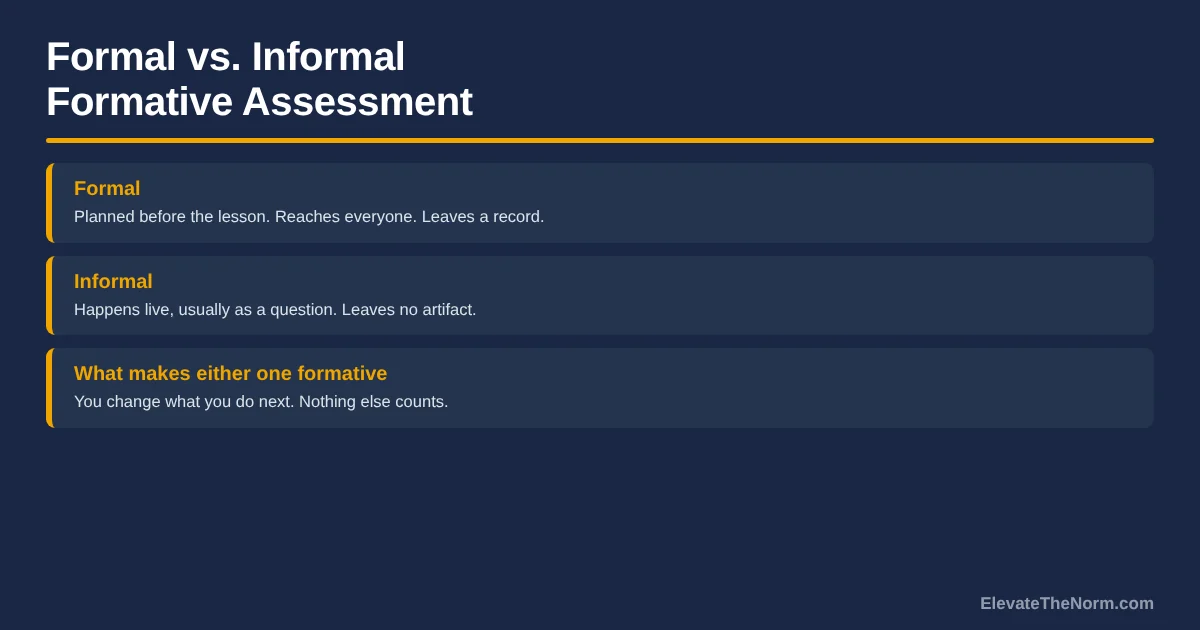
    Formal formative assessment is planned before the lesson and produces a record you can look at later — an exit ticket, a quiz, an embedded prompt. Informal formative assessment happens in the moment, usually through questioning, and leaves no artifact. Both are formative only if you actually change what you do next.

    Key Takeaways

    • The difference between formal and informal formative assessment is planning and evidence, not rigor: formal checks are designed ahead of time and leave a record, informal checks happen live and do not.
    • Informal questioning is the most common form of formative assessment in classrooms, which means most teachers are already doing the harder one badly rather than not doing it at all.
    • Ruiz-Primo and Furtak’s ESRU model — elicit, student responds, recognize, use — is the clearest test of whether an informal check was real. Most classroom questioning stops at the second step.
    • The famous 0.4 to 0.7 effect size for formative assessment is not well supported. A 2011 meta-analysis found a weighted mean of 0.20 across 42 effect sizes, and a 2012 critique argued even that number is unreliable.
    • Formal and informal are not a clean binary. WestEd lists informal-versus-formal as just one of fourteen dimensions along which formative assessments vary.

    Every district PD session on formative assessment eventually reaches the slide that says “formal vs. informal,” and the slide is almost always wrong. It usually implies formal means serious and informal means casual, which leaves teachers thinking the real work is the exit ticket and the questioning is just talking.

    It is the other way around more often than not. The informal version is harder to do well, happens hundreds of times a day, and is the one nobody ever gets coached on. This article explains what the distinction actually is, what the research says about each, and when to use which. If you want the strategies themselves rather than the categories, the full list of formative assessment strategies is the better starting point.

    Is formative assessment formal or informal? What separates them

    Formal formative assessment is planned in advance, given to everyone at a set point, and produces something you can look at after the bell. Informal formative assessment is unplanned, happens inside instruction — usually as a question — and produces only what you noticed at the time. Both are formative because of what you do with the information, not because of the format.

    That last clause is the one people skip. Formative assessment is defined by purpose, not by instrument. Black and Wiliam’s 1998 definition, still the one most researchers use, covers activities that “provide information to be used as feedback to modify the teaching and learning activities.” A quiz you collect, grade, and never act on is not formative. A question you ask and genuinely respond to is.

    WestEd’s review of the research makes the same point and then complicates it usefully: formal and informal are not two boxes but a spectrum, and the report lists informal-versus-formal as only one of fourteen dimensions along which formative assessments vary — alongside spontaneous versus planned and curriculum-embedded versus stand-alone. Those dimensions overlap but they are not the same axis. A question can be planned in advance and still leave no record. An exit ticket can be invented on the spot.
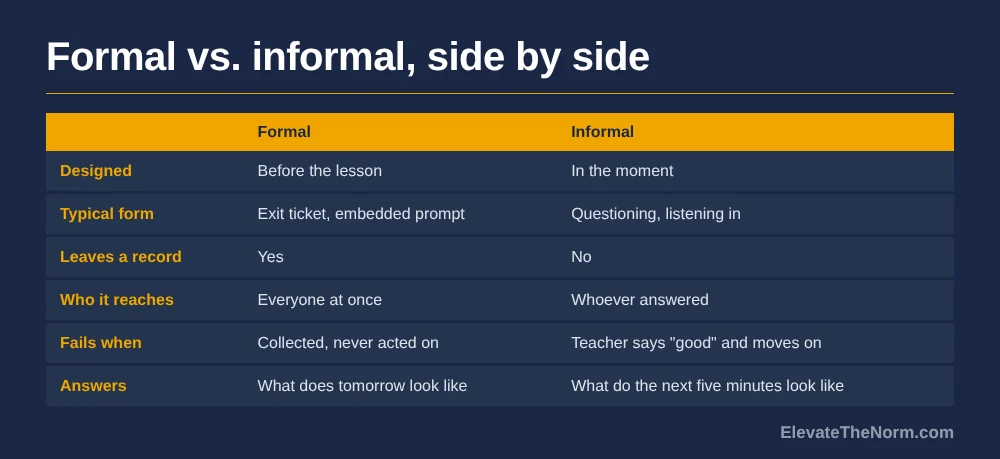
    Comparison table of formal and informal formative assessment across six rows: when it is designed, typical form, whether it leaves a record, who it reaches, how it fails, and which question it answers.
    Formal and informal formative assessment compared across six dimensions.
    Formal formative assessmentInformal formative assessment
    When it is designedBefore the lessonIn the moment, usually inside a discussion
    Typical formsExit ticket, embedded written prompt, ungraded quiz, hinge question on a slide, whiteboard checkQuestioning, listening in on group work, reading over a shoulder, a follow-up probe
    Leaves a record?Yes — you can sort it, re-read it, bring it to a PLCNo, unless you write something down
    Who it reachesEveryone, at onceWhoever answered, which is rarely everyone
    Main failure modeCollected and never acted on; becomes a gradeTeacher hears the answer, says “good,” and moves on
    Cost per usePlanning time up front, review time afterAlmost no prep; high cognitive load during the lesson
    Best forDeciding what tomorrow looks like; evidence you can show someoneDeciding what the next five minutes look like
    Grade it?NoNot possible, and that is a feature
    Formal and informal formative assessment compared on the dimensions that change what a teacher does.

    What counts as informal formative assessment?

    Questioning, mostly. WestEd calls informal questioning the most common form of formative assessment there is. It also includes listening to a group argue, reading over a shoulder during work time, and the follow-up probe you ask when an answer sounds memorized.

    The useful research here comes from Maria Araceli Ruiz-Primo and Erin Furtak, who studied three middle school science teachers working through a physical science unit on buoyancy and built a model called the ESRU cycle. It has four steps: the teacher Elicits a response, the Student responds, the teacher Recognizes what the response actually revealed, and the teacher Uses it to do something different.

    That fourth step is where almost all classroom questioning dies. A teacher asks, a student answers, the teacher says “right” and keeps going. That is an E and an S. Nothing was assessed. The ESRU model is valuable precisely because it makes the gap visible: in Ruiz-Primo and Furtak’s study, the teacher who more often completed full cycles had students who performed better on an embedded assessment than the students of the other two teachers.

    Be careful how much weight you put on that result. It is three teachers, in middle school science, in one unit, with no control group — a point later raised by Derek Briggs and colleagues when they reviewed how this literature gets synthesized. It is a good model and a small study. Treat the ESRU cycle as a coaching lens, not as proof of an effect size.
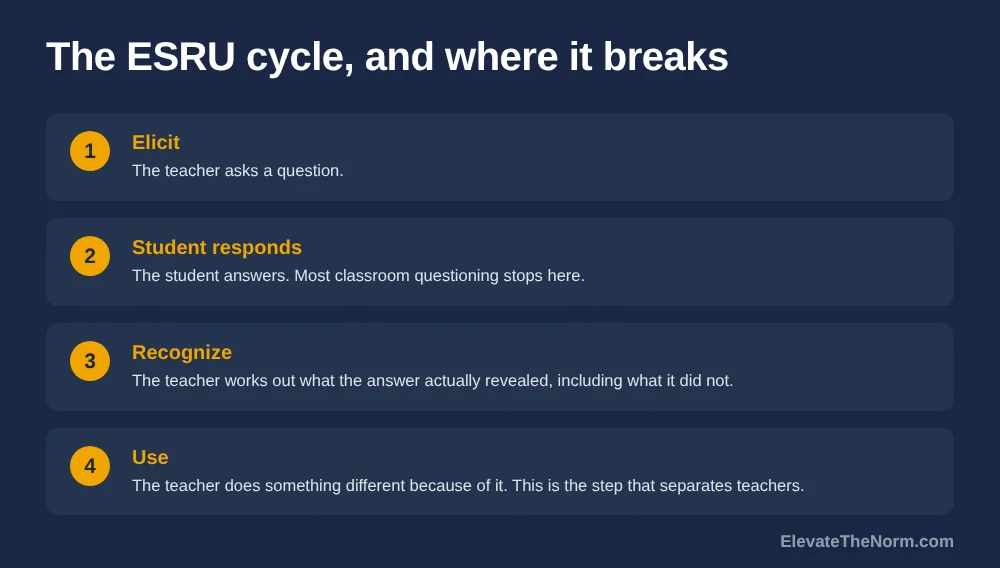
    The four steps of the ESRU cycle for informal formative assessment: elicit, student responds, recognize what the answer revealed, and use it to do something different. Most classroom questioning stops at the second step.
    The ESRU cycle, and the step where most questioning stops.

    What counts as formal formative assessment?

    Anything written and planned that you designed to show whether the class is ready to move on — and that you do not grade. Exit tickets, embedded written prompts, whiteboard checks, hinge questions, ungraded quizzes. Each sits at a point in the unit where you need a decision, and each is built before the lesson rather than improvised in it.

    What makes these formal is not that they are written. It is that you decided in advance what you needed to know and built an instrument to find out. WestEd describes these as embedded prompts, often requiring a written response, placed at key points in instruction to identify next steps. The planning is the point: a question you wrote yesterday is almost always a better question than one you improvise at 10:42.

    The failure mode is equally specific. A formal check becomes a small summative test the moment it enters the gradebook, and students respond accordingly — they protect the score instead of showing you the confusion. If you want the evidence to be honest, the check cannot count. That is also the argument running through our piece on what standards-based grading actually fixes.

    Is formal formative assessment the same thing as summative assessment?

    No, and this is the confusion that wrecks the whole topic. Formal and informal describe how a check is built. Formative and summative describe what the result is for. They are two separate axes, which means a written test can be formal and formative, formal and summative, or — most commonly in real schools — formal, labeled formative, and used summatively. Our guide to the difference between formative and summative assessment works through that second axis in detail.

    Run the four combinations and the distinction gets concrete. A planned exit ticket you sort and act on is formal and formative. A unit test that decides a grade is formal and summative. A follow-up question that changes your next sentence is informal and formative. And a teacher mentally marking a student as “one of the weak ones” based on an offhand answer is informal and summative, which is the one nobody names and the one that does the most damage.

    That fourth box deserves a sentence of its own. An informal check that quietly hardens into a judgment about a student is not assessment at all; it is a prediction, and teenagers notice being predicted. If an informal check does not change what you do, it should not change what you think about who the student is either.

    The practical test for any check, formal or informal: name the decision it feeds. If the only answer is “it shows me where they are,” it is going in a gradebook or a drawer, not into instruction.

    The formal-and-summative box still has to be filled at some point, usually at the end of the semester. For that one, the Mid-Terms.org library has 200 free printable midterms with answer keys for grades 6–12 across Social Studies, ELA, Math and Science, which leaves your planning time for the formative checks that actually change instruction.

    Is formal or informal formative assessment more effective?

    No study answers that cleanly, and anyone who tells you otherwise is extrapolating. The honest position is that the evidence base for formative assessment as a whole is thinner than its reputation, and it has almost never been broken out by formal versus informal.

    Start with the number everybody quotes. Black and Wiliam reported in 1998 that “typical effect sizes of the formative assessment experiments were between 0.4 and 0.7,” drawing on 250 sources. That range is on a thousand PD slides.

    It did not hold up. Neal Kingston and Brooke Nash reviewed more than 300 K–12 studies in 2011 and found that only 13 reported enough information to calculate an effect size. From 42 independent effect sizes they got a median of 0.25 and a weighted mean of 0.20 — a third of the low end of the famous range. By subject: English language arts 0.32, mathematics 0.17, science 0.09.

    And then the correction got corrected. In 2012 Derek Briggs, Maria Araceli Ruiz-Primo, Erin Furtak, Lorrie Shepard and Yue Yin argued that the 0.20 figure is not reliable either: the search was not replicable, studies meeting the criteria were excluded while one without a control group was included, and effect sizes calculated with and without pretest data are not comparable. In one study they recalculated, the mean shifted from −0.32 to −0.14 depending on the formula. Their conclusion is the one worth carrying: a different sample of studies could produce an average substantially higher or lower, so considerable uncertainty remains.

    What that means for a Tuesday: formative assessment is a reasonable bet with an unreliable price tag. Do not choose between formal and informal on the strength of an effect size, because there is no credible effect size for either one separately.

    When should you use formal vs. informal formative assessment?

    Match the check to the decision you are about to make. Informal checks tell you what to do in the next five minutes. Formal checks tell you what tomorrow looks like. If you are not about to make either decision, you are collecting data for no one.

    • Mid-explanation, something feels off. Informal. Stop, ask one student to say the last step back in their own words, then probe the part they skipped. You need an answer in ten seconds, not a record.
    • Deciding whether to move to the next lesson. Formal. You need everyone, not the four hands that go up. Three questions on the way out is enough.
    • Group work is running and you cannot tell who is doing the thinking. Informal. Listen without intervening for ninety seconds per group; you learn more than any written check will tell you.
    • A misconception you have seen every year. Formal, and planned months ago. Write the prompt that exposes it and put it in the unit at the point it usually appears.
    • You have to explain a reteach decision to a coach, a parent, or a PLC. Formal. “It felt shaky” is not evidence. Sixty-one exit tickets is.

    How do you run both in one week with 150 students?

    Run informal checks constantly and formal checks twice a week, and read the formal ones in a sort rather than a grade. The whole system should cost you under thirty minutes of out-of-class time per week, or it will not survive October.

    1. Pick one informal habit to improve, not five. The highest-value one is the U in ESRU: after a student answers, do something with it out loud. “So if that’s true, what happens when…” Thirty seconds, no prep, and it is the step the research says separates teachers.
    2. Write two formal checks when you plan the unit, not the night before. Place them at the two points where students have historically gotten lost. Three questions each, maximum.
    3. Sort, do not grade. Three piles: got it, partial, not yet. Count the piles. That takes about eight minutes for 150 papers and it is the only number you need.
    4. Change one thing tomorrow because of the piles. Reteach the partials in a ten-minute opener, or pull the “not yet” group while everyone else starts. If nothing changes, stop running the check.
    5. Tell students what the pile meant. Not a score — the actual gap. A check students cannot see the result of teaches them that checks are for the teacher.
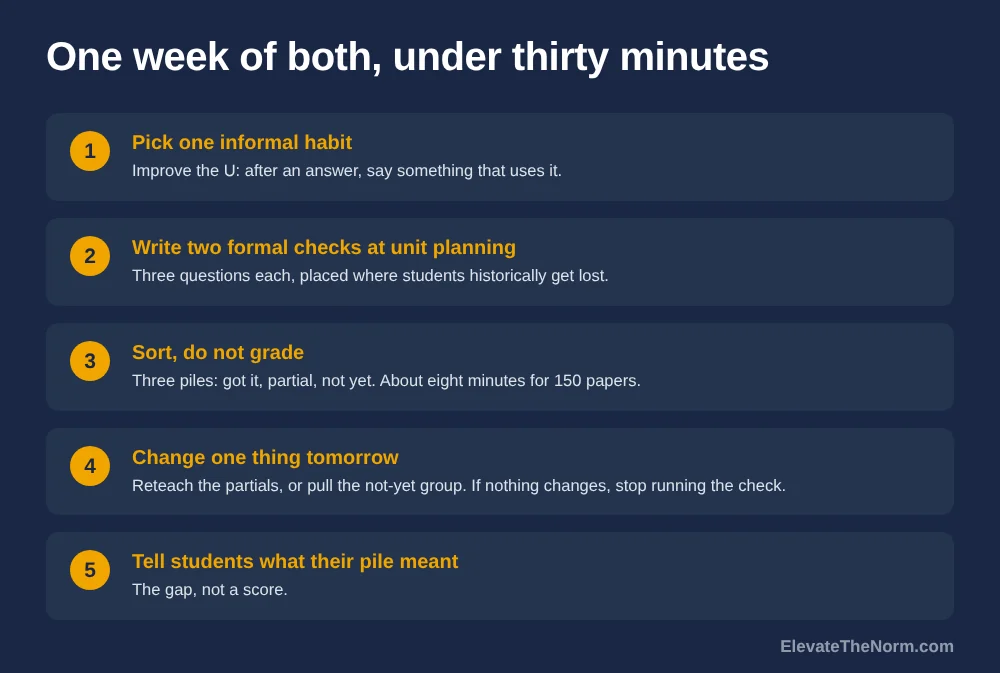
    Five steps for running both formal and informal formative assessment in one week in under thirty minutes: improve one informal habit, write two formal checks during unit planning, sort rather than grade, change one thing tomorrow, and tell students what their pile meant.
    A week of both, for under thirty minutes of out-of-class time.

    Subject-specific versions of step two are worth stealing rather than inventing: there are worked examples for reading, writing and science, and a free printable set if you would rather not build from scratch.

    What does good informal formative assessment look like to an observer?

    It looks like the teacher changing course. An observer cannot see a formative check directly, because the evidence is a decision rather than a document. What they should watch for is the gap between what the lesson plan said and what the teacher actually did after a student spoke.

    Four things worth looking for, whether you are being observed or doing the observing:

    • Follow-up questions outnumber new questions. A room where every question goes to a different student is a room where nothing is being probed.
    • Wrong answers get used rather than corrected. “Say more about that” after a wrong answer is the single clearest sign the teacher is assessing rather than quizzing.
    • The plan visibly bends. Something got cut, repeated, or reordered during the period.
    • Being wrong is survivable. If the only students answering are the ones who are sure, the informal check is sampling the wrong population and the data is worthless.

    That last point is not a soft one. An informal check only works if students will show you a half-formed idea, and they will only do that if the room is safe for it — which is why respect that goes both ways is an assessment issue before it is a culture issue.

    What should a school actually invest in?

    Coaching on the informal side and time to build the formal side — in that order, and neither of them is a purchase. The most common district response to formative assessment is to buy a platform or mandate a template, and both of those produce compliance rather than instruction.

    Three things that cost staffing rather than software:

    1. Someone scripting questioning with teachers. A coach sitting in for twenty minutes and transcribing the question-and-answer sequence is the only feedback that improves informal checks. There is no template for the U in ESRU.
    2. Unit planning time that includes writing the two checks. If the checks are written during planning, they land at the right points and cost nothing in-week. If they are written the night before, they will be generic and they will stop in October.
    3. A rule that formative checks do not enter the gradebook. This is free, it is the single biggest determinant of whether the evidence is honest, and it has to come from leadership because an individual teacher who stops grading checks looks like they are lowering the standard.

    One caution on the evidence, since this is where a district asks for it. The strongest study design in this area is Decristan and colleagues’ cluster-randomized trial of embedded formative assessment, and it found that the assessment and general classroom process quality — cognitive activation, supportive climate, classroom management — interacted. The practice did not work on its own; it worked in rooms that were already running well. That sample was elementary science, so a secondary leader is reasoning by analogy. But the implication travels: a formative assessment rollout in a building where classroom management is the real problem is solving the second problem first.

    Clay’s take: the informal one is the one nobody coaches

    Districts invest in the formal side because it produces artifacts, and artifacts are what you can put in a binder. So teachers get templates, exit ticket banks, and a data meeting. Nobody sits in the back of a room and says, “you asked eleven questions this period and used the answer to two of them.”

    That is backwards, and it is backwards for a reason worth naming: the informal version is the one that respects students as thinkers. A written check asks a teenager to produce the right answer. A real follow-up question asks them to explain their reasoning to an adult who is actually listening, and then does something visible with what they said. Teenagers can tell the difference between those two experiences instantly.

    The other thing I would say to an administrator: do not mandate a daily exit ticket. You will get 180 pieces of paper a year per teacher and no change in instruction, because the mandate produces the artifact and the artifact is not the thing. Ask instead what got retaught last week and why. If the answer is specific, the assessment is working regardless of what format it took.

    What should you do next?

    Count your U’s for one period. Teach normally, and afterward mark how many times a student answer actually changed what you said next. Most teachers find the number is one or two, and most are surprised by that. It is the cheapest diagnostic in this whole article and it does not require a template.

    Then add exactly one formal check to next week’s plan, sort it into three piles, and change one thing because of it. If you want strategies to fill that slot, go to the main strategies list; if you are assessing a project rather than a lesson, assessment for project-based learning covers the version where there is no unit test at the end.

    Frequently Asked Questions

    Is formative assessment formal or informal?

    It can be either. Formative assessment is defined by purpose, not format: any check whose results you use to change what you teach next. A planned exit ticket or ungraded quiz is formal formative assessment because it is designed in advance and leaves a record. A follow-up question during a discussion is informal formative assessment because it happens live and leaves no artifact.

    What are examples of informal formative assessment?

    Questioning is the most common example. Others include listening in on a group while it works, reading over a shoulder during work time, and asking a follow-up probe when an answer sounds memorized. They count as formative only if you use what you heard, which is the step most classroom questioning skips.

    What is the difference between formal and informal formative assessment?

    Formal formative assessment is planned before the lesson, given to the whole class, and leaves a record you can review later – an exit ticket or an embedded written prompt. Informal formative assessment happens live inside instruction, usually through questioning, and leaves no artifact. Both are formative only if the teacher changes something as a result.

    Is a quiz a formal or an informal formative assessment?

    A quiz is formal, because it is planned in advance and produces a record. Whether it is formative depends on what happens next. If the score goes in the gradebook and nothing is retaught, it functioned as a small summative test. If you sort the results and change tomorrow’s lesson, it was formative, regardless of the name on it.

    Which is more effective, formal or informal formative assessment?

    No credible study separates them. Formative assessment as a whole has a contested evidence base: the often-quoted 0.4 to 0.7 range from 1998 was revised to a weighted mean of 0.20 in a 2011 meta-analysis, and a 2012 critique argued even 0.20 is unreliable. Choose based on the decision you need to make, not on an effect size.

    What is the ESRU cycle?

    ESRU stands for elicit, student responds, recognize, use. Ruiz-Primo and Furtak proposed it in 2007 to describe informal formative assessment: the teacher asks, the student answers, the teacher recognizes what the answer revealed, and the teacher uses it. Most classroom questioning stops after the student answers, which means no assessment actually happened.

    Should formative assessments be graded?

    No. The moment a check counts, students protect the score instead of showing you what they do not understand, and the evidence you get back is worse. Sort the responses into got it, partial and not yet, tell students what their pile meant, and keep the gradebook out of it. The point is a teaching decision, not a number.

    How many formal formative assessments should I run per week?

    Two is enough for most secondary courses, placed at the points in a unit where students historically get lost. Three questions each. If you are running one every day and never changing instruction because of them, you have added paperwork rather than assessment. The weekly cost should stay under thirty minutes of out-of-class time.

    Does informal formative assessment work with a class that will not talk?

    Only if you fix the talking first, because informal checks sample whoever answers. In a quiet room the four confident students become your data, which tells you almost nothing about the other twenty-six. Use written formal checks as the backbone until wrong answers are survivable, then shift weight back toward questioning.

    Sources

    About Clay Shumate

    Clay Shumate is a certified secondary Social Studies teacher in the public schools of West Alabama, with seven years of classroom experience, a B.A. in History, and an M.Ed. in Secondary Education. He writes about project-based learning, student responsibility, respect, and practical ways to hold young people to a higher standard while giving them room to learn from mistakes. He is a member of the Society of Professional Journalists and writes to its Code of Ethics; this site’s editorial standards and corrections policy are published in full. More about Clay.

  • Formative Assessment Strategies for Listening: 7 Checks That Work

    Formative Assessment Strategies for Listening: 7 Checks That Work

    By Clay Shumate

    Formative assessment strategies for listening are quick, ungraded checks that reveal what students actually took from something they heard — a lecture, a video, a classmate’s argument, a podcast. They work the same way a reading check does: ask for a specific response, read it fast, and change the next ten minutes based on what you see.

    Listening is the one language skill almost every secondary standards document asks for and almost no secondary gradebook contains. This page gives seven checks that fit a real class period, the honest size of the research behind them, and where that research runs out.

    Key Takeaways

    • A listening check has to ask for something only a listener could produce. “Any questions?” is not a check. “Write the speaker’s strongest piece of evidence and the weakest one” is, because a student who tuned out cannot fake it.
    • The standards already require it. The Common Core speaking and listening standards for grades 9–10 ask students to integrate information from diverse media “evaluating the credibility and accuracy of each source” and to evaluate a speaker’s “point of view, reasoning, and use of evidence and rhetoric.” Those are listening tasks with no listening assessment attached in most courses.
    • 🔴 The honest effect size for formative assessment is around 0.20, not the 0.4 to 0.7 people quote. That comes from a meta-analysis of 13 studies, and a published erratum later corrected its subject-level numbers after eight science studies were found miscoded as reading.
    • 🔴 The English language arts figure everyone cites rests on four effect sizes. After correction, the meta-analysis reports ELA at 0.32 from n = 4, mathematics at 0.17 from n = 19, and science at 0.19 from n = 17. Four is not a strong basis for a subject-level claim and should not be treated as one.
    • The best listening-instruction evidence is not from a secondary content classroom. The strongest single study taught second-language learners how to listen and found less-skilled listeners gained most. That is a real result and it is not a grades 6–12 social studies result.

    Free Download · PDF

    Listening Check Planner

    A two-page printable: all seven checks with what each one reveals, a decision-rule worksheet to fill in before you collect anything, the three-pile sort, and the three access decisions to make in advance.

    Download the free PDF

    Free. No email address required. Designed for grades 6–12. Browse every printable in Your Free Library.

    What Are Formative Assessment Strategies for Listening?

    A formative assessment strategy for listening is any low-stakes task that makes a student’s comprehension of spoken input visible while you can still do something about it. The input is the thing that distinguishes it: not a text the student can re-read, but speech that happened once.

    That constraint is the whole design problem. A reading check can always send the student back to the page. A listening check cannot, which means two things. The task has to be answerable from what was heard rather than from what can be looked up, and it has to come close enough to the listening that the student still has it. Ten minutes later you are assessing memory.

    Everything else is the same machinery you already use for reading checks and writing checks: a prompt narrow enough to read in seconds, a decision rule for what you do with each kind of answer, and no grade attached.

    Why Does Listening Go Unassessed in Most Secondary Classrooms?

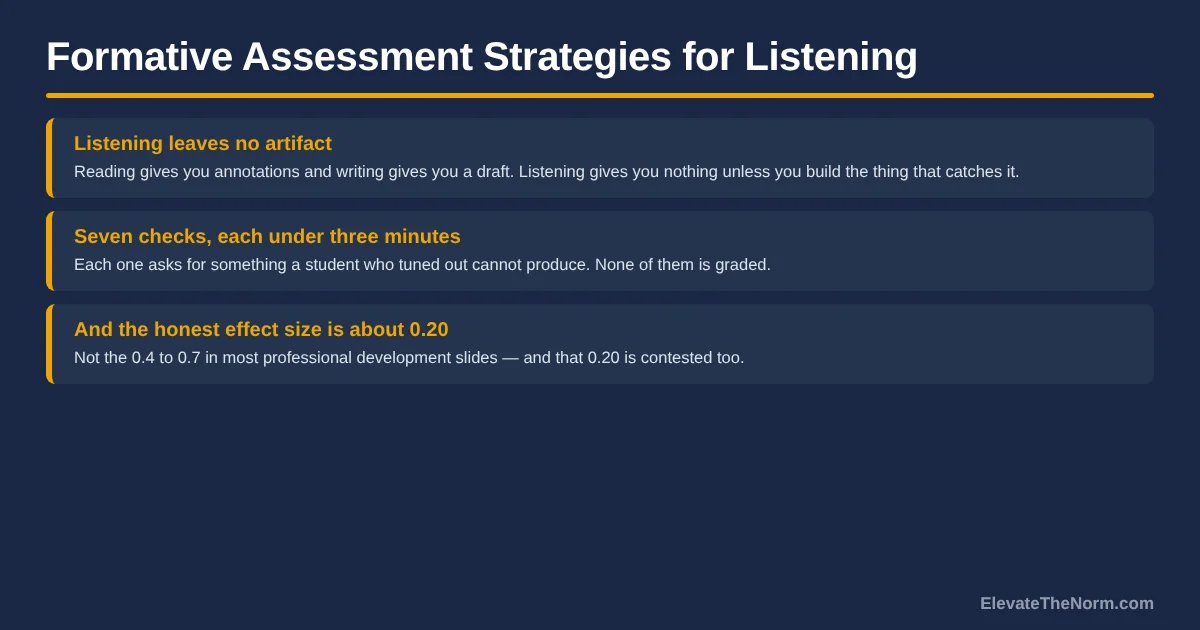
    Because listening has no artifact. Reading produces annotations, writing produces a draft, and both leave something a teacher can collect. Listening produces nothing unless the teacher builds the thing that catches it, and nobody is required to.

    The standards do ask for it. The grades 9–10 speaking and listening standards, as published in state implementation documents including the New Mexico Public Education Department’s standards breakdown, include:

    • SL.9-10.2 — “Integrate multiple sources of information presented in diverse media or formats” while “evaluating the credibility and accuracy of each source.”
    • SL.9-10.3 — “Evaluate a speaker’s point of view, reasoning, and use of evidence and rhetoric, identifying any fallacious reasoning or exaggerated or distorted evidence.”

    Read SL.9-10.3 again as a teacher. That is a hard analytical task, performed in real time, on speech. It appears on no common assessment I have seen, in no benchmark, and in no gradebook category. It gets taught when a teacher happens to run a debate and assessed when a teacher happens to notice.

    Clay’s take: the gap is not laziness, it is accounting. Teachers assess what gets reported, and listening does not get reported. If you want it to exist in your room, you have to decide it exists and build four or five checks that take under three minutes. Nobody is coming to require it of you, and the students who most need the practice — the ones who can decode a page but go blank in a discussion — are invisible until you look.

    Which Seven Listening Checks Fit a Real Class Period?

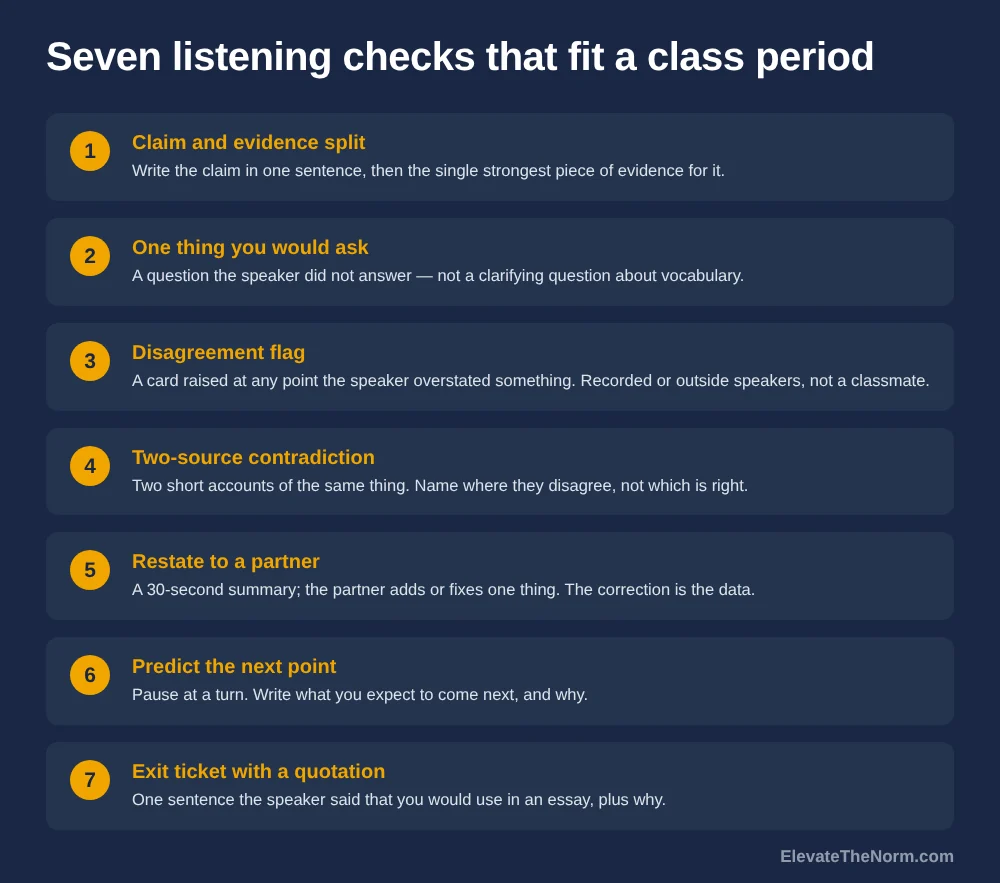
    Seven checks, each under three minutes, each asking for something a non-listener cannot produce. None of them is graded.

    #The checkWhat it actually revealsTimeWhat it costs you
    1Claim and evidence split. After a speaker or clip: write the claim in one sentence, then the single strongest piece of evidence for it.Whether the student separated an argument from its support, or heard one undifferentiated block2 minNothing to prepare; you must read fast
    2One thing you would ask the speaker. A question the speaker did not answer, not a clarifying question about vocabulary.Whether the student tracked the argument well enough to find its hole90 secStudents default to clarifying questions until you model the difference twice
    3Disagreement flag. Students raise a card at any point they think the speaker overstated something, then two of them say why. Run this on recorded or outside speakers, not on a classmate presenting.Real-time evaluation — the SL.9-10.3 skill — rather than after-the-fact recallLive, 0 extra minNeeds a norm set in advance; aimed at a student presenter it is a public critique, not a check
    4Two-source contradiction. Play or read two short accounts of the same thing. Students name where the two disagree, not which is right.SL.9-10.2 directly; also exposes students who assume all sources agree3 minYou need two genuinely conflicting short sources ready
    5Restate to a partner, partner corrects. Student A summarizes in 30 seconds; Student B adds or fixes one thing; you listen to three pairs.Gaps you would never see on paper, because the correction is the data2 minA spot check, not coverage — and it makes one student’s gap visible to another, so pair deliberately
    6Predict the next point. Pause a lecture or clip at a turn and have students write what they expect to come next and why.Whether the student is following a structure or collecting facts60 secYou have to know your own material’s structure well enough to pick the pause
    7Exit ticket with a quotation. One sentence the speaker said that the student would use in an essay, plus why.Attention to language, and it doubles as evidence collection for later writing2 minStudents paraphrase instead of quoting unless you insist on the actual words

    Pick two. Run them until they are routine, then add a third. Seven at once is a project, and projects get abandoned in October.

    Start with 1 and 7. Both are written, individual, and require no new norms, so you can run them tomorrow without teaching a procedure first. Checks 2 and 6 need one round of modelling, because students will produce clarifying questions and plot guesses until they see what you are actually after. Checks 3, 4 and 5 need a norm or a prepared source and belong in week three, not week one.

    Grade band changes the prompt more than the check. In grades 6–8 the claim-and-evidence split works better as two separate questions asked one at a time, and 30 seconds of partner restatement is plenty. By grades 11–12 you can hand students check 4 with two conflicting sources and no framing at all, which is closer to what SL.9-10.2 is actually describing.

    Seven numbered listening checks: claim and evidence split, one thing you would ask, disagreement flag, two-source contradiction, restate to a partner, predict the next point, and exit ticket with a quotation
    Seven checks, each under three minutes. Start with 1 and 7 — they need no new norms.

    What About Students Who Cannot Access the Listening?

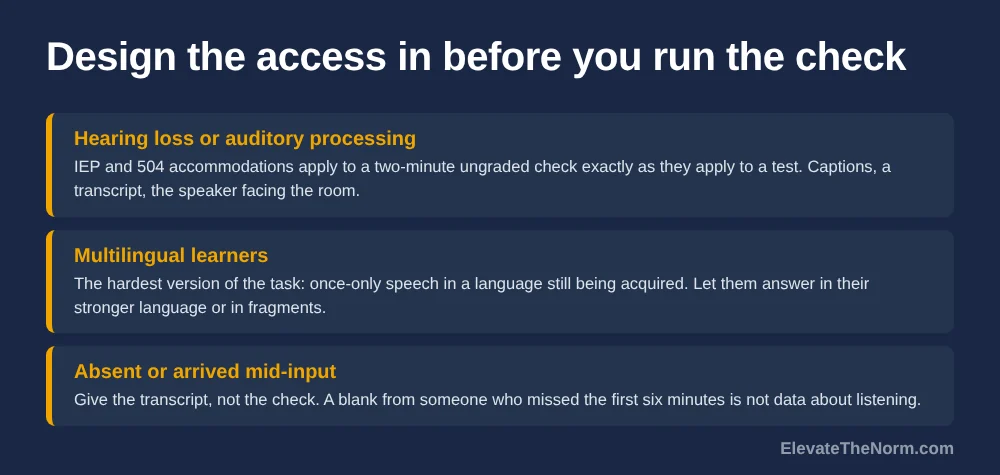
    Design the access in before you run the check, because a listening task assesses hearing and language processing along with comprehension, and you will not be able to tell the three apart afterwards.

    Three groups need a decision made in advance rather than improvised. Students with hearing loss or auditory processing needs have accommodations in an IEP or 504 plan, and those apply to a two-minute ungraded check exactly as they apply to a test — captions on anything recorded, a transcript available, preferential seating, and the live-speech checks run with the speaker facing the room. Multilingual learners are being asked to do the hardest version of the task: comprehend once-only speech in a language they are still acquiring. Let them write the response in their stronger language or in fragments, and judge the content rather than the English. Students who were absent or arrived mid-input should be given the transcript rather than the check; a blank from someone who missed the first six minutes is not data about listening.

    None of that costs prep time if you decide it once. All of it is invisible if you do not, and the students it affects will land in the “missed it” pile for reasons that have nothing to do with attention.

    Three access decisions to make before running a listening check: students with hearing loss or auditory processing needs, multilingual learners, and students who were absent or arrived mid-input
    Three decisions to make once, before the first check, not after the first blank response.

    Does Formative Assessment Actually Raise Achievement?

    Modestly, and the real number is smaller than the one in most professional development slides. The widely quoted range of 0.4 to 0.7 standard deviations does not come from a meta-analysis. The best available meta-analytic estimate is about 0.20.

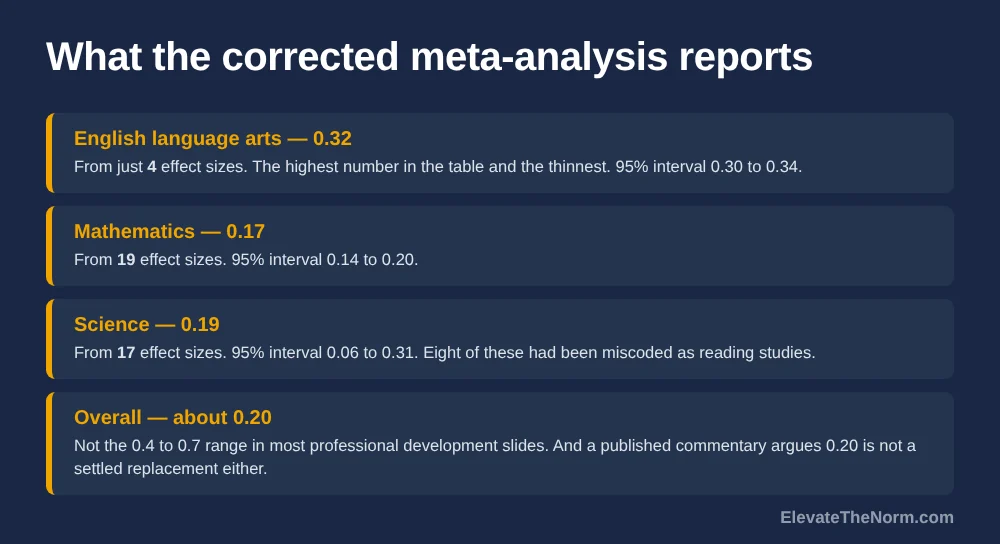
    That figure comes from Kingston and Nash’s meta-analysis in Educational Measurement: Issues and Practice, which found a median effect of 0.25 and a random-effects mean of 0.20 across 42 effect sizes drawn from just 13 studies. Then it got more interesting. A published erratum in the same journal reported that eight science studies had been miscoded as reading studies — an error the erratum credits Paul Black with catching. The corrected subject-level table is worth reading carefully:

    SubjectEffect sizes (n)Corrected mean effectCorrected 95% interval
    English language arts40.320.30 to 0.34
    Mathematics190.170.14 to 0.20
    Science170.190.06 to 0.31

    Two things follow, and both matter for anyone planning to assess listening in an English or social studies room. First, the ELA figure rests on four effect sizes. It is the highest number in the table and the thinnest. Anyone citing “formative assessment works best in ELA” is citing four studies. Second, the correction changed the comparison: before it, ELA ran about three times science; after it, science sits at 0.19 against ELA’s 0.32. The erratum states that both of the original article’s main conclusions still hold — an overall effect of about 0.20, and a need for more and better research.

    And there is a serious methodological challenge to the 0.20 itself. A commentary by Briggs, Ruiz-Primo, Furtak, Shepard and Yin argued the search strategy was not replicable, that the inclusion criteria were applied inconsistently — two studies meeting the stated criteria were left out, one of them reporting 0.88 — and that mixing effect-size formulas across studies shifted the estimates. Their conclusion is the one to carry into a staff meeting: the 0.4 to 0.7 range is overstated, and 0.20 should not be treated as a settled replacement, because “considerable uncertainty remains.”

    That is not a reason to skip the checks. A 0.20 effect from a two-minute routine that costs no prep is a good trade. It is a reason not to promise anyone a transformation.

    Corrected meta-analysis effect sizes by subject: English language arts 0.32 from four effect sizes, mathematics 0.17 from nineteen, science 0.19 from seventeen, and an overall figure of about 0.20
    The number of effect sizes behind each figure is the column nobody quotes.

    What Does the Research Say About Teaching Students to Listen?

    The strongest single finding is that explicitly teaching the listening process helps, and helps weaker listeners most — but the study was run on second-language learners, not on content-area secondary students, and that distinction has to travel with the finding.

    Vandergrift and Tafaghodtari, in Language Learning, worked with 106 learners of French as a second language in six intact course sections taught by the same teacher, 59 in the experimental group and 47 in the control. Over one semester the experimental group was walked through the listening process itself — predicting, monitoring, evaluating, problem-solving — while the control group heard the same texts the same number of times without that guidance. The experimental group significantly outperformed the control on the final comprehension measure, and the less-skilled listeners in the experimental group gained more than their stronger peers. The published record for the study reports no effect size, only that the difference was significant, so treat the size of it as unknown.

    Read the population honestly. These were second-language learners being taught to listen in a language they were still acquiring. That is the group with the most room to move, and it is not a tenth grader listening to a lecture in their first language. What transfers is the mechanism — naming the process, giving students something to do while listening rather than after — not the magnitude.

    The broader evidence is also softer than it looks. The Education Endowment Foundation rates oral language interventions at an average of +6 months of additional progress from 188 identified studies, with evidence security rated high. Four caveats come straight off that page and all four matter here: the impact is measured mainly through reading comprehension tests rather than listening; more of the studies sit in early years and primary than in secondary; the topic lost a padlock because many studies were not independently evaluated and provider-run evaluations tend to report larger effects; and the EEF says plainly that the listening-only evidence base is smaller, while noting it may be particularly effective. “May be” is the operative phrase and it is theirs, not mine.

    How Do You Run These Without Reading 120 Responses?

    You do not read them all. A formative check is a sample you act on in the next ten minutes, not a set you grade. Five rules keep the workload at zero.

    1. Sort into three piles, do not score. Got it, partly, missed it. Count the piles, look at two from the middle, move on. If you are writing comments you have turned a check into an assignment.
    2. Read a sample, not a class. In my experience eight responses pulled from across the room usually tell you what you need before the next ten minutes — that is a working rule of thumb, not a sampling result, and I am not going to dress it up as one. If the eight disagree with each other, read eight more; that disagreement is itself the finding.
    3. Decide the decision rule before you collect. Write down in advance what you will do if a third of the room misses it, and what you will do if two students do. Without that, you read the responses and teach the same lesson anyway.
    4. Keep it off the gradebook. The moment a listening check is worth points, students write for credit instead of writing what they heard, and the data stops being about listening.
    5. Let students read each other’s. Check 5 is built on this, and it is the only one of the seven that gives you comprehension data without you reading anything.

    If you want the general version of this workload argument, it is in the piece on checking for understanding, and the full menu of checks across every subject is in the list of formative assessment strategies.

    Where Does the Evidence Run Out?

    Earlier than the slides suggest. No study could be found that tests these specific listening checks against a control group in a grades 6–12 content classroom and reports an effect on listening. That is the honest state of it.

    It is worth saying out loud on a site that cites its sources, because the alternative is to let the reader assume a body of evidence that does not exist.

    What exists is three separate bodies of work pointing the same direction: meta-analytic evidence that formative assessment generally produces a modest gain, around 0.20 and contested; experimental evidence that teaching the listening process works, in a second-language population; and a large but primary-weighted body of oral language intervention research measured mostly through reading outcomes. Nobody has joined those three up in a high school history room.

    So the defensible claim is narrow: these checks make student listening visible, visibility is the precondition for responding to it, and formative response has a modest evidence base. The indefensible claim is that running seven listening checks will move a test score. Do not let a professional development deck tell you otherwise, and do not tell your department it will.

    What to Do Next

    Pick checks 1 and 7 and run them this week on spoken input you already use — a video you always show, your own ten-minute explanation. Write your decision rule down before you collect anything.

    Then look at who ends up in the “missed it” pile and ask whether those are the same students who struggle on paper. Often they are not, and that is the finding worth having. It is also the one that will change what you do with the next unit, which is the only reason to run a formative check at all.

    For the subject-specific versions of this, the science checks handle the problem of assessing reasoning about evidence, and questions for a Socratic seminar is where listening assessment and discussion structure meet most naturally in a secondary room. To score that listening, use the Socratic seminar grading rubric.

    Want this as a printable? The seven checks, the decision-rule worksheet, the three-pile sort and the access list, on two printable pages. Download the free PDF — no email address required.

    Frequently Asked Questions

    What are formative assessment strategies for listening?

    They are quick, ungraded checks that make a student’s comprehension of spoken input visible while you can still act on it. The input is what makes them different from reading checks: speech that happened once and cannot be re-read. A good listening check asks for something only a listener could produce, such as the speaker’s strongest piece of evidence, rather than a yes-or-no about understanding.

    Should listening checks be graded?

    No. The moment a listening check is worth points, students write for credit instead of writing what they actually heard, and the responses stop being data about listening. Keep them off the gradebook, sort them into three piles rather than scoring them, and decide in advance what you will do with each pile. The value is in changing the next ten minutes, not in the record.

    How is a listening check different from a reading check?

    A reading check can always send the student back to the page. A listening check cannot, because the input happened once. That changes two things about the design: the task has to be answerable from what was heard rather than from what can be looked up, and it has to come close enough to the listening that the student still has it. Ten minutes later you are assessing memory.

    Does the research show listening assessment improves achievement?

    Not directly. No study was found that tests specific listening checks against a control group in a grades 6-12 content classroom. What exists is meta-analytic evidence that formative assessment generally produces a modest gain of about 0.20 standard deviations, which is itself contested, plus experimental evidence that teaching the listening process helps second-language learners. Nobody has joined those together in a secondary content room.

    How do I run a listening check for a student with hearing loss?

    Use the accommodations already written into the student’s IEP or 504 plan, because they apply to a two-minute ungraded check exactly as they apply to a test. In practice that means captions on anything recorded, a transcript available on request, preferential seating, and running the live-speech checks with the speaker facing the room. Decide this once rather than improvising it when a response comes back blank.

    What should I do about multilingual learners on a listening check?

    Let them respond in their stronger language or in fragments, and judge the content rather than the English. A listening check in an acquired language is the hardest version of the task, because the student is decoding once-only speech while still building the language. If you score the English, you will record a language gap as a comprehension gap, and the check will have told you nothing useful.

    What does a student get out of a listening check?

    A reason to listen for structure rather than for facts, and some evidence about their own comprehension that nobody usually gives them. Students who read well but go blank in discussions rarely find that out until something makes it visible. A student is entitled to ask what the check is for and what you will do with the results, and the honest answer is that it changes the next ten minutes of teaching.

    Sources

    1. Common Core State Standards for English Language Arts, Speaking and Listening, grades 9–10 (SL.9-10.1 through SL.9-10.6). Read in the state implementation breakdown hosted by the New Mexico Public Education Department; the document itself names no publishing organization on its face. Source for the SL.9-10.2 and SL.9-10.3 wording quoted above. ped.state.nm.us (PDF)
    2. Kingston, N., & Nash, B. (2011). “Formative Assessment: A Meta-Analysis and a Call for Research.” Educational Measurement: Issues and Practice, 30(4), 28–37. 13 studies, 42 effect sizes, median 0.25, random-effects mean 0.20. The publisher’s full text could not be reached from this session, so every figure attributed to it here is taken from the published erratum and the Briggs et al. commentary below, both of which were read in full.
    3. Erratum to Kingston & Nash. Educational Measurement: Issues and Practice, Summer 2015, 34(2), p. 55. Reports that eight science studies were miscoded as reading studies, credits Paul Black with catching it, and publishes the corrected subject table: English language arts n = 4 at 0.32 (0.30–0.34), mathematics n = 19 at 0.17 (0.14–0.20), science n = 17 at 0.19 (0.06–0.31), total n = 40. States that the original article’s two main conclusions still hold. ncme.org (PDF)
    4. Briggs, D. C., Ruiz-Primo, M. A., Furtak, E., Shepard, L., & Yin, Y. (2012). “Meta-Analytic Methodology and Conclusions about the Efficacy of Formative Assessment.” Educational Measurement: Issues and Practice; pre-print read in full. Source for the search-strategy and inclusion-criteria criticisms, the excluded study reporting 0.88, the effect-size formula objection, and the conclusion that “considerable uncertainty remains.” colorado.edu (PDF)
    5. Vandergrift, L., & Tafaghodtari, M. H. (2010). “Teaching L2 Learners How to Listen Does Make a Difference: An Empirical Study.” Language Learning, 60(2), 470–497. 106 learners of French as a second language in six intact sections taught by the same teacher, 59 experimental and 47 control, over one semester; less-skilled listeners in the experimental group gained more. No effect size, test statistic or p-value appears in the published record, and the full text was not reachable; read via the ERIC record EJ883421. eric.ed.gov
    6. Education Endowment Foundation. “Oral Language Interventions,” Teaching and Learning Toolkit. +6 months of additional progress on average from 188 identified studies, evidence security rated high after losing one padlock because many studies were not independently evaluated. Source also for the four caveats quoted: impact measured mainly through reading comprehension, more studies in early years and primary than secondary, provider-run evaluations reporting larger effects, and a smaller listening-only evidence base. educationendowmentfoundation.org.uk

    About Clay Shumate

    Clay Shumate is a certified secondary Social Studies teacher in the public schools of West Alabama, with seven years of classroom experience, a B.A. in History, and an M.Ed. in Secondary Education. He writes about project-based learning, student responsibility, respect, and practical ways to hold young people to a higher standard while giving them room to learn from mistakes. He is a member of the Society of Professional Journalists and writes to its Code of Ethics; this site’s editorial standards and corrections policy are published in full. More about Clay.

  • Would You Rather Questions for Students: 105 Classroom-Safe Prompts for Grades 6–12

    Would You Rather Questions for Students: 105 Classroom-Safe Prompts for Grades 6–12

    By Clay Shumate · Updated October 24, 2026

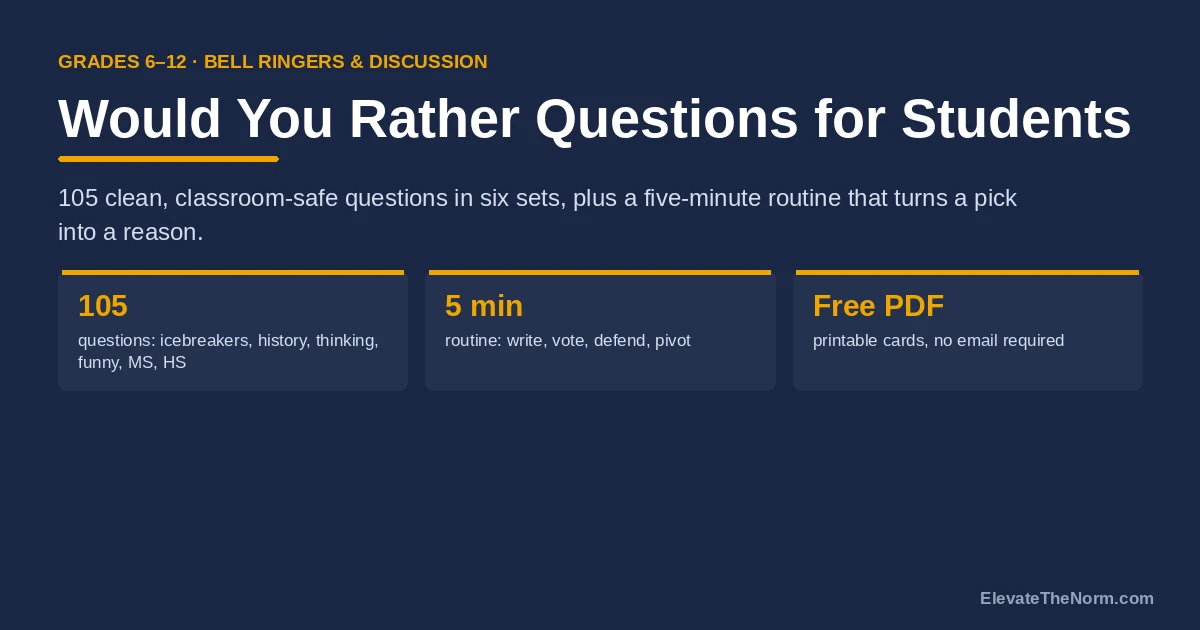
    Would you rather questions are two-choice prompts that force a decision and a reason. In a grades 6–12 classroom they make fast bell ringers, discussion warm-ups and brain breaks, because every student can answer and nobody can be “wrong.” Below are 105 clean, school-appropriate would you rather questions for students, sorted into six sets, plus a five-minute routine that keeps the fun from turning into chaos.

    The questions are the easy part. The routine is what makes a would you rather game worth the class time: students commit in writing, pick a side, and defend it with a reason. That is the same skill a Socratic seminar asks for, practiced in five low-stakes minutes.

    Key Takeaways

    • 105 questions in six sets: icebreakers, history and social studies, academic and thinking, funny, middle school, and high school.
    • Every question is classroom-safe. Nothing about appearance, family money, religion, politics or anything a student could not answer in front of the whole room.
    • Write before you talk. Thirty seconds of silent writing first is what turns a would you rather game into a thinking routine.
    • Reasons win, not volume. Grade the reason, never the choice.
    • Free printable cards. All 105 questions come as cut-apart PDF cards, with no email required.

    Why use would you rather questions in class?

    Because every student can answer one, the first minute of class starts with everyone in the conversation instead of the same five hands. There is no background knowledge needed and no right answer to fear. That makes these questions especially useful in the first weeks of school, with new students, and with classes that are slow to talk.

    They also teach something real. To answer well, a student has to make a choice, give a reason, and listen to someone who chose the other side. Those are the core moves of argument writing and discussion in every subject. A would you rather question is a low-stakes place to practice them before the stakes go up. When students are ready for a graded discussion, use the Socratic seminar rubric for high school.

    Finally, they are a classroom management tool. A short, predictable opener gives students something to do the moment they walk in, which is the same idea behind good bell ringer ideas and classroom routines. When the routine is the same every day, the start of class runs itself.

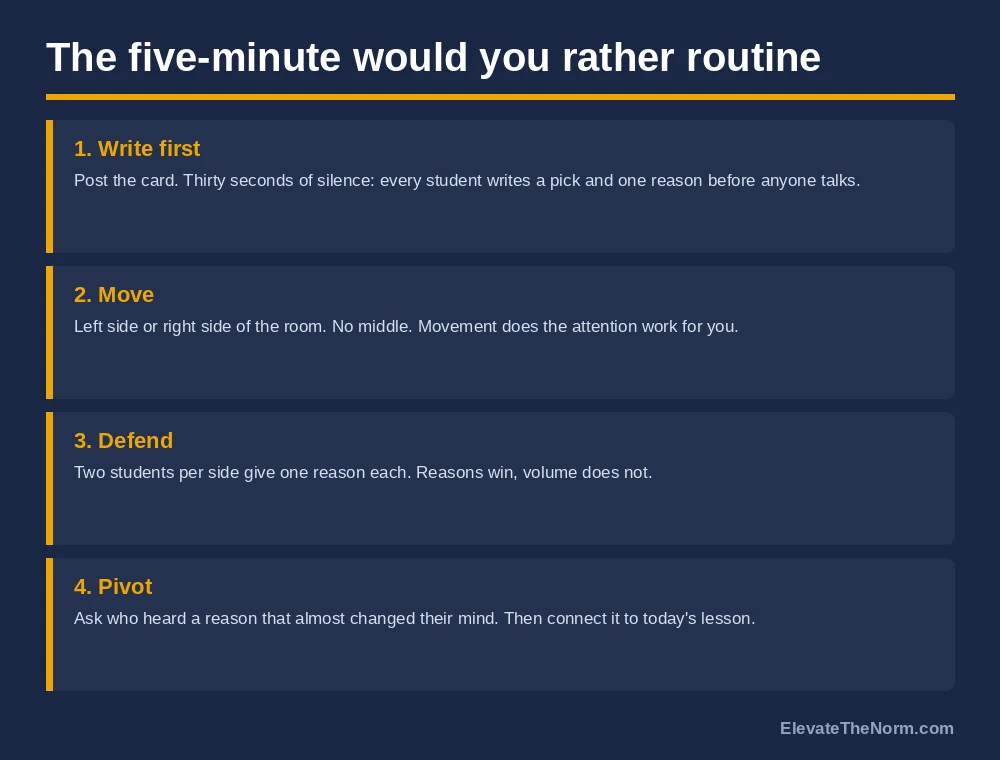
    Four steps of a five-minute would you rather classroom routine: write first, move, defend, pivot
    Same four steps every time, so students know the drill.

    How do you use would you rather questions as bell ringers?

    Run the same four steps every time: write, move, defend, pivot. The whole thing takes about five minutes once students know it.

    1. Write first. Post the question as students walk in. They write their pick and one reason in a notebook or on a sticky note. Thirty seconds of silence. This step keeps quieter students from just copying the loudest opinion.
    2. Move. One side of the room for option A, the other for option B. No middle. Movement wakes up a sleepy first period and makes the vote visible.
    3. Defend. Call on two students from each side for one reason each. If you use cold calling, the written answer from step one means nobody is caught empty-handed.
    4. Pivot. Ask, “Did anyone hear a reason that almost changed your mind?” Then connect it to the lesson and move on.

    Stop at five minutes. A bell ringer that eats fifteen minutes stops being a bell ringer, and students learn they can stretch it.

    When you would rather have the question written for you, our daily bell ringers page posts a fresh set for grades 6–8 and 9–12 every school day, with teacher notes hidden until you want them.

    StepWhat students doWhy it matters
    1. WriteWrite their pick and one reason during 30 seconds of silenceQuiet students commit before hearing the loudest opinion
    2. MoveGo to the option A or option B side of the room, no middleWakes up the room and makes the vote visible
    3. DefendTwo students from each side give one reason eachPractices claim and reason; nobody is caught empty-handed
    4. PivotAnswer: did anyone hear a reason that almost changed your mind?Connects the warm-up to the lesson
    The five-minute would you rather routine. Stop at five minutes.

    How do you use would you rather questions for class discussion?

    For a longer discussion, pick a question from the history or thinking sets and ask students to argue the side they did not choose. This is harder than it sounds, and it is one of the best quick exercises for argument writing. Other variations that work well in grades 6–12:

    • Reason ranking. Collect five reasons on the board. Students rank them from strongest to weakest and explain the top one.
    • Evidence round. For a history question, students must use one fact from the unit to support their choice.
    • Write-around. Each student writes a reason, passes the paper, and the next student responds to it in writing.
    • Exit ticket version. Use a question that connects to the day’s lesson as the last thing students answer before they leave.

    How do you keep would you rather questions from getting out of hand?

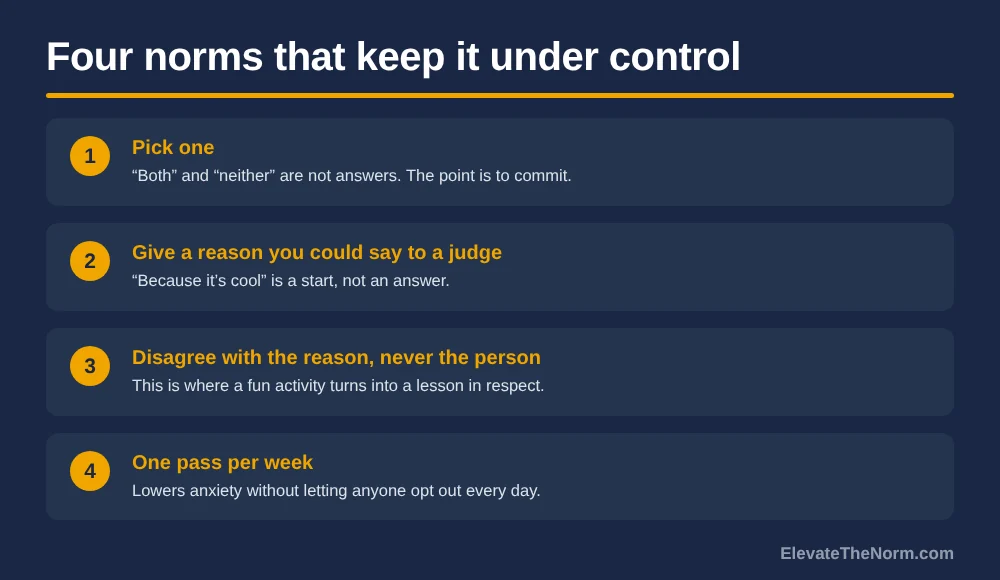
    The noise comes from unclear rules, not from the questions. Set these four norms once and post them:

    Graphic titled Four norms that keep it under control, listing pick one, give a reason you could say to a judge, disagree with the reason never the person, and one pass per week.
    The four norms to post before the first round.
    • Pick one. “Both” and “neither” are not answers. The point is to commit.
    • Give a reason you could say to a judge. “Because it’s cool” is a start, not an answer.
    • Disagree with the reason, never the person. This is where a fun activity can turn into a lesson in respect in the classroom.
    • One pass per week. Students may pass once. It lowers anxiety without letting anyone opt out every day.

    Use a consistent signal to end the movement and bring the room back. If you need one, our post on classroom attention getters has several that work with teenagers. And keep the questions fair: skip any prompt that would make a student reveal something about their family, money, body or beliefs. Every question on this list was written with that rule in mind.

    Free download: 105 would you rather question cards

    Fifteen pages. Page 1 is the five-minute routine and classroom norms. The rest are 105 cut-apart cards, eight per page, labeled by set and numbered to match this article. Print on card stock and keep a stack by the door.

    Free. No email address required. Built for grades 6–12.

    The questions below are numbered straight through, 1 to 105, so the cards and this page match.

    Icebreaker would you rather questions

    Use these in the first weeks, after a long break, or any time a new student joins. They are low-stakes, so every student can answer without knowing anything.

    1. Would you rather be able to talk to animals or speak every human language?
    2. Would you rather have a rewind button or a pause button for your life?
    3. Would you rather live in a big city or in the middle of the countryside?
    4. Would you rather be the best player on a losing team or a bench player on a championship team?
    5. Would you rather read the book or watch the movie first?
    6. Would you rather have summer all year or winter all year?
    7. Would you rather be famous for something you made or for something you did?
    8. Would you rather explore the deep ocean or outer space?
    9. Would you rather always know the answer or always ask the best question?
    10. Would you rather have a personal chef or a personal driver?
    11. Would you rather wake up at sunrise every day or stay up until 2 a.m. every night?
    12. Would you rather be able to fly or be invisible?
    13. Would you rather know how to play every instrument or speak every language?
    14. Would you rather have one best friend or ten good friends?
    15. Would you rather be really good at one thing or pretty good at everything?
    16. Would you rather never have homework again or never have a test again?
    17. Would you rather live without music or without movies?
    18. Would you rather plan every detail of a trip or show up and figure it out?
    19. Would you rather be the oldest sibling or the youngest?
    20. Would you rather have a free week off school now or an extra week of summer later?

    History and social studies would you rather questions

    These do double duty as a hook. The reasons students give about living in Rome or signing the Constitution tell you what they already think about the period before you teach it. See our history project ideas for unit ideas they lead into.

    1. Would you rather meet a famous person from the past or a famous person from 100 years in the future?
    2. Would you rather live in ancient Rome or ancient Egypt?
    3. Would you rather sail with Magellan or ride with the Pony Express?
    4. Would you rather sign the Declaration of Independence or help write the Constitution?
    5. Would you rather be a medieval knight or a medieval merchant?
    6. Would you rather travel the Silk Road or cross the Atlantic on the Mayflower?
    7. Would you rather witness the first Moon landing or the fall of the Berlin Wall?
    8. Would you rather be a scribe in ancient Egypt or a printer right after Gutenberg?
    9. Would you rather live through the Renaissance or the Industrial Revolution?
    10. Would you rather be president for one year or a Supreme Court justice for twenty?
    11. Would you rather be an explorer who finds a new land or a scientist who finds a new cure?
    12. Would you rather live without electricity or without running water?
    13. Would you rather visit the Library of Alexandria or the Great Wall while it was being built?
    14. Would you rather be a newspaper reporter during the American Revolution or the Civil Rights Movement?
    15. Would you rather have dinner with Benjamin Franklin or with Harriet Tubman?
    16. Would you rather lead an army or lead a debate in Congress?
    17. Would you rather live in a monarchy with a fair king or a democracy with an unpopular leader?
    18. Would you rather be a pioneer on the Oregon Trail or a worker building the transcontinental railroad?
    19. Would you rather be the first person to fly with the Wright brothers or the first to ride a car with Henry Ford?
    20. Would you rather know the full history of your town or the full history of your family?
    21. Would you rather have a vote on every law or elect someone you trust to vote for you?
    22. Would you rather be an inventor in the 1800s or an astronaut in the 1960s?
    23. Would you rather live in a castle with no heat or a log cabin with a fireplace?
    24. Would you rather read a diary from a teenager in 1776 or a letter from a soldier in 1944?
    25. Would you rather be remembered in history books or remembered by everyone in your town?

    Academic and thinking would you rather questions

    These are about learning itself. They make good openers before a test, a project launch or a feedback conversation, because students end up talking about how they work best.

    1. Would you rather solve a hard problem alone or an easy problem in a group?
    2. Would you rather write a five-page essay or give a five-minute speech?
    3. Would you rather learn by reading or learn by doing?
    4. Would you rather know a little about everything or everything about one subject?
    5. Would you rather be graded on effort or graded on results?
    6. Would you rather take one big final exam or ten small quizzes?
    7. Would you rather have a teacher who is strict and fair or relaxed and unpredictable?
    8. Would you rather discover a new planet or a new species of animal?
    9. Would you rather be able to remember everything you read or understand everything you hear?
    10. Would you rather argue the side you agree with or the side you disagree with?
    11. Would you rather build a robot or write a novel?
    12. Would you rather have unlimited books or unlimited internet?
    13. Would you rather fix a problem fast or fix it perfectly?
    14. Would you rather be the person with the idea or the person who makes it happen?
    15. Would you rather get honest feedback that stings or kind feedback that is vague?
    16. Would you rather study with music or in total silence?
    17. Would you rather have a class with no grades or a class with no deadlines?
    18. Would you rather be able to predict the weather perfectly or predict the stock market perfectly?
    19. Would you rather lose your phone for a week or lose your voice for a week?
    20. Would you rather make a mistake in front of the class or never try at all?

    Funny would you rather questions (still classroom-safe)

    Save these for Fridays, the day before a break, or the class that needs a reset. They are silly on purpose, but every one is clean enough to read aloud with an administrator in the room.

    1. Would you rather have spaghetti for hair or sweat maple syrup?
    2. Would you rather talk like a pirate for a day or sing everything you say?
    3. Would you rather have a pet dinosaur the size of a cat or a cat the size of a dinosaur?
    4. Would you rather only be able to whisper or only be able to shout?
    5. Would you rather have hands for feet or feet for hands?
    6. Would you rather wear socks that are always wet or shoes that are always one size too small?
    7. Would you rather sneeze glitter or hiccup bubbles?
    8. Would you rather have a rewind button for embarrassing moments or a mute button for annoying people?
    9. Would you rather ride a giant chicken to school or a tiny horse?
    10. Would you rather eat only pizza for a year or never eat pizza again?
    11. Would you rather have a nose that glows when you lie or ears that wiggle when you are nervous?
    12. Would you rather be a superhero with a useless power or a villain with an amazing one?
    13. Would you rather have a theme song play every time you walk in or a laugh track play after every joke you make?
    14. Would you rather live in a house made of candy or a house made of LEGO?
    15. Would you rather have a talking backpack or a talking locker?
    16. Would you rather fight one horse-sized duck or one hundred duck-sized horses?
    17. Would you rather have to hop everywhere or crab-walk everywhere?
    18. Would you rather lose all your eyebrows or have one giant eyebrow?
    19. Would you rather swap lives with your pet for a day or with your teacher for a day?
    20. Would you rather have a cloud that follows you and rains or a sun that follows you and makes you sweat?

    Would you rather questions for middle school

    Middle schoolers want to talk about their world: lunch, seats, field trips and friends. These keep the question close to that world.

    1. Would you rather have recess back or have a longer lunch?
    2. Would you rather be the class president or the yearbook photographer?
    3. Would you rather go on a field trip to a museum or to a science center?
    4. Would you rather sit wherever you want or have the teacher pick the perfect seat for you?
    5. Would you rather have a pet hamster in class or a fish tank?
    6. Would you rather be on the school play crew or in the school play?
    7. Would you rather have gym every day or art every day?
    8. Would you rather write with a pencil forever or a pen forever?
    9. Would you rather be able to skip one class a week or leave school an hour early on Fridays?
    10. Would you rather do a group project with your best friend or with the smartest person in class?

    Would you rather questions for high school

    High schoolers are starting to make real decisions about work, school and money. These questions take those decisions seriously without asking anyone to share anything private.

    1. Would you rather go to college right after graduation or take a gap year to work and travel?
    2. Would you rather have a job you love that pays okay or a job you tolerate that pays a lot?
    3. Would you rather learn a trade or earn a four-year degree?
    4. Would you rather have your first car be brand new and boring or old and awesome?
    5. Would you rather live close to home after high school or move across the country?
    6. Would you rather start your own business or work your way up at a big company?
    7. Would you rather have a great reputation or a great bank account?
    8. Would you rather know your future career now or figure it out as you go?
    9. Would you rather run for city council at 18 or vote in your first presidential election?
    10. Would you rather be the team captain or the player who scores the most?

    How do you write your own would you rather questions?

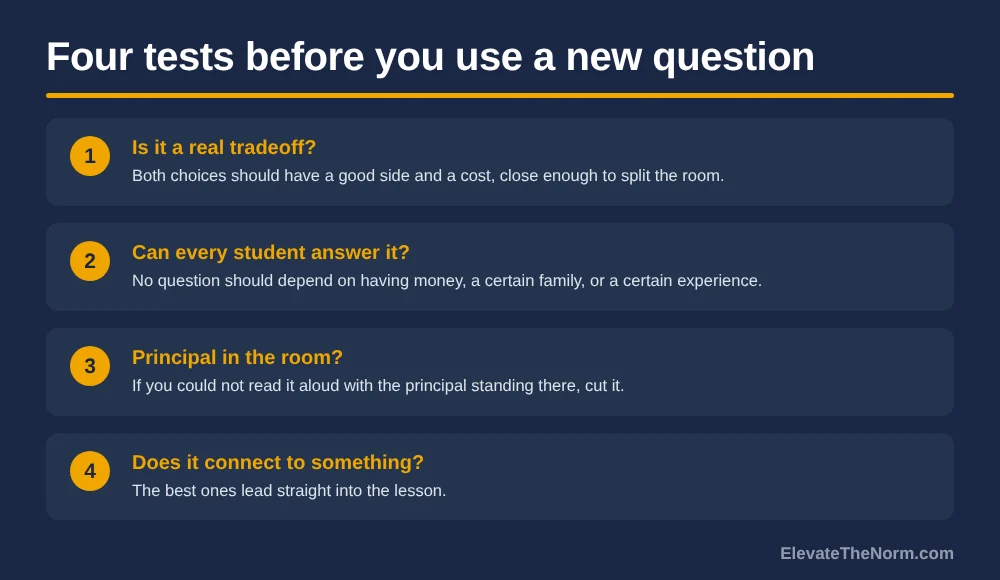
    A good classroom would you rather question has two choices that are close enough to split the room. If 28 out of 30 students pick the same side, there is nothing to discuss. A few tests before you use a new one:

    Graphic titled Four tests before you use a new question, listing is it a real tradeoff, can every student answer it, could you read it with the principal in the room, and does it connect to something.
    Four tests to run on a prompt before it reaches the class.
    • Is it a real tradeoff? Both choices should have a good side and a cost.
    • Can every student answer it? No question should depend on having money, a certain family, or a certain experience.
    • Could you read it aloud with the principal in the room? If not, cut it.
    • Does it connect to something? The best ones lead into the lesson. “Would you rather live in a monarchy with a fair king or a democracy with an unpopular leader?” is a two-week civics unit in one sentence.

    Students can write them too. Having a class write would you rather questions about a unit is a quick review activity that shows you what they think the big tradeoffs were. It pairs well with classroom review games at the end of a unit.

    Frequently Asked Questions

    A set like this runs out eventually, which is why I put a fresh bell ringer idea in every issue of Bell to Bell, my free weekly newsletter for grades 6–12 teachers. A new issue goes out each Wednesday, and every other one includes a printable classroom resource.

    What are good would you rather questions for high school students?

    Good high school questions are classroom-safe and make students weigh a real trade-off, so the reason matters more than the pick. Questions about history, ethics, the future, and how they would solve a problem work well. Avoid anything about appearance, family money, religion, or politics, or anything a student could not answer in front of the whole room.

    How long should a would you rather bell ringer take?

    About five minutes. Students write a pick and one reason in 30 seconds of silence, move to a side of the room, hear two reasons from each side, then answer one pivot question that connects to the lesson. A bell ringer that runs fifteen minutes stops being a bell ringer, and students learn they can stretch it.

    What are good would you rather questions for students?

    Good would you rather questions for students offer two choices that are close enough to split the class, can be answered by every student, and are clean enough to read aloud in any classroom. Examples include: Would you rather be able to talk to animals or speak every human language? Would you rather live in ancient Rome or ancient Egypt? Would you rather learn by reading or learn by doing?

    How do you play the would you rather game in a classroom?

    Post the question, give students thirty seconds to write their choice and one reason, have them move to one side of the room for each option, then call on two students per side to share a reason. End by asking if anyone heard a reason that almost changed their mind. The whole routine takes about five minutes.

    Are would you rather questions good bell ringers?

    Yes. They work as bell ringers because every student can answer without background knowledge, they get students writing and talking in the first minute, and they practice the core skill of making a claim and supporting it with a reason. Keep them to about five minutes so they stay a warm-up.

    How do you keep would you rather discussions from getting out of hand?

    Set a few norms and post them: pick one side, give a real reason, disagree with the reason and not the person, and allow one pass per week. Use the same signal every time to end movement and bring the room back. Most of the noise comes from unclear rules, not from the questions.

    Can would you rather questions be used for history class?

    Yes. History would you rather questions make strong hooks, such as asking whether students would rather sign the Declaration of Independence or help write the Constitution. The reasons students give show what they already believe about a period, and you can require them to support their choice with one fact from the unit.

    Are these would you rather questions appropriate for middle school?

    Yes. Every question on this list is clean and school-appropriate, and none asks students to share anything about their appearance, family, money, religion or politics. There is also a set written specifically for middle school students and another for high school students.

    Is there a printable version of these questions?

    Yes. All of the questions are available as free printable cut-apart cards in a PDF, labeled by set and numbered to match this article. It downloads directly with no email or sign-up.

    About Clay Shumate

    Clay Shumate is a certified secondary Social Studies teacher in the public schools of West Alabama, with seven years of classroom experience, a B.A. in History, and an M.Ed. in Secondary Education. He writes about project-based learning, student responsibility, respect, and practical ways to hold young people to a higher standard while giving them room to learn from mistakes. He is a member of the Society of Professional Journalists and writes to its Code of Ethics; this site’s editorial standards and corrections policy are published in full. More about Clay.

Teacher Emergency Toolkit — practical resources, real classroom support. Shop on TPT.Teacher Emergency Toolkit — practical resources, real classroom support. Shop on TPT.