The Elevate Blog banner: Real Classrooms. Practical Ideas. Higher Expectations. Three students climb a rocky ridge at sunrise, each pulling the next one up, toward a teacher reaching down to help.

Tag: classroom routines

  • Managing Classroom Procedures: What the Rubric Wants and What Actually Works

    Managing Classroom Procedures: What the Rubric Wants and What Actually Works

    By Clay Shumate

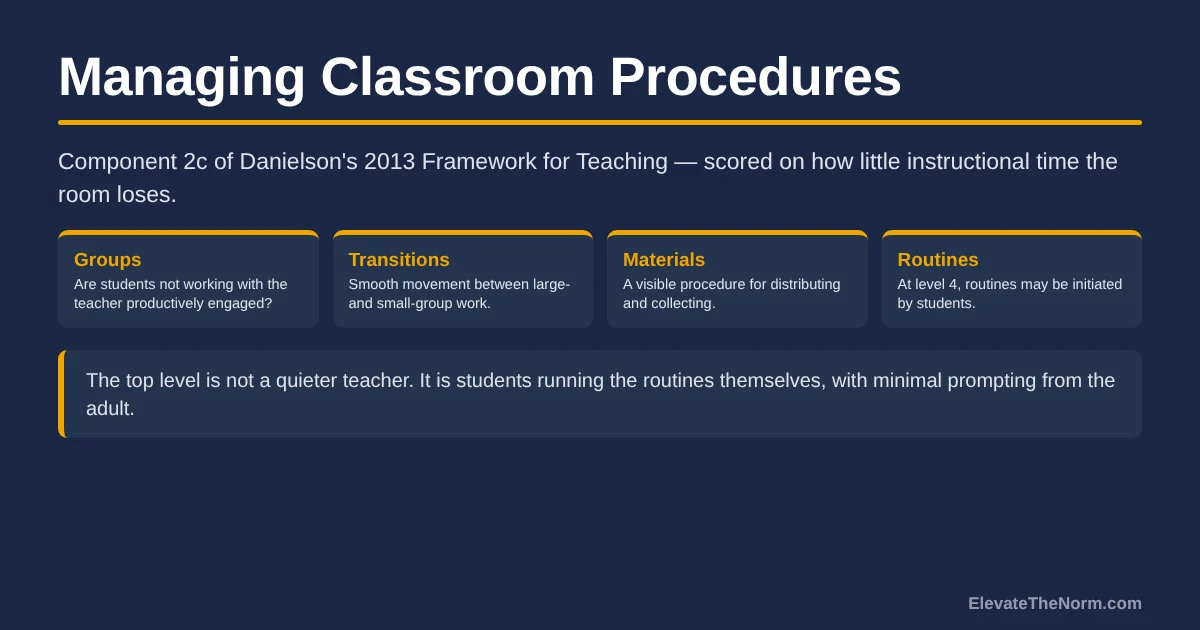
    Managing classroom procedures is component 2c of Charlotte Danielson’s 2013 Framework for Teaching. It scores how little instructional time a room loses to instructional groups, transitions, materials and routines. The top level is not a quieter teacher. It is students running the routines themselves with minimal prompting from the adult.

    Key Takeaways

    • “Managing classroom procedures” is the name of component 2c in the 2013 edition of Danielson’s Framework for Teaching, and it is scored on four levels from “much instructional time is lost” up to “instructional time is maximized.”
    • The 2022 edition of the Framework renamed 2c to “Maintaining Purposeful Environments.” Many districts are still evaluating on the 2013 wording, so a teacher can be observed under either name depending on which instrument the district bought.
    • Level 4 on this component cannot be reached by a teacher who runs everything personally. The rubric requires that students take initiative in transitions, materials and instructional groups, and that routines “may be initiated by students.”
    • A single observation by a single observer produced reliability between .27 and .45 in the Measures of Effective Teaching study, which used this exact instrument. One score on 2c is a weak estimate of what a room normally does.
    • Seven districts and charter networks spent $597 million from 2009 to 2016 building evaluation systems around rubrics like this one. RAND’s final report concluded the initiative “did not achieve its goal of increased student achievement and graduation.”

    Most teachers meet the phrase “managing classroom procedures” in one of two ways. Either a pre-observation form asks them to write about it, or a post-observation conference hands them a 2 on it and a sentence about transitions.

    Neither of those tells you what the phrase means. So here is the whole thing: where it comes from, what each score level actually says, which procedures carry the most weight in a secondary room, and what the research says about how much one of these scores is worth. Some of that research is not flattering to the rubric, and it is in here anyway.

    What does “managing classroom procedures” mean?

    Managing classroom procedures means running the non-teaching machinery of a classroom so it costs as little learning time as possible. In the Danielson rubric it covers four things: instructional groups, transitions, materials and supplies, and everyday classroom routines.

    That is a narrower idea than “classroom management,” and the distinction matters when you are being scored. Classroom management in ordinary staff-room usage covers behavior, relationships, consequences, tone, everything. Component 2c is not about behavior. Behavior lives in a different component. 2c is about logistics: whether the room knows how to start, move, get supplies, work in groups and finish without an adult narrating every step.

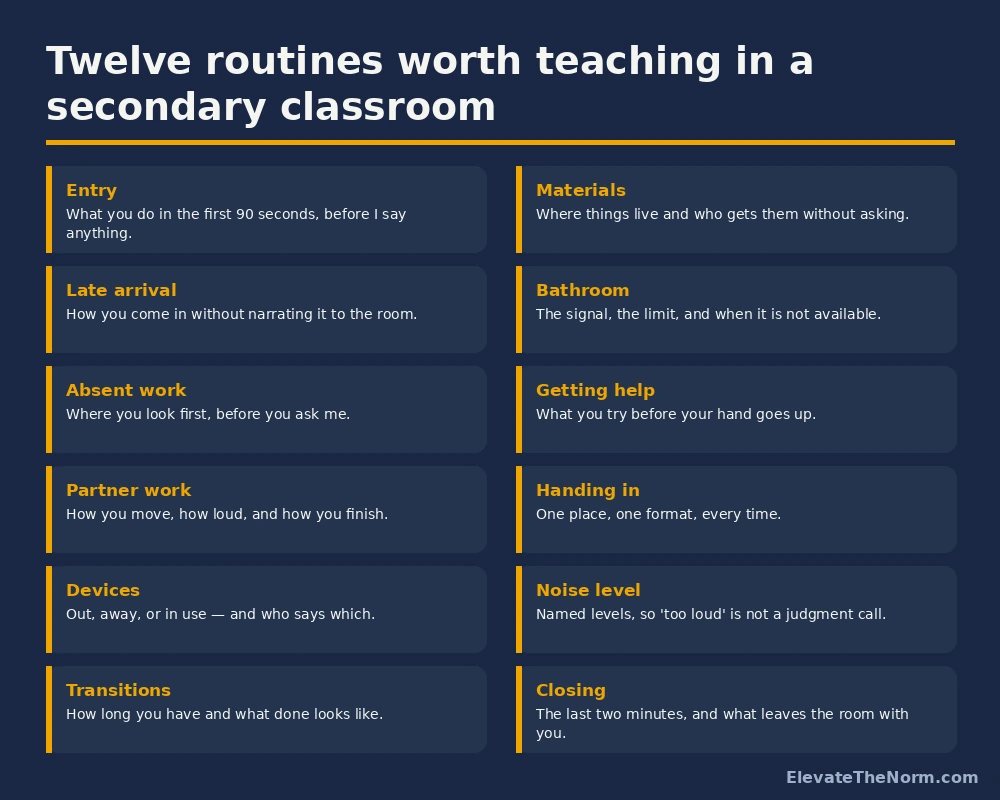
    If you want the practice side rather than the rubric side, the companion piece on classroom routines and procedures for grades 6–12 is the one that walks through which routines to teach and how to teach them. This article is about the instrument.

    Where does the phrase come from, and is it still in the rubric?

    “Managing Classroom Procedures” is component 2c of Domain 2 in the 2013 edition of the Framework for Teaching. The 2022 edition of the Framework renamed that slot to “Maintaining Purposeful Environments,” which the Danielson Group publishes as its current 2c rubric.

    That rename is worth knowing before a pre-conference, because the two editions are in use at the same time. A district that adopted the Framework a decade ago and never repurchased is still scoring teachers on the 2013 language. A district that updated is using the 2022 language. The phrase on your evaluation form tells you which one you are on.

    EditionComponent 2c is calledWhat it emphasizesWho is likely using it
    2013 Framework for TeachingManaging Classroom ProceduresInstructional groups, transitions, materials, routines, and minimizing lost instructional timeDistricts still on the instrument they adopted during the evaluation-reform era
    2022 Framework for TeachingMaintaining Purposeful EnvironmentsThe same ground, framed as a purposeful environment rather than a set of managed proceduresDistricts that have repurchased or retrained since 2022

    Both versions are asking the same practical question. The older wording is blunter about it, and because the keyword people actually search is the older wording, that is the version the rest of this article quotes.

    What does an observer look for at each level?

    An observer is looking for lost instructional time and who prevents it. The 2013 rubric sorts rooms by how much time the procedures cost and by how much prompting students need, and the jump from Proficient to Distinguished is entirely about students doing the work instead of the teacher.

    Here is the actual ladder, in the rubric’s own terms.

    LevelInstructional timeStudent prompting requiredWhat an observer writes down
    1 — Unsatisfactory“Much instructional time is lost due to inefficient classroom routines and procedures”“Little evidence that students know or follow established routines”Disorganized transitions, no visible procedure for handing out or collecting anything, students not working with the teacher are off task
    2 — Basic“Some instructional time is lost due to partially effective classroom routines and procedures”Students follow routines “with regular guidance and prompting”Procedures appear to exist but do not run smoothly; students are confused about carrying them out; independent work is only partially engaged
    3 — Proficient“There is little loss of instructional time due to effective classroom routines and procedures”Students follow routines “with minimal guidance and prompting”Smooth transitions between large and small group, efficient distribution and collection of materials, productive small-group and independent work
    4 — Distinguished“Instructional time is maximized due to efficient and seamless classroom routines and procedures”Routines “are well understood and may be initiated by students”Students take initiative in transitions, in distributing and collecting materials, and in managing instructional groups; they ensure their own time is used productively

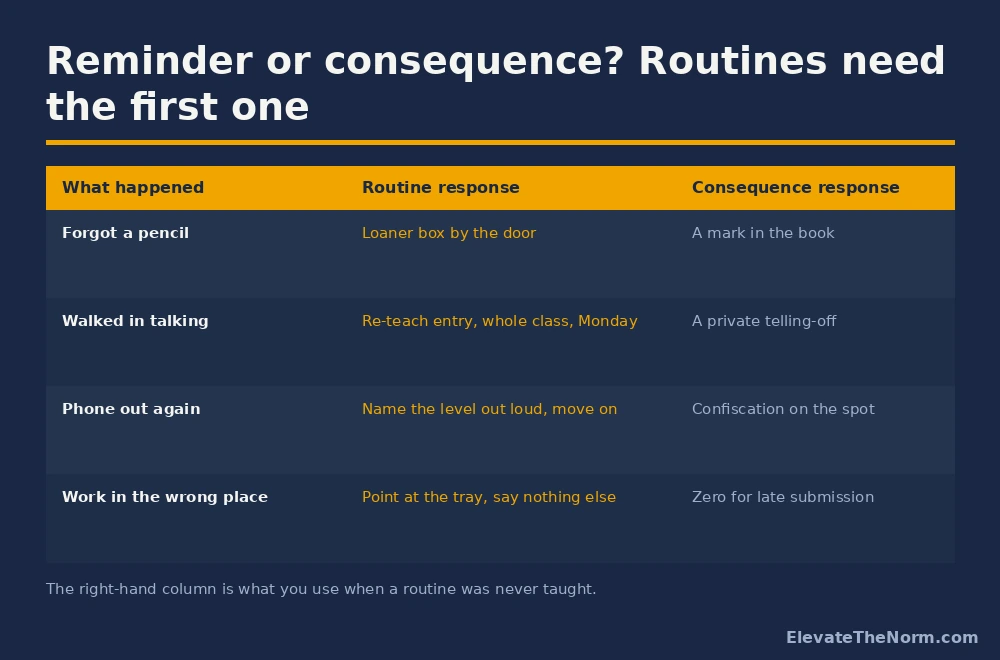
    Read the top row again, because it is the part that gets missed. You cannot earn a 4 on this component by being an excellent manager of a room. The rubric explicitly requires that students take initiative, and that routines can start without you. A teacher who runs a beautifully tight ship personally, calling every move, is describing a 3.
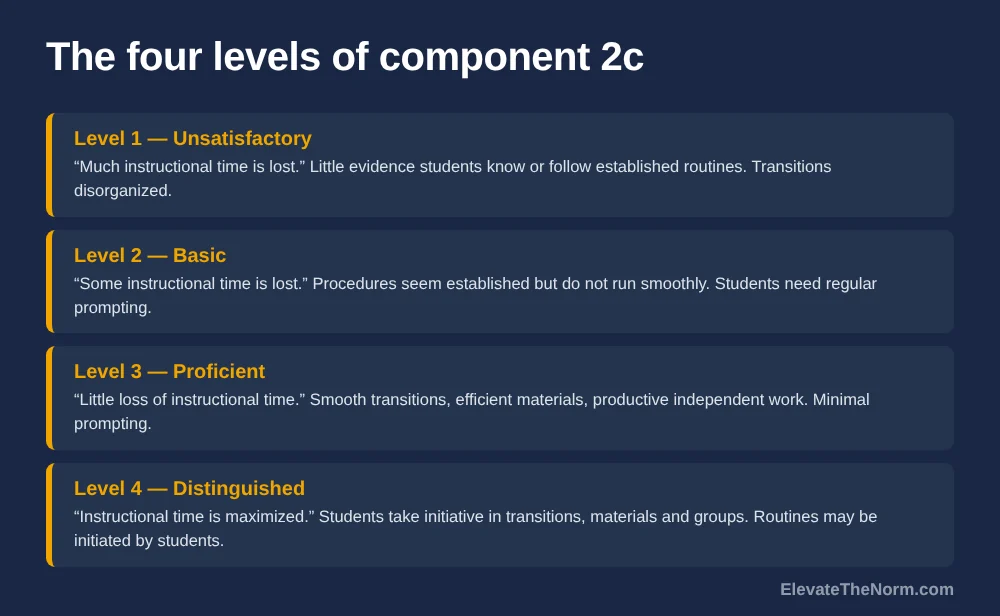
    Four stacked rows showing the Unsatisfactory, Basic, Proficient and Distinguished level descriptors for component 2c, managing classroom procedures.
    The four levels, in the 2013 rubric’s own words.

    Which means the move from 3 to 4 is a handoff, not an improvement. Take one of the four procedures the rubric names — materials is usually the easiest — and give it to students to start and run. Three guardrails on that, because the handoff goes wrong in predictable ways. Do not turn it into peer policing, where students enforce the routine on each other; the rubric asks students to run procedures, not to discipline classmates. Do not let the same three reliable kids absorb every job, which is how a management win becomes unpaid labor for the students who were already compliant. And check it against accommodations first, because a routine that requires every student to get up and collect their own materials is not neutral for a student whose IEP or 504 plan says otherwise.

    That is a demand this site happens to agree with, for reasons that have nothing to do with evaluation scores. If a 15-year-old cannot be trusted to hand back papers or start a group task without an adult counting down, somebody decided that in advance.

    Which procedures carry the most weight in grades 6–12?

    The four the rubric names carry the weight, because those are the four an observer is scoring. Everything else in a secondary classroom is downstream of entry, transitions, materials and group work.
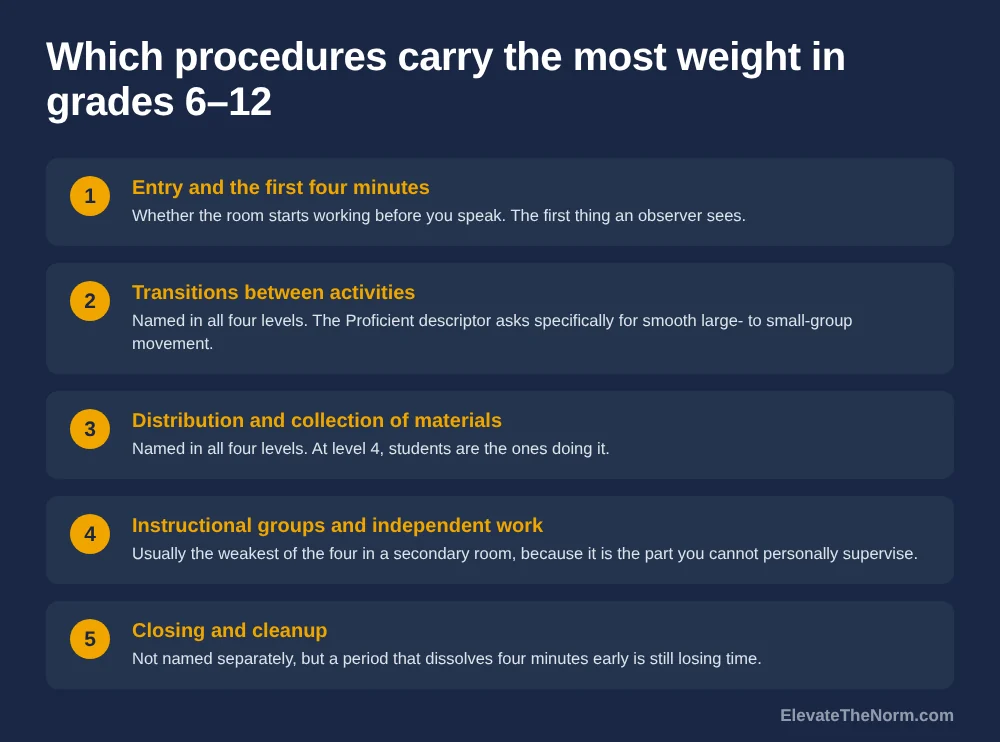
    Numbered list of five classroom procedures that carry the most weight in grades 6 to 12, from entry routines through closing and cleanup.
    Entry and transitions cost the most time in most secondary rooms.
    1. Entry and the first four minutes. Whether the room starts working before you speak. This is the procedure an observer sees first and the one that colors the rest of the period.
    2. Transitions between activities. The rubric’s Proficient language is specifically “transitions between large- and small-group activities are smooth.” If you only tighten one thing before an observation, tighten this.
    3. Distribution and collection of materials. Named in all four levels. At level 4, students are doing it. Chromebook carts, paper, lab equipment, novels, calculators — whatever your room hands out, there is a visible procedure for it or there is not.
    4. Instructional groups and independent work. The rubric asks whether students not working directly with the teacher are productively engaged. In a secondary room this is usually the weakest of the four, because it is the one you cannot personally supervise.
    5. Closing and cleanup. Not separately named in the rubric, but it is the visible end of “instructional time is maximized.” A period that dissolves four minutes early is losing time no matter how good the middle was.

    Transitions are the usual culprit, and they have their own article: how to stop losing six minutes a lesson, plus a shorter piece on cues students can actually see for rooms where verbal direction is already competing with thirty conversations.

    How do you show this to an observer who is only in the room for 15 minutes?

    Pick a segment that contains a transition and some independent work. A short observation that lands entirely inside a lecture gives an observer nothing to score on 2c, so they score what they can infer, which is worse for you than showing them the real thing.

    Short observations are now common, and the MET study found they are not worthless: a single 15-minute observation produced about 60 percent of the reliability of a full-lesson observation while taking under a third of the time. That is a reasonable trade for an observer with forty teachers to see. It also means the 15 minutes they pick carries a lot of weight, which is an argument for making sure those minutes are representative rather than exceptional.

    Plenty of districts do unannounced walkthroughs with no pre-conference at all, and in that case none of the framing above is available to you. The only defense there is that the procedures run the same whether an adult with a clipboard is standing in the door or not — which is the actual point of the component, and the reason gaming it is a waste of a week.

    • Name the component in the pre-conference. Say which procedures they will see and when. An observer who knows the materials routine happens at minute six will look for it.
    • Make one student-run routine visible. Level 4 language requires student initiative. If a student starts the routine, say so in the post-conference reflection, because an observer who missed the first thirty seconds cannot score what they did not see.
    • Have the written procedure somewhere. Posted, in the syllabus, in the slide deck — it does not matter where. It matters that “procedures seem to have been established” (level 2) can be upgraded to “established” with something you can point at.
    • Do not stage a procedure the room does not have. The rubric’s level 2 descriptor is literally the look of a staged routine: procedures that “seem to have been established, but their operation is not smooth,” with students confused about carrying them out. Observers recognize it.
    • Ask which edition you are scored on. 2013 or 2022. It changes the vocabulary of the entire conference.

    If your procedures are not where you want them yet, the honest move is to say so in the pre-conference and name what you are working on. A teacher who can diagnose their own level 2 is easier to coach than one who is surprised by it, and in most districts the conversation is the part that actually changes anything.

    Does a good score on this component mean you are a better teacher?

    Not reliably, and the research on that is clear enough that it should change how much weight anybody puts on one number. The instrument is a decent description of good practice. The scoring of it is noisy, and the systems built on top of it did not produce the results they were built to produce.

    The Measures of Effective Teaching project tested exactly this instrument — ten items from Domains 2 and 3 of the Framework for Teaching, scored on the four-point scale, in Hillsborough County, Florida. Its finding on single observations is the number every teacher being evaluated should know: reliability for one observation by one observer ranged from .27 to .45.

    It gets more specific. Broken out by who is doing the observing, one rating by one observer produced reliability of .510 for a same-school administrator, .433 for an administrator from another school, .287 for a peer with the same certification, and .240 for a peer with a different certification. The study’s blunt conclusion was that “having more than one observer really does matter” — adding a second set of eyes bought more than twice the reliability gain of adding a second lesson with the same observer. The smallest combination the study tested that reached a .65 threshold was four full-lesson observations by two observers.

    Almost no district does that. Which means most 2c scores in America are a single reading with somewhere between .27 and .51 reliability attached to it.
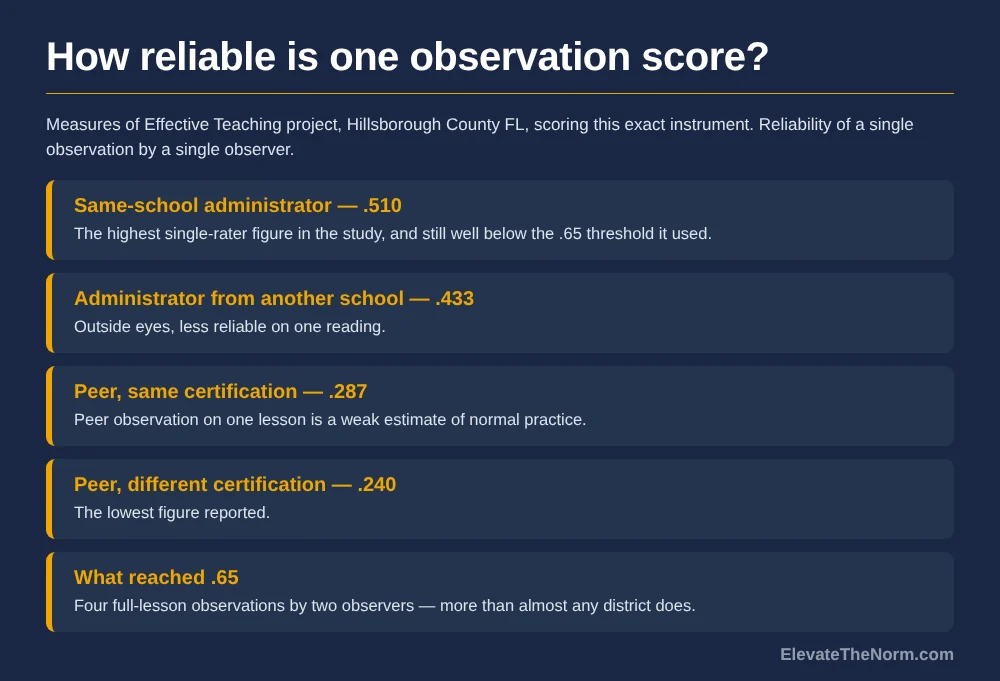
    Five rows of classroom observation reliability figures by observer type, from .510 for a same-school administrator down to .240 for a peer with different certification.
    One observer, one lesson, on the same instrument being scored.

    One honest limit on those figures: they come from a single district, Hillsborough County, Florida, with observers trained for that study. A different district with different training could do better or worse. The direction of the finding — one observer, one lesson, weak estimate — has held up well enough to be worth acting on, but the specific decimals are not a national constant.

    The bigger finding is about the systems rather than the scores. RAND’s final evaluation of the Intensive Partnerships for Effective Teaching followed seven sites — three districts and four charter management organizations — from 2009 through 2016 as they built evaluation systems combining rubric-based observation with student achievement growth. The initiative cost $597 million, of which $237 million came from Gates Foundation grants.

    RAND’s conclusion was that “the initiative did not achieve its goal of increased student achievement and graduation.” There were exceptions in both directions — high school English improved in the charter networks and in Pittsburgh, grades 3–8 math declined in the charter networks — but no widespread gain, no graduation improvement in most sites and grade ranges, and no improvement in low-income minority students’ access to effective teaching, which had been one of the stated goals. By the end, almost all teachers were rated effective, with only 1 to 2 percent rated ineffective at most sites.

    Two caveats before anyone quotes that as a verdict. The seven sites covered elementary through high school, so the achievement results are not specific to grades 6–12. And the initiative changed far more than observation rubrics — it touched pay, tenure, staffing and professional development — so the null result belongs to the whole package, not to component 2c.
    Report that honestly and it cuts both ways. It is not evidence that procedures do not matter. Lost instructional time is real and the rubric describes it accurately. It is evidence that scoring teachers on it, at the scale and frequency districts can afford, did not move student outcomes. Districts are still legally required to evaluate teachers, so the useful question is not whether to do it but what to take from it — and the specific, concrete feedback has always been the valuable half.

    Clay’s take: the rubric is better than the score

    The 2c language is one of the few places in a teacher evaluation instrument that says something genuinely useful about teenagers. Read level 4 without the evaluation context and it is a description of a classroom where students are trusted with the running of their own room.

    That is worth chasing on its own terms. Not because a 4 looks good on a summative, but because the alternative is a room where a near-adult cannot distribute a stack of papers without supervision. The rubric is right that those are different rooms, and it is right about which one loses less time.

    Where I would not spend much energy is the number itself. A measurement with .27 to .45 reliability from one observer is not a verdict on a semester of work, and a half-billion-dollar initiative built on these instruments did not raise achievement or graduation rates. Take the feedback, which is usually specific and often correct. Hold the score loosely.

    And if the feedback says your transitions cost time, that is probably true regardless of what the reliability coefficient says. Transitions are the one thing on this component that nearly every teacher can see for themselves with a stopwatch.

    What to do next

    Find out which edition your district evaluates on, then read your own 2c language rather than a summary of it. Pick the one procedure that costs you the most time — for most secondary teachers that is transitions or materials — and build it into something a student can start.

    Then put it in writing somewhere an observer can see. If you want the longer version of the underlying work, start with which routines are worth teaching in grades 6–12, keep a management plan that actually runs on one page, and if the room is still loud through every handoff, the prevention side is the better place to spend a week than the rubric is. The expectations framework covers what the procedures are supposed to be serving.

    Frequently Asked Questions

    What is component 2c Managing Classroom Procedures?

    Component 2c is a slot in Domain 2 of the 2013 edition of Charlotte Danielson’s Framework for Teaching. It scores how much instructional time a classroom loses to instructional groups, transitions, materials and supplies, and everyday routines, and how much teacher prompting students need to follow them. It is scored on four levels, from much time lost up to instructional time maximized.

    Is managing classroom procedures the same as classroom management?

    No. Classroom management in everyday staff-room usage covers behavior, relationships, consequences and tone. Component 2c is narrower and deliberately excludes behavior, which is scored elsewhere in the framework. 2c is logistics: whether the room can start, move between activities, handle materials and work in groups without an adult narrating every step.

    What does a Distinguished rating on 2c actually require?

    Student initiative, not teacher efficiency. The 2013 rubric’s level 4 says routines are well understood and may be initiated by students, and that students take initiative in transitions, in distributing and collecting materials, and in managing instructional groups. A teacher who personally directs every smooth move is describing level 3, not level 4.

    Was component 2c renamed in the 2022 Framework for Teaching?

    Yes. The 2022 edition renamed 2c from Managing Classroom Procedures to Maintaining Purposeful Environments, and the Danielson Group publishes that as the current 2c rubric. Both editions are in active use, because districts adopt the instrument they purchased. Ask which edition your evaluation form uses before a pre-observation conference.

    How reliable is one observation score on classroom procedures?

    Not very. The Measures of Effective Teaching study, which scored this exact instrument, found reliability of .27 to .45 for a single observation by a single observer. Broken out by observer, one rating ran .510 for a same-school administrator down to .240 for a peer with different certification. More observers helped more than more lessons.

    Which classroom procedures should a secondary teacher fix first?

    Transitions, in most rooms. The rubric names transitions in all four levels and the Proficient descriptor specifically calls for smooth movement between large- and small-group activities. Transitions are also the easiest procedure to measure yourself with a stopwatch, which makes them the cheapest place to find real lost time before anybody observes you.

    Do evaluation systems built on these rubrics improve student outcomes?

    The largest test of that says no. RAND’s final evaluation of the Intensive Partnerships for Effective Teaching followed seven sites from 2009 to 2016 at a cost of $597 million and concluded the initiative did not achieve its goal of increased student achievement and graduation. The sites spanned elementary through high school, and the initiative changed pay and staffing too, so the null result belongs to the package rather than to one rubric component.

    What should you do if you disagree with your score on managing classroom procedures?

    Ask which level descriptor the score was based on and what specific evidence the observer recorded, because the rubric language is public and checkable. Most evaluation systems allow a written teacher response in the record. Disagreeing about a decimal is rarely worth the energy; disagreeing about an inaccurate factual observation, in writing, sometimes is.

    Sources

    About Clay Shumate

    Clay Shumate is a certified secondary Social Studies teacher in the public schools of West Alabama, with seven years of classroom experience, a B.A. in History, and an M.Ed. in Secondary Education. He writes about project-based learning, student responsibility, respect, and practical ways to hold young people to a higher standard while giving them room to learn from mistakes. He is a member of the Society of Professional Journalists and writes to its Code of Ethics; this site’s editorial standards and corrections policy are published in full. More about Clay.

  • Early Finisher Activities for Grades 6–12 That Students Won’t Read as a Punishment

    Early Finisher Activities for Grades 6–12 That Students Won’t Read as a Punishment

    By Clay Shumate

    Early finisher activities are what a student does with the minutes between finishing the assigned work and the end of the period. In grades 6–12 the question is not which activity is fun enough. It is what the activity teaches the room about finishing early. Hand out more work and students learn to work slower; hand out nothing and you lose the minutes. Everything below is built on that one trade.

    Search for this and you get kindergarten centers, art-room doodle bins and first-grade challenge cards. Very little of it survives contact with a fifteen-year-old who has worked out that being done means being handed another worksheet.

    Key Takeaways

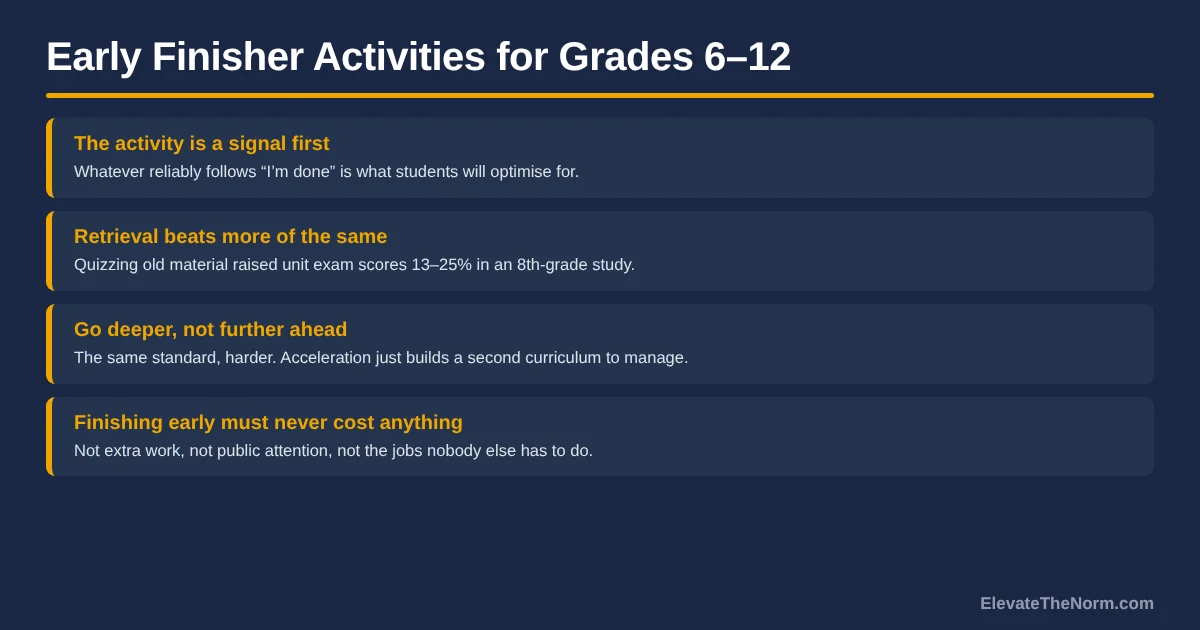
    • The activity is a signal before it is a task. Whatever reliably follows “I’m done” is what students will optimise for. Design the signal first and the activity second.
    • Use the minutes for retrieval, not new content. Quizzing on material already taught produced 13–25% gains on unit exams in an eighth-grade science classroom, and practice testing is one of only two techniques a major review rated high utility.
    • Going deeper beats going further. Pushing an early finisher into next week’s content creates a second, invisible curriculum you then have to manage.
    • A standing menu beats daily invention. Choice reliably lifts motivation — but the same meta-analysis found no significant effect on learning, so build the menu for willingness, not for test scores.
    • Never make finishing early cost anything. Not more work, not public attention, not a job nobody else has to do.

    What Are Early Finisher Activities?

    Early finisher activities are planned, low-supervision tasks a student moves to independently after completing the assigned work, before the class has moved on together. In a secondary classroom they usually need to work in gaps of three to twelve minutes, require no new instruction, make no noise that disrupts students still working, and need no grading from you.

    This is the operational end of differentiation rather than differentiation itself. Deciding how to vary a task by readiness is a planning question; deciding what a student does in the nine minutes after they finish it is a routine question. They are related and they are not the same job, and conflating them is why early finisher advice so often arrives as a lesson-planning project nobody has time for.

    That list of constraints is the whole design problem. Most published ideas fail at least two of them. Anything that needs you to explain it, mark it, or supervise it is not an early finisher activity — it is a second lesson you are now teaching to one student while twenty-nine others work.

    Why This Changes After Elementary School

    An elementary teacher with one class of twenty-four can keep a physical bin of activities, knows every child’s reading level, and has the same students all day. None of that is true in a middle or high school room. You may see 150 students across five or six sections, in periods short enough that ten minutes is a fifth of the class, and you will never have the same ten minutes free twice.

    The second difference matters more, and almost nothing written about early finishers acknowledges it. Teenagers read incentives accurately and act on them. A nine-year-old handed a bonus puzzle is usually pleased. A sixteen-year-old handed a bonus puzzle does the arithmetic: working efficiently produced more work, so next time, work slower. You are not managing boredom. You are setting the price of finishing.

    This is the same reason the usual advice about keeping students busy stops working somewhere around sixth grade, and it is why a routine that students can see the logic of does more for you than any individual activity. The ones that hold up are the ones a student would still choose if nobody were watching.

    How Much Time Is Actually in Play?

    Less than the productivity advice implies, and more than you would guess from any single lesson.

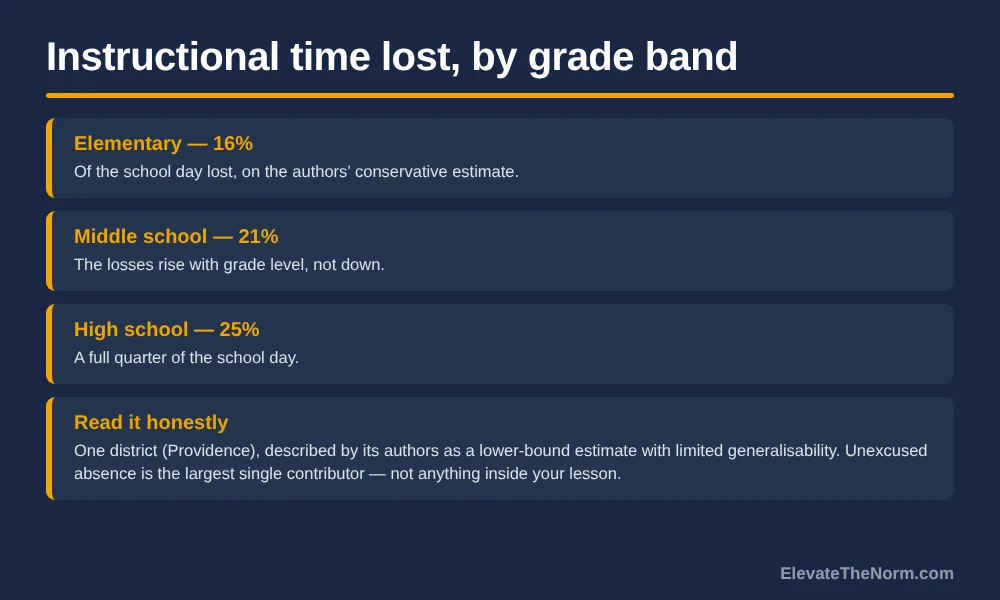
    Matthew Kraft and Sarah Novicoff’s 2024 analysis of Providence Public Schools estimated that students lose 16 to 25 percent of the school day, rising by grade band: 16 percent for the average elementary student, 21 percent in middle school and 25 percent — a full quarter — in high school. Two honest caveats belong with those numbers. The largest single contributor is unexcused student absence, not anything happening inside your lesson. And the authors call their own figure a lower-bound estimate from one district with, in their words, “limited generalizability.”

    Chart listing instructional time lost by grade band: 16 percent elementary, 21 percent middle school, 25 percent high school, with a note that the figures come from one district, are a lower-bound estimate, and that unexcused absence is the largest contributor.
    Time lost rises with grade level – and the headline figure is mostly not about your lesson.

    Their paper also cites other researchers’ estimates that off-task behaviour, transitions and wait time together occupy 17 to 29 percent of instructional time. That is the range closest to the early finisher problem — but it is a figure Kraft and Novicoff are reporting from other studies rather than measuring themselves, it bundles three different things together, and no part of it is specifically “students who finished early.” Anyone quoting you a clean number for that is estimating.

    What you can say defensibly: the dead minutes are a real and measurable share of the week, they are worse in secondary than in elementary, and the portion you personally control is smaller than the headline. That is still worth planning for. It is not worth a system so elaborate it costs more time than it recovers — and the same arithmetic applies to the minutes lost moving a class from one task to the next.

    The One Rule: Finishing Early Can Never Cost a Student

    If you take one thing from this, take this. Every early finisher system succeeds or fails on whether students believe that working well is safe.

    Three things make finishing early expensive, and all three are common:

    • More of the same. Another page of the problems they just demonstrated they can do. This is the most common response and the most costly one, because it is transparently a penalty for competence.
    • Public attention. “Marcus is finished — everyone else needs to hurry up.” You have just made finishing early a social liability and told the rest of the room they are behind.
    • Unpaid labour. Handing out papers, tidying, tutoring a classmate who has not asked for help. Occasionally fine and genuinely useful; as a default it means the fastest workers do the chores.

    The alternative is not a reward system. It is predictability. Students should be able to state, without asking, what happens when they finish — and it should be the same thing on Monday as on Thursday. Respecting students mostly comes down to doing exactly what you said you would do, every time, and an early finisher routine is an unusually visible test of it. If you promise that finishing early buys you a free read and then fill the time with a worksheet twice, the routine is finished.

    The useful question is not “what do I give them?” but “what do I want students to conclude about finishing early?” Answer that and the activity list mostly writes itself. This is the same logic that makes a written plan for how the room runs more useful than a list of rules.

    Early Finisher Activities That Hold Up in Grades 6–12

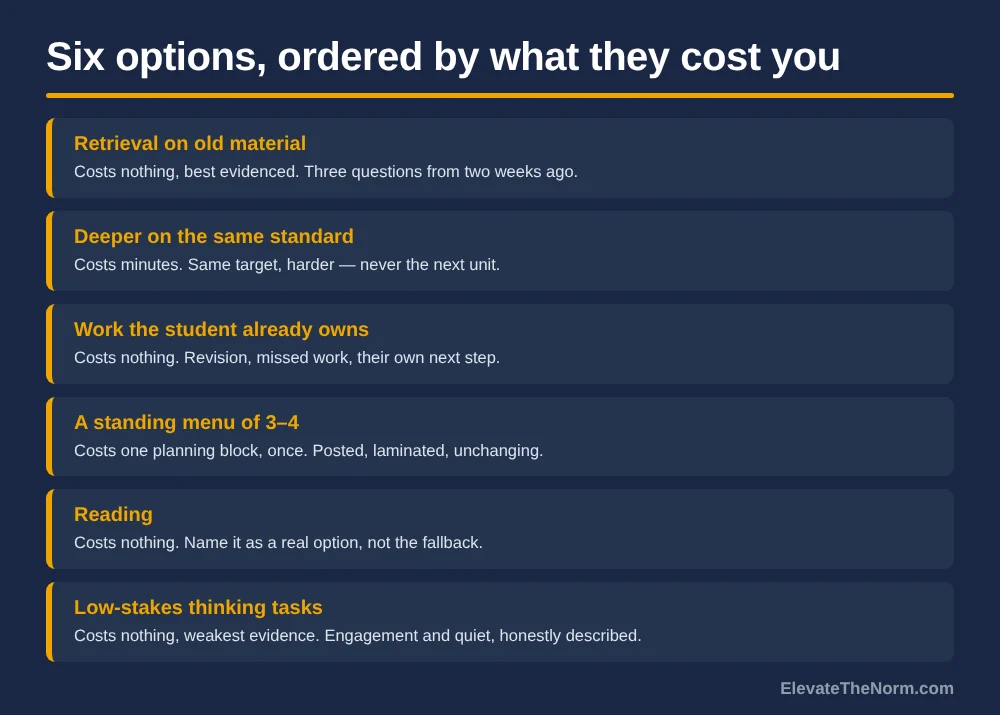
    Ordered by what they cost you, cheapest first. The first three cost nothing once set up, which is the only reason they survive a real February.

    List of six early finisher options ordered by what they cost the teacher: retrieval on old material, going deeper on the same standard, work the student already owns, a standing menu of three or four, reading, and low-stakes thinking tasks.
    Six options, cheapest first. The first three cost nothing once set up.

    1. Retrieval on old material — costs nothing, pays the most

    Have the student answer three or four questions about material from two or three weeks ago, not from today. This is the single best-evidenced use of the time, and the evidence is from the right age group. In an eighth-grade science classroom, McDaniel and colleagues found that quizzing on previously taught content produced 13 to 25 percent gains on summative unit exams compared with content that was not quizzed, and the advantage persisted on cumulative semester and end-of-year exams. Review quizzing — close to the exam rather than immediately after the lecture — produced the largest gains.

    A broader review by Dunlosky and colleagues rated only two of ten study techniques as high utility: practice testing and distributed practice. Both are exactly what a three-minute retrieval card is. Summarising, highlighting and rereading were rated low utility, which rules out most of what students do voluntarily with spare minutes. The same authors are careful to say these techniques “will not be a panacea” and will benefit only students motivated and able to use them — so this is a strong default, not a guarantee.

    The practical objection is where the questions come from, and the answer has to be “not from you, daily.” Build one stack per unit as you teach it — four index cards, three questions each, written once while the material is fresh — and then reuse the stack for the rest of the term. A system that needs you to generate questions in the moment is a system you will stop using in week three.

    Keep it ungraded and keep it short. The point is the act of retrieving, and the moment it carries a grade it becomes an assessment you have to mark. If you already run a recall task at the start of the period, the early finisher version is the same instrument pointed at a different gap in the lesson. If you want a stack you did not have to write, I give away a free five-day warm-up sampler for grades 6–12 that works the same way in the spare minutes.

    2. Going deeper on the same standard — costs minutes

    Not the next unit. The same target, harder. If the task was identifying a claim, the extension is to find the weakest evidence supporting it and say why. If the task was solving for x, the extension is to write a problem whose answer is seven and explain how they built it.

    Depth keeps everyone on the same destination, which is the thing that makes it manageable. Acceleration creates a second curriculum: a student three sections ahead is now a planning problem for the rest of the term, and you will be the one reconciling it.

    3. Work the student already owns — costs nothing

    Revising a graded piece against the rubric. Finishing something missed during an absence. Writing the next step on a goal they set earlier. None of this requires you to invent anything, and all of it is work the student has a reason to care about because it is already theirs.

    This is the most under-used option in secondary classrooms and the easiest to defend to anybody who asks what a student was doing. It also pairs naturally with pulling a few students for a short booked session, because it gives the rest of the room something legitimate to be getting on with.

    4. A standing menu of three or four options — costs one planning block, once

    A posted, laminated, unchanging list. Three or four choices, not twelve. Students pick without asking. The menu is the system; the items on it matter less than the fact that it never changes and never has to be re-explained.

    Four is roughly the right number for a reason covered in the next section, and the list should include at least one option that is clearly not more work.

    Worth letting the class fill one of the slots. Not all four — you need the retrieval option on there and students will not choose it — but handing over one line costs you nothing, tells you what they actually consider worth doing with eight minutes, and makes the menu something they had a hand in rather than another posted rule.

    5. Reading — costs nothing, and say it plainly

    A book, an article, anything of their choosing. This is a legitimate use of eight minutes and it is worth announcing as such rather than treating it as what happens when you have run out of ideas. The honest framing is that nothing on this list is better for a student who has already demonstrated the standard.

    Two practical notes. Keep a shelf of anything readable in the room, because the student who has nothing to read is the student who has no option three. And whatever students bring is subject to the same materials expectations as anything else in your building — worth knowing your school’s position before you make reading a standing option rather than after.

    Where it goes wrong is leaving it unnamed. If reading is the fallback nobody mentions, students read it as the teacher giving up. If it is option three on a posted menu, it is a choice.

    6. Low-stakes thinking tasks — costs nothing, weakest evidence

    Puzzles, logic problems, a discussion prompt to write on, a challenge card. Genuinely useful for the student who is done, restless and not going to read. Put them last because the evidence that they produce learning is thin — their case is engagement and quiet, which is a real benefit honestly described rather than dressed up as rigour. I sell a print-and-go set of early finisher and brain break cards in my No-Prep Sub Plans, Early Finishers & Brain Breaks bundle for teachers who would rather not build the stack themselves.

    What Not to Hand Them

    More of the work they just finished. It is the default, it is understandable on a Tuesday, and it is the one thing on this page that actively trains students to slow down.

    There is relevant evidence, with a population caveat that matters on a secondary site. In a study reported by Reis and Renzulli, teachers across 27 districts eliminated 40 to 50 percent of the standard curriculum for students who had already mastered it. Post-test scores in science, maths, social studies and spelling were no different from the control group, and in language arts the compacted students scored significantly higher. Removing work from students who already knew the material cost them nothing.

    The caveat: that sample was 465 teachers in grades 2 through 6. Only the top of that band overlaps with this site’s readers, and the study was about formally compacting a curriculum, not about what to do with a spare eight minutes. It does not transfer directly. What it does establish is that the instinct behind “more practice can’t hurt” is wrong often enough to stop treating it as obviously safe. The same researchers also noted that many replacement activities their teachers used were not advanced enough to be worth the swap — which is the risk on this page too.

    Two more to avoid. Anything that needs new instruction, because you will be teaching it one-to-one while the class works. And anything you have to grade, because a system that generates marking will be abandoned by October.

    Does Giving Them a Choice Actually Help?

    Yes for motivation, and — stated plainly, because most articles on this topic imply otherwise — no for learning.

    Patall, Cooper and Robinson’s meta-analysis of 41 studies found choice had a positive effect on intrinsic motivation, with a weighted average of d = 0.30 (0.36 under a random-effects model). The effect was stronger when two to four successive choices were offered, stronger when no reward followed, and stronger for children than for adults — which means the benefit is probably smaller for your seniors than the headline figure suggests.

    The finding worth knowing: the effect of choice on subsequent learning was not significant (d = 0.10, with a confidence interval crossing zero). Thirteen of the ninety-one motivation effect sizes were negative. So build the menu because it makes students more willing to use the time and less likely to read the time as a penalty. Do not claim it raises test scores, because the best available synthesis does not support that.

    Practically: three or four options, no points attached, and do not keep adding to the list.

    Setting It Up So It Runs Without You

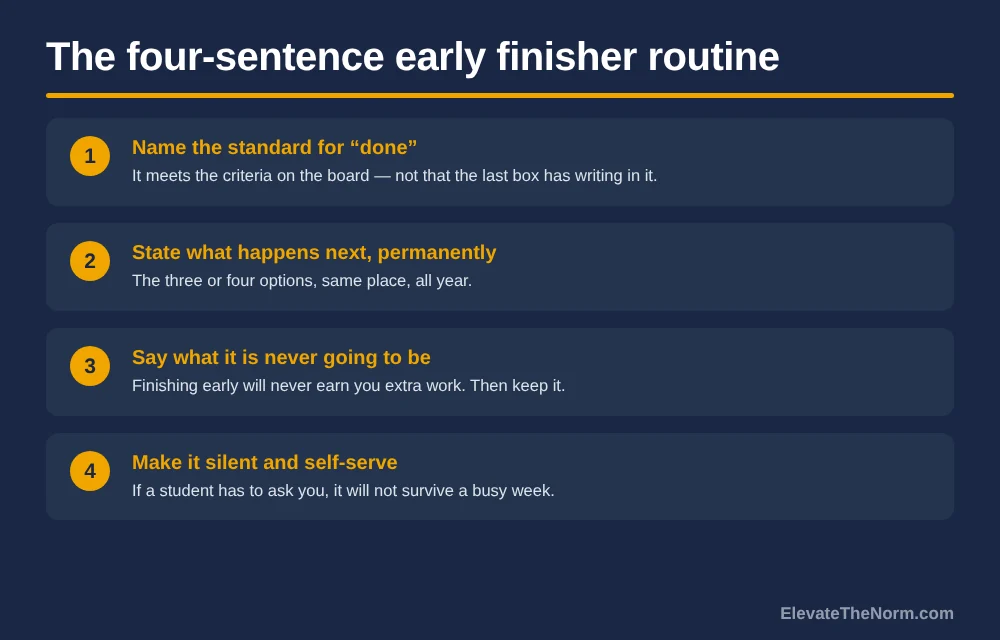
    The system is four sentences, posted where students can see it.

    1. Name the standard for “done.” Done means it meets the criteria on the board, not that the last box has writing in it.
    2. State what happens next, permanently. The three or four options, in the same place, all year.
    3. Say what it is never going to be. Telling a class outright that finishing early will never earn them extra work is worth more than any activity on the menu, and you then have to keep it.
    4. Make it silent and self-serve. If a student has to ask you, it will not survive a week when you are busy.
    Numbered list of the four-sentence early finisher routine: name the standard for done, state what happens next permanently, say what it is never going to be, and make it silent and self-serve.
    The whole system is four sentences, posted where students can see them.

    Two things that decide whether it holds. Phones. In a secondary room, “finished early” means phone unless you have said otherwise, and a menu that ignores that is a menu competing with a device and losing. Whatever your school’s policy is, the early finisher routine has to state its own position explicitly, because silence reads as permission. And the posted menu is your answer to a walkthrough. A room where six students are doing six different quiet things looks like drift to anyone standing in the doorway for ninety seconds; a laminated list on the wall is what makes it legible as a routine rather than a loss of control.

    What If They Finished Early Because They Rushed?

    Then the problem is the definition of “done,” not the activity, and no menu fixes it.

    The gate goes before the menu. If “done” means meets the posted criteria, a rushed paper is not done, and the student’s early finisher activity is the work itself. That conversation is short and it is not a reprimand: this does not meet the third criterion yet, have another look. Rushing is usually a rational response to a system in which finishing fast is rewarded and quality is not checked — which is the same mechanism as before, pointed the other way.

    The case that matters more, and the one most advice misses entirely: a student can arrive at “done” because they got stuck and quietly gave up. That looks identical to finishing early from across the room. It is the reason the gate is worth checking rather than assuming, and the response is not the menu — it is the two minutes of help the student did not ask for. A routine that cannot tell mastery from surrender will reliably reward the wrong one.

    If a student genuinely finishes good work early and often, that is information. It may mean the task is too easy for them, and the answer is a conversation about the course, not a sixth item on the menu.

    Where the Evidence Runs Out

    Honestly: there is no body of research on early finisher activities as such. Nobody has run a controlled trial on what secondary students should do with nine spare minutes.

    What exists is evidence about the components — retrieval practice, distributed practice, choice, curriculum compacting — mostly gathered in other settings and for other purposes, and in two of the four cases in samples younger than this site’s readers. The recommendations above are those findings applied by reasoning, and the reasoning is visible so you can disagree with it. The claim that the signal matters more than the activity is an argument from how incentives work, not a measured result.

    Treat the retrieval recommendation as well supported, the menu as reasonable and low-risk, and the rest as practice worth trying rather than settled.

    What to Do Next Week

    Write three options on a piece of paper and post it. Make one of them retrieval questions from two weeks ago, one of them work the student already owns, and one of them reading. Tell the class, once, that finishing early will never produce extra work.

    Then keep that promise for a month and watch two things. Whether the pace of the room changes — students stop stalling when stalling stops paying. And who is using the menu, because that is the equity question in this whole topic. Early finishers are disproportionately students who arrived already knowing more, so a routine that quietly hands the best minutes of the week to the students with the most prior knowledge widens a gap rather than closing one. If the same six names are always on option one, the honest read is that the task is too easy for them and too hard for everyone else, and that is a problem with the lesson rather than the menu.

    Different problem, same two minutes. When the whole class needs the reset rather than the fast finishers, see what a brain break looks like with 14- to 18-year-olds — and why the dance video is the fastest way to lose them. Retrieval needs something to retrieve from, which is an argument for a page students can actually quiz themselves on.

    Frequently Asked Questions

    What are early finisher activities?

    Early finisher activities are planned, low-supervision tasks a student moves to independently after completing the assigned work, before the class moves on together. In grades 6 through 12 they need to work in gaps of roughly three to twelve minutes, require no new instruction from the teacher, stay quiet enough not to disturb students still working, and generate nothing the teacher has to grade. Most published ideas fail at least two of those four constraints.

    What should early finishers do in middle school and high school?

    The best-evidenced option is retrieval practice on material taught two or three weeks earlier, because quizzing previously taught content raised unit exam scores by 13 to 25 percent in an eighth-grade science study. After that: going deeper on the same standard rather than moving ahead to new content, finishing or revising work the student already owns, and reading. Keep the whole list to three or four standing options rather than inventing something each day.

    Should early finisher work be graded?

    No. A grade turns the task into an assessment the teacher has to mark, and any early finisher system that generates marking gets abandoned within a few weeks. It also changes what the activity signals: work that counts is work, and students who notice that finishing early produces more graded work will simply finish later. Keep it ungraded and keep it short.

    How many options should an early finisher menu have?

    Three or four. The meta-analysis on choice found the motivational benefit was strongest when two to four successive choices were offered, and a longer list costs more to maintain without adding anything. One of the options should be clearly not more work. Letting the class choose what goes in one of the slots is worth doing, though the retrieval option should not be the one put to a vote.

    What do I tell a parent who asks why their child spent ten minutes reading?

    The honest answer is usually the best one: their child met the standard for the assignment before the period ended, and rather than being given repetitive extra practice they already demonstrated they do not need, they read. If a parent pushes further, the useful information is whether this happens often. A student who regularly finishes good work early is telling you the task is not demanding enough for them, and that is a conversation about the course rather than about the ten minutes.

    What if a student finishes early because they gave up rather than because they understood?

    This is the case most advice misses, and from across the room it looks identical to genuine early finishing. It is the reason done should mean meets the posted criteria rather than has writing in every box. When a student has stopped because they are stuck, the response is not the activity menu, it is two minutes of help they did not ask for. A routine that cannot tell mastery from surrender will reliably reward the wrong one.

    Do early finisher activities widen the gap between students?

    They can, and it is worth watching for. Students who finish early are disproportionately students who arrived already knowing more, so a routine that gives the best spare minutes of the week to that group can widen a gap rather than close it. The practical check is who is actually using the menu. If it is the same few names every time, the likeliest explanation is that the task is too easy for them and too hard for the rest, which is a problem with the lesson rather than with the menu.

    Can students use their phones when they finish early?

    That depends on your school policy, but the routine has to state its own position out loud either way. In a secondary classroom, finished early means phone unless something else has been established, so silence on the question reads as permission. A menu that does not address phones is competing with a device and losing.

    Sources

    1. Kraft, M. A., & Novicoff, S. (2024). Time in School: A Conceptual Framework, Synthesis of the Causal Research, and Empirical Exploration. EdWorkingPaper No. 22-653, Annenberg Institute, Brown University. Estimated that students in the Providence Public School District lose 16–25% of the school day — 16% in elementary, 21% in middle and 25% in high school — with unexcused student absence the largest single contributor. The authors describe this as a lower-bound estimate from a single district and state that their case-study results likely have “limited generalizability.” The separate 17–29% figure for off-task behaviour, transitions and wait time combined is their summary of other researchers’ estimates, not their own measurement, and is not specific to students who finish early. https://www.edworkingpapers.com/ai22-653
    2. McDaniel, M. A., Agarwal, P. K., Huelser, B. J., McDermott, K. B., & Roediger, H. L. (2011). Test-Enhanced Learning in a Middle School Science Classroom: The Effects of Quiz Frequency and Placement. Journal of Educational Psychology, 103(2), 399–414. Eighth-grade science classes; multiple-choice quizzes with feedback on some unit content and not others, allowing a within-class comparison. Quizzing produced 13–25% gains on summative unit examinations, review quizzing close to the exam produced the largest gains, and the advantage persisted on cumulative semester and end-of-year exams. https://doi.org/10.1037/a0021782
    3. Dunlosky, J., Rawson, K. A., Marsh, E. J., Nathan, M. J., & Willingham, D. T. (2013). Improving Students’ Learning With Effective Learning Techniques: Promising Directions From Cognitive and Educational Psychology. Psychological Science in the Public Interest, 14(1). Of ten study techniques reviewed, only practice testing and distributed practice received a high utility rating; summarisation, highlighting and underlining, and rereading were rated low utility. The authors caution that the techniques “will not be a panacea” and will benefit only students who are motivated and capable of using them. Cited here from the Association for Psychological Science’s published summary of the report, which was the version read; the full monograph was not accessed. https://www.psychologicalscience.org/news/releases/which-study-strategies-make-the-grade.html
    4. Patall, E. A., Cooper, H., & Robinson, J. C. (2008). The Effects of Choice on Intrinsic Motivation and Related Outcomes: A Meta-Analysis of Research Findings. Psychological Bulletin, 134(2), 270–300. 41 studies, 290 effect sizes from 46 samples. Choice had a positive effect on intrinsic motivation (weighted average d = 0.30, 95% CI 0.25–0.35 fixed-error; d = 0.36 random-error), strongest when two to four successive choices were offered, when no reward followed, and for children rather than adults. The effect on subsequent learning was not significant (d = 0.10, 95% CI −0.02 to 0.21), and 13 of the 91 intrinsic-motivation effect sizes were negative. https://pubmed.ncbi.nlm.nih.gov/18298272/
    5. Reis, S. M., & Renzulli, J. S. (2005). Curriculum Compacting: An Easy Start to Differentiating for High-Potential Students, reporting the technical results of Reis et al. (1992). 27 school districts and 465 teachers, randomly assigned to treatment or control. Where 40–50% of the standard curriculum was eliminated for students who had already mastered it, post-test scores did not differ from controls in science, mathematics concepts, mathematics computation, social studies or spelling, and were significantly higher in language arts. The sample was grades 2 through 6, so only the top of that band overlaps with secondary classrooms, and the study concerned formal curriculum compacting rather than short in-period extension tasks. The authors also noted that many replacement activities their teachers used were not advanced enough to suit high-ability students. https://gifted.uconn.edu/schoolwide-enrichment-model/curriculum_compacting

    About Clay Shumate

    Clay Shumate is a certified secondary Social Studies teacher in the public schools of West Alabama, with seven years of classroom experience, a B.A. in History, and an M.Ed. in Secondary Education. He writes about project-based learning, student responsibility, respect, and practical ways to hold young people to a higher standard while giving them room to learn from mistakes. He is a member of the Society of Professional Journalists and writes to its Code of Ethics; this site’s editorial standards and corrections policy are published in full. More about Clay.

  • Tardy Policy: What Actually Gets Students Through the Door on Time

    Tardy Policy: What Actually Gets Students Through the Door on Time

    By Clay Shumate

    A tardy policy is the set of rules and responses a school or classroom uses when a student arrives after the bell. A good one protects instructional time without removing more of it than tardiness costs, escalates by pattern rather than by the adult’s patience, and treats the first ten seconds at the door as the most important part of the whole system.

    Most tardy policies fail in the same direction. They are written to feel firm, enforced hard in September, and quietly abandoned by February — which teaches teenagers that the rule was never really a rule.

    Key Takeaways

    • The research on tardiness specifically is thin, and anyone who tells you otherwise is rounding. There is far more evidence on full-day absence than on walking in four minutes late. Build your policy on principles you can defend, not on a statistic you cannot source.
    • Escalate by pattern, not by annoyance. One tardy is information. Four tardies in two weeks is a problem with a cause. Those two things should not get the same response.
    • Do not solve four lost minutes by removing forty. Hallway lockouts and suspensions for lateness remove instruction in order to punish missing instruction, and nationally about 7 percent of secondary students were suspended out of school in 2017–18.
    • The cause is usually logistical before it is attitudinal. Distance, a locker, a bathroom, a sibling drop-off, a class on the far side of the building. Ask before you assign a motive.
    • Thresholds are local. Compulsory attendance exists in every state, but most laws do not specify how many incidents trigger what, and districts set their own definitions. Read yours before you write a classroom rule that contradicts it.

    What Should a Tardy Policy Actually Do?

    It should get a student into a seat and working with the smallest possible loss of instruction — theirs and everybody else’s. That is the whole job. Every other goal people attach to tardy policies — teaching punctuality, preparing students for work, holding a standard — is downstream of that one, and none of them is served by a rule that costs more minutes than it saves.

    It helps to say out loud what a tardy policy is not. It is not an attendance policy. A student who is late to third period has not missed school; they have missed the opening of one class. Those are different problems with different causes and different fixes, which is why missing whole days of school belongs in a separate conversation from missing the first four minutes of a period. It is also not a late work policy. Turning in an essay three days late and arriving to class three minutes late look similar on paper and have almost nothing in common underneath.

    What Does the Research Actually Say About Tardiness?

    Less than you would like. This is worth saying plainly, because the internet is full of confident numbers about what tardiness costs and most of them trace back to nothing.

    The clearest study aimed directly at the problem is Tyre, Feuerborn and Pierce’s 2011 paper in Preventing School Failure. They ran a schoolwide intervention in a middle and high school and reported that average daily tardiness “decreased substantially” and stayed down over time. The intervention had three parts, and the parts are the useful finding: explicitly teaching what transition behavior should look like, actively supervising common areas during passing time, and applying consequences consistently. Note what is not in that list. No lockout, no mass detention, no public shaming.

    What the published abstract does not give is a number for how much tardiness fell, so I am not going to give you one. If you see this study quoted with a precise percentage attached, somebody added it.

    The stronger evidence sits one step sideways, in attendance. Rogers and Feller’s 2018 experiment in Nature Human Behaviour is the piece worth knowing: 28,080 high-risk K–12 students, randomly assigned, with the treatment being personalized mailings that corrected parents’ mistaken beliefs about how many days their child had actually missed. The most effective versions reduced chronic absenteeism by 10 percent or more, the effect held across every grade level, and it even reduced absences among untreated siblings in the same household. It was, in the authors’ words, more than an order of magnitude more cost-effective than standard absence-reduction practice.

    That is a study about absences, not tardies, and I am not going to pretend the transfer is automatic. But the mechanism is the part that generalizes, and it is the opposite of what most tardy policies assume. Families were not indifferent. They were wrong about the count. Giving them accurate information changed behavior more cheaply than any punishment in the building.

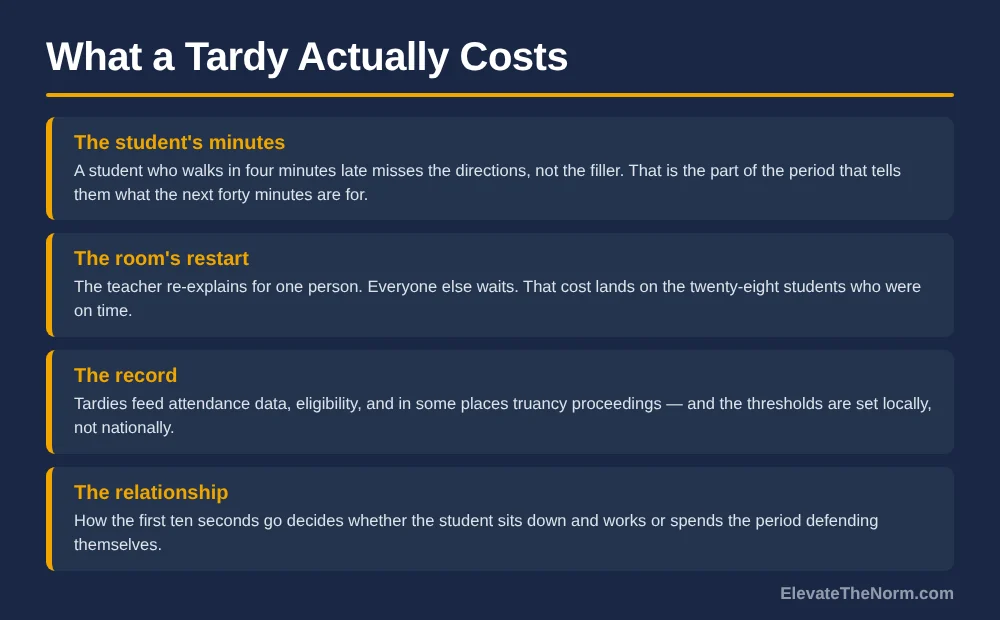
    Four-row graphic listing what a tardy costs: the student's missed directions, the room's restart for one person, the attendance record and locally set thresholds, and the relationship in the first ten seconds
    A tardy costs four different things, and only one of them is minutes.

    What Does a Tardy Actually Cost?

    Four things, and only one of them is the minutes. If your policy only accounts for the minutes, it will keep producing rules that make the other three worse.

    The first cost is the student’s. The opening of a period is not padding. It is where the directions live, where the day’s question gets posted, where whatever is already on the board when students walk in is doing its work. A student who misses four minutes has not missed four minutes of content. They have missed the part that explains the next forty.

    The second cost is the room’s. When a teacher stops to re-explain for one person, twenty-eight people wait. Do that three times a period and the tardy policy is costing the class more than the tardiness.

    The third is the record. Tardies feed attendance data, athletic eligibility, and in some districts the early steps of a truancy process. That matters to a student well after you have forgotten the day.

    The fourth is the relationship, and it is the one teachers control completely. How the first ten seconds go decides whether the student sits down and works or spends the period building a case for why it was not their fault.

    What Is a Tardy Response That Escalates Properly?

    One that distinguishes a single late arrival from a pattern, and responds to the pattern rather than to the incident. Here is a four-tier structure that does that. It is a recommendation, not a mandate, and it assumes you have read your school’s policy first.

    Numbered four-tier tardy response graphic: tier one say nothing and keep teaching, tier two thirty seconds at the door, tier three make the cause the plan and contact home, tier four hand it to the counselor or administrator
    Four tiers, escalating by pattern rather than by the teacher’s patience.

    Tier 1 is to say nothing. A student walks in late, you hand them the materials, point at the board, and keep teaching. No announcement, no sign-in ritual that stops the class, no raised eyebrow performed for the room. This feels like doing nothing. It is not. It is refusing to spend the class’s attention on one person’s arrival, and it is the move that keeps a late student from becoming a late and defensive student.

    Tier 2 is thirty seconds at the door, on a second or third tardy in a short window. Not while you are mid-explanation — the moment the class is working independently, you walk over. Quiet, private, specific, and — this is the part people skip — a question rather than a verdict. What is happening before this class? What would have to change for you to be here on time tomorrow? You are collecting a cause. The same logic governs any consequence worth using: it has to be related to the behavior, and you cannot make it related until you know what the behavior is about.

    Two cautions on that conversation. It happens at a volume the next row cannot hear, because a doorway conversation is not private by default. And a student does not owe you a medical or family explanation — “something I can’t really get into” is a complete answer, and the right response to it is to move to a scheduling fix rather than to push. Start the written record here, not at Tier 4: date, time, and one line of what the student said. You will want it later and you will not remember it.

    Tier 3 is to make the cause the plan. By now you know whether this is a locker on the wrong end of the building, a class that releases late, a bathroom situation nobody wants to discuss, or a student who is genuinely choosing the hallway. Change something concrete. Then contact home — with information, in the Rogers and Feller shape. Not “your son is disrupting my class,” but “here is the count, here is what it is costing, here is what we are trying.” If you need the structure for that conversation, deciding in advance who you contact and at what point is what keeps it from becoming a complaint call.

    Tier 4 is to hand it to the system, with your dated notes attached. The obstacle is outside your room: transportation, a schedule conflict, something at home. Do not invent a classroom consequence for a transportation problem. That is not firmness, it is a category error, and students can tell.

    Be realistic about what Tier 4 buys you. One counselor covering four hundred students is not going to solve a schedule next period, and a referral is not a handoff — you are still the adult that student sees every day. Keep running Tier 1 while the referral works its way through. And tell students the tiers exist. A ladder nobody has described is not a system, it is a surprise, and teenagers are right to resent being escalated through something they were never shown.

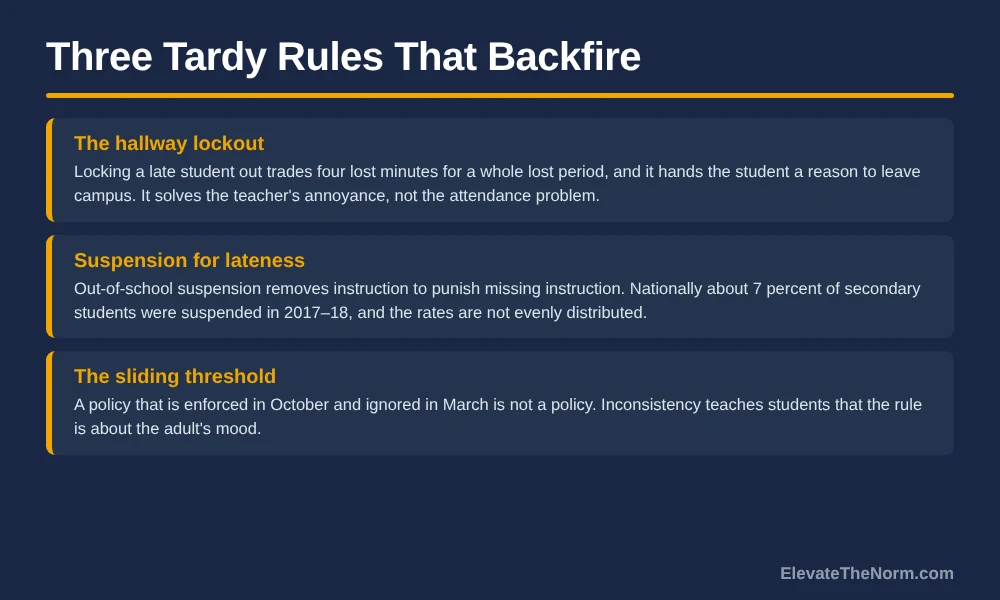
    Which Tardy Rules Backfire?

    The ones that remove instruction to punish missing instruction. Three show up constantly, and all three are worth retiring.

    Three-row graphic naming tardy rules that backfire: the hallway lockout, suspension for lateness with the 2017 to 2018 national secondary suspension rate of about 7 percent, and a sliding enforcement threshold
    Three common tardy rules that cost more instruction than they recover.

    The hallway lockout trades four lost minutes for a whole lost period. It also puts an unsupervised teenager in a hallway, which is a supervision problem you just created, and it hands a student who was already struggling to get to class a reason to stop trying. To be fair to the practice: a staffed tardy room where a student signs in, gets the day’s materials and is walked back to class is a different animal, and some schools run one well. The failure mode is the unsupervised version, where “you can’t come in” is the whole intervention.

    Suspension for lateness is the same error with the volume up. The Learning Policy Institute’s 2022 analysis of federal Civil Rights Data Collection figures found that in 2017–18, nearly 1 in 14 secondary students — about 7 percent — received at least one out-of-school suspension, and the burden was not evenly spread: 12 percent of Black students, 9 percent of students with disabilities, and more than 1 in 4 Black boys with disabilities in secondary schools. Those numbers cover all suspensions, not tardiness alone. But when a tardy ladder has suspension at the top of it, that ladder is feeding this distribution, and it is worth knowing what you are feeding.

    The sliding threshold is the quiet one. A policy enforced in October and ignored in March is not a policy; it is a mood. Students read inconsistency accurately and conclude that the rule was about the adult all along. If you cannot sustain a response for the whole year, write a smaller one you can.

    How Do You Make a Tardy Policy Hold?

    Teach the transition, then do exactly what you said you would do, every time. That second half is the entire difference between a policy and a sign.

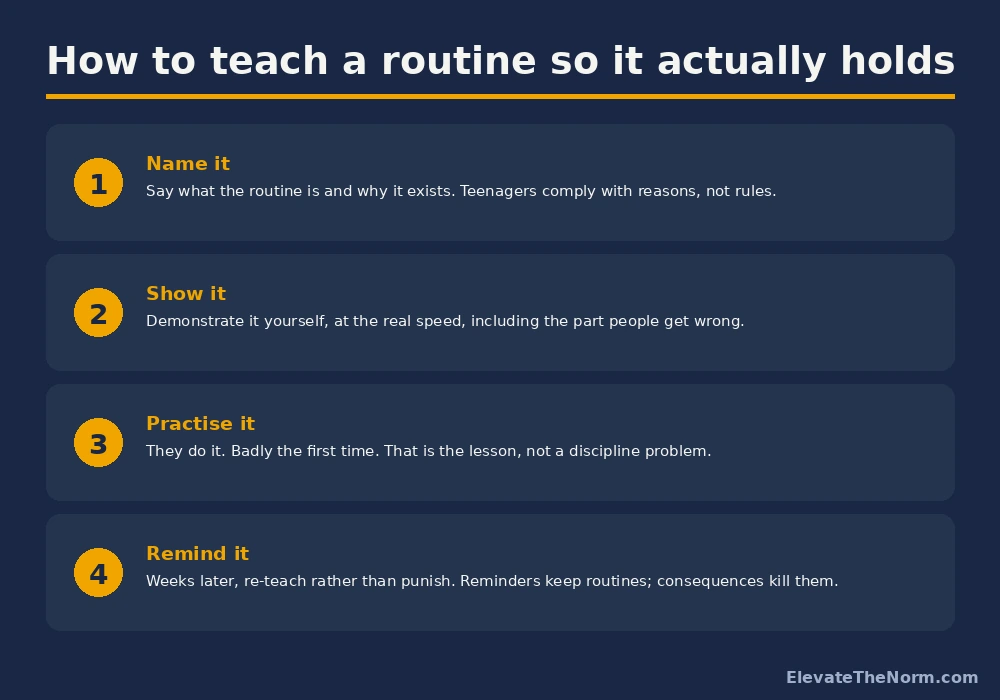
    Tyre and colleagues’ intervention is instructive here precisely because it is unglamorous. They taught transition behavior explicitly, the way you would teach anything else, rather than assuming teenagers already knew. That is the same logic behind teaching a routine so it actually holds past September — you do not get a routine by announcing it.

    Explicitly teaching a transition is less abstract than it sounds. It means naming the three things that have to happen between the bell and the start — bag down, materials out, first task started — walking the class through them once at normal speed, and then narrating what you see for the first week until it stops needing narration. Thirty seconds a day for five days. That is the whole scaffold, and it is the cheapest thing in this article.

    Taking control of a classroom is done by organization to the minute, and then you pause. Both halves matter. The posted plan is a budget and a promise; the pause is where you stop talking and let the room settle without filling the silence or raising your voice. A start-of-class routine that works does most of your tardy enforcement for you, because the student who walks in late finds a room already working and slides into it rather than interrupting it.

    One more thing about the door, and this is the part I would keep if I had to throw the rest out. When students walk through that doorframe, they have 100 percent of my respect. That is not softness and it is not a slogan I printed. It is a statement about where the line is: whatever happened in the hallway, in the last class, or at home, the price of entry is nothing. You still owe me the work. You do not owe me an apology for existing in the doorway at 9:04.

    What About the Student Who Is Always Late for a Reason You Cannot Fix?

    Stop treating it as a discipline problem and start treating it as a scheduling problem. Some of these are genuinely outside the room: a student who takes a sibling to a different building, a bus that runs late, a medical routine, a class that physically cannot release in time to cross campus.

    For those students, the honest answer is that the tardy ladder has nothing to offer and should be taken off the table. Document it, loop in the counselor, and ask for the schedule to change. What you can still do is make the opening of your class recoverable — the question on the board, the directions written down, a neighbor who knows the routine well enough to catch them up in thirty seconds. That is not lowering the standard. The standard is the work, not the clock.

    How Does This Fit With School Policy and State Law?

    Your classroom rule has to sit inside your school’s rule, and your school’s rule sits inside a state framework that is less specific than most people assume. Compulsory attendance laws exist everywhere, but as the Education Commission of the States documented in its survey of state truancy definitions, “for the most part, compulsory attendance laws do not specify the number of times a student must be truant before sanctions are enforced,” and in many states the thresholds are set by local boards rather than by the legislature. The examples range from five days in a school year in one state to ten full days or seven consecutive days in another.

    Practically, that means two things. Whether a tardy ever converts into an absence, and at what point, is a local decision you need to look up rather than guess. And a classroom rule that is harsher than the district’s written policy is a liability, not a virtue — especially for a student with an IEP or a 504 plan, where attendance-related consequences can run straight into an accommodation.

    What to Do Next

    Pick one thing. If your current response to a late student is a comment to the room, drop it this week and replace it with Tier 1 — materials, a point at the board, keep teaching. That single change costs nothing, takes no planning, and removes the most common way a four-minute problem becomes a forty-minute one.

    Then, before you write anything down: read your school’s actual tardy language, count how many tardies your worst-hit class period really has over two weeks, and ask three of those students what is happening before your class. You will almost certainly find the problem is more boring, and more fixable, than it looked from the front of the room.

    When you do write it down, publish it twice — once to students, in the words you will actually use, and once to families, before anybody gets a phone call. A policy a parent first hears about at Tier 3 sounds like an ambush no matter how reasonable it is. And leave a route open: a student who has a scheduling problem should be able to say so without it reading as a confession, which usually means a one-line note or a two-minute conversation you have offered in advance rather than one they have to request in front of the room.

    Frequently Asked Questions

    How many tardies should trigger a consequence?

    There is no national answer, and anyone who gives you one is quoting their own district. Compulsory attendance laws exist in every state, but as the Education Commission of the States documented, most of them do not specify how many incidents trigger sanctions, and in many states the threshold is set by the local board. Look up your district’s written number first and build your classroom ladder inside it. A classroom rule that is harsher than the district policy is a liability, not a virtue.

    Should a tardy ever count as an absence?

    That is a local decision, not a judgement call you get to make at your door. Some districts convert a certain number of tardies into an absence or count arrival after a set point as a half-day absence; others do not. It matters because attendance records feed eligibility and, in some places, truancy proceedings. Find the rule in writing before you tell a student or a parent how it works.

    Is it fair to respond differently to different students?

    Yes, and a policy that cannot do that is the unfair one. A student who is late twice in a semester and a student who is late nine times because of a bus do not have the same problem, and giving them the same consequence only looks like fairness. What has to stay identical is the standard and the process: everybody gets the same ladder, described in advance, applied in the same order. What changes is the fix at the end of it.

    What do I do about a student whose tardies are caused by their schedule?

    Take the tardy ladder off the table and treat it as a scheduling problem. Document the pattern, loop in the counselor, and ask for the schedule or the route to change. In the meantime, make the opening of your class recoverable — directions written down rather than only spoken, the day’s question posted, and a neighbour who can catch them up in thirty seconds. The standard is the work, not the clock.

    Should I lock late students out of the room?

    No, not in the unsupervised version. Shutting a student into an empty hallway trades four lost minutes for a whole lost period, creates a supervision problem you did not have a moment earlier, and gives a struggling student a reason to leave campus. A staffed tardy room where a student signs in, collects materials and is walked back to class is a different thing and some schools run one well. The failure mode is when “you cannot come in” is the entire intervention.

    How do I track tardies across five or six sections without losing my prep?

    Keep it to one line. Date, period, name, and a few words of what the student said — in whatever you already open every day, not a new system. You are not building a case file; you are making sure that when you call home or write a referral you can say “nine times since the 12th” instead of “a lot.” That specificity is the whole reason the record exists, and Rogers and Feller’s attendance experiment is the evidence for it: families responded to an accurate count, not to a complaint.

    What should I tell parents, and when?

    Tell them the policy before anybody needs it, and make the first real contact informational rather than disciplinary. A parent who first hears about your tardy ladder when their child is already three steps up it will hear an ambush no matter how reasonable the ladder is. When you do call, lead with the count and what it is costing instructionally, then what you are trying. The strongest evidence in this area — a randomized experiment with 28,080 students — found that correcting parents’ beliefs about how much their child had actually missed reduced chronic absenteeism by 10 percent or more.

    Does a classroom tardy policy work if the rest of the school does not have one?

    Partly. You can control your own door, your start-of-class routine and your response, and those are the pieces that protect your instruction. What you cannot fix alone is a passing period that is physically too short or a building where supervision disappears between bells. The one tardiness study aimed squarely at secondary schools found results from a schoolwide approach — explicit teaching of transition behaviour, active supervision of common areas, and consistent consequences — which is a reminder that the hallway is not your jurisdiction and the school-level conversation is worth having.

    Sources

    1. Tyre, Ashli, Laura Feuerborn, and Jennifer Pierce. “Schoolwide Intervention to Reduce Chronic Tardiness at the Middle and High School Levels.” Preventing School Failure, vol. 55, no. 3, 2011, pp. 132–139. Schoolwide intervention combining explicit teaching of transition behavior, active supervision during transitions, and consistent consequences; average daily tardiness “decreased substantially” and was maintained over time. Cited from the published abstract via the ERIC record; the abstract reports no magnitude, so no percentage is quoted here. https://eric.ed.gov/?id=EJ923238
    2. Rogers, Todd, and Avi Feller. “Reducing Student Absences at Scale by Targeting Parents’ Misbeliefs.” Nature Human Behaviour, vol. 2, no. 5, 2018, pp. 335–342. Randomized experiment, 28,080 high-risk K–12 students; personalized mailings correcting parents’ beliefs about accumulated absences reduced chronic absenteeism by 10% or more in the most effective versions, with spillover to untreated siblings. This study measures full-day absences, not tardiness; the transfer to lateness is an inference and is labelled as one in the text. https://www.nature.com/articles/s41562-018-0328-1
    3. Leung-Gagné, Melanie, Jennifer McCombs, Caitlin Scott, and Daniel J. Losen. Pushed Out: Trends and Disparities in Out-of-School Suspension. Learning Policy Institute, 2022. Analysis of federal Civil Rights Data Collection figures; in 2017–18, 7% of secondary students, 12% of Black students, 9% of students with disabilities and 27% of Black boys with disabilities in secondary schools received out-of-school suspension. Figures cover all out-of-school suspensions, not suspensions for tardiness specifically. https://learningpolicyinstitute.org/product/crdc-school-suspension-report
    4. Frey, Dinah. Truancy and Habitual Truancy: Examples of State Definitions. Education Commission of the States, updated April 2011. Documents that compulsory attendance laws generally do not specify the number of incidents triggering sanctions, and that thresholds are set at district level in some states and state level in others; 23 state examples with widely varying definitions. Dated 2011 — verify your own state’s current statute before relying on it. https://www.ecs.org/clearinghouse/92/39/9239.pdf
    5. “A Primer on Attendance and Absenteeism on the Nation’s Report Card and Beyond.” National Assessment Governing Board. Defines chronic absenteeism as missing 10% of instructional days — 18 or more days in a 180-day year — counting excused absences, unexcused absences and suspensions; reports that in 2022, 22% of 4th graders said they had been absent five or more days in the previous month, double the 2019 figure. The NAEP survey question captures full-day absence only, not late arrival. https://www.nagb.gov/naep/chronic-absenteeism.html

    About Clay Shumate

    Clay Shumate is a certified secondary Social Studies teacher in the public schools of West Alabama, with seven years of classroom experience, a B.A. in History, and an M.Ed. in Secondary Education. He writes about project-based learning, student responsibility, respect, and practical ways to hold young people to a higher standard while giving them room to learn from mistakes. He is a member of the Society of Professional Journalists and writes to its Code of Ethics; this site’s editorial standards and corrections policy are published in full. More about Clay.

  • What Is a Classroom Management Plan? The Version That Actually Runs

    What Is a Classroom Management Plan? The Version That Actually Runs

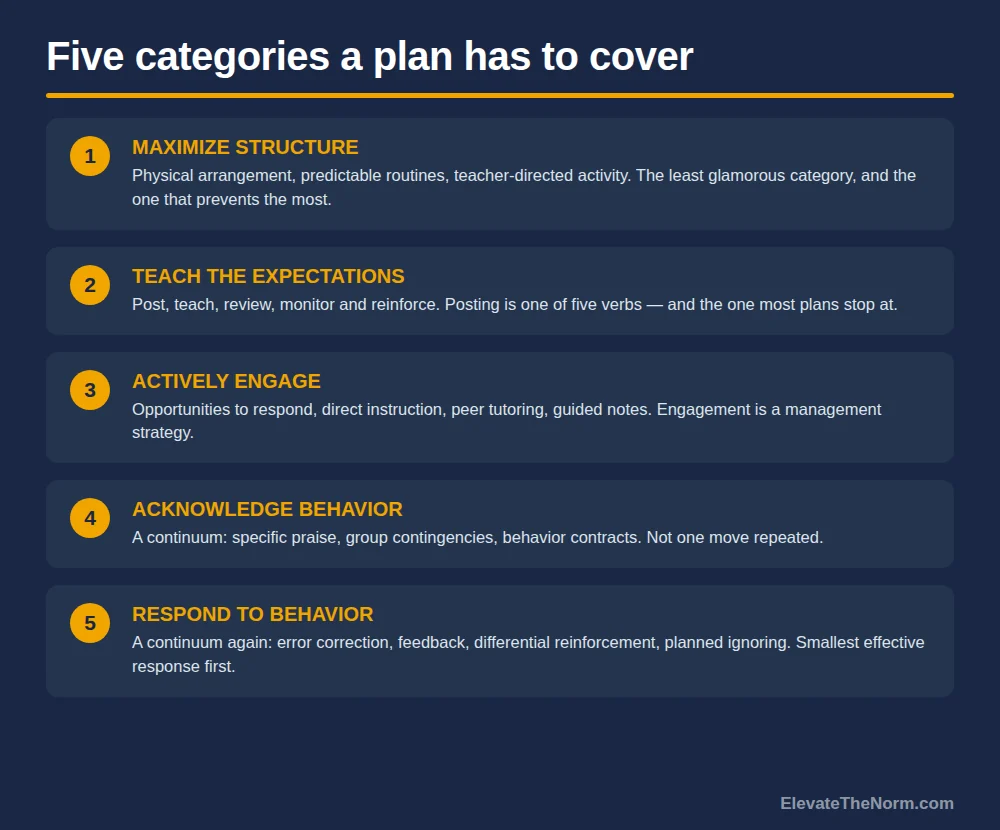
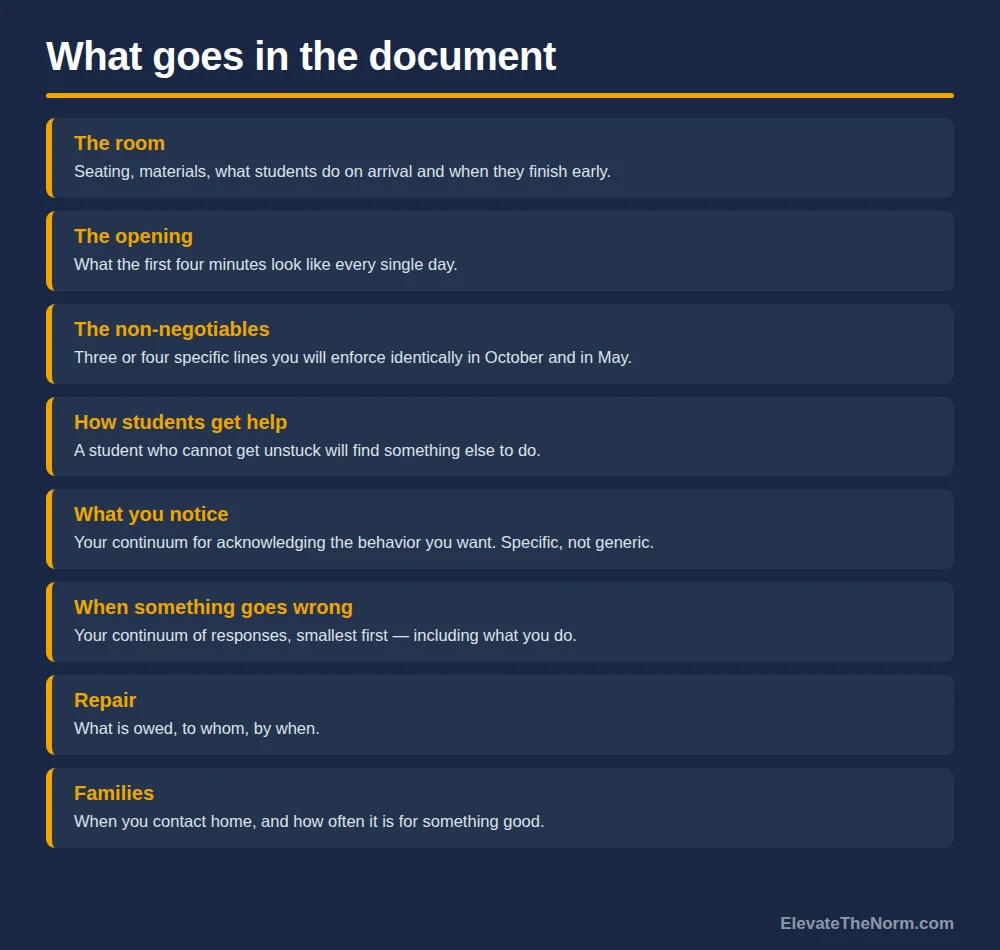
    A classroom management plan is a written document setting out how your room runs: the structure students walk into, the expectations you have taught them, how you acknowledge the behavior you want, and what you do about the behavior you don’t. It is not a poster of rules and it is not a philosophy statement. It is the answer you have decided in advance, so that you are not inventing it at 1:40 on a Thursday with twenty-nine people watching. If you want wording to start from rather than a blank page, there are worked examples of expectations written for teenagers.

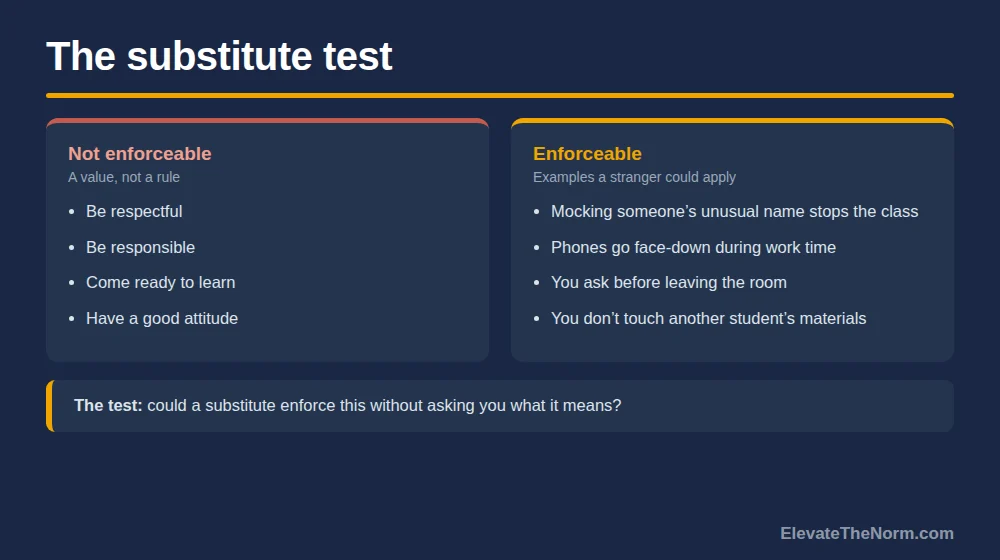
    Most plans fail the same way. They are written for an evaluator, they are full of words like “respectful” and “responsible,” and they cannot be run. A plan you cannot run on a bad day is not a plan.

    So that is what a classroom management plan is. What follows is the harder part: what the research says it has to contain, the test that separates a real plan from a decorative one, and how to write one that survives contact with an actual class. The individual moves that go inside the plan, and how strong the evidence is behind each one, are handled separately in the strategy-by-strategy breakdown.

    Key Takeaways

    • A plan is a decision made early, not a description written late. Its value is that it removes improvisation from the moments you improvise worst.
    • The research converges on five areas. A 2008 review identified 20 evidence-based classroom management practices grouped into five categories: structure, taught expectations, active engagement, acknowledging appropriate behavior, and responding to inappropriate behavior.
    • The test is enforceability, not tone. “Be respectful” cannot be enforced consistently by anyone, including you. A narrow, specific line can.
    • Write it for yourself first. A plan aimed at an evaluator produces language that sounds defensible and does nothing at 1:40.
    • Many teachers were never taught this. In one study of 110 teacher candidates, roughly half of one group reported no behavior management training at all before the intervention — which is a curriculum gap, not a personal failing.

    What is a classroom management plan, specifically?

    The IRIS Center at Vanderbilt frames comprehensive classroom behavior management as doing two things: creating an organized, consistent, culturally responsive classroom environment that supports instruction, and engaging and communicating with students and families on an ongoing basis. Developing a written plan is named as one of the foundational practices within that, alongside creating a positive climate and a structured classroom.

    That framing is useful because of what it excludes. A management plan is not your discipline ladder. The ladder is one component, and in a good plan it is one of the smaller ones. The bulk of the document is about the conditions that make the ladder rarely necessary — how the room is arranged, what happens in the first four minutes, what students do when they finish early, how they get help without waiting with a hand up.

    One more distinction worth holding onto: classroom-level management sits underneath any school-wide system. If your building runs three to five posted expectations, your plan translates those into the specific, contextual version that applies in your room. It does not compete with them, and it does not ignore them.

    The five things the research says a plan has to cover

    The most useful single source here is Simonsen, Fairbanks, Briesch, Myers and Sugai’s 2008 review, which set a deliberately high bar: a practice counted as evidence-based only if it had been evaluated with sound experimental design and supported by at least three empirical studies in peer-reviewed journals. Twenty practices cleared it, sorted into five categories.

    1. Maximize structure. Physical arrangement, predictable routines, teacher-directed activity. The least glamorous category and the one that prevents the most.
    2. Post, teach, review, monitor and reinforce expectations. Note the verbs. Posting is one of five, and it is the one most plans stop at.
    3. Actively engage students in observable ways. Opportunities to respond, direct instruction, peer tutoring, guided notes. Engagement is a management strategy, not a separate department.
    4. Use a continuum of strategies to acknowledge appropriate behavior. Specific praise, group contingencies, behavior contracts.
    5. Use a continuum of strategies to respond to inappropriate behavior. Error correction, performance feedback, differential reinforcement, planned ignoring.
    Five numbered categories of evidence-based classroom management: maximize structure, teach expectations, actively engage, acknowledge behavior, respond to behavior
    From Simonsen and colleagues’ 2008 review of evidence-based classroom management practices.

    The word doing the most work in categories four and five is continuum. A plan with one response in it — a referral, a call home, a warning system — will be used for everything or nothing. A continuum means the smallest effective response is available and gets used first.

    An honest caveat on that review, because it matters for how much weight to put on it: the authors themselves note that roughly 48% of the studies in their table were published before 1987. The categories have held up and are widely replicated, but this is an older evidence base than its frequent citation implies, and it was not assembled with today’s secondary classrooms specifically in view.

    Why “Be Respectful” is not a plan

    Here is the test I would apply to every line in a management plan: could a substitute enforce this without asking you what it means? If not, it is a value, not a rule — and values belong in the first paragraph, not in the enforcement section.

    Two-column comparison of unenforceable classroom rules such as be respectful beside enforceable, specific rules a substitute could apply
    Could a substitute enforce this without asking you what it means?

    “Be respectful” fails immediately. Two reasonable adults will disagree about whether a particular eye-roll qualifies, which means the students experience it as arbitrary, which is the precise thing that costs you a room. Inconsistency is not a small flaw in a plan. It is the flaw.

    Compare it to an actual line from my room: making fun of how unusual someone’s name is stops the class. It is narrow. It is unmistakable. Nobody has to interpret it, there is no version of it I would let go on a Friday because I am tired, and a student can tell you in advance exactly what will happen. That is what an enforceable expectation looks like, and it is worth more than a wall of adjectives.

    You do not need many of these. Three or four lines that are genuinely non-negotiable, that you will enforce identically in October and in May, will do more for a room than a laminated list of twelve. The rest of what you want — effort, kindness, people taking care of each other — is built through how the room is run day to day, not through rules about it.

    What actually goes in the document

    Here is the structure I would use. It maps onto the five research categories without reading like a compliance form.

    • The room. How seating is arranged and why. Where materials live. What students do when they walk in, and what they do when they finish early. Most of a management plan is logistics, and the logistics are load-bearing.
    • The opening. What the first four minutes look like every single day. A routine students can run without you is worth more than any consequence you could write down.
    • The non-negotiables. Three or four specific, enforceable lines. Apply the substitute test to each one.
    • How students get help. Genuinely part of management. A student who cannot get unstuck will find something else to do, and then you have a behavior problem that was originally an access problem.
    • What you notice, and how. Your continuum for acknowledging the behavior you want. Specific rather than generic — naming what a student did beats telling them they are great.
    • What happens when something goes wrong. Your continuum of responses, smallest first, written out. Include what you do, not just what the student gets.
    • Repair. What is owed, to whom, by when. A plan that ends at the consequence is only half-written.
    • Families. When you contact home, for what, and how often it is for something good.
    Eight sections of a classroom management plan: the room, the opening, non-negotiables, how students get help, what you notice, when something goes wrong, repair, families
    Two pages is enough. Twelve means you are writing a philosophy statement.

    That is two pages, not twelve. If yours is running to twelve, you are probably writing a philosophy statement with a consequence ladder stapled to the back.

    The response section, and the part people get wrong

    Most consequence sections are written as an escalating list of things that happen to a student. The useful version also specifies what you do, because your behavior is the variable you actually control.

    The smallest effective response is usually proximity and a quiet word. In my room a redirect happens at close range, to one student, at their eye level — not announced across the room. That is a deliberate choice and it belongs in a written plan, because it is the thing you will abandon first when you are frustrated. Announcing a correction to the whole room gives the class a performance to react to and hands the student an audience they now have to save face in front of. It reliably makes a small thing bigger.

    Write down the pause, too. A deliberate beat before you respond — for me it averages around fifteen seconds, though it genuinely varies with the room, the day, and the student — is not a technique with a fixed number. It is a commitment to not answer a behavior with your first reaction. Put it in the plan as a commitment rather than a count, because a count is the first thing that breaks.

    And be careful what your consequences are actually teaching. A response that only makes a student feel worse has done nothing about the thing that happened. The question the plan should answer is what gets repaired, not what gets paid.

    What the plan does not get to decide

    This section is short and it is the one most plans omit entirely. Some things outrank your document, and writing as though they do not is how a well-intentioned plan creates a real problem.

    • An IEP or a behavior intervention plan. If a student has one, it governs. Your classroom plan does not override it, cannot be applied to that student in place of it, and should say so explicitly. If you do not know which of your students have one, that is the first thing to find out — before you write a consequence section, not after you have applied it.
    • District and building policy. Your plan operates inside them. Where your preference and the policy disagree, the policy wins and you raise the disagreement through the actual channel rather than quietly running your own version.
    • Anything that has to leave the room. Threats, weapons, harassment, anything involving a student’s safety, and anything that triggers mandatory reporting are not classroom-management matters and do not belong on a continuum of responses. Name them in the plan as the category that goes straight to an administrator, so that the decision is already made.

    A plan that quietly assumes the teacher handles everything is not a strong plan. It is an unsupported one, and the cost of that lands on a student.

    Who the plan is for

    In order: you, then your students, then anyone covering your room, then your evaluator. That order matters and it is usually inverted.

    A plan written for an evaluator optimizes for language that sounds defensible in a post-observation conference. It will use the word “proactive” and it will not help you at 1:40. A plan written for yourself is blunter, shorter, and contains the things you actually forget — which is why the good ones read a little like notes.

    Your students should be able to read it, or a version of it. Not as a handout on day one that nobody retains, but because everything in it should be something they could accurately predict by October. If a student could not tell you what happens when work is late, that section is not real yet.

    Which raises a fair question: should students help write it? My honest answer is that it depends on which part. The non-negotiables are yours — they exist precisely because they do not move, and putting them to a vote tells the room they are negotiable after all. But a great deal of a management plan is not about safety or dignity at all. It is about how the room works, and on that, teenagers have opinions worth hearing and a much better sense than adults expect of what actually helps them work. Asking them what gets in their way, and then visibly changing something, does more for buy-in than any explanation of why your rules are reasonable.

    Families should be able to see it too, or at least the part that affects them — what you contact home about, when, and what happens before you do. A parent who learns your system for the first time during a difficult phone call is meeting it at the worst possible moment. Send the short version early, while nothing is wrong.

    And a plan is the single most useful thing you can hand to someone covering your class. If you cannot hand it over and have it make sense to a stranger, it is not finished.

    If nobody ever taught you this

    It is worth saying plainly that the preparation gap here is real and documented, because a lot of teachers privately treat it as a personal deficiency.

    A 2025 study in the Journal of Emotional and Behavioral Disorders worked with 110 teacher candidates in student-teaching internships at a large public southeastern university. Among the group receiving a specialized 16-hour classroom management curriculum, 49.3% reported having had no behavior management training beforehand; in the comparison group the figure was 31.7%. The authors also note that while most states require classroom management coursework, estimates of how many programs offer a focused course on it range from under 50% to 74%.

    Those numbers deserve their limits stated. It is a quasi-experimental study at a single university, the training figures are self-reported, and the classroom observation subsample was fourteen teachers. It does not establish a national rate. What it does support — alongside the range the authors cite for program offerings — is that arriving in a classroom without formal management training is common rather than exceptional. If that is you, you are in a large group, and writing the plan is how you close the gap yourself.

    What a plan will not do

    It will not make a class comply because it exists. It will not survive being written once in August and never opened again. And it will not substitute for knowing the students in front of you — the same line lands differently depending on what a kid walked in carrying, and no document accounts for that.

    It also will not fix a task that was badly built. A very large share of what gets logged as a behavior problem is a student who could not access the work and found something else to do. Before adding a consequence for off-task behavior, check whether the work was doable. That is a planning question wearing a discipline costume, and treating it as discipline makes it permanent.

    Writing one this week

    Do it in one sitting and keep it to two pages. Draft the eight sections above quickly and badly — the first version is for finding out what you have not actually decided, and you will find two or three things you have been improvising all year.

    Then run the substitute test on every enforcement line, cut anything you would not enforce in May, and use it for two weeks. Mark the places you did something other than what you wrote. Those are the real edits, and they are worth more than anything you would have thought of at the desk.

    So: what is a classroom management plan, in the end? It is a short, specific, honest document that tells you what you have already decided, so that the version of you who is tired on a Thursday afternoon does not have to decide it again, worse. Structure first. A handful of lines you will actually hold. A continuum of responses, smallest first. And a way back for a student who got it wrong — which is the part that turns a set of rules into a room worth being in.

    Printables for this

    Two of mine on TPT, both built for this. The Classroom Norms Poster Set is free and gives you the posted version of the expectations section — written narrowly enough to pass the substitute test. De-escalation Strategies: 100 Scripts is the continuum the response section asks for, with actual wording for each rung instead of one referral.

    Sources

    • Simonsen, B., Fairbanks, S., Briesch, A., Myers, D., & Sugai, G. (2008). Evidence-based practices in classroom management: considerations for research to practice. Read the review (PDF) — source for the 20 evidence-based practices, the five categories, and the inclusion bar of at least three peer-reviewed empirical studies per practice. Limitation stated by the authors: roughly 48% of the studies in their table were published before 1987.
    • Hart, K. C., Poznanski, B., & Cramer, E. D. (2025). Preparing teacher candidates in classroom management prior to entering the teaching profession. Journal of Emotional and Behavioral Disorders. Read the study — source for the 49.3% / 31.7% no-prior-training figures and the “under 50% to 74%” range for programs offering a focused course. Quasi-experimental, n = 110 at a single southeastern university, self-reported training history, observation subsample of 14. Not a national estimate.
    • The IRIS Center, Vanderbilt University. Classroom and school-wide behavior management. Read the module — source for the two-part framing of comprehensive classroom behavior management, the four foundational practices, and the classroom-versus-school-wide distinction. Practitioner training material from a federally funded center, not a primary study.

    Every link above was checked on September 20, 2026. The classroom practices described in the first person — the close-range redirect, the deliberate pause before responding, and the line about mocking an unusual name — are my own and are used across this site.

    Frequently Asked Questions

    What is a classroom management plan?

    It is a written document setting out how your classroom runs: the structure students walk into, the expectations you have taught them, how you acknowledge the behavior you want, and how you respond to the behavior you do not. It is not a poster of rules and it is not a philosophy statement. Its purpose is to decide things in advance so you are not improvising them under pressure.

    What should a classroom management plan include?

    Eight sections cover it: how the room and materials are arranged, what the opening routine looks like every day, three or four genuinely non-negotiable expectations, how students get help when stuck, how you acknowledge the behavior you want, a continuum of responses when something goes wrong, what repair looks like afterward, and when you contact families. Two pages is usually enough. Twelve pages usually means a philosophy statement with a consequence ladder stapled to the back.

    Why is “be respectful” a bad classroom rule?

    Because it cannot be enforced consistently. Two reasonable adults will disagree about whether a given eye-roll counts, so students experience enforcement as arbitrary — and arbitrary enforcement is what costs a teacher a room. Respect belongs in the plan as a value in the opening paragraph. The enforcement section needs lines narrow enough that a substitute could apply them without asking what they mean.

    What does the research say classroom management plans should cover?

    A 2008 review by Simonsen, Fairbanks, Briesch, Myers and Sugai identified 20 evidence-based practices grouped into five categories: maximize structure; post, teach, review, monitor and reinforce expectations; actively engage students in observable ways; use a continuum of strategies to acknowledge appropriate behavior; and use a continuum of strategies to respond to inappropriate behavior. Worth knowing its limit — the authors note about 48% of the underlying studies predate 1987.

    Does my classroom management plan apply to a student with an IEP or behavior plan?

    No. An IEP or behavior intervention plan governs, and your classroom plan does not override it or get applied in its place. Say so explicitly in the document. Find out which of your students have one before you write the consequence section rather than after you have applied it to someone it should not have applied to. District and building policy outrank your plan the same way.

    Should students help write the classroom management plan?

    Partly. The non-negotiables are yours — they exist because they do not move, and putting them to a vote signals the opposite. But much of a management plan is about how the room works rather than about safety or dignity, and on that students have useful opinions and a better sense than adults expect of what gets in their way. Ask them, then visibly change something. That does more for buy-in than explaining why your rules are reasonable.

    Is a classroom management plan the same as a discipline plan?

    No, and treating them as the same is the most common mistake. A discipline or consequence ladder is one section of a management plan, and in a good one it is among the smaller sections. The bulk of the document covers the conditions that make consequences rarely necessary: room arrangement, opening routines, how students get help, what happens when they finish early.

    What if I was never trained in classroom management?

    That is common rather than exceptional. In a 2025 study of 110 teacher candidates at one southeastern university, 49.3% of one group reported no prior behavior management training, and the authors cite estimates that between under 50% and 74% of preparation programs offer a focused course on it. Those figures come from a single-university quasi-experimental study with self-reported training history, so they are not a national rate — but the gap is documented, and writing a plan is the practical way to close it for yourself.


    About Clay Shumate

    By Clay Shumate — Clay Shumate is a certified secondary Social Studies teacher in the public schools of West Alabama, with seven years of classroom experience, a B.A. in History, and an M.Ed. in Secondary Education. He writes about project-based learning, student responsibility, respect, and practical ways to hold young people to a higher standard while giving them room to learn from mistakes. He is a member of the Society of Professional Journalists and writes to its Code of Ethics; this site’s editorial standards and corrections policy are published in full.

  • Classroom Routines and Procedures for Grades 6–12: What to Teach and When

    Classroom Routines and Procedures for Grades 6–12: What to Teach and When

    Classroom routines and procedures are the taught, repeated ways a room handles its ordinary business — entering, getting materials, asking for help, moving between tasks, handing work in, leaving. In grades 6–12 they are worth explicit teaching for one reason: every minute a class spends negotiating a procedure is a minute nobody is learning anything, and there are a lot of those minutes. There is a second reason as well: a taught routine is one less thing a student has to hold in their head.

    The word “taught” is doing the work in that sentence. Most secondary teachers have a set of procedures. Far fewer have taught them the way they would teach content — named, demonstrated, practised, and re-taught weeks later when they slip.

    This is the part of classroom management with the most evidence behind it and the least glamour attached to it.

    Key Takeaways

    • Structure is one of five evidence-based features of classroom management identified in the standard review of this literature — alongside explicitly teaching and reviewing expectations.
    • Routines are held with reminders, not consequences. If forgetting a pencil costs a mark, you have a discipline system, not a routine.
    • Teach them like content. Name it, show it, practise it, remind it. The practice step is the one everybody skips.
    • Re-teach at the start of every term, not just in August. Routines decay. Planning for the decay is cheaper than reacting to it.
    • Twelve routines cover most secondary rooms. More than that and nobody remembers them, including you.
    • Be honest about the evidence. About half the studies in the main review are more than twenty years old, and the authors say they do not know how these practices should vary by school level.

    What Classroom Routines and Procedures Actually Are

    A procedure is how something gets done. A routine is that procedure once it has been practised enough that nobody thinks about it. The gap between the two is entirely teaching time, and the mistake is assuming teenagers skip that gap because they are old enough to have worked it out.

    They have worked something out. They have worked out what the previous four teachers wanted, and those four all wanted different things. A fourteen-year-old moving through six rooms a day is running six different operating systems. Assuming they will intuit yours is not high expectations — it is just an unwritten test.

    This is also why routines are not the same thing as rules. Rules say what is forbidden. Routines say what happens. A room that has taught and modelled what it expects of students but has no routines will still lose ten minutes a period to logistics.

    What the Research Supports

    The standard reference is Simonsen, Fairbanks, Briesch, Myers and Sugai’s review in Education and Treatment of Children, which screened the literature for practices meeting a real evidentiary bar — sound design, empirical validation, clear procedures, replication across sites, and evidence of sustainability — and identified twenty practices across five critical features.

    Two of those five features are what this article is about: maximise structure, and post, teach, review, monitor and reinforce expectations. Not post. Post and teach and review and monitor. The verbs are the finding.

    Parsonson’s review in Kairaranga lands in the same place from the behaviour-analysis side, listing clear consistently applied rules and predictable routines among the antecedent strategies that reduce disruption — the ones that work by preventing the problem rather than responding to it. The same paper reports that teacher greetings and brief small talk raised on-task behaviour from around 45 percent to around 75 percent, which is a striking figure for something that costs nothing and takes place before the lesson starts.

    The caveats, stated by the authors themselves

    Simonsen and colleagues note that roughly half the studies in their review were conducted twenty or more years ago, and that the literature does not tell us how these practices should be adjusted across school levels, ability levels or demographic contexts. That last gap is the one that matters here: this is a grades 6–12 site, and the evidence base does not cleanly separate a seventh grader from a second grader.

    So the honest position is that structure and explicitly taught expectations are about as well supported as anything in classroom management, and that the specific shape they should take in a secondary room is professional judgment rather than settled science.

    Twelve Classroom Routines Worth Teaching

    Twelve is not a target to hit. It is roughly what a secondary room actually needs, and going much past it means nobody remembers any of them, including you.

    Grid of twelve classroom routines worth teaching in a secondary classroom, from entry and materials to transitions and closing
    Twelve is not a target. It is the list most secondary rooms actually need.

    The Indiana classroom management primer for middle and secondary teachers, written by Mary Ellen Adams and Pamela Ray, names a similar core: arriving, submitting work, group work, restroom, getting supplies, and getting help from the teacher. Their instruction is to put routines in writing and teach them, at the start of each term, with periodic review.

    Three on the list above are worth singling out because secondary teachers most often leave them implicit.

    Getting help. “What do you try before your hand goes up?” If you have never answered that out loud, half your class is waiting for you and the other half has given up. Name two or three moves — check the board, ask your partner, look at the example — and the queue at your desk halves.

    Late arrival. A student who is late is already having a worse day than you are. A taught routine — come in, sit down, catch up from the board, see me at the end if it matters — removes the performance entirely. What goes on that board matters as much as the routine does: a do-now built on retrieving last week’s material settles a room as well as a word search and does something on the way. Without one, every late arrival becomes a small public event. When lateness becomes a pattern rather than a one-off, the routine needs a tardy response that escalates by pattern rather than by mood standing behind it.

    Noise level. “Too loud” is a judgment you are making that students cannot predict. Named levels — silent, partner voice, group voice — turn an argument into a correction that takes one word. Where the talking is the whole period rather than one task, the strategies written for a chatty class start by scheduling the talk instead of suppressing it.

    The routine that pays back fastest is not on that list as a single item, because it runs through several of them. The handful of moves between activities — into the room, into group work, back out of it, and out of the door — are where the measured time actually goes, and they are worth scripting before anything else here. If you want the signal itself to carry the timing rather than your voice, a transition track students can hear is the cheapest version of that. None of it starts, though, until the room actually stops, and getting a secondary class quiet without raising your voice is worth sorting out before you script anything else.

    How to Teach a Routine So It Actually Holds

    Four moves, in order. It takes about six or seven minutes per routine the first time and almost nothing afterwards.

    Four-step process for teaching a classroom routine: name it, show it, practise it, remind it
    Naming a routine is not teaching it. Practice is the part people skip.

    Name it, with the reason. Teenagers comply with reasons far more reliably than with rules. “We hand in to one tray so that nobody’s work goes missing and I am not carrying six piles” takes four seconds and buys you the rest of the year.

    Show it. Do it yourself, at real speed, including the bit people get wrong. Demonstrating the failure mode is more useful than demonstrating the ideal.

    Practise it. They do it. It will be bad the first time — that is the lesson working, not a behaviour problem. This is the step that separates a room where routines hold from a room where they were announced once in August.

    Remind it. Six weeks later it will have decayed. Re-teach it to the whole class rather than correcting individuals, because individual correction turns a decayed routine into a story about particular students.

    Reminders Hold Routines. Consequences Do Something Else.

    This is the single most useful distinction in the article, and the Indiana primer states it directly: routines are enforced through reminders rather than consequences. Their example is the pencil — keep loaners rather than punishing the student who forgot one.

    Table comparing a routine reminder response and a consequence response to four common classroom situations
    Routines are held with reminders. Consequences are for something else.

    The reason is practical rather than soft. A consequence attached to a routine failure teaches students that the routine is a trap, and their attention moves from doing the thing to avoiding the penalty. A reminder keeps the routine a piece of housekeeping, which is what it is.

    Consequences are still real and still necessary — for choices, for harm, for repeated refusal after the routine has genuinely been taught. That is a different system, and it is worth keeping the two apart deliberately. Consequences that teach rather than humiliate are a separate piece of work from a room that runs smoothly.

    The test: if your response to a routine failure would feel strange applied to the whole class at once, it is a consequence and it does not belong here.

    The Routine That Does the Most Work in My Room

    Working next to somebody is the resting state of my classroom, not a reward I hand out on a Friday. The tables are pushed together in pairs and fours and they stay that way, which means partner work needs no setup, no announcement and no transition.

    That is a routine decision disguised as a furniture decision. When collaboration is the default, the only thing that ever needs announcing is silence — and silence is easy to ask for and easy to get. When rows are the default, every piece of partner work costs you ninety seconds of scraping chairs, and you start quietly avoiding it.

    The other half of it is telling them the plan for the day down to the minute, on the board, before anything starts. Those times are a budget and a promise rather than a script — when I miss them I say so out loud and give the reason, which is the part that keeps it honest. A room that knows what is coming and roughly how long it has does not need most of the routines on that list of twelve enforced at all. They just happen.

    When to Establish Classroom Routines

    The first week, obviously. Less obviously: the first week of every term, and the week after any long break.

    Adams and Ray put it as teaching routines at the start of each term with periodic review throughout, and that is the right cadence. Routines decay — not because students are testing you, but because six weeks is long enough to forget which of six teachers wanted which thing.

    Three moments worth putting in your calendar now:

    • Week one of the year. Teach four or five routines properly rather than twelve badly. Entry, materials, getting help, handing in. The rest can wait.
    • Week one of each new term. Re-teach, do not re-announce. Fifteen minutes, whole class, no reference to anyone’s behaviour.
    • The day back after a long break. Assume everything has decayed and plan for it, and the day costs you nothing instead of costing you a week.

    If you want the printable version to plan from, the free checklist pack built for grades 6 through 12 lists them with space to write your own wording, no email required.

    Routines also decide what supplies a room actually needs. The guide to cheap classroom supplies for grades 6–12 builds its shopping list from the borrowing and materials procedures.

    Where Routines Break Down in Secondary Classrooms

    • Announced but never practised. The most common failure by a distance. Saying it once is not teaching it.
    • Too many at once. Twelve routines in week one is twelve routines nobody retains. Four, properly, beats twelve badly.
    • Enforced with consequences. Turns housekeeping into a discipline system and makes the room adversarial over pencils.
    • Never re-taught. Then the November version gets treated as defiance rather than decay.
    • Inconsistent from the adult. If the tray is the routine, it is the routine on the day you are tired too.
    • Unexplained. A routine without a reason reads to a teenager as arbitrary, and they are not wrong.

    The honest test of whether a routine has taken hold is what happens on a day when you are not there. If the room only runs because you are standing in it, the routine was never the routine — you were. That is why a day with someone else running the room tells you more about your procedures than any week you teach yourself. It is also the argument for leaving sub plans that run without you rather than a worksheet and an apology. The Tuesday after a three-day weekend tests the same routines in a different direction.

    If the reason you are reading this is that an evaluator put a number next to your routines, the companion piece on what the managing classroom procedures rubric actually asks for walks through the four levels in the rubric’s own words.

    What to Do Next

    Pick the single routine costing you the most time right now — for most secondary teachers it is entry or getting help — and teach it properly this week. Name it with the reason, demonstrate it including the failure mode, have the class practise it, and put a reminder in your calendar for six weeks out. If the routine you need is the one that governs reading on a screen rather than on paper, the twenty-minute digital reading routine is already scripted minute by minute and can be taught the same four ways.

    One routine, taught properly, will buy back more minutes than a list of twelve announced on the first day and never mentioned again. Then do the next one next month. This is slow work, and it is the kind that compounds.

    Routines are one section of something larger. If you have never written that larger thing down, the eight sections a written plan actually needs shows where routines sit relative to expectations and consequences.

    Printables for this

    Two of mine on TPT, both built for this. The First 10 Days procedures checklist is free and sequences which routines to teach on which day. Daily Reset Bell Ringers is the entry routine itself: 180 prompts so the first five minutes run the same way every day, which is the routine that stops the others from decaying.

    If you are stocking up during a sitewide sale, the TPT sale guide explains how the discounts stack and what is worth the money.

    Frequently Asked Questions

    What is the difference between a classroom routine and a classroom rule?

    A rule says what is not allowed. A routine says how something gets done. “No phones out” is a rule; “phones go face down in the top corner of the table unless I say otherwise” is a routine. Rules need enforcement, routines need teaching and reminders. Most secondary rooms have plenty of rules and not enough routines, which is why so much time goes on logistics.

    How many routines should I actually teach?

    Four or five properly in the first week, building to around a dozen over the term. Twelve announced on day one is twelve nobody remembers. Start with the ones costing you the most time — usually entry, materials, getting help, and handing work in — and add the rest as they become necessary.

    Isn’t this a bit young for high school students?

    The content is not young; the assumption that teenagers already know your procedures is just untested. A student moving through six rooms a day is running six different systems, none of which they chose. Teaching yours explicitly is not treating them like children — it is removing a guessing game. What would be condescending is the tone, not the practice, so teach them the way you would teach anything else to an adult: name it, give the reason, move on.

    What do I do when a routine stops working in November?

    Re-teach it to the whole class, without reference to anyone in particular. Routines decay on a predictable schedule and November is right on it. Treating decay as defiance is the most common way a functioning routine turns into a behaviour problem. Fifteen minutes of whole-class re-teaching costs less than a term of individual corrections.

    Should students help decide the routines?

    For some of them, yes, and it works better in secondary than people expect. Noise levels, how partner work ends, and what counts as a reasonable bathroom signal are all genuinely negotiable and students will hold a standard they helped set. Safety procedures, anything your school mandates, and anything involving how work is recorded are not negotiable, and pretending otherwise creates a problem later.

    How do routines work if I share a room or teach on a cart?

    Focus on the routines that live in people rather than furniture — entry, getting help, handing in, noise levels, closing. Anything depending on a fixed physical setup will not survive a shared room, so do not build your system on it. Write your core routines on something portable and post it in the same place every period; the consistency of the location matters more than the location itself.

    Do routines actually improve learning, or just behaviour?

    Honestly, the direct evidence is about behaviour and time on task rather than achievement. The reviews that support structure and explicitly taught expectations measure disruption, on-task behaviour and engagement. The learning argument is an inference: time not spent on logistics is time available for instruction. That inference is reasonable, and it is not the same thing as a study showing routines raise test scores.

    Routines are also what a stranger inherits. A procedure that is obvious to your students is invisible to someone covering the class, which is why running a room that isn’t yours depends so much on what the regular teacher wrote down.

    Sources

    • Simonsen, B., Fairbanks, S., Briesch, A., Myers, D., & Sugai, G. (2008). Evidence-based practices in classroom management: Considerations for research to practice. Education and Treatment of Children, 31(3), 351–380. Full text (PDF) — the source for the five critical features, and for the authors’ own caution that about half the reviewed studies are twenty or more years old.
    • Parsonson, B. S. (2012). Evidence-based classroom behaviour management strategies. Kairaranga, 13(1), 16–23. Full text (PDF) — the source for predictable routines as an antecedent strategy and for the greeting figures, which Parsonson reports from other studies rather than testing directly.
    • Adams, M. E., & Ray, P. (2016). A classroom management primer for middle and secondary school teachers. Indiana Commission for Higher Education. Read the primer (PDF) — the source for teaching routines at the start of each term and for enforcing them through reminders rather than consequences.

    Every link above was checked on September 12, 2026. Where a figure is reported by a review rather than measured in it, the text says so.


    About Clay Shumate

    By Clay Shumate — Clay Shumate is a certified secondary Social Studies teacher in the public schools of West Alabama, with seven years of classroom experience, a B.A. in History, and an M.Ed. in Secondary Education. He writes about project-based learning, student responsibility, respect, and practical ways to hold young people to a higher standard while giving them room to learn from mistakes. He is a member of the Society of Professional Journalists and writes to its Code of Ethics; this site’s editorial standards and corrections policy are published in full.

Teacher Emergency Toolkit — practical resources, real classroom support. Shop on TPT.Teacher Emergency Toolkit — practical resources, real classroom support. Shop on TPT.