By Clay Shumate
Active learning strategies are classroom routines that make every student do something with the content, such as retrieving it, explaining it, sorting it or arguing about it, instead of only listening. The strongest evidence comes from college STEM, where a 225-study meta-analysis found higher exam scores and lower failure rates than lecture. In grades 6–12, short routines that take 2 to 15 minutes fit inside a normal period.
Key Takeaways
- The headline research is college STEM, not middle or high school. Freeman and colleagues (2014) pooled 225 undergraduate studies; the direction is clear, but the exact numbers don’t transfer automatically to a 7th-grade history class.
- Moving around is not the same as thinking. The ICAP framework separates activity that only touches the material from activity that makes students produce new ideas or build them with a partner.
- Dose matters. A 2020 follow-up meta-analysis found that only high-intensity active learning, measured by share of class time, narrowed achievement gaps.
- Most good strategies are small. Eight of the twelve below take ten minutes or less and need no prep beyond a good question.
- Check the product, not the noise level. If you can’t point to what each student said, wrote or decided, the activity probably didn’t do its job.
What is active learning in the classroom?
Active learning in the classroom means students spend part of the period doing the cognitive work themselves instead of watching the teacher do it. They answer, explain, compare, rank, solve, draw or argue, and they produce something you can see or hear. It’s the opposite of a period where the only person who has to retrieve, organize and explain the material is the one standing at the front.
It doesn’t mean abandoning direct instruction. The most practical version is a mix: you teach a chunk, then students do something with it, then you teach the next chunk. A 50-minute class might have three or four of those cycles. That rhythm is what the strategies below are built for.
One terminology trap: researchers use “active” in two ways. In everyday teaching talk, active learning is anything other than pure lecture. In the ICAP framework (covered below), “Active” is a specific, lower level of engagement, like highlighting or copying, that sits beneath “Constructive” and “Interactive.” Keep the two meanings apart and a lot of confusing advice starts to make sense.
Does active learning work? What the research shows
The most cited study is a 2014 meta-analysis in PNAS by Scott Freeman and colleagues. They gathered 225 studies of undergraduate science, engineering and math courses that compared active learning with traditional lecturing. Across the studies that measured exam or concept-inventory scores, active learning raised performance by 0.47 standard deviations, which the authors translate to roughly a 6% gain in average exam scores. On failure rates, students in lecture sections were about 1.5 times more likely to fail than students in active-learning sections (an odds ratio of 1.95). The effects showed up across STEM disciplines and class sizes, and were largest in classes of 50 or fewer.
A 2020 follow-up in PNAS led by Elli Theobald looked at whether active learning helps some students more than others. In undergraduate STEM courses, it reduced the exam-score gap for underrepresented students by about 33% and the passing-rate gap by about 45%. The catch: only courses with high-intensity active learning, meaning a larger share of class time spent on activities, narrowed the gaps. A single activity tacked onto a lecture day isn’t what those numbers describe.
Know the limits. These are college STEM classes with older students. They show that lecture-only teaching has a cost and that more student work during class tends to help. They don’t tell you how much a given strategy will move scores in a 9th-grade civics room. Treat them as strong direction, not a guarantee.
What is the ICAP framework, and why does it matter for planning?
Michelene Chi and Ruth Wylie’s 2014 paper in Educational Psychologist gives teachers a useful way to sort activities by what students actually do. ICAP stands for four modes of engagement, from lowest to highest:
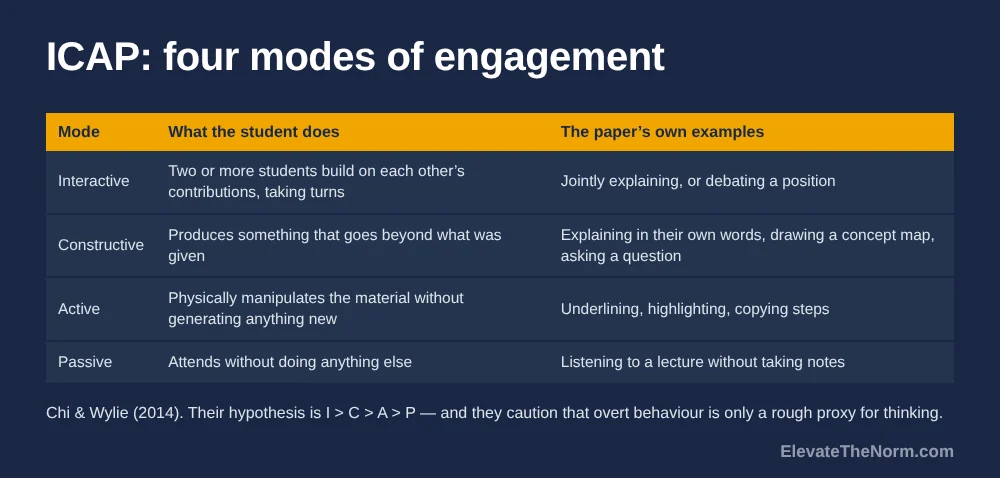
- Passive: attending without doing anything else, such as listening to a lecture without taking notes.
- Active: physically manipulating the material without generating anything new, such as underlining, highlighting or copying steps.
- Constructive: producing something that goes beyond what was given, such as explaining in your own words, drawing a concept map or asking a question.
- Interactive: two or more students building on each other’s constructive contributions, taking turns, such as jointly explaining or debating a position.
Their hypothesis is that learning deepens as you move from passive to active to constructive to interactive (I > C > A > P), and they report that laboratory and classroom evidence is largely consistent with that ordering. The authors also list caveats worth knowing: overt behavior is only a rough proxy for thinking, a task you assign can be done at a lower level than you intended, and putting students together isn’t automatically interactive. If one partner talks and the other nods, that’s closer to passive for the listener.
The planning move this gives you: before you use a strategy, ask what the student has to produce. Copying vocabulary into a foldable is Active. Writing your own example of each word is Constructive. Explaining to a partner why your example fits and theirs doesn’t is Interactive.
What are 12 active learning strategies that fit in a normal class period?
The table lists the time each one usually takes and the ICAP level it reaches when it’s run well. Time estimates are practical planning numbers, not research figures; adjust for your class.
| Strategy | What students do | Typical time | Prep | ICAP level when done well |
|---|---|---|---|---|
| 1. Think-pair-share | Think alone, discuss with a partner, share out | 2–5 min | One good question | Interactive |
| 2. Cold call with wait time | Everyone prepares an answer; you choose who speaks | 1–3 min | None | Constructive |
| 3. Mini whiteboards | Every student writes an answer and holds it up | 2–5 min | Boards or paper | Constructive |
| 4. Brain dump | Write everything you remember about yesterday’s topic, no notes | 3–5 min | None | Constructive |
| 5. Vote, discuss, revote | Answer a multiple-choice question, argue with a neighbor, answer again | 5–8 min | One question with tempting wrong answers | Interactive |
| 6. One-sentence summary | Summarize the chunk in one sentence using two required terms | 2–3 min | Pick the terms | Constructive |
| 7. Card sort | Group or rank cards (causes, examples, events) and justify the groups | 8–12 min | Printed cards | Interactive in pairs |
| 8. Error analysis | Find and fix the mistake in a sample answer | 5–8 min | One flawed example | Constructive |
| 9. Concept map | Connect key terms with labeled arrows | 8–12 min | Term list | Constructive |
| 10. Jigsaw | Learn one piece in an expert group, teach it to a home group | 25–40 min | Split readings | Interactive |
| 11. Gallery walk | Rotate to posted prompts and respond in writing | 15–25 min | Posters or stations | Constructive to interactive |
| 12. Exit ticket | Answer one or two questions on the day’s target before leaving | 3–5 min | Two questions | Constructive |
A few notes on running the ones teachers most often get wrong.
Think-pair-share lives or dies on the “think” step. Give silent time and require students to write something before they talk, or the faster partner does the thinking for both. The full routine is in the think-pair-share guide.
Cold calling works because every student has to prepare, not just the volunteers. Ask the question, pause, then name the student. Keep the tone warm and predictable; the cold calling article covers how to do it without making it feel like a trap.
Jigsaw is the biggest time investment on the list, and it pays off only when each expert group’s piece is necessary for the home group’s task. The jigsaw method guide walks through the setup. The gallery walk is a good alternative when you want movement plus written responses without the expert-group logistics.
How do I avoid “activity without learning”?
The most common failure isn’t a bad strategy. It’s a strategy that keeps students busy without making them think about the target. A colorful poster project where most of the time goes to lettering is Active at best. A card sort where students sort by guessing and never justify their groups is barely more than shuffling. Here’s a short check before and after any activity.
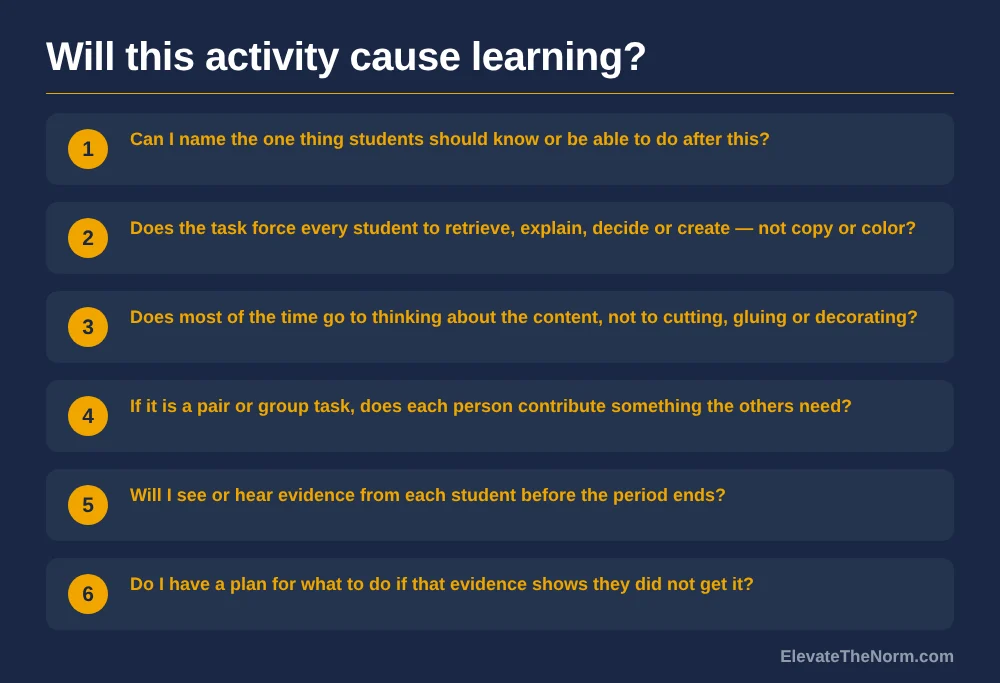
Copy-and-use checklist: Will this activity cause learning?
- Can I name the one thing students should know or be able to do after this?
- Does the task force every student to retrieve, explain, decide or create something, not just copy or color?
- Does most of the time go to thinking about the content, not to cutting, gluing, decorating or moving?
- If it’s a pair or group task, does each person have to contribute something the others need?
- Will I see or hear evidence from each student (writing, a board, a cold-called answer) before the period ends?
- Do I have a plan for what to do if that evidence shows they didn’t get it?
If you can’t say yes to at least the first, second and fifth items, trim the activity or switch to a shorter one from the table. Items five and six connect directly to checking for understanding; an active routine that doesn’t feed back into your next move is half done.
How do I build active learning into a 50-minute period?
Here’s a template you can copy and adapt for tomorrow. It keeps direct instruction and fits three short active routines around it.
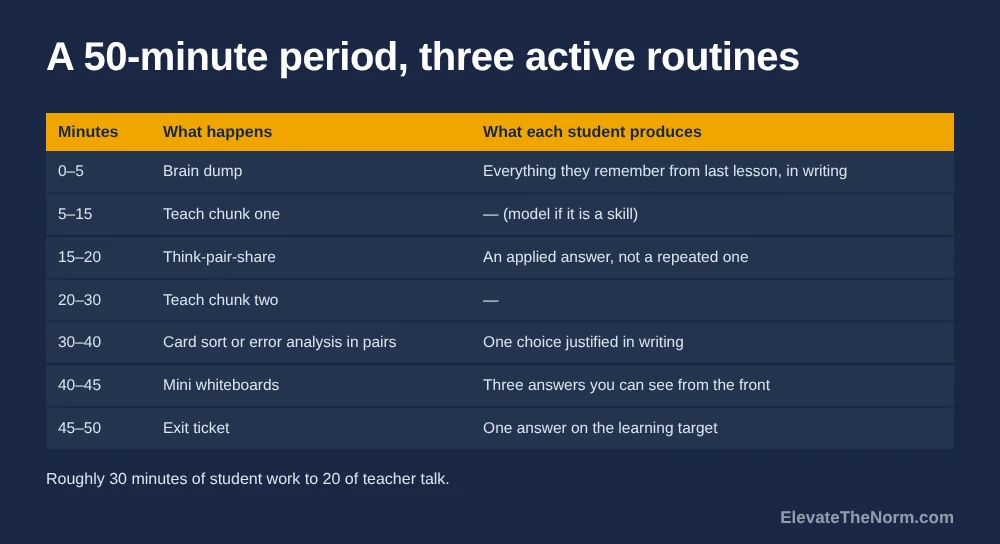
- 0–5 min: Brain dump. Students write everything they remember from the last lesson. Cold call two or three.
- 5–15 min: Teach chunk one. Keep it tight. Model if it’s a skill.
- 15–20 min: Think-pair-share. One question that makes students apply chunk one, not repeat it.
- 20–30 min: Teach chunk two.
- 30–40 min: Card sort or error analysis in pairs. Each pair must justify one choice in writing.
- 40–45 min: Mini whiteboards. Three quick questions; reteach on the spot if many boards are wrong.
- 45–50 min: Exit ticket. One question on the learning target.
That’s roughly 30 minutes of student work and 20 of teacher talk, which leans toward the higher-intensity end the 2020 meta-analysis pointed to, without throwing out explanation. On block schedules, add a jigsaw or gallery walk in the middle instead of stretching the lecture.
Clay’s take: start with the two-minute routines
The big structures get the attention, but the routines that change a classroom are the small ones you run every day: cold call with wait time, mini whiteboards, a brain dump at the bell. They cost almost nothing, they show you who’s lost before the test does, and students stop treating them as special events. Get two of those automatic first. Then add one bigger structure a week where the content earns it. And when an activity looks great but you can’t say what each student produced, drop it. A quiet room where every kid just wrote an explanation is more active than a loud one where four kids did the work.
Where the active learning evidence is weakest
The honest summary is that the direction is well supported and the size is not. Freeman and colleagues (2014) pooled 225 studies and found lower failure rates and higher exam scores under active learning, but those were undergraduate STEM courses, and the comparison condition was lecture-only. Almost nothing in that literature compares one good secondary strategy against another good secondary strategy, which is the comparison a teacher actually faces on a Tuesday.
Two further caveats travel with the ICAP ordering, and Chi and Wylie state both themselves. Overt behaviour is a rough proxy for thinking, so a task you assign at the Constructive level can be completed at the Active level by a student who copies a neighbour’s wording. And putting students in a pair does not make the work Interactive: if one partner talks and the other nods, the listener is closer to Passive than to anything else. That is not an argument against pairs. It is an argument for giving each partner something the other one needs.
What to do next week
Pick one class and one period, and run the 50-minute template above exactly as written. Do not add a new strategy to it. The point of the first run is to find out how long your chunks actually take, which is almost always longer than planned, and to see whether you can name what every student produced by the bell.
Then keep the two smallest routines and drop everything else for a fortnight. A brain dump at the bell and three mini-whiteboard questions before the exit ticket cost you nothing in prep and give you a read on the whole room twice a period. Once those two are automatic and students have stopped treating them as special events, add one larger structure a week where the content earns it. Starting with the big structure and working down is the order that usually collapses by Thursday.
Frequently Asked Questions
What are active learning strategies?
Active learning strategies are classroom routines where every student does something with the content, like retrieving it, explaining it, sorting it or debating it, instead of only listening. Common examples are think-pair-share, cold calling with wait time, mini whiteboards, card sorts, jigsaw and exit tickets. Most can be run in 2 to 15 minutes inside a regular class period.
Is there research showing active learning works?
Yes. A 2014 PNAS meta-analysis of 225 undergraduate STEM studies by Freeman and colleagues found active learning raised exam performance by about 0.47 standard deviations and that students in lecture sections were about 1.5 times more likely to fail. Most of this evidence comes from college courses, so treat it as strong direction for grades 6–12 rather than a precise prediction.
What is the ICAP framework?
ICAP is a framework from Chi and Wylie (2014) that sorts student engagement into four modes: Passive, Active, Constructive and Interactive. Their hypothesis is that learning deepens from passive to interactive. It helps teachers judge an activity by what students produce, such as their own explanation, rather than by how busy they look.
Does active learning mean no lecturing?
No. Most practical models mix short chunks of direct instruction with short periods of student work. A 50-minute class might alternate three teaching chunks with three active routines. The goal is that students do some of the thinking during class, not that the teacher stops explaining.
How much class time should go to active learning?
No single number is proven for grades 6–12. A 2020 PNAS meta-analysis of undergraduate STEM courses found that only high-intensity active learning, meaning a larger share of class time, narrowed achievement gaps. A practical target is to have students working on the content for roughly half the period, in several short blocks.
What is the quickest active learning strategy?
Cold calling with wait time and mini whiteboards are the fastest, often taking one to three minutes. Ask a question, give every student time to prepare an answer, then either call on a student by name or have everyone hold up a written answer. Both show you right away who understands and who doesn’t.
Why do some active learning activities fail?
They keep students busy without making them think about the target. Decorating, cutting or copying takes the time, or one group member does the work while others watch. Before running an activity, check that every student must retrieve, explain, decide or create something, and that you’ll see evidence from each student before the period ends.
Sources
- Freeman, S., Eddy, S. L., McDonough, M., Smith, M. K., Okoroafor, N., Jordt, H., & Wenderoth, M. P. (2014). Active learning increases student performance in science, engineering, and mathematics. PNAS, 111(23), 8410–8415. Used for the 225-study count, the 0.47 SD and roughly 6% exam gain, and the failure-rate comparison.
- Theobald, E. J., et al. (2020). Active learning narrows achievement gaps for underrepresented students in undergraduate science, technology, engineering, and math. PNAS. Used for the 33% and 45% gap reductions and the finding that only high-intensity active learning narrowed gaps.
- Chi, M. T. H., & Wylie, R. (2014). The ICAP framework: Linking cognitive engagement to active learning outcomes. Educational Psychologist, 49(4), 219–243. Used for the four engagement modes, the I > C > A > P hypothesis and the authors’ caveats.