By Clay Shumate
Student discourse is students talking to each other about the content — explaining, challenging, building on and revising ideas — rather than taking turns answering the teacher. It is not the same thing as participation, and it is not the same thing as volume. The research that holds up says the part that pays is elaboration spread across the whole room, not how much noise it makes.
That distinction is the whole article. Almost every piece of advice on this topic is about getting students to talk more. The best available evidence says more talk helps only when most of the room is in it and when what gets said builds on something — and the first of those two conditions is the one nearly every classroom misses.
Key Takeaways
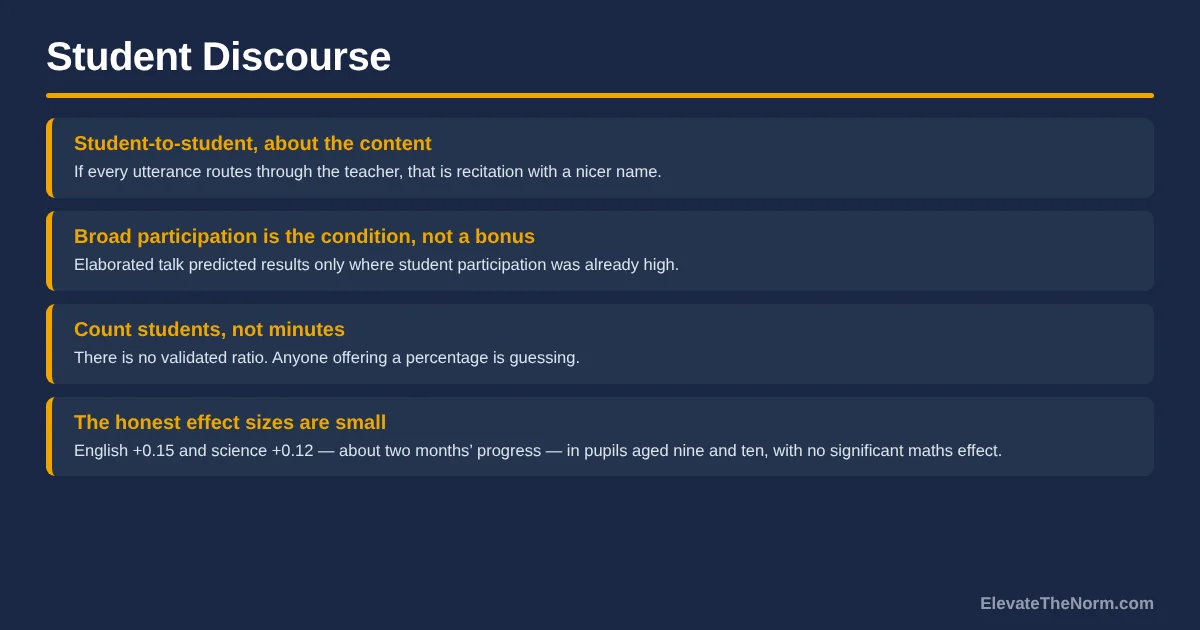
- Student discourse is student-to-student, about the content. If every utterance routes through the teacher, that is recitation with a nicer name. The research calls the real version dialogic, and its two markers are authentic questions and uptake.
- Broad participation is the condition, not a bonus. In 72 English Year 6 classes, elaborated and querying talk predicted maths and spelling-grammar results only where student participation was rated high. Where it was low, the same talk produced no measurable benefit.
- Individual talk time tracked achievement for every group of students. Across 639 ninth graders, a student’s own talk time and reasoning utterances were strongly linked to a standardised reading score, regardless of socio-economic background or gender.
- Discussion-based teaching has secondary-level evidence behind it. In 64 middle and high school English classrooms, discussion-based approaches predicted spring performance after controlling for fall performance, and worked for low- and high-achieving students alike.
- The honest effect sizes are small, and the strongest trial was not run on teenagers. The best randomised test found +0.15 in English and +0.12 in science — about two months’ progress — with no significant maths effect, in pupils aged nine and ten.
What Is Student Discourse?
Student discourse is sustained, content-focused talk in which students respond to each other’s reasoning rather than to the teacher’s prompt. The test is simple: pick any student utterance and ask what it is answering. If the answer is always “the teacher’s last question,” you have a recitation pattern — teacher asks, student answers, teacher evaluates, repeat. That pattern is not useless. It checks coverage fast and keeps a room steady. It just is not discourse, and it does not do what discourse does.
Two pieces of research vocabulary are worth borrowing because they name what actually changes. An authentic question seeks a student’s thinking rather than checking whether they already know the answer in the teacher’s head. “What year did it start?” is not authentic. “Which of those three causes mattered most, and what makes you say that?” is. Uptake means your next move is built from what the student just said rather than from the plan’s next bullet. Uptake is the cheapest high-value habit on this page and it costs nothing but attention.
Both ideas come out of a long research programme on eighth- and ninth-grade English classes — one of the few large bodies of classroom-talk research done on students the age this site writes for. The original report followed classes across eight midwestern communities over two school years, testing more than 1,100 students in the fall and spring of each. It is cited here for the two definitions and nothing else: it reports descriptive comparisons rather than a modelled effect, and no effect size for discussion is claimed anywhere on this page.
Why Does Student Discourse Matter More Than Participation?
Because participation is a count and discourse is a structure. A class where eleven students each said one sentence has high participation and no discourse. A class where four students argued for twenty minutes has discourse and a participation problem. The evidence says you need both, and the second is usually what is missing.
This is the most useful finding in the literature and it is almost never quoted. A naturalistic study of 72 Year 6 classes across 48 English schools coded two video-recorded lessons per class turn by turn, then matched the codes against end-of-year tests taken months later. Two features came out positive: elaborated talk, where a student extends or explains an idea, and querying, where a student questions or challenges a claim. Both predicted maths and spelling-punctuation-grammar scores only in classes rated high for student participation. In low-participation classes the same talk showed no benefit.
Read that the way a teacher has to. Getting four articulate students to reason beautifully in front of twenty-two silent ones did nothing for test scores in that study. The talk has to be distributed before its quality starts to matter.
The same study is worth citing for what it failed to find. Reasoned talk — statements giving an explicit reason — did not predict attainment. Not in maths, not in reading, not on a purpose-built reasoning test. The authors call the work a staging post rather than a conclusion, note the design is correlational and cannot support causal claims, and record that their talk-rules measure had to be discarded because most lessons scored zero on it. That last detail is its own finding: across 72 real classrooms, almost nobody had explicit talk rules.
What Does the Research Actually Say About Student Talk?
That it helps, that the effects are modest, and that most of the strongest studies were run on children younger than the students in a 6–12 building. All three are true at once, and an article giving you only the first is selling something.
| Study | Who it was run on | What it found | What it cannot tell you |
|---|---|---|---|
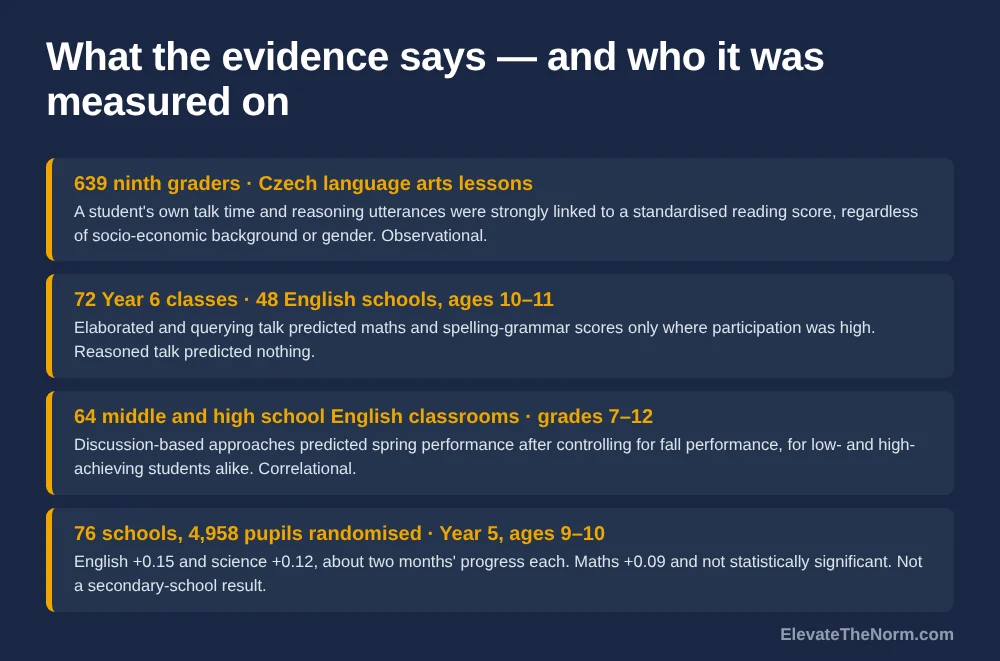
| Šeďová & Sedláček (2019) | 639 ninth graders, Czech language arts | A student’s own talk time and reasoning utterances were strongly linked to a standardised reading score. Talkative classrooms also did better. The individual link held regardless of socio-economic background or gender. | Observational — cannot separate “talking makes you better” from “better readers talk more.” Classroom-level reasoning showed no link. |
| Applebee, Langer, Nystrand & Gamoran (2003) | 64 middle and high school English classrooms, grades 7, 8, 10, 11, 12 | Discussion-based approaches were significantly related to spring performance after controlling for fall performance and background, for low- and high-achieving students alike. | Correlational. The authors note instruction was unequally distributed across tracks. |
| Howe, Hennessy, Mercer, Vrikki & Wheatley (2019) | 72 Year 6 classes (ages 10–11), 48 English schools | Elaborated and querying talk predicted maths and SPAG scores, but only where participation was high. Reasoned talk predicted nothing. | Correlational, primary-aged, one country. The authors ask for intervention trials. |
| EEF Dialogic Teaching trial (2017) | 76 schools, 4,958 pupils randomised — Year 5, ages 9–10 | English +0.15 and science +0.12, about two months’ progress each. Free-school-meals pupils gained +0.16 in maths. | Maths overall was +0.09 and not significant. 21% of pupils dropped out of the analysis. Effects fell below the trial’s own detectable threshold. Not a secondary result. |
| Murphy and colleagues (2009), meta-analysis | Studies of discussion approaches; most participants in grades 4–6 | Several approaches strongly increased student talk, reduced teacher talk, and substantially improved text comprehension. | Few improved critical thinking and reasoning, or literal and inferential comprehension. Effects varied by design, measure and student ability. |
Three things follow from the table rather than from a summary of it. The strongest causal evidence is about nine- and ten-year-olds — the EEF trial is the cleanest test anyone has run, across 76 schools in three English cities all above 20% free school meals, and it is a Year 5 result. The practices transfer to a secondary room; the numbers do not automatically transfer with them.
The secondary-level evidence is correlational, and it is still the most relevant evidence you have. The 64-classroom study and the 639-student study are both observational and neither can prove talk caused the learning. Both were run on students aged thirteen to eighteen, which no trial of this size has managed. Careful correlational work on the right students beats a clean trial on the wrong ones, as long as nobody dresses the first up as the second.
And discussion is not a reasoning intervention. The 2009 meta-analysis found several approaches reliably moved comprehension and reliably increased student talk, and that few moved critical thinking. Howe and colleagues found the same from the other direction: reasoning was the one outcome with no main effects. If your pitch is “it teaches them to think critically,” the literature does not have your back yet. If it is “it moves comprehension and gets more students into the content,” it does.
What About the Effect Size Everyone Quotes?
Treat it carefully. A large effect size for “classroom discussion” circulates widely in professional development materials, usually traced to the Visible Learning synthesis. Two things are worth knowing first. The official Visible Learning glossary entry for classroom discussion carries a definition and no effect size at all. And the synthesis has a documented correction history: Hattie has acknowledged that the Common Language Effect size figures throughout the original book were calculated incorrectly, with only the Cohen’s d values correct, and a 2014 paper by Schulmeister and Loviscach catalogued further problems with study selection and method.
None of that makes classroom discussion a bad idea. It makes the headline number a bad citation. Use the trial figures instead — +0.15, +0.12, two months, one non-significant result, primary-aged pupils. They are smaller and they are defensible, and a claim that survives a sceptical administrator is worth more than one that impresses a staff meeting.
How Much Should Students Be Talking?
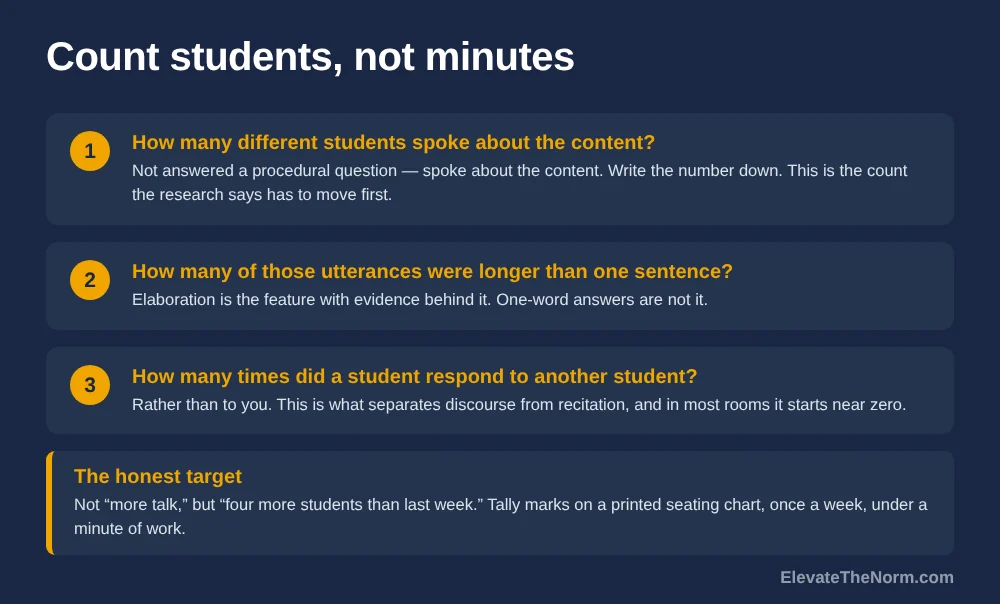
There is no validated ratio, and anyone who gives you one is guessing. The research supports a direction and a distribution, not a percentage. So stop counting minutes and count students. Three questions, answerable from a seating chart and a pencil:
- How many different students spoke about the content today? Not answered a procedural question — spoke about the content. Write the number down.
- How many of those utterances were longer than one sentence? Elaboration is the feature with evidence behind it. One-word answers are not it.
- How many times did a student respond to another student rather than to you? This is what separates discourse from recitation, and in most rooms it starts near zero.
Those three numbers, taken weekly for a month, will tell you more about your classroom than any observation rubric, and they make an honest target: not “more talk,” but “four more students than last week.”
On scope, honestly: tally marks on a printed seating chart during one discussion, once a week. Under a minute of work, no grades, no data entry, nothing to upload. And nothing here is a record of individual students’ speech that anyone else needs to see — the chart is a working note, and it belongs in the recycling at the end of the month rather than in a file.
A word on class size, because the advice gets harder as the roster grows. In a section of thirty-two on a fifty-minute period, whole-class discourse will not reach everybody and pretending otherwise wastes the period. Pairs and fours are not the training-wheels version — in a large room they are the version that satisfies the participation condition the research identified. One two-minute paired exchange gets more students reasoning out loud than twenty minutes of whole-class discussion will.
What Are the Five Moves That Produce Student Discourse?
Ask something that has no answer in your head, wait, make students respond to each other, keep the thread alive, and write down the rules. Each move is small enough to add to a lesson you have already planned.
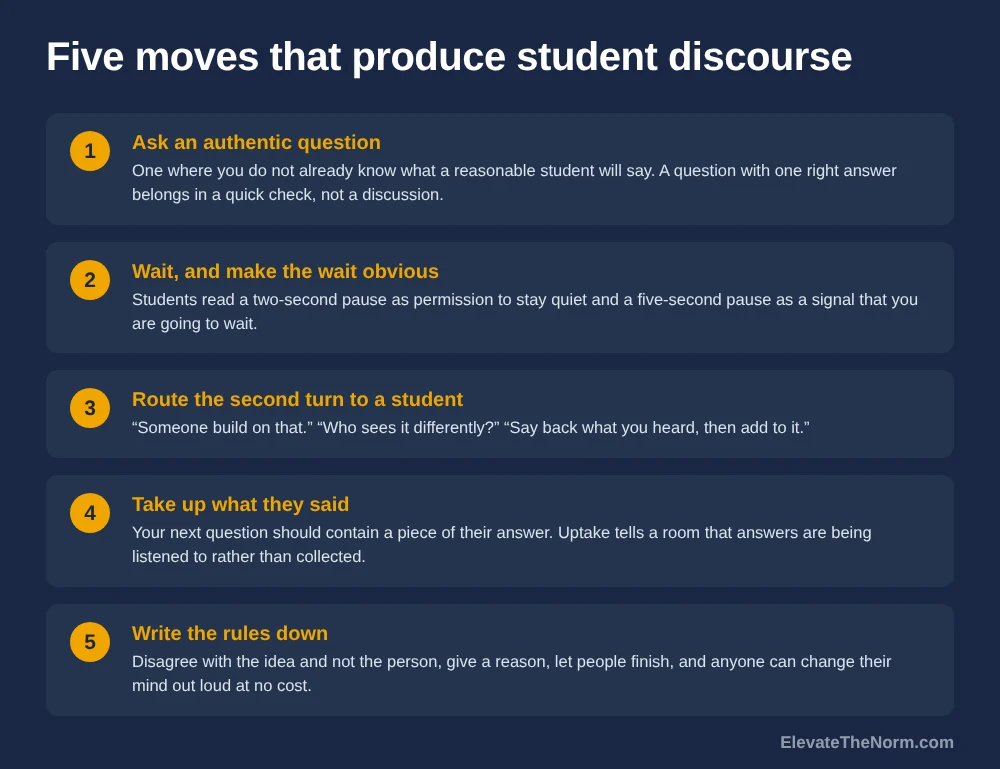
- Ask an authentic question. One where you do not already know what a reasonable student will say. “Was the compromise worth it?” rather than “What did the compromise do?” A question with one right answer belongs in a quick check, not a discussion.
- Wait, and make the wait obvious. Ask, then say nothing and let the silence be visible. Students read a two-second pause as permission to stay quiet and a five-second pause as a signal that you are going to wait.
- Route the second turn to a student, not to yourself. After a student answers, the default next move is the teacher evaluating. Replace it: “Someone build on that.” “Who sees it differently?” “Say back what you heard, then add to it.” This one substitution turns recitation into conversation.
- Take up what they said. Your next question should contain a piece of their answer. “You said it was about money — whose money?” Uptake tells a room that answers are being listened to rather than collected. It is the operational version of standing by your word: if you ask what someone thinks, do something with what they tell you.
- Write the rules down. In 72 observed classrooms the talk-rules measure was thrown out because most lessons scored zero. Four lines on the wall is enough: disagree with the idea and not the person, give a reason, let people finish, and anyone can change their mind out loud at no cost.
That fifth rule carries more weight than it looks. A room where changing your mind is embarrassing will produce confident nonsense and nothing else, because the only safe move is to defend your first answer. Say early that revising a position in public is the point — then praise it the first time it happens, by name, in front of everybody.
How Do You Run Discourse Without It Going Off the Rails?
You plan the structure, not the content of what students will say. If a discussion in a grades 6–12 classroom collapses into chaos or dead silence, that is almost always a planning result rather than a student result. Four decisions, made before the lesson:
- Decide the unit of talk. Whole class, pairs, or small groups. A room with no student-to-student history should not start whole class — pairs first, then fours, then the floor. If you are moving toward groups, defined roles inside each group remove the most common failure, which is one student talking and three watching.
- Decide what everyone writes before anyone speaks. Thirty seconds of writing raises the number of students who can enter the discussion, which is the condition the research says matters most. It also gives the quiet student something to read from instead of something to invent under pressure.
- Decide how you will call on people. Hands-up alone concentrates talk in the already-confident, which is exactly the low-participation pattern that made elaborated talk worthless in the 72-class study. A warm, predictable version of calling on students who did not volunteer — after writing time, with a route to pass once — distributes talk without ambushing anybody.
- Decide where it ends. A discussion with no landing point teaches students that talk is filler. Name the product: a written claim, a revised answer, one sentence on the strongest counterargument. Then use it in the next thing you do.
And decide, out loud, what a student who does not want to talk is allowed to do. Most discourse advice skips this, and it is the part students notice first. Give an explicit route: a pass, once, with no explanation owed and no penalty, and the answer written instead. Then honour it the first time somebody uses it, in front of everyone, without a sigh — a pass that costs social capital is not a pass. The same provision quietly does the work for a student with a speech difference, a student still acquiring English, and a student having a bad week, none of whom should have to disclose anything to get it. Sentence stems on the wall (“I agree with… because…”, “I see it differently because…”, “Can you say more about…”) raise the floor for all three at once and cost one piece of paper.
For a structured version of all of this at once, a Socratic seminar is the most forgiving format to start with, because the protocol does the management for you. It lives or dies on the prompt, so it is worth borrowing questions already known to open up rather than writing your own on the first attempt. In a smaller setting, the same five moves work inside small-group instruction at the secondary level, where the participation problem is easier to see and easier to fix.
What Happens When the Discussion Gets Near Something Contentious?
You separate the question you are asking from the question students bring, and you decide which one the lesson is for before you open the floor. A room full of teenagers reasoning out loud will eventually reach something a family has strong feelings about. That is a reason to prepare, not a reason to avoid discourse.
Three things keep it clean. Frame the prompt around evidence rather than personal position — “what does this source let us conclude” travels much further than “what do you believe.” State the standard you are grading against, if anything is graded, so nobody can reasonably believe their conclusion is what is being scored. And have the redirect sentence ready: name the move, not the student — “that is about a person rather than the idea, so try it again on the idea.” Rehearse it once and it stops being a crisis. If a discussion does go somewhere you did not intend, the useful question afterward is what the prompt invited. A fifteen-year-old cannot derail a conversation that had a clear question, a clear product and clear rules.


Can a School Actually Roll This Out?
Yes, with one condition stated plainly: the trial that produced those numbers tested a supported programme, not a handout. The EEF study trained teachers and ran a mentoring cycle inside each school. Fidelity was high for training attendance and the mentor-cycle format, and more variable for how the approach reached the curriculum. So the +0.15 belongs to that package — training, a mentor, two terms — and nobody should promise it for a one-hour staff meeting and a PDF.
The cost line is small by district standards. No purchase, no platform, no licence, no staffing change. What it needs is time: somebody who can sit in a colleague’s room, watch for the three numbers above, and talk about them afterward without it being an evaluation. A peer-observation cycle with no rating attached is the cheapest intervention on this page and the one most likely to get cut first.
It is also unusually coachable, which matters for anyone allocating instructional-coach hours. The five moves are observable from the back of a room, countable in one period, and separable — a teacher can work on routing the second turn for three weeks without changing anything else. Standards alignment mostly takes care of itself, because speaking-and-listening standards already require this and are usually the least-taught strand in the document.
Does Student Discourse Work for Every Student?
The best data says the individual benefit did not depend on background. In the 639-student Czech study, the link between a student’s own talk time and their reading score, and between their reasoning utterances and that score, held across students regardless of socio-economic background or gender. That is observational and should be stated as such. It is also the most direct evidence available on a question teachers ask constantly, usually in the form of an assumption: that students from harder circumstances need tighter control and less open talk.
There is no support for that assumption here. The EEF trial’s schools were all above 20% free school meals, and its one statistically significant maths result was for the free-school-meals subgroup specifically. The 64-classroom secondary study found discussion-based approaches working for low- and high-achieving students alike, and the Czech study found the link between a student’s own participation and achievement held regardless of socio-economic background or gender.
Be careful what that adds up to. It does not say discourse closes gaps; nobody has shown that. It says the appetite to talk about something that matters is not the thing that varies by zip code — and the burden of proof sits with whoever claims some students need silence instead.
What Goes Wrong, and How Do You Fix It?
| Failure | What you will see | The repair |
|---|---|---|
| Four voices, twenty silences | Rich talk, flat results | Write first, then pairs, then floor. Track distinct speakers, not volume |
| Questions with answers | Short replies, then nothing | Rewrite the prompt until you cannot predict a reasonable answer |
| Teacher as the hub | Every turn routes through you | Hand the second turn to a student every time, for two weeks, until it is habit |
| No stated rules | Interrupting, or point-scoring | Four lines on the wall. Most observed classrooms have none |
| Talk with no product | “Why are we doing this?” | Name the written output before the talk starts, and collect it |
One more, because it is the hardest to see from the front of the room: grading the talk. The moment a discussion carries points, some students stop reasoning and start performing, and the least confident get quieter rather than louder. If a discussion needs assessing, assess the written product that came out of it, and keep the quick checks that tell you whether they understood separate from the conversation that got them there.
How Long Does This Take to Work?
Longer than one unit, and the best trial we have says its own window was too short. Teachers in the EEF study reported two terms was not enough to embed the approach, which the evaluators recorded as a reason the measured effects may be underestimates. That is an unusually honest thing for a trial report to say, and it sets a realistic expectation: the five moves are easy to start and slow to pay.
Expect three phases. In the first week or two the distinct-speaker count moves and the talk is awkward. Over the next month students start responding to each other without being told to, which is when your third weekly number stops being zero. After that the content of the talk gets better, and the elaboration the research cares about shows up on its own. Skipping to phase three by demanding sophisticated reasoning in week one produces the four-voices pattern, which the evidence says buys nothing.
What Should Families Expect to See?
More talking at school, the same expectations, and nothing new to do at home. Worth saying to parents before they hear a version of it from their child, because “we just talked today” can sound like a wasted period from the outside.
Three things are fair to promise, and they are what a quiet student’s parent will want to hear. A student is not graded on how much they say — talk is not a behaviour category or a participation score, and the written product is what gets assessed. There is a real route to not speaking, used without explanation, with the answer written instead. And a student who thinks out loud and changes their mind is doing it correctly, not backing down; if that reads as weakness at school the whole method stops working, so it gets named as a strength out loud.
The honest caveat for a family who asks about evidence: the gains in the strongest study were about two months’ progress in English and science, in a trial on nine- and ten-year-olds, with no significant maths effect. That is worth doing and it is not a transformation. The clearer case for a 6–12 classroom is the Czech ninth-grade data — students who talked more and reasoned out loud more did better on a standardised reading test, across backgrounds.
What to Do This Week
Pick one class. Do four things.
Monday: count the distinct students who say something about the content, and the number of student-to-student responses. Change nothing yet. You need the baseline, and it will probably be worse than you expect.
Tuesday: rewrite one question in your existing plan so you cannot predict a reasonable answer to it. One question. Ask it, then wait five visible seconds.
Wednesday: hand the second turn to a student every time, all period. “Build on that.” “Who disagrees?” Nothing else changes.
Friday: put four talk rules on the wall and count again. If the distinct-speaker number went up, you have the result the research says has to come first.
Then go find the person in your building who is already good at this and ask how they start. Keeping your ears open and asking a direct question pays off more reliably than reading another article, this one included — and most of the teachers worth asking are waiting for somebody to ask.
Frequently Asked Questions
What is student discourse?
Student discourse is students talking to each other about the content — explaining, challenging, building on and revising ideas — rather than taking turns answering the teacher. The research tradition calls the real version dialogic, and its two markers are authentic questions (ones with no prespecified answer in the teacher’s head) and uptake (the teacher’s next question built out of what a student just said). If every utterance routes through the teacher, that is recitation rather than discourse.
What is the difference between student discourse and participation?
Participation is a count; discourse is a structure. Eleven students each saying one sentence is high participation and no discourse. Four students arguing for twenty minutes is discourse with a participation problem. The evidence says you need both: in a study of 72 Year 6 classes, elaborated and querying talk predicted maths and spelling-grammar scores only in classes where student participation was rated high. Where participation was low, the same quality of talk produced no measurable benefit.
How much should students be talking in class?
There is no validated ratio, and anyone offering a percentage is guessing. What the research supports is a direction — several discussion approaches increased student talk and reduced teacher talk — and a distribution, which matters more than the total. Instead of counting minutes, count three things weekly: how many different students spoke about the content, how many said more than one sentence, and how many responded to another student rather than to you. The third number starts near zero in most rooms.
Does student discourse improve test scores?
Modestly, and the strongest evidence is not from secondary classrooms. The best randomised trial of dialogic teaching found +0.15 in English and +0.12 in science — about two months’ progress — with maths at +0.09 and not statistically significant, in pupils aged nine and ten. At the secondary level the evidence is correlational: discussion-based approaches predicted spring performance across 64 middle and high school English classrooms, and across 639 ninth graders a student’s own talk time tracked their standardised reading score. Discussion is not a reasoning intervention — a meta-analysis found several approaches improved text comprehension while few improved critical thinking.
What are examples of student discourse moves?
Five, in order. Ask an authentic question you cannot predict a reasonable answer to. Wait, visibly, for about five seconds rather than two. Route the second turn to a student instead of evaluating yourself — “build on that,” “who sees it differently,” “say back what you heard, then add to it.” Take up what a student said by putting a piece of their answer into your next question. And write four talk rules on the wall: disagree with the idea not the person, give a reason, let people finish, and anyone can change their mind out loud at no cost.
How do you include a student who does not want to speak?
Give an explicit route and honour it. A pass, once, with no explanation owed and no penalty, and the answer written instead — then accept it the first time somebody uses it, in front of everyone, without a sigh. A pass that costs social capital is not a pass. Thirty seconds of writing before anyone speaks raises the number of students who can enter the discussion, and sentence stems posted on the wall (“I agree with… because…”, “I see it differently because…”) raise the floor for a reluctant speaker, a student with a speech difference and a student still acquiring English at the same time, without anyone having to disclose anything.
Should student discourse be graded?
Assess the written product that comes out of the discussion, not the talking. The moment a discussion carries points, some students stop reasoning and start performing, and the least confident get quieter rather than louder. Keep quick checks for understanding separate from the conversation that produced the understanding. Telling families plainly that a student is not graded on how much they say is also the single most effective thing you can do to head off the question a quiet student’s parent will otherwise ask.
Sources
- Jay, T., Willis, B., Thomas, P., Taylor, R., Moore, N., Burnett, C., Merchant, G., & Stevens, A. (2017). Dialogic Teaching: Evaluation Report and Executive Summary. Education Endowment Foundation / Sheffield Hallam University. Three-level clustered randomised controlled trial; 76 schools randomised (38 intervention, 38 control) in Leeds, Bradford and Birmingham, all with over 20% of pupils eligible for free school meals; 4,958 pupils randomised and 3,912 analysed. Pupils were in Year 5, aged nine and ten — this is not a secondary-school result. English +0.15 (95% CI 0.00 to 0.30, p = 0.05, about two months); science +0.12 (0.01 to 0.23, p = 0.04, about two months); maths +0.09 (−0.04 to 0.20, p = 0.19, not statistically significant). Free-school-meals pupils: maths +0.16 (0.01 to 0.30). Rated three padlocks (moderate security). Reported limitations include 21% attrition, with 7 of 38 intervention schools providing no post-test data; a baseline EAL imbalance; effects below the trial’s own minimum detectable effect size of roughly 0.25; and teachers reporting that two terms was too short to embed the approach. Read in full. shura.shu.ac.uk (PDF)
- Howe, C., Hennessy, S., Mercer, N., Vrikki, M., & Wheatley, L. (2019). Teacher–Student Dialogue During Classroom Teaching: Does It Really Impact on Student Outcomes? Journal of the Learning Sciences. 72 Year 6 classes (ages 10–11) in 48 schools across England; two video-recorded lessons per class coded turn by turn; outcomes were end-of-year tests and a pupil attitude survey taken months later, analysed in two-level models with measured confounds controlled. Elaborated and querying talk were positively associated with mathematics and spelling-punctuation-grammar scores only where the lesson-level rating for student participation was high; with low participation there was no benefit. Reading showed the same pattern but not significantly. Reasoned talk predicted nothing, there were no significant science effects, and there were no main effects on the reasoning test. The talk-rules scale was discarded because most lessons scored zero. Authors’ own caveats: the design is correlational and cannot support causal claims; the sample is England-only and primary-aged; the science and reasoning tests were newly designed; they describe the work as a “staging post” and call for intervention trials. Accepted manuscript read in full; the Cambridge copy of that manuscript has since gone offline, so this links to the published article. doi.org/10.1080/10508406.2019.1573730
- Šeďová, K., & Sedláček, M. (2019). Do Those Who Talk More Learn More? The Relationship Between Student Classroom Talk and Student Achievement. Learning and Instruction. 639 ninth-grade students in Czech schools; talk time and the number of utterances featuring reasoning were recorded for each individual student during language arts lessons; achievement was measured with a standardised reading literacy test. A strong link was found between a student’s own talk time and reasoning utterances and that student’s achievement, and at classroom level students in talkative classrooms did better. At classroom level, reasoning utterances were not linked to better results. The positive link between individual participation and achievement was observed in all students regardless of socio-economic background or gender. Observational, so it cannot separate whether talking raises achievement or stronger readers talk more. Abstract read in full from the publisher’s record. pedagogika.phil.muni.cz
- Applebee, A. N., Langer, J. A., Nystrand, M., & Gamoran, A. (2003). Discussion-Based Approaches to Developing Understanding: Classroom Instruction and Student Performance in Middle and High School English. American Educational Research Journal, 40(3). 64 middle and high school English classrooms spanning grades 7, 8, 10, 11 and 12. Discussion-based approaches were significantly related to spring performance in hierarchical linear models controlling for fall performance and background variables, and appeared effective across a range of situations and for both low- and high-achieving students. Non-experimental; the authors note that instruction was unequally distributed across tracks, which complicates interpretation. Cited from the ERIC record, which was read; the journal’s full text was not opened in this session. eric.ed.gov
- Murphy, P. K., Wilkinson, I. A. G., Soter, A. O., Hennessey, M. N., & Alexander, J. F. (2009). Examining the Effects of Classroom Discussion on Students’ Comprehension of Text: A Meta-Analysis. Journal of Educational Psychology, 101(3). Several discussion approaches produced strong increases in the amount of student talk with reductions in teacher talk, and substantial improvements in text comprehension. Few approaches were effective at improving literal or inferential comprehension, or critical thinking and reasoning. Effects were moderated by study design, the nature of the outcome measure and student academic ability. The age range was wide but most studies involved fourth through sixth graders, so this is not a secondary-school finding. Cited from the published abstract and record; the full article was not opened in this session. pure.psu.edu
- Murphy, P. K., Greene, J. A., Firetto, C. M., Hendrick, B. D., Li, M., Montalbano, C., & Wei, L. (2018). Quality Talk: Developing Students’ Discourse to Promote High-Level Comprehension. American Educational Research Journal, 55(5). A year-long study of a teacher-facilitated small-group discussion approach in two fourth-grade classrooms. Teacher-initiated discourse decreased, student discourse showed more critical-analytic thinking, and written measures of basic and high-level comprehension increased. The authors describe it as an initial study; two classrooms is a small sample and the abstract reports no effect sizes. Cited from the abstract, which was read; the full text is behind access controls. journals.sagepub.com
- Nystrand, M., & Gamoran, A. (1990). Student Engagement: When Recitation Becomes Conversation. National Center on Effective Secondary Schools, Wisconsin Center for Education Research, University of Wisconsin–Madison. The source of the two terms used above: authentic questions, which open the floor to what students actually think, and uptake, where the next question is built out of what a student just said. Eighth- and ninth-grade English classes across eight midwestern communities — 16 middle schools feeding nine high schools — with over 1,100 students tested in the fall and spring of 1987–88 and 1988–89. Cited for the definitions only. This report gives descriptive comparisons rather than regression models, publishes no effect size for discussion, and none is claimed here. The research centre’s own summary page for the wider programme is currently unreachable — its TLS certificate does not match its hostname — so it is not cited. files.eric.ed.gov (PDF)
- On the widely quoted “classroom discussion” effect size: the official Visible Learning glossary entry for classroom discussion gives a definition and no effect size and no meta-analyses. Separately, Hattie has acknowledged that the Common Language Effect size figures throughout the original book were calculated incorrectly, with only the Cohen’s d values correct — raised by Topphol (2011) in Norsk pedagogisk tidsskrift — and Schulmeister and Loviscach (2014), Errors in John Hattie’s “Visible Learning”, argued there are considerable issues with study selection and method. No formal published erratum or revised edition is documented. This article therefore does not cite a Visible Learning figure for discussion and uses the trial estimates instead. visible-learning.org glossary · overview of the criticism