The Elevate Blog banner: Real Classrooms. Practical Ideas. Higher Expectations. Three students climb a rocky ridge at sunrise, each pulling the next one up, toward a teacher reaching down to help.

Tag: PBIS

  • Top-Rated Classroom Culture Frameworks for Middle School, Ranked

    Top-Rated Classroom Culture Frameworks for Middle School, Ranked

    By Clay Shumate

    The top-rated classroom culture frameworks for middle school, ranked on grades 6–8 evidence and fit, are CHAMPS, PBIS, Responsive Classroom’s middle school practices, Developmental Designs, Teach Like a Champion and restorative practices. CHAMPS is the only one with a middle school randomized trial. Most middle schools do best pairing one schoolwide system with one classroom routine.

    Key Takeaways

    • CHAMPS ranks first for grades 6–8 because it’s the only framework here tested in a middle school randomized trial: 102 teachers and 1,450 students in nine Missouri middle schools.
    • PBIS is the schoolwide system the other frameworks plug into, but its biggest randomized trial ran in elementary schools.
    • Responsive Classroom and Developmental Designs both offer advisory routines built for middle level, and neither has a middle school randomized trial.
    • Restorative practices had mixed middle school results in RAND’s Pittsburgh study: in grades 6–8, suspensions didn’t change and academic results got worse.
    • Three short routines with middle school trials, the CW-FIT praise routine, Establish-Maintain-Restore and positive greetings at the door, fit inside any of these frameworks.

    “Top-rated” here doesn’t mean popular or best-reviewed. It means ranked on evidence and on fit for how middle school actually runs. For every framework across all grades, see the classroom culture frameworks Q&A hub.

    How were these middle school frameworks ranked?

    Each middle school framework on this list was scored on four questions, with evidence from grades 6–8 weighted most.

    1. Middle school evidence: Has it been tested in grades 6–8, and how strong was the study?
    2. Built for middle level: Does it plan for students who change rooms every period and teachers who see 100+ students a day, or was it written for one self-contained elementary class?
    3. Adolescent fit: Does it respect a 12- to 14-year-old’s need for peer connection, voice and dignity, or will it feel babyish?
    4. Can one teacher start it? Some need a whole-school decision. Others work in one room on Monday.

    A framework with strong elementary research but no middle school study ranks below one tested in grades 6–8. We left out anything we couldn’t verify.

    What are the top-rated classroom culture frameworks for middle school?

    The top-rated classroom culture frameworks for middle school are, in order, CHAMPS, PBIS, Responsive Classroom’s middle school practices, Developmental Designs, Teach Like a Champion and restorative practices, ranked on grades 6–8 evidence first.

    RankFrameworkLevelMiddle school evidenceBuilt for grades 6–8?
    1CHAMPS (Safe & Civil Schools)ClassroomRandomized trial, 102 teachers, grades 6–8Used across grades; tested in middle school
    2PBISSchoolwideStrongest trials are elementaryK–12 framework
    3Responsive Classroom (middle school)Classroom / advisoryTrial was grades 2–5Yes, separate secondary practices
    4Developmental Designs (Origins)Advisory / classroomNo trial foundYes, middle level
    5Teach Like a ChampionInstructionNo trial of the book foundNo, all grades
    6Restorative practicesSchoolwideRAND study: no suspension change, lower academics in grades 6–8No, K–12

    1. CHAMPS (Safe & Civil Schools)

    Best for: a middle school teacher who wants more time on task and calmer transitions. CHAMPS is Randy Sprick’s proactive, positive approach to classroom management, part of his Safe & Civil Schools materials (University of Kansas Center for Research on Learning). The acronym stands for Conversation, Help, Activity, Movement, Participation and Success: for each activity, students know whether they can talk, how to get help, what the task is, whether they can move, what participation looks like and how success is recognized (LiveSchool).
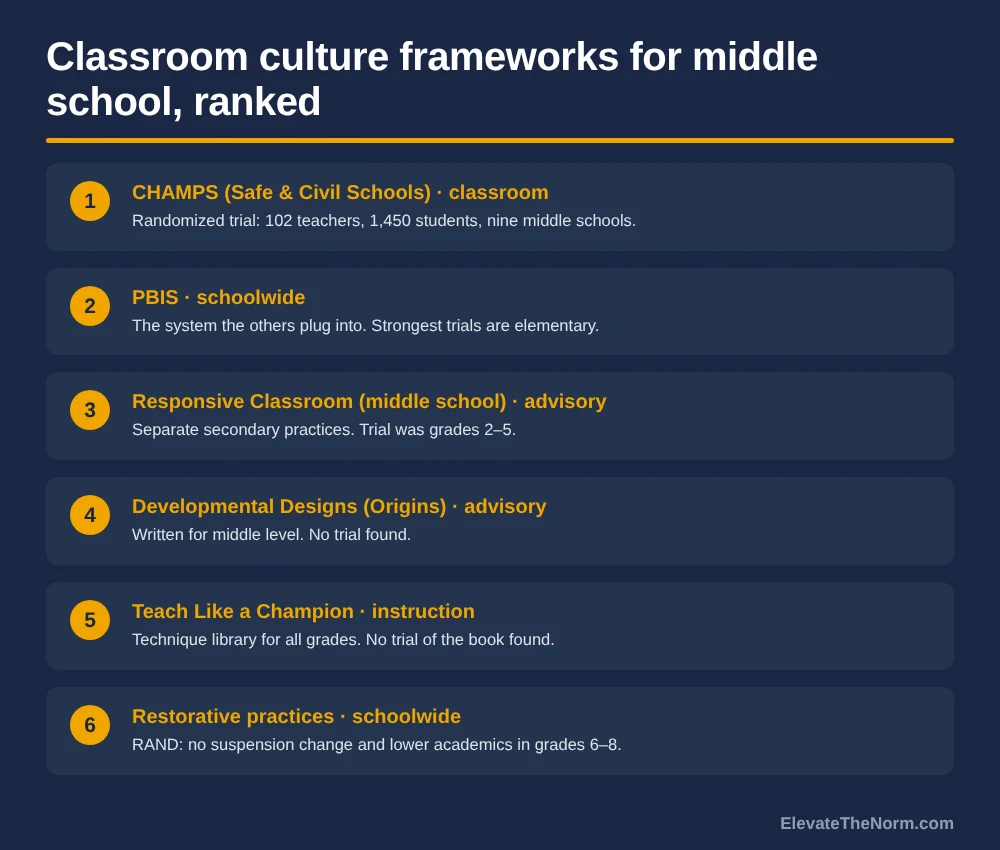
    Numbered graphic ranking six classroom culture frameworks for middle school: 1 CHAMPS, 2 PBIS, 3 Responsive Classroom middle school practices, 4 Developmental Designs, 5 Teach Like a Champion, 6 restorative practices, each with its level and middle school evidence.
    The six classroom culture frameworks for middle school, ranked by grades 6–8 evidence and fit.

    It ranks first because of the evidence. In a randomized trial with 102 teachers and 1,450 students in nine Missouri middle schools, teachers trained in CHAMPS praised more and gave more opportunities to respond. Their students were more focused, completed more classwork and spent more time on schoolwork (IES). The catch: teachers got three days of training plus monthly coaching. Reading the book alone isn’t the same thing.

    2. PBIS

    Best for: a middle school choosing one behavior system for every adult in the building. PBIS is a three-tier framework: universal supports for everyone, targeted help for students at risk, and intensive individual support (Center on PBIS). Its big randomized trial ran in 37 elementary schools and found a 33% drop in the odds of an office referral (Johns Hopkins). It ranks second because it’s the system the other frameworks plug into, not because it has middle school trial data. It doesn’t tell a teacher what to do at 10:14 on a Tuesday; CHAMPS or Responsive Classroom fills that gap.

    3. Responsive Classroom (middle school)

    Best for: a school that wants a daily advisory routine for belonging. Responsive Classroom has a separate set of secondary practices: Responsive Advisory Meeting, Brain Breaks, Investing Students in the Rules, Active Teaching, Student Practice, Small Group Learning and Independent Practice (Responsive Classroom). An advisory meeting runs arrival, announcements, acknowledgments and a short activity, and its first two weeks focus on predictability, safety and belonging (RAM grades 6–8 first ten days).

    Its randomized trial was in grades 2–5 and found gains only where teachers used it faithfully (AERA). That’s why it sits below CHAMPS for middle school. More in Responsive Classroom vs PBIS.

    4. Developmental Designs (Origins)

    Best for: a middle school building an advisory program from scratch. Developmental Designs comes from the Origins Program, founded by Linda Crawford, and it’s aimed at middle level schools. Its advisory guide is written for grades 5–9 and is built on two formats, the Circle of Power and Respect and a shorter Activity Plus Advisory, plus seven target skills: cooperation, communication, assertion, responsibility, engagement, empathy and self-control (MiddleWeb review). It’s designed for this age group from the ground up, which is its biggest strength. We didn’t find a randomized trial, so it ranks below the three above.

    5. Teach Like a Champion

    Best for: teachers who want concrete instructional techniques rather than a behavior system. Doug Lemov’s Teach Like a Champion 3.0 lays out 63 techniques and covers student engagement, trust, respect, accountability and excellence (Jossey-Bass, 2021, via Porchlight Books). It’s a technique library, not a middle school framework, and we found no trial of the book as a whole. Many of its ideas overlap with the moves that worked in the CHAMPS trial, like getting every student to respond.

    6. Restorative practices

    Best for: repairing harm after conflict, as one part of a larger system. RAND’s Pittsburgh study found suspension days fell 36% in program schools versus 18% elsewhere, and 63% of staff said relationships with students improved. But in grades 6–8, suspensions didn’t change and academic results got worse (EdSource on the RAND study). That’s the reason it ranks last for middle school. It’s still useful for circles and repair conversations. See restorative practices in schools.
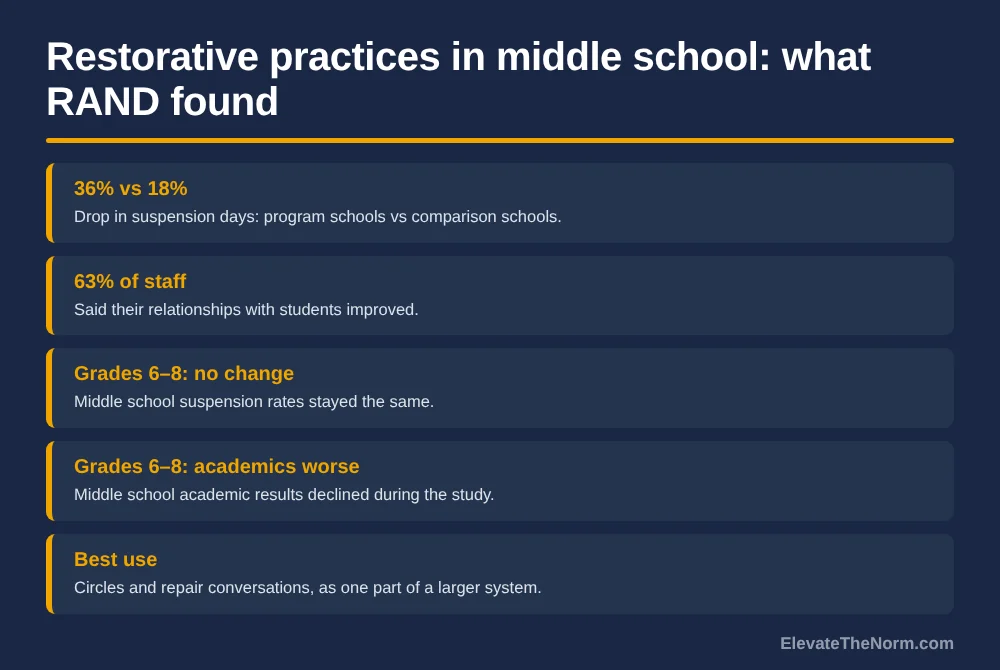
    Graphic summarizing RAND's Pittsburgh restorative practices study: suspension days fell 36% in program schools vs 18% in comparison schools, 63% of staff reported better relationships, and in grades 6–8 suspensions did not change and academic results got worse.
    What RAND’s restorative practices study found for middle school.

    Clay’s take, as a grades 6–12 classroom teacher: pair one schoolwide system with one classroom routine. If your school already runs PBIS, keep it and use CHAMPS or an advisory routine inside it rather than stacking a second schoolwide program on top.

    Are there smaller routines worth adding in middle school?

    Three short classroom routines have middle school trials and fit inside any of the six frameworks: the CW-FIT praise routine, Establish-Maintain-Restore relationship training, and positive greetings at the door.

    • CW-FIT (praise routine): in 28 middle school classrooms, getting to at least one praise per reprimand raised class-wide on-task behavior 60–70% (BYU).
    • Establish-Maintain-Restore: a three-hour relationship training that improved relationships, engaged time and disruption in a small middle school trial (Duong et al., 2018).
    • Positive greetings at the door: raised engaged time and reduced disruption for middle school teachers in a randomized study (Cook et al., 2018).
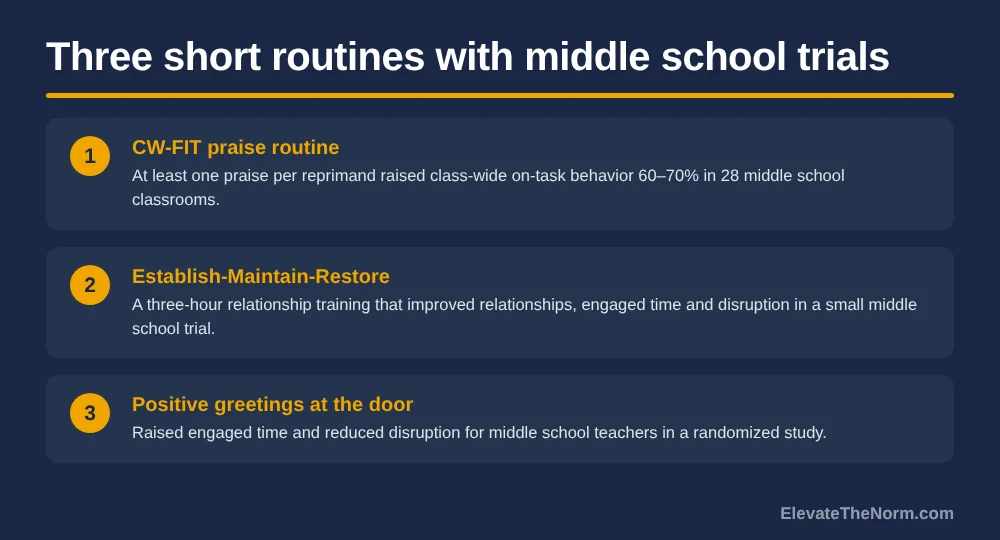
    Numbered graphic of three short routines with middle school trials: the CW-FIT praise routine, Establish-Maintain-Restore relationship training, and positive greetings at the door.
    Three short routines with middle school trials that fit inside any framework.

    If engagement is your main concern, our evidence breakdown is in the best classroom culture framework for student engagement.

    Why do middle schoolers need a different framework than elementary students?

    Middle schoolers need a different classroom culture framework because the school day and the student are both different: a middle school teacher sees several groups for under an hour each, and 12- to 14-year-olds care more about peers and fairness. A self-contained elementary teacher can build community in a morning meeting with the same 25 kids all day. A middle school teacher may see five or six groups, each for under an hour. Frameworks that assume one homeroom don’t transfer cleanly, which is why advisory-based models like Responsive Advisory Meeting and Developmental Designs exist.

    Middle schoolers also care a lot about peers and fairness. Generic praise and prize charts can feel childish. The routines that held up in middle school trials were specific and frequent: naming exactly what a student did, and giving everyone a chance to answer. Our guides on respect in the classroom and classroom management for new teachers go further on this.

    Where does Elevate the Norm fit?

    Elevate the Norm is this site’s own free grades 6–12 classroom approach, so it’s labeled rather than ranked, and it hasn’t been independently evaluated. It was built by Clay Shumate, a certified 6–12 social studies teacher. It belongs in the “one teacher can start it Monday” group alongside CHAMPS, and it works inside a school’s PBIS system.

    • Three recognition tiers (Immediate Recognition, Student of the Week, Student of the Month) with criteria announced in advance and judged on consistency and self-improvement, not perfection.
    • A 3-2-1-Done class-vs-class point system for quieting down, which suits middle schoolers’ competitive streak. Buy-in usually takes about three weeks; in its most recent year it took about six.
    • Respect both ways, with student talk channeled constructively instead of shut down.

    Materials are free with no email gate at the resource library. A paid option from the same teacher, the Teacher Emergency Toolkit on TPT, includes de-escalation scripts and behavior documentation (store).

    Frequently Asked Questions

    What is the best classroom management framework for middle school?

    CHAMPS has the strongest middle school evidence of the major classroom culture frameworks. In a randomized trial with 102 teachers and 1,450 students in nine Missouri middle schools, students of CHAMPS-trained teachers were more focused, finished more classwork and spent more time on schoolwork. Teachers got three days of training plus monthly coaching. Pair CHAMPS with PBIS if the school wants one schoolwide system.

    Does Responsive Classroom work for middle school?

    Responsive Classroom has a separate set of middle school practices built around Responsive Advisory Meeting, Brain Breaks and investing students in the rules. Its randomized trial followed students in 24 schools from second grade through fifth grade and found gains only where teachers used the practices faithfully. The middle school version is designed for adolescents but hasn’t been tested in its own trial.

    What is Developmental Designs?

    Developmental Designs is a middle level approach from the Origins Program, founded by Linda Crawford. Its advisory guide, written for grades 5–9, centers on the Circle of Power and Respect and a shorter Activity Plus Advisory format, and it targets seven skills including cooperation, responsibility and self-control. It’s built for this age group, but no randomized trial of it was found.

    Do restorative practices work in middle school?

    Restorative practices had mixed middle school results. In RAND’s study of Pittsburgh schools, suspension days fell 36% in program schools versus 18% elsewhere, but in grades 6–8 suspensions didn’t change and academic results got worse. Restorative practices still help with circles and repair conversations after conflict when they’re used as one part of a larger behavior system.

    Can one middle school teacher use a framework without the whole school?

    One middle school teacher can run CHAMPS, a praise routine like CW-FIT, positive greetings at the door or Elevate the Norm in a single classroom without waiting for a schoolwide decision. PBIS and restorative practices work best when the whole building adopts them, because both are designed as schoolwide systems rather than one-room routines.

    Is PBIS enough on its own in middle school?

    PBIS sets schoolwide expectations and three tiers of support, but it doesn’t tell a middle school teacher what to do minute to minute in a class period. Its largest randomized trial ran in 37 elementary schools, where it cut the odds of an office referral by 33%. Most middle schools add a classroom routine such as CHAMPS or an advisory model on top of it.

    How much training does CHAMPS take to get the trial results?

    In the middle school trial that put CHAMPS first on this list, teachers received three days of training plus monthly coaching. That support was part of what was tested. Reading the CHAMPS book alone is a different, untested experience, so a school expecting results like the trial’s should plan for training and follow-up coaching, not just a book order.

    Will middle schoolers think these frameworks are babyish?

    Middle schoolers can find generic praise and prize charts childish, which is why fit for 12- to 14-year-olds is one of the four ranking criteria here. The routines that held up in middle school trials were specific and frequent: naming exactly what a student did and giving every student a chance to respond. Advisory models also build in peer connection and student voice.

    Sources

    How is this page kept accurate?

    This middle school framework ranking is based on the studies and publisher pages linked inline and in the Sources list, and it will be updated if new middle school trials are published. Elevate the Norm is labeled as this site’s own framework and is not ranked. Corrections follow the editorial standards and corrections policy. For what a positive room looks like in measurable terms, see frameworks for a positive classroom environment.

    About Clay Shumate

    Clay Shumate is a certified secondary Social Studies teacher in the public schools of West Alabama, with seven years of classroom experience, a B.A. in History, and an M.Ed. in Secondary Education. He writes about project-based learning, student responsibility, respect, and practical ways to hold young people to a higher standard while giving them room to learn from mistakes. He is a member of the Society of Professional Journalists and writes to its Code of Ethics; this site’s editorial standards and corrections policy are published in full. More about Clay.

  • Elevate the Norm vs Other Classroom Culture Frameworks

    Elevate the Norm vs Other Classroom Culture Frameworks

    By Clay Shumate

    Elevate the Norm is a free classroom approach built by one teacher for grades 6–12 only. Against other classroom culture frameworks like PBIS, Responsive Classroom, CHAMPS and restorative practices, it’s narrower, cheaper and untested. Pick it for a no-cost recognition and transition system in one secondary classroom. Pick PBIS for a whole school and CHAMPS for middle school trial evidence.

    Key Takeaways

    • Elevate the Norm is free, written only for grades 6–12, and has not been independently evaluated.
    • PBIS is the pick for a whole school: the framework is free, and a randomized trial in 37 elementary schools found students 33% less likely to get an office referral.
    • CHAMPS has the strongest secondary evidence of these frameworks: a randomized study of 102 middle school teachers and 1,450 students.
    • Responsive Classroom and Conscious Discipline fit PreK–5 teachers better than any framework built for secondary grades.
    • The biggest hidden cost in every classroom culture framework is staff time, not books or training fees.

    Full disclosure up front: Elevate the Norm is this site’s own framework. That’s exactly why this page puts it in a table next to programs with bigger research bases and says plainly where each one wins. Every price and study below links to its source. For the full list of frameworks, see the classroom culture frameworks Q&A hub. If you want the reasoning behind Elevate’s design rather than a side-by-side, read what makes Elevate the Norm different.

    How does Elevate the Norm compare side by side?

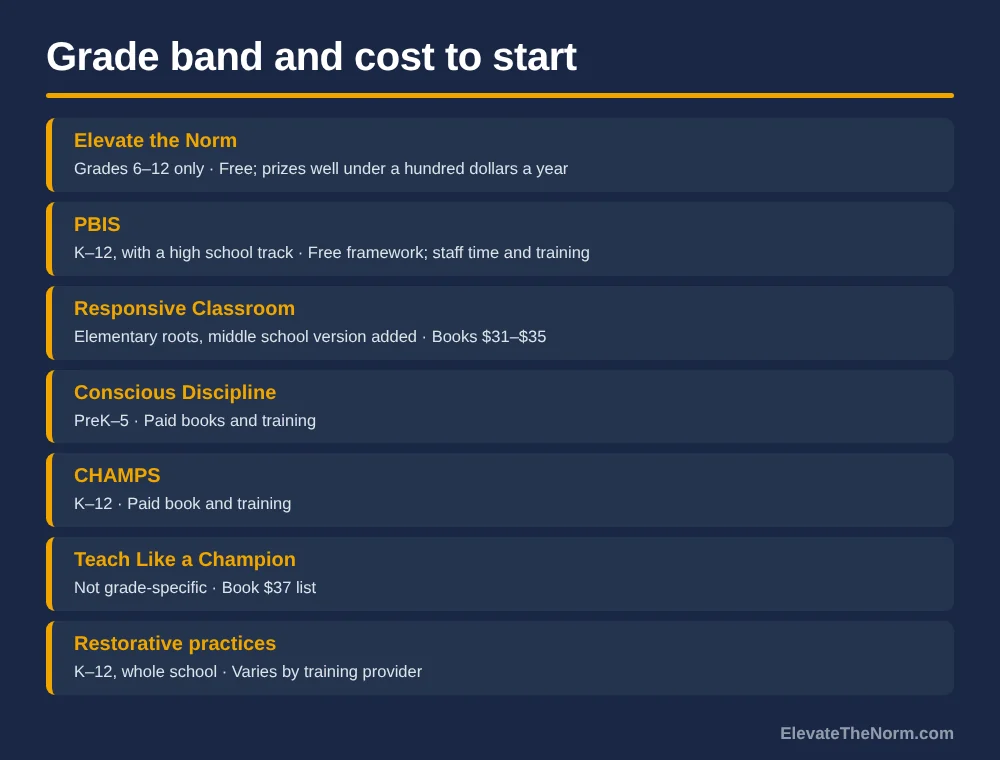
    Elevate the Norm is the only one of these seven that’s free, built only for grades 6–12, and written by a single classroom teacher, and it’s also the only one with no independent evaluation.

    FrameworkGrade bandCost to startCore mechanismEvidence baseRewards philosophy
    Elevate the Norm (this site)6–12 onlyFree; prizes well under a hundred dollars a year for one teacherThree recognition tiers, class-vs-class 3-2-1-Done points, firm follow-throughNone independent; built on cited researchAnnounced, earned recognition for consistency
    PBISK–12, with a high school trackFree framework; staff time and trainingSchoolwide three-tier system, taught expectations, data teamsRandomized trials (elementary)Acknowledgment systems, often tokens
    Responsive ClassroomElementary roots, middle school version addedBooks $31–$35Daily meetings, Interactive Modeling, teacher languageRandomized trial, grades 2–5Reinforcing language over tokens
    Conscious DisciplinePreK–5Paid books and trainingAdult self-regulation, School FamilyQuasi-experimental, Pre-KConnection before consequences
    CHAMPSK–12Paid book and trainingClear expectations for each activity, praise, opportunities to respondRandomized trial, grades 6–8Specific praise plus planned reinforcement
    Teach Like a ChampionNot grade-specificBook $37 listNamed teaching techniques for routines, engagement and rigorObservation of effective teachers; no program trial foundHigh expectations and precise praise
    Restorative practicesK–12, whole schoolVaries by training providerCircles, repairing harm, relationshipsRandomized trial (RAND), mixed resultsRelationship and repair, not rewards

    Sources: Center on PBIS; High School PBIS; Responsive Classroom bookstore; Responsive Classroom middle school expansion; Conscious Discipline; CHAMPS K–12 session listing (Region 11 ESC); Teach Like a Champion 3.0 listing; RAND restorative practices trial. Prices change, so confirm current prices with each publisher.

    Which frameworks are built for middle and high school?

    PBIS, CHAMPS and Elevate the Norm cover high school; Responsive Classroom reaches middle school; Conscious Discipline stops at grade 5.

    PBIS has a dedicated high school track that adds student voice, department-wide consistency and extra freshman-year support (Center on PBIS). CHAMPS training is offered for elementary, middle and high school teachers (Region 11 ESC). Responsive Classroom spent about thirty years in elementary schools before building a middle school version (Responsive Classroom). Conscious Discipline lists its market as early childhood and PreK–5 (Conscious Discipline).

    Elevate the Norm is the narrowest: it was written for grades 6–12 and nothing else. That’s a strength if you teach teenagers and a dealbreaker if you don’t. If you’re in an elementary building, stop here and look at the other six.

    Graphic comparing grade band and cost to start for seven classroom culture frameworks: Elevate the Norm (grades 6–12, free), PBIS, Responsive Classroom, Conscious Discipline, CHAMPS, Teach Like a Champion and restorative practices.
    Grade band and starting cost, Elevate the Norm vs other classroom culture frameworks.

    How much does each one cost?

    PBIS and Elevate the Norm cost nothing to adopt; the rest run from a $31 book to paid multi-day training.

    • Free: PBIS (framework and Center on PBIS materials) and Elevate the Norm (every classroom resource on the free resource library, no email required).
    • A book to start: Responsive Classroom titles list at $31.20–$35.00 at the publisher’s bookstore. Teach Like a Champion 3.0 lists at $37.00.
    • Book plus training: CHAMPS, Conscious Discipline and restorative practices are usually adopted through paid workshops or district contracts. We couldn’t confirm a current public list price for training, so ask the provider for a quote.

    The hidden cost in every framework is staff time. The Center on PBIS says plainly that PBIS isn’t something you learn in a one-day training; it’s an ongoing commitment that involves teams, data and coaching (Center on PBIS). Elevate the Norm is cheap partly because it asks less: one teacher, one room, no team.

    What does each framework actually ask a teacher to do every day?

    Classroom culture frameworks split into four types: systems (PBIS, restorative practices), teacher-technique playbooks (CHAMPS, Teach Like a Champion), community practices (Responsive Classroom, Conscious Discipline), and recognition systems (Elevate the Norm).

    • PBIS: teach three to five schoolwide expectations, acknowledge them, and use data to decide which students need Tier 2 or Tier 3 support.
    • Restorative practices: build relationships through circles and respond to harm by repairing it. RAND’s trial studied the whole-school model from the International Institute for Restorative Practices (RAND).
    • CHAMPS: define expectations for every activity and transition, praise specifically, and give more chances to respond.
    • Teach Like a Champion: a catalog of named techniques Doug Lemov observed in highly effective teachers (Education Week).
    • Responsive Classroom: morning or advisory meetings, modeling routines before expecting them, and precise teacher language.
    • Conscious Discipline: adults practice self-regulation first, then teach children the skills of discipline.
    • Elevate the Norm: immediate recognition, Student of the Week and Student of the Month on criteria announced ahead of time; the 3-2-1-Done class-vs-class point system for quieting and transitions; and strict follow-through, including removing positives after repeated warnings.

    Which framework has the strongest evidence?

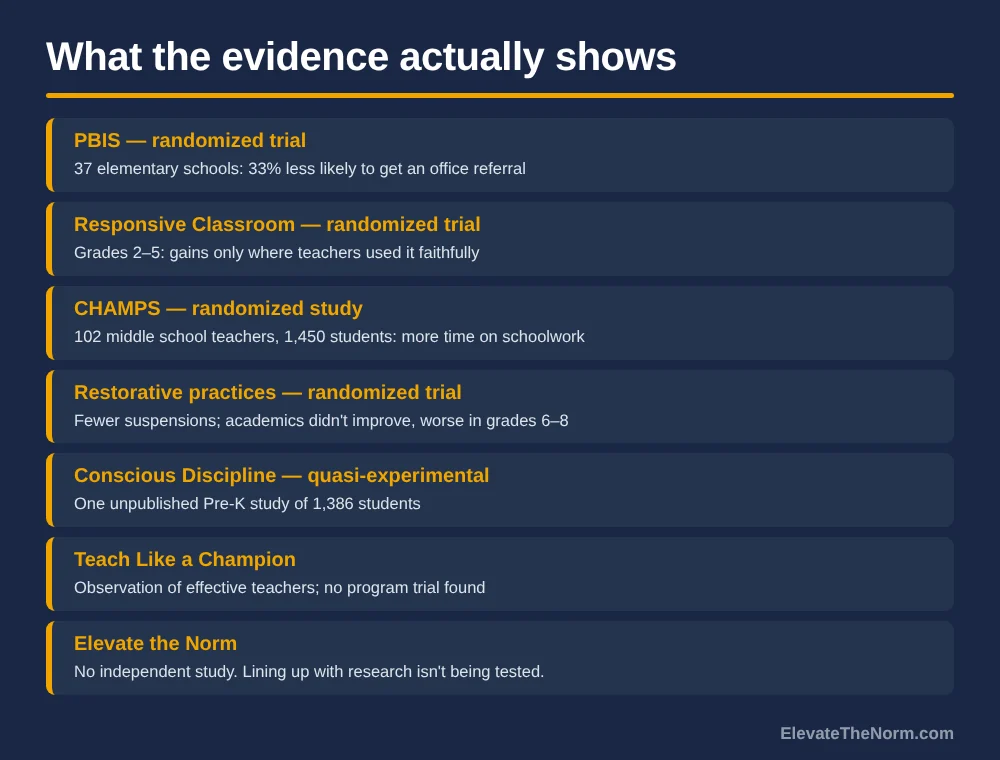
    PBIS, Responsive Classroom, CHAMPS and restorative practices each have a randomized trial; Elevate the Norm has none. The largest studies found the following.

    • PBIS: In 37 elementary schools and 12,344 children, students in schoolwide PBIS schools were 33% less likely to get an office referral, with no significant difference in suspensions (Bradshaw, Waasdorp & Leaf, Pediatrics, 2012).
    • Responsive Classroom: In 24 schools and 2,904 students in grades 2–5, schools using it didn’t outperform controls overall, but teachers who used the practices faithfully saw gains of 0.26 in math and 0.30 in reading (Rimm-Kaufman et al., 2014).
    • CHAMPS: A randomized study of 102 middle school teachers and 1,450 students found CHAMPS teachers praised more and gave more chances to respond, and their students spent more time on schoolwork (IES). It’s the strongest secondary evidence on this list.
    • Restorative practices: Pittsburgh’s randomized trial found larger drops in suspensions and better teacher-rated climate, but academic outcomes didn’t improve and got worse in grades 6–8 (RAND, 2018).
    • Conscious Discipline: one quasi-experimental study of 1,386 Pre-K students, from an unpublished manuscript (CASEL).
    • Teach Like a Champion: the techniques come from observing effective teachers; we didn’t find a randomized trial of the program as a whole.
    • Elevate the Norm: no independent study. Its design choices line up with published research on praise and awards, which we cover in what makes Elevate the Norm different, but lining up with research isn’t the same as being tested.
    Graphic summarizing the evidence behind seven classroom culture frameworks: randomized trials for PBIS, Responsive Classroom, CHAMPS and restorative practices, a quasi-experimental Pre-K study for Conscious Discipline, and no independent study for Elevate the Norm.
    What the largest studies found for each framework.

    How do their views on rewards differ?

    Responsive Classroom and restorative practices avoid token rewards, PBIS often uses them, and Elevate the Norm uses small, announced rewards tied to consistency.

    Responsive Classroom’s own explainer says tokens and prizes can produce short-term compliance but may build dependence on outside incentives, and it favors reinforcing teacher language instead (Responsive Classroom, 2025). PBIS doesn’t require tokens but is often run with tickets or points. The Center on PBIS also warns against clip charts and recommends equitable acknowledgment systems (Classroom PBIS).

    Elevate the Norm sits in the middle. It uses real prizes, but the criteria are posted in advance and judged on consistency and self-improvement, not perfection. If you’re firmly in the no-rewards camp, Responsive Classroom or restorative practices will fit your beliefs better.

    When is another framework the better choice?

    Another classroom culture framework is the better choice whenever your situation is anything other than one secondary teacher with no budget.

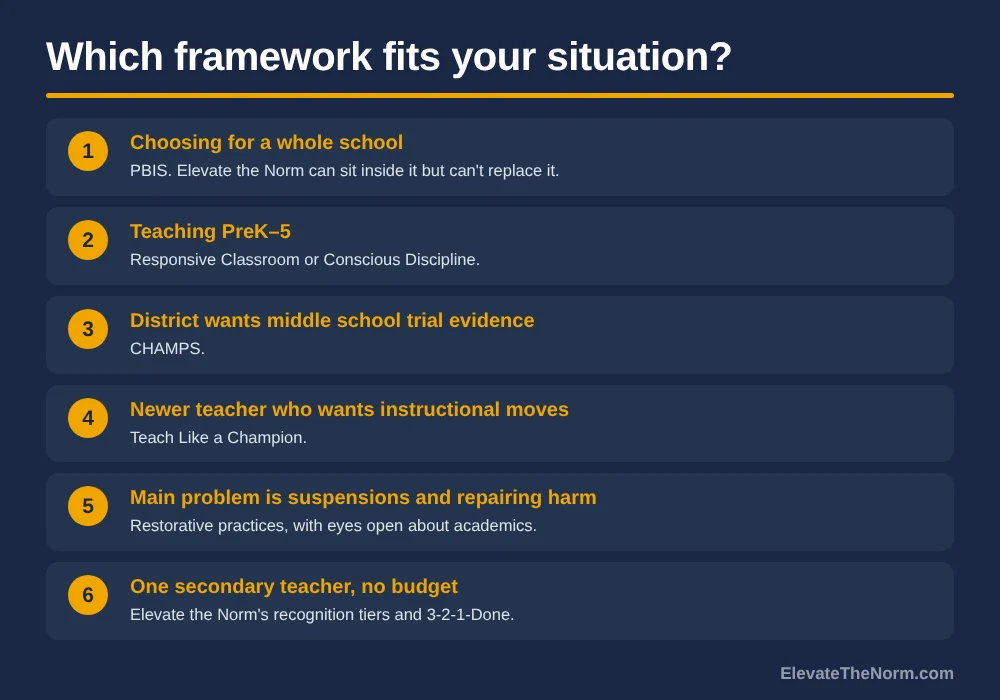
    • You’re choosing for a whole school: PBIS. Elevate the Norm can sit inside it but can’t replace it. See classroom culture frameworks vs PBIS.
    • You teach PreK–5: Responsive Classroom or Conscious Discipline. Compare them in Responsive Classroom vs PBIS vs Conscious Discipline.
    • Your district wants trial evidence for middle school: CHAMPS.
    • You’re a newer teacher who wants concrete moves for instruction, not just behavior: Teach Like a Champion.
    • Your main problem is suspensions and repairing harm: restorative practices, with eyes open about the academic results. Background in restorative practices in schools.
    Numbered graphic matching six situations to a classroom culture framework: PBIS for a whole school, Responsive Classroom or Conscious Discipline for PreK–5, CHAMPS for middle school trial evidence, Teach Like a Champion for newer teachers, restorative practices for suspensions, and Elevate the Norm for one secondary teacher with no budget.
    Pick a framework by situation, not by brand.

    Where does Elevate the Norm fit?

    Elevate the Norm fits a grades 6–12 teacher who wants a free recognition and transition system that works alone or inside PBIS. Again: it’s this site’s own framework, built by Clay Shumate, a Class A certified 6–12 social studies teacher, and it hasn’t been independently evaluated.

    • Free and open: every classroom resource is on the resource library with no email gate. A separate paid option from the same teacher, the Teacher Emergency Toolkit on TPT, is listed on the store page; nothing in the framework requires it.
    • Honest about time: 3-2-1-Done took about six weeks for students to buy in during its most recent year, double the usual three.
    • Not soft: do exactly what you say, remove positives after repeated warnings, and send serious discipline to administration. More in positive discipline for teens.
    • Built for project-based learning and student leadership; see student leadership activities.

    Clay’s take, as a grades 6–12 classroom teacher: if you’re one secondary teacher with no budget and no schoolwide system, start with Elevate the Norm’s recognition tiers and 3-2-1-Done. If your school already runs PBIS, keep PBIS and use Elevate inside it as your classroom acknowledgment system.

    The values behind it are on the what we believe page.

    Sources

    Frequently Asked Questions

    Is Elevate the Norm evidence-based?

    Elevate the Norm is not evidence-based in the formal sense, because no independent study has evaluated it. Its design lines up with published research on praise and awards, and every claim on this site links to a source. Lining up with research isn’t the same as being tested, so treat it as a promising classroom approach, not a proven program.

    Is Elevate the Norm free?

    Yes. Every Elevate the Norm classroom resource is free on the resource library, with no email gate. The only ongoing cost is prizes, which run one teacher well under a hundred dollars a year. The Teacher Emergency Toolkit on TPT is a separate paid product from the same teacher, and nothing in the framework requires it.

    Can I use Elevate the Norm with PBIS?

    Yes. PBIS is a schoolwide system and Elevate the Norm is a single-classroom approach, so the two don’t compete. Elevate’s recognition tiers can serve as your classroom acknowledgment system inside PBIS, as long as your recognition criteria match the schoolwide expectations your building already teaches. Elevate the Norm can sit inside PBIS, but it can’t replace it.

    Does Elevate the Norm work in elementary school?

    Elevate the Norm wasn’t built for elementary school. It was written for grades 6 to 12 and nothing else, and it hasn’t been tried or studied with younger children. Elementary teachers will find better fits in Responsive Classroom, Conscious Discipline or Classroom PBIS, which were designed with younger students in mind.

    Which classroom framework has the best research for middle school?

    CHAMPS has the strongest middle school evidence of the major classroom culture frameworks. A randomized study of 102 middle school teachers and 1,450 students found CHAMPS teachers praised more and gave more chances to respond, and their students spent more time on schoolwork. PBIS and Responsive Classroom also have randomized trials, but those were run in elementary schools.

    Which classroom culture framework is best for a whole school?

    PBIS is the best fit for a whole school. It’s a free, schoolwide three-tier framework with taught expectations, data teams and a dedicated high school track. The Center on PBIS is clear that it takes ongoing teams, data and coaching rather than a one-day training, so budget staff time even though the framework itself costs nothing.

    Do classroom culture frameworks use rewards?

    Classroom culture frameworks differ on rewards. Responsive Classroom and restorative practices avoid token rewards and lean on teacher language and repair. PBIS doesn’t require tokens but is often run with tickets or points, and the Center on PBIS warns against clip charts. Elevate the Norm uses small real prizes with criteria posted in advance and judged on consistency, not perfection.

    Do restorative practices improve academic results?

    Not in the largest trial. RAND’s randomized study in Pittsburgh found restorative practices cut suspensions more than in comparison schools and improved teacher-rated climate, but academic outcomes didn’t improve and got worse in grades 6–8. Restorative practices are a reasonable choice when suspensions and repairing harm are the main problem, as long as you watch academic results closely.

    How is this page kept accurate?

    This page is kept accurate by taking prices from publisher or retailer listings and study figures from the original papers or official summaries linked inline; prices change, so confirm them with each publisher. Elevate the Norm is labeled as this site’s own framework everywhere it appears. Corrections follow the editorial standards and corrections policy.


    About Clay Shumate

    Clay Shumate is a certified secondary Social Studies teacher in the public schools of West Alabama, with seven years of classroom experience, a B.A. in History, and an M.Ed. in Secondary Education. He writes about project-based learning, student responsibility, respect, and practical ways to hold young people to a higher standard while giving them room to learn from mistakes. He is a member of the Society of Professional Journalists and writes to its Code of Ethics; this site’s editorial standards and corrections policy are published in full. More about Clay.

  • Best Classroom Culture Framework for Student Engagement (By Grade)

    Best Classroom Culture Framework for Student Engagement (By Grade)

    By Clay Shumate · Every study figure linked to its source

    Short answer: The best classroom culture framework for student engagement is CHAMPS for grades 6–8, where a randomized trial found students more focused and finishing more classwork. For K–5, Responsive Classroom inside schoolwide PBIS has the trial evidence. No framework has a high school engagement trial, so grades 9–12 should use the core moves those frameworks share.

    Key takeaways

    • CHAMPS is the only classroom-level framework with a middle school randomized trial that measured time on task, and students in CHAMPS classrooms were more focused and finished more classwork.
    • A four-year randomized trial in 37 elementary schools found schoolwide PBIS reduced concentration problems and lowered the odds of an office discipline referral by 33%.
    • Responsive Classroom produced no overall achievement gain in its trial, but math and reading improved where teachers used its practices faithfully.
    • The engagement gains in these trials came from three teacher moves: frequent opportunities to respond, more praise than correction, and expectations defined for each activity.
    • Training alone isn’t enough: the CHAMPS trial paired three days of workshops with a full year of monthly coaching.

    This page looks at one outcome only: engagement, meaning time on task, participation and finished work. It doesn’t rank frameworks on discipline or climate in general. If you want the full list of frameworks first, start with the classroom culture frameworks Q&A hub. For a ranked list built for grades 6–8, see classroom culture frameworks for middle school.

    What is the best classroom culture framework for student engagement?

    CHAMPS is the best classroom culture framework for student engagement when engagement is the main goal, though the right pick still depends on grade band. CHAMPS is the only classroom-level framework we found with a randomized trial that measured time on task directly and found gains in middle school.

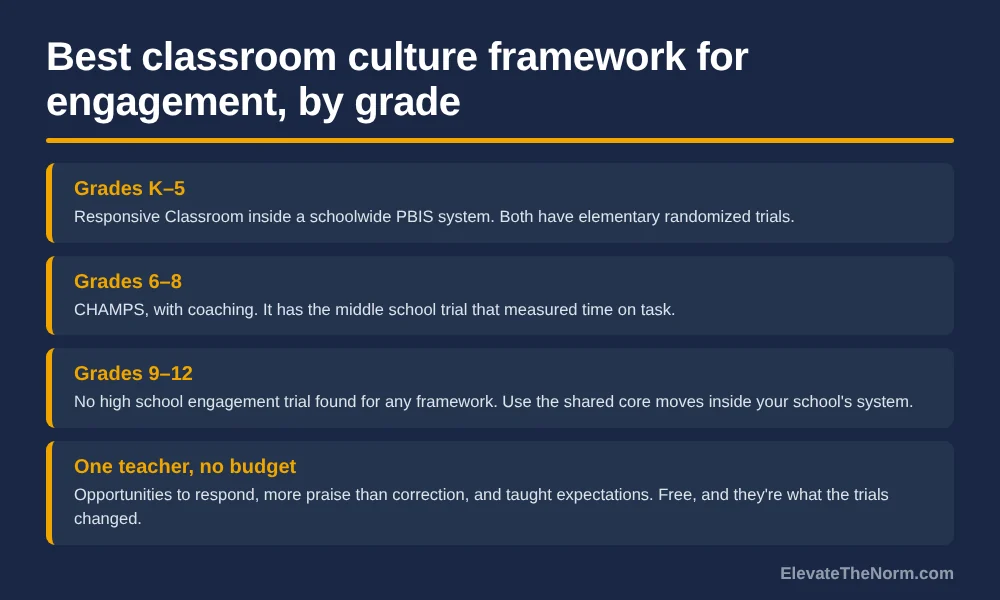
    Graphic listing the best classroom culture framework for student engagement by grade band: Responsive Classroom with PBIS for K–5, CHAMPS with coaching for 6–8, core moves for 9–12, and free core moves for one teacher with no budget.
    Which framework to pick for engagement, by grade band.
    • Grades K–5: Responsive Classroom inside a schoolwide PBIS system. Both have elementary randomized trials.
    • Grades 6–8: CHAMPS, with coaching. It has the middle school trial.
    • Grades 9–12: no framework has a high school engagement trial we could find. Use the core moves CHAMPS and PBIS share (opportunities to respond, specific praise, taught expectations) inside whatever system your school runs.
    • No budget, one teacher: start with the three core moves below. They’re free and they’re what the trials actually changed.

    Which frameworks have actually been tested on engagement?

    Only five approaches have strong trials or large evaluations behind them: CHAMPS, schoolwide PBIS, Responsive Classroom, Establish-Maintain-Restore and restorative practices, and each study measured different outcomes. Here’s what the main studies found, kept to engagement and achievement.

    FrameworkStrongest studyGradesWhat happened to engagement
    CHAMPSRandomized trial, 102 teachers, 1,450 students6–8Students more focused, completed more classwork, more time on schoolwork
    Schoolwide PBISRandomized trial, 37 schools, 12,344 studentsElementaryFewer concentration problems; 33% lower odds of an office referral
    Responsive ClassroomRandomized trial, 24 schools, 2,904 students2–5No overall achievement gain; gains where teachers used it faithfully
    Establish-Maintain-Restore (relationship routine)Randomized trial, 20 teachers, 190 studentsMiddle schoolMore academically engaged time, less disruption (small sample)
    Restorative practicesRAND evaluation, PittsburghK–12Fewer suspensions in elementary; no suspension change and lower academics in grades 6–8

    CHAMPS

    In a federally funded efficacy study, 102 teachers in nine Missouri middle schools were randomly assigned to CHAMPS training or business as usual. CHAMPS teachers got three days of workshops and monthly coaching for a year. They praised more often and gave students more opportunities to respond, and their students were more focused, completed more classwork and spent more time on schoolwork. Students also scored higher on the state communication test, partly explained by the extra time on task, though not on the state math test (IES project summary; Herman, Reinke, Dong & Bradshaw, Journal of Educational Psychology).

    Schoolwide PBIS

    A four-year randomized trial in 37 elementary schools found students in PBIS schools had fewer behavior and concentration problems and were 33% less likely to get an office discipline referral. Effects were strongest for students who started PBIS in kindergarten (Bradshaw, Waasdorp & Leaf, Pediatrics, 2012). PBIS is a three-tier school system rather than a classroom routine, and the Center on PBIS is funded by the U.S. Department of Education (Center on PBIS).

    Responsive Classroom

    A three-year randomized trial followed 2,904 students in 24 schools from the end of grade 2 through grade 5. Students in Responsive Classroom schools didn’t outperform the control group overall. But where teachers actually used the practices, math and reading improved, with the biggest math gain for students who started low (Rimm-Kaufman et al., AERA). That trial didn’t report an engagement measure, so we can’t say it raised time on task. For how it compares to PBIS head to head, see Responsive Classroom vs PBIS.

    Restorative practices

    RAND’s evaluation of Pittsburgh’s program found days lost to suspension fell 36% in program schools versus 18% elsewhere, and staff reported better relationships. But middle schools saw no change in suspensions, and middle schoolers’ academic results got worse over the two years (EdSource summary of the RAND study). Restorative work is about repairing harm, not engagement, which is why it ranks low on this page. More in restorative practices in schools.

    What actually drives engagement inside these frameworks?

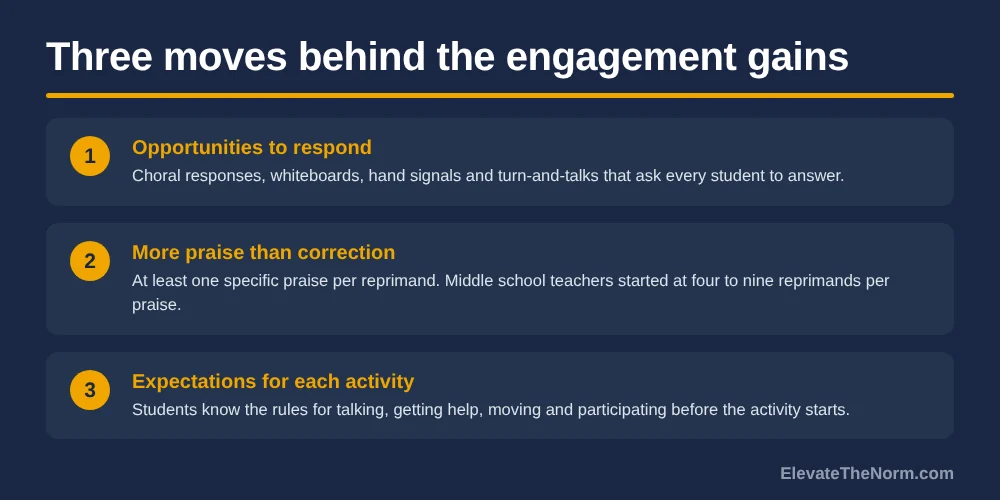
    Three teacher moves drive engagement inside classroom culture frameworks: frequent opportunities to respond, more praise than correction, and clear expectations for each activity. The frameworks are mostly delivery systems for these three moves.

    Numbered graphic of three moves behind student engagement gains: opportunities to respond, more praise than correction, and expectations defined for each activity.
    The three moves the engagement trials actually changed.

    1. Opportunities to respond

    An opportunity to respond is any prompt that asks every student, or a named student, to answer: a choral response, a whiteboard, a hand signal, a turn-and-talk. A 2019 meta-analysis of 12 single-case studies found that increasing teacher-directed opportunities to respond was linked to better student behavior across grade levels and response formats (Fitzgerald Leahy, Miller & Schardt, Journal of Behavioral Education, 2019). It’s also one of the two teacher behaviors that changed in the CHAMPS trial.

    2. More praise than correction

    In 28 middle school classrooms, teachers started out reprimanding four to nine times as often as they praised. When trained teachers reached at least one praise per reprimand, class-wide on-task behavior rose 60–70%, and high-risk students’ grades rose a full letter (Caldarella et al., BYU, Journal of Positive Behavior Interventions). The intervention there, CW-FIT, is a class-wide routine you can layer inside any framework.

    3. Expectations defined per activity

    CHAMPS is built on this. Its letters stand for Conversation, Help, Activity, Movement, Participation and Success, and the idea is that students know the rules for each of those during each kind of activity (LiveSchool overview). Students who know how to get help or whether they can talk don’t spend the first five minutes of an activity guessing. Our guides to classroom expectations and routines and procedures show what that looks like in a grades 6–12 room.

    Do relationship routines raise engagement?

    Yes. Relationship routines such as Establish-Maintain-Restore and positive greetings at the door raised academically engaged time in two small middle school trials, and both cost little to run.

    • Establish-Maintain-Restore: a three-hour teacher training on building, keeping and repairing relationships. In a randomized trial with 20 middle school teachers and 190 students, it improved teacher-student relationships, observed academically engaged time and disruptive behavior. The sample was small and the confidence intervals wide, so treat the size of the effect cautiously (Duong et al., School Psychology Quarterly, 2018).
    • Positive greetings at the door: middle school teachers randomly assigned to greet students at the door saw significant gains in academically engaged time and less disruption (Cook et al., Journal of Positive Behavior Interventions, 2018).

    Neither is a full framework, but both fit inside any of them. See building relationships with students for secondary-specific versions.

    Which framework should I pick for my situation?

    Pick a classroom culture framework by grade band and support: CHAMPS for a middle school teacher with coaching, PBIS with Responsive Classroom for an elementary school, and the three core moves for a high school teacher or anyone without a budget.

    Your situationBest pick for engagementWhy
    Elementary school adopting a schoolwide systemPBIS, with Responsive Classroom in classroomsBoth have elementary trials; they’re commonly combined
    Middle school teacher with coaching supportCHAMPSOnly middle school trial with time-on-task gains
    Middle school wanting community timeResponsive Classroom’s Responsive Advisory Meeting, plus CHAMPS-style expectationsAdvisory builds belonging; expectations drive time on task
    High school teacherCore moves inside your school’s PBISNo high school engagement trial found for any framework
    One teacher, no budgetOpportunities to respond + 1:1 or better praise ratio + greetingsFree, and they’re what the trials changed
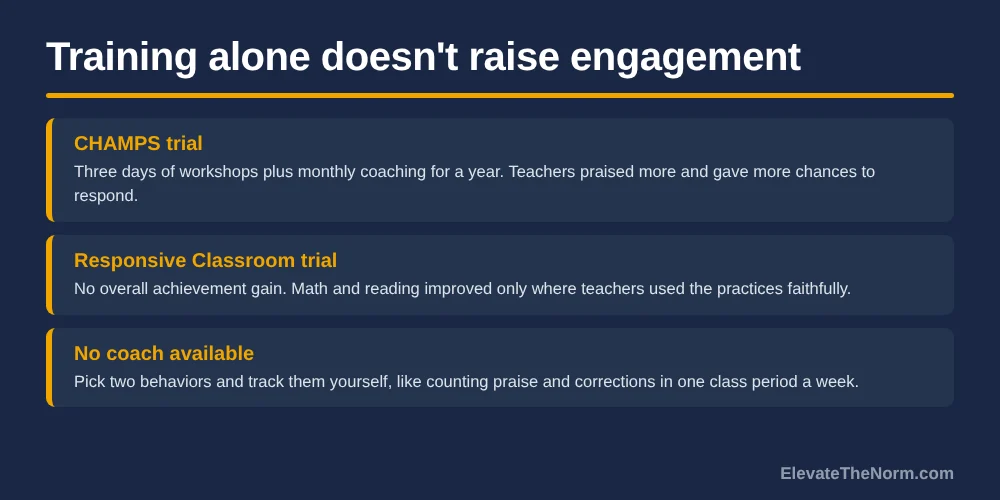
    Graphic explaining that training alone doesn't raise engagement: the CHAMPS trial paired workshops with monthly coaching, Responsive Classroom helped only with faithful use, and teachers without a coach can track praise and corrections themselves.
    Coaching and faithful use, not training alone, drove the gains.

    One warning from the research: training alone doesn’t do it. The CHAMPS trial paired workshops with monthly coaching, and Responsive Classroom only helped where teachers used it faithfully. If you can’t get coaching, pick two behaviors and track them yourself, like counting praise and corrections in one class period a week. Our classroom management strategies guide has more on running that in a secondary room.

    Clay’s take, as a grades 6–12 classroom teacher: if you teach middle or high school and don’t have a coach, start with the three core moves before you buy any program. They’re free, and they’re what the trials actually changed.

    Where does Elevate the Norm fit?

    Elevate the Norm is a free, grades 6–12 positive-reinforcement approach that puts the praise-and-expectations moves into a routine. Disclosure: it’s this site’s own framework, built by Clay Shumate, a certified 6–12 social studies teacher, and it hasn’t been independently evaluated. Nothing on this page claims it raises engagement; the studies above are about other programs.

    • Recognition with criteria announced ahead of time: Immediate Recognition, Student of the Week and Student of the Month, judged on consistency and self-improvement rather than perfection.
    • Faster transitions: the 3-2-1-Done class-vs-class point system rewards a class for getting quiet quickly. In its most recent year it took about six weeks for students to buy in.
    • Follow-through: the teacher does exactly what was announced, removes positives after repeated warnings, and leaves serious discipline to administration.

    Everything is free with no email gate in the resource library.

    Frequently Asked Questions

    Which classroom culture framework is best for student engagement?

    CHAMPS has the most direct evidence for student engagement. A randomized trial with 102 teachers in nine middle schools found students in CHAMPS classrooms were more focused, finished more classwork and spent more time on schoolwork. In elementary school, schoolwide PBIS and Responsive Classroom both have randomized trials, though neither measured time on task the way the CHAMPS trial did.

    Does PBIS increase student engagement?

    In a four-year randomized trial of 37 elementary schools, schoolwide PBIS reduced students’ concentration problems and cut the odds of an office discipline referral by 33%. That is evidence of better focus, though the study did not measure time on task directly. PBIS is a three-tier school system rather than a classroom routine, so one teacher can’t adopt it alone.

    What are opportunities to respond?

    Opportunities to respond are prompts that ask every student, or a named student, to answer: choral responses, whiteboards, hand signals or turn-and-talks. A 2019 meta-analysis of 12 single-case studies linked more teacher-directed opportunities to respond with better student behavior across grade levels. Giving more opportunities to respond was also one of two teacher behaviors that changed in the CHAMPS trial.

    What praise-to-correction ratio should teachers aim for?

    Teachers should aim for at least one specific praise per correction. In a study of 28 middle school classrooms, teachers started out reprimanding four to nine times as often as they praised. When teachers praised at least as often as they reprimanded, class-wide on-task behavior rose 60 to 70%, and high-risk students’ grades rose a full letter.

    What works for high school student engagement?

    No named classroom culture framework has a high school engagement trial that we could find. The safest approach for grades 9–12 is to use the moves the middle school trials changed, which are frequent opportunities to respond, specific praise and expectations taught for each activity, inside whatever system the school already runs, such as schoolwide PBIS.

    Do teachers need coaching for a classroom culture framework to work?

    Training alone doesn’t appear to be enough. The CHAMPS trial paired three days of workshops with monthly coaching for a full year, and Responsive Classroom improved math and reading only where teachers used the practices faithfully. A teacher without a coach can pick two behaviors and track them, such as counting praise and corrections in one class period a week.

    Do restorative practices improve student engagement?

    Restorative practices are built to repair harm, not to raise engagement. RAND’s evaluation of Pittsburgh’s program found days lost to suspension fell 36% in program schools versus 18% elsewhere. But middle schools saw no change in suspensions, and middle schoolers’ academic results got worse over the two years, so restorative work ranks low as an engagement tool.

    Has Elevate the Norm been proven to raise engagement?

    No. Elevate the Norm is this site’s own free grades 6–12 positive-reinforcement approach, built by Clay Shumate, and it hasn’t been independently evaluated. It puts the praise-and-expectations moves into a routine with recognition criteria announced ahead of time, a class-vs-class transition system and consistent follow-through, but none of the studies on this page tested it.

    How is this page kept accurate?

    Every study figure on this page comes from the original paper or an official summary linked inline. Elevate the Norm is labeled as this site’s own framework wherever it appears. Corrections follow the editorial standards and corrections policy. For what makes a room feel positive rather than just on task, see classroom culture frameworks for a positive classroom environment.
    Sources

    1. Institute of Education Sciences, project summary: evaluation of a classroom management training program for middle school teachers (CHAMPS)
    2. ScienceDaily summary of Herman, Reinke, Dong & Bradshaw, Journal of Educational Psychology
    3. Johns Hopkins Bloomberg School of Public Health, summary of Bradshaw, Waasdorp & Leaf, Pediatrics, 2012
    4. Center on Positive Behavioral Interventions and Supports
    5. Rimm-Kaufman et al., Efficacy of the Responsive Classroom approach, AERA
    6. EdSource summary of the RAND evaluation of restorative practices in Pittsburgh
    7. Fitzgerald Leahy, Miller & Schardt, Journal of Behavioral Education, 2019
    8. BYU News summary of Caldarella et al., Journal of Positive Behavior Interventions
    9. LiveSchool, overview of CHAMPS behavior management
    10. Duong et al., School Psychology Quarterly, 2018
    11. Cook et al., Journal of Positive Behavior Interventions, 2018

    About Clay Shumate

    Clay Shumate is a certified secondary Social Studies teacher in the public schools of West Alabama, with seven years of classroom experience, a B.A. in History, and an M.Ed. in Secondary Education. He writes about project-based learning, student responsibility, respect, and practical ways to hold young people to a higher standard while giving them room to learn from mistakes. He is a member of the Society of Professional Journalists and writes to its Code of Ethics; this site’s editorial standards and corrections policy are published in full. More about Clay.

  • Responsive Classroom vs PBIS vs Conscious Discipline: Which Fits Grades 6–12?

    Responsive Classroom vs PBIS vs Conscious Discipline: Which Fits Grades 6–12?

    By Clay Shumate · Prices checked October 2026

    Short answer: PBIS is a free, schoolwide system for teaching and acknowledging behavior. Responsive Classroom is a paid set of daily classroom practices, like Morning Meeting and Interactive Modeling, that builds community. Conscious Discipline is a paid program that starts with adult self-regulation, and it is written for PreK through grade 5. For grades 6–12, PBIS is the only one of the three with a real secondary track, and Responsive Classroom is the only one with randomized-trial evidence on achievement (in grades 2–5, with gains only when teachers used it faithfully). Many schools run PBIS as the system and a classroom-level approach inside it.

    This page compares the three on what they do, what they cost, what the research shows, and how well each fits a middle or high school room. Every figure links to its source. For the broader list of frameworks, see the classroom culture frameworks Q&A hub.

    Responsive Classroom vs PBIS vs Conscious Discipline at a glance

    Responsive ClassroomPBISConscious Discipline
    Run byCenter for Responsive Schools (nonprofit)Center on PBIS (federally funded)Loving Guidance / Dr. Becky Bailey
    What it isDaily classroom practices and teacher languageSchoolwide, three-tier system with dataAdult self-regulation plus a “School Family” culture
    GradesPreK–8 (middle school course since 2016)K–12, with a dedicated high school trackEarly childhood through grade 5
    Core piecesMorning Meeting / Responsive Advisory Meeting, Interactive Modeling, Teacher Language, Logical Consequences, Academic ChoiceDefined and taught expectations, acknowledgment system, tiered supports, data-based decisionsBrain State Model, Seven Powers for Adults, Seven Skills of Discipline, School Family
    How it motivatesReinforcing teacher language; avoids token rewardsAcknowledgment, often tickets, points or privilegesConnection and regulation before consequences
    Cost to startBooks $29–$35; live virtual workshops and seminars about $219–$259 per seatFree framework; costs are staff time and trainingCore book $44; onsite training by quote
    Best evidenceRandomized trial, 24 schools, grades 2–5Randomized trials, 37 elementary schoolsQuasi-experimental, Pre-K
    Fit for grades 6–12Moderate (middle school yes, high school limited)StrongWeak (not written for secondary)
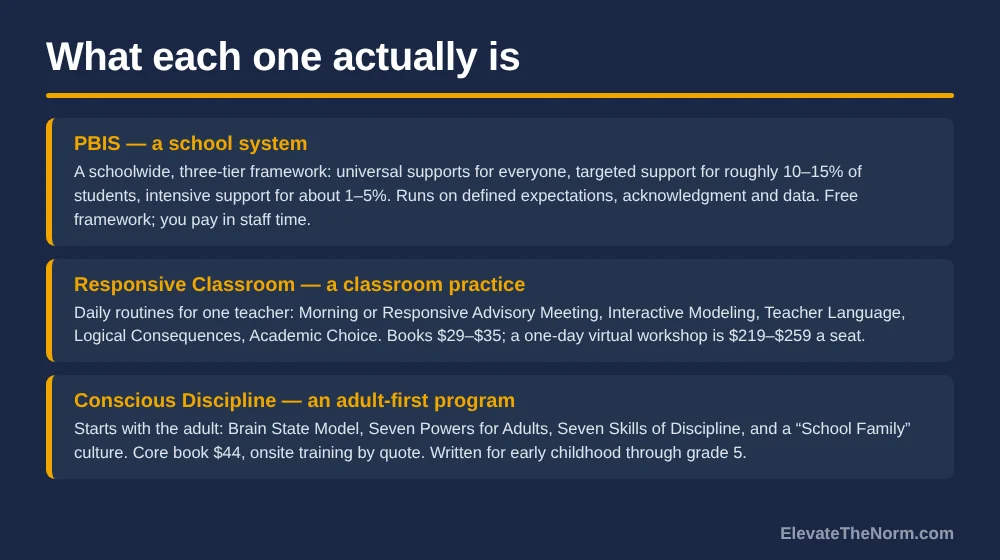
    Three-panel graphic describing PBIS as a schoolwide three-tier system, Responsive Classroom as daily classroom practices for one teacher, and Conscious Discipline as an adult-first program for early childhood through grade 5, each with its starting cost.
    PBIS is a school system, Responsive Classroom is a classroom practice, and Conscious Discipline starts with the adult.

    What is the difference between Responsive Classroom and PBIS?

    PBIS is a school system. Responsive Classroom is a classroom practice. PBIS tells a school how to organize behavior support across three tiers: universal supports for everyone, targeted support for roughly 10–15% of students, and intensive support for about 1–5% (Center on PBIS). It runs on defined expectations, acknowledgment and data.

    Responsive Classroom gives one teacher a set of daily routines: a morning (or advisory) meeting, modeling a routine before expecting it, and specific language for redirecting and reinforcing. The Center for Responsive Schools describes the split this way: PBIS supplies the schoolwide systems and data, and Responsive Classroom supplies the daily practices that help students internalize the behavior (Responsive Classroom, Sept. 2025).

    The real disagreement is about rewards. PBIS schools often use token systems, like tickets, points or prizes. Responsive Classroom steers teachers away from those and toward reinforcing language that names what a student did and why it helped the group.

    Can a school use Responsive Classroom and PBIS together?

    Yes, and it’s common. PBIS is a framework, not a curriculum, so it doesn’t compete with a classroom approach. Responsive Classroom says it’s compatible with PBIS. The friction point is the acknowledgment system. If your PBIS team runs a schoolwide ticket economy and your classroom uses Responsive Classroom language, decide ahead of time which one a student hears first. Usually it’s specific praise first, with the token given as the record of it.

    What is Classroom PBIS?

    Classroom PBIS is the PBIS framework applied inside one teacher’s room. The Center on PBIS describes it as evidence-based practices that make classrooms “predictable, positive, effective, and equitable,” with differentiated support across the same three tiers (Center on PBIS, Classroom PBIS). Its free materials include a classroom teaching matrix, a guide to the evidence-based practices behind it, and guides for supporting teachers who are implementing it.

    If your school doesn’t run PBIS, you can still use Classroom PBIS on your own. In practice that means posting three to five expectations, teaching them like content, acknowledging them often, and correcting calmly and briefly.

    Conscious Discipline vs Responsive Classroom: which should a school buy?

    Buy for your grade band first. Conscious Discipline lists its market as early childhood and PreK–5 schools (Conscious Discipline, About). Its distinctive idea is that discipline starts with the adult’s own regulation, built through the Brain State Model and the Seven Powers for Adults. That makes it a strong fit for early grades and for staff working with students who have experienced trauma.

    Responsive Classroom covers PreK–8. It added a middle school course in 2016 built around Responsive Advisory Meeting, Interactive Modeling and teacher language (THE Journal). It also has the stronger research base.

    • PreK–2, or a staff struggling with its own stress responses: Conscious Discipline.
    • K–8, with a goal of community plus academics: Responsive Classroom.
    • Grades 9–12: neither is a natural fit. Look at PBIS, restorative practices, or a secondary-built approach.
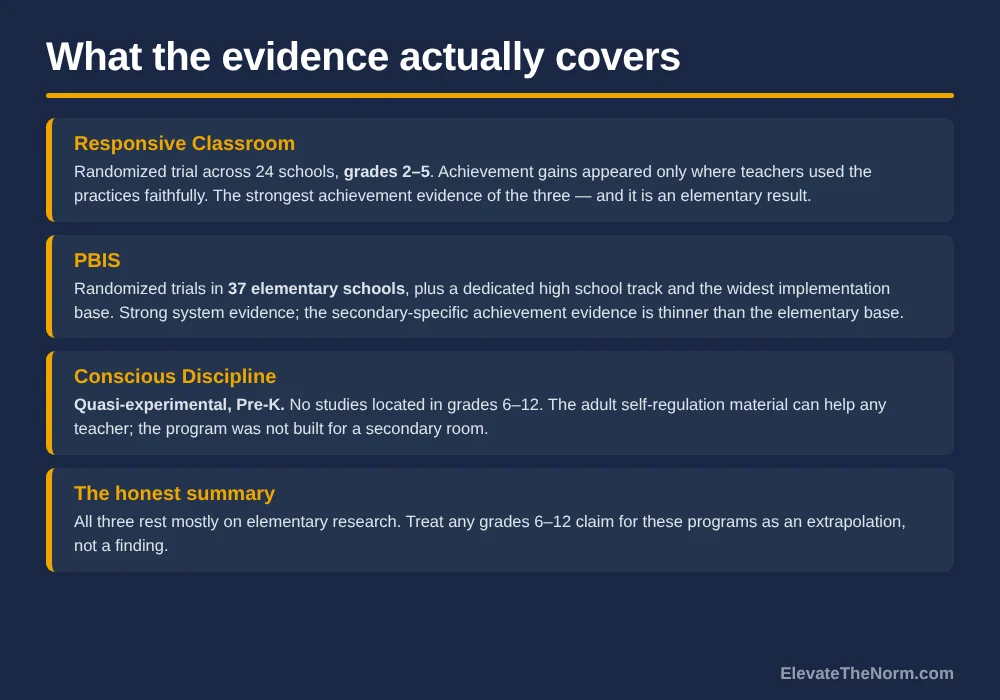
    Graphic summarising the research base for each framework: Responsive Classroom randomized trial in 24 schools grades 2-5, PBIS randomized trials in 37 elementary schools plus a high school track, Conscious Discipline quasi-experimental at Pre-K, with the note that all three rest mostly on elementary research.
    All three frameworks rest mostly on elementary research, which matters for a grades 6-12 decision.

    What does the research actually show for each one?

    All three have some evidence. None has strong evidence for high school. Here is what the largest studies found, in plain terms.

    Responsive Classroom

    A three-year randomized controlled trial covered 24 schools and 2,904 students from the end of grade 2 through grade 5. Students in Responsive Classroom schools did not outperform control schools in math or reading. But within those schools, teachers who used the practices faithfully saw gains: effect sizes of 0.26 in math and 0.30 in reading, and 0.89 in math for students who started low (Rimm-Kaufman et al., American Educational Research Journal, 2014). The lesson is that buying it does nothing; doing it does. Evidence for ESSA rates its reading impact “Promising” for grades 1–5 (Evidence for ESSA).

    PBIS

    In a randomized trial of 37 elementary schools and 12,344 children, students in schoolwide PBIS schools were 33% less likely to receive an office discipline referral. They also showed small improvements in disruptive behavior (effect size 0.12), concentration (0.08), prosocial behavior (0.17) and emotion regulation (0.11). That analysis found no significant difference in suspensions (Bradshaw, Waasdorp & Leaf, Pediatrics, 2012). CrimeSolutions rates schoolwide PBIS “Effective” for ages 5–11 (CrimeSolutions). High school PBIS is supported by implementation guidance, but we did not find a high school randomized trial.

    Conscious Discipline

    The main published evaluation is quasi-experimental, a 2012–13 study of 1,386 Pre-K students that reported positive gains (CASEL program profile). We found no randomized trial and no study in grades 6–12.

    Evidence by grade band

    This is the comparison most reviews skip: where the strongest study for each program was actually run.

    ProgramGrades in strongest studyRandomized trial?Any randomized evidence in grades 6–12?
    Responsive Classroom2–5YesNo
    PBIS (schoolwide)ElementaryYesNone found at high school
    Conscious DisciplinePre-KNoNo
    CHAMPS (for comparison)6–8Yes (102 teachers, 1,450 students)Yes, middle school
    Restorative practices (for comparison)K–12Yes (RAND, Pittsburgh)Yes, mixed: fewer suspensions, but grades 6–8 academics worsened

    Sources: IES, CHAMPS evaluation; RAND, Augustine et al., 2018. More on restorative work in restorative practices in schools.

    Which one works best for middle and high school?

    For grades 6–12, start with PBIS as the system and add a classroom layer built for teenagers. PBIS is the only one of the three with a dedicated high school track, covering student voice and the freshman transition (Center on PBIS, High School). Responsive Classroom works in middle school through Responsive Advisory Meeting. Conscious Discipline wasn’t written for secondary.

    Secondary classrooms have needs elementary frameworks don’t plan for. A teacher may see 150 students a day instead of 25, there’s no single homeroom where community gets built, and older students notice right away if praise is generic or a reward feels babyish. The approaches with middle school trial evidence, like CHAMPS, put a lot of weight on clear expectations, more specific praise, and more chances for students to respond. You can read how that plays out in a real secondary room in classroom management strategies that work in grades 6–12.

    What does each one cost?

    PBIS is free to adopt. Responsive Classroom costs about $30–$35 per book and about $219–$259 per seat for a live virtual workshop or seminar. Conscious Discipline’s core book is $44, and onsite training is quoted.

    • PBIS: the framework, practice briefs and the Tiered Fidelity Inventory are free from the Center on PBIS. Real costs are team meeting time, coaching through your state network, and whatever your acknowledgment system buys.
    • Responsive Classroom: The First Six Weeks of School (3rd ed.) $35.00; The Power of Our Words (2nd ed.) $34.80; Interactive Modeling $31.20 (CRS bookstore). A live-virtual leadership seminar was listed at $259 a seat for 1–4 seats, $239 for 5–9 and $219 for 10 or more (CRS). Multi-day institutes cost more.
    • Conscious Discipline: Building Resilient Classrooms is $44 (Conscious Discipline store). Onsite trainings for up to 150 people are priced by quote (onsite training sheet).

    Prices change. Confirm on the publisher’s site before you put anything in a budget request.

    Token rewards or teacher language: which motivates students better?

    Specific praise does the heavy lifting. Rewards help when they’re predictable and earned, and they can backfire when they’re a surprise. Three findings matter here.

    The takeaway for any of these frameworks: make the criteria public ahead of time, reward effort and consistency rather than rare perfection, and pair every token with specific words.

    Where does Elevate the Norm fit?

    Elevate the Norm is a free, grades 6–12 classroom approach. It works as the classroom layer inside a school’s PBIS, or on its own where a school has no system. Full disclosure: it’s this site’s own framework, built by Clay Shumate, a certified 6–12 social studies teacher. It has not been independently evaluated, and every research claim on this site is cited so you can check it.

    • Three recognition tiers: immediate recognition, Student of the Week and Student of the Month. Criteria are announced in advance and based on consistency and self-improvement, not perfection, which lines up with the awards research above.
    • A class-vs-class point system for transitions, written up in the 3-2-1-Done method, including the honest note that it took six weeks to work.
    • Firm follow-through alongside the positives, as covered in positive discipline for teens and classroom expectations for grades 6–12.
    • Cost: free materials with no email gate on the free resource library. Prizes run well under a hundred dollars a year for one teacher.
    • Built for project-based learning, where students lead and collaborate. See student leadership roles.

    If your school already runs PBIS, Elevate’s recognition tiers can serve as your classroom acknowledgment system. If you’re in grades 6–12 with no budget and no schoolwide system, it’s a place to start this week. The principles behind it are on the what we believe page.

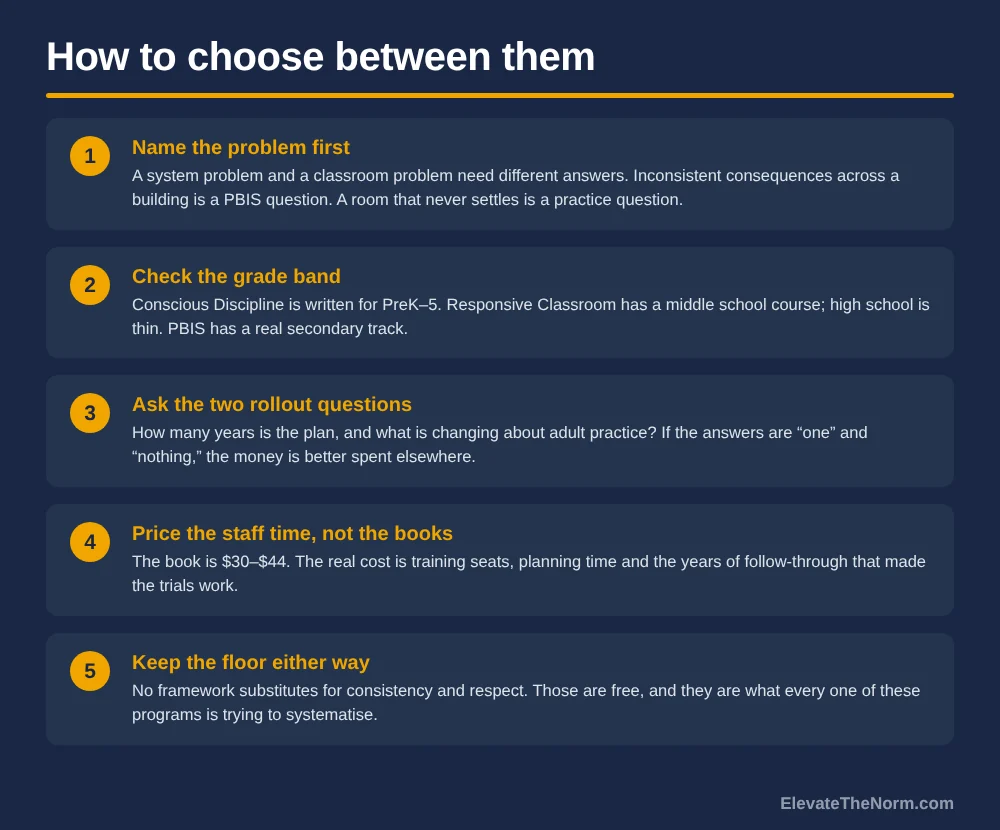
    Five numbered steps for choosing a framework: name the problem first, check the grade band, ask the two rollout questions, price the staff time rather than the books, and keep consistency and respect as the floor either way.
    Five questions worth answering before a school buys any behavior framework.

    How should you choose?

    1. Name the level. If you’re choosing a whole-school system, look at PBIS. If you’re choosing what one teacher does every day, look at a classroom approach.
    2. Match the grade band. Don’t buy an elementary program for a high school and hope it adapts.
    3. Budget for coaching, not binders. The Responsive Classroom trial showed gains only with faithful use, and the CHAMPS trial paired a workshop with monthly coaching.
    4. Decide your reward philosophy in writing: tokens, language, or both, and in what order.
    5. Pick two measures before you start, such as office referrals and observed on-task time, and check them each quarter.

    For a one-page planning tool, see what a classroom management plan looks like when it actually runs.

    Frequently Asked Questions

    Is Responsive Classroom part of PBIS?

    No. They come from different organizations. PBIS is a federally supported schoolwide framework, and Responsive Classroom is a classroom approach from the Center for Responsive Schools. Many schools use both together.

    Is PBIS free?

    Yes. The framework and the Center on PBIS materials are free. Schools pay in staff time, training and whatever they spend on acknowledgments.

    Does Conscious Discipline work in middle school?

    It’s written for early childhood through grade 5, and we found no studies of it in grades 6–12. Its emphasis on adult self-regulation can still help any teacher, but older students usually need a different structure.

    Which framework has the best research?

    PBIS and Responsive Classroom both have randomized trials, but both were run in elementary schools. For middle school specifically, CHAMPS has a randomized trial with 102 teachers.

    What’s the cheapest way to start?

    Adopt PBIS-style expectations for free, use one core book (about $30–$55), and aim for at least one specific praise for every correction. Elevate the Norm’s grades 6–12 materials are free.

    How this page is maintained

    Prices come from each publisher’s site as listed in October 2026. Study figures come from the original papers or official summaries linked inline. Elevate the Norm is labeled as this site’s own framework wherever it appears. Corrections follow the editorial standards and corrections policy. Comparing a program not listed here? Send the question in.


    About Clay Shumate

    Clay Shumate is a certified secondary Social Studies teacher in the public schools of West Alabama, with seven years of classroom experience, a B.A. in History, and an M.Ed. in Secondary Education. He writes about project-based learning, student responsibility, respect, and practical ways to hold young people to a higher standard while giving them room to learn from mistakes. He is a member of the Society of Professional Journalists and writes to its Code of Ethics; this site’s editorial standards and corrections policy are published in full. More about Clay.

Teacher Emergency Toolkit — practical resources, real classroom support. Shop on TPT.Teacher Emergency Toolkit — practical resources, real classroom support. Shop on TPT.