
By Clay Shumate
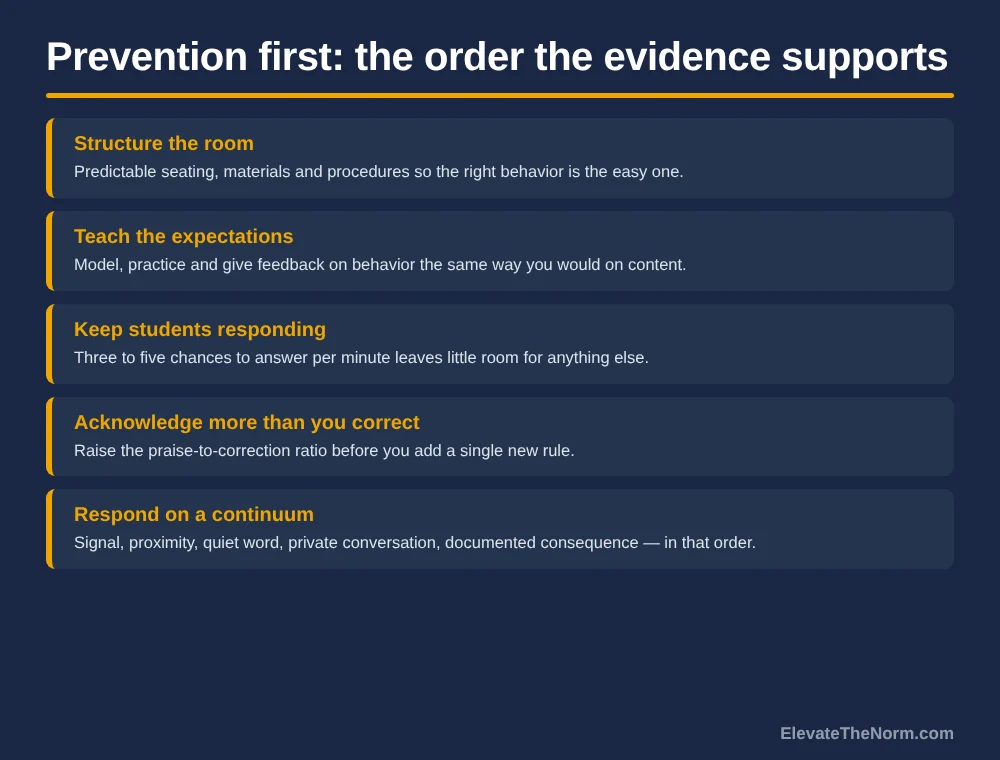
The classroom management strategies with the strongest research support are preventive rather than reactive: explicitly teach the behavior you want, build routines that run without you, keep students actively responding, and interact positively far more often than you correct. Consequence systems still matter, but they are the smallest part of the work.
I have seven years of classroom experience in the public schools of West Alabama, and the thing I wish somebody had said to me in year one is that management is mostly design work done before students arrive. The teacher who looks like a natural is usually just a teacher whose room has fewer gaps in it. Below is what the evidence actually supports, what it only weakly supports, and what order I would put it in if I were starting over on a Monday with a hard group.
Key Takeaways
- Prevention outperforms response. The practices with the best support — structure, taught expectations, active engagement, acknowledgment — all happen before a behavior problem exists.
- Your ratio matters more than your rules. In middle school classrooms, higher praise-to-reprimand ratios tracked with better on-task behavior; most teachers start out reprimanding several times more often than they praise.
- Engagement is a management strategy. Students answering questions three to five times a minute are not students looking for something else to do.
- The research base is thinner than the confident advice suggests. Much of it ran in elementary rooms, on small samples, with single-subject designs. Grades 6–12 teachers are extrapolating more than they are told.
- Most of what fails is not a bad strategy — it is an unenforced one. A rule you apply on Tuesday and ignore on Thursday teaches students that your word is a suggestion.
What does the research actually say about classroom management?
It says proactive, structural practices work, that the effects are real but modest, and that most of the evidence was collected on younger students than ours. That is a less satisfying answer than the internet gives you, and it is the honest one.
The clearest synthesis for practitioners is still Simonsen and colleagues’ review, which screened the literature for classroom practices with genuine empirical support and came out with about twenty, sorted into five jobs: maximize structure and predictability; post, teach, review, monitor and reinforce expectations; actively engage students in observable ways; use a continuum of strategies to acknowledge appropriate behavior; and use a continuum of strategies to respond to inappropriate behavior (Simonsen, Fairbanks, Briesch, Myers & Sugai, 2008). Notice the ordering. Four of the five categories are things you do before anyone misbehaves.
On effect size, two reviews are worth knowing. A Campbell systematic review of teacher classroom management practices found a classroom-level mean effect of roughly d = .71 to .80 on disruptive and aggressive behavior — but it located only 12 eligible studies out of more than five thousand screened titles, two-thirds of them in grades K–6, and the authors said plainly that they lacked the power to test any moderators (Oliver, Wehby & Reschly, 2011). A newer meta-analysis of 76 controlled trials of classroom management interventions reported a small overall effect, Hedges’ g = .23, and that one ran entirely in primary education (Korpershoek, de Boer & Mouw, 2026). It also found something counterintuitive: interventions that tried to do all four things at once — teacher behavior, relationships, student behavior, and social-emotional development — worked less well than narrower ones.
Read those two together and you get a reasonable working belief. The basics work. They do not work like magic. And a focused change you actually sustain will beat a comprehensive program you half-implement.
Classroom management strategies, ranked by payback for effort
If you only have the energy to change one thing this week, change something near the top of this table. The ranking is my professional judgment about return on effort for grades 6–12; the evidence column is the honest state of the research, not a sales pitch.
| Strategy | What it costs you | What it pays back | Evidence |
|---|---|---|---|
| Teach expectations explicitly, then re-teach them | Two to three class periods up front, five minutes after each break | Fewer arguments about what the rule meant; faster recovery after disruptions | Strong across reviews; rated strong evidence in the IES guide, though that guide is K–6 |
| Routines for entry, materials, transitions, exit | Design time once, plus two weeks of patient correction | Recovers several minutes per period; removes the dead air where problems start | Strong as part of “structure and predictability” |
| Positive greeting at the door | Under five minutes a period, zero prep | Better engagement and less disruption in a middle school trial | One randomized middle school study; promising, not settled |
| Raise your praise-to-correction ratio | Nothing but attention and habit | Class-wide on-task gains; grade improvement for at-risk students | Direct middle school evidence |
| High rates of active responding | Rewriting how you question, not what you teach | On-task behavior and achievement both move | Consistent but mostly elementary and single-subject |
| Private, brief, specific correction | Self-control in the moment | Avoids the audience problem; keeps the student in the room | Supported as part of a response continuum |
| Relationship investment with the hardest students | Real time, weeks of it | Largest long-run payoff; strongest in upper grades | Meta-analytic, correlational — direction of causation is genuinely unclear |
| Written consequence ladders and point systems | Significant setup and record-keeping | Useful for consistency; does not by itself change behavior | Weakest of the group for secondary students |
Teach your expectations like content, not like a warning
The single most reliable move in classroom management is to treat your expectations as something you teach, model, practice and reassess — exactly as you would a skill in your subject. A poster is not instruction. Reading a list aloud on the first day is not instruction either.
Secondary students arrive in your room having had five other teachers that morning, each with a different definition of “ready.” Ready for what? Phone where? Talking allowed when? If you have not shown them, they are guessing, and a guess that goes wrong looks like defiance when it is actually an information problem. I would write three to five expectations in observable terms, demonstrate what each one looks like and does not look like, have the class do it once, and give feedback. Then do a two-minute version after every long weekend, every schedule change, and every time the room drifts. If you want the longer version of how to word them so they hold up in November, we go deeper in our piece on setting expectations that survive the whole year and on why those expectations matter more than the rules list.
One caution about evidence quality, because it is the kind of thing nobody tells teachers. The IES practice guide that assigns strong evidence to modifying the classroom environment and to teaching and reinforcing appropriate skills is titled, accurately, Reducing Behavior Problems in the Elementary School Classroom (Epstein et al., 2008). It covers kindergarten through sixth grade. The logic transfers to a tenth-grade room; the effect sizes were not measured there.
Build routines that make the right behavior the easy behavior
A routine is a decision you make once so that thirty students do not have to make it thirty different ways every day. Routines are where most of the recoverable time in a secondary schedule is hiding.
Count the seams in your period: coming in, getting started, handing something out, moving to groups, moving back, cleaning up, leaving. Each seam is unstructured time, and unstructured time is where the problems you spend your afternoon documenting actually begin. Build a specific procedure for each one, teach it, and hold it. Our walkthroughs on building procedures from the ground up and on making transitions stop costing you five minutes have the mechanics.
The honest limit here: routines reduce opportunity for disruption. They do not address a student who is disrupting because something is wrong. Do not confuse a tight room with a healthy one.
Fix the first four minutes
How class starts predicts most of how class goes, which is why the cheapest strategy on this list is standing at the door and speaking to students by name as they come in.
A randomized study of a strategy called Positive Greetings at the Door, run in middle school classrooms, found improvements in academic engaged time and reductions in disruptive behavior, and teachers rated it as feasible and reasonable to do (Cook et al., 2018). I want to be careful not to oversell a single trial, and the figures that circulate about it online are frequently inflated past what the published abstract reports. But it is a middle school study, it is randomized, it costs nothing, and the mechanism is not mysterious: you have made contact with every student before anyone has done anything wrong.
Pair it with a task on the board that students can begin without you. A warm-up that requires your instructions is not a warm-up. Our collection of openers students can start alone is built for exactly that gap.
Raise your ratio of positive to corrective interaction
Most of us correct far more than we acknowledge, we do not know we are doing it, and fixing the imbalance is free.
This is the strategy with the most direct secondary evidence. In a study of 28 middle school classrooms, researchers found a statistically significant linear relationship between teachers’ praise-to-reprimand ratios and student behavior: as the ratio rose, class-wide on-task behavior improved, and students at risk for emotional and behavioral disorders showed more engagement, less disruption, and better grades (Caldarella, Larsen, Williams & Wills, 2023). What is striking in the surrounding literature is the baseline: teachers commonly reprimand several times more often than they praise before anyone points it out to them.
Two practical notes. First, specific beats general — naming the behavior does more than “good job.” Second, thirteen-year-olds and seventeen-year-olds have different tolerances for public praise. Some students will do more for a quiet word at their desk than for recognition in front of the room, and a few will actively sabotage the behavior you praised loudly. That is not ingratitude. It is social self-protection, and it is worth respecting.
Keep students responding, not just listening
Opportunities to respond — the rate at which students actively produce an answer rather than receive information — is a management lever disguised as an instructional one.
A systematic review of teacher-directed opportunities to respond found that higher rates improved academic and behavioral outcomes, with presentation rates around three to five per minute producing favorable results, and unison formats such as choral responding and response cards outperforming individual hand-raising (MacSuga-Gage & Simonsen, 2015). The IRIS Center’s secondary behavior module gives teachers the same working target of three to five opportunities per minute (IRIS Center, Vanderbilt University).
Here is the caveat the review states about itself: of its 15 studies, eleven were elementary, only two middle school and one high school, and the designs were heavily single-subject. Three to five per minute is a reasonable aim for a secondary room; it is not a number that was validated in one. Whiteboards, structured turn-and-talk, cold call with think time, and quick written responses all get you there. Our list of quick formative checks doubles as a response-rate toolkit.
Correct quietly, privately, and briefly
When you do have to respond, keep it small, keep it near the student, and get instruction moving again inside ten seconds.
The response continuum in the evidence-based list runs from a brief nonverbal signal, to proximity, to a quiet redirect, to a private conversation, to a documented consequence. Most teachers skip the first three rungs under stress and jump to the loudest option available, which costs the room its momentum and costs the student their standing in front of peers. A secondary student will accept a correction and resent an audience. If you want the full argument against volume as a tool, we make it in our piece on what yelling actually buys you, and the companion article on classroom control techniques covers de-escalation in detail.
What are the most common classroom management techniques that do not work?
The ones that rely on public pressure, escalating volume, collective punishment, or a system too complicated to run on a bad day.
I will name them, because the folklore in this field is persistent and most of it was handed down rather than tested.
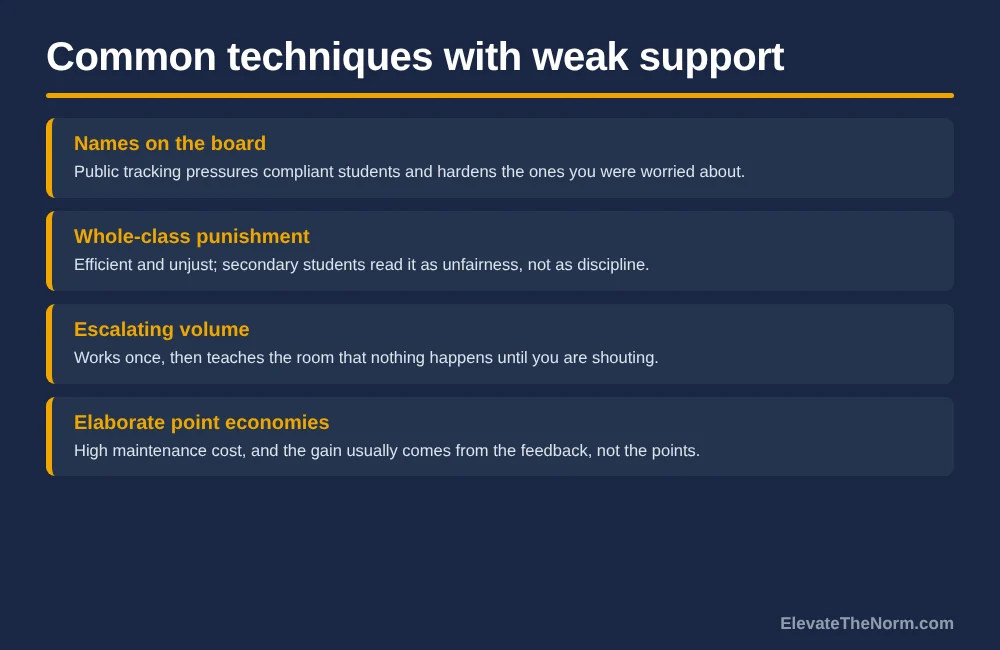
- Names on the board and visible behavior charts in secondary rooms. Public shaming works on students who were going to comply anyway and hardens the ones who were not.
- Whole-class punishment for one student’s choice. It is efficient and it is unjust, and teenagers have an unerring sense for the difference.
- Escalating volume. It works once. After that you have established that nothing happens until you are shouting.
- Elaborate point economies. Not harmful, but the maintenance cost is high and the thing driving the gain is usually the attention and feedback, not the points.
- “Don’t smile until Christmas.” There is no evidence for it and it costs you the relationship capital you will need in February.
Most advice and strategies on classroom management fail for a duller reason than being wrong, though. They fail because they were not held. A consequence you deliver on Monday and forget on Thursday has taught the class something precise: your word is negotiable. Everything else in this article depends on the opposite being true.


How do you handle the student who is not buying any of it?
You stop treating it as a management problem and start treating it as a motivation problem, because that is usually what it is.
A meta-analysis of 144 studies with just over 79,000 participants, average age 16.5, found teacher autonomy support correlated .48 with intrinsic motivation and −.32 with amotivation — and that students’ sense of competence (ρ = .58) and autonomy (ρ = .57) were the strongest predictors of self-determined motivation (Bureau, Howard, Chong & Guay, 2021). These are correlations, not experiments, and self-report measures on both sides inflate relationships. Still: the student with his head down is frequently a student who does not believe he can do the work. Lower the entry cost on one assignment and watch what happens before you write a referral. We take this apart further in the article on students who have stopped trying.
How long before classroom management in the classroom starts to feel different?
Expect two to three weeks for routines to hold, a full grading period for your ratio to change the room’s mood, and a semester for relationships with the hardest students to pay.
The slow one is worth waiting for. A meta-analysis of 99 studies on teacher–student relationships found medium-to-large associations with engagement and small-to-medium associations with achievement, and reported that effects were stronger in the higher grades (Roorda, Koomen, Spilt & Oort, 2011). That is good news for secondary teachers and it comes with the usual correlational warning: easier students are easier to have good relationships with, and that alone could produce part of the pattern. Our guide to building these relationships without faking it is the practical companion.
Where classroom management methods fail: three honest limits
Know these three before you implement anything, because they are the reason good management strategies for classroom use stop working in real buildings.
The evidence skews young
The single largest problem with the research base for grades 6–12 is that so much of it was gathered in grades K–6. The structural logic transfers. The specific doses and effect sizes do not, and anyone who tells you otherwise is extrapolating without saying so.
Doing everything at once backfires
The 76-study meta-analysis found that interventions addressing all four strategy categories simultaneously were less effective than targeted ones. Pick two changes. Hold them for a grading period. Add the third.
Equity is not automatic
A room can be orderly and still be delivering its consequences unevenly. If you are not periodically looking at who gets redirected, who gets referred, and who gets the benefit of the doubt, you do not actually know whether your system is fair — you only know it is quiet. Our material on consequences that are predictable rather than punitive addresses this directly.
What to do Monday: putting these classroom management strategies in order
Do not implement this article. Implement two lines of it. The classroom management strategies above are not a program, and treating them as one is how teachers end up with a binder and no change in their room.
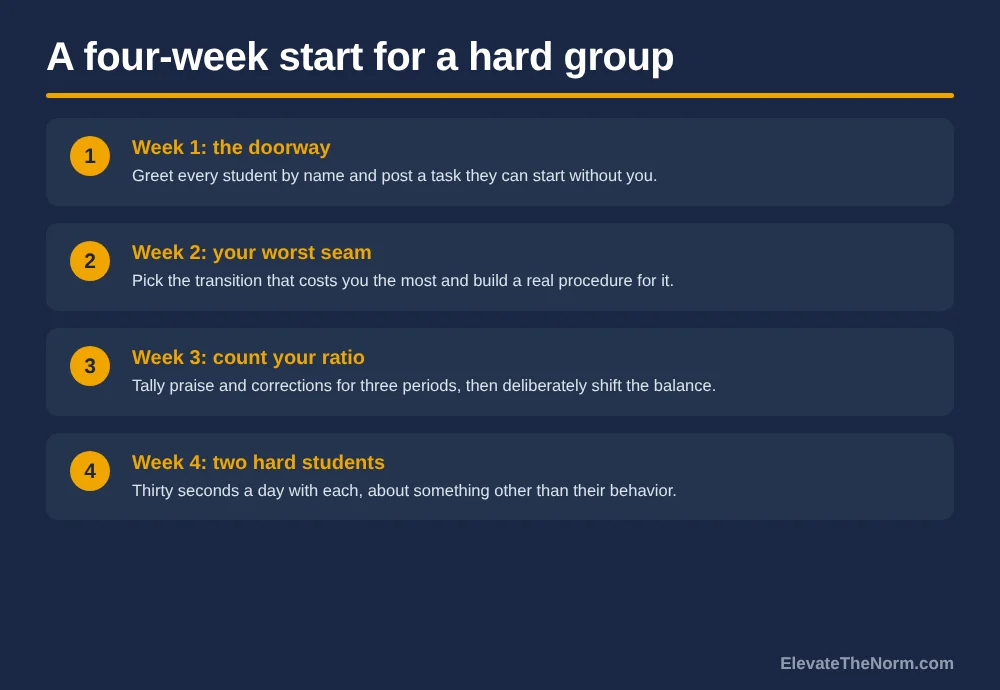
Here is the order I would use. Week one: stand at the door, greet every student by name, and have something on the board they can start without you. Week two: pick your worst seam — usually the transition into group work or the last four minutes — and build a real procedure for it, teach it, and hold it. Week three: count your own praise and corrections for three periods, then fix the ratio. Week four: choose the two students you dread most and spend thirty seconds a day on something that is not about their behavior. That is it. Four moves, each cheap, each with evidence behind it, and none of which requires anyone’s permission.
If you are in your first year or two and need the whole scaffold rather than four moves, start with the new-teacher version of all this, then write the plan down using our classroom management plan framework. And if you want to know which of these moves you default to under pressure — which tells you a lot about what you need to work on — read our breakdown of classroom management styles and find your own.
Sources
- Simonsen, B., Fairbanks, S., Briesch, A., Myers, D., & Sugai, G. “Evidence-Based Practices in Classroom Management: Considerations for Research to Practice.” Education and Treatment of Children, vol. 31, 2008, pp. 351–380. Supports the five categories of evidence-based classroom practice and the roughly twenty specific practices named. Caveat: linked here as a full-text reproduction hosted by the University of Nebraska–Lincoln Student Engagement Project rather than the paywalled journal of record. https://k12engagement.unl.edu/sites/unl.edu.cehs.special-ed-communic-disorders.student-engagement-project/files/media/file/Classroom%20Management%206-8-16.pdf
- Oliver, R. M., Wehby, J. H., & Reschly, D. J. “Teacher Classroom Management Practices: Effects on Disruptive or Aggressive Student Behavior.” Campbell Systematic Reviews, 2011(4). Supports the d = .71–.80 classroom-level effect for management practices. Caveat: only 12 studies met inclusion criteria out of more than 5,000 screened, about two-thirds in grades K–6, and the authors state they lacked power for moderator analyses. https://www.mona.uwi.edu/cop/sites/default/files/resource/files/Oliver_Classroom_Management_Review.pdf
- Korpershoek, H., de Boer, H., & Mouw, J. M. “An Update of the Meta-Analysis of the Effects of Classroom Management Interventions on Students’ Academic, Behavioral, Social-Emotional, and Motivational Outcomes.” Review of Educational Research, vol. 96, no. 5, 2026, pp. 1640–1680. Supports the small overall effect (g = .23) and the finding that broad multi-component interventions underperformed targeted ones. Caveat: the 76 included trials were conducted in primary education, so the figures should not be read as secondary-school effects; linked via the publisher record and repository abstract. https://research.rug.nl/en/publications/an-update-of-the-meta-analysis-of-the-effects-of-classroom-manage/
- Caldarella, P., Larsen, R. A. A., Williams, L., & Wills, H. P. “Effects of Middle School Teachers’ Praise-to-Reprimand Ratios on Students’ Classroom Behavior.” Journal of Positive Behavior Interventions, vol. 25, no. 1, 2023, pp. 28–40. Supports the praise-to-reprimand findings for class-wide on-task behavior and for students at risk for emotional and behavioral disorders. Caveat: 28 classrooms in middle schools only; effects for high school were not measured. https://journals.sagepub.com/doi/10.1177/10983007211035185
- Cook, C. R., Fiat, A., Larson, M., Daikos, C., Slemrod, T., Holland, E. A., Thayer, A. J., & Renshaw, T. “Positive Greetings at the Door: Evaluation of a Low-Cost, High-Yield Proactive Classroom Management Strategy.” Journal of Positive Behavior Interventions, vol. 20, no. 3, 2018, pp. 149–159. Supports the door-greeting strategy’s effect on academic engaged time and disruptive behavior in middle school. Caveat: a single randomized trial; the specific percentage figures circulating online are not in the published abstract and are not repeated here. https://experts.umn.edu/en/publications/positive-greetings-at-the-door-evaluation-of-a-low-cost-high-yiel/
- MacSuga-Gage, A. S., & Simonsen, B. “Examining the Effects of Teacher-Directed Opportunities to Respond on Student Outcomes: A Systematic Review of the Literature.” Education and Treatment of Children, vol. 38, no. 2, 2015, pp. 211–240. Supports the three-to-five-per-minute response rate and the advantage of unison response formats. Caveat: 15 studies, 172 participants, eleven of them elementary and only one high school, with heavy reliance on single-subject designs. https://journals.sagepub.com/doi/abs/10.1177/1074295619835207
- Epstein, M., Atkins, M., Cullinan, D., Kutash, K., & Weaver, R. Reducing Behavior Problems in the Elementary School Classroom. IES Practice Guide, What Works Clearinghouse, U.S. Department of Education, September 2008. Supports the strong-evidence ratings for modifying the classroom environment and for teaching and reinforcing appropriate skills. Caveat: the guide explicitly covers kindergarten through grade 6; its ratings were not established for secondary classrooms. https://ies.ed.gov/ncee/wwc/PracticeGuide/4
Frequently Asked Questions
Do I have to choose between being warm and being strict?
No, and the framing is the problem. The approach with the best support is high structure plus high warmth at the same time: expectations are clear and non-negotiable, and the relationship is real. Warmth without structure produces a room students enjoy and do not learn in. Structure without warmth produces compliance that evaporates the moment you leave. If you think you must pick one, you are probably describing a consistency problem rather than a personality problem. Hold the line and be kind while you do it.
My school requires a specific behavior system. Can I still use these strategies?
Almost always, yes. Nearly everything in this article lives inside your own four walls: how you greet students, how you teach procedures, how often you acknowledge rather than correct, how many chances students get to respond. Those are instructional choices, not policy changes. Where a mandated system conflicts — for instance, if it requires public tracking of behavior — follow the policy, document what you are seeing, and raise it with your administrator as feasibility feedback rather than quietly opting out.
How do I know whether this is working instead of just feeling better?
Pick a number before you start. Count minutes lost to transitions, tally your own praise and corrections for three periods, log referrals by week, or sample on-task behavior with a simple scan every five minutes for one class. Any of those takes under ten minutes a day and gives you something other than mood to judge by. Two weeks of baseline, then two weeks after the change. If the number has not moved at all after a full grading period, change the strategy rather than working harder at it.
Is there a cost to the district, and does any of this require training?
The four moves in the closing section cost nothing and require no purchase, no platform and no release time. That is deliberate. Where cost appears is in coaching: the reason praise-to-correction ratios do not change on their own is that teachers cannot see their own rates, so someone has to count for them. A colleague with a clipboard for twenty minutes does that as well as a consultant. If a vendor is quoting you a comprehensive program, the meta-analytic evidence suggests narrower is better anyway.
What about students with IEPs, behavior plans, or significant trauma histories?
These strategies are the universal layer and they help, but they are not a substitute for individualized support. Clear routines, predictable responses, high response rates and a good ratio make a room safer for a student with anxiety or a behavior plan, not less so. What they cannot do is replace the plan itself. If a student’s IEP or BIP specifies a different response, that document wins. Bring what you are observing to the case manager rather than improvising around it.
Will students see explicitly taught procedures as babyish?
Some will say so out loud, and the way you teach it decides whether they mean it. Teenagers resent being managed and do not resent being told the actual reason for something. “We do it this way because it gives us back four minutes and I would rather spend those on the project” lands differently from “because those are the rules.” Keep the practice brief, explain the purpose once, and ask them where the procedure is clumsy. Students will cooperate with a system they had a hand in sanding down.
What should I tell a parent who asks how behavior is handled in my room?
Tell them the sequence, in order, before anything happens. Something like: expectations are taught in the first week and posted; a problem gets a nonverbal signal, then a quiet word, then a conversation with me outside of class; if it continues I call home before I write anything up; consequences are the same for every student and I will explain the reasoning to your child. Parents are rarely upset by a consequence they understood in advance. They are upset by surprises and by inconsistency.
Which single strategy should I start with if my class is already out of control?
Start with the entry routine and the first four minutes, because a class that begins badly cannot be recovered mid-period. Stand at the door, speak to every student by name, and put a task on the board they can begin without instructions from you. It takes no prep, it has randomized evidence behind it in middle school classrooms, and it gives you contact with everyone before the day can go wrong. Once the opening holds for a full week, fix your next worst seam.