Tag: teaching responsibility

  • Activities for Teaching Responsibility to Middle and High School Students

    Activities for Teaching Responsibility to Middle and High School Students

    By Clay Shumate

    The best activities for teaching responsibility to middle and high school students give students something to actually own, not a lecture about character. Below are ten activities built around real ownership, structured reflection, and clear repair after mistakes, sequenced from ones you can add to a class you already run to ones that take more trust to pull off. Before selecting activities, it helps to clarify what you are building—the article on what is student responsibility offers a definition that distinguishes genuine ownership from simple compliance.

    Key Takeaways

    • Responsibility is a practiced behavior, not a character trait you either have or lack. Adolescents develop it through repeated opportunities to own tasks, meet deadlines, and deal honestly with what happens when they fall short.
    • The best responsibility activities for secondary students involve real stakes within safe boundaries — meaning the work matters, but a failure does not destroy a student’s standing or grade.
    • Self-regulation research confirms that adolescents benefit most from structured responsibility practice paired with warm, responsive adult relationships (Murray & Rosanbalm, 2017).
    • Reflection is where responsibility actually grows. An activity without a reflection step is just compliance — the student did the thing but never examined why it mattered.
    • Repair after mistakes is the hardest part to teach and the most important. It requires activities that go beyond “say sorry” and into “what do you owe, to whom, and by when?”

    Why Activities — Not Lectures — Teach Responsibility

    Most educators agree that responsibility matters. The disagreement is about how it develops. One approach treats responsibility as a character trait: talk about it, model it, hope students absorb it. The other approach treats responsibility as a skill: design situations where students practice it, receive feedback, and try again.
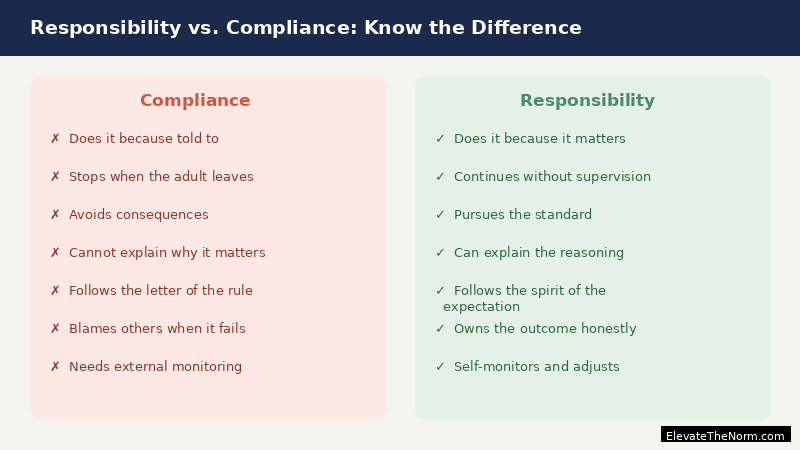
    Comparison showing the difference between teaching responsibility and teaching compliance, with responsibility involving genuine choice and self-assessment while compliance involves following rules without reflection
    Responsibility internalizes through genuine choice and honest reflection — not through compliance alone.

    The research supports the second approach. Self-determination theory, developed by Deci and Ryan and applied extensively in educational settings, identifies autonomy, competence, and relatedness as the three psychological needs that drive internalized motivation (Ryan & Deci, 2020). Responsibility does not internalize through compliance — it internalizes when students experience genuine choice, see evidence of their own competence, and feel connected to the people holding them accountable. Understanding what actually motivates students is the foundation for designing responsibility activities that work.

    That is what the activities below are designed to create. Each one gives students something real to own, a clear standard to meet, a structure for reflection when they fall short, and a path back after a mistake.

    Activities That Build Responsibility Through Real Ownership

    1. The Deadline Choice Contract

    Instead of assigning a single due date, give students a planning window. They choose when to submit — within a defined range — and commit to that date in writing. If they meet their chosen deadline, the work is graded normally. If they miss it, they complete a brief reflection: what happened, what they would change, and what their revised deadline is.

    Why it works: It shifts the locus of control. The teacher is no longer the person imposing the deadline — the student chose it. Missing it becomes a broken commitment to themselves, not just a rule violation.

    What to watch: Some students will choose the latest possible date every time. That is fine. The skill is making a plan and keeping it, not choosing the earliest date to impress the teacher.

    2. The Group Role Rotation

    Assign clear, named roles within group work — timekeeper, recorder, quality checker, presenter — and rotate them across projects. Each role comes with specific deliverables. After each project, every student writes a one-paragraph self-assessment of how they handled their role, and the group writes a brief evaluation of how the rotation worked.

    Why it works: Named roles with deliverables make responsibility visible. A student who was the quality checker either caught errors or did not — there is evidence. The rotation prevents students from hiding in the same comfortable role every time. The same logic scales past group work: a role is only worth assigning when the student controls something real.

    What to watch: Do not let the “quality checker” role become a way for strong students to redo weak students’ work. The role checks quality and identifies problems — it does not fix them for the other person.

    Naming what the role is meant to develop keeps that line clear. Our breakdown of what a leadership skill is, as opposed to a personality trait gives you the observable behaviour for each one, which is also the fairest way to grade a role.

    3. The Missing-Work Conversation

    When a student misses an assignment, replace the zero-and-move-on approach with a structured conversation. The student answers three questions in writing before the conversation: What was the assignment? What got in the way? What is your plan to complete it?

    This is not optional and it is not a punishment. It is the practice of taking responsibility for an incomplete obligation.

    Why it works: It requires the student to acknowledge the gap honestly and propose a solution — two components of genuine responsibility that a zero on a gradebook never teaches.

    What to watch: Keep it brief and private. This is a five-minute conversation at the whiteboard table, not a public interrogation. The goal is a plan, not a confession. And account for circumstances beyond the student’s control — transportation problems, family obligations, lack of internet access at home, or a job that keeps them up late. The conversation should distinguish between a student who chose not to do the work and a student who could not. Both need a plan. Only the first needs a conversation about choices.
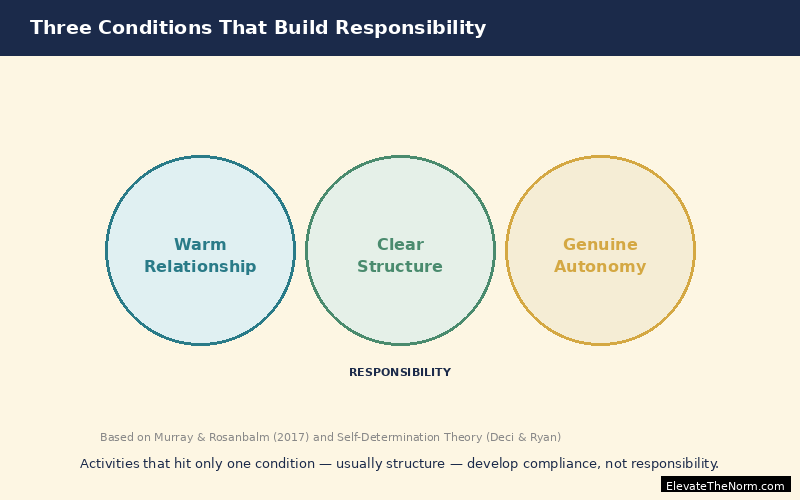
    Diagram showing the three conditions research identifies for building adolescent responsibility: warm adult relationships, structured environment with clear expectations, and genuine autonomy within structures
    Self-regulation research identifies three conditions that help adolescents build genuine responsibility.

    4. The Repair Letter

    After a significant behavioral incident — not every small disruption, but the ones that damage trust or affect other students — ask the student to write a letter addressing three things: what happened (facts, not excuses), who was affected and how, and what they will do differently. The letter is not graded. It is reviewed by the teacher, discussed, and then the incident is considered addressed.

    I use this after repair conversations in my room. When something goes wrong — when a student lets a group down, or says something they should not have — we sit down and talk about what is owed, to whom, and by when. The letter is the student’s record of that conversation. It matters because writing it requires them to articulate what they are taking responsibility for, not just nod and leave. The repair process connects directly to the broader idea of helping students learn from their mistakes rather than simply penalizing them.

    Why it works: It connects behavior to impact. Most adolescents are not trying to cause harm — they are impulsive, reactive, or unaware. The letter forces awareness without humiliation.

    What to watch: Never require a forced apology. The letter should be honest. If a student genuinely believes they were not wrong, the conversation that follows the letter is more useful than the letter itself. And be clear: a repair letter does not replace required school discipline documentation. If your school policy requires an incident report, a referral, or a parent contact for the behavior in question, complete those first. The repair letter is an addition to the process, not a substitute for it.

    5. The Project Check-In Protocol

    For any multi-day assignment or project, build in structured check-ins where the student — not the teacher — reports on progress. The format is simple: What have I done? What is next? What am I stuck on?

    During check-ins, the student explains their choices and defends their decisions. “I chose to focus on the primary source analysis first because…” is more useful than a teacher looking over a shoulder and saying “You’re behind.”

    Why it works: It practices the professional skill of giving a progress report — something adults do constantly and students almost never practice. It also creates a record: if a student says “I’m on track” at the check-in and then is not on track at the deadline, the gap between their self-assessment and their output becomes the teaching moment.

    What to watch: Do not turn check-ins into micromanagement. The point is for the student to report and reflect, not for the teacher to direct every decision.

    6. The Self-Assessment Before the Grade

    Before returning a graded assignment, have students assess their own work against the rubric. They predict their score, identify their strongest section, and name one area where they fell short. Then they receive the actual grade and compare.

    Why it works: Self-assessment accuracy is a metacognitive skill directly tied to responsibility. Students who consistently overestimate their work are not being arrogant — they are not seeing their own gaps. Students who consistently underestimate may not be recognizing their own competence. Either pattern is worth a conversation.

    What to watch: This works best with a clear, student-friendly rubric distributed before the assignment. If students do not know what “proficient” looks like in advance, the self-assessment is just guessing.
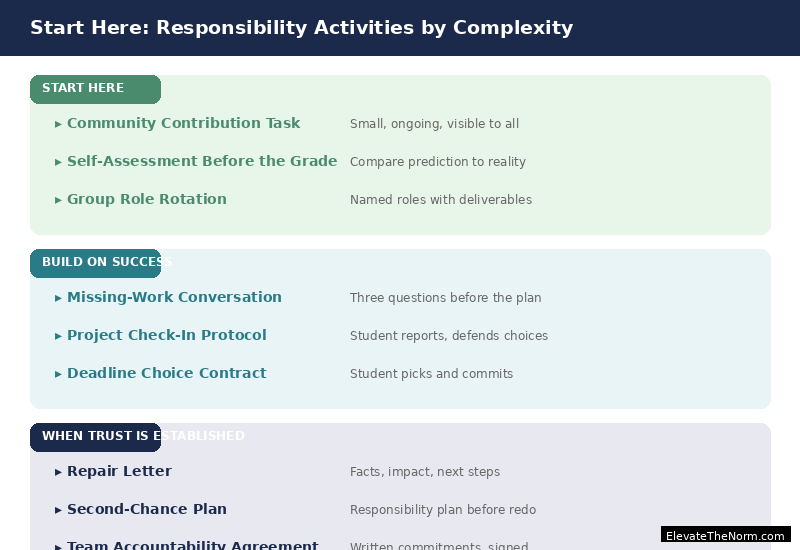
    Chart organizing ten responsibility activities by complexity level from simple to advanced, showing which work best for middle school versus high school students
    Start with two or three activities and add more as you and your students get comfortable.

    7. The Responsibility Debrief

    At the end of a unit, project, or quarter, students write a responsibility reflection: What commitment did I keep this unit? What commitment did I break? What did I learn about how I work? What will I do differently next time?

    Why it works: It normalizes honest self-evaluation. Most schools give students grades but never ask them to reflect on the habits that produced those grades. The debrief is where students connect effort to outcome — or more importantly, connect avoidance to outcome.

    What to watch: Students will write what they think you want to hear unless you make it clear that honesty is valued more than optimism. Share your own example if you can: a time this semester when you planned poorly, fell behind, and had to adjust.

    8. The Team Accountability Agreement

    Before any group project, each team writes a brief agreement: what each person is responsible for, when each piece is due, what happens if someone does not deliver, and how the group will handle conflict. The agreement is signed and kept by the teacher.

    Why it works: It front-loads responsibility instead of back-loading blame. When a group falls apart — and some will — the agreement provides a reference point for a conversation that is about commitments, not feelings.

    What to watch: Do not let the “what happens if someone does not deliver” section become punitive. The healthiest answer is usually “We have a conversation and make a plan” — not “They get a zero.” Effective classroom consequences are always about what comes next, not just what went wrong.

    9. The Community Contribution Task

    Assign each student a real, ongoing responsibility that serves the class: maintaining the supply station, updating the assignment board, organizing returned work, or keeping the shared digital folder clean. The task is small, consistent, and visible.

    Why it works: It gives students a piece of the room to own. Not a pretend ownership — an actual, ongoing responsibility where others notice if it does not get done. The student is not doing it for a grade. They are doing it because the room needs it done.

    What to watch: Rotate tasks quarterly so the same students do not get stuck with the least appealing jobs. And acknowledge it when it is done well — not with a reward, but with a thank-you that names what they contributed.

    10. The Second-Chance Plan

    When a student bombs an assignment or test, offer a structured second attempt. The catch: before they can redo the work, they must complete a responsibility plan. What happened the first time? What will they do differently? What specific support do they need? They submit the plan, the teacher approves it, and then they redo the work.

    Why it works: It separates the failure from the identity. “You failed this assignment” is a fact. “You are a failure” is a conclusion students draw when there is no path forward. The second-chance plan keeps the standard high — you still have to meet it — while making the path back visible.

    What to watch: Set a clear window for the redo. “Whenever you get around to it” is not a plan — it is an invitation to never complete it. A deadline on the redo teaches the same skill as the original deadline.

    How Responsibility Activities Fail (and How to Prevent It)

    The most common failure is not the activities themselves — it is the gap between the activity and the follow-through.

    Responsibility activities fail when teachers assign them but do not follow up on the reflections. They fail when the consequences for not completing a responsibility task are identical to the consequences for not completing any other assignment — a zero in the gradebook. And they fail when the activities are age-inappropriate, making teenagers feel like they are being managed rather than developed.

    Research on adolescent self-regulation confirms that young people build responsibility most effectively when three conditions are present: a warm relationship with the adult holding them accountable, a structured environment where classroom expectations are clear, and genuine autonomy within those structures (Murray & Rosanbalm, 2017). Activities that check all three boxes develop responsibility. Activities that hit only one — usually structure — develop compliance.

    Before You Start: Tell Families What You Are Doing

    Responsibility activities work best when families understand the framework. Early in the year — ideally before the first missed assignment or behavioral conversation — communicate to parents and guardians what your classroom responsibility process looks like: that students will be asked to reflect on missed work rather than simply receive zeros, that repair conversations focus on what is owed rather than punishment, and that second chances come with plans attached. A family that understands the system can reinforce it. A family that encounters it only when their child is in trouble will question it.

    What Teaching Responsibility Actually Looks Like Day to Day

    It looks like follow-through. It looks like a teacher who says “I will check your progress on Thursday” and then checks on Thursday. It looks like a room where a student who missed a deadline has a conversation — not a lecture, not a zero entered silently — about what happened and what comes next.

    It also looks like grace. Not the kind of grace that eliminates standards, but the kind that maintains them while holding the door open. A student who writes an honest responsibility reflection about why they did not finish a project — and then finishes it — has learned more about responsibility than a student who met every deadline without ever having to recover from a miss.

    The goal is not to produce students who never fail. It is to produce students who know what they owe when they do. For a deeper look at how teaching responsibility connects to broader classroom culture, and the research behind why student responsibility is a skill rather than a trait, those articles explore the framework in more detail.


    At what age should responsibility activities start in school?

    Responsibility activities should be developmentally appropriate at every grade, but the version described here — involving self-assessment, planning, written reflection, and repair — is designed for grades 6–12. Middle schoolers can handle simpler versions (the community contribution task, the group role rotation). High schoolers can handle the full range, including the deadline choice contract and the second-chance plan. The key is matching the complexity of the activity to the student’s capacity for abstract thinking and self-reflection.

    How do you teach responsibility without making it feel like a punishment?

    By separating the activity from consequences. A repair letter is not a punishment — it is a process for honest self-examination. A second-chance plan is not a penalty — it is a structured path to improvement. The tone of the teacher matters more than the structure of the activity. If you approach a responsibility conversation with curiosity (“What happened?”) rather than judgment (“Why didn’t you…?”), students are more likely to engage honestly.

    What if a student refuses to participate in a responsibility activity?

    Start with a private conversation. Ask what is getting in the way. Sometimes refusal is about the activity; sometimes it is about something else entirely. If the student still refuses after the conversation, document the refusal and follow your classroom or school procedure — but do not abandon the expectation. The activity stands. The student may need more time, a different format, or a different adult to have the conversation with.

    Do responsibility activities work for students with IEPs or behavioral plans?

    Yes, with modifications. Consult the IEP or 504 plan first — some students have specific accommodations around deadlines, reflection activities, or self-assessment that must be followed. The principles of responsibility still apply: students with behavioral plans deserve the same expectation of honest self-assessment, repair, and follow-through. The accommodations adjust the how, not the whether.

    How do you grade responsibility?

    Most of these activities should not carry a traditional grade. Grading a reflection on what went wrong creates an incentive to lie. The activities that are graded — the project, the assignment, the group work — carry grades based on the quality of the academic work. The responsibility activities support the academic work but are evaluated through conversation, not points.

    Can these activities backfire?

    Yes, if they are applied inconsistently. If one student writes a repair letter and another student who did the same thing does not, the first student learns that the system is arbitrary. Consistency across students is non-negotiable. The activities also backfire if the teacher does not follow through — assigning a responsibility reflection and then never reading it teaches students that the activity is busywork.

    How many of these activities should a teacher use at once?

    Start with two or three. The deadline choice contract, the self-assessment before the grade, and the project check-in protocol are a strong starting combination because they integrate into work you are already assigning. Add the repair letter and the responsibility debrief as you get comfortable. Trying all ten at once will overwhelm you and your students.


    Sources


    About Clay Shumate

    Clay Shumate is a certified secondary Social Studies teacher in the public schools of West Alabama, with seven years of classroom experience, a B.A. in History, and an M.Ed. in Secondary Education. He writes about project-based learning, student responsibility, respect, and practical ways to hold young people to a higher standard while giving them room to learn from mistakes. He is a member of the Society of Professional Journalists and writes to its Code of Ethics; this site’s editorial standards and corrections policy are published in full. More about Clay.
  • Teaching Responsibility Without Treating Teenagers Like Children

    Teaching Responsibility Without Treating Teenagers Like Children

    By Clay Shumate

    Teaching responsibility means giving students real ownership over their choices, holding them to clear expectations, and following through with honest consequences that teach when they fall short—without stripping them of their dignity in the process. It does not mean lecturing them about responsibility while making every decision for them. If you want students to act like responsible young adults, you have to treat them like developing young adults and then hold them to that standard. The hardest version of that is handing a student authority that is genuinely theirs and then not quietly taking it back.

    Key Takeaways

    • Responsibility is not the same thing as obedience. A student who follows orders without thinking is compliant, not responsible.
    • Teaching responsibility requires transferring real decision-making power to students—then holding them accountable for what they decide.
    • Adolescent brains are still developing the prefrontal cortex, which means teenagers need structured practice with responsibility, not excuses to avoid it.
    • The most effective consequences are connected to the behavior, preserve the student’s dignity, and include a clear path back.
    • Rebuilding trust after a student makes a serious mistake is part of the work, not an exception to it.

    Responsibility Is Not Obedience

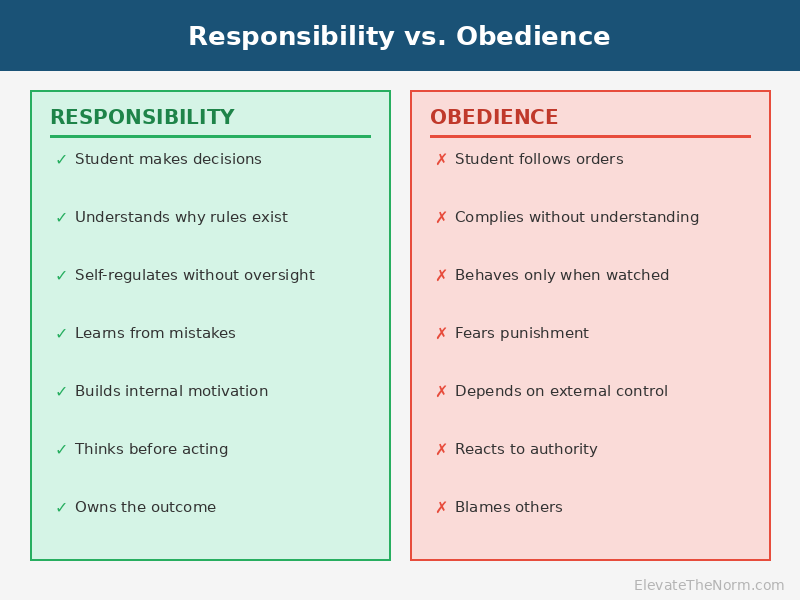
    This distinction matters more than most educators realize. A responsible student makes thoughtful decisions, follows through on commitments, and accepts the consequences when things go wrong. An obedient student does what they are told.

    When mistakes happen — and they will — the question is whether the system turns them into learning. A clear process for learning from mistakes makes accountability productive instead of punitive.

    Those are not the same thing.

    Comparison chart showing the differences between teaching responsibility and demanding obedience in secondary classrooms
    Responsibility produces self-directed learners. Obedience produces students who behave only when watched.

    A classroom built entirely on obedience produces students who behave well when someone is watching and fall apart when no one is. A classroom built on responsibility produces students who can manage themselves, make reasonable choices under pressure, and recover from mistakes without an adult directing every step.

    Self-determination theory, developed by psychologists Edward Deci and Richard Ryan and applied to education by Niemiec and Ryan in a 2009 review published in Theory and Research in Education, identifies three basic psychological needs that drive human motivation: autonomy, competence, and relatedness. When teachers satisfy those needs—by offering meaningful choices, providing feedback focused on mastery, and building genuine relationships—students develop what the researchers call “autonomous self-regulation.” They do the right thing because they understand why it matters, not because they fear what happens if they do not.

    Obedience skips all three. It removes autonomy, ignores competence, and replaces relationship with compliance. That works for short-term control. It does not work for building the kind of young adults who can handle college, a job, a relationship, or the ordinary pressure of adult life.

    Why Adolescents Need Structured Practice, Not Speeches

    Here is what the brain science actually says—and what it does not.

    The American Academy of Child and Adolescent Psychiatry explains that the prefrontal cortex, the brain region responsible for reasoning, planning, and impulse control, continues developing well into early adulthood. Teenage decisions are guided more by the amygdala—the emotional, reactive part of the brain—and less by the prefrontal cortex.

    But the AACAP makes a critical clarification that too many educators skip: these brain differences “don’t mean that young people can’t make good decisions or tell the difference between right and wrong. It also doesn’t mean that they shouldn’t be held responsible for their actions.”

    The developing brain is not an excuse to lower expectations. It is a reason to provide more structured opportunities for students to practice making decisions, living with the results, and doing better next time. Teenagers get better at responsibility the same way they get better at algebra—through guided practice, honest feedback, and the chance to try again after getting it wrong.

    A longitudinal study published in Developmental Psychology by Wray-Lake, Syvertsen, and Flanagan found that social responsibility values actually decline from ages 9 to 16 before leveling off in later adolescence. The researchers identified ecological factors that predicted whether individual students bucked that trend: family compassion messages, democratic climates at home and school, community trust, and strong peer relationships. Every ecological asset they examined—except school democratic climate alone—predicted positive within-person change in responsibility.

    The takeaway is not that teenagers are naturally irresponsible. The takeaway is that responsibility does not develop automatically. The environments adults create—in classrooms, at home, in communities—determine whether adolescents practice responsibility or simply lose it during the years when they need it most.

    What Teaching Responsibility Actually Looks Like

    Teaching responsibility is not a single lesson. It is a set of daily practices built into how your classroom runs. Here is what it looks like in a secondary classroom where responsibility is taught, not just expected.

    Transfer Real Ownership

    Students cannot learn responsibility for decisions they never get to make. Start by identifying places where you currently make every choice—and hand some of them over.

    This does not mean chaos. It means structured choice within clear boundaries:

    • Let students choose how they demonstrate mastery—a paper, a presentation, a project, a recorded explanation—within your assessment criteria.
    • Give students deadlines with flexibility in how they manage their time across days, not minute by minute.
    • Allow students to set some of their own goals for a unit and explain why those goals matter to them.
    • Let students choose their own working groups for some assignments, with the understanding that they are responsible for the outcome.

    The key is that choices must come with accountability. If a student chooses to work alone and the result is weak, that is a conversation about planning and self-assessment—not a bailout. If a group chooses their members and the group falls apart, that is a conversation about collaboration and repair—not a teacher reassigning everyone. This kind of structured ownership is also foundational to project-based learning, where students manage real decisions throughout extended projects.

    Set Expectations That Respect the Age Group

    Expectations for middle and high school students should sound like what you would say to a young colleague, not to a kindergartner. Compare these:

    Sounds like elementary school: “We use kind words in this classroom. Put your name on your paper. Raise your hand before speaking.”

    Sounds like a secondary classroom: “Disagree with ideas, not people. Meet your deadlines or communicate in advance. If you damage something—a relationship, a piece of equipment, someone’s trust—you are responsible for repairing it.”

    The second set treats students as developing young adults. It assumes they can handle direct language, reasonable expectations, and the responsibility that comes with both.

    When you set expectations, teach them explicitly. Do not assume students know what “take responsibility” means in practice. Model it. Show what it looks like when you make a mistake—apologize, explain what you will do differently, and follow through. Students learn more about responsibility from watching how adults handle their own failures than from any poster on the wall. If you are new to teaching, setting these expectations early and consistently will save you from relying on control-based management later.

    Follow Through Every Time

    Inconsistent follow-through is the fastest way to destroy a responsibility-centered classroom. If you tell students they are responsible for meeting deadlines and then quietly accept late work without conversation, you have taught them that deadlines are suggestions. If you tell students they are responsible for respectful communication and then ignore disrespect because you are tired or the student is popular, you have taught them that respect is optional.

    Following through does not mean being harsh. It means being consistent:

    • When a student misses a deadline, have the conversation. Ask what happened. Ask what their plan is. Hold them to a next step.
    • When a student is disrespectful, address it directly and privately. Explain the impact. Expect repair.
    • When a student does something well—meets a commitment, helps a peer, follows through without being reminded—say so. Responsibility deserves recognition, not just correction.

    Consistency is what makes expectations real. Without it, your expectations are decoration.

    Use Consequences That Teach

    The Responsive Classroom framework identifies three types of logical consequences that maintain dignity while teaching responsibility:

    1. “You break it, you fix it.” If a student damages something—a relationship, a piece of equipment, another student’s work—they take direct action to repair it.
    2. Loss of privilege. If a student misuses a privilege—technology, independent work time, a flexible seating arrangement—they lose that specific privilege until they demonstrate they can handle it.
    3. Positive time-out. If a student needs to regain self-control, they move to a designated space to regroup—not as punishment, but as a skill.

    The common thread is that every consequence connects directly to the behavior. A student who disrupts a lab loses lab privileges until they demonstrate readiness. A student who plagiarizes rewrites the assignment and has a conversation about academic integrity. A student who damages a relationship writes or speaks a genuine apology and follows it with changed behavior.

    What does not work: consequences designed to humiliate, embarrass, or punish without teaching. Making a student stand in the hallway while the class watches teaches shame, not responsibility. Reading a student’s poor grade aloud teaches public failure, not reflection. Calling a parent in front of the class teaches distrust, not accountability. As we have discussed before, yelling does not restore order—it manufactures it temporarily while destroying the relationship that makes real accountability possible.

    Build Reflection Into the Routine

    Responsibility without reflection is just compliance that worked out. Students need regular opportunities to think about what they chose, what happened, and what they would do differently.

    Build reflection into your classroom routines:

    • Weekly self-assessment: Students rate their effort, preparation, and collaboration for the week and identify one specific thing to improve.
    • Post-project reflection: After completing a project, students answer: What did I do well? Where did I struggle? What would I change next time? What did I learn about working with others?
    • After-mistake reflection: When a student makes a poor decision, the reflection conversation replaces or accompanies the consequence: What happened? Who was affected? What will you do to repair it? What will you do differently?

    Don Hellison’s Teaching Personal and Social Responsibility (TPSR) model, developed for working with at-risk youth, structures responsibility into five progressive levels: respecting others’ rights and feelings, participation and effort, self-direction, helping others and showing leadership, and demonstrating responsibility outside the classroom. Students journal about their choices and use self-assessment to track their own growth. The model has been studied extensively with adolescents and consistently shows improvements in both personal and social responsibility when implemented with fidelity.

    Reflection turns experience into learning. Without it, students repeat mistakes not because they are irresponsible but because no one helped them think about what went wrong.

    Common Mistakes That Undermine Responsibility

    Even teachers who believe in student responsibility sometimes undermine it without realizing it. Here are the most common mistakes I have seen—and made.

    Rescuing Students From Consequences

    When a student forgets their materials, borrowing a pencil is reasonable. When a student chronically forgets materials and you supply everything every day without conversation, you are teaching them that someone will always cover for them. The same applies to deadlines, group responsibilities, and behavioral expectations.

    There is a difference between supporting a student who is struggling and protecting a student from the natural results of their choices. Support says, “Let’s figure out a plan so this does not keep happening.” Rescue says, “Don’t worry about it.”

    Confusing Accountability With Humiliation

    Accountability is a private conversation about what happened, what needs to change, and what happens next. Humiliation is a public performance designed to make a student feel bad enough to behave.

    Carl Pickhardt, writing in Psychology Today, frames the teaching of responsibility as helping adolescents understand the “choice/consequence connection”—recognizing that they make choices and are obligated to cope with the outcomes. He emphasizes non-evaluative correction: address the decision, not the character. “We disagree with the choice you made, and here is why” is accountability. “What is wrong with you?” is humiliation.

    When accountability feels safe, students are more likely to be honest about what happened. When accountability feels dangerous, students learn to lie, hide, and blame.

    Assigning Responsibility Without Teaching It

    Telling a student to “be more responsible” without showing them what that looks like is the same as telling a student to “write better” without teaching writing. Responsibility is a set of skills: planning, time management, self-assessment, communication, follow-through, and repair. Each one can be modeled, practiced, and improved.

    If your students are struggling with responsibility, the first question is not “What is wrong with these kids?” The first question is “Have I taught them what responsible behavior looks like, practiced it with them, and given them honest feedback?” Good checking for understanding applies here too—do not assume students understood the expectation just because you stated it once.

    Punishing the Whole Group for One Student’s Behavior

    Group punishment teaches one thing: resentment. It does not teach the offending student to take responsibility. It teaches every other student that fairness is not a priority in your classroom. Address individual behavior individually.

    Ignoring Executive Function Differences

    Some students struggle with responsibility not because they do not care but because executive function skills—planning, organizing, managing time, shifting between tasks—develop unevenly. Students with ADHD, learning disabilities, or trauma histories often need additional scaffolding: visual checklists, broken-down steps, shorter planning horizons, and more frequent check-ins. Scaffolding is not lowering the standard. It is building the ramp so the student can reach the standard. If you offer the same support to every student and call it fair, you have confused equality with equity.

    Working Outside Your School’s Existing Framework

    Responsibility-centered classroom practices work best when they align with your school’s broader behavior system—whether that is PBIS, MTSS, restorative justice, or a homegrown discipline framework. If your classroom expects repair conversations and your administration expects only referrals and suspensions, students receive conflicting messages. Talk with your administrator about how your approach fits the schoolwide structure. Where conflicts exist, advocate for alignment rather than working around the system.

    When to Handle It Yourself and When to Involve Administration

    Not every responsibility failure belongs in the classroom. As a general guide:

    Handle it yourself when the behavior is a normal adolescent mistake—missed deadlines, low-level disrespect, disorganization, minor conflict between students, failure to follow through on a commitment. These are teaching moments. Use them.

    Involve administration when safety is at risk, when the behavior violates school policy in ways that require formal documentation, when a pattern persists despite consistent classroom-level intervention, or when the situation involves harassment, threats, substance use, or any mandatory reporting obligation. Handling these alone is not brave—it is negligent.

    The line between classroom-level and administrative-level is not always clean. When in doubt, consult your administrator. A quick conversation about whether something warrants a referral is always better than finding out later that it did.

    How to Rebuild Trust After a Student Makes a Serious Mistake

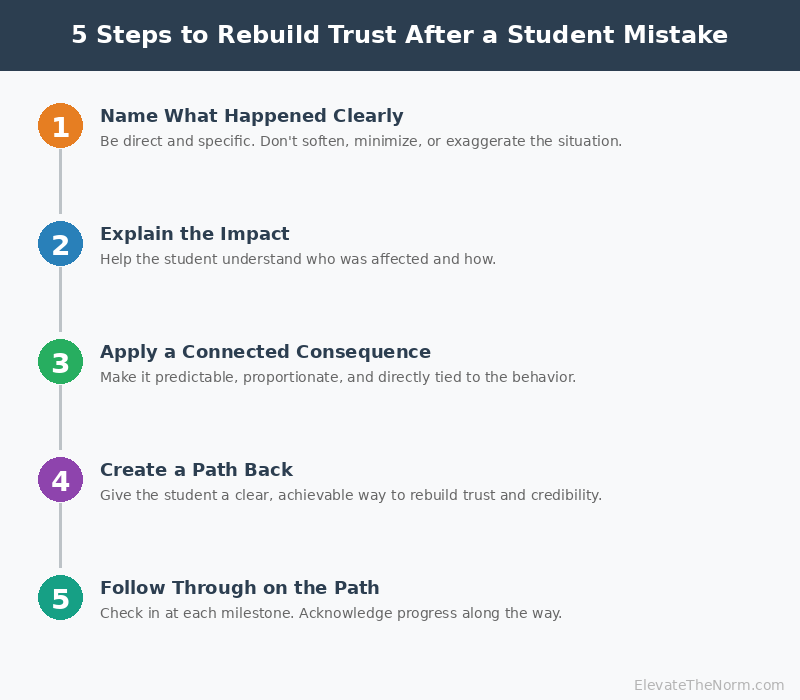
    Five-step process for rebuilding trust after a student makes a serious mistake in the classroom
    Rebuilding trust follows a predictable sequence—from naming what happened to following through on the path back.

    Students will make serious mistakes. They will cheat. They will say something cruel. They will break a promise, damage property, or betray a peer’s confidence. How you handle those moments determines whether the student learns from the mistake or decides they are permanently defined by it.

    Rebuilding trust after a serious mistake follows a predictable sequence:

    Step 1: Name what happened clearly. Do not soften, minimize, or exaggerate. “You copied three paragraphs from a website and submitted them as your own work” is clear. “You kind of had some issues with the assignment” is not.

    Step 2: Explain the impact. Who was affected? How? “When you copy someone else’s work, you are lying about what you know. That hurts your credibility with me and cheats yourself out of learning.”

    Step 3: Apply the consequence. The consequence should be predictable, proportionate, and connected to the behavior. For plagiarism, rewriting the assignment and having a conversation about academic integrity makes sense. For a first offense, a failing grade on the assignment without the chance to rewrite teaches punishment, not responsibility.

    Step 4: Create a path back. This is where most systems fail. A student who is permanently labeled “cheater” after one incident has no incentive to improve. A student who rewrites the assignment, demonstrates understanding of academic integrity, and earns back the teacher’s trust has a reason to grow.

    Step 5: Follow through on the path. If you told a student they could rebuild trust by meeting three consecutive deadlines, check in at each one. Acknowledge progress. A path back means nothing if nobody notices when the student walks it. Strong student-teacher relationships make this follow-through natural rather than forced.

    Research on restorative practices from the Learning Policy Institute shows that approaches focused on repairing harm rather than merely punishing offenders reduce suspensions, decrease disciplinary disparities, improve school climate, and strengthen student-teacher relationships. A large-scale California study found that the more students experienced restorative practices, the more student behavior, mental health, and disciplinary outcomes improved—with stronger effects for Black and Latino students.

    Repair is not softness. It is accountability with a future attached.

    Starting Responsibility Practices: The First Two Weeks

    If you are introducing these practices to a class that has not experienced them, the first two weeks set the tone.

    Days 1–3: Explain your expectations in plain language. Do not read a list from a slide. Talk to students like people. Explain why each expectation exists. Ask students what they think is missing. Listen. This is not a negotiation—you are still setting the standards—but student input on the front end builds investment.

    Days 4–7: Practice the routines. Model the opening check-in. Walk through the self-assessment. Run a short reflection. Practice the repair protocol with a low-stakes hypothetical. This is the same approach a coach uses: you do not play the game on day one. You practice the plays.

    Week 2: Start holding students accountable with the system you taught. The first time a student misses a deadline, have the conversation. The first time a student is disrespectful, use the repair protocol. Consistency during week two teaches students that you meant what you said in week one.

    Expect resistance. Some students have spent years in classrooms where expectations were announced and never enforced. They will test whether you are serious. The answer is yes, every time, without anger and without exceptions.

    Classroom Routines That Build Responsibility Daily

    Responsibility is not a unit you teach in September and hope sticks. These daily and weekly routines keep it alive:

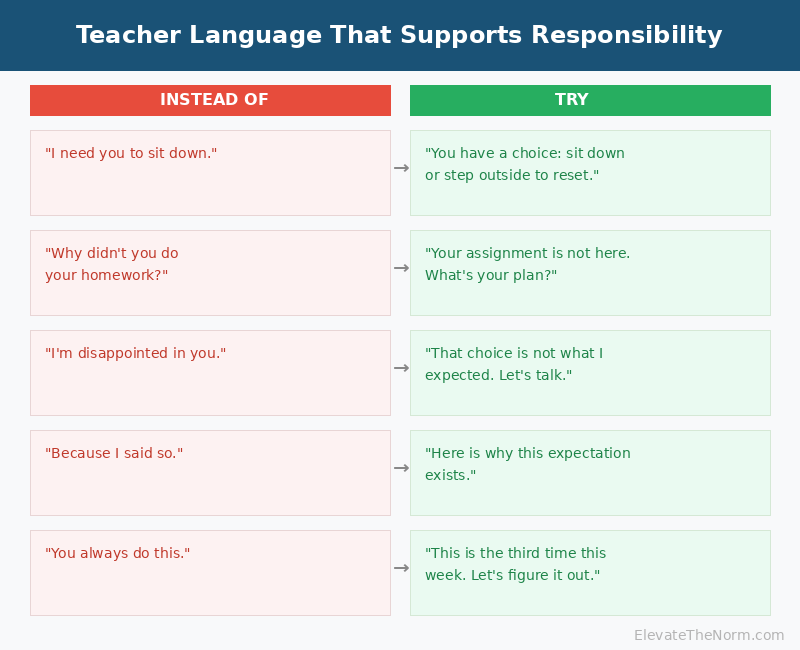
    Side-by-side examples of teacher language that undermines versus supports student responsibility
    The words you use shape how students understand responsibility. Address the behavior, not the person.

    Morning or class-opening check-in: Students identify their main goal for the period and what they need to accomplish it. This takes two minutes and builds the habit of intentional work.

    Assignment tracker: Students maintain a simple tracker—paper or digital—of their commitments, deadlines, and completion status. The teacher reviews it periodically, not to micromanage but to have informed conversations about patterns.

    End-of-week accountability conversation: Pairs of students spend three minutes discussing what they accomplished, what they did not, and what they will do differently next week. The teacher circulates and listens.

    Repair protocol: When conflict or harm occurs, the classroom has a clear process: name what happened, identify the impact, agree on repair, follow through. Students know this process because it has been taught and practiced.

    Student-led conferences: At least once per semester, students present their own work, progress, and goals to their families. The student runs the meeting. The teacher facilitates. This is one of the most powerful responsibility-building practices available because it requires students to own and explain their own learning.

    Teacher Language That Supports Responsibility

    The words you use shape how students understand responsibility. Here are phrases that work—and phrases that do not.

    Instead of: “I need you to sit down.”
    Try: “You have a choice: sit down and join the discussion, or step outside for a minute to reset. What works for you?”

    Instead of: “Why didn’t you do your homework?”
    Try: “Your assignment is not here. What happened, and what is your plan?”

    Instead of: “I’m disappointed in you.”
    Try: “That choice is not what I expected from you. Let’s talk about what happened and what comes next.”

    Instead of: “Because I said so.”
    Try: “Here is why this expectation exists, and here is what happens when people do not meet it.”

    Instead of: “You always do this.”
    Try: “This is the third time this week. Let’s figure out what’s making this hard and what you can change.”

    The pattern is consistent: address the behavior, not the person. Offer a choice when possible. Ask the student to think, plan, and commit to a next step. Treat the student as someone capable of improvement, because they are.

    Conclusion

    Teaching responsibility to teenagers is not complicated, but it is demanding. It requires you to transfer real decisions to students and then hold them to the results. It requires consequences that teach instead of humiliate. It requires rebuilding trust after failures instead of writing students off. And it requires daily routines that make responsibility a habit, not a lecture topic.

    The research is consistent: when adults provide structure, autonomy, honest feedback, and a genuine relationship, adolescents develop responsibility. When adults provide only control, students learn obedience—and obedience has an expiration date.

    Your students are developing young adults. Treat them that way. Hold them to a higher standard. Give them room to fail. And when they fail, show them how to get back up and do better. That is what teaching responsibility looks like. For specific classroom activities that put these principles into practice — from deadline choice contracts to repair letters to structured second chances — see activities for teaching responsibility in middle and high school.

    For a deeper look at what student responsibility actually looks like across seven observable domains—and the critical difference between responsibility and compliance—see student responsibility in the classroom on this site.


    One prerequisite worth naming: none of this works if students are guessing at the standard. If you’re building that foundation, start with a practical framework for classroom expectations — fewer, clearer, taught, and held the same way every day.

    Frequently Asked Questions

    What is the difference between teaching responsibility and just expecting it?

    Teaching responsibility means explicitly showing students what responsible behavior looks like, practicing it, providing feedback, and giving students structured opportunities to improve. Just expecting responsibility means announcing standards and then being frustrated when students do not meet them. If you have not taught it, practiced it, and followed up on it, you have not taught it—you have wished for it.

    How do I teach responsibility without giving up classroom control?

    Responsibility and classroom control are not opposites. You can offer students meaningful choices—how they demonstrate learning, how they manage their time, who they work with—while maintaining clear boundaries on safety, respect, and academic standards. The teacher still sets the expectations and enforces them. The difference is that students have genuine ownership over some decisions, which makes them more invested in the outcomes.

    What do I do when a student keeps making the same mistake?

    First, check whether the student has actually been taught a better alternative. Repeating a consequence without changing the support is unlikely to produce different results. Have a private conversation: “This keeps happening. Let’s figure out why and make a specific plan.” If the pattern continues despite genuine support, involve a counselor, administrator, or family member—not to escalate punishment, but to add resources.

    Should I let natural consequences do the work, or should I intervene?

    Use natural consequences when they are safe, timely, and proportionate. If a student does not study, a low test score is a natural consequence. If a student does not prepare for a presentation, an awkward moment in front of peers is a natural consequence. But intervene when a natural consequence would be dangerous, delayed so long that a student cannot connect it to their behavior, or so severe that it damages the student’s wellbeing beyond what the situation warrants.

    How do I handle parents who think I am being too strict—or too lenient?

    Communicate your system proactively. At the start of the year, explain your expectations, your approach to consequences, and your commitment to treating students as developing young adults. When a parent raises a concern, listen first. If you are being consistent, fair, and focused on teaching responsibility rather than punishment, most parents will support the approach once they understand it. If a parent insists on no consequences for their child, explain that accountability in a safe classroom is practice for the real world—and the real world does not offer that exemption.

    Is this approach realistic with 30 students in a classroom?

    Yes, because most of these practices are routines, not individual interventions. A two-minute opening check-in, a weekly self-assessment, a standard repair protocol—these work at scale because they are systematic. You are not having a 20-minute conversation with every student every day. You are building a classroom culture where responsibility is the norm, not the exception, and then intervening individually when a student struggles.

    What about students with ADHD or executive function challenges?

    Students with executive function difficulties often need more scaffolding to practice responsibility—not lower expectations. Break large assignments into smaller checkpoints with intermediate deadlines. Use visual checklists students can reference independently. Check in more frequently at the start, then gradually reduce support as the student builds capacity. The goal is the same standard with a more supported path to get there. If a student has an IEP or 504 plan, their accommodations should be integrated into your responsibility framework, not treated as exceptions to it.

    How can parents reinforce these practices at home?

    The core principles translate directly: give teenagers real decisions with real consequences, follow through consistently, address behavior without attacking character, and provide a clear path to rebuild trust after mistakes. If you know your child’s teacher uses a responsibility-centered approach, ask about it at conferences and use similar language at home. Consistency between school and home accelerates the learning.


    Sources


    About Clay Shumate
    Clay Shumate is a certified secondary Social Studies teacher in the public schools of West Alabama, with seven years of classroom experience, a B.A. in History, and an M.Ed. in Secondary Education. He writes about project-based learning, student responsibility, respect, and practical ways to hold young people to a higher standard while giving them room to learn from mistakes. He is a member of the Society of Professional Journalists and writes to its Code of Ethics; this site’s editorial standards and corrections policy are published in full. More about Clay.
Teacher Emergency Toolkit — practical resources, real classroom support. Shop on TPT.Teacher Emergency Toolkit — practical resources, real classroom support. Shop on TPT.