
By Clay Shumate
A tardy policy is the set of rules and responses a school or classroom uses when a student arrives after the bell. A good one protects instructional time without removing more of it than tardiness costs, escalates by pattern rather than by the adult’s patience, and treats the first ten seconds at the door as the most important part of the whole system.
Most tardy policies fail in the same direction. They are written to feel firm, enforced hard in September, and quietly abandoned by February — which teaches teenagers that the rule was never really a rule.
Key Takeaways
- The research on tardiness specifically is thin, and anyone who tells you otherwise is rounding. There is far more evidence on full-day absence than on walking in four minutes late. Build your policy on principles you can defend, not on a statistic you cannot source.
- Escalate by pattern, not by annoyance. One tardy is information. Four tardies in two weeks is a problem with a cause. Those two things should not get the same response.
- Do not solve four lost minutes by removing forty. Hallway lockouts and suspensions for lateness remove instruction in order to punish missing instruction, and nationally about 7 percent of secondary students were suspended out of school in 2017–18.
- The cause is usually logistical before it is attitudinal. Distance, a locker, a bathroom, a sibling drop-off, a class on the far side of the building. Ask before you assign a motive.
- Thresholds are local. Compulsory attendance exists in every state, but most laws do not specify how many incidents trigger what, and districts set their own definitions. Read yours before you write a classroom rule that contradicts it.
What Should a Tardy Policy Actually Do?
It should get a student into a seat and working with the smallest possible loss of instruction — theirs and everybody else’s. That is the whole job. Every other goal people attach to tardy policies — teaching punctuality, preparing students for work, holding a standard — is downstream of that one, and none of them is served by a rule that costs more minutes than it saves.
It helps to say out loud what a tardy policy is not. It is not an attendance policy. A student who is late to third period has not missed school; they have missed the opening of one class. Those are different problems with different causes and different fixes, which is why missing whole days of school belongs in a separate conversation from missing the first four minutes of a period. It is also not a late work policy. Turning in an essay three days late and arriving to class three minutes late look similar on paper and have almost nothing in common underneath.
What Does the Research Actually Say About Tardiness?
Less than you would like. This is worth saying plainly, because the internet is full of confident numbers about what tardiness costs and most of them trace back to nothing.
The clearest study aimed directly at the problem is Tyre, Feuerborn and Pierce’s 2011 paper in Preventing School Failure. They ran a schoolwide intervention in a middle and high school and reported that average daily tardiness “decreased substantially” and stayed down over time. The intervention had three parts, and the parts are the useful finding: explicitly teaching what transition behavior should look like, actively supervising common areas during passing time, and applying consequences consistently. Note what is not in that list. No lockout, no mass detention, no public shaming.
What the published abstract does not give is a number for how much tardiness fell, so I am not going to give you one. If you see this study quoted with a precise percentage attached, somebody added it.
The stronger evidence sits one step sideways, in attendance. Rogers and Feller’s 2018 experiment in Nature Human Behaviour is the piece worth knowing: 28,080 high-risk K–12 students, randomly assigned, with the treatment being personalized mailings that corrected parents’ mistaken beliefs about how many days their child had actually missed. The most effective versions reduced chronic absenteeism by 10 percent or more, the effect held across every grade level, and it even reduced absences among untreated siblings in the same household. It was, in the authors’ words, more than an order of magnitude more cost-effective than standard absence-reduction practice.
That is a study about absences, not tardies, and I am not going to pretend the transfer is automatic. But the mechanism is the part that generalizes, and it is the opposite of what most tardy policies assume. Families were not indifferent. They were wrong about the count. Giving them accurate information changed behavior more cheaply than any punishment in the building.
What Does a Tardy Actually Cost?
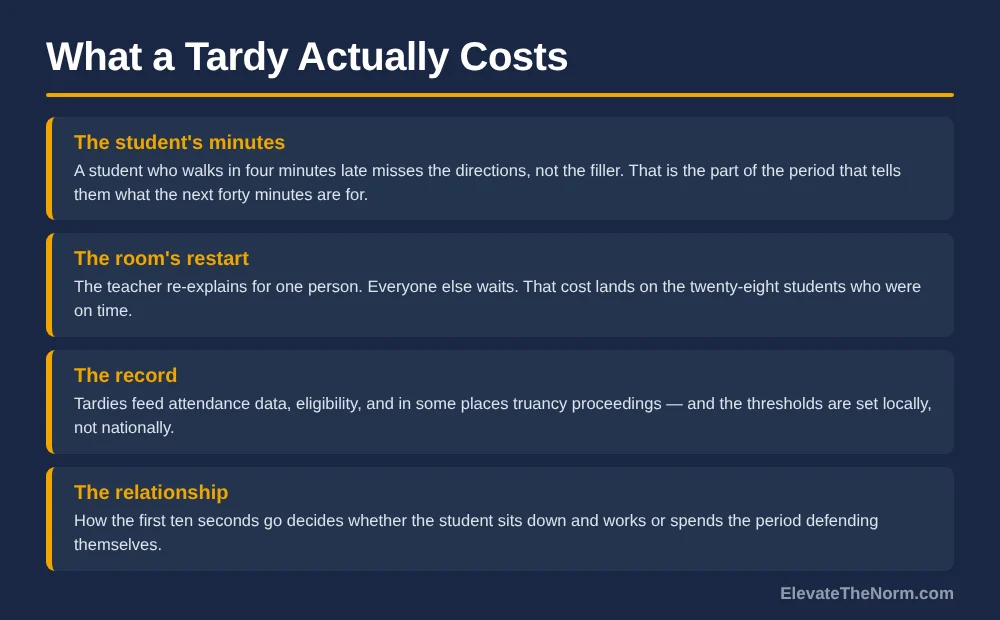
Four things, and only one of them is the minutes. If your policy only accounts for the minutes, it will keep producing rules that make the other three worse.
The first cost is the student’s. The opening of a period is not padding. It is where the directions live, where the day’s question gets posted, where whatever is already on the board when students walk in is doing its work. A student who misses four minutes has not missed four minutes of content. They have missed the part that explains the next forty.
The second cost is the room’s. When a teacher stops to re-explain for one person, twenty-eight people wait. Do that three times a period and the tardy policy is costing the class more than the tardiness.
The third is the record. Tardies feed attendance data, athletic eligibility, and in some districts the early steps of a truancy process. That matters to a student well after you have forgotten the day.
The fourth is the relationship, and it is the one teachers control completely. How the first ten seconds go decides whether the student sits down and works or spends the period building a case for why it was not their fault.
What Is a Tardy Response That Escalates Properly?
One that distinguishes a single late arrival from a pattern, and responds to the pattern rather than to the incident. Here is a four-tier structure that does that. It is a recommendation, not a mandate, and it assumes you have read your school’s policy first.

Tier 1 is to say nothing. A student walks in late, you hand them the materials, point at the board, and keep teaching. No announcement, no sign-in ritual that stops the class, no raised eyebrow performed for the room. This feels like doing nothing. It is not. It is refusing to spend the class’s attention on one person’s arrival, and it is the move that keeps a late student from becoming a late and defensive student.
Tier 2 is thirty seconds at the door, on a second or third tardy in a short window. Not while you are mid-explanation — the moment the class is working independently, you walk over. Quiet, private, specific, and — this is the part people skip — a question rather than a verdict. What is happening before this class? What would have to change for you to be here on time tomorrow? You are collecting a cause. The same logic governs any consequence worth using: it has to be related to the behavior, and you cannot make it related until you know what the behavior is about.
Two cautions on that conversation. It happens at a volume the next row cannot hear, because a doorway conversation is not private by default. And a student does not owe you a medical or family explanation — “something I can’t really get into” is a complete answer, and the right response to it is to move to a scheduling fix rather than to push. Start the written record here, not at Tier 4: date, time, and one line of what the student said. You will want it later and you will not remember it.
Tier 3 is to make the cause the plan. By now you know whether this is a locker on the wrong end of the building, a class that releases late, a bathroom situation nobody wants to discuss, or a student who is genuinely choosing the hallway. Change something concrete. Then contact home — with information, in the Rogers and Feller shape. Not “your son is disrupting my class,” but “here is the count, here is what it is costing, here is what we are trying.” If you need the structure for that conversation, deciding in advance who you contact and at what point is what keeps it from becoming a complaint call.
Tier 4 is to hand it to the system, with your dated notes attached. The obstacle is outside your room: transportation, a schedule conflict, something at home. Do not invent a classroom consequence for a transportation problem. That is not firmness, it is a category error, and students can tell.
Be realistic about what Tier 4 buys you. One counselor covering four hundred students is not going to solve a schedule next period, and a referral is not a handoff — you are still the adult that student sees every day. Keep running Tier 1 while the referral works its way through. And tell students the tiers exist. A ladder nobody has described is not a system, it is a surprise, and teenagers are right to resent being escalated through something they were never shown.
Which Tardy Rules Backfire?
The ones that remove instruction to punish missing instruction. Three show up constantly, and all three are worth retiring.
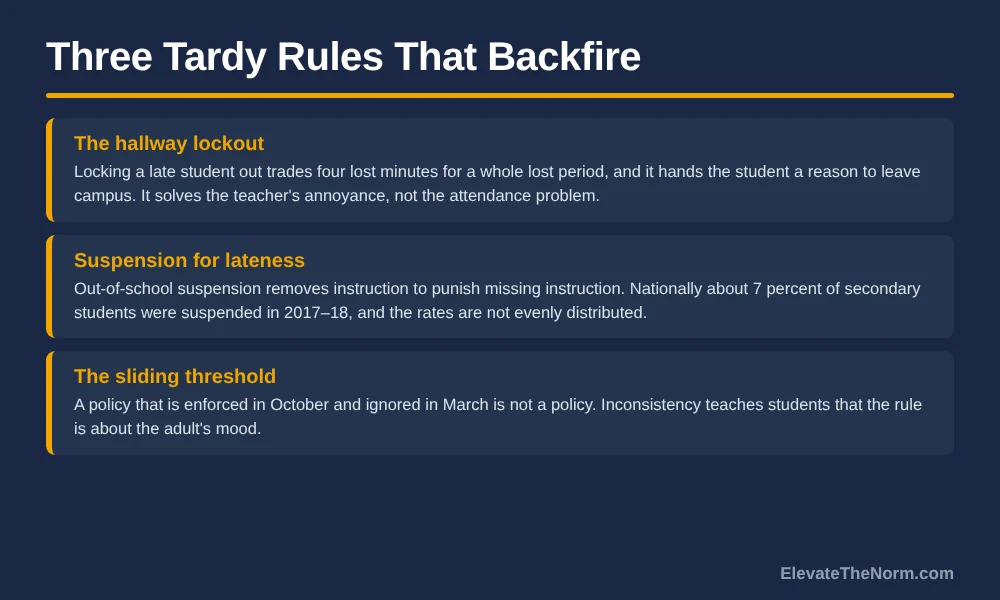
The hallway lockout trades four lost minutes for a whole lost period. It also puts an unsupervised teenager in a hallway, which is a supervision problem you just created, and it hands a student who was already struggling to get to class a reason to stop trying. To be fair to the practice: a staffed tardy room where a student signs in, gets the day’s materials and is walked back to class is a different animal, and some schools run one well. The failure mode is the unsupervised version, where “you can’t come in” is the whole intervention.
Suspension for lateness is the same error with the volume up. The Learning Policy Institute’s 2022 analysis of federal Civil Rights Data Collection figures found that in 2017–18, nearly 1 in 14 secondary students — about 7 percent — received at least one out-of-school suspension, and the burden was not evenly spread: 12 percent of Black students, 9 percent of students with disabilities, and more than 1 in 4 Black boys with disabilities in secondary schools. Those numbers cover all suspensions, not tardiness alone. But when a tardy ladder has suspension at the top of it, that ladder is feeding this distribution, and it is worth knowing what you are feeding.
The sliding threshold is the quiet one. A policy enforced in October and ignored in March is not a policy; it is a mood. Students read inconsistency accurately and conclude that the rule was about the adult all along. If you cannot sustain a response for the whole year, write a smaller one you can.


How Do You Make a Tardy Policy Hold?
Teach the transition, then do exactly what you said you would do, every time. That second half is the entire difference between a policy and a sign.
Tyre and colleagues’ intervention is instructive here precisely because it is unglamorous. They taught transition behavior explicitly, the way you would teach anything else, rather than assuming teenagers already knew. That is the same logic behind teaching a routine so it actually holds past September — you do not get a routine by announcing it.
Explicitly teaching a transition is less abstract than it sounds. It means naming the three things that have to happen between the bell and the start — bag down, materials out, first task started — walking the class through them once at normal speed, and then narrating what you see for the first week until it stops needing narration. Thirty seconds a day for five days. That is the whole scaffold, and it is the cheapest thing in this article.
Taking control of a classroom is done by organization to the minute, and then you pause. Both halves matter. The posted plan is a budget and a promise; the pause is where you stop talking and let the room settle without filling the silence or raising your voice. A start-of-class routine that works does most of your tardy enforcement for you, because the student who walks in late finds a room already working and slides into it rather than interrupting it.
One more thing about the door, and this is the part I would keep if I had to throw the rest out. When students walk through that doorframe, they have 100 percent of my respect. That is not softness and it is not a slogan I printed. It is a statement about where the line is: whatever happened in the hallway, in the last class, or at home, the price of entry is nothing. You still owe me the work. You do not owe me an apology for existing in the doorway at 9:04.
What About the Student Who Is Always Late for a Reason You Cannot Fix?
Stop treating it as a discipline problem and start treating it as a scheduling problem. Some of these are genuinely outside the room: a student who takes a sibling to a different building, a bus that runs late, a medical routine, a class that physically cannot release in time to cross campus.
For those students, the honest answer is that the tardy ladder has nothing to offer and should be taken off the table. Document it, loop in the counselor, and ask for the schedule to change. What you can still do is make the opening of your class recoverable — the question on the board, the directions written down, a neighbor who knows the routine well enough to catch them up in thirty seconds. That is not lowering the standard. The standard is the work, not the clock.
How Does This Fit With School Policy and State Law?
Your classroom rule has to sit inside your school’s rule, and your school’s rule sits inside a state framework that is less specific than most people assume. Compulsory attendance laws exist everywhere, but as the Education Commission of the States documented in its survey of state truancy definitions, “for the most part, compulsory attendance laws do not specify the number of times a student must be truant before sanctions are enforced,” and in many states the thresholds are set by local boards rather than by the legislature. The examples range from five days in a school year in one state to ten full days or seven consecutive days in another.
Practically, that means two things. Whether a tardy ever converts into an absence, and at what point, is a local decision you need to look up rather than guess. And a classroom rule that is harsher than the district’s written policy is a liability, not a virtue — especially for a student with an IEP or a 504 plan, where attendance-related consequences can run straight into an accommodation.
What to Do Next
Pick one thing. If your current response to a late student is a comment to the room, drop it this week and replace it with Tier 1 — materials, a point at the board, keep teaching. That single change costs nothing, takes no planning, and removes the most common way a four-minute problem becomes a forty-minute one.
Then, before you write anything down: read your school’s actual tardy language, count how many tardies your worst-hit class period really has over two weeks, and ask three of those students what is happening before your class. You will almost certainly find the problem is more boring, and more fixable, than it looked from the front of the room.
When you do write it down, publish it twice — once to students, in the words you will actually use, and once to families, before anybody gets a phone call. A policy a parent first hears about at Tier 3 sounds like an ambush no matter how reasonable it is. And leave a route open: a student who has a scheduling problem should be able to say so without it reading as a confession, which usually means a one-line note or a two-minute conversation you have offered in advance rather than one they have to request in front of the room.
Frequently Asked Questions
How many tardies should trigger a consequence?
There is no national answer, and anyone who gives you one is quoting their own district. Compulsory attendance laws exist in every state, but as the Education Commission of the States documented, most of them do not specify how many incidents trigger sanctions, and in many states the threshold is set by the local board. Look up your district’s written number first and build your classroom ladder inside it. A classroom rule that is harsher than the district policy is a liability, not a virtue.
Should a tardy ever count as an absence?
That is a local decision, not a judgement call you get to make at your door. Some districts convert a certain number of tardies into an absence or count arrival after a set point as a half-day absence; others do not. It matters because attendance records feed eligibility and, in some places, truancy proceedings. Find the rule in writing before you tell a student or a parent how it works.
Is it fair to respond differently to different students?
Yes, and a policy that cannot do that is the unfair one. A student who is late twice in a semester and a student who is late nine times because of a bus do not have the same problem, and giving them the same consequence only looks like fairness. What has to stay identical is the standard and the process: everybody gets the same ladder, described in advance, applied in the same order. What changes is the fix at the end of it.
What do I do about a student whose tardies are caused by their schedule?
Take the tardy ladder off the table and treat it as a scheduling problem. Document the pattern, loop in the counselor, and ask for the schedule or the route to change. In the meantime, make the opening of your class recoverable — directions written down rather than only spoken, the day’s question posted, and a neighbour who can catch them up in thirty seconds. The standard is the work, not the clock.
Should I lock late students out of the room?
No, not in the unsupervised version. Shutting a student into an empty hallway trades four lost minutes for a whole lost period, creates a supervision problem you did not have a moment earlier, and gives a struggling student a reason to leave campus. A staffed tardy room where a student signs in, collects materials and is walked back to class is a different thing and some schools run one well. The failure mode is when “you cannot come in” is the entire intervention.
How do I track tardies across five or six sections without losing my prep?
Keep it to one line. Date, period, name, and a few words of what the student said — in whatever you already open every day, not a new system. You are not building a case file; you are making sure that when you call home or write a referral you can say “nine times since the 12th” instead of “a lot.” That specificity is the whole reason the record exists, and Rogers and Feller’s attendance experiment is the evidence for it: families responded to an accurate count, not to a complaint.
What should I tell parents, and when?
Tell them the policy before anybody needs it, and make the first real contact informational rather than disciplinary. A parent who first hears about your tardy ladder when their child is already three steps up it will hear an ambush no matter how reasonable the ladder is. When you do call, lead with the count and what it is costing instructionally, then what you are trying. The strongest evidence in this area — a randomized experiment with 28,080 students — found that correcting parents’ beliefs about how much their child had actually missed reduced chronic absenteeism by 10 percent or more.
Does a classroom tardy policy work if the rest of the school does not have one?
Partly. You can control your own door, your start-of-class routine and your response, and those are the pieces that protect your instruction. What you cannot fix alone is a passing period that is physically too short or a building where supervision disappears between bells. The one tardiness study aimed squarely at secondary schools found results from a schoolwide approach — explicit teaching of transition behaviour, active supervision of common areas, and consistent consequences — which is a reminder that the hallway is not your jurisdiction and the school-level conversation is worth having.
Sources
- Tyre, Ashli, Laura Feuerborn, and Jennifer Pierce. “Schoolwide Intervention to Reduce Chronic Tardiness at the Middle and High School Levels.” Preventing School Failure, vol. 55, no. 3, 2011, pp. 132–139. Schoolwide intervention combining explicit teaching of transition behavior, active supervision during transitions, and consistent consequences; average daily tardiness “decreased substantially” and was maintained over time. Cited from the published abstract via the ERIC record; the abstract reports no magnitude, so no percentage is quoted here. https://eric.ed.gov/?id=EJ923238
- Rogers, Todd, and Avi Feller. “Reducing Student Absences at Scale by Targeting Parents’ Misbeliefs.” Nature Human Behaviour, vol. 2, no. 5, 2018, pp. 335–342. Randomized experiment, 28,080 high-risk K–12 students; personalized mailings correcting parents’ beliefs about accumulated absences reduced chronic absenteeism by 10% or more in the most effective versions, with spillover to untreated siblings. This study measures full-day absences, not tardiness; the transfer to lateness is an inference and is labelled as one in the text. https://www.nature.com/articles/s41562-018-0328-1
- Leung-Gagné, Melanie, Jennifer McCombs, Caitlin Scott, and Daniel J. Losen. Pushed Out: Trends and Disparities in Out-of-School Suspension. Learning Policy Institute, 2022. Analysis of federal Civil Rights Data Collection figures; in 2017–18, 7% of secondary students, 12% of Black students, 9% of students with disabilities and 27% of Black boys with disabilities in secondary schools received out-of-school suspension. Figures cover all out-of-school suspensions, not suspensions for tardiness specifically. https://learningpolicyinstitute.org/product/crdc-school-suspension-report
- Frey, Dinah. Truancy and Habitual Truancy: Examples of State Definitions. Education Commission of the States, updated April 2011. Documents that compulsory attendance laws generally do not specify the number of incidents triggering sanctions, and that thresholds are set at district level in some states and state level in others; 23 state examples with widely varying definitions. Dated 2011 — verify your own state’s current statute before relying on it. https://www.ecs.org/clearinghouse/92/39/9239.pdf
- “A Primer on Attendance and Absenteeism on the Nation’s Report Card and Beyond.” National Assessment Governing Board. Defines chronic absenteeism as missing 10% of instructional days — 18 or more days in a 180-day year — counting excused absences, unexcused absences and suspensions; reports that in 2022, 22% of 4th graders said they had been absent five or more days in the previous month, double the 2019 figure. The NAEP survey question captures full-day absence only, not late arrival. https://www.nagb.gov/naep/chronic-absenteeism.html