By Clay Shumate
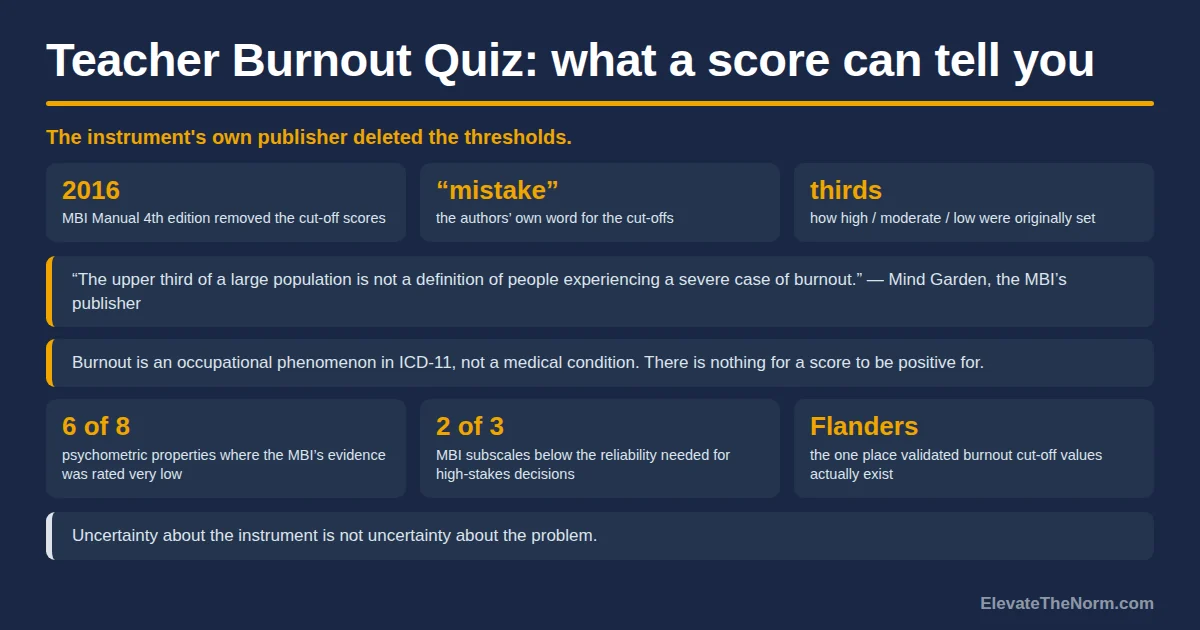
No online teacher burnout quiz can tell you whether you have burnout. The best-known instrument in the field, the Maslach Burnout Inventory, removed its cut-off scores in 2016 because they had no diagnostic validity, and its publisher says outright that it is not a clinical diagnostic tool. What is worth doing instead is describing the job rather than scoring yourself.
If you typed the question at eleven at night and wanted a number, that is a reasonable thing to want. A number feels like permission. The problem is not that you wanted one — it is that nobody has built one that works on a person.
This page is about the instruments. For the word itself, start with what the word covers, and the three dimensions every instrument is trying to catch; for what the three symptoms look like in a 6–12 room, the symptom picture, described rather than scored. What follows is the measurement question, and it ends in a reflection sheet that returns no score on purpose.
Key takeaways
- The Maslach Burnout Inventory deleted its cut-off scores in 2016. Its publisher says they went “due to having no diagnostic validity” and that the authors came to see them as a mistake.
- The original “high / moderate / low” labels were population thirds. You were “high” in exhaustion if you landed in the top third of a sample. A third of any group is in the top third.
- Burnout is not a medical diagnosis. The World Health Organization calls it an occupational phenomenon rather than a condition, so there is nothing for a score to be positive for.
- Measurement is not hopeless. Cut-offs do exist for one newer instrument — validated on Belgian workers, not American teachers.
- Uncertainty about the measure is not uncertainty about the problem. A weak instrument is no evidence that nothing is wrong.
- A self-report survey hears least from the staff with least security. Anyone whose renewal is a live question answers their employer carefully.
- Use five questions about the job instead. No rating scale, no total, no names. It ends with one sentence and one person to ask, not a result.
The Teacher Burnout Job Check
Two printable pages. Page one is the five write-in questions — load, control, recovery, support and direction — with room to answer in sentences and a boxed rule about what never goes on it. Page two is how to read the five answers together, the one sentence and one name they are supposed to produce, and the two rules for any school thinking about handing these out. It is not a screening instrument, there is nothing to add up, and it returns no score. Free. No email address required. Designed for grades 6–12.
Download the free PDFIs there a real teacher burnout quiz?
Yes. It runs to 22 questions, it costs money, and it will not tell you whether you have burnout.
The instrument teachers are looking for is the Maslach Burnout Inventory — Educators Survey, the version written for people who work in schools. Twenty-two items, ten to fifteen minutes, sold by Mind Garden — $20 for a self-report version, $50 for the manual, $2.75 a head to administer it with a fifty-person minimum.
So the free quiz you found is not the MBI. It cannot be. What it usually is instead is somebody’s paraphrase of the MBI’s items with a scoring rule bolted on, and the scoring rule is the invented part.
Then there is what the publisher says about its own product. Mind Garden’s page states that the MBI “is a research measure… but it is not a clinical diagnostic tool,” developed “to assess burnout as a continuum.” A continuum has no line on it that you cross.
Why did the Maslach Burnout Inventory remove its cut-off scores?
Because the people who built it decided the cut-offs were a mistake.
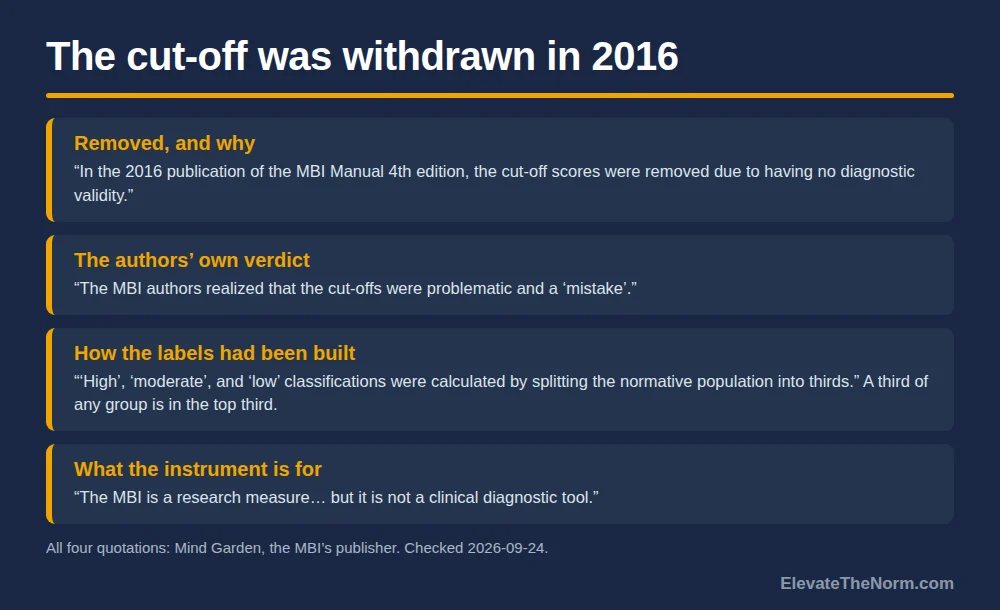
Mind Garden publishes a short document about it, worth reading in the publisher’s own words. “In the 2016 publication of the MBI Manual 4th edition, the cut-off scores were removed due to having no diagnostic validity” — and “the MBI authors realized that the cut-offs were problematic and a ‘mistake’.”
Here is how the original categories were built. “‘High’, ‘moderate’, and ‘low’ classifications were calculated by splitting the normative population into thirds — where a person was considered ‘high’ in emotional exhaustion simply because they scored in the upper third percentile of the population.” Then the line that should end the argument: “The upper third of a large population is not a definition of people experiencing a severe case of burnout.”
Read it as arithmetic and it gets clearer. A third of any group is in the top third of that group. Score a thousand teachers, label the top third “high burnout,” and you will label a third of them every time — in a brutal year and in a good one. The label tells you where somebody sits in a queue, not whether anything is wrong.
That is the machinery underneath most burnout quizzes online: a convenience the instrument’s own authors withdrew a decade ago, kept anyway.
How well can burnout be measured at all?

Better than nothing, worse than you would hope, and not well enough to draw a line.
The most systematic answer is a 2021 review in Epidemiology and Psychiatric Sciences that put five burnout instruments through COSMIN, a standard framework for rating measurement quality. The MBI had more validation studies behind it than any of the others and still came out with “very low quality of evidence on validity for six psychometric properties out of eight.” Only the Copenhagen and, less so, the Oldenburg inventory met the reviewers’ bar for valid medical use.
The same review explains why no quiz can honestly claim a threshold: “the absence of an accepted diagnostic standard precluded measuring sensitivity and specificity” for any of them. You cannot work out how often a test catches the thing, or cries wolf, when there is no agreed definition to check it against.
A second problem sits inside the MBI itself. A meta-analysis of 221 studies, 84 supplying usable reliability figures, found emotional exhaustion holding up reasonably well while the other two subscales did not: depersonalization and personal accomplishment were “well below recommended levels for high-stakes decisions, such as the diagnosis of burnout syndrome.” Two of the three scores a quiz hands back are the least reliable two.
One warning about how to read that. Uncertainty about the instrument is not uncertainty about the problem. Nothing here says teachers are fine, and none of it is a reason to answer a teacher who says the job has become unmanageable with a note about psychometrics. Correcting a measurement is not answering a complaint. For the size of the thing rather than the quality of the ruler, the same question asked of the national numbers.
So does any burnout score mean anything?
Yes, and this is the part a debunk usually skips.
In 2001 a team led by Wilmar Schaufeli tested the MBI on people who had actually sought psychological treatment, rather than on working adults well enough to be at work: 71 employees with work-related neurasthenia under ICD-10 criteria against 68 without. The three-factor structure held up, burnout was partly distinguishable from anxiety and depression, and two of the three scales — emotional exhaustion and depersonalization — discriminated between the groups. It measures something real, and it tracks a clinical distinction.
Cut-off scores exist too, for a newer instrument. The Burnout Assessment Tool’s manual reports norms against the Flemish and Dutch workforce, representative samples of 1,500 each, and states that “based on a group that suffers from serious burnout cut-off scores have been calculated. To date, such cut-off values are only available for Flanders.”
So the honest summary is narrower than either headline. Burnout can be measured, and for one instrument, in one region of Belgium, there are cut-offs built on a clinical sample. None of that describes a free web page scoring an American teacher against a threshold nobody validated here. The BAT norms are Belgian and Dutch workers across all occupations, not teachers. And the 2001 sample was people already in treatment — the opposite end of the pipeline from somebody searching at eleven at night.
Is burnout even a diagnosis?
No, and that is not a technicality.
The World Health Organization includes burn-out in ICD-11, but under “Factors influencing health status or contact with health services,” and states plainly that it is not classified as a medical condition. Its definition names the three dimensions the research uses: “feelings of energy depletion or exhaustion,” “increased mental distance from one’s job, or feelings of negativism or cynicism,” and “reduced professional efficacy.” It also “should not be applied to describe experiences in other areas of life.” It is a relationship with a job.
Two things follow. When a quiz reports “you have moderate burnout,” it is borrowing the grammar of diagnosis for something that is not one — there is no condition to be positive for, so nothing for the result to be right or wrong about. And the things nearby that are diagnosable — depression, anxiety, a thyroid problem, sustained sleep loss — get diagnosed by a person who can ask you a follow-up question. The overlap with depression in particular is real and unsettled, and the symptom page goes through what is and is not distinguishable.
What to use instead: five questions about the job

Stop measuring yourself and start describing the job.
That switch is not a way of dodging the question you came with. It is that between you and the job, the job is the part that can change. Every instrument above tries to detect a state inside a person; the research keeps pointing at the position instead — the demands loaded onto it, the resources attached to it. That is the Job Demands–Resources frame, and it makes the useful exercise a job description rather than a self-rating. Five questions, answered in sentences rather than scores.
- Load. What is on my plate this year that was not on it last year?
- Control. Which of those did I choose?
- Recovery. In a normal week, when am I off the clock and actually off?
- Support. Who do I ask when something goes wrong, and did I ask them this month?
- Direction. Is this heavier, lighter, or about the same as three months ago?
Four rules are the difference between this and a quiz.
- No rating scale and no total. No one to five, no counting, no “if you answered yes to three.” Everything above about invented cut-offs applies to one you invent for yourself at the kitchen table.
- Question five is the only comparison, and it compares the job to itself — not you to other teachers. Direction is the honest version of what a score was pretending to give you.
- No names on it. Not a student’s and not a colleague’s; describe the situation. A sheet with a student’s name on it stops being private reflection and becomes a record about a child.
- Paper, and off the district network. A work device is not a private place to write down that you are not coping.
You should end with two things: one sentence describing the job, and the name of one person who could change one item on it. That is the output — not a number, not a category, not a verdict on whether you are the kind of teacher who copes. For which of your answers is even addressable, which items on that list somebody with a title can actually lift; to write it somewhere built for it, a blank page built for exactly this kind of writing.
Question four most often has a fixable answer, and it is the one worth taking to a coach or a department chair, because knowing who to ask is learnable rather than a personality trait. But keep the categories straight: a coaching cycle offered in place of removing an item from question one will be read as exactly that. And take one item to that person, not the sheet — a completed sheet handed across a desk reads as the opening of a grievance, which is not what you were doing.
If the honest answer to question four is that there is nobody — you are the only person teaching your course, the chair is the problem, the building is between principals — write the item down anyway. A written description of the job is what you need for every conversation after this one, including the one about whether to stay.
A note for the people in a school who get scored most, which is the students. The question this page turns on is worth owning — what was this cut-off built from, and who decided where it went? — and it applies to a reading-level band or a benchmark percentile too. Sometimes the answer is solid. Sometimes somebody split a population into thirds. That is a fair thing for a sixteen-year-old to ask about a number attached to their name.

What a school should never do with this
Turn it into a threshold.
The failure mode is easy to walk into with good intentions. A district likes the five questions, prints them for a faculty meeting, and adds one line at the bottom: three or more flagged, refer for follow-up. It has now built the kind of cut-off the MBI’s own authors withdrew in 2016 for having no diagnostic validity — except this one has no normative sample behind it at all, and it is attached to somebody’s employment.
The second rule is do not collect them. A reflection sheet is honest precisely because nobody is going to read it; ask teachers to hand it in and what comes back is the set of answers people give their employer. Harder version of the same point: a collected sheet is a record, records can be requested, and a district holding staff-written statements that the workload is unmanageable has documented its own notice. If you are going to ask, intend to act — and the records a district already keeps are better material than a survey. Sections, preps, duties, coverage days and time-to-fill are facts, not self-reports.
There is a constructive version of the five questions for an administrator, and it is not screening: ask them of a role rather than a person. Take one position on paper, before anybody is in it, and answer load, control, recovery and support about the job as written. That is a scheduling conversation, it belongs to whoever builds the master schedule, and it can be answered in August while something can still be done.
One more reason to be careful with self-report, and it is not about psychometrics. The staff most likely to give a careful, unrevealing answer to a workplace questionnaire are the ones with the least security — anyone new, anyone whose renewal is a live question. A survey does not just measure the job imprecisely; it hears least clearly from the people whose jobs are hardest to refuse.
What to do next
Take the five questions onto any piece of paper, or print the sheet above. Answer question five first, because it is the one that tells you something. Write your sentence about the job, name the person who could change one item, and ask for that one thing.
Then keep the two questions apart, because that is this page’s whole argument. “Is this job too heavy?” is answered by describing the job. “Am I all right?” is not, and if the honest answer is that something is wrong in a way a schedule change would not touch, that is a conversation with your doctor or a counselor — and if you are not sure who that would be, the checked list of who that person could be. A person who can ask you a follow-up question, not a page that hands back a score.
Want it as a printable? Download The Teacher Burnout Job Check (2 pages, free, no email required) — five questions, no scale, and nothing to total up.
Frequently asked questions
Is there a free teacher burnout quiz that actually works?
Not in the sense you are hoping for, and the reason is not that the free ones are cheap imitations of a good paid one. The paid instrument does not do it either. The Maslach Burnout Inventory’s publisher removed its cut-off scores from the 2016 manual “due to having no diagnostic validity” and states that the MBI “is a research measure… but it is not a clinical diagnostic tool.” A free quiz that hands you a category is using a threshold the instrument’s own authors withdrew. What a free page can honestly give you is a set of questions about the job and no score, which is what the sheet on this page is.
Can I take the Maslach Burnout Inventory myself?
You can buy access to it. Mind Garden sells a self-report version for $20 and the manual for $50, and the Educators Survey is the 22-item version written for people who work in schools. What you will not get is a verdict. You will get three subscale scores on a continuum with no cut-offs, because the cut-offs were deleted. Worth knowing before you spend the money: a 2011 meta-analysis of 221 studies found the depersonalization and personal accomplishment reliabilities “well below recommended levels for high-stakes decisions, such as the diagnosis of burnout syndrome.” Two of your three numbers are the shaky ones.
Why does this site not publish a burnout quiz?
Because a quiz implies a threshold and there is no validated threshold in this literature for a person to cross. A 2021 COSMIN review of five burnout instruments reported that “the absence of an accepted diagnostic standard precluded measuring sensitivity and specificity” for any of them — meaning nobody can say how often a burnout test is right, because there is no agreed definition of the condition to check it against. Publishing a scored quiz anyway would mean inventing a line and putting this site’s name on it. The five questions on this page return no score on purpose.
Can a quiz tell burnout apart from depression?
No. The one study that tried the clinical version of this question — testing the MBI on 71 employees in treatment for work-related neurasthenia against 68 who were not — found burnout could be partly distinguished from anxiety and depression, with two of three subscales discriminating between the groups. Partly, in a clinical sample, by researchers. That is a long way from a web page sorting the two from twenty questions. If the distinction matters to you right now, it matters enough for a doctor or a counselor rather than a page.
My school wants to give the staff a burnout survey. Is that a good idea?
It can be, with two conditions. Do not attach a threshold to it and do not tie it to any individual. A scoring line invented for a faculty meeting is the same mistake the MBI’s authors corrected in 2016, with no normative sample behind it and employment attached. And be realistic about what a survey hears: the staff with the least job security give the most careful answers, so the people whose workloads are hardest to refuse are the ones you will hear from least. Counting what the district already records — sections, preps, duties, coverage days, time-to-fill — is usually better material, and it is fact rather than self-report.
If the measures are this shaky, is teacher burnout even real?
Yes, and that inference is the one misuse of this page worth naming. Uncertainty about a ruler is not uncertainty about the thing being measured. The World Health Organization defines burn-out in ICD-11 as an occupational phenomenon with three dimensions; what it declines to do is call it a medical condition. Weak instruments make the rate hard to pin down. They say nothing about whether a particular job has become unmanageable, and answering a teacher who says so with a note about psychometrics is not a reply.
I am a parent and I think my child’s teacher is burned out. What should I do?
Start from the same place this page ends: you cannot score a person from outside, and a validated instrument administered by researchers struggles to do it from inside. What you can do is describe what you have actually seen — work coming back slowly, a class that seems to have lost its shape — and raise it with the school as a question about the class rather than a judgment about the adult. Two things to avoid: do not ask your child to report on how their teacher seems, which puts a kid in the middle of an adult problem, and keep it out of the class group chat. A teacher’s apparent state is not community information.
I am a student and my teacher seems exhausted. Is that because of us?
No. How many classes a teacher has, how many students are in each one, how many duties come with the job and whether there is any time in the day to recover are decisions made by adults, before you walked in. Nothing on this page measures a student and none of the research behind it asked one anything. You are allowed to notice that a class has gone flat, and if it is affecting your work the person to tell is a counselor or another teacher you trust — describe the class, not the person. What is not yours is fixing an adult’s workload.
Sources
- Mind Garden. Cut-Off Scores for the Maslach Burnout Inventory. The publisher’s statement that the cut-off scores were removed from the 2016 MBI Manual 4th edition “due to having no diagnostic validity,” that the authors regarded them as a “mistake,” and that high / moderate / low “were calculated by splitting the normative population into thirds.” mindgarden.com
- Mind Garden. Maslach Burnout Inventory — Educators Survey (MBI-ES). 22 items, three subscales; prices as listed 2026-09-24. States the MBI “is a research measure… but it is not a clinical diagnostic tool.” mindgarden.com
- World Health Organization. Burn-out an “occupational phenomenon” (ICD-11, QD85). Listed under “Factors influencing health status or contact with health services” and not classified as a medical condition. who.int
- Shoman, Y., Marca, S. C., Bianchi, R., Godderis, L., van der Molen, H. F., & Guseva Canu, I. (2021). Psychometric properties of burnout measures: a systematic review. Epidemiology and Psychiatric Sciences, 30, e8. 19 studies, 5 instruments, COSMIN-rated. Read in full via KU Leuven Lirias. doi.org
- Wheeler, D. L., Vassar, M., Worley, J. A., & Barnes, L. L. B. (2011). A reliability generalization meta-analysis of coefficient alpha for the Maslach Burnout Inventory. Educational and Psychological Measurement, 71(1), 231–244. 221 studies, 84 usable alphas. doi.org
- Schaufeli, W. B., Bakker, A. B., Hoogduin, K., Schaap, C., & Kladler, A. (2001). On the clinical validity of the Maslach Burnout Inventory and the Burnout Measure. Psychology & Health, 16(5), 565–582. 71 employees in treatment for work-related neurasthenia (ICD-10) against 68 without. Read via the PubMed abstract; the full text was not reachable from this session and nothing beyond the abstract is claimed. pubmed.ncbi.nlm.nih.gov
- Schaufeli, W. B., De Witte, H., & Desart, S. (2020). Manual Burnout Assessment Tool (BAT), version 2.0. Norms on representative Flemish and Dutch workforce samples, N = 1,500 each; workers across occupations, not teachers, and not a United States sample. burnoutassessmenttool.be
- Hawrot, A., & Koniewski, M. (2018). Factor structure of the Maslach Burnout Inventory–Educators Survey in a Polish-speaking sample. Journal of Career Assessment, 26(3), 515–530. 1,206 teachers. The three-factor model did not fit well; a bifactor model fit best, so the MBI-ES behaves more like one overall measure than three independent dimensions. Polish primary school teachers — not a United States secondary result, cited for the structural finding only. doi.org
Every source above was opened and read on 2026-09-24. Where one could not be opened in full, the list says which abstract was read instead. No figure on this page went unchecked against the document that produced it.
About Clay Shumate
Clay Shumate is a certified secondary Social Studies teacher in the public schools of West Alabama, with seven years of classroom experience, a B.A. in History, and an M.Ed. in Secondary Education. He writes about project-based learning, student responsibility, respect, and practical ways to hold young people to a higher standard while giving them room to learn from mistakes.