Formative assessment strategies are the moves a teacher makes to find out what students understand while there is still time to do something about it. Not a quiz average. Not a unit test. A signal you collect during the lesson and act on before the lesson is over. Below is a working list of them — organised by the five strategies the research actually names, then by the point in the period where you would reach for each one.
One warning before the list: collecting the information is the easy half, and it is the half most lists stop at.
Key Takeaways
- There are five key formative assessment strategies, not fifty. Everything else on this page is a technique serving one of them.
- A technique is only formative if you change something because of it. An exit ticket you never read is a closing routine, not an assessment.
- The honest effect size is about 0.20, not 0.70. Real, worth doing, not magic.
- Attaching a grade undercuts the feedback. Comments alone outperformed comments-plus-a-grade in the most-cited study on this.
- Pick two techniques and run them for a month rather than sampling twenty. The routine is what produces the data, not the novelty.
What Are Formative Assessment Strategies?
A formative assessment strategy is any deliberate method for gathering evidence of student understanding during instruction and using that evidence to adjust what happens next. The two halves are equally load-bearing. Gathering evidence you never use is not formative assessment; it is data collection. Adjusting instruction based on a hunch is not formative assessment either; it is guessing.
The distinction people usually reach for is timing — formative during, summative after — and that is mostly right but slightly off. A unit test can be used formatively if you read it, find that two-thirds of the class missed the same standard, and reteach it. A daily exit ticket is not formative if it goes in a pile. The word describes what you do with the information, not when you collected it.
What Are the 5 Formative Assessment Strategies?
The framework almost every other list is downstream of comes from Siobhan Leahy, Christine Lyon, Marnie Thompson and Dylan Wiliam, writing in Educational Leadership in 2005. They identified five core strategies:1
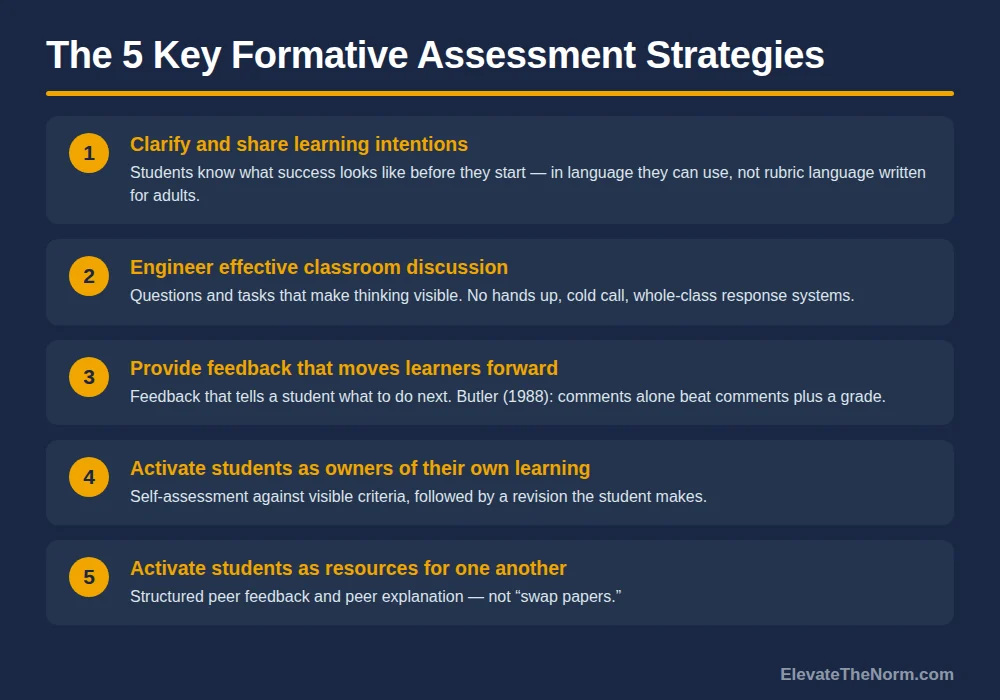
- Clarifying and sharing learning intentions and criteria for success. Students cannot hit a target they cannot describe.
- Engineering effective classroom discussions, questions and tasks that elicit evidence of learning. The key word is engineering — designing the question so that the answer tells you something.
- Providing feedback that moves learners forward. Feedback that describes the gap and names the next action.
- Activating students as owners of their own learning. Self-assessment and self-monitoring.
- Activating students as instructional resources for one another. Structured peer feedback and peer explanation.
Notice that only the second one is about collecting information. The other four are about what surrounds the collection — whether students know the target, whether the feedback is usable, and whether students can act on it without you. That ratio is the whole point, and it is why a list of twenty exit-ticket variations is not a formative assessment programme.
A List of Formative Assessment Strategies You Can Use Tomorrow
These are the techniques, grouped by where they fit in a period. None of them requires technology, a purchase, or a planning period you do not have.
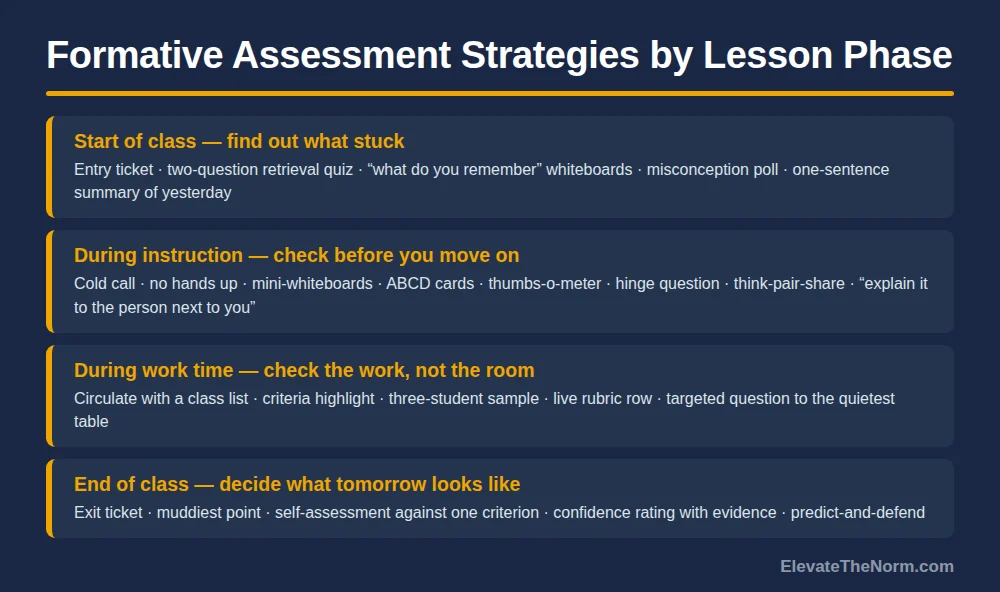
Start of class — find out what survived the night
- Entry ticket. Two questions on yesterday’s material, answered before anything else happens.
- Retrieval quiz, ungraded. Three questions, self-scored, no record kept. The point is the retrieval, not the score.
- Misconception poll. Offer the wrong answer students usually give as one of the options and see how many take it.
- One-sentence summary of yesterday. Fast, and the vagueness of the sentences tells you as much as the content.
During instruction — check before you move on
- Cold call with no hands up. Hands-up sampling tells you what your four most confident students think. Nothing else.
- Mini-whiteboards. Every student answers, every answer is visible at once, and it takes eight seconds. Still the highest-yield low-tech move available.
- Hinge question. One multiple-choice question at the pivot point of the lesson, written so each wrong option corresponds to a specific misunderstanding. If more than a quarter of the room misses it, you do not go on.
- ABCD cards or finger votes. A mini-whiteboard substitute when you have thirty seconds and no markers.
- Think-pair-share with a required report-out. The report-out is what makes it assessment rather than conversation.
- Ask a student to explain it to the person beside them. Explanation exposes gaps that recognition hides.
During work time — assess the work, not the room
- Circulate with a class list. Tick who you actually looked at. Most of us overestimate this badly.
- The three-student sample. Read one strong, one middling and one struggling student’s work in the first five minutes. You will know whether the task is landing before you have wasted the period.
- Criteria highlight. Students mark the sentence or step meeting each criterion. What they cannot highlight is the revision.
- Live rubric row. Score one row of the rubric, out loud, on a volunteer’s work, on the document camera.
End of class — decide what tomorrow looks like
- Exit ticket. One question. One that actually discriminates — not one everybody gets right.
- Muddiest point. “What is still unclear?” Students are more honest here than on a content question.
- Self-assessment against one criterion. Not the whole rubric. One row.
- Confidence rating with evidence. A number plus one sentence defending it. The sentence is the data.
A note on cold call, because it is easy to do badly
Cold call is the most effective technique on that list and the one most likely to go wrong. Done carelessly it is a gotcha, and a teenager who has been embarrassed in front of thirty peers will not take a risk in your room again for a long time. Three things make it safe. Ask the question, then pause, then name the student — so everyone has to think, and the named student has had the same processing time as everyone else. Accept “I need a minute” and come back to them, genuinely, so it is not a way out but is also not a trap. And make a wrong answer useful out loud — “that is the answer most people give, and here is why it is tempting” — so being wrong in public is survivable. Students who need more processing time, students still acquiring English, and students with anxiety-related plans all benefit from the pause; so does everyone else.
The same principle applies to every technique here. A student will only tell you honestly that they do not understand something if doing so is safe. Every formative assessment strategy on this page depends on that, and none of them will work in a room where it is not true.
If you want these in a printable form rather than rebuilding the list each term, the free formative assessment strategies PDF collects them in a ready-to-copy pack. No email required.
The Part Most Lists Skip: What You Do With the Information
Here is the failure I would bet on if I walked into a school that had just done a formative assessment PD day. Teachers will be running exit tickets. Very few will have changed a lesson because of one.
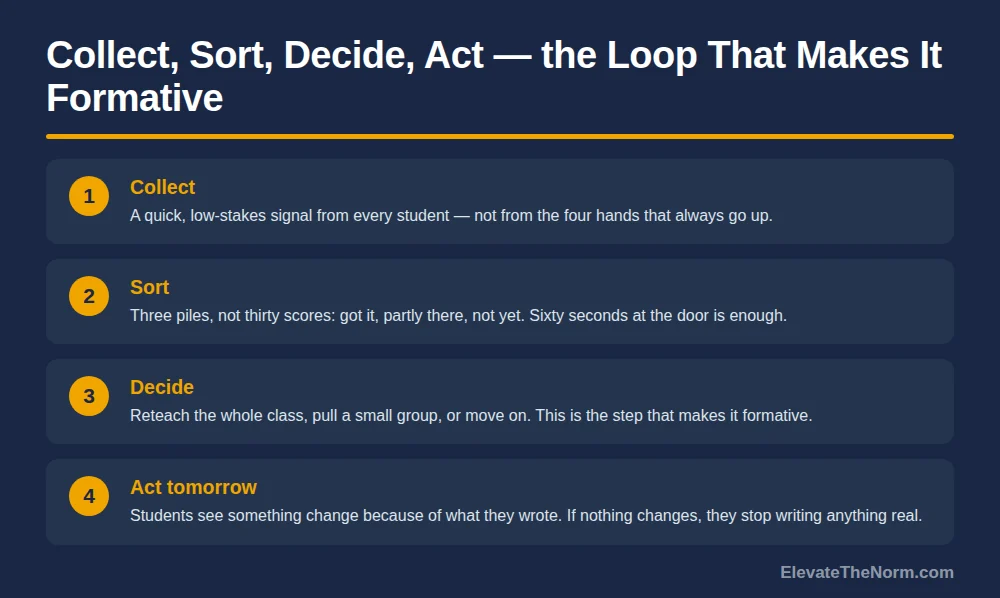
Collect. A signal from every student, not from volunteers. This is the part everyone already does.
Sort. Three piles, not thirty scores: got it, partly there, not yet. You can do this standing at the door as students leave. Sixty seconds. Resist the urge to record anything.
Decide. Reteach the whole class, pull a small group tomorrow, or move on. That is the entire decision space, and making it is what converts a technique into formative assessment. If the answer is always “move on,” your question was not discriminating enough to be worth asking.
Act, visibly. Students need to see something change because of what they wrote. Say it out loud: “Eleven of you missed the second question yesterday, so we are starting there.” A class that never sees its exit tickets change anything will start writing whatever gets them out the door fastest, and they will be right to.


What the Evidence Honestly Shows
Formative assessment has a reputation problem of the unusual kind: it is oversold, and the overselling has made careful people suspicious of something that is genuinely worth doing.
The number you have heard in a staff meeting is probably 0.70. It traces to Paul Black and Dylan Wiliam’s landmark 1998 review, which cited a 1986 meta-analysis by Fuchs and Fuchs reporting a mean effect of 0.70 across 21 studies — rising to 0.92 where teachers systematically reviewed the data and planned a response, against 0.42 where the response was left to teacher judgment.2 That last contrast is the most useful thing in the whole literature for a practising teacher, and it almost never gets quoted. Black and Wiliam themselves attached a caveat that also rarely travels: there is “no guarantee that it will do so irrespective of the context and the particular approach adopted.”2
Then the correction. Neal Kingston and Brooke Nash screened more than 300 K–12 formative assessment studies and concluded that most had “severely flawed research designs yielding uninterpretable results.” Thirteen were usable. Across those thirteen, the weighted mean effect size was 0.20, median 0.25 — and they published the paper explicitly as a corrective to the 0.70 figure.3 By subject: 0.32 in English language arts, 0.17 in mathematics, 0.09 in science. Professional development and computer-delivered implementations came in around 0.30 and 0.28.
An effect of 0.20 is not nothing. It is a modest, real gain from a practice that costs no money and adds no grading. But it is not the transformation the 0.70 implies, and the subject variation should make a science department sceptical of a one-size district mandate. If a consultant quotes you 0.70 without mentioning Kingston and Nash, you now know more than they do.
One more finding worth building policy around. In a study Black and Wiliam highlight, Ruth Butler found students given comments only improved substantially, while students given comments alongside a grade showed a significant decline — the grade appears to crowd out the comment entirely.2 If your formative assessment initiative ends with a number in the gradebook, you may have spent the effort and cancelled the benefit.
Additional Formative Assessment Strategies for Specific Situations
When the class is too large to read everything. Sample deliberately rather than comprehensively. Three students per period, rotated, gets you a picture of the whole room across a week without a single extra hour of reading.
When students will not write anything real. Usually a trust problem, not a compliance one. Make it anonymous for two weeks, act visibly on what comes back, then put names on it.
When you teach a skills subject rather than a content subject. Watch the process, not the product. A student who arrives at the right answer by a method that will fail next week has not understood it, and only the process shows you that.
When you need it to survive a substitute or a bad week. Pick the two lowest-effort techniques on this page — an entry ticket and a hinge question — and run only those. A routine that survives a bad week beats a system that collapses in one.
When students need to own it themselves. That is the fourth strategy on the list above, and it is substantial enough to have its own guide: what student self assessment is and how to introduce it without losing a week of class.
What Goes Wrong
Collecting more than you can act on. Four techniques in one period produces a pile of paper and no decisions. Two per week, acted on, beats ten per week filed.
Questions that do not discriminate. If everyone gets it right, you learned nothing. A good hinge question should split the room.
Grading it. See Butler, above. The moment it counts, students optimise for the score rather than tell you the truth.
Mistaking participation for understanding. A lively discussion carried by six students tells you about six students. This is what checking for understanding is for, and it is why every-student-responds techniques beat hands-up every time.
Making it an initiative. Formative assessment implemented as a compliance requirement — exit tickets collected and audited by an administrator — produces exit tickets and no instructional change. The 0.92-versus-0.42 contrast in the Fuchs data points at teachers systematically reviewing and planning, which is professional judgment, not paperwork.2
Where This Connects
Formative assessment only pays off if the grading system it feeds can absorb it. A standards-based grading scale makes that easier, because evidence gathered mid-unit has somewhere to go that is not an average. And the mirror-image practice for the adult in the room is teacher reflection — same loop, same logic, different subject.
Where to Start
Do not try to implement a list of formative assessment strategies. Pick two. One at the start of class and one at the end is a reasonable pairing — an entry ticket and an exit ticket, or a hinge question and a muddiest point. Run them for a month without adding anything. Sort the results into three piles and let one decision each week come from that sorting.
That is a smaller ambition than most professional development sells, and it is the version that is still running in March. The techniques on this page are not the hard part. Changing a lesson because of what a student wrote is the hard part, and it is the only part that makes any of it formative.
Frequently Asked Questions
What are the 5 formative assessment strategies?
Leahy, Lyon, Thompson and Wiliam named five in Educational Leadership in 2005: clarifying and sharing learning intentions and success criteria; engineering classroom discussions, questions and tasks that elicit evidence of learning; providing feedback that moves learners forward; activating students as owners of their own learning; and activating students as instructional resources for one another. Every technique on this page serves one of those five.
What is the difference between formative and summative assessment?
Summative assessment measures what a student has learned at the end of something and produces a record. Formative assessment gathers evidence during learning and produces a decision about what to do next. The cleanest test is not timing but consequence: if nothing about your teaching changes because of it, it was not formative, whatever it was called.
Should formative assessment be graded?
Generally no. In a study highlighted in Black and Wiliam’s 1998 review, Ruth Butler found students who received comments only improved substantially while students who received the same comments with a grade attached showed a significant decline. The grade appears to crowd out the comment. If credit must be given, give it for completing and acting on the work, not for how correct the first attempt was.
Is cold call unfair to anxious or quiet students?
It can be, and how you run it decides. Ask the question first, pause, then name the student, so everyone thinks and the named student gets the same processing time. Accept a request for a moment and genuinely come back. Treat wrong answers as useful information out loud. Handled that way, cold call reaches the students that hands-up questioning silently skips, which is usually the students who most need reaching.
How many formative assessment strategies should I use in one lesson?
One or two, and the same one or two for weeks. Four techniques in a period generates a pile of information and no decisions. The routine is what produces usable data, not the variety. Pick an entry point and an exit point, run them for a month, and let one instructional decision each week come out of them.
How does this work for students with IEPs, 504 plans, or English learners?
Build in processing time and give more than one way to respond. A pause before naming a student, a written option alongside a verbal one, sentence stems, and mini-whiteboards instead of on-the-spot speaking all widen access without changing the technique. These adjustments help the whole room, which is usually the sign that they are the right ones.
Why does my child seem to be assessed every single day?
Because these checks are not tests. Most take under two minutes, almost none are graded, and their purpose is to tell the teacher what to teach tomorrow rather than to judge your child. A student who writes down that they are confused has done the task correctly. If any of it is going into a gradebook, that is a fair question to ask the teacher, because the research suggests it should not be.
Does formative assessment actually raise test scores?
Modestly, on the best available evidence. Kingston and Nash screened more than 300 K-12 studies, found only 13 methodologically usable, and reported a weighted mean effect size of 0.20 with a median of 0.25, varying by subject from 0.32 in English language arts to 0.09 in science. That is a real gain from a practice that costs nothing, but it is well short of the 0.70 often quoted in professional development.
Sources
- Leahy, Siobhan, Christine Lyon, Marnie Thompson, and Dylan Wiliam. “Classroom Assessment: Minute by Minute, Day by Day.” Educational Leadership, vol. 63, no. 3, November 2005, pp. 18–24. ERIC EJ745452. https://eric.ed.gov/?id=EJ745452
- Black, Paul, and Dylan Wiliam. “Assessment and Classroom Learning.” Assessment in Education: Principles, Policy & Practice, vol. 5, no. 1, 1998, pp. 7–74. (Full text copy hosted by UC Riverside; includes the Fuchs & Fuchs 1986 and Butler 1988 findings discussed above.) https://assess.ucr.edu/sites/default/files/2019-02/blackwiliam_1998.pdf
- Kingston, Neal, and Brooke Nash. “Formative Assessment: A Meta-Analysis and a Call for Research.” Educational Measurement: Issues and Practice, vol. 30, no. 4, 2011, pp. 28–37. ERIC EJ951173. https://eric.ed.gov/?id=EJ951173
- Andrade, Heidi L. “A Critical Review of Research on Student Self-Assessment.” Frontiers in Education, vol. 4, art. 87, 2019. https://doi.org/10.3389/feduc.2019.00087
- Panadero, Ernesto, Anders Jonsson, and Juan Botella. “Effects of self-assessment on self-regulated learning and self-efficacy: Four meta-analyses.” Educational Research Review, vol. 22, 2017, pp. 74–98. https://doi.org/10.1016/j.edurev.2017.08.004