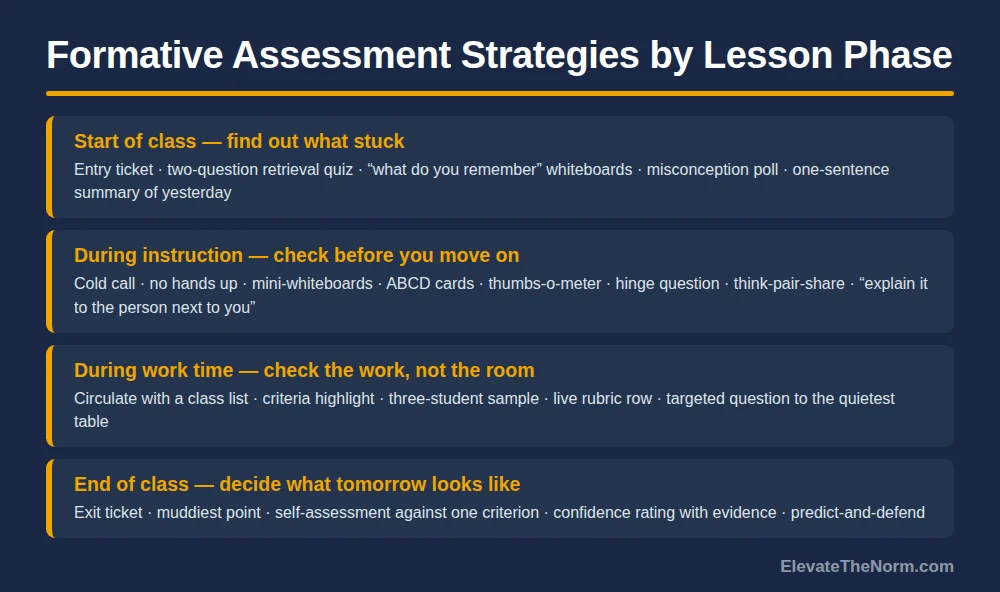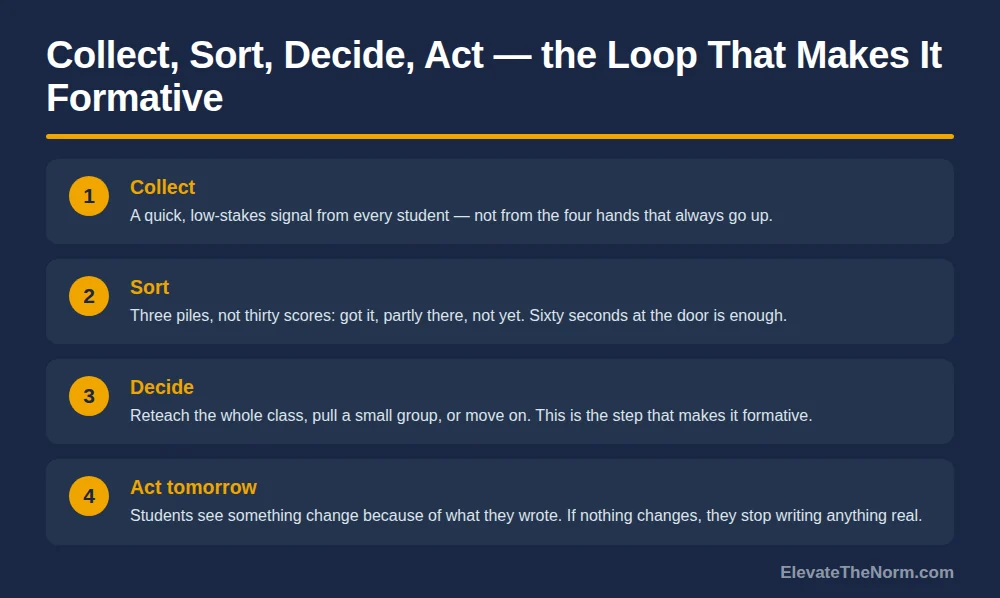
Tag: student engagement

  • Gallery Walk Activity: How to Run One So the Feedback Is Worth Reading

    Gallery Walk Activity: How to Run One So the Feedback Is Worth Reading

    By Clay Shumate

    A gallery walk activity posts student work around the room and sends classmates around to read it and leave written feedback. The walking is not what makes it work. The peer assessment underneath it is the part with research behind it, and that research says it only pays off when students are told exactly what they are looking for before they stand up.

    What follows is what the evidence actually supports, the one study at the right grade level and why it is weaker than it looks, and a six-step version that produces feedback worth reading instead of thirty sticky notes that say “good job.”

    Key Takeaways

    • Peer assessment has real evidence. The gallery walk format does not, separately. A meta-analysis of 54 control-group studies put peer assessment at g = 0.31 on achievement, and at secondary level specifically, g = 0.44.
    • Peer assessment beat teacher assessment in that analysis (0.31 versus 0.28) and tied with self-assessment. It is not a second-best substitute for your own marking.
    • Attaching a grade to peer feedback helped university students and did not help school students. Keep the walk ungraded in grades 6–12.
    • Feedback is not automatically good. Across 607 effect sizes, feedback raised performance on average but made it worse in over a third of cases — mostly when it pointed at the person instead of the work.
    • The single highest-leverage change is naming one focus before students circulate. Open-ended walks produce praise, not information.
    • If nobody revises anything afterward, you ran a walking tour. The revision block is the lesson, not the extra.

    Free Download · PDF

    The Gallery Walk Planner (2 pages)

    Page 1 plans the walk: the four decisions, the three sentence stems, the access check and the two rules that keep it fair. Page 2 runs it: the six steps in order, a student revision slip, and the four failure modes with their fixes.

    Download the free PDF

    Free. No email address required. Designed for grades 6–12. Browse every printable in Your Free Library.

    What Is a Gallery Walk Activity?

    It is a critique protocol: student work goes up on the walls or tables, students circulate in small groups, and each group leaves written feedback on what it sees. Then the authors read their feedback and change something.

    That last clause is the one teachers drop, and it is the one that turns the activity into instruction. Everything before it is logistics.

    The format is flexible in the ways that do not matter much and rigid in the one way that does. It works with drafts, lab write-ups, solved problems, design sketches, annotated sources, project prototypes. It works on paper taped to a wall or on a shared digital board. What it does not work without is a stated thing students are supposed to judge.

    Does a Gallery Walk Activity Actually Improve Learning?

    The peer assessment inside it does. The format itself has almost no rigorous evidence, and that is worth saying out loud because most articles about gallery walks imply otherwise.

    Double, McGrane and Hopfenbeck published a meta-analysis of peer assessment in Educational Psychology Review covering 54 experimental and quasi-experimental control-group studies. The overall effect on academic performance was g = 0.31 — small to medium, and statistically significant. Peer assessment outperformed no assessment and outperformed teacher assessment (g = 0.28). It showed no advantage over self-assessment.

    Two details in that analysis matter more for a grades 6–12 classroom than the headline number.

    First, the effect at secondary level was higher than the average: g = 0.44 across 13 studies. That runs against the usual pattern on this site, where secondary tends to be the weakest band in cooperative-learning research. Second, the effect held up across implementation choices — online or in person, anonymous or named, frequent or occasional, trained or untrained. None of those moderators came out significant. That is good news for a teacher deciding whether to buy clipboards: the fiddly choices are not where the result lives.

    There was one moderator that did split, and it splits against school students. Peer feedback that carried a grade significantly helped university students (g = 0.55). The same effect could not be shown for primary or secondary students. Do not grade the sticky notes.
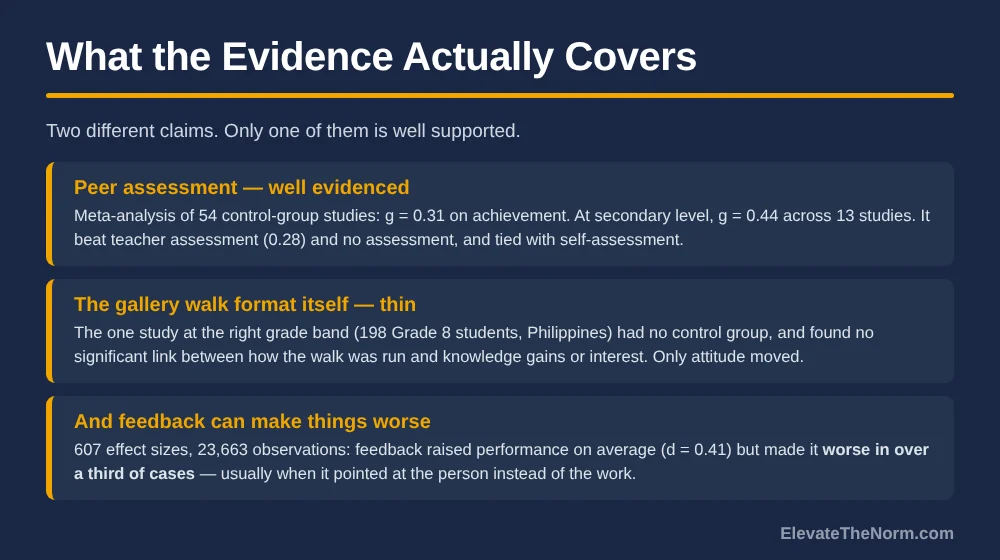
    Three-part evidence summary comparing well-evidenced peer assessment at g equals 0.31 overall and 0.44 at secondary level, thin evidence for the gallery walk format itself from one Grade 8 study with no control group, and the finding that feedback made performance worse in over a third of cases
    Two different claims get mixed together. Only one of them is well supported.

    What About Research on Gallery Walks Specifically?

    Thin, and the one study at the right grade level found less than its abstract suggests.

    The closest match is a 2023 study of 198 Grade 8 students at a public high school in the Philippines, measuring knowledge, interest and attitude across three social studies lessons taught through gallery walk activities. It is a genuine secondary-level sample, which almost nothing else in this literature is.

    It is also a one-group pre-test/post-test design with no control group. Students gained on the researcher-made test — mean gained scores of 7.88, 8.15 and 8.01 across the three lessons — but with no comparison class, there is no way to separate the gallery walk from three weeks of teaching. More pointed: when the researchers correlated the specific features of how the walk was implemented against outcomes, none of the correlations with cognitive skills were significant, and none of the correlations with interest were significant either. Only attitude moved reliably.

    So the honest summary is: students liked it, and this study cannot tell you whether it taught them anything. Most of the remaining gallery-walk literature is small single-classroom work outside the United States, often in language instruction, and frequently without a control group either.

    The best-known practitioner guide, from PBLWorks, is also worth reading accurately. It describes a protocol and reports that giving participants a specific focus and criteria “helps generate higher-quality feedback,” while open-ended walks produced superficial comments like “good DQ!” That is a credible observation from people who run these constantly. It is not a study, and the article cites none. It should be quoted as what it is.

    None of this means skip the activity. It means the reason to run it is the peer assessment evidence, and the way to run it should be built to make that peer assessment real.

    Why Does Feedback Sometimes Make Students Worse?

    Because a lot of feedback is about the student instead of the work, and that redirects attention away from the task.

    Kluger and DeNisi’s review of feedback interventions remains the uncomfortable finding in this whole area. Across 607 effect sizes and 23,663 observations, feedback raised performance on average, d = 0.41. But in over a third of cases it lowered performance. Their explanation is that when feedback draws attention to the self rather than the task, the recipient spends their effort on defending themselves rather than improving the thing.

    Anybody who has watched a fifteen-year-old read a comment on their essay knows what that looks like. “This is confusing” is a verdict on a person. “I couldn’t find your claim in the second paragraph” is information about a page. The second one gets acted on; the first one gets argued with.

    That is also why the sentence stems matter more than they sound like they should. “I notice…” and “I wonder…” are not politeness training. They are a grammatical trick that forces the comment to describe the work. The EL Education framing that runs through a lot of critique practice — feedback should be kind, specific and helpful — is making the same move from a different direction, and the people who use it are explicit that it depends on an existing culture. As Ron Berger puts it in that work, this is not a strategy you drop into a classroom without a respectful one already in place.

    That is a real precondition, not a throat-clearing caveat. A gallery walk in a room where students are not already being treated decently by each other and by you produces insults on sticky notes, and you will spend the period on discipline instead of drafts.

    How Do You Run a Gallery Walk That Produces Useful Feedback?

    Six steps. Five of them cost nothing; the sixth costs ten minutes of class time and is the one that makes the other five worth doing.

    Six numbered steps for running a gallery walk activity: name the one thing students look for, hand out criteria before they walk, require written feedback, give descriptive sentence stems, put a clock on each station, and build in revision time
    None of these adds a planning period. The last one is the one that gets cut.

    0. Model it once, on one piece of work, before anybody walks

    Put a single piece of work up on the projector — ideally one of yours, or an anonymous sample from a previous year — and have the whole class write one note about it together. Then read three of their notes aloud and say plainly which one is useful and why. That takes eight minutes and it is the difference between a protocol students understand and a protocol they are performing. Skipping it is the most common reason a first gallery walk falls flat, and it is also the thing a coach watching your room will ask about first.

    1. Name one thing they are looking for

    Not “give feedback.” One focus: content accuracy, or evidence quality, or whether the claim is actually answerable. If you name three, you get one sentence about the easiest of the three. This single decision is what separates a walk that generates information from a walk that generates compliments.

    2. Hand over the criteria before they walk, not after

    Students should be holding the same rubric you will grade against while they circulate. Giving it to them afterward turns peer feedback into a guessing game about what you wanted. If you do not have a rubric for this task yet, three success criteria written on the board will do.

    3. Require it in writing

    Spoken feedback evaporates at the bell. Sticky notes work. So does a feedback slip per station, or a shared document with a row per project. The requirement is that the author can read it later, because step six depends on that.

    4. Give stems that describe rather than judge

    Post three and require them: I notice… / I wonder… / One thing that would strengthen this is… Teenagers will write “nice” if you let them, and they will write something sharper than you expect if you make the sentence start with a verb that forces specificity.

    5. Put a clock on each station

    Two or three minutes, then rotate on a signal. Without a timer the quick groups finish in forty seconds and the room drifts, which is a transition problem dressed up as a behavior problem. A posted rotation order prevents the traffic jam at station one. My Station Rotation Toolkit on TPT has eight reusable station frames, signs, and recording sheets if you would rather not build them.

    6. Build in the revision

    Ten minutes at the end: read your notes, pick one change, make it. Not “consider the feedback.” Pick one, make it, and be ready to say what you changed and why. This is the step that gets cut when the period runs long, and cutting it is what turns a critique into a field trip around your own classroom.

    One more thing belongs in that ten minutes, and it is the part students care about most: they do not have to take the advice. Some peer feedback is confidently wrong. A student who reads “your thesis is unclear” from someone who skimmed two sentences is entitled to decide that note is not useful. The requirement is that they can say which note they acted on and why, or which note they rejected and why. Both are evidence of judgment, which is the actual skill being taught. A protocol that forces a student to obey bad advice is teaching the opposite of what peer assessment is for.

    Whose Work Goes on the Wall?

    This is the question a parent asks first, and most guides to this activity never raise it.

    Putting a student’s work in front of thirty classmates is not a neutral act. For the student who knows their draft is the weakest in the room, a gallery walk can be the worst twenty minutes of their week, and no amount of “I wonder…” stems fixes that by itself.

    Three things keep it fair. First, everything goes up, every time — a walk where only the strong work is displayed is a showcase, and students read the selection as the verdict. Second, do not use personal writing. Narrative and reflective pieces where a student has written about their own life do not belong on a wall; use the analytical task, the lab, the problem set, the project artifact. Third, let a student put work up unnamed if they ask. Peer assessment effects in the meta-analysis held up whether feedback was anonymous or not, so you are giving away nothing that the research says you need.

    If a family asks why their child’s work was displayed, the answer should be a sentence you already have: everyone’s work goes up, nobody’s name has to, and nothing personal is ever used. Worth putting in a back-to-school message the first time you run it, rather than after a phone call.

    What Goes Wrong, and How Do You Tell It Is Your Structure?

    Four failure modes cover almost all of it, and all four are things you set up rather than things students did.
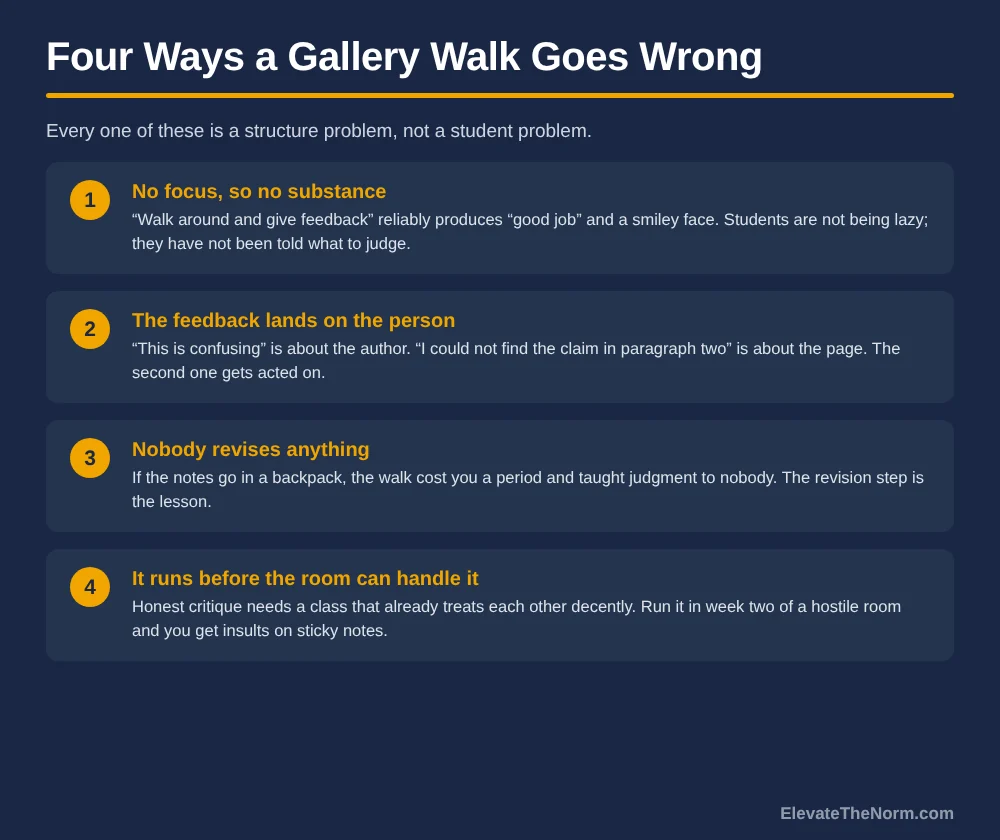
    Four numbered failure modes of a gallery walk activity: no focus so no substance, feedback aimed at the person rather than the work, no revision after the walk, and running critique before the classroom culture can support it
    Every one of these is a structure problem, not a student problem.

    The first is no focus, which produces “good job” and a smiley face. Students are not being lazy. They have not been told what to judge, so they default to the safest comment available.

    The second is feedback aimed at the person. See above. The fix is mechanical — stems, and a rule that every note names a specific part of the work.

    The third is no revision, which is the most common and the most expensive. If the notes go into a backpack, the walk taught judgment to nobody and cost you a period.

    The fourth is running it too early. Critique is a high-trust activity. In a room where that trust is not there yet, start with something lower stakes — structured peer response on a single paragraph at their desks, with you reading over shoulders — and build toward the full walk over a few weeks.

    Two practical notes, because the guides tend to skip both. Prep is roughly ten minutes — deciding the focus, writing three criteria, and finding the sticky notes. There is no packet to build, which is a large part of why this protocol survives in real classrooms. And the student who has nothing to post is an ordinary Tuesday, not a crisis. They post what exists, even if it is a title and two sentences, and they do the walk and give feedback like everybody else. Giving feedback is most of the cognitive work in this activity anyway. Exempting them from the one part they can still do teaches them that the room has stopped expecting anything from them.

    Where Does This Fit in a Unit?

    Mid-draft, not at the end. A gallery walk on finished work is a showcase, which is a fine thing but a different thing. The activity earns its period when the work is still changeable.

    In a project, the natural slot is the day the first full draft exists and before any of it is graded. The critique and revision tools in a PBL toolkit are built around exactly that moment. In a writing unit, it is after the first full draft and before the revision conference. In a problem-based math or science lesson, it is after groups have committed to an approach and before they have invested two days in it.

    One per unit is plenty. Run it weekly and it becomes the thing students perform rather than the thing they use, which is the same failure mode that eventually catches every student-centered routine that gets over-used.

    Does This Work in a Class of Thirty-Five?

    Yes, and it is one of the few protocols that gets easier as the class gets bigger, because it runs in parallel.

    Eight or nine stations, groups of four, three minutes each, and the whole room is working at once. The constraint is wall space and traffic flow, not headcount. If the room is tight, put work flat on desks and rotate groups between desk clusters instead of around the perimeter — same protocol, less collision.

    Where class size does bite is the revision block. Thirty-five students each wanting to ask you about one piece of feedback does not fit in ten minutes. The answer is that they do not ask you. They pick one change and make it. You circulate. The ones who are genuinely stuck will find you.

    Access is worth planning for rather than improvising. A student who reads well below grade level cannot absorb six peers’ drafts in three minutes, and a student newer to English may be able to judge the work and not able to write the note quickly. Both are solved the same way: let feedback be spoken to a partner who writes it, or give a sentence frame with the technical words already in it. Neither reduces the demand — the judgment is still theirs — and both stop the activity quietly sorting the room by reading speed.

    What to Do Next

    Pick a task you already have, where the work is half-finished and you were going to collect it anyway. Decide the one thing students will look for. Write three success criteria on the board. Give them sticky notes, three sentence stems and three minutes a station, and reserve the last ten minutes of the period for one change each.

    Do not grade it. The research says the grade does nothing for students this age, and the moment it is graded you are back to students writing what they think you want to read.

    Then look at the revisions rather than the sticky notes. The sticky notes tell you how well you set up the protocol. The revisions tell you whether anybody learned anything, which is the only question that matters.

    Before you go: grab the free The Gallery Walk Planner (2 pages) (PDF) — ElevateTheNorm.com branded, printable, no email required.

    Frequently Asked Questions

    Is there actual research behind the gallery walk activity, or just blog posts?

    Both, and they are not the same strength. The peer assessment that happens inside a gallery walk is well evidenced: a meta-analysis of 54 control-group studies found g = 0.31 on academic performance, rising to g = 0.44 at secondary level. The gallery walk format is a different claim, and the evidence there is thin. The closest study at the right grade level followed 198 Grade 8 students but had no control group, and found no significant relationship between how the walk was run and students’ knowledge gains or interest. Run the activity for the peer assessment, and build it so the peer assessment is real.

    How do you keep a gallery walk from humiliating the student whose work is weakest?

    Three rules handle most of it. Everyone’s work goes up every time — a wall of selected work tells the room exactly who was selected. Never use personal or narrative writing; use the analytical task, the lab, the problem set or the project artifact. And let a student display work without their name if they ask for that. Anonymity was not a significant moderator in the peer assessment research, so you lose nothing measurable by allowing it. If a student still refuses, take it privately rather than in front of the room.

    Should peer feedback on a gallery walk be anonymous or signed?

    Either works, and you can decide it on classroom grounds rather than research grounds. In the Double, McGrane and Hopfenbeck meta-analysis, anonymity was one of several implementation choices that showed no significant difference in effect. Signed notes tend to be more careful and let the author follow up with a question; anonymous notes tend to be more honest early in the year. A reasonable default is signed, with the caveat that you will read them.

    Should you grade the feedback students give?

    No, not in grades 6–12. The one place the research splits by age is exactly here: peer feedback carrying a grade significantly improved university students’ performance, and that effect could not be shown for primary or secondary students. Grading it also changes what students write — they start producing what they think you want rather than what they noticed. Hold them accountable for completing it, not for a score on it.

    What if a student gets feedback that is simply wrong?

    They are allowed to reject it, and saying so out loud is part of the lesson. Require that every student can name one note they acted on and why, or one note they decided not to act on and why. Both answers show judgment, which is the skill peer assessment is supposed to build. A protocol that makes a student obey bad advice from a classmate is teaching compliance, not critique.

    How long does a gallery walk take, and how much preparation?

    One class period, and about ten minutes of prep. The prep is deciding the single focus, writing three success criteria, and finding sticky notes — there is no packet to build. In the period, allow eight minutes to model the protocol the first time, two to three minutes per station, and a protected ten minutes at the end for revision. If the period is short, cut the number of stations, never the revision block.

    What do you do when a student writes something unkind on a note?

    Collect it, handle it privately, and do not re-run the whole protocol as a punishment for the class. Then look at what made it possible: unkind notes are far more common when the focus was vague, because “say something about this” invites personal commentary while “find the claim and say whether the evidence supports it” does not. Critique also depends on an existing classroom culture — if the room is not there yet, scale back to partner feedback at desks and build up to the full walk.

    How do you know whether the gallery walk actually taught anything?

    Look at the revisions, not the sticky notes. The notes tell you how well you set up the protocol; the changes students made tell you whether the feedback was understood and used. A quick version: collect the one-sentence statement of what each student changed and why. If most of them name a surface change — spelling, formatting, length — the focus you set was too broad and the next walk needs a narrower one.

    Sources

    1. Double, K. S., McGrane, J. A., & Hopfenbeck, T. N. (2019). “The Impact of Peer Assessment on Academic Performance: A Meta-analysis of Control Group Studies.” Educational Psychology Review, 32. Meta-analysis of 54 experimental and quasi-experimental control-group studies; overall g = 0.31 (p < .001) on academic performance; peer assessment outperformed no assessment and teacher assessment (0.28) and was comparable to self-assessment; effects robust across delivery mode, frequency and educational level. https://ora.ox.ac.uk/objects/uuid:0a09975c-e7e6-416f-b888-977230b29ba4
    2. Clearinghouse Unterricht (TUM), Short Review 28 on Double et al. (2020). Cited as a summary, not as the primary study. This is where the secondary-level figure used above comes from — g = 0.44 across 13 studies — together with the moderator finding that peer feedback carrying a grade significantly helped university students (g = 0.55) but could not be shown to help primary or secondary students. https://www.clearinghouse.edu.tum.de/wp-content/uploads/2023/10/CHU-KR-28_ENG_Double_2020.pdf
    3. “Gallery Walk Activities in Teaching Social Studies: Inputs in Enhancing Knowledge, Interest, and Attitude of Grade 8 Students” (2023). International Journal of Research Publications. 198 Grade 8 students, Philippines. One-group pre-test/post-test and correlational design with no control group. Mean gained scores 7.88 / 8.15 / 8.01 across three lessons; correlations between implementation features and cognitive skills were not significant, and correlations with interest were “not significant at 0.05 level”; only attitude correlations reached significance. https://ijrp.sfo3.cdn.digitaloceanspaces.com/pubjournal/5094/1001281720235215.pdf
    4. PBLWorks / Buck Institute for Education. “Using Gallery Walks for Critique & Revision in PBL.” Practitioner protocol. The claim that a specific focus and criteria produce higher-quality feedback is reported by the authors as their own experience — “We’ve found” — and the article cites no studies. Quoted here as practice knowledge, not as research. https://www.pblworks.org/blog/using-gallery-walks-critique-revision-pbl
    5. Kluger, A. N., & DeNisi, A. (1996). “The Effects of Feedback Interventions on Performance: A Historical Review, a Meta-analysis, and a Preliminary Feedback Intervention Theory.” Psychological Bulletin, 119(2). 607 effect sizes across 23,663 observations; average d = 0.41; feedback interventions reduced performance in over a third of cases. The primary article was not reachable from this session; the figures above are taken from a secondary summary of it and are labelled as such. https://explore.psychsafety.com/n/kluger-denisi-1996/
    6. Varlas, L. (2017). “Peer Feedback Without the Sting.” Educational Leadership (ASCD), May 2017. Source of the “kind, specific, helpful” framing attributed to Ron Berger of EL Education, and of the point that peer critique depends on existing classroom culture rather than on the protocol alone. https://www.ascd.org/el/articles/peer-feedback-without-the-sting
    About Clay Shumate

    Clay Shumate is a certified secondary Social Studies teacher in the public schools of West Alabama, with seven years of classroom experience, a B.A. in History, and an M.Ed. in Secondary Education. He writes about project-based learning, student responsibility, respect, and practical ways to hold young people to a higher standard while giving them room to learn from mistakes. He is a member of the Society of Professional Journalists and writes to its Code of Ethics; this site’s editorial standards and corrections policy are published in full. More about Clay.

  • Cold Calling in the Classroom: What the Research Says and How to Do It Without the Gotcha

    Cold Calling in the Classroom: What the Research Says and How to Do It Without the Gotcha

    By Clay Shumate

    Cold calling in the classroom means calling on a student who did not raise a hand. The research says it works: more students answer voluntarily in classes where it is normal, and the gap between who speaks and who stays quiet narrows. The same research says it makes students anxious. Both are true, and the second one is the part most teaching advice leaves out.

    What follows is what the studies actually measured, who they measured it on, and the version of cold calling that holds a high standard without turning a question into a punishment.

    Key Takeaways

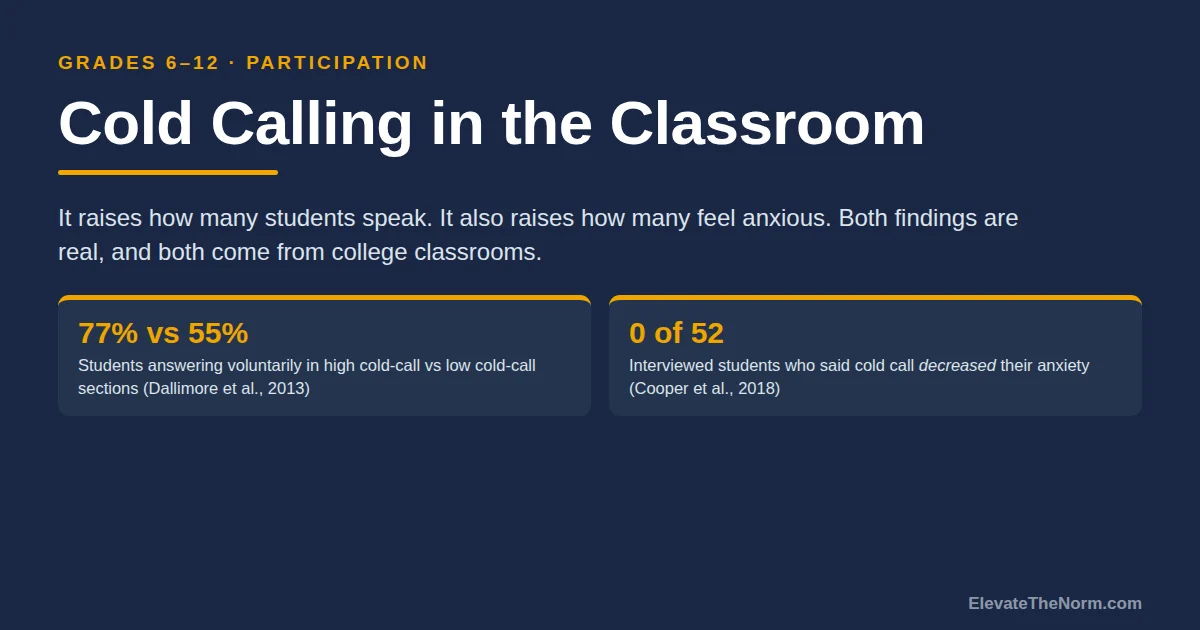
    • Cold calling raises voluntary participation, and the effect is not small. 77% of students answered voluntarily in high cold-call sections, against 55% in low cold-call sections — and it grew over the term rather than wearing off.
    • It closes a gender gap in who talks. Women answered less often than men in low cold-call classes and more often than men in high cold-call classes.
    • It also makes students anxious, reliably. Of 52 students interviewed about active-learning practices, 31 said cold call only increased their anxiety. Not one said it decreased it.
    • Every one of those studies was run on college undergraduates. There is no comparable randomized evidence from a grades 6–12 classroom, and anyone who tells you there is has not read the papers.
    • The design decisions are what separate the two outcomes. Rehearsal time, three seconds of silence, visible randomness and a return path cost nothing and change what the practice feels like from a seat.

    Free Download · PDF

    The Cold Call Card and Participation Log (2 pages)

    Page 1 is the six moves, the sentence to say out loud in week one, and what to do about a flat refusal, a student newer to English, and a documented accommodation. Page 2 is a five-day log for finding the names that never speak.

    Download the free PDF

    Free. No email address required. Designed for grades 6–12. Browse every printable in Your Free Library.

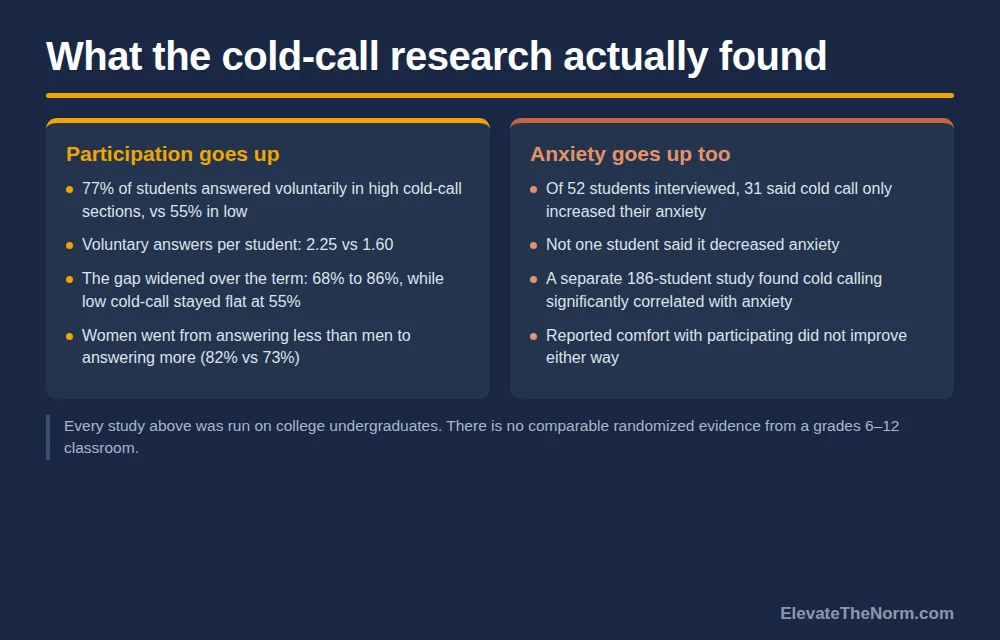
    Two-column comparison of cold calling research: participation findings including 77 percent versus 55 percent voluntary answering, beside anxiety findings including 31 of 52 students reporting increased anxiety
    The two halves of the evidence, side by side. Most articles quote one column.

    What Is Cold Calling in the Classroom?

    Cold calling is asking a question and then naming a student who did not volunteer. That is the whole definition. It is not a discipline move, it is not a pop quiz, and it is not the thing where you catch the kid who was looking out the window.

    The confusion matters because the two versions produce opposite results. A question asked of a class, followed by silence, followed by a name, is an instructional move. The same name said to a student who has stopped paying attention, with a question attached as the consequence, is a correction wearing a question’s clothes. Students can tell the difference in about half a second, and so can anyone watching.

    Hands-up questioning has an obvious problem that cold calling is meant to solve. If you only call on raised hands, you learn what your four most confident students think. Everyone else gets to opt out of thinking, because they know in advance that nothing will be asked of them. That is not a participation problem. It is an information problem — you are teaching a room you cannot see.

    Which means the answer has to be worth collecting. If a student says something that reveals half the room is stuck on the same step and you carry on to the next slide anyway, you have not run a check, you have run a performance. The point of hearing from the students who were not going to volunteer is that they are the ones most likely to tell you something you did not already know.

    Does Cold Calling Actually Increase Participation?

    Yes, and the increase is larger and more durable than I expected when I went looking for the numbers.

    The most careful study on this is Dallimore, Hertenstein and Platt (2013), published in the Journal of Management Education. They tracked 632 undergraduate sophomores across 16 sections of a required accounting course, with seven different instructors. Observers sat in classrooms twice per section and recorded every answer and whether it was volunteered or cold-called. Sections were then sorted into high cold-call and low cold-call environments.

    The results, in the order that matters:

    • 77% of students in high cold-call sections answered at least one voluntary question, against 55% in low cold-call sections.
    • Voluntary answers per student: 2.25 in high cold-call sections, 1.60 in low.
    • The effect grew. High cold-call sections went from 68% at the first observation to 86% at the second. Low cold-call sections sat at 55% both times and did not move.

    That last line is the one worth sitting with. The usual objection to cold calling is that students will participate only under threat and will shut down the moment you stop. The observed pattern is the opposite — voluntary participation climbed as the term went on. The students in those rooms were not being dragged into speaking. They were getting used to it.

    And it narrows a gap in who speaks

    The same research team published a follow-up in 2019 looking specifically at gender. In low cold-call sections, 52% of women answered voluntarily against 57% of men, and men answered more questions each (1.78 against 1.33). In high cold-call sections that flipped: 82% of women answered voluntarily against 73% of men, and the per-student difference disappeared. The rate of increase for women was statistically significant.

    If you have ever looked at a discussion and thought the same six boys are carrying this, that is the finding that speaks to it. The quiet half of a room is not quiet because it has nothing to say. It is quiet because volunteering is a social risk, and it is a bigger social risk for some students than others. Taking volunteering out of the equation changes who is heard.

    Does Cold Calling Make Students Anxious?

    Yes, and this is the part of the literature that rarely makes it into a staff meeting.

    Cooper, Downing and Brownell (2018), in the International Journal of STEM Education, interviewed 52 students in large active-learning biology courses about which practices raised or lowered their anxiety. Cold call was the single most negative practice they studied. Thirty-two students brought it up unprompted. Thirty-one of them said it only increased their anxiety. One said it had no effect. Zero students said it decreased their anxiety. The driver students named was fear of being evaluated badly in front of a large group.

    That is not an isolated finding. A 2024 study of 186 students at a Chinese university found cold calling significantly and positively correlated with anxiety, and the authors recommended using it with caution for exactly that reason.

    And here is the uncomfortable detail: in the Dallimore work, students’ self-reported comfort with class participation did not significantly improve in high cold-call sections either. Participation went up. Comfort did not follow it. Those are two different things and the studies measured both.

    So the honest summary is that cold calling makes more students speak and makes some of them feel worse while doing it. Anyone who tells you it is a free win is selling something.

    Does Any of This Apply to a Grades 6–12 Classroom?

    Not directly, and this is the biggest caveat on the page.

    Every study above was conducted on university undergraduates — accounting sophomores, biology majors, design students. Teenagers in a required course they did not choose, in a building where they will see the same classmates for four years, are not undergraduates. The social cost of being wrong in front of people is higher in a high school than in a 300-seat lecture hall, and the floor on it is lower. A fourteen-year-old who gets laughed at in October remembers it in May.

    What transfers is the mechanism, not the number. The mechanism is that when answering is optional, most students opt out of thinking, and when it is not optional, they do not. That is about how attention works, not about how old you are. The specific percentages do not transfer, and I would not quote them at a faculty meeting as if they did. If you want the broader picture of what counts as real evidence that a class understood something, that is a separate question with its own answer.

    Why Three Seconds of Silence Changes What You Get Back

    Most teachers wait about one second between asking a question and doing something else. That measurement comes from Mary Budd Rowe’s wait-time research, and it is one of the few findings in education that has survived essentially unchallenged for fifty years.

    When Rowe trained teachers to extend that pause to three to five seconds, the changes were not subtle. Average student response length went from 8 words to 27. Failures to respond dropped from 7 to 1. Unsolicited appropriate responses rose from 5 to 17. Students the teachers had described as slow started contributing.

    The caveat, stated plainly: Rowe’s classrooms were primary grades. That is elementary science, not a ninth-grade room, and this site does not pretend elementary findings are secondary findings. But the mechanism behind it — that a one-second pause only has time to surface an answer that was already sitting there, and three seconds has time to produce a new one — is not age-specific. The reason to believe it for teenagers is that it describes thinking, and the reason to be careful about it is that nobody has run Rowe’s study on a high school.

    Put together with a cold call, the sequence is: ask, wait three seconds, say a name, wait three more seconds. The first pause is for the class. The second is for the student. Filling either one is the most common way a well-intentioned cold call turns into an interrogation.

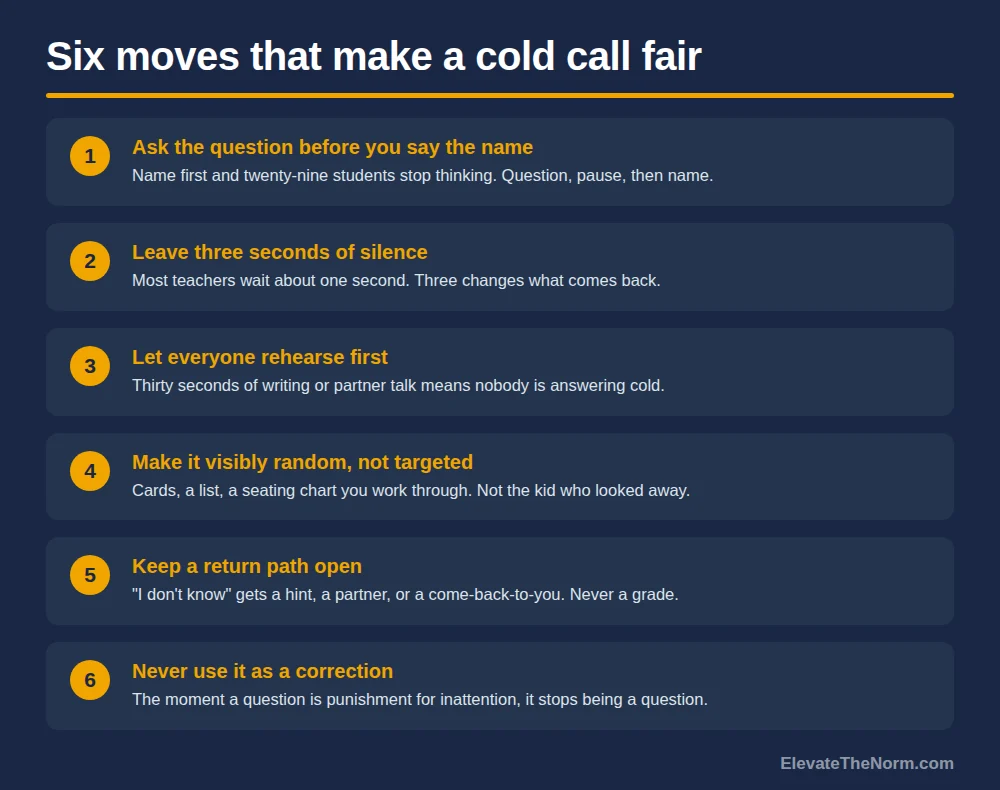
    Six numbered moves for fair cold calling: ask before naming, leave three seconds of silence, let everyone rehearse first, make it visibly random, keep a return path open, and never use it as a correction
    None of these costs lesson time. Four of them cost nothing at all.

    How Do You Cold Call Without Making It a Gotcha?

    You make it predictable, you let everyone rehearse, and you make sure no student can lose by being called on. Six moves, in the order you would use them.

    1. Ask the question before you say the name. Say the name first and twenty-nine students stop thinking, because the question is now somebody else’s problem. Question, pause, name. That order is the entire difference between a cold call that teaches the room and one that teaches one kid.

    2. Leave three seconds of silence. Covered above, and it is the move teachers find hardest. Three seconds is longer than it sounds when you are standing up in front of people.

    3. Let everyone rehearse first. Thirty seconds of writing, or thirty seconds of turning to a partner, before any name is said. Now nobody is actually answering cold — every student has already produced something and is being asked to read it out. This single change removes most of what the anxiety research is describing, because the fear is not of speaking, it is of having nothing to say.

    4. Make it visibly random, not targeted. Name cards, a list you work down, a seating chart you move through. The point is not fairness in the abstract. The point is that a student who gets called on knows it was not about them. The moment the selection looks like judgment, you have the gotcha back.

    5. Keep a return path open. “I don’t know” has to lead somewhere other than embarrassment — a hint, permission to ask a partner, or a straight “I’ll come back to you,” followed by actually coming back with a question they can answer. The return is the part people skip, and it is the part that makes the whole thing safe.

    6. Never use it as a correction. The moment a question is the consequence for inattention, it stops being a question and the class learns that your questions are weapons. Handle the off-task student the way you would handle anything else — quietly, at close range, and not as a performance for the room.

    What About the Student Who Genuinely Cannot Answer?

    If a student freezes badly enough to matter, the task was mis-scoped, and that is on the plan rather than the kid.

    I believe this about classrooms generally. A student cannot screw up that badly in a well-planned room. If they can, the question was wrong, the scaffolding was missing, or the adult was not paying attention. The honest fix after a cold call goes wrong is not to stop cold calling and it is not to apologise at length in front of everyone. It is to come back to that student inside the same period with something they can answer, and to look at why the first question had no entry point.

    This is also where the anxiety research should change your practice rather than end it. Students in those interviews were not afraid of being asked things. They were afraid of being evaluated badly in public. Those are separable. You can ask a student something hard and make it structurally impossible for the answer to count against them — nothing said out loud is graded, “I don’t know” is a legitimate answer, and the return path exists. Do that and you have kept the demand while removing most of the threat.

    Respecting students is not complicated, and it mostly comes down to doing exactly what you said you would do, every time. If you tell a class that nothing they say when called on is graded, that has to be true in week fourteen as well as week one.

    Two groups need a decision made in advance rather than in the moment. A student who is newer to English, or who stammers, or who has a documented anxiety accommodation, should not be finding out mid-lesson what your rules are. For the first two, written rehearsal time does most of the work and a quiet “would you rather read what you wrote or tell me after?” does the rest. For the third, the plan governs, not the technique — if a 504 or IEP says the student is not called on without warning, that is the end of the discussion and no research finding overrides it.

    And occasionally a student will simply refuse. Not freeze — refuse, flatly, in front of everyone. Take it at face value, move on without comment, and deal with it later and privately, because a standoff in front of thirty people is a fight you cannot win and should not be having. Nine times out of ten the refusal is about something that happened before the bell.

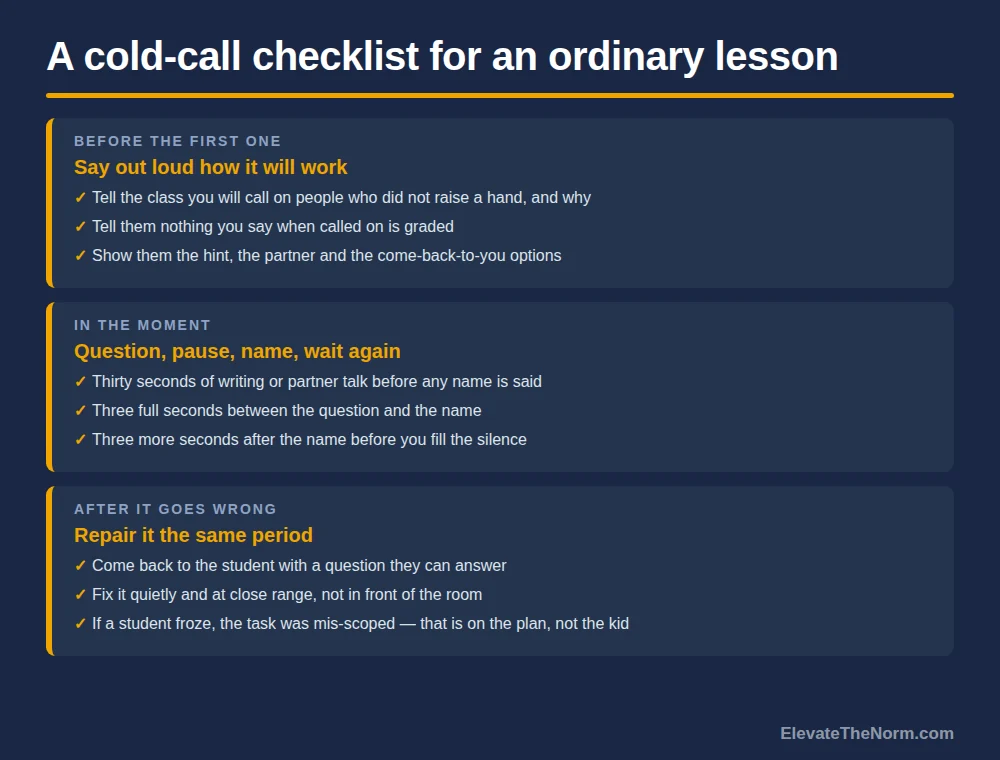
    Three-phase cold calling checklist covering what to say before the first cold call, the question-pause-name-wait sequence in the moment, and how to repair it the same period when it goes wrong
    Before, during, after. The third block is the one that gets skipped.

    Organization to the Minute, and Then the Pause

    The hardest part of all of this is the silence, and I have an expensive data point about silence.

    I once waited over five minutes. It was one of the most awkward moments of my life. That section finished nine minutes behind my other classes, and it is the only time I have ever assigned homework — I do not otherwise assign it at all. That is the price tag, and most advice about waiting students out does not come with one.

    What I would take from it, applied to a three-second pause rather than a five-minute one: the silence works, and it costs something, and you should know what it costs before you spend it. Three seconds is cheap. Three seconds times forty questions is two minutes of a lesson. That is a trade worth making. Standing there for five is a different decision, and you should make it on purpose.

    My room runs as a workshop — tables in pairs and fours, nobody sitting in a row facing front, me on a wheeled stool moving between groups. Cold calling in a room like that is less of an event than it is in a lecture hall, because students are already talking to each other all period. That is part of why the rehearse-first move matters so much. In a room where partner talk is the default condition rather than a treat, “say what you just told your partner” is barely a cold call at all.

    Where Cold Calling Goes Wrong

    • Using it to catch people. The fastest way to poison it. One targeted question in front of thirty people and every subsequent question in your room reads as a threat.
    • Grading it. Participation points attached to cold-call answers convert a thinking task into a performance task, and the students who most need to practise speaking are the ones who will now dread it most.
    • Skipping the rehearsal. Cold calling without think time is the version the anxiety studies describe. With think time, it is a different practice wearing the same name.
    • Filling the silence. Rephrasing your own question after two seconds, which teachers do constantly, resets the clock and tells the room you did not mean it.
    • Doing it inconsistently. If it happens twice a month, it is an event, and events are frightening. If it happens every day, it is the weather.
    • Only cold calling the strong students. It feels safe and it defeats the purpose. The information you need is from the students who were not going to volunteer.

    What to Do Next

    Pick one class. Tomorrow, before the first question, say out loud how it is going to work: you will call on people who did not raise a hand, nothing said out loud is graded, and “I don’t know” gets you a hint and a second try. Then run the sequence — thirty seconds of writing, ask, three seconds, a name off a list, three more seconds.

    Do it for two weeks before you judge it. The Dallimore data showed the effect growing between the first observation and the second, which means a first week that feels awkward is not evidence of anything. Then look at who is talking and compare it to your memory of September.

    It is also worth putting one line in a newsletter or a back-to-school email: this class expects everyone to answer questions, nothing said out loud is graded, and no student is ever stuck with no way out. A parent who hears about cold calling first from an upset teenager will assume the worst. A parent who heard it from you in August usually does not.

    If you want this inside a wider system of checks rather than as a single technique, the full list of formative assessment strategies puts cold call alongside the other moves that tell you what a room actually understands, and a structured seminar is what this turns into once students are used to being expected to speak. Both work better once the expectations you set in the first week have made being asked a question an ordinary event rather than a surprise.

    Before you go: grab the free The Cold Call Card and Participation Log (2 pages) (PDF) — ElevateTheNorm.com branded, printable, no email required.

    Frequently Asked Questions

    Is cold calling in the classroom bad for anxious students?

    It raises anxiety for a lot of students — in one interview study, 31 of 52 said cold call only increased theirs, and none said it decreased it. But the thing students named as the cause was fear of being evaluated badly in public, not being asked a question. You can remove most of that while keeping the demand: give everyone thirty seconds to write or talk to a partner first, say out loud that nothing spoken aloud is graded, and make sure "I don’t know" leads to a hint rather than an audience. A student with a documented anxiety accommodation should be handled through that plan, not through a classroom technique.

    Does cold calling actually work, or does participation just drop again when you stop?

    In the best study available, it did not drop — it grew. Dallimore, Hertenstein and Platt tracked 632 undergraduates across 16 sections and found 77% of students in high cold-call sections answered voluntarily, against 55% in low cold-call sections, and the high cold-call figure rose from 68% at the first observation to 86% at the second while the low cold-call sections stayed flat. That pattern is the opposite of compliance wearing off.

    Is there any research on cold calling in middle or high school?

    Not of the same quality, and that is worth saying plainly. The participation studies were run on college sophomores in an accounting course, the anxiety study on undergraduate biology students, and a third on university design students. There is no comparable randomized evidence from a grades 6–12 classroom. The mechanism — that optional answering lets most students opt out of thinking — is about attention rather than age, so it is reasonable to expect it to transfer. The specific percentages are not yours to quote.

    How is cold calling different from putting a student on the spot?

    Order and intent. A cold call asks the question first, pauses so the whole class thinks, then names someone from a list or a set of cards. Putting a student on the spot names the student first, usually because they were not paying attention, and attaches a question as the consequence. The first is an instructional move that happens to land on one person. The second is a correction, and the room reads it as one immediately.

    Should I tell students in advance that I am going to cold call?

    Yes, and it costs you nothing. Surprise is not the active ingredient — the active ingredient is that answering is not optional, and students can know that in advance. Telling them the rules, including that nothing said aloud is graded and that there is always a way back from "I don’t know", converts the practice from an ambush into a routine. Routines are not frightening. Events are.

    How long should I wait after asking the question?

    Three seconds before you say a name, and three more after. Mary Budd Rowe’s wait-time research found teachers typically wait about one second; extending the pause to three to five seconds raised average response length from 8 words to 27 and cut failures to respond from 7 to 1. That work was done in primary-grade science classrooms rather than secondary ones, so treat the mechanism as transferable and the exact numbers as not yet tested on teenagers.

    Does cold calling help close participation gaps between boys and girls?

    The one study that looked directly at this found that it did. In low cold-call sections, 52% of women answered voluntarily against 57% of men, and men answered more questions each. In high cold-call sections it reversed: 82% of women against 73% of men, with the per-student gap gone. The authors are clear this was a single institution and a single discipline, so read it as a reason to try it rather than a settled result.

    What do I do when a student freezes and cannot answer at all?

    Give the return path immediately — a hint, permission to ask a partner, or "I will come back to you" followed by actually coming back with a question they can answer inside the same period. Then look at the question itself. If a student froze badly enough that it mattered, the task was mis-scoped or the scaffolding was missing, and that is a planning problem rather than a student problem. Fix the entry point, not the student.

    Sources

    1. Dallimore, Elise J., Julie H. Hertenstein, and Marjorie B. Platt. “Impact of Cold-Calling on Student Voluntary Participation.” Journal of Management Education, vol. 37, no. 3, 2013, pp. 305–341. 632 undergraduate sophomores, 16 sections, 7 instructors, two classroom observations per section; high cold-call sections 77% voluntary participation vs 55% low; 2.25 vs 1.60 voluntary answers per student; high cold-call rose 68% to 86% across observations while low cold-call held at 55%; no significant effect on self-reported comfort in the main analysis. Authors note the single-course design limits generalizability. https://journals.sagepub.com/doi/abs/10.1177/1052562912446067
    2. Dallimore, Elise J., Julie H. Hertenstein, and Marjorie B. Platt. “Leveling the Playing Field: How Cold-Calling Affects Class Discussion Gender Equity.” Journal of Education and Learning, vol. 8, no. 2, 2019, pp. 14–24. Low cold-call: women 52% / men 57% voluntary participation, 1.33 vs 1.78 questions per student (p < .01). High cold-call: women 82% / men 73%, per-student difference not significant; women’s rate of increase significant at p = 0.004. No significant effect on comfort ratings. Single institution, single discipline. https://files.eric.ed.gov/fulltext/EJ1207291.pdf
    3. Cooper, Katelyn M., Virginia R. Downing, and Sara E. Brownell. “The Influence of Active Learning Practices on Student Anxiety in Large-Enrollment College Science Classrooms.” International Journal of STEM Education, vol. 5, no. 1, 2018, article 23. Interviews with 52 undergraduates in large active-learning biology courses; 32 raised cold call, 31 reported it only increased anxiety, 1 reported no effect, 0 reported decreased anxiety; fear of negative evaluation in front of large groups named as the driver. Exploratory interview design. https://link.springer.com/article/10.1186/s40594-018-0123-6
    4. Yang, Hongze, Bo Li, Jiajing Yu, and Lichen Sun. “Impact of Active Learning Instruction in Blended Learning on Students’ Anxiety Levels and Performance.” Frontiers in Education, vol. 9, 2024, article 1332778. 186 students at a Chinese university, 80.6% undergraduate; cold calling significantly positively correlated with anxiety (SE = 0.632, p < 0.001); authors recommend cautious use. https://www.frontiersin.org/journals/education/articles/10.3389/feduc.2024.1332778/full
    5. Rowe, Mary Budd. Wait-Time and Rewards as Instructional Variables: Their Influence on Language, Logic, and Fate Control. ERIC ED061103, presented at the National Association for Research in Science Teaching, April 1972. Over 300 initial recordings plus 84 further tapes; baseline teacher wait time averaged about one second; extending to 3–5 seconds raised mean response length from 8 to 27 words, cut failures to respond from 7 to 1, and raised unsolicited appropriate responses from 5 to 17. Primary-grade science classrooms — not a secondary sample. https://files.eric.ed.gov/fulltext/ED061103.pdf

    About Clay Shumate

    Clay Shumate is a certified secondary Social Studies teacher in the public schools of West Alabama, with seven years of classroom experience, a B.A. in History, and an M.Ed. in Secondary Education. He writes about project-based learning, student responsibility, respect, and practical ways to hold young people to a higher standard while giving them room to learn from mistakes. He is a member of the Society of Professional Journalists and writes to its Code of Ethics; this site’s editorial standards and corrections policy are published in full. More about Clay.

  • Classroom Review Games That Actually Review: Two Formats for Grades 6-12

    Classroom Review Games That Actually Review: Two Formats for Grades 6-12

    By Clay Shumate

    Classroom review games work because they force retrieval, not because they make content fun. The ones that hold up give every student a real job instead of four, keep questions short and frequent, and end with kids asking when you are playing again. The ones that fail almost always fail the same way: twenty-four students watching four.

    What follows is the mechanism the research actually supports, two formats broken down far enough to run on Monday, and the design failures that turn a review game into a spectator sport.

    Key Takeaways

    • Retrieval is the mechanism. Pulling an answer out of memory builds retention; re-reading it does not. The game is the packaging.
    • A format without a sideline job is not a whole-class review game. It is four students reviewing and the rest of the room waiting.
    • Two formats are broken down in full below: a four-square court built around eight assigned roles, and a five-minute trash-can format that needs nothing but a ball.
    • The evidence is good and it is not unlimited. Games reliably move content knowledge. The strongest school-based meta-analysis found no significant effect on metacognitive outcomes at all.
    • Short and repeated beats long and once. Fifteen minutes on three days does more than a full period the day before the test.

    Free Download · PDF

    Formative Assessment Quick-Use Pack

    A strategy decision matrix, an evidence tracker, four exit-ticket formats, and a next-day response planner — for turning what a review game surfaces into the next day’s lesson.

    Download the free PDF

    Free. No email address required. Designed for grades 6–12. Browse every printable in Your Free Library.

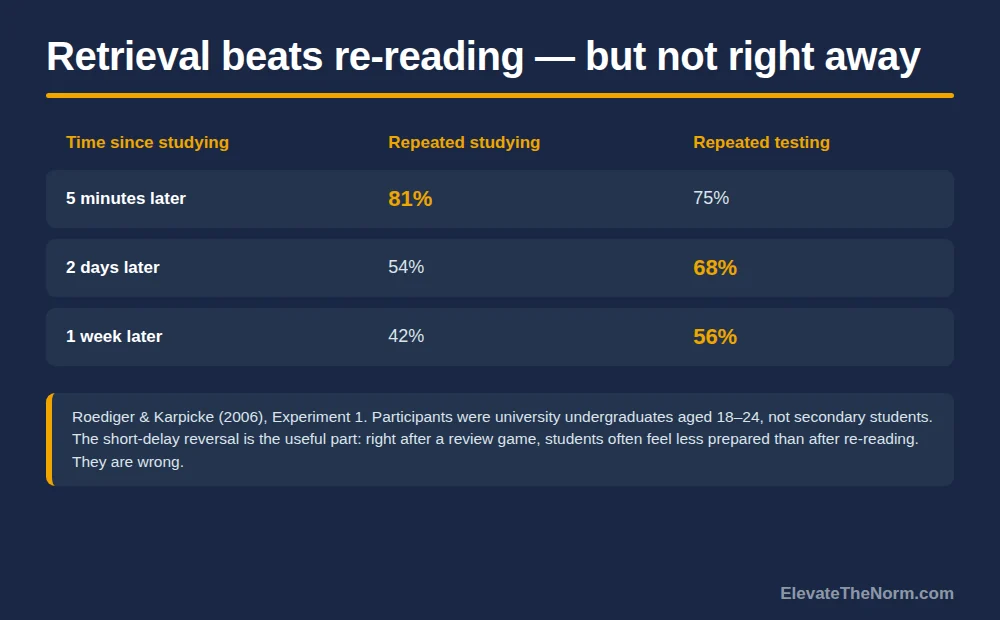
    Three-row table comparing recall after repeated studying and repeated testing at five minutes, two days and one week: 81 versus 75 percent, 54 versus 68 percent, and 42 versus 56 percent
    Five minutes after studying, re-reading looks better. A week later it is not close.

    Why Do Classroom Review Games Work?

    Because retrieving an answer from memory strengthens it more than reading it again does. That effect has a name — the testing effect, or retrieval practice — and it is one of the better-replicated findings in learning science.

    The landmark demonstration is worth knowing precisely, including the part that gets left out. Roediger and Karpicke had readers either study a passage repeatedly or study it once and then take repeated recall tests. Five minutes later, the repeated studiers were ahead — 81% recall against 75%. A week later the result had flipped hard: 56% for the testers, 42% for the studiers. In their second experiment the gap was wider still, 61% against 40%.

    Two honest caveats belong with that study. The participants were university undergraduates, ages 18 to 24, not teenagers. And the short-delay reversal is the most useful part of the finding for a teacher: immediately after a review game, students will often feel less prepared than they would after twenty minutes of re-reading their notes. They will be wrong, and they will tell you so. Knowing that in advance is what keeps you from abandoning a format that is working.

    The classroom evidence runs in the same direction. A five-year applied research project across more than 1,400 middle school students found that retrieval practice built into normal classroom quizzing improved long-term learning, that delayed quizzes were more potent than immediate ones, and that quizzes with feedback beat quizzes without. A 2021 systematic review screened nearly 2,000 abstracts and coded 50 classroom experiments covering 5,374 students: 57% of effect sizes showed medium or large benefits. The authors flag their own limit plainly — only 6% of the experiments were run outside WEIRD countries.

    A review game is a low-stakes retrieval quiz wearing a costume. The costume is not decoration; it is what gets a room of teenagers to willingly retrieve the same content twelve times without it feeling like a test. It belongs in the same toolbox as any other strategy built around real thinking rather than visible compliance.

    What Does the Research Not Say?

    It does not say that making something a game teaches students how to learn. This is where most review-game advice quietly oversells.

    The strongest recent synthesis of game-based learning in schools — Barz and colleagues, in Review of Educational Research — pooled studies of digital game-based learning and found a medium overall effect (g = .54), a solid cognitive effect (g = .67), a small affective-motivational effect (g = .32), and no significant effect on metacognitive outcomes. The authors found no evidence of publication bias, which makes the null finding harder to wave away.

    Two things follow. First, that meta-analysis covers digital games, and the formats below are a taped floor and a trash can — the content-knowledge finding transfers by mechanism, the effect size does not transfer automatically. Second, and more practically: a review game will help students remember what you taught. It will not teach them to study, to plan, or to notice what they do not know. If you want that, the reflective work has to be built in on purpose — which is what a separate student self-assessment routine is for.

    Why Do Most Classroom Review Games Fail?

    Because the format only has room for four players and no plan for everyone else.

    Almost every teacher has lived this period. Four students play a game-show format at the front. Twenty-four watch. The four are genuinely engaged and learning. The twenty-four are half-watching, half on their phones, and the review reached a sixth of the room. That is not a review game. It is a spectator sport with a curriculum connection.

    The failure is not the game and it is not the students. It is a design gap, and it is fixable before the first round: if a format has room for a handful of active participants, it needs a real job for everybody else. “Pay attention” is not a job.

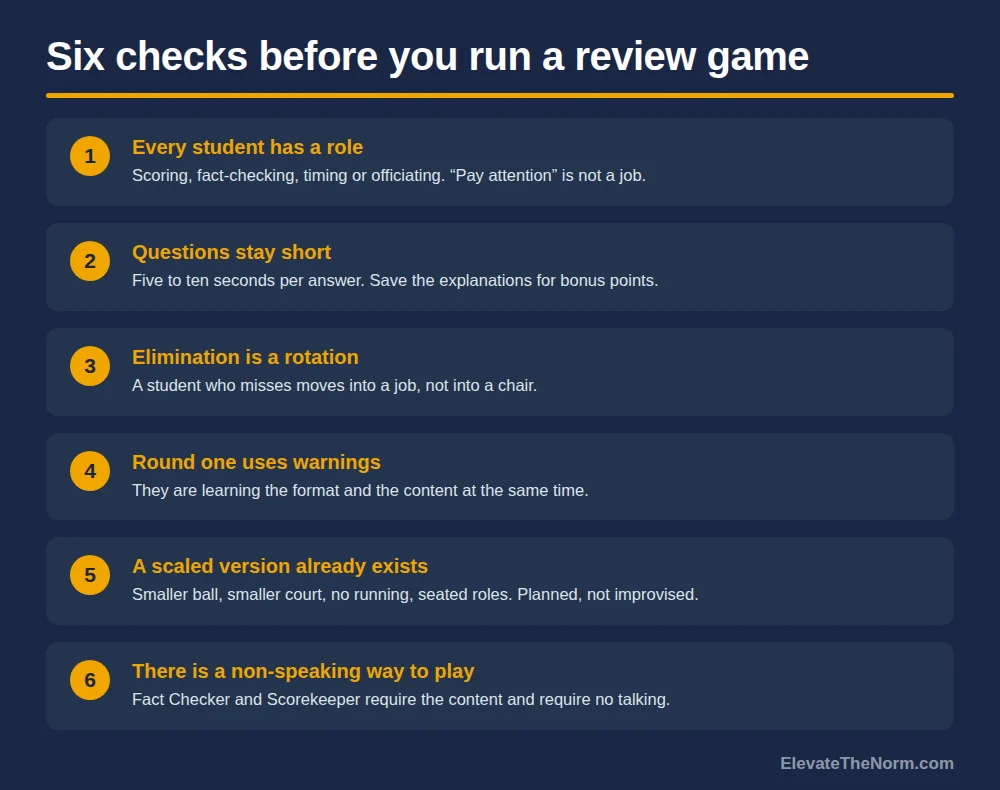
    Numbered checklist of six design checks for a classroom review game: every student has a role, questions stay short, elimination is a rotation, round one uses warnings, a scaled version already exists, and there is a non-speaking way to play
    Six checks. Miss the first one and the rest do not matter.

    How Do You Design a Review Game That Actually Works?

    Run it against six checks before you build it or borrow it.

    • Every student has a role. The students not currently answering should be scoring, checking answers, timing or officiating — not spectating.
    • Questions stay short. Five to ten seconds per answer keeps the pace up. Save the multi-sentence explanations for bonus points, not the base question.
    • Elimination does not mean disappearing. A student who misses rotates into another job. A student who is “out” with nothing to do will find something to do, and it will not be what you wanted.
    • The first round uses warnings, not eliminations. Students are learning the format and the content at the same time; do not punish them for the first. This is the same logic behind teaching a routine explicitly before holding anyone to it.
    • A scaled version exists before you need it. Smaller ball, smaller court, no running, seated variant. Planned, not improvised.
    • There is a non-speaking way to play. Scorekeeper, fact checker and timekeeper all require knowing the content and none requires answering out loud. Build that in from the start rather than after a student has to ask for it.

    Those six are the difference between a format that runs itself after the first week and one you referee forever. Most of them are the same principle underneath any student-centered activity: the structure works when students genuinely own a piece of it, not when they have permission to join in.

    What Does a Full Format Look Like? The 4 Square Review Game

    A four-square court, four players, and eight assigned jobs for everyone else. It is built specifically to solve the spectator problem, and the roles do not change by subject — only the question cards do.

    Setup. Tape a 16′ × 16′ court split into four 8′ × 8′ squares, labeled A through D. Square A is the top position; D is the entry point. Split the class into four teams, one player from each team on the court, the next four in a marked Sub Zone.

    The round. Before a player serves or returns, the Question Master asks a content question. The player has about five seconds. A correct answer makes the ball live and standard four-square rules apply — one bounce before the return. A wrong answer eliminates the player unless a challenge changes the ruling, and they rotate to the end of their team’s line. The next player enters at D and everyone on the court steps up one square.

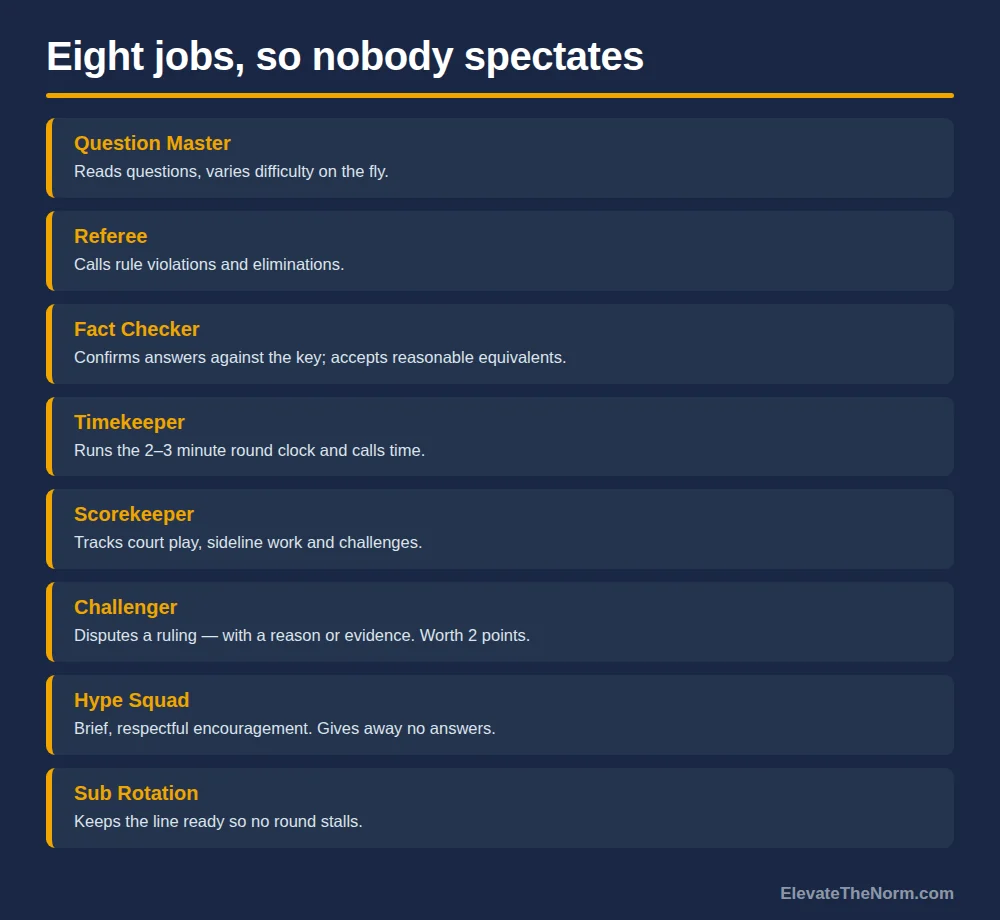
    The eight jobs. This is the part that makes it a whole-class format:

    • Question Master reads the questions and varies the difficulty.
    • Referee calls rule violations and eliminations.
    • Fact Checker confirms answers against the key and accepts reasonable equivalents.
    • Timekeeper runs a two-to-three-minute round clock and calls time.
    • Scorekeeper tracks points for court play, sideline jobs and challenges.
    • Challenger can dispute a ruling — but only with a reason or a piece of evidence, which turns disagreement into an academic move instead of an argument with you.
    • Hype Squad keeps energy up with brief, respectful encouragement and gives away no answers.
    • Sub Rotation manages the line so the next players are always ready.

    Roles rotate every round, so the student who spent one round scoring is playing the next. Scoring stays simple: a point for a correct answer, a point for a successful serve or return, a point for reaching Square A, a point for a clean sideline call, two points for a successful challenge. Small bonuses for a team lifeline, strong supporting evidence, or a team that covers every assigned role keep the sideline jobs from reading as busywork.

    Adapting 4 Square to Any Subject

    The court and the roles never change. The question bank does. A social studies class can run cause-and-effect recall one round and source-analysis the next. A math class swaps in problem-solving questions with a slightly longer answer window. An English class runs vocabulary in context. Build more questions than you think you need, sorted by difficulty, so the Question Master can adjust live when a round runs hot or cold. Running out of questions kills the pace faster than anything else on this page.

    List of eight assigned student roles for a review game: Question Master, Referee, Fact Checker, Timekeeper, Scorekeeper, Challenger, Hype Squad and Sub Rotation, each with a one-line description of the job
    Four players. Eight jobs. Nobody spectates.

    What If You Only Have Five Minutes to Set Up? Trashketball

    A question, a correct answer, then a shot at the trash can from a distance the student picks. Trashketball is a long-standing, widely used classroom format, and it earns its place here for one reason: it delivers the same retrieval mechanism with no court to tape and no roles to assign.

    I did not invent it and I want to be clear about that, because how I got it is the more useful part of the story. In my first year I did not have many review formats that were actually enjoyable, and another teacher on my hall noticed. I asked. They walked me through Trashketball, and I have been running some version of it ever since.

    Keeping your ears open and your mouth shut pays off some of the time. Asking a direct question pays off faster. If you are in your first years and your review days are flat, the fix is probably already being run two doors down by somebody who would be glad you asked. That is not a soft lesson about collegiality — it is the cheapest professional development available and it costs one conversation.

    The basic loop is a question to a team, a short answer window, and a shot worth more points from further out. The self-chosen distance is the good part — it gives a student who is sure of the content a way to press the advantage and a student who is not a way to stay in without being exposed.

    Two upgrades are worth building in. First, give the non-shooting teams a job: one team fact-checks the answer, one keeps score, and both rotate. Second, have each question lead into a one-or-two-sentence note rather than a full explanation, so movement and note-taking land in the same fifteen minutes instead of competing for them. My Station Rotation Toolkit on TPT has eight reusable station frames, signs, and recording sheets if you would rather not build them.

    The lesson from both formats is the same. A physically engaged class and a content-reviewing class are not in competition. They can be the same fifteen minutes.

    What Do You Watch For While It Runs?

    The answers you overhear, not the score.

    My room runs as a workshop — tables grouped rather than in rows, me on a wheeled stool moving between them instead of standing at the front. That habit is worth more during a review game than during almost anything else I do. Circulating while a round plays, you hear a group land on a confident wrong answer before it reaches anybody’s notes, and you can fix it in the next question instead of on the test. The scoreboard tells you who is winning. The sideline conversation tells you what you still have to teach.

    That is also the honest answer to whether a review game is “real” instruction. It is, if you are listening. It is not, if you are refereeing.

    What Are the Most Common Mistakes?

    • No job for the sideline. The single most common failure, and the one that turns a review game into a spectator sport.
    • Elimination with nowhere to go. Rotate eliminated students into a job instead of into a chair.
    • No warning period. Hard eliminations from question one punish students for not knowing a format they have never played.
    • Speed rewarded over accuracy. A five-second window is fine. A game that rewards the fastest guess over the most defensible answer teaches the wrong thing.
    • The same students in the low-status seat every time. If the fast recallers always play and the same kids always keep score, you have built a ranking system, not a review game. Rotate on a schedule, not on volunteering.
    • No safety plan. Any physical format needs its scaled version ready before somebody asks for it.
    • Treating it as a time-filler. If the game does not require retrieving real content, it is recess with a curriculum label.

    What Should You Do Next?

    Pick one format — 4 Square if your class needs structure and assigned roles, Trashketball if you need something running in five minutes — and build a question bank of about thirty questions sorted into three difficulty tiers. Run it for fifteen minutes on three separate days before your next unit test rather than for a full period the day before it. The spacing is doing as much work as the game.

    Then watch two things. Whether the sideline stays engaged, which tells you if the roles are real. And whether students ask when you are playing again, which tells you whether you have a repeatable Friday or a one-time novelty. A review game also fits an awkward period well — the kind covered in teaching after a long weekend, when a straight lecture is fighting uphill no matter how good it is.

    Before you go: grab the free Formative Assessment Quick-Use Pack (PDF) — ElevateTheNorm.com branded, printable, no email required.

    Frequently Asked Questions

    Do classroom review games actually work, or do they just feel productive?

    They work when they force retrieval — students pulling an answer out of memory rather than recognizing it on a page in front of them. That mechanism has been tested directly. Roediger and Karpicke found repeated testing beat repeated studying by 14 points of recall a week later. The game format is the delivery system, not the mechanism. A game where students look up every answer is a worksheet with a ball in it.

    How do I keep 28 students engaged when only four can play at a time?

    Assign every non-playing student a real job and rotate the jobs every round — scorekeeper, fact checker, timekeeper, referee, challenger. “Pay attention” is not a job, it is a hope. If a format has no work for the twenty-four students who are not currently answering, it is not a whole-class review game and you should expect it to behave like one.

    Won’t the competition discourage my students who are already behind?

    It can, and the design has to answer for it. Three things keep it from landing on the same students every time: rotate the jobs so nobody sits in the low-status seat all period, score sideline work as heavily as court play, and score teams rather than individuals so a wrong answer is absorbed. If a specific student is visibly shrinking during a game, give them the Fact Checker role — it is high-status, it requires knowing the content, and it never requires answering in front of the room.

    What if my class is not ready for something physical?

    Scale it before ruling it out. A softer or larger ball, a smaller court, a no-running rule, or a fully seated version of every role keeps the structure intact. The roles and scoring do not depend on anyone moving. Plan the scaled version before the first round rather than improvising it after someone gets hurt or someone gets left out.

    How long should a review game run?

    Rounds of two to three minutes with a role rotation between them, for a total of fifteen to twenty minutes. That is long enough to cycle the whole class through several retrievals and short enough that it does not eat the period. A game that runs forty minutes has stopped being retrieval practice and started being an activity.

    Do these formats work outside social studies?

    Yes, because nothing in the court, the roles or the scoring references a subject. Only the question bank changes. A math class can lengthen the answer window for a multi-step problem; an English class can run vocabulary-in-context questions; a science class can run prediction questions. The one thing that does not travel is a question bank written the morning of.

    A student is arguing with my ruling. How do I handle it without losing the room?

    Build the argument into the format. A Challenger role that requires a brief reason or a piece of evidence turns a dispute into an academic move and takes you out of the middle of it. Award points for a successful challenge. Students who would never volunteer an answer will absolutely argue a call, and a challenge is a retrieval too.

    Is a review game a good use of a class period before a test?

    It is a good use of fifteen to twenty minutes of one, run more than once. The retrieval research is consistent that spaced, repeated retrieval beats one long session, so a short game on three different days will do more than a single period-long game the day before the exam. It is also worth being honest about what games do not do: the best meta-analysis of game-based learning in schools found solid gains in content knowledge and no significant effect on metacognitive outcomes. A game will help students remember. It will not, on its own, teach them how to study.

    Sources

    1. Roediger, Henry L., III, and Jeffrey D. Karpicke. “Test-Enhanced Learning: Taking Memory Tests Improves Long-Term Retention.” Psychological Science, vol. 17, no. 3, 2006, pp. 249–255. Participants were university undergraduates aged 18–24. https://journals.sagepub.com/doi/10.1111/j.1467-9280.2006.01693.x
    2. Agarwal, Pooja K., Ludmila D. Nunes, and Janell R. Blunt. “Retrieval Practice Consistently Benefits Student Learning: A Systematic Review of Applied Research in Schools and Classrooms.” Educational Psychology Review, vol. 33, no. 4, 2021, pp. 1409–1453. 50 coded experiments, 5,374 participants; 57% of effect sizes medium or large; only 6% of experiments conducted outside WEIRD countries. https://link.springer.com/article/10.1007/s10648-021-09595-9
    3. Agarwal, Pooja K., Patrice M. Bain, and Roger W. Chamberlain. “The Value of Applied Research: Retrieval Practice Improves Classroom Learning and Recommendations from a Teacher, a Principal, and a Scientist.” Educational Psychology Review, vol. 24, no. 3, 2012, pp. 437–448. Five-year project with more than 1,400 middle school students. https://eric.ed.gov/?id=EJ977134
    4. Barz, Nathalie, Manuela Benick, Laura Dörrenbächer-Ulrich, and Franziska Perels. “The Effect of Digital Game-Based Learning Interventions on Cognitive, Metacognitive, and Affective-Motivational Learning Outcomes in School: A Meta-Analysis.” Review of Educational Research, 2024. Overall g = .54; cognitive g = .67; affective-motivational g = .32; no significant effect on metacognitive outcomes; no evidence of publication bias. https://journals.sagepub.com/doi/10.3102/00346543231167795

    About Clay Shumate

    Clay Shumate is a certified secondary Social Studies teacher in the public schools of West Alabama, with seven years of classroom experience, a B.A. in History, and an M.Ed. in Secondary Education. He writes about project-based learning, student responsibility, respect, and practical ways to hold young people to a higher standard while giving them room to learn from mistakes. He is a member of the Society of Professional Journalists and writes to its Code of Ethics; this site’s editorial standards and corrections policy are published in full. More about Clay.

  • A List of Formative Assessment Strategies That Work in Real Classrooms

    A List of Formative Assessment Strategies That Work in Real Classrooms

    By Clay Shumate

    Formative assessment strategies are the moves a teacher makes to find out what students understand while there is still time to do something about it. Not a quiz average. Not a unit test. A signal you collect during the lesson and act on before the lesson is over. Below is a working list of them — organised by the five strategies the research actually names, then by the point in the period where you would reach for each one.

    One warning before the list: collecting the information is the easy half, and it is the half most lists stop at.

    Key Takeaways

    • There are five key formative assessment strategies, not fifty. Everything else on this page is a technique serving one of them.
    • A technique is only formative if you change something because of it. An exit ticket you never read is a closing routine, not an assessment.
    • The honest effect size is about 0.20, not 0.70. Real, worth doing, not magic.
    • Attaching a grade undercuts the feedback. Comments alone outperformed comments-plus-a-grade in the most-cited study on this.
    • Pick two techniques and run them for a month rather than sampling twenty. The routine is what produces the data, not the novelty.

    What Are Formative Assessment Strategies?

    A formative assessment strategy is any deliberate method for gathering evidence of student understanding during instruction and using that evidence to adjust what happens next. The two halves are equally load-bearing. Gathering evidence you never use is not formative assessment; it is data collection. Adjusting instruction based on a hunch is not formative assessment either; it is guessing.

    The distinction people usually reach for is timing — formative during, summative after — and that is mostly right but slightly off. A unit test can be used formatively if you read it, find that two-thirds of the class missed the same standard, and reteach it. A daily exit ticket is not formative if it goes in a pile. The word describes what you do with the information, not when you collected it.

    What Are the 5 Formative Assessment Strategies?

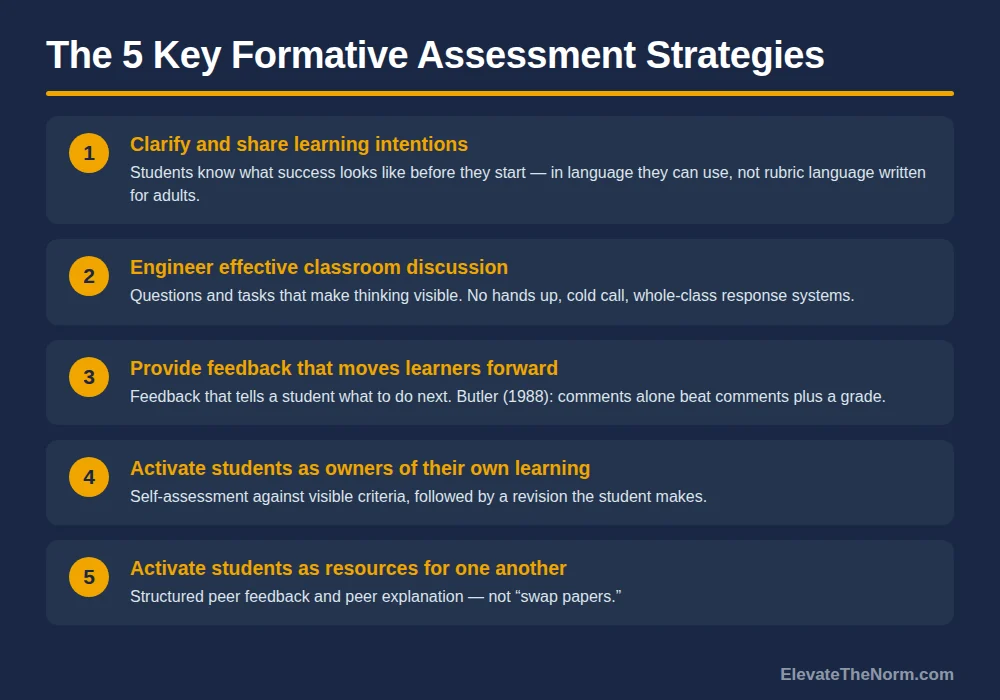
    The framework almost every other list is downstream of comes from Siobhan Leahy, Christine Lyon, Marnie Thompson and Dylan Wiliam, writing in Educational Leadership in 2005. They identified five core strategies:1

    Numbered graphic listing the five key formative assessment strategies: clarify and share learning intentions, engineer effective classroom discussion, provide feedback that moves learners forward, activate students as owners of their own learning, and activate students as resources for one another
    The five key strategies identified by Leahy, Lyon, Thompson and Wiliam (2005).
    1. Clarifying and sharing learning intentions and criteria for success. Students cannot hit a target they cannot describe.
    2. Engineering effective classroom discussions, questions and tasks that elicit evidence of learning. The key word is engineering — designing the question so that the answer tells you something.
    3. Providing feedback that moves learners forward. Feedback that describes the gap and names the next action.
    4. Activating students as owners of their own learning. Self-assessment and self-monitoring.
    5. Activating students as instructional resources for one another. Structured peer feedback and peer explanation.

    Notice that only the second one is about collecting information. The other four are about what surrounds the collection — whether students know the target, whether the feedback is usable, and whether students can act on it without you. That ratio is the whole point, and it is why a list of twenty exit-ticket variations is not a formative assessment programme.

    A List of Formative Assessment Strategies You Can Use Tomorrow

    These are the techniques, grouped by where they fit in a period. None of them requires technology, a purchase, or a planning period you do not have.

    Reference chart grouping formative assessment techniques by lesson phase: start of class, during instruction, during work time, and end of class, with specific techniques listed under each
    The same techniques, sorted by when in the lesson you would actually reach for them.

    Start of class — find out what survived the night

    • Entry ticket. Two questions on yesterday’s material, answered before anything else happens.
    • Retrieval quiz, ungraded. Three questions, self-scored, no record kept. The point is the retrieval, not the score.
    • Misconception poll. Offer the wrong answer students usually give as one of the options and see how many take it.
    • One-sentence summary of yesterday. Fast, and the vagueness of the sentences tells you as much as the content.

    During instruction — check before you move on

    • Cold call with no hands up. Hands-up sampling tells you what your four most confident students think. Nothing else.
    • Mini-whiteboards. Every student answers, every answer is visible at once, and it takes eight seconds. Still the highest-yield low-tech move available.
    • Hinge question. One multiple-choice question at the pivot point of the lesson, written so each wrong option corresponds to a specific misunderstanding. If more than a quarter of the room misses it, you do not go on.
    • ABCD cards or finger votes. A mini-whiteboard substitute when you have thirty seconds and no markers.
    • Think-pair-share with a required report-out. The report-out is what makes it assessment rather than conversation.
    • Ask a student to explain it to the person beside them. Explanation exposes gaps that recognition hides.

    During work time — assess the work, not the room

    • Circulate with a class list. Tick who you actually looked at. Most of us overestimate this badly.
    • The three-student sample. Read one strong, one middling and one struggling student’s work in the first five minutes. You will know whether the task is landing before you have wasted the period.
    • Criteria highlight. Students mark the sentence or step meeting each criterion. What they cannot highlight is the revision.
    • Live rubric row. Score one row of the rubric, out loud, on a volunteer’s work, on the document camera.

    End of class — decide what tomorrow looks like

    • Exit ticket. One question. One that actually discriminates — not one everybody gets right.
    • Muddiest point. “What is still unclear?” Students are more honest here than on a content question.
    • Self-assessment against one criterion. Not the whole rubric. One row.
    • Confidence rating with evidence. A number plus one sentence defending it. The sentence is the data.

    A note on cold call, because it is easy to do badly

    Cold call is the most effective technique on that list and the one most likely to go wrong. Done carelessly it is a gotcha, and a teenager who has been embarrassed in front of thirty peers will not take a risk in your room again for a long time. Three things make it safe. Ask the question, then pause, then name the student — so everyone has to think, and the named student has had the same processing time as everyone else. Accept “I need a minute” and come back to them, genuinely, so it is not a way out but is also not a trap. And make a wrong answer useful out loud — “that is the answer most people give, and here is why it is tempting” — so being wrong in public is survivable. Students who need more processing time, students still acquiring English, and students with anxiety-related plans all benefit from the pause; so does everyone else. There is a longer, more careful treatment of running cold call without the gotcha, including what the research does and does not support for grades 6–12.

    The same principle applies to every technique here. A student will only tell you honestly that they do not understand something if doing so is safe. Every formative assessment strategy on this page depends on that, and none of them will work in a room where it is not true.

    If you want these in a printable form rather than rebuilding the list each term, the four-page pack that matches each check to the decision it answers collects them in one place. No email required.

    The Part Most Lists Skip: What You Do With the Information

    Here is the failure I would bet on if I walked into a school that had just done a formative assessment PD day. Teachers will be running exit tickets. Very few will have changed a lesson because of one.

    Four-step process graphic showing the formative assessment response loop: collect a signal from every student, sort responses into three piles, decide whether to reteach or move on, and act on it the next day
    Collecting the information is the easy half. The loop only becomes formative at step three.

    Collect. A signal from every student, not from volunteers. This is the part everyone already does.

    Sort. Three piles, not thirty scores: got it, partly there, not yet. You can do this standing at the door as students leave. Sixty seconds. Resist the urge to record anything.

    Decide. Reteach the whole class, pull a small group tomorrow, or move on. That is the entire decision space, and making it is what converts a technique into formative assessment. If the answer is always “move on,” your question was not discriminating enough to be worth asking.

    Act, visibly. Students need to see something change because of what they wrote. Say it out loud: “Eleven of you missed the second question yesterday, so we are starting there.” A class that never sees its exit tickets change anything will start writing whatever gets them out the door fastest, and they will be right to.

    What the Evidence Honestly Shows

    Formative assessment has a reputation problem of the unusual kind: it is oversold, and the overselling has made careful people suspicious of something that is genuinely worth doing.

    The number you have heard in a staff meeting is probably 0.70. It traces to Paul Black and Dylan Wiliam’s landmark 1998 review, which cited a 1986 meta-analysis by Fuchs and Fuchs reporting a mean effect of 0.70 across 21 studies — rising to 0.92 where teachers systematically reviewed the data and planned a response, against 0.42 where the response was left to teacher judgment.2 That last contrast is the most useful thing in the whole literature for a practising teacher, and it almost never gets quoted. Black and Wiliam themselves attached a caveat that also rarely travels: there is “no guarantee that it will do so irrespective of the context and the particular approach adopted.”2

    Then the correction. Neal Kingston and Brooke Nash screened more than 300 K–12 formative assessment studies and concluded that most had “severely flawed research designs yielding uninterpretable results.” Thirteen were usable. Across those thirteen, the weighted mean effect size was 0.20, median 0.25 — and they published the paper explicitly as a corrective to the 0.70 figure.3 By subject: 0.32 in English language arts, 0.17 in mathematics, 0.09 in science. Professional development and computer-delivered implementations came in around 0.30 and 0.28.

    An effect of 0.20 is not nothing. It is a modest, real gain from a practice that costs no money and adds no grading. But it is not the transformation the 0.70 implies, and the subject variation should make a science department sceptical of a one-size district mandate. If a consultant quotes you 0.70 without mentioning Kingston and Nash, you now know more than they do.

    One more finding worth building policy around. In a study Black and Wiliam highlight, Ruth Butler found students given comments only improved substantially, while students given comments alongside a grade showed a significant decline — the grade appears to crowd out the comment entirely.2 If your formative assessment initiative ends with a number in the gradebook, you may have spent the effort and cancelled the benefit.

    Additional Formative Assessment Strategies for Specific Situations

    When the class is too large to read everything. Sample deliberately rather than comprehensively. Three students per period, rotated, gets you a picture of the whole room across a week without a single extra hour of reading.

    When students will not write anything real. Usually a trust problem, not a compliance one. Make it anonymous for two weeks, act visibly on what comes back, then put names on it.

    When you teach a skills subject rather than a content subject. Watch the process, not the product. A student who arrives at the right answer by a method that will fail next week has not understood it, and only the process shows you that.

    When you need it to survive a substitute or a bad week. Pick the two lowest-effort techniques on this page — an entry ticket and a hinge question — and run only those. A routine that survives a bad week beats a system that collapses in one.

    When students need to own it themselves. That is the fourth strategy on the list above, and it is substantial enough to have its own guide: what student self assessment is and how to introduce it without losing a week of class.

    What Goes Wrong

    Collecting more than you can act on. Four techniques in one period produces a pile of paper and no decisions. Two per week, acted on, beats ten per week filed.

    Questions that do not discriminate. If everyone gets it right, you learned nothing. A good hinge question should split the room.

    Grading it. See Butler, above. The moment it counts, students optimise for the score rather than tell you the truth.

    Mistaking participation for understanding. A lively discussion carried by six students tells you about six students. This is what the general discipline of asking every student for evidence is for, and it is why every-student-responds techniques beat hands-up every time. When discussion itself is the format you want, the fix is structural rather than motivational: a text-anchored seminar that requires a written question from every student puts a prepared contribution in every hand before the circle opens.

    Making it an initiative. Formative assessment implemented as a compliance requirement — exit tickets collected and audited by an administrator — produces exit tickets and no instructional change. The 0.92-versus-0.42 contrast in the Fuchs data points at teachers systematically reviewing and planning, which is professional judgment, not paperwork.2

    Where This Connects

    Formative assessment only pays off if the grading system it feeds can absorb it. A grading scale built on four proficiency levels instead of percentages makes that easier, because evidence gathered mid-unit has somewhere to go that is not an average. And the mirror-image practice for the adult in the room is the same loop turned on your own teaching, written out entry by entry — same logic, different subject.

    Where to Start

    Writing is the one place where this general list does not transfer cleanly, because a draft takes days and is too long to read thirty times a week; the checks built for writing are a separate set, and the five checks built for reading a text are another. Do not try to implement a list of formative assessment strategies. Pick two. One at the start of class and one at the end is a reasonable pairing — an entry ticket and an exit ticket, or a hinge question and a muddiest point. Run them for a month without adding anything. Sort the results into three piles and let one decision each week come from that sorting. My Daily Bell Ringers on TPT give students a short journal prompt to start on the moment they sit down.

    That is a smaller ambition than most professional development sells, and it is the version that is still running in March. The techniques on this page are not the hard part. Changing a lesson because of what a student wrote is the hard part, and it is the only part that makes any of it formative.

    Frequently Asked Questions

    What are the 5 formative assessment strategies?

    Leahy, Lyon, Thompson and Wiliam named five in Educational Leadership in 2005: clarifying and sharing learning intentions and success criteria; engineering classroom discussions, questions and tasks that elicit evidence of learning; providing feedback that moves learners forward; activating students as owners of their own learning; and activating students as instructional resources for one another. Every technique on this page serves one of those five.

    What is the difference between formative and summative assessment?

    Summative assessment measures what a student has learned at the end of something and produces a record. Formative assessment gathers evidence during learning and produces a decision about what to do next. The cleanest test is not timing but consequence: if nothing about your teaching changes because of it, it was not formative, whatever it was called.

    Should formative assessment be graded?

    Generally no. In a study highlighted in Black and Wiliam’s 1998 review, Ruth Butler found students who received comments only improved substantially while students who received the same comments with a grade attached showed a significant decline. The grade appears to crowd out the comment. If credit must be given, give it for completing and acting on the work, not for how correct the first attempt was.

    Is cold call unfair to anxious or quiet students?

    It can be, and how you run it decides. Ask the question first, pause, then name the student, so everyone thinks and the named student gets the same processing time. Accept a request for a moment and genuinely come back. Treat wrong answers as useful information out loud. Handled that way, cold call reaches the students that hands-up questioning silently skips, which is usually the students who most need reaching.

    How many formative assessment strategies should I use in one lesson?

    One or two, and the same one or two for weeks. Four techniques in a period generates a pile of information and no decisions. The routine is what produces usable data, not the variety. Pick an entry point and an exit point, run them for a month, and let one instructional decision each week come out of them.

    How does this work for students with IEPs, 504 plans, or English learners?

    Build in processing time and give more than one way to respond. A pause before naming a student, a written option alongside a verbal one, sentence stems, and mini-whiteboards instead of on-the-spot speaking all widen access without changing the technique. These adjustments help the whole room, which is usually the sign that they are the right ones.

    Why does my child seem to be assessed every single day?

    Because these checks are not tests. Most take under two minutes, almost none are graded, and their purpose is to tell the teacher what to teach tomorrow rather than to judge your child. A student who writes down that they are confused has done the task correctly. If any of it is going into a gradebook, that is a fair question to ask the teacher, because the research suggests it should not be.

    Does formative assessment actually raise test scores?

    Modestly, on the best available evidence. Kingston and Nash screened more than 300 K-12 studies, found only 13 methodologically usable, and reported a weighted mean effect size of 0.20 with a median of 0.25, varying by subject from 0.32 in English language arts to 0.09 in science. That is a real gain from a practice that costs nothing, but it is well short of the 0.70 often quoted in professional development.

    Sources

    1. Leahy, Siobhan, Christine Lyon, Marnie Thompson, and Dylan Wiliam. “Classroom Assessment: Minute by Minute, Day by Day.” Educational Leadership, vol. 63, no. 3, November 2005, pp. 18–24. ERIC EJ745452. https://eric.ed.gov/?id=EJ745452
    2. Black, Paul, and Dylan Wiliam. “Assessment and Classroom Learning.” Assessment in Education: Principles, Policy & Practice, vol. 5, no. 1, 1998, pp. 7–74. (Full text copy hosted by UC Riverside; includes the Fuchs & Fuchs 1986 and Butler 1988 findings discussed above.) https://assess.ucr.edu/sites/default/files/2019-02/blackwiliam_1998.pdf
    3. Kingston, Neal, and Brooke Nash. “Formative Assessment: A Meta-Analysis and a Call for Research.” Educational Measurement: Issues and Practice, vol. 30, no. 4, 2011, pp. 28–37. ERIC EJ951173. https://eric.ed.gov/?id=EJ951173
    4. Andrade, Heidi L. “A Critical Review of Research on Student Self-Assessment.” Frontiers in Education, vol. 4, art. 87, 2019. https://doi.org/10.3389/feduc.2019.00087
    5. Panadero, Ernesto, Anders Jonsson, and Juan Botella. “Effects of self-assessment on self-regulated learning and self-efficacy: Four meta-analyses.” Educational Research Review, vol. 22, 2017, pp. 74–98. https://doi.org/10.1016/j.edurev.2017.08.004

    About Clay Shumate

    Clay Shumate is a certified secondary Social Studies teacher in the public schools of West Alabama, with seven years of classroom experience, a B.A. in History, and an M.Ed. in Secondary Education. He writes about project-based learning, student responsibility, respect, and practical ways to hold young people to a higher standard while giving them room to learn from mistakes. He is a member of the Society of Professional Journalists and writes to its Code of Ethics; this site’s editorial standards and corrections policy are published in full. More about Clay.

  • Teaching After a Long Weekend: A 3-Day Weekend Classroom Plan

    By Clay Shumate

    Three-day weekends are awesome. Nobody argues that part. The argument I want to have is about the two days that sit on either side of one — the Friday before and the Tuesday after — because those are the two days most of us quietly write off every single year.

    I don’t write them off. I use them to introduce new material. Here’s how.

    The Friday tension nobody names

    As soon as that final bell hits on Friday — and really the day or two before it — these kids are going to be all riled up. They are going to be ready to go as much as you are. And that creates a tension whether you believe it or not.

    They’re happy. And you’re probably, let’s just be honest, a little unhappy at how happy they are. Because you’re standing there running the checklist in your head: are they actually paying attention? Are they getting their information? Are you meeting your standards for those two days that you don’t already have enough time to do?

    Probably not. So what do you do?

    Don’t review. Not yet.

    Review is the reflex. It’s the move that feels responsible, because it looks like content and it fills a block. But a review on Friday afternoon, aimed at a room that mentally left the building on Thursday, is not going to repair anything. If they didn’t have it Wednesday, one more pass at 2:15 on Friday isn’t the fix.

    Save review for a day they can actually spend it. You don’t need it yet.

    Play a game — a real one, that you built

    So go back to what I did on the Thursday or Friday before: play games.

    And I need to be specific about that word, because it gets used badly. These games aren’t Candy Land and dice and pick-it-up-off-the-shelf. It’s a true game that you have taken the time to build, one that creates curiosity, interest, and fun. The build is the whole thing. A game you didn’t design is a babysitter. A game you designed is a lesson wearing better clothes. If you want the design rules rather than the argument, they are set out in how to build a review game that actually teaches something.

    The engine underneath it is curiosity. You ask them questions they more than likely don’t know the answer to — not questions that check whether they were listening Tuesday. Not knowing is the point. Not knowing is what makes a fourteen-year-old pick up a laptop on a Friday.

    Make it a webquest, not a worksheet

    Here’s the turn that makes it a lesson instead of a time-filler. Instead of this webquest being on a piece of paper that they turn in at the end of the day, you create a webquest for them to do. Then you ask them the questions and you tell them: you are free to use your computer. You must cite the source. And you must say in the source where you found the info.

    That’s it. That’s the whole rule set. Everything they turn in has a trail attached to it.

    Yes, they can use AI. Make them show the receipts.

    Including if they choose to use AI. Especially then.

    Please remember, everyone’s using AI. Instead of being afraid of it or trying to fight it, start teaching them how to successfully use it on a daily basis.

    I don’t think that’s a controversial position anymore, but plenty of buildings are still acting like it is. The kids are using it whether it’s on your syllabus or not. The only variable you control is whether they learn to use it well — naming the tool, checking what it told them against a real source, and being able to say out loud where a fact came from.

    A webquest on a Friday before a long weekend is about the lowest-stakes place in the calendar to teach that skill. Nobody’s grade is riding on it. The topic is brand new. And you get to watch, in real time, which students can tell a source from a sentence that just sounds confident.

    Now it’s Tuesday. Everybody’s energized, right?

    No.

    Most of the time the teachers are energized and the students are tired, peeved, wondering why they didn’t do this or that this weekend, and catching up with their friends. That’s the room you’re walking into. Planning a Tuesday like it’s a Wednesday is how good lessons get burned.

    So what do you do on that day? It’s a rinse and repeat, folks. Find a new game. Same structure, new topic, new questions they don’t know the answer to yet.

    Notes get taken Wednesday

    Then, as we settle back down on Wednesday and they wake up a little bit more, we begin maybe fifteen minutes of direct instruction.

    Their notes are not taken on a Tuesday after a long weekend. And if we’ve got a more in-depth activity on deck, that activity is going to be given a lot more attention and love by those students when they’re not exhausted and unable to wake up no matter what time of day it is.

    Same content. Same standards. Different order. That’s the entire trick.

    Long weekends are not the only stretch that drains a room. The weeks with no days off drain the teacher, too, and it helps to have a few habits for getting through them without burning out before you need them.

    The three-day-weekend shape, start to finish

    • Thursday/Friday before: built game plus webquest on the next unit. Sources cited, AI disclosed. No review, no notes.
    • Tuesday back: new game, same rules, next slice of the same topic. Low floor, high curiosity, zero note-taking.
    • Wednesday: about fifteen minutes of direct instruction into a room that already has the vocabulary in its hands — plus the in-depth activity, now that they can actually give it something.

    If you’re a new teacher, classroom management on those two bookend days is most of the battle, and this is a management plan as much as it’s a lesson plan. A room chasing an answer is not a room you have to manage. That’s not a trick — it’s just where their attention already wanted to go.

    This is not anti-direct-instruction

    I talk about project based learning constantly, and I live and die by it, so it seems like this is that. It’s not, or at least not only that.

    I am somebody who believes in direct instruction. I just believe in less direct instruction. I don’t believe in wasting days.

    That’s the honest version of my position, and it’s the same one I’d give you about PBL versus traditional instruction. Direct instruction works. Fifteen focused minutes into a prepared room beats fifty minutes into a room that’s still asleep, every time. This is my way of not wasting days, introducing new topics, and buying myself a Wednesday where the notes actually stick.

    Fun and learning are not opposites

    So embrace the fun. Embrace the fact that fun can be learning. Embrace the fact that you can have an entire class walk out thinking they hadn’t learned anything — and then come back the next day and not have to take half their notes, because they already know it.

    That gap between what they think happened and what happened is the best feedback you’ll get all year. When a kid tells you Friday was a blow-off day and then answers your Wednesday question before you finish asking it, you built the right game. And if you want more ideas to build from, that’s the standard I’d hold them to.

    Kids figure things out. That’s what people do.

    Kids learn in a myriad of ways. Remember that we are a people who have evolved over millions of years, and through that time you see evolution create people who know how to get out of problems. Those become us. We were the first to figure out small problems, and instead of ignoring them or working around them, we figured out a solution.

    It’s the same thing now. Just because we have evolved does not mean we don’t have basic instincts. Hand a teenager a question they can’t answer and a way to go find it, and something old kicks in. They will figure that stuff out.

    Which leaves the part that’s on us. It comes down to two questions, and neither one is about the kids:

    1. Are you giving them enough time?
    2. Are you presenting the opportunity on the correct day for them to have the information they need in order to execute?

    Get those two right and a three-day weekend stops costing you two days. It starts buying you one.

    Frequently asked questions

    Why introduce new material before a long weekend instead of reviewing?

    Review on a Friday afternoon into a room that has mentally left the building rarely sticks. New material paired with a curiosity-driven game works because it meets students where their energy already is — not bored by something they’ve heard twice, but genuinely stumped by something they haven’t seen yet. The review gets its proper day later, when they can actually spend the attention.

    What makes a teacher-built game different from a commercial classroom game?

    A commercial game is built for generic engagement. A teacher-built game is built around the specific vocabulary and questions of the next unit. The questions students can’t answer are the point — that gap is what generates real curiosity instead of hollow competition. The build takes time upfront, but it doubles as next-unit pre-exposure, not filler.

    How should students properly cite an AI tool in a webquest?

    Students should name the specific tool (e.g., “ChatGPT, September 2026”), record the question or prompt they used, and then cite a primary or secondary source they consulted to verify the AI’s answer. Both the AI disclosure and the verification citation are required. The goal isn’t just transparency — it’s teaching students that AI output is a starting place, not a source.

    Does this approach work across different subjects and grade levels?

    Yes, with adaptation. The structure — curiosity-first game, webquest with sourcing requirements, notes deferred to Wednesday — applies from middle through high school across most content areas. A science teacher builds a game around phenomena students haven’t studied yet; an English teacher builds one around an author or text coming up next. The rules are the same. The content is yours.

    How long does it take to build one of these games?

    Forty-five minutes to a couple of hours, depending on how elaborate the question set needs to be and how well you already know the content. The webquest sourcing rules add a few minutes of setup once you have a bank of reliable sites. The investment is front-loaded: once you’ve built the game for a unit, the next year you refine it rather than starting from scratch.

    What if district pacing guides expect direct instruction on those days?

    The approach doesn’t drop content — it reorders it. Students meet the same standards on the same week; they just encounter the vocabulary through a game on Friday and Tuesday and take formal notes on Wednesday. If a pacing guide is day-specific, document Friday and Tuesday as “unit introduction and pre-exposure” and Wednesday as “note-taking and structured input.” Most pacing guides care about when students have the content, not which day the notes were written.

    What if students don’t take the Friday game seriously?

    That’s a management signal, not a content problem. A room that won’t engage with a curiosity-driven question on a Friday afternoon is telling you something about established expectations, not about the game design. The fix is building throughout the year — starting in September — that every class has a task with a standard attached. Students who believe you mean it in the fall behave differently by spring.

    About Clay Shumate

    Clay Shumate is a certified secondary Social Studies teacher in the public schools of West Alabama, with seven years of classroom experience, a B.A. in History, and an M.Ed. in Secondary Education. He writes about project-based learning, student responsibility, respect, and practical ways to hold young people to a higher standard while giving them room to learn from mistakes. He is a member of the Society of Professional Journalists and writes to its Code of Ethics; this site’s editorial standards and corrections policy are published in full. More about Clay.

Teacher Emergency Toolkit — practical resources, real classroom support. Shop on TPT.Teacher Emergency Toolkit — practical resources, real classroom support. Shop on TPT.