By Clay Shumate
The best bell ringer ideas ask students to retrieve something they already learned, from memory, without notes. Not today’s content, not a puzzle, not a quote of the day. Retrieval is the one opener move with strong evidence behind it, and it takes the same five minutes as the worksheet you were going to hand out.
Below are twenty do-now activities that meet that bar, the evidence for why retrieval beats the alternatives, and the rule that keeps an opener from eating fifteen minutes.
Key Takeaways
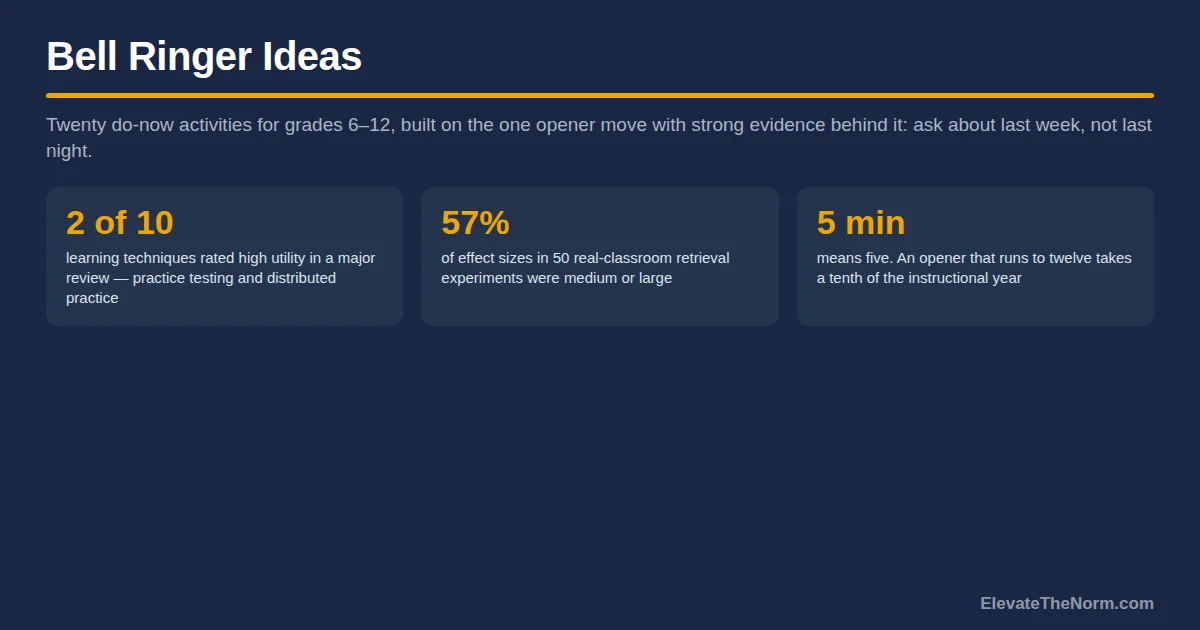
- Two study techniques were rated high utility out of ten reviewed: practice testing and distributed practice. Rereading, highlighting and summarizing all came out low.
- A bell ringer is the cheapest slot in the day for both of them. Ask about last week, not last night, and you have run distributed retrieval practice without calling it anything.
- Do not make the do-now about today’s lesson. If students cannot answer it from memory, it is not retrieval — it is a cold open with a worksheet.
- Five minutes means five minutes. An opener that runs to twelve has taken a tenth of the year from the rest of the lesson.
- Most bell ringer advice optimizes for compliance — getting bodies seated and quiet. That is a real problem, but it is a smaller one than what you do with the time.
Free Download · PDF
20 Bell Ringer Ideas and the Five-Minute Planner
All twenty prompts grouped by retrieval, spaced practice and openers, the four rules of the five-minute routine, a three-day rotation, and a planner for next week.
Free. No email address required. Designed for grades 6–12. Browse every printable in Your Free Library.
What Is a Bell Ringer?
A bell ringer — also called a do-now, warm-up, entry task or starter — is a short independent task students begin the moment they sit down, before the lesson formally starts. The names are interchangeable. What varies is whether the task does anything.
Two jobs get bundled into that five minutes and they pull against each other. The first is management: get twenty-eight teenagers from the hallway into a working posture without a speech. The second is learning: use the time on something that improves retention. Most bell-ringer advice solves the first and quietly abandons the second, which is how you end up with a semester of word searches that produced a calm room and nothing else.
You can have both, but only if you pick the task for the second job. A retrieval question settles a room just as well as a word search does, because the settling comes from the routine being predictable, not from the task being easy.
What Should a Bell Ringer Actually Do?
Make students pull something out of memory that they learned days or weeks ago. That single design rule is what separates an opener with evidence behind it from a stalling tactic.
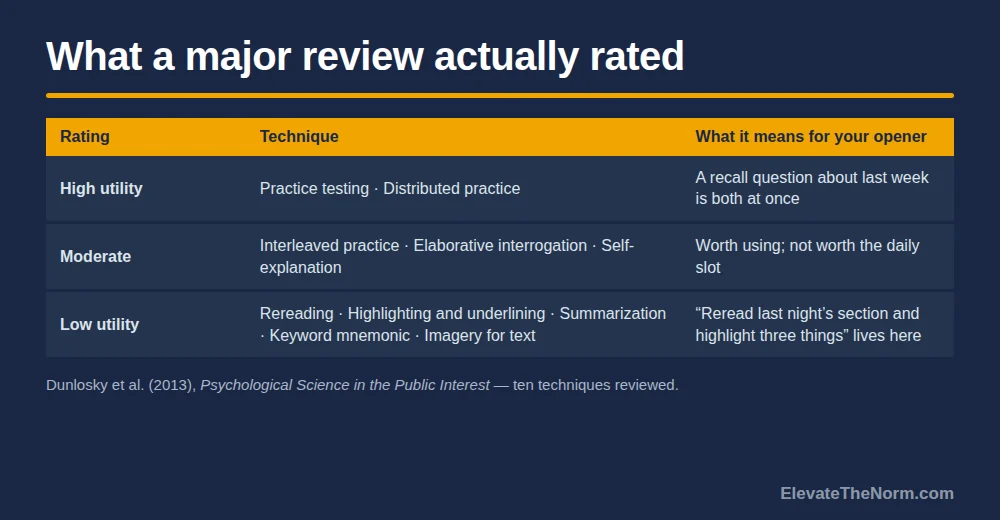
Dunlosky and colleagues reviewed ten common learning techniques for Psychological Science in the Public Interest and rated exactly two as high utility: practice testing and distributed practice. Their reason is worth quoting because it is unusually plain: those two “can help students regardless of age, they can enhance learning and comprehension of a large range of materials, and, most important, they can boost student achievement.”
What came out low utility is the part that should change what you assign: rereading, highlighting and underlining, summarization, the keyword mnemonic, and imagery for text. Highlighting in particular “has been shown to have failed to help students of all sorts.” If your bell ringer is “reread last night’s section and highlight three things,” you have spent five minutes a day, every day, on a technique that review rated at the bottom.
One objection worth answering before it is raised, because families will raise it: does asking students to recall something cold, every day, make school more stressful? The best evidence says the opposite, mildly. A meta-analytic review of 24 studies and 3,374 participants found practice tests reduced test anxiety, with a stronger effect in real classrooms than in labs. The authors are careful, and so should we be: 28 percent of students reported no benefit, and they note that quizzes can themselves be more stressful than other activities. The design implications are straightforward. Keep it ungraded, keep the answers private, and never read a wrong answer aloud with a name attached to it.
The classroom evidence for the good half is solid too. Agarwal, Nunes and Blunt reviewed 50 experiments with 5,374 participants conducted in real schools and classrooms rather than labs, and found that 57 percent of effect sizes showed medium or large benefits from retrieval practice, across education levels, subjects, test formats and delays. One limitation they state and I will repeat: only 6 percent of those experiments were run outside Western, educated, industrialised, rich, democratic countries.
Worth saying for anyone above the classroom: none of this requires a purchase. The bell-ringer market is full of subscription question banks, and what the evidence supports is a question about last week written on a whiteboard. The cost of doing this well is the ninety seconds afterward, not a licence.
A bell ringer is the easiest place in the school day to run both high-utility techniques at once. Ask a question about last week and you have practice testing. Ask about last week rather than yesterday and you have added distributed practice for free. The same mechanism is what makes a review game actually review something rather than just raise the noise level.
Does the Routine Itself Matter?
Yes, and the evidence for it is older and narrower than people assume. It is worth knowing both halves of that.
Simonsen and colleagues reviewed the classroom management literature and identified twenty evidence-based practices grouped under five features, three of which describe a bell ringer almost exactly: maximize structure and predictability; post, teach, review, monitor and reinforce expectations; and actively engage students in observable ways. Their line on the last one is the whole argument for a do-now in one sentence: “If students are actively engaged in instruction, then it is difficult to engage in incompatible behaviors.” They also report that increasing students’ rate of opportunities to respond has a positive effect on both achievement and behavior.
The honest caveat, from the same review: roughly 48 percent of the studies in their main table were published before 1987. This is a well-established literature, not a fresh one, and it is drawn from K–12 broadly rather than from secondary specifically. The practices are not in doubt. The precision of the numbers behind them is older than most of the teachers using them.
The practical version is a routine so predictable that it does not need announcing. The question is posted before the bell. Students start without being told. You are at the door, not at the board. That predictability is the thing doing the work, which is why changing the format every week undoes it. The same logic sits under the site’s wider argument about routines that run without you narrating them.
20 Bell Ringer Ideas for Grades 6–12
Grouped by what they are for, and all of them work in any subject. The first two groups are the ones with evidence behind them. The third is for days when you need something else, and it is labelled honestly as such.
Retrieval: ask about last week, not last night
- Three things you remember from Monday. No notes, no neighbor.
- Brain dump: two minutes, everything you can recall about the unit so far.
- One question from last week’s material that you could not answer today.
- What did we conclude about ___? State it in one sentence, from memory.
- Two vocabulary terms from two weeks ago, defined in your own words.
- Draw the process we studied Tuesday. Labels only, no sentences.
- What is the single most important thing from last unit, and why that one?
- Yesterday, last week, last month: one fact from each.
Spaced practice and connection
- Here is a term from September. Where does it connect to what we are doing now?
- Two ideas from different units. What do they have in common?
- Correct this: a wrong statement about older material, fixed and explained.
- Predict: based on what we already know, what happens next?
- Which of these three problems is from last unit? Solve that one.
- Explain last week’s idea to someone who missed class. Four sentences.
Openers that set up thinking (use sparingly — weaker evidence)
- One-sentence response to a short quotation connected to today’s work.
- Two questions you want answered before this unit ends.
- What would change if the opposite were true?
- Rank these three things by importance. Be ready to defend the order.
- A number on the board. What could it be measuring?
- One thing from this class you have used or noticed outside of school.
The Five-Minute Rule
Post it, start it without a word, stop it on time, and use the answers. Four moves, and the last two are where most openers fail.
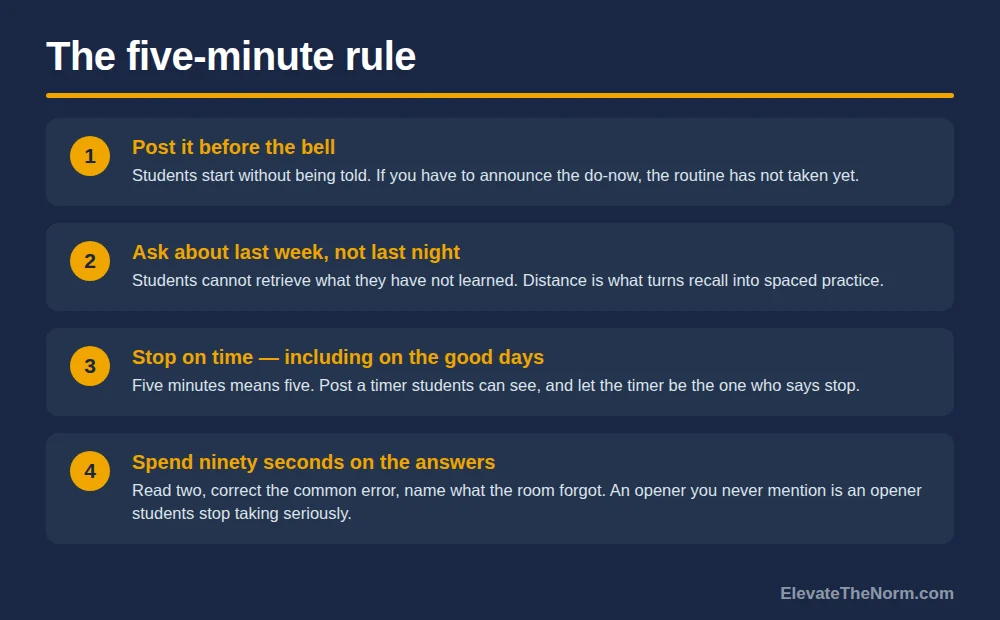
Stopping on time is a discipline problem for the adult, not the students. An opener that regularly runs to twelve minutes is taking about a tenth of the instructional year from everything downstream of it. Clay’s own method for the front of a lesson is organization to the minute and then a pause — you post the plan, you stop talking, and you let the silence do the work rather than filling it. The pause is what makes the clock credible. If you announce five minutes and take twelve, the announcement stops meaning anything by October.
Using the answers is the other half. A retrieval question you collect and never mention has taught students that the first five minutes are a formality. Spend ninety seconds on it: read two answers aloud, correct the common error, name the thing most people forgot. That is also a real formative check — the data arrived, and what you do next is the whole point of having collected it.
One note about the room itself, because it belongs to the first five minutes. I do not turn the overhead fluorescents on; the room runs on floor lamps and a few desk lamps, warm and low. Walking out of a bright hallway into a room that is not shouting at you does more for the first two minutes than any task on the board. It is also one of the few accommodations that helps far more students than the ones who would ever have asked for it.


How Should You Grade a Bell Ringer?
Mostly you should not, and the reason is mechanical rather than philosophical. Retrieval practice works partly because students are willing to be wrong in it. Attach points and they will check their notes, and a retrieval question answered from notes is not retrieval.
What to do instead: collect them, or do not, depending on whether you will look. Give credit for completion if your school requires something in the gradebook, and weight it low enough to be honest about what it is. Tell students out loud that the answers are not scored for correctness and then behave that way for two weeks, because they will not believe you on the first day and they should not.
If you want a number from the routine, take it from a periodic ungraded check on the same material rather than from the daily opener. That gives you the signal without spending the thing that makes the signal worth having.
Bell Ringer Mistakes That Waste the Five Minutes
Five, and four of them are about design rather than discipline.
- It is about today’s lesson. Students cannot retrieve what they have not learned, so the task becomes guessing or waiting. Ask about last week.
- It requires materials not already on the table. Anything needing a device login, a handout at the front, or a textbook from the shelf costs more minutes than the task is worth.
- It changes format every day. Novelty is not the goal; predictability is. Rotate among three or four shapes so students know what a do-now is without being told.
- It is never referenced again. If the answers do not affect the next ninety seconds of class, students correctly conclude the routine is about keeping them busy.
- It punishes lateness. A do-now that a student walking in at the four-minute mark cannot join teaches them not to bother coming in. Let them start where the room is.
A related line worth holding: a do-now is not a tardy-enforcement mechanism. Some schools use the opener as the thing a late student loses, which converts an instructional routine into a discipline consequence and guarantees that the students who most need the retrieval practice get the least of it. If lateness is a problem, handle it as a lateness problem, through whatever system your school actually uses for that.
The fifth one matters more than it looks. The students most likely to arrive late are frequently the ones for whom the opener would do the most, and a routine designed so they always begin behind is a routine designed to lose them. The same is true of any transition built so that the slowest student is always wrong.
Does the Subject Change the Bell Ringer?
Less than you would think. The format transfers; the content is the only thing that changes.
“Three things you remember from Monday” works identically in algebra, biology, English and social studies, because the cognitive move — pull it from memory without notes — is the same regardless of what is being pulled. The subject-specific bell ringer lists you find online are mostly the same six formats with different nouns.
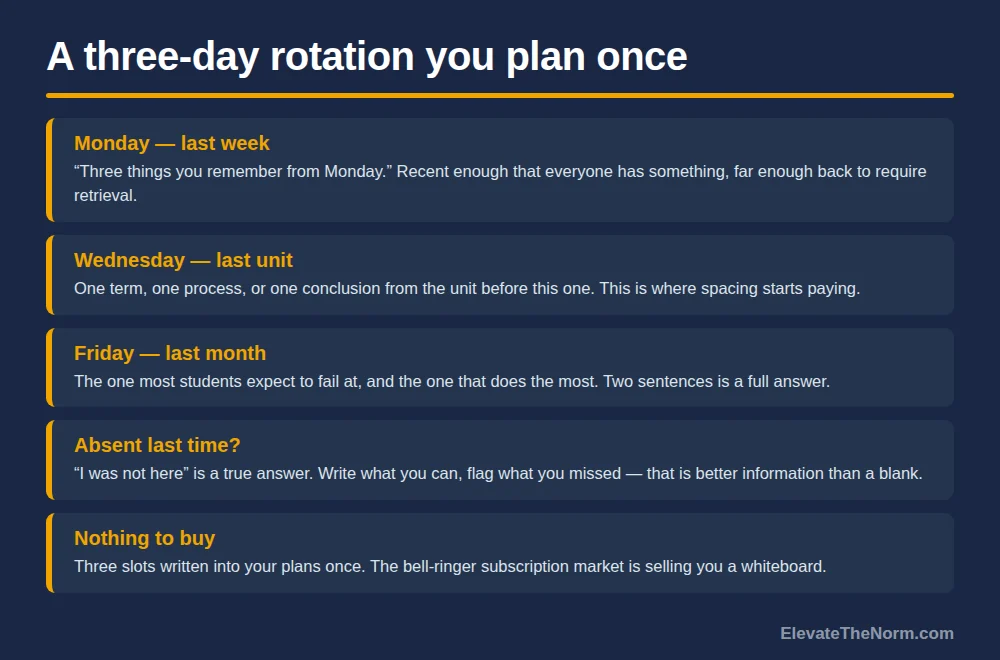
The question most teachers get stuck on is not the format but the content: what do I ask about today? A three-day rotation solves it and takes no planning. Monday, something from last week. Wednesday, something from the previous unit. Friday, something from the month before. Write the three slots into your plans once and you never have to invent a do-now again.
And decide in advance what a student who was absent does. “I was not here” is a true answer to a retrieval question and it should not be a problem — let them write what they can and flag what they missed, which is more useful information for you than a blank. Attendance is usually being taken during these five minutes anyway; you will know.
Two real differences worth naming. In a math or science class, a retrieval opener can be a single problem from an older unit, which doubles as spaced practice on a procedure. In English and social studies, retrieval is usually verbal or written recall, and the trap is that a question about an interpretation is not retrieval — it is discussion, which is a good thing that takes longer than five minutes. If you want the discussion, schedule it as one.
What to Do Next
Pick three formats from the first group above and rotate them. Write Monday’s on the board before you leave on Friday, so the routine does not depend on you remembering in the morning. Set a timer where students can see it. Spend ninety seconds afterward on what the answers showed you, out loud.
Then check one thing after two weeks: are students starting without being told? That is the only measure of whether the routine has taken. If they are still waiting for you to say go, the problem is predictability, not motivation — and the fix is to change the format less often, not more.
Before you go: grab the free 20 Bell Ringer Ideas and the Five-Minute Planner (PDF) — ElevateTheNorm.com branded, printable, no email required.
Frequently Asked Questions
What is a bell ringer in a classroom?
A short independent task students begin the moment they sit down, before the lesson formally starts. Do-now, warm-up, entry task and starter all mean the same thing. The name does not matter; what matters is whether the task asks students to retrieve something from memory or just keeps them occupied while you take attendance.
How long should a bell ringer take?
Five minutes, and it should actually be five. An opener that habitually runs to twelve is taking roughly a tenth of your instructional year from everything downstream. Post a visible timer, and stop the task when the timer does — including on the days when the answers are interesting.
What makes a good do-now activity?
It asks students to pull something from memory that they learned days or weeks ago, without notes. That one design rule gets you practice testing and distributed practice at the same time, the two techniques a major review rated as high utility out of ten. It should also need nothing that is not already on the table.
Should bell ringers be about today’s lesson?
No, and this is the most common mistake. Students cannot retrieve material they have not learned yet, so a do-now about today’s content becomes guessing, copying or waiting. Ask about last week, last unit or last month. The distance is the point — spacing is what makes the retrieval stick.
Should you grade bell ringers?
Not for correctness. Retrieval practice works partly because students are willing to be wrong in it, and attaching points is how you get twenty-eight students checking their notes instead of retrieving. If something has to go in the gradebook, give completion credit, weight it low, and say out loud that the answers are not scored for accuracy.
Are bell ringers actually backed by research?
The retrieval half is, strongly. A review of 50 classroom experiments with 5,374 participants found 57 percent of effect sizes showed medium or large benefits. The routine half rests on classroom-management research that identifies structure, predictability and opportunities to respond as evidence-based — though about half of the studies in that review predate 1987, which is worth knowing before quoting it as new.
What are good bell ringer ideas for high school versus middle school?
Largely the same ones. The cognitive move — recall it without notes — does not change between seventh and twelfth grade; the content and the expected length of the answer do. A seventh grader might list three things from Monday in phrases; a senior should be writing a defensible sentence. Do not change the format by grade, change the standard you hold the answer to.
Does a daily recall task stress students out?
A meta-analytic review of 24 studies and 3,374 participants found that practice tests reduced test anxiety rather than increasing it, with a stronger effect in real classrooms than in laboratories. The authors are careful about it, and so should you be: 28 percent of students reported no benefit, and quizzes can be more stressful than other activities. The design that keeps it safe is the same one that makes it work — ungraded, answers private, and no wrong answer read aloud with a name on it.
Sources
- Dunlosky, John, Katherine A. Rawson, Elizabeth J. Marsh, Mitchell J. Nathan, and Daniel T. Willingham. “Improving Students’ Learning With Effective Learning Techniques: Promising Directions From Cognitive and Educational Psychology.” Psychological Science in the Public Interest, vol. 14, no. 1, 2013, pp. 4–58. Ten techniques reviewed; practice testing and distributed practice rated high utility; interleaved practice, elaborative interrogation and self-explanation moderate; rereading, highlighting/underlining, summarization, keyword mnemonic and imagery for text low. https://www.aft.org/ae/fall2013/dunlosky
- Agarwal, Pooja K., Ludmila D. Nunes, and Janell R. Blunt. “Retrieval Practice Consistently Benefits Student Learning: A Systematic Review of Applied Research in Schools and Classrooms.” Educational Psychology Review, vol. 33, no. 4, Dec. 2021. 50 experiments, 5,374 participants, 49 effect sizes, 57 percent showing medium or large benefits. Limitation stated by the authors: only 6 percent of experiments were conducted outside WEIRD countries. https://eric.ed.gov/?id=EJ1319572
- Simonsen, Brandi, Sarah Fairbanks, Amy Briesch, Diane Myers, and George Sugai. “Evidence-Based Practices in Classroom Management: Considerations for Research to Practice.” Education and Treatment of Children, vol. 31, no. 3, 2008, pp. 351–380. Twenty evidence-based practices across five features; increasing opportunities to respond improves both achievement and behavior. Roughly 48 percent of the studies tabulated predate 1987, and the review covers K–12 broadly rather than secondary specifically. https://dropoutprevention.org/wp-content/uploads/2015/05/Simonsen_Fairbanks_Briesch_Myers_Sugai_2008.pdf
- Yang, Chunliang, et al. “Do Practice Tests Reduce or Provoke Test Anxiety? A Meta-Analytic Review.” Accepted manuscript, UCL Discovery repository, 2023. 24 studies, 25 effects, 3,374 participants; practice tests reduced test anxiety, Hedges’ g = −0.52 (95% CI [−0.69, −0.36]), and g = −0.55 in classroom settings specifically. The authors note 28 percent of students reported no benefit, and that quizzes themselves may be more stressful than other learning activities. https://discovery.ucl.ac.uk/id/eprint/10177686/