By Clay Shumate
Team building activities for students are short structured tasks a group can only finish together. The ones that work in grades 6–12 share five features: the task genuinely needs everyone, you assign the groups, nothing forces personal disclosure, nothing requires touching, and it ends with a question rather than a winner.
Here is the part most articles on this skip. The strongest research on team building was not done on teenagers — it was done on adults at work. That does not make it useless, but it changes what you can honestly promise. Below: what the evidence actually covers, six activities that hold up with secondary students, and the three kinds you should stop running.
Key Takeaways
- Five conditions decide whether an activity works, and four of them are design choices you make before students walk in.
- 🔴 The best teamwork-training evidence is about adults. McEwan and colleagues pooled 51 articles and 8,439 participants from health care, aviation, the military and industry. Not one school.
- The school-age evidence is softer and still positive. The EEF puts social and emotional learning at about +5 months for secondary across 119 studies, at moderate security.
- 🔴 Teacher support beats peer activities for belonging. In a meta-analysis of 51 studies and 67,378 students, teacher support was the strongest predictor of school belonging.
- Short and often beats long and rare. The EEF reports sessions up to 45 minutes, twice a week, embedded in routine practice.
- Three activity types to drop: anything needing physical contact, anything needing personal disclosure, and anything where teams get picked in public.
What Are Team Building Activities for Students?
They are structured tasks run to improve how a class functions together, rather than to teach a standard. That is the whole category, and it is broader than the icebreaker it usually gets reduced to.
The useful distinction is not between types of activity. It is between an activity with interdependence built into it and one without. If three students can finish while two watch, you have run a game with an audience. The students who were already confident had a nice time; the ones you were hoping to pull in watched from the edge, which is exactly what they do the rest of the day.
This is the same mechanism that makes structured cooperative learning different from sitting students in groups — the task has to need everybody, or the structure does nothing.
What Makes a Team Building Activity Work?
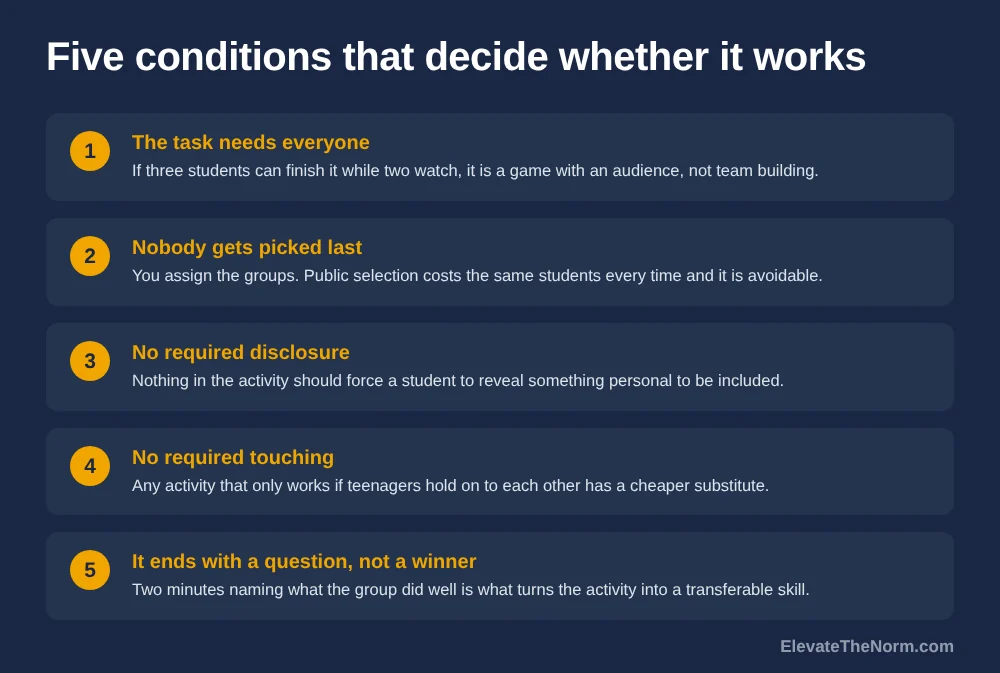
Five conditions. Miss any one and the activity either does nothing or does harm.
1. The task needs everyone. Build in a genuine information gap or a genuine division of labour. The quickest test is to ask whether your most capable student could do it alone in half the time. If yes, redesign it.
2. Nobody gets picked last. You assign the groups. Letting students choose looks generous and costs the same two or three students every single time, in public, repeatedly. It is one of the few genuinely avoidable social injuries in a school day and it is entirely within your control.
3. No required disclosure. Nothing in the activity should make a student reveal something about their family, their weekend or their feelings in order to take part. A student with a complicated home life should not have to choose between lying and opting out in front of thirty people.
4. No required touching. This rules out a short list of old favourites and it should. You do not know which students have reasons, and they are not obliged to tell you in order to be left alone.
5. It ends with a question, not a winner. Two minutes where the group names what it did well and what it would change. This is the step that gets cut when the bell is coming, and it is the one that turns a fun ten minutes into something students get better at. A short format for that reflection step saves you inventing one.
Do Team Building Activities Actually Work for Students?
Probably, modestly — and the strongest numbers you will see quoted are from adults, not students. This is the honest state of it.
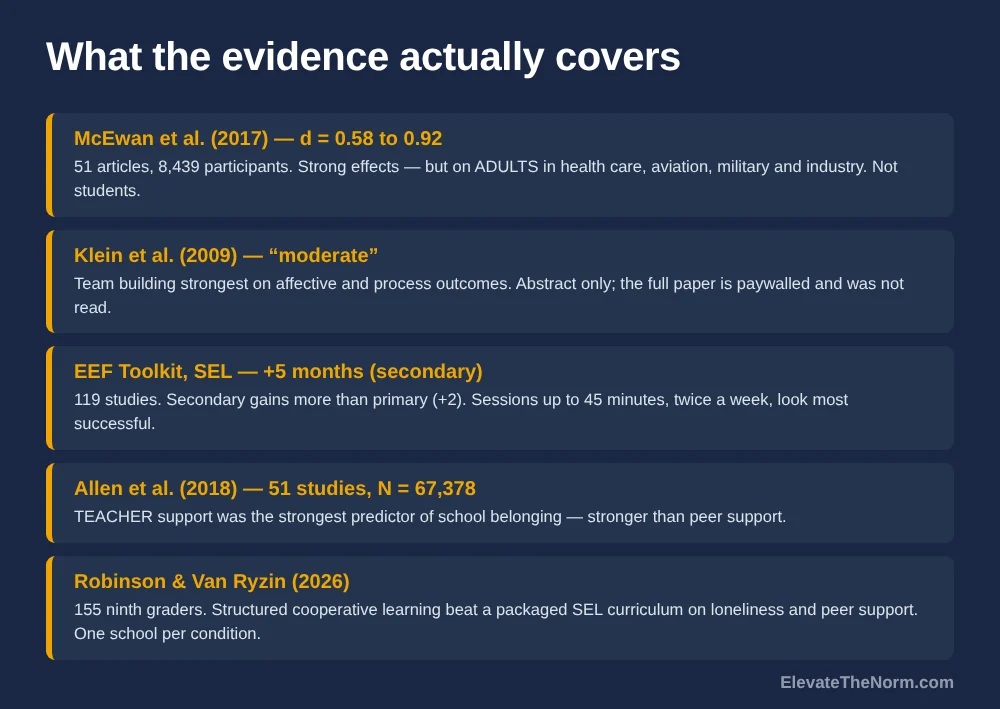
McEwan and colleagues (2017), in PLOS ONE, pooled 51 articles covering 72 interventions and 8,439 participants. Teamwork behaviours improved at d = 0.68, team performance at 0.92. Removing outliers brings both to about 0.55 and 0.58, which is still a real effect. But the participants were adults in health care, aviation, the military, academia and industry. The authors also report very high heterogeneity and note they could not analyse team size or how long the training ran, because the included studies reported those inconsistently.
Klein and colleagues (2009), in Small Group Research, found a moderate positive overall effect for team building, strongest on affective and process outcomes. We could not read the full paper — it is paywalled — so nothing here goes beyond what the abstract states. Same caveat on population: this is the organisational literature, not the school one.
The EEF Toolkit is the closest thing to school-specific evidence, and it does not cover team building as such — it covers social and emotional learning, the broader family these activities belong to. It reports about +5 months for secondary pupils, against +2 for primary, from 119 studies, at moderate evidence security. It lost a padlock because many studies were not independently evaluated, and the Foundation notes that evaluations run by the people selling an approach tend to show larger impacts.
So: a defensible reason to spend some class time on this. Not a reason to buy a program, and not a reason to promise anyone a measurable achievement gain.
What Matters More Than the Activities?
You do. Allen and colleagues’ 2018 meta-analysis in Educational Psychology Review examined what predicts school belonging across 51 studies and 67,378 students. Teacher support and positive personal characteristics came out as the strongest predictors — ahead of peer support, ahead of extracurricular activities.
That finding should change how you read every list of activities on the internet, including this one. The activities are a multiplier on a relationship that either exists or does not. A teacher who does exactly what they said they would do, every time, builds more cohesion in a semester than any sequence of games will — which is the argument this whole site is built on, and it starts with how students get treated at the door.
There is one trial worth knowing on the student side. Robinson and Van Ryzin, in School Mental Health in 2026, randomly assigned two rural high schools to a structured cooperative learning platform or a packaged social-emotional learning curriculum, following 155 ninth graders for four months. The cooperative learning school came out ahead on peer support, loneliness, victimisation and several mental health measures. The limitation is serious and the authors state it: one school per condition, and every measure was student self-report. Read as a hint rather than a finding, it points somewhere useful — the structured academic work did more for how students felt about each other than the curriculum designed to.
Six Team Building Activities for Grades 6–12
These are common, widely used classroom formats rather than anything proprietary. What makes each one worth running is that it meets the five conditions above, and that most of them can carry the material you were going to teach anyway.
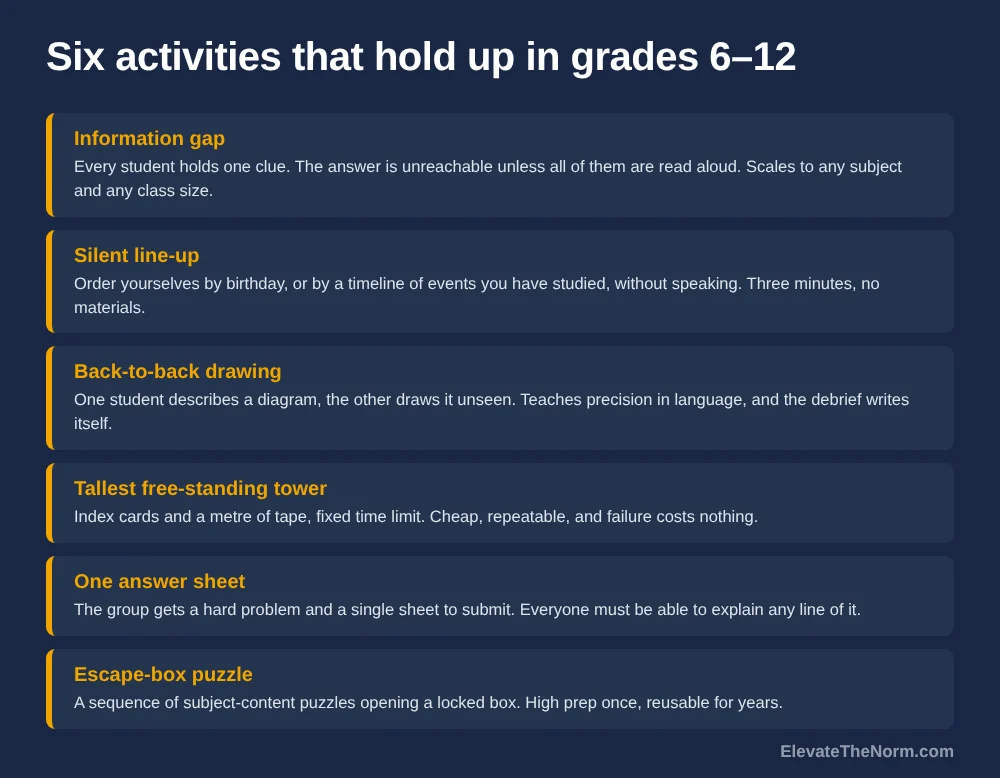
Information gap. Every student gets one clue on a slip of paper. The answer is unreachable unless every slip is read out. Works at any class size, scales to any subject, and the quietest student in the room holds something the group needs, which is the point.
Silent line-up. Order yourselves without speaking — by birthday, or better, by a timeline of events you have studied. Three minutes, no materials, no preparation. The content version makes it defensible to anyone who walks in.
Back-to-back drawing. One student describes a diagram they can see; their partner draws it without looking. Use a diagram from the unit. The debrief writes itself, because every pair can see exactly where the description failed.
Tallest free-standing tower. Index cards and a metre of tape, fixed time limit. Cheap, repeatable, and failing costs nothing — which matters, because the groups that collapse at minute six usually learn more than the ones that do not.
One answer sheet. The group gets a genuinely hard problem and a single sheet to submit, and any member may be asked to explain any line of it. That last clause is what stops one student writing it alone, and it is the same individual accountability that makes group roles work at all.
Escape-box puzzle. A sequence of subject-content puzzles whose answers open a combination lock. High preparation once, then reusable for years. This is the one to build over a long weekend rather than the night before.
What Should You Stop Running?
Three categories, and none of them is a judgement call about your particular group.
Anything that requires physical contact. The human knot and its relatives. There is always a substitute that achieves the same thing, and you cannot know in advance which student it will cost. A student should not have to explain why in order to be excused.
Anything that requires personal disclosure to participate. Two truths and a lie is the common one. It is fine if students can give entirely trivial answers without anyone noticing, and it is not fine if the activity rewards the most revealing answer.
Anything where teams get picked in public. Captains choosing, counting off into visible tiers, “find three people you have not worked with” — all of them end the same way for the same students.
And one hard line that is not about the activity format at all: making fun of how unusual someone’s name is is a stop in my room. Team building activities put names in play more than an ordinary lesson does, which is exactly when that one needs saying out loud beforehand rather than enforced afterwards.
How Often, and For How Long?
Short, embedded and repeated beats long, separate and rare. The EEF reports that sessions of up to 45 minutes held twice a week appear most successful, and that impact is more likely when this is part of routine practice rather than bolted on.
For a secondary timetable that usually means five to fifteen minutes inside a normal lesson, often. Not an hour in the first week of August that nobody repeats until the week before finals. The August version is the one most schools run, and it is the one the evidence supports least.
It also means these work best as part of the routines a class already runs on rather than as an event. An activity students recognise takes thirty seconds to set up. An activity they have never seen takes eight minutes and most of your patience.


How Do You Run One Without Losing the Room?
Set the constraint before you set the task, and give the end of the activity a landing place. Most of what teachers mean by “it went feral” happens in the two minutes after a group finishes early and the two minutes after you say “go.”
Four things that hold it. State the time limit and what the room looks like when the time is up — not just “you have six minutes,” but where materials go and what is on the desk afterwards. Give early finishers a next thing before anyone needs it; a group with nothing to do is not misbehaving, it is unoccupied. Keep groups small enough that a student cannot disappear inside one, which is three to five for most of these. And circulate the whole time — an activity is not the part of the lesson where the teacher gets to sit down.
The other half of it is that volume is not the same as chaos. A class working hard on a genuinely difficult problem is loud, and a class that has quietly given up is quiet. If you judge the activity by the noise level you will cancel the good ones and keep the boring ones. Judge it by what the groups are actually producing instead.
What Do You Tell an Administrator or a Parent?
That the activity is carrying content, what the evidence does and does not support, and how long it took. All three of those are easier to say if you built it that way to begin with.
The strongest defence is the first one. A silent line-up ordering events from the unit and an information gap built from the reading are not time taken away from the material — they are the material, done in a format that also does social work. That is why most of the six activities above are content-carrying rather than generic, and it is the single change that turns this from something you justify into something you just show.
On the evidence, be straight. You can say that the EEF puts social and emotional learning at about five months of additional progress for secondary pupils, at moderate evidence security, and that the broader teamwork-training research is strong but was mostly done on adults. You should not say this will raise test scores by a specific amount, because nobody can support that. An administrator who hears an honest qualification is far more likely to believe the rest of it.
For a coach or a department lead walking in, the look-fors are short: is the task one student could have done alone, were the groups assigned or self-selected, is the teacher moving, and did it end with a debrief? Those four questions take ninety seconds and catch nearly everything that goes wrong with this.
What If Students Think It Is Cringe?
Expect it, and do not read it as the verdict.
My students once voted on getting a class pet, and they wanted one. High school students want recognition. They want cheap prizes. They want the room to be a decent place to be. They just may not show it on the outside, and a teenager’s first public reaction to anything organised by an adult is not reliable evidence about whether they want it.
Two things make the eye-rolling shorter. Keep the activity brief enough that the awkward part is over before it settles in. And make the task genuinely hard — teenagers will throw themselves at a real problem much faster than at a game whose obvious purpose is to make them bond. The social outcome is a side effect of the task being worth doing, which is the reverse of how most of these get designed.
A third thing, which costs nothing: ask them. Students have opinions about which of these are worth the time and they are usually right, because they are the ones who have sat through every version since sixth grade. Running a format a class picked is not a concession — it is the same reason giving students real say in how a room runs tends to produce better compliance than announcing it does. And a student who tells you an activity is pointless has given you better feedback than the thirty who said nothing.
What to Do Next
Take one activity from the six above and rebuild it around content you are teaching in the next two weeks. The information gap is the easiest to convert and the hardest to object to.
Then check your current list against the three categories to drop. If something on it requires touching, disclosure or public picking, cut it — you are not losing anything you cannot replace.
And put the two-minute debrief in from the start. It is the step that converts an activity into a skill, it is free, and it is the first one that disappears when the schedule gets tight.
Frequently Asked Questions
What are team building activities for students?
They are short structured tasks that a group can only finish by working together, run to improve how a class functions rather than to teach content. In grades 6–12 the useful ones share five features: the task genuinely needs everyone, the teacher assigns the groups, nothing forces a student to disclose something personal, nothing requires physical contact, and it ends with a short debrief rather than a winner. An activity missing those is usually just a game.
Do team building activities actually work for students?
The honest answer is that the strongest evidence is not about students. The best meta-analysis of teamwork training — McEwan and colleagues, 51 articles and 8,439 participants — found solid effects on teamwork behaviours and team performance, but its participants were adults in health care, aviation, the military and industry. For school-age students the closest evidence is the EEF’s social and emotional learning entry, which reports about +5 months for secondary pupils across 119 studies at moderate evidence security. That is a reasonable basis for doing this. It is not a basis for promising a transformed class.
How long should a team building activity take?
Shorter and more often beats long and rare. The EEF reports that sessions of up to 45 minutes, held twice a week, appear to be the most successful structure for social and emotional learning, and that impact is more likely when it is embedded in routine practice rather than bolted on. In practice, five to fifteen minutes inside a normal lesson, repeated, does more than one hour-long session in August that nobody repeats until May.
What team building activities should you avoid with teenagers?
Three categories. Anything requiring physical contact, such as the human knot — there is always a cheaper substitute and you cannot know in advance who it will cost. Anything requiring personal disclosure to participate, such as two truths and a lie, unless students can opt into trivial answers without being noticed. And anything where students choose teams publicly, which lands on the same two or three students every time. None of those three are judgement calls about your particular group; they are design faults.
Are team building activities a waste of instructional time?
They can be, and the way to stop that is to make the task carry content. An information gap built from the actual unit, a silent line-up ordering events you have studied, an escape-box whose puzzles are subject problems — all of these do the social work while students are thinking about the material. That also makes them far easier to defend to an administrator, and it is why the activities in this article are mostly content-carrying rather than generic.
What matters more than team building activities?
Teacher support. Allen and colleagues’ 2018 meta-analysis of 51 studies, covering 67,378 students, found that teacher support and positive personal characteristics were the strongest predictors of school belonging — ahead of peer support. That does not mean the activities are pointless. It means a teacher who is consistent, who follows through on what they said, and who treats students as people will do more for a class’s cohesion than any activity will, and the activities work best sitting on top of that rather than substituting for it.
How do you run team building when students think it is cringe?
Expect the eye-rolling and run it anyway, with two adjustments. Keep it short enough that the awkward part is over quickly, and make the task hard enough to be interesting — teenagers will engage with a genuine problem far faster than with a game designed to make them bond. Also, do not read the reaction as the verdict. In my experience high school students want recognition and want the room to be a decent place to be; they are just not going to say so in front of each other.
Sources
- McEwan, D., Ruissen, G. R., Eys, M. A., Zumbo, B. D., & Beauchamp, M. R. (2017). The Effectiveness of Teamwork Training on Teamwork Behaviors and Team Performance: A Systematic Review and Meta-Analysis of Controlled Interventions. PLOS ONE, 12(1), e0169604. Source of d = 0.683 for teamwork behaviours and 0.919 for team performance, falling to 0.550 and 0.582 with outliers removed, from 51 articles and 8,439 participants. Population: adults in health care, aviation, military, academia, industry and laboratory settings — not school students. Heterogeneity was very high (I² = 94.2% before outlier removal), and the authors could not analyse team size or intervention length. journals.plos.org
- Klein, C., DiazGranados, D., Salas, E., Le, H., Burke, C. S., Lyons, R., & Goodwin, G. F. (2009). Does Team Building Work? Small Group Research, 40(2), 181–222. Abstract only — the full text is behind a paywall and was not read for this article. Cited here solely for the abstract’s statement of a positive moderate overall effect, strongest on affective and process outcomes, across the goal-setting, interpersonal-relations, problem-solving and role-clarification components. No effect sizes are quoted because the abstract gives none. journals.sagepub.com
- Education Endowment Foundation, Teaching and Learning Toolkit: Social and emotional learning. Source of +3 months overall, about +5 for secondary and +2 for primary, the 119-study base, and the finding that sessions of up to 45 minutes twice a week embedded in routine practice appear most successful. Evidence security: moderate. It lost a padlock because many studies were not independently evaluated, and the Foundation notes that provider-run evaluations tend to show larger impacts. educationendowmentfoundation.org.uk
- Allen, K., Kern, M. L., Vella-Brodrick, D., Hattie, J., & Waters, L. (2018). What Schools Need to Know About Fostering School Belonging: A Meta-Analysis. Educational Psychology Review, 30(1), 1–34. Source of the finding that teacher support and positive personal characteristics were the strongest predictors of school belonging, from 51 studies and a combined sample of 67,378 adolescents. Read via the ERIC record, which gives the abstract but not the per-predictor effect sizes; no effect size is quoted here because we could not verify one. eric.ed.gov
- Robinson, L. E., & Van Ryzin, M. J. (2026). Promoting Positive Social and Mental Health Outcomes: Technology-Supported Cooperative Learning vs. Curriculum-Based SEL. School Mental Health, 18, 137–148. Cluster-randomised, 155 ninth graders, two rural Pacific Northwest high schools, four months, against an active SEL control. Reported with the authors’ stated limitations: one school per condition, all student self-report, a homogeneous rural sample, and low reliability on the bullying measure at follow-up. springer.com