By Clay Shumate
The best student motivation activities for grades 6–12 give teenagers a first step they can take right away and a visible reason to keep going. Goal setting, real choices, progress tracking, peer recognition, and relevance hooks all work because they put students in charge of something small and let them see it pay off.
This post is the hands-on companion to the bigger-picture guide on motivating students. If you’re dealing with one or two kids who seem checked out entirely, start with motivating students who don’t care and come back here for activities to try once you’ve found the barrier.
Everything below is built for a secondary teacher juggling roughly 150 students across five or six periods. If an activity needs an hour of prep per class, it won’t last past October, so these are designed to fold into lessons you’re already teaching.
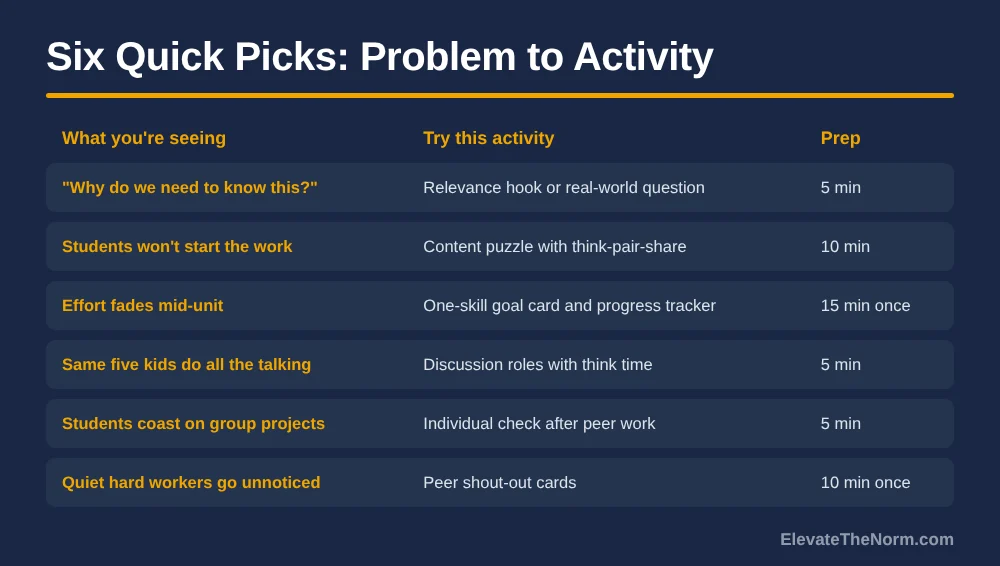
Quick Picks: Which Activity Fits Which Problem?
| What you’re seeing | Try this activity | Prep |
|---|---|---|
| “Why do we need to know this?” | Relevance hook or real-world question | 5 minutes |
| Students won’t start the work | Content puzzle with think-pair-share | 10 minutes |
| Effort fades halfway through a unit | One-skill goal card and progress tracker | 15 minutes once |
| Same five kids do all the talking | Discussion roles with think time | 5 minutes |
| Students coast on group projects | Individual check after peer work | 5 minutes |
| Nobody notices the quiet hard workers | Peer shout-out cards | 10 minutes once |
Relevance Hooks: Give Students a Reason to Care in the First Five Minutes
Motivation usually dies at the start of class, not the end. A good hook gives students a question worth answering before they’ve decided to tune out.
Content Puzzle With Think-Pair-Share
Put something slightly off on the board: two accounts of the same event that don’t match, an equation with a mistake, a graph with a weird spike. In World History, that might be two descriptions of the same encounter written by people on opposite sides. Ask, “Which details would you need to check?”
Students write a private answer first, compare with a partner, then share one disagreement they settled or one question they still have. Everyone has something on paper before discussion, so the quiet kids aren’t skipped. Add a vocabulary note if the reading level is a barrier.
The Real-World Question
Pick a problem with an actual decision attached: how a community should remember a historical event, whether a viral claim holds up, how the school could cut cafeteria waste. Students generate questions, then you help narrow them. “Was industrialization good?” turns into “Whose lives got better or worse, and how do we know?”
This is where student voice and choice earns its keep. Students steer the questions; you keep the curriculum, the evidence standards, and the final grade.
Video Spark and Quick-Write
Show a short captioned clip, but post the question before you press play: “Which detail best supports the claim that geography shaped this settlement?” Afterward, students write one claim and one concrete detail. If most of them describe the scene without connecting it to the claim, model that connection before moving on.
Choice Activities: Small Decisions, Same Learning Target
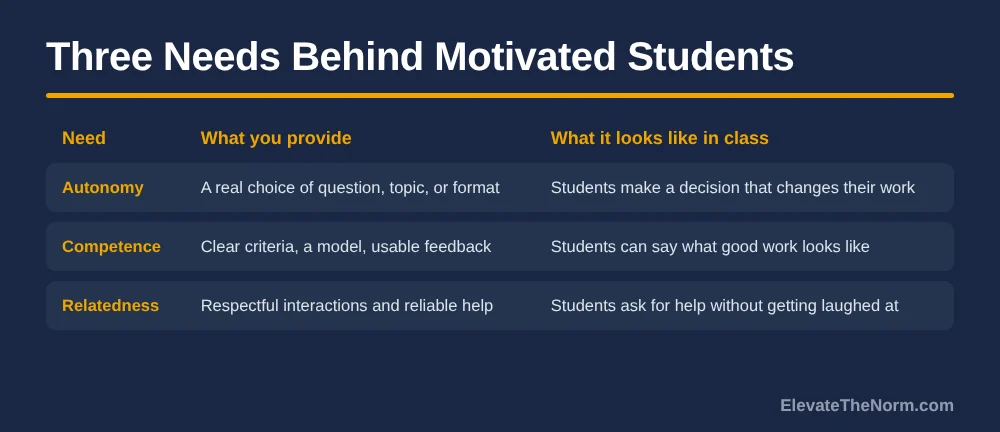
Self-determination theory (Deci and Ryan) is a useful lens here. People are more motivated when they have some autonomy, feel competent, and feel connected to the people around them. You don’t need to hand over the whole lesson. One meaningful decision is often enough.
| Need | What you provide | What it looks like in class |
|---|---|---|
| Autonomy | A real choice of question, topic, or format | Students make a decision that changes their work |
| Competence | Clear criteria, a model, usable feedback | Students can say what good work looks like |
| Relatedness | Respectful interactions and reliable help | Students ask for help without getting laughed at |
Two Ways to Show the Same Learning
Offer a written explanation or a recorded one with annotated visuals, as long as both prove the same skill. Hold them to the same standard for evidence and reasoning. If you’re actually assessing writing, keep it written and give the choice through the topic or the examples instead.
A Small Choice Board
Three or four options is plenty. Make sure every option has the materials it needs in the room, so device access or supplies at home never decide for a student. More on why this works in the post on student autonomy.
Goal Setting and Progress Tracking: Make Improvement Visible
Teenagers rarely feel motivated by “get better at history.” They do respond when they can point at their own work and see what changed.
The One-Skill Goal Card
Before a task, each student picks one skill tied to it: “Explain how evidence supports a claim,” not “try harder.” Then they name one action that goes with it, like underlining the link between a document detail and the claim. The full process is in the guide to student goal setting.
Before-and-After Folders
Students keep an early attempt next to a revision and mark what improved. Then they answer two questions: which feedback did they use, and what skill comes next? That’s competence they can inspect, not a pep talk.
Exit Tickets That Change Tomorrow’s Lesson
Ask an exit-ticket question that tells you something you’ll act on. Sort the answers into three piles: reteach, supported practice, or extension. Then tell students what you changed because of their responses. Seeing their work actually move the lesson is a motivator by itself.


Peer Activities: Participation Everyone Has to Prepare For
Group work motivates when every student has something to bring and something they’re accountable for afterward.
Discussion Roles With Think Time
Start with a question that needs evidence, and give a minute of silent thinking before anyone talks. Assign group work roles tied to real actions: a facilitator invites contributions, an evidence checker asks where claims come from, a recorder captures the reasoning. Rotate the roles so nobody gets stuck as permanent note-taker.
Peer Teaching With an Individual Check
Partners each explain a worked example or short passage while the other asks questions. Listen for explanations of *why* a step works, and jump in briefly if you hear a misconception getting rehearsed. Finish with an independent question using a new example. That’s how you know who learned it and who rode along.
Evidence-Based Debate
Pick a question with more than one defensible answer, like which factor mattered most in a revolution, using a shared document set. Students have to summarize the other side’s argument accurately before they respond. Offer a written route for students who can’t or won’t speak publicly yet.
Recognition Activities: Notice the Work Grades Miss
Recognition motivates when it’s specific and when it reaches the kids who never get noticed for high scores.
Peer Shout-Out Cards
Students write short notes recognizing a classmate’s contribution: “You found the quote that settled our argument.” You read them before anything is shared, and any student can keep their recognition private. Skip anything about appearance or anything that turns into a popularity contest.
Specific Praise and Three Recognition Tiers
Name the exact action: “You checked your claim against the document before turning it in.” That tells the student what to repeat.
In the Elevate system, recognition runs on three tiers: Immediate Recognition, Student of the Week, and Student of the Month. My Student of the Week is judged on self-improvement and consistency, not perfection, because nobody’s perfect. Announce the criteria ahead of time and keep brief notes so the quiet, steady students show up in your picks.
A Fresh-Start Class Competition
Class-vs-class competition works with teenagers as long as everyone starts over each week. The 3-2-1-Done routine gives each period zero points on Monday and awards points for getting quiet on the countdown, with a point lost for every second past “done.” The winning class gets a small snack, a water, and 15–20 minutes of their own time at a low murmur. You’ll find the full scoring in whole-class rewards. Keep the scoring yours so no student can be blamed for a loss.
Review Games Without Making Speed the Point
Kahoot! or a paper quiz is fine for retrieval, but pause after tricky questions and ask why an answer holds up. Reward a good correction, not just the fastest click. Keep rankings optional and out of the gradebook.
How to Pick and Run One Activity This Week
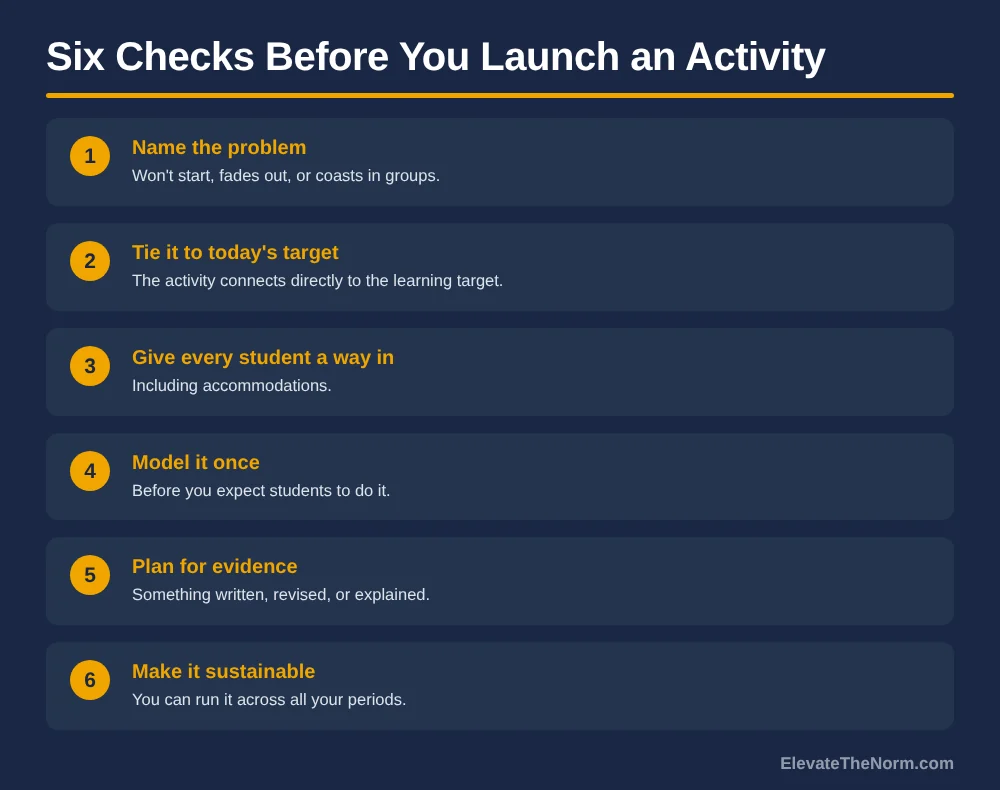
For new teacher classroom management especially, one activity done consistently beats five tried once. Before you launch, run through this:
- You know which problem you’re solving (won’t start, fades out, coasts in groups).
- The activity ties directly to today’s learning target.
- Every student has a way in, including accommodations.
- You’ve modeled it once before expecting it.
- You’ll see evidence: something written, revised, or explained.
- You can sustain it across all your periods.
If a student still won’t start, ask privately: show me the first step, or tell me where it gets hard. The answer usually points to unclear directions, a missing skill, a workload that looks too big, or something outside class. Each of those needs a different fix, not another activity.
Frequently Asked Questions
What are good student motivation activities for high school?
Relevance hooks, a small amount of real choice, one-skill goal setting, before-and-after progress folders, and specific recognition all work with high schoolers. Skip anything that feels babyish, and keep public attention optional.
How do I motivate students without rewards?
Choice, visible progress, and specific praise do most of the work on their own. Small rewards help some classes buy in, but students also stay motivated when they can see their own improvement and know you noticed it.
How often should I change motivation activities?
Less often than you’d think. Teenagers settle into routines they recognize, so run one activity long enough for students to learn it before swapping. Change it when the evidence says it isn’t working, not because it feels stale to you.
What if only a few students participate?
Build in private think time and a written response before any discussion, so everyone has something ready. Then use roles or partner talk to make sure each student has a reason to share.
Start Small and Stay Consistent
Pick the problem you see most, match it to one activity, and run it long enough to see results. Track what students actually produce, adjust support when they need it, and keep naming the specific progress you see.
Want a ready-to-use starting point? The free Elevate the Norm resource library has classroom tools built for grades 6–12. Free to download, no email required.