By Clay Shumate
A project based learning curriculum is a planned year of standards-aligned projects in which each project is the unit, not a dessert after it. For grades 6–12, map the standards first, then choose the few projects that carry them. The best-tested design used five project units across one year, and its teachers named pacing as the hardest part.
Key Takeaways
- A project based learning curriculum is a planned sequence of projects that together carry a course’s standards. PBLWorks separates the main-course model, where the project is the unit, from the dessert project assigned after the content has already been taught the usual way.
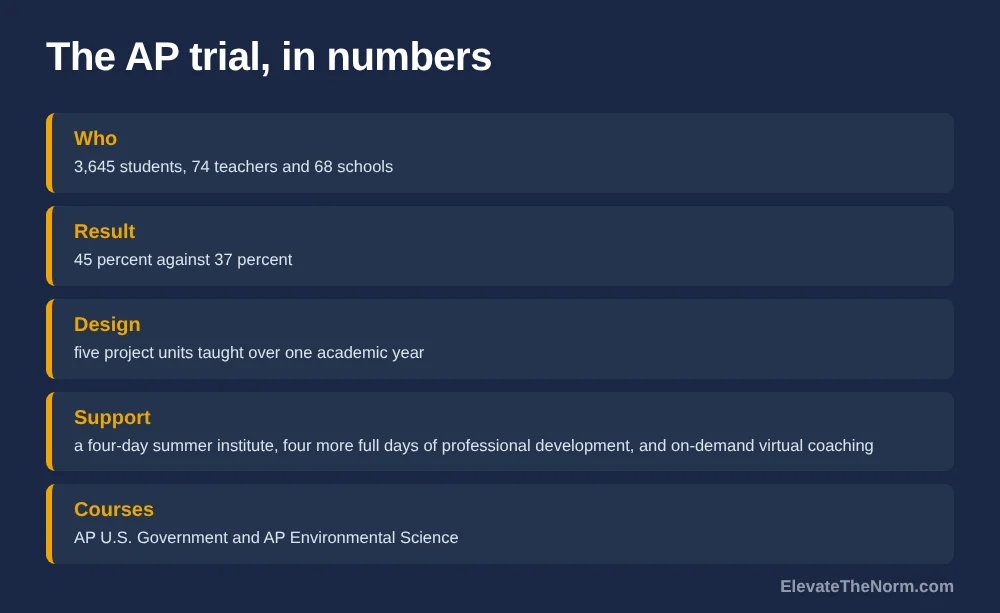
- The strongest evidence is a randomized trial in AP U.S. Government and AP Environmental Science. The research team reports 3,645 students, 74 teachers and 68 schools, and an estimated 45 percent against 37 percent scoring 3 or higher on the exam, an 8-point gap. That curriculum came with a summer institute, professional development and coaching.
- The same study’s teachers named pacing as the hardest part. One said projects “always took twice as long” as planned. Build slack into the map before the first launch, not after the first overrun.
- No research settles how many projects a year, or how long each should run. MDRC’s review found little consensus on unit length. Any number, including the one in this article, is a starting hypothesis.
- Build the map backward: standards first, evidence second, projects third. Buy or adapt units only after you know which group of standards each one has to carry.
Most project based learning advice stops at the single project: the driving question, the product, the rubric. A curriculum is the bigger question. Which projects, in what order, carrying which standards, across how many weeks, and what happens in the days between them?
That bigger question is where first-year PBL teachers get into trouble, and the research is more candid about it than the marketing is. The best-tested project-based curriculum on record came with a summer institute and coaching, and its teachers still ran out of calendar. This page is the map-making version: how to plan a year of projects for grades 6–12, what the evidence does and does not support, and when buying beats building.
What is a project based learning curriculum?
A project based learning curriculum is a planned sequence of projects that together carry a course’s standards, so the projects organize the instruction instead of following it.
PBLWorks, which trains teachers in the model, draws the line between a main-course project, where the project is the unit and frames the instruction, and a dessert project, a short, lightweight one assigned after the unit content has been taught the usual way. Projects in either role can run from about a week up to a semester. Both are legitimate. Only one of them is a curriculum.
Three different things get called a PBL curriculum. A single well-designed project is a unit plan with a longer fuse. A purchased set of project units is a product. A curriculum map is the document that decides which projects a particular class will do, in what order, carrying which standards, with what happening between them. The first two are easy to find. The third is yours to write, and it is the part this article is about. If you need the single-project version first, start with what project based learning actually is and the seven steps of project based learning.
How many projects should a grades 6–12 curriculum include?
No study has settled it. The best-tested curriculum ran five project units taught over one academic year in AP courses, with heavy support. For a first year in grades 6–12, plan two or three main-course projects and add more only once one finishes near schedule.
That last sentence is editorial judgment, not a finding, and it rests mostly on how the AP study’s own teachers described their pacing, covered below. Beyond that the research is thin. MDRC’s literature review for Lucas Education Research notes there is little consensus on how long project units should run, or on how projects fit with other instructional methods. Anyone quoting you a magic number of projects per year is quoting past the evidence. The table lays out the four year-plan shapes teachers use and what each one has behind it.
| Year-plan model | What the year looks like | What supports it | Main risk |
|---|---|---|---|
| Dessert projects only | Teach every unit the usual way and end it with a short project. | PBLWorks names this pattern and distinguishes it from the main-course model. | The project does not organize instruction, so the year is not a project-based curriculum. |
| Two anchor projects plus short ones | Two main-course projects, one per semester, with shorter projects in between. | None directly. It follows from the pacing reports in the AP study. | Projects carry the least of the standards; the rest still needs a plan. |
| One main-course project per grading period | Four or five projects, each built around a group of standards. | Resembles the five-unit AP curriculum, a different course type with heavy support. | Pacing. Teachers in the AP study reported projects running far longer than planned. |
| Fully project-organized year with supplied units | Units, training and coaching come from a developer or the district. | The AP randomized trial, which included that full package. | Fit to your context. Some trial projects had to be adapted to local settings. |
How do you build a project based learning curriculum map, step by step?
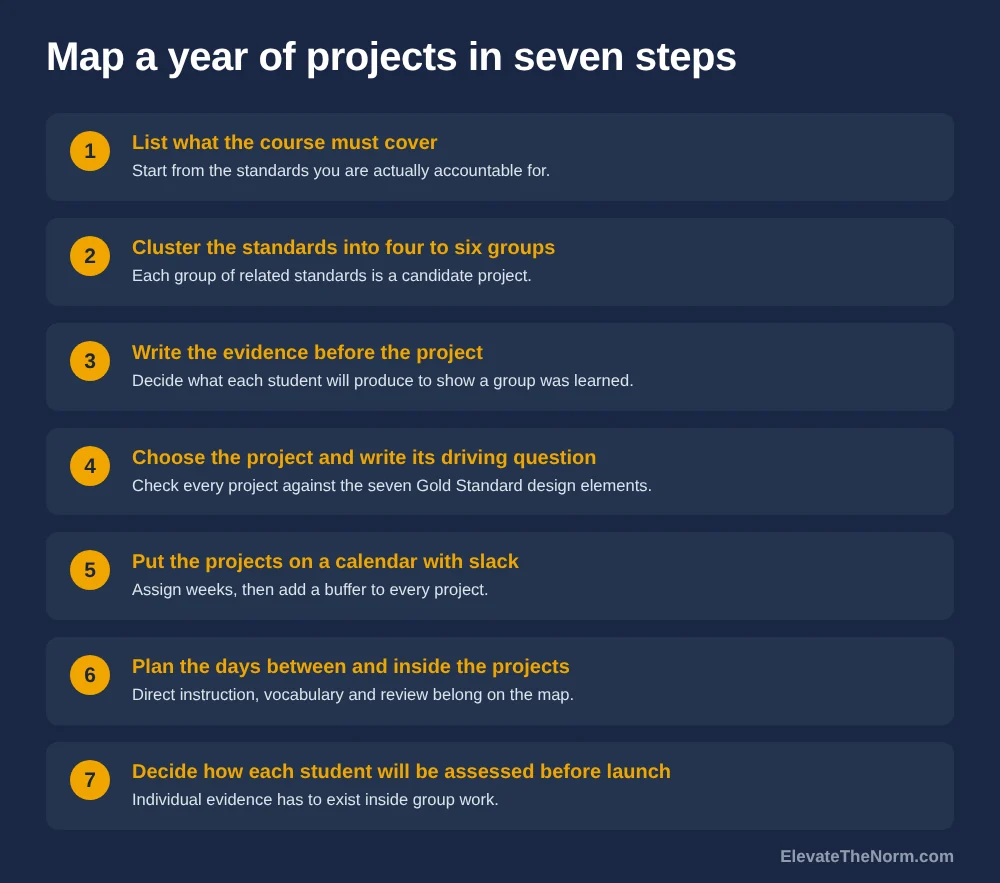
Work backward from the standards. List what the course must cover, cluster it into a few topic groups, decide what evidence will show each group was learned, then choose the project that produces that evidence and place the projects on a calendar with slack.
This is backward design applied to a whole year. Grant Wiggins and Jay McTighe’s Understanding by Design, as summarized by the University of Toronto, describes three stages: identify desired results, determine acceptable evidence, and plan learning experiences and instruction. Most project planning starts at the third stage, with an idea that sounds engaging, and works back toward the standards afterwards, if at all. The map reverses that.
- List what the course must cover. Start from the standards you are actually accountable for. Use the state standards, the district pacing guide or the exam blueprint, whichever applies, and put them on one page. If a standard is not on that page, it will not be on the map.
- Cluster the standards into four to six groups. Each group of related standards is a candidate project. Group by topic, not by the order a textbook happens to list them. A standard that fits no group is flagged now for direct instruction, so it does not turn up in the spring as a surprise.
- Write the evidence before the project. Decide what each student will produce to show a group was learned. An argument, a model, a data set with a claim attached. This is the second stage of backward design, and it is the step most project planning skips. If you cannot name the evidence, the project is not ready to be on the map.
- Choose the project and write its driving question. Check every project against the seven Gold Standard design elements. PBLWorks lists them as a challenging problem or question, sustained inquiry, authenticity, student voice and choice, reflection, critique and revision, and a public product. For wording, see driving question examples for grades 6–12, and for the mechanics of a single project, the seven steps of project based learning.
- Put the projects on a calendar with slack. Assign weeks, then add a buffer to every project. Mark testing windows, holidays and school events first. Treat your first time estimate as a floor, not a plan, and give the first project the biggest buffer.
- Plan the days between and inside the projects. Direct instruction, vocabulary and review belong on the map. A mini-lesson on a skill, a retrieval warm-up, a reading everyone needs: these are part of the curriculum, not a retreat from it. Write them in so they are planned rather than improvised when the calendar tightens.
- Decide how each student will be assessed before launch. Individual evidence has to exist inside group work. Choose the rubric and the checkpoints now. Start with a free editable rubric for project based learning, and see how to assess project based learning for the checkpoints.
Two details inside those steps carry most of the weight. The first is the calendar. Teachers who try this almost always underestimate it, and the one randomized trial of a full project-based curriculum is blunt about that, in the section on what goes wrong below. The second is the days between the projects. A year map that is all projects and no instruction does not hold up: in the AP study, some teachers fell back on lecture late in the year when the calendar ran out. If you teach on a schedule that makes long projects hard, see project based learning in high schools without rebuilding the schedule.
Should you buy a project based learning curriculum or build one?
Write the map first, then decide. A purchased set of units can save weeks of design time, but no vendor knows your standards, your calendar or your students, so buy units that fit a map you already have and check each one’s alignment yourself.
On the buying side, where to get Common Core aligned PBL units and how to check them and the project based learning kits worth buying cover the vendors, the prices and the alignment check. Here is the part those pages cannot do for you: decide which group of your standards each unit has to carry. A unit that is excellent and carries the wrong standards is a very good use of three weeks you needed for something else.
It is also worth being exact about what the research studied. The curriculum in the AP trial was designed by University of Washington researchers working with local teachers, and it came with instructional materials plus a four-day summer institute, four more full days of professional development, and on-demand virtual coaching. A box of units is not that package. MDRC’s review goes further and concludes that professional development for teachers is likely to be essential to making project-based learning work, which is the line item district budgets tend to leave out.
At the scale of a school or district the same logic points to a pilot. Put a map and a set of units in front of a few willing teachers in one course, support them the way the trial did, and look at what happened to pacing and student work before buying for everyone. That recommendation is this article’s judgment, not a finding; nothing read for it compares a pilot-first rollout with a district-wide one.
What does the research say a PBL curriculum can deliver?
In the strongest study available, students in project-based AP classrooms were more likely to score 3 or higher on the exam than students in typical classrooms: 45 percent against 37 percent, an 8-point gap. The field as a whole is promising rather than proven.
The study was a randomized controlled trial of a curriculum called Knowledge in Action, run by researchers from five universities in AP U.S. Government and AP Environmental Science. The research team’s own summary reports 3,645 students, 74 teachers and 68 schools across five large, mostly urban districts, with 38 percent of students from low-income households. It says the pattern held in each district and across student subgroups. A University of Washington summary reports that the gap grew to 10 points in the second year.
Read the result at its real size. These were AP courses in high school, so the study says nothing about grade 6, 7 or 8. The outcome is an exam score, which tells you about content mastery on a standardized test, not about the collaboration and self-direction project advocates also care about. The trial registry notes that attrition was correlated with treatment status. And the comparison was not projects versus no projects: the study’s own instruction logs show that control teachers used long-term projects on 45 percent of log days, against 60 percent for the project-based teachers, so the contrast was one of degree and design rather than of kind.
The wider field is mixed on the same terms. As of its 2017 review, MDRC found some studies with positive effects in science and social studies, more limited evidence in math, and no studies of project-based learning in K–12 English language arts, and it warned that many designs leave open whether something other than PBL produced the results. That is why this article keeps saying promising.


What goes wrong in the first year of a PBL curriculum?
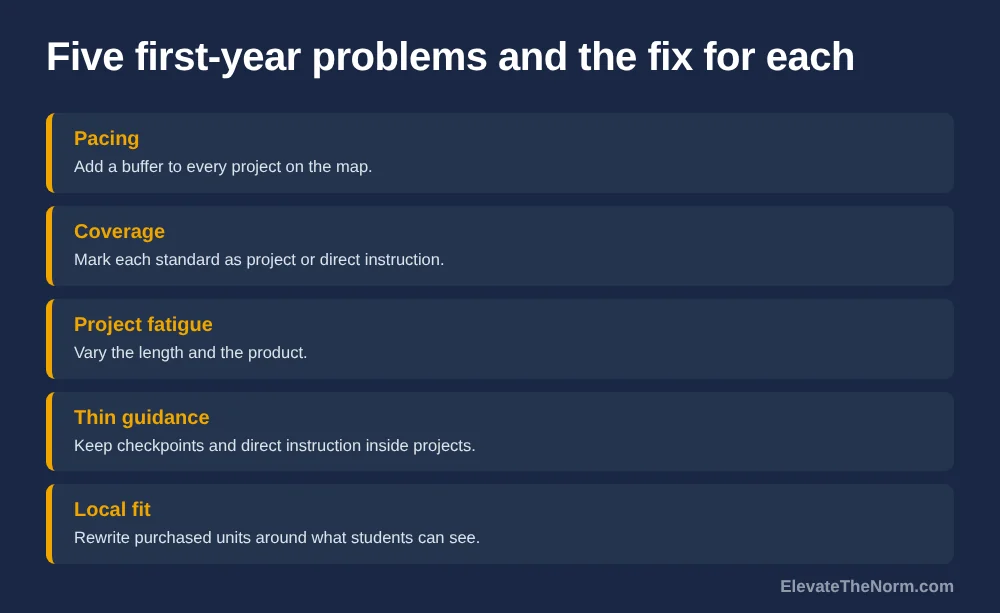
Pacing, coverage worries, project fatigue, thin guidance and poor local fit. All five showed up in the interviews with teachers and students in the AP study, and each one can be planned for on the map before the first launch.
- Pacing. A teacher in the AP study said, “It always took twice as long as it said it was going to take,” and another said, “our first two projects took five months or something like that.” Fix: Add a buffer to every project on the map.
- Coverage. Teachers in the same study worried about covering everything the exam requires, reviewed factual material in more traditional ways, and some leaned more on lecture late in the year. Fix: Mark each standard as project or direct instruction.
- Project fatigue. The report says some treatment teachers explained that project fatigue became an issue by later in the spring. Three projects that all end in a poster and a presentation is a recipe for it. Fix: Vary the length and the product.
- Thin guidance. One student told interviewers, “We basically taught ourselves this course, the whole thing.” MDRC’s review makes the same point from the teacher’s side: teachers have to shift from directing lessons to facilitating them, and that takes new scaffolding skills, not fewer of them. Fix: Keep checkpoints and direct instruction inside projects.
- Local fit. Some projects in the trial were tied to other regions, and teachers had to adapt them to their own settings. A driving question about a place your students have never been is a weaker question. Fix: Rewrite purchased units around what students can see.
The source for all five is the study team’s own implementation report, Shifting to Project-Based Learning in the Advanced Placement Context, which is a manuscript submitted for publication. The fixes are this article’s, drawn from those findings; the report does not test them.
How do you assess students across a year of projects?
Assess each student’s own learning against the same few criteria in every project, and keep individual evidence inside group work. One rubric structure reused across the year lets students see their own progress from one project to the next.
That is a design recommendation, not a finding, and it is the answer to the first thing a skeptical parent asks: how do I know what my own child learned if the work was done in a group? Decide the individual evidence on the map, in step seven, so it is built into each project rather than reconstructed afterwards from memory. For rubrics, see a free editable rubric for project based learning; for checkpoints and the evidence behind them, how to assess project based learning.
What should students and families see?
The map itself, in plain language: the name of each project, what it is for, roughly how long it runs, and how individual work is graded.
A fifteen-year-old can read a year map, and showing it is a form of respect that costs nothing. It also protects you. If a project runs long and the next one shrinks, a family who has seen the map understands what changed and why. Tell students where the plan moved. Keep public products to what your school’s visitor and privacy rules allow, and offer an in-class audience as the alternative when they do not.
Clay’s take
I think the word curriculum is doing something sneaky in this search. People type it hoping to buy a finished thing, and I understand why: a first-year teacher has a hundred other jobs. But a project-based curriculum is mostly a set of promises about what students will be able to do by certain weeks, and the only person who can make those promises is the one standing in the room. The calendar is the part nobody sells you.
Where I would push back on how the AP result gets quoted: it came from a team that designed the curriculum, trained the teachers and coached them for a year. That is a strong result for the whole package. It is not a result for a purchase order, and anyone who quotes the 8-point gap while selling you a binder is quoting past the end of the sentence. If you want what the study had, you need the training and the coaching, and you need to budget for them.
The part I would protect is students’ time. A year of projects is a lot of weeks, and if every one ends in a poster and a presentation, students notice. Vary what they make. Give them the map. Tell them when you change it. Treat a teenager who is worn out by the third project as a signal about the plan, not as a student who stopped trying.
What to do next
Pick one course. Put its standards on a single page and sort them into four to six groups. Choose only the first group, write the evidence a student will produce for it, and draft the driving question. Do not map the whole year in one sitting; map one project well and let it tell you what the calendar needs. When you are ready for the idea stage, 50 real-world project ideas for grades 6–12 is a place to look. Everything on this site is free and nothing asks for your email address.
Frequently Asked Questions
What is a project based learning curriculum?
A project based learning curriculum is a planned sequence of projects that together carry a course’s standards, so the projects organize instruction rather than following it. A single project is a unit; a curriculum is the year-long map of which projects a class will do, in what order, carrying which standards.
How many projects should a PBL curriculum have in a year?
No study has settled it. The best-tested curriculum used five project units across one AP course year, with heavy support. For a first year in grades 6–12, two or three main-course projects is a reasonable editorial starting point, adding more only once one finishes near schedule.
Is there a free project based learning curriculum for middle and high school?
Free project examples, driving questions, rubrics and templates are on this site, and nothing asks for an email address. Free full-year curricula are rarer and vary in quality, so check any set against your own standards before adopting it. The guide to Common Core aligned PBL units covers where to look and how to verify alignment.
Does project based learning work in AP or test-heavy courses?
One randomized trial found it can. In AP U.S. Government and AP Environmental Science, an estimated 45 percent of students in project-based classrooms scored 3 or higher, against 37 percent in typical classrooms. That curriculum came with training and coaching, and it was tested in high school AP courses only.
Why do PBL units take longer than planned?
Teachers in the AP study reported it routinely. One said it always took twice as long as it said it was going to take, and another said the first two projects took five months or something like that. Plan a buffer into every project on the map and treat your first time estimate as a floor.
Can I cover all my standards with a PBL curriculum?
Teachers in the AP study worried about coverage, reviewed factual material more traditionally, and some leaned on lecture late in the year. Mark each standard on the map as carried by a project or by planned direct instruction, so nothing is left to chance and no standard depends on the calendar.
Do I need training to teach a PBL curriculum?
MDRC’s review concludes that professional development is likely to be essential for successful project-based learning. The AP trial included a four-day summer institute, four more days of training and on-demand coaching. A purchased unit set without any of that has not been tested against the trial’s result.
How do I grade a year of projects fairly?
Use the same few criteria in every project, keep individual evidence inside group work, and decide the checkpoints before launch. One reusable rubric structure lets students and families see progress from project to project and answers the question of what each student learned when the work was shared.
Sources
- PBLWorks. What is PBL? Source for the main-course and dessert project distinction, and for the statement that projects run from about a week up to a semester. Page read.
- PBLWorks. Gold Standard PBL: Essential Project Design Elements. The seven elements as named in step four. Page read.
- MDRC. Project-Based Learning: A Promising Approach to Improving Student Outcomes. Evidence described as promising rather than proven; little consensus on unit length; professional development likely to be essential; limits in math and no K–12 English language arts studies as of the 2017 review. Read at the publication-page level; the full report was not read.
- PBLWorks. Research: Project-Based Learning, a Literature Review. Identifies the 2017 review by Condliffe and colleagues for MDRC and Lucas Education Research as covering studies from about 2015 to 2017. Page read.
- University of Washington College of Education. Project-Based Learning Approach Pioneered at the UW College of Education Significantly Improves Student Performance. Randomized controlled trial; 8-point gap in year one and 10 points in year two; researchers from five universities. The page gives no sample size or course names, so those come from the sources below. Page read.
- The 74. Analysis: Project-Based Learning or Lectures? Our Research Shows PBL Helps Low-Income Students Do Better in AP Classes. The study team’s own summary: 3,645 students, 74 teachers, 68 schools, five districts, 38 percent low-income, an estimated 45 percent against 37 percent scoring 3 or higher, and the curriculum, institute, professional development and coaching. An authors’ summary, not the journal paper; read in full.
- American Economic Association RCT Registry. Knowledge in Action Efficacy and Maturation Studies (AEARCTR-0002189). Intervention description, randomization, outcomes, and the note that attrition was correlated with treatment status. Page read.
- Saavedra, A., Rapaport, A., Marwah, E., Carle, J., Liu, Y., Johnson, S. J., Li, J., Hoepfner, D., & Garland, M. Shifting to Project-Based Learning in the Advanced Placement Context. Manuscript submitted for publication; hosted by PBLWorks. Source for the five project units over one academic year, the instruction-log figures (long-term projects 60 versus 45 percent), and the pacing, coverage, fatigue and guidance quotations. Quotations were checked against the document text. The document is an unpublished manuscript with no date shown.
- University of Toronto Open Course Ware. Backward Design. The three stages attributed to Wiggins and McTighe’s Understanding by Design. Page read; the book itself was not read.
- Disclosure. PBLWorks provided the training in the AP trial and also hosts several of the sources above. The trial’s researchers were university-based. Both facts are worth holding in mind when reading the result.
- The seven mapping steps, the second and third rows of the year-plan table, the pilot recommendation, the “two or three projects” starting point, the five fixes and the assessment advice are written for this article. They are editorial judgment drawn from the findings above, not findings, and no source above tests them. They do not report any individual teacher’s classroom.