By Clay Shumate
Teaching current events in the classroom works best as a short, repeatable routine, not a reaction to every headline. In grades 6–12, choose events that connect to your course, teach settled facts as settled and open questions as open, tell families the plan before the first hard topic, and grade the reasoning rather than the opinion.
Key Takeaways
- In a national survey of 1,439 U.S. K–12 teachers, 65 percent had limited political and social discussion on their own, including 55 percent with no state or local restriction. The top reason was doubt that leaders would back them.
- In a study of nearly 90,000 14-year-olds in 28 countries, an open classroom climate for discussion went with higher civic knowledge. The link is correlational.
- In a four-year study of 1,001 high school students, the teachers who did this well taught settled questions as settled and open questions as open. Students disliked being pushed toward one view.
- In the latest NAEP civics assessment, only 22 percent of students tested in grade 8 reached Proficient.
- A weekly fifteen-minute slot costs about nine 60-minute class hours over a 36-week year, an illustrative estimate.
Most advice about teaching current events starts with the news and works backward. The harder problem is upstream: how often to do it, how to pick topics, what to say when a parent emails, and how to keep it from eating the unit you are supposed to be teaching.
This article takes the planning view for grades 6–12. It is a set of recommendations compiled from the research below, not a report of any one teacher’s classroom, and it says so where the evidence is thin. Checking whether a particular source is trustworthy is a separate skill, so it appears here only in passing.
What does teaching current events in the classroom involve?
Teaching current events in the classroom means using real, recent events as material for skills students already need: reading closely, weighing evidence, explaining a position, and listening to a different one. The event is the material. The lesson is the thinking.
That rules out two things that often get called current events: the news recap, where students report headlines and nothing changes in how they think, and the free-for-all reaction, where the loudest opinion wins the room. Neither builds a skill you can assess.
A current event earns its minutes when it connects to the course: a vote that echoes a unit on representation, a trade dispute that echoes a unit on economics. If it does not connect, it is a different kind of conversation and may not belong in the lesson.
Does teaching current events work, and what does the research say?
The research is encouraging but mostly associational. Open classroom discussion is linked to higher civic knowledge and a stronger intent to vote, yet few studies isolate current-events instruction itself. Treat it as a well-supported habit rather than a proven program, and watch what happens with your own students.
The largest body of evidence is the IEA Civic Education Study, which surveyed nearly 90,000 14-year-olds in 28 countries. In most of them, students who reported an open classroom climate for discussion scored higher on civic knowledge and were more likely to expect to vote. Many students did not perceive their classrooms as open at all.
Two cautions apply. The finding is correlational, and the voting outcome is intended behavior, not actual voting. A research summary published by CIRCLE adds a third: state policies encouraging explicit news discussion showed promise when students had to use news sources, but state policies overall had very few effects on student knowledge, activities or values. Mandating the topic is not the same as teaching it well.
The most detailed look at skilled teachers comes from Diana Hess and Paula McAvoy’s study of political discussion in high school classrooms, described in an NPR interview about their book. It followed 1,001 students over four years in schools that were political but not partisan. The teachers who did it well treated settled questions as settled and open questions as open. The researchers found no evidence of deliberate indoctrination, and students valued hearing different views but disliked being pushed toward one.
Why do so many teachers avoid current events, and what do students need?
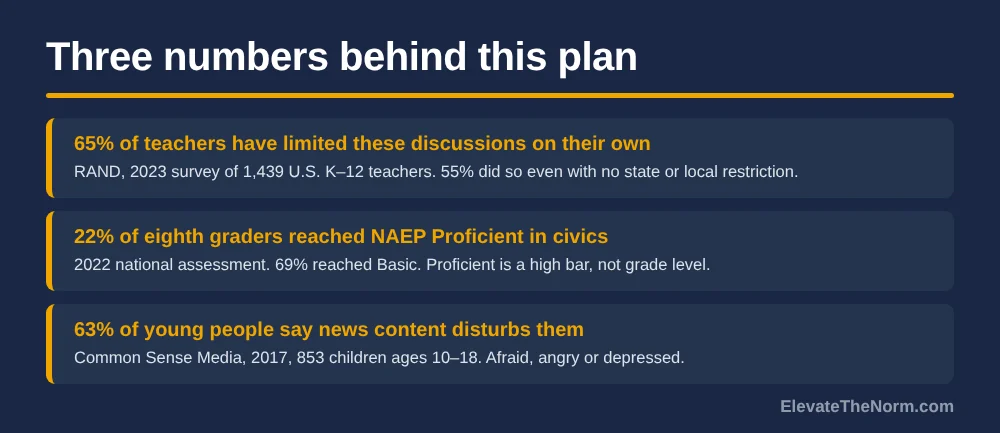
Mostly because of support, not skill. In a national RAND survey, 65 percent of teachers said they had limited political and social discussion on their own, and a leading reason was doubt that leaders would back them if parents complained. Students, meanwhile, report that news can be disturbing.
The survey asked 1,439 K–12 teachers whether they had ever decided on their own, without direction from leaders, to limit these discussions. Sixty-five percent said yes, including 55 percent of teachers with no state or local restriction. In that group, 47 percent were unsure leaders would support them if parents complained, 39 percent feared altercations with upset parents, and 33 percent lacked guidance.
Read that carefully. It is self-reported, covers every grade from kindergarten up, and cannot say what teachers actually did or whether the question meant the same thing to everyone. What it suggests is that the barrier teachers name most is not a shortage of ideas but a shortage of backup, which is a planning problem you can partly solve.
The student side is mixed. On the NAEP civics assessment, 22 percent of eighth graders scored at or above Proficient and 69 percent at or above Basic, three points lower than the previous assessment. NAEP cautions that Proficient does not represent grade-level proficiency. Lower-scoring students were far less likely to agree that civics schoolwork helps them understand the world: 30 percent, versus 62 percent of higher scorers.
A Common Sense Media survey of 853 children ages 10 to 18 found that 63 percent said news content left them afraid, angry or depressed, yet 70 percent said it made them feel smart and knowledgeable. The sample includes children younger than secondary age. One reasonable reading is that students need help making sense of the news more than protection from it, but the surveys do not test that directly.
How often should you teach current events?
For most secondary classrooms, a fixed weekly slot of about fifteen minutes is the most sustainable starting point. It is predictable for students and parents, cheap to plan, and easy to protect. Daily openers, event-triggered pauses and monthly deep dives also work, with different trade-offs.
| Routine | Time | Best for | Main drawback |
|---|---|---|---|
| Weekly slot | About 15 minutes a week | Building a habit that fits most schedules | Can feel disconnected if the topic does not match the unit |
| Daily opener | About 5 minutes a day | Short-attention classes and light, low-stakes exposure | Little time for depth; easy to slide into a recap |
| Event-triggered pause | 20–40 minutes as needed | Major events students are already talking about | Depends on your judgment in the moment; facts may still be incomplete |
| Monthly deep dive | 40–50 minutes a month | Connecting one event to a unit through a full discussion or short product | Long gaps between practice; routines fade |
Many teachers combine two: a weekly slot as the default and an event-triggered pause for the rare event students cannot ignore. A bell ringer format keeps a daily opener short; the bell ringer ideas on this site show how. If you run project-based units, a monthly deep dive can feed a project, as the page on project-based learning in social studies shows. Whatever you pick, put it on the calendar.
How do you choose which current events to teach?
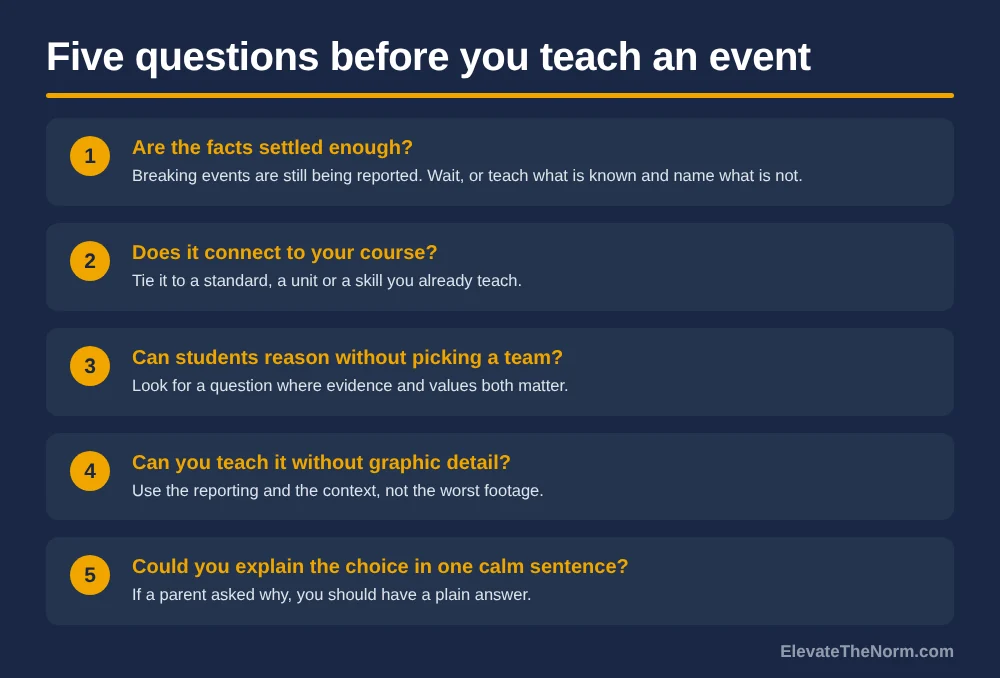
Choose events that connect to your course, rest on reasonably settled facts, and support a question students can reason about without needing a team. Skip anything you cannot teach without graphic detail. If you could not explain the choice to a parent in one calm sentence, pick another event.
The five questions in the graphic are the working filter, and the first matters most. Hess and McAvoy note that breaking events are harder to teach because the information is incomplete and changes by the hour. Waiting a few days can produce a better lesson than racing the news cycle.
Let students nominate events, but run every nomination through the same filter. A short form with two prompts, what happened and how it connects to what we are studying, keeps the choice with students while keeping you in charge of the plan. Glance at your list each term: if every event leans the same way, the filter is not working.
How do you handle contested or upsetting topics?
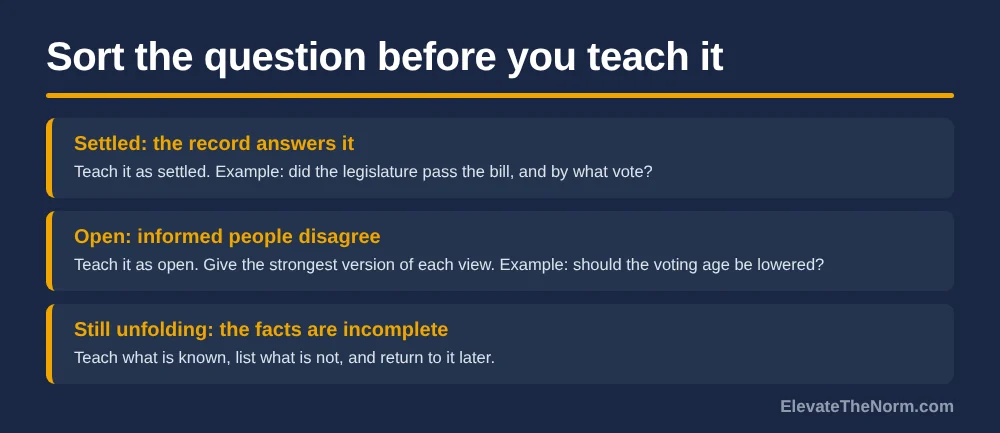
Sort the question first. Teach settled questions as settled, open questions as open, and unfolding events as unfolding. Then set ground rules before the topic arrives, avoid graphic material, and give students with a personal connection a way to take part without being put on the spot.
The sorting step comes from Hess and McAvoy: presenting a settled question as open is dishonest, and presenting an open one as settled shuts down the discussion. The third bin, still unfolding, is the one the news cycle produces most. The honest move there is to list what is known, what is not, and when you will return to it.
Keep ground rules short and set them early: critique ideas, not people; give a reason for any claim; no sarcasm. Hess and McAvoy warn about political seepage, the sarcasm and partisan humor that signal which side the room is supposed to be on. It is easy to do without noticing.
Upsetting topics need extra care. With 63 percent of the young people in the Common Sense survey reporting disturbing news content, assume some students in any room are carrying something. Give advance notice, describe events without graphic detail, offer a written reflection as an alternative to speaking, and talk privately with any student who has a direct connection. Hess and McAvoy consider a blanket opt-out hard to defend, though serious personal reasons can justify one.
Should you share your own view on a current event?
Not by default. Hess and McAvoy found effective teachers on both sides of this question, so the research does not settle it. The safer plan is to decide in advance, check your school’s policy, and make sure students can see that every view got the same serious treatment.
Two risks apply. Parents can misread a teacher’s shared view as recruiting, even when nothing of the kind was meant. And a teacher who assumes the students all think alike is almost sure to be wrong, according to Hess’s account in that interview, so a discussion that ends with the teacher’s position tells part of the room the conversation is over.
A workable rule: when students ask what you think, answer the evidence question first, say which parts are open, and then decide whether to share. Apply whatever you decide to every topic, not only the ones where your view is popular in the room. Staying nonpartisan is mostly symmetry: give each view the strongest version its own defenders would give, and ask every student the same kind of follow-up.


How do you connect current events to standards and course content?
Treat the event as an application of a skill or concept you already teach. The C3 Framework’s fourth dimension covers discussion and informed action on real problems, and the research behind it finds students learn best through active methods, including discussion of real issues in the classroom.
Croddy and Levine’s overview in Social Education describes that dimension as covering debate and discussion in a plural democracy, framing real problems, deliberating, and taking civic action. It is written by people who support the framework, so read it as guidance, not as a test of effectiveness.
Anchor the event to context first; Hess and McAvoy recommend placing events in historical context rather than asking for reactions alone. A fifteen-minute lesson can follow a fixed pattern:
- Two minutes: state the event in two sentences and say what is confirmed.
- Three minutes: connect it to the unit with a short background fact or earlier case.
- Three minutes: students write a claim and one piece of evidence on their own.
- Four minutes: pairs compare, then the class discusses one open question.
- Two minutes: list what is still unknown and what would change the answer.
- One minute: an exit slip with one claim, one reason and one question.
The same shape works outside social studies, for example with a local environmental decision in science or an editorial in English. For step four, the guides to student discourse and Socratic seminars show discussion structures, and the primary source analysis frameworks suit step two when the event echoes a historical document.
How do you assess current events discussions fairly?
Grade the reasoning, never the position. Score whether students state facts accurately, support claims with evidence, address the strongest opposing point, and follow the ground rules. Keep it low-stakes at first, and let students argue an assigned side so nobody is graded on their own beliefs.
A four-line rubric is enough: accuracy of facts, use of evidence, engagement with another view, and respectful discussion. Share it before the first lesson. The exit slip from the last step doubles as the evidence of learning an instructional coach would ask to see.
Keep stakes low until the routine is stable, and do not grade participation by volume. Some students reason best in writing, so offer a written and a spoken option for the same credit, plus the usual accommodations: sentence frames, extra time, a shortened reading.
What do parents and administrators need to know?
Tell them the plan before the first hard topic. A one-page overview covering purpose, routine, how topics are chosen, ground rules and how to raise a concern answers most objections in advance, and it gives an administrator something concrete to support.
The RAND reasons were doubt about leadership support, fear of altercations with parents, and lack of guidance. Each has a planning answer. Ask your administrator to read the one-pager and confirm the plan fits district policy, since rules differ by state and district. Show parents the same page. And ask a colleague who has taught the course to read your first three topics; that takes ten minutes and is ordinary professional practice.
Offer parents a way to see what was taught: a short note after a lesson that names the question and the skill, not students’ comments. Never share anything from a discussion that could identify the speaker.
How do you keep current events fair for every student?
Plan for unequal starting points. Students differ in news exposure, reading level, language, home devices and how close an event is to their own lives. Provide print options, plain-language summaries and vocabulary support, and build in a written route so participation does not depend on who talks fastest.
Access is a documented gap. The CIRCLE summary reports that students in higher-income districts were more than one and a half times as likely to report political debates and panel discussions, and the NAEP lower scorers were less likely to find civics useful, 30 percent versus 62 percent. Neither figure proves cause, but both are reasons not to assume every student arrives ready to join in.
Practical supports are inexpensive: a one-paragraph summary at two reading levels, a short glossary of three to five terms, printed copies for students without reliable devices, and sentence starters for disagreement. Rotate who facilitates so the most confident speakers do not set the pace every week.
How much class time does teaching current events actually take?
A weekly fifteen-minute slot over a 36-week year takes 540 minutes, about nine 60-minute class hours. That is an illustrative estimate, not a measured figure. Your calendar, period length and testing windows will change it.
On the same assumptions, a five-minute daily opener across 180 days is 900 minutes, or fifteen class hours; a monthly 45-minute deep dive across nine months is 405 minutes; four event-triggered 40-minute lessons add 160. Small slots add up, so tie each one to a skill you already assess, and the minutes come out of your unit rather than on top of it.
Clay’s take: students are ready for structure, not shielding
What strikes me most in this literature is how little of it is about shielding students from the news. The young people surveyed found it disturbing and said it made them feel knowledgeable. Both can be true, and neither is solved by silence.
My position is the one this site takes everywhere: treat students as developing young adults. That means high expectations for the quality of their reasoning, clear structure so they can meet them, and fair consequences when a discussion breaks its ground rules. It does not mean leaving them alone with a headline, or telling them what to conclude.
It also means being straight with the adults. Many teachers limit discussion without being told to because expectations are unclear and backup is uncertain, not because of a character flaw. Write the plan down, share it, and ask a colleague to read it first. For a longer-form route into the same skills, the civics project ideas on this site include a mock election.
What to do next
To start teaching current events in the classroom, pick the weekly slot and put it on the calendar for the whole term, not just the next two weeks. Draft the one-page plan this week and show it to an administrator before you teach a single hard topic.
Then run the first lesson on an event that is settled, connected to your unit, and low on emotional heat. Use the six-step pattern, score the exit slips with the rubric, and adjust. If a major event interrupts the plan, use one pause lesson, then return to the weekly rhythm.
Frequently Asked Questions
Can I teach current events if my state or district restricts political topics?
Possibly, but check before you plan. Rules differ by state and district, and RAND noted that teachers may not know what their own state’s rules say. Read the actual policy text, ask an administrator to confirm in writing, and choose events tied to your required standards. This is general information, not legal advice.
What if a student says something offensive or one-sided in discussion?
Respond to the statement, not the student. Pause, restate the ground rule, and ask for the evidence behind the claim or for the strongest opposing view. If it targeted a classmate, follow your school’s discipline process and speak with the student privately afterward. The goal is repair and a clearer expectation, not public embarrassment.
Can students opt out of a current events lesson?
Hess and McAvoy consider a blanket opt-out hard to defend, but they accept that serious reasons, such as a direct personal connection to an event, can justify one. Talk privately first, offer a written or observer role, and check your school’s policy on parent requests. Sitting out one topic should not mean sitting out the routine.
What should I say when students ask for my opinion?
Answer the evidence question first: what is known, what is disputed, and where you are unsure. Then decide, ahead of time and for every topic, whether you will share a view. Research on skilled teachers shows both choices can work, but parents can misread a shared view as recruiting, so consistency and transparency matter.
What if an event is too recent for reliable information?
Teach the uncertainty. List what is confirmed, what is claimed but unverified, and what nobody knows yet, then return to the event after a few days. Hess and McAvoy note that breaking events are harder because information is incomplete. Waiting costs little, and the follow-up lesson shows students how reporting improves.
How do I explain a current events routine to parents?
Send a one-page overview before the first lesson: why you do it, how often, how topics are chosen, the ground rules, how work is graded, and whom to contact with a concern. Describe the question and the skill, not student comments. Offer a phone call or meeting, and give your administrator a copy.
Sources
- Woo, A., Diliberti, M. K., & Steiner, E. D. (2024). Policies Restricting Teaching About Race and Gender Spill Over into Other States and Localities: Findings from the 2023 State of the American Teacher Survey Research Report RR-A1108-10, RAND Corporation. Teachers nationally representative, 1,439 K–12 teachers, surveyed in early 2023. 65 percent had limited discussion on their own; 55 percent with no restriction; reasons 47, 39 and 33 percent. Limits: self-report, K–12 rather than secondary only, item interpretation unclear, descriptive not causal, only a minority gave interpretable open-ended reasons.
- National Center for Education Statistics. NAEP 2022 Civics, Grade 8 achievement results, with the 2022 civics highlights. 22 percent at or above Proficient, 69 percent at or above Basic, 30 versus 62 percent on civics schoolwork helping understand the world. Limits: eighth graders only; NAEP states that Proficient does not represent grade-level proficiency; the 30 and 62 percent figures are agreement rates, not causal estimates.
- Torney-Purta, J., et al. Civic Education Study, chapter 10 (IEA). Nearly 90,000 14-year-olds in 28 countries. Open classroom climate for discussion was associated with higher civic knowledge and expected voting in most countries. Limits: associational, voting measured as expectation, no effect sizes in the portion read, 14-year-olds only.
- Center for Information and Research on Civic Learning and Engagement. Research Roundup, Around the Circle (April 2010). Secondary summary of working papers by Hess, Syvertsen, Flanagan and Stout, Kahne and Middaugh, and Lopez and colleagues. Higher-income districts more than 1.5 times as likely to report debates and panels; state policies encouraging news discussion showed promise but had very few overall effects. Limits: summary of other researchers’ papers, which were not read in full here.
- Hess, D., & McAvoy, P. (2015). The Political Classroom, as discussed in an NPR interview with the authors, Politics In The Classroom: How Much Is Too Much? Study of political issue discussion in high school classrooms, 1,001 students over four years. Settled versus open questions, political seepage, opt-outs, breaking events. Limits: read through the NPR interview and the publisher description, not the full book.
- Common Sense Media. News and America’s Kids (2017). Online, nationally representative survey of 853 children ages 10–18. 63 percent found news content disturbing; 70 percent felt smart and knowledgeable from news. Limits: includes elementary-age children, self-report, older survey.
- Croddy, M., & Levine, P. (2014). The C3 Framework: A Powerful Tool for Preparing Future Generations for Informed and Engaged Civic Life Social Education, 78(6), 282–285. Describes Dimension 4 (debate, discussion, deliberation, civic action) and civic education research on active methods. Limits: an overview by framework supporters, not an effectiveness study; indicator wording was not read.
- The routine options, the fifteen-minute lesson pattern, the four-line rubric, the time arithmetic and the five-question event filter are compiled and written for this article from the sources above. They are recommendations, not a report of any teacher’s classroom, and no study above tests them as a set. Time figures assume a 36-week year, 180 school days and 60-minute class hours, which are this article’s assumptions.