By Clay Shumate
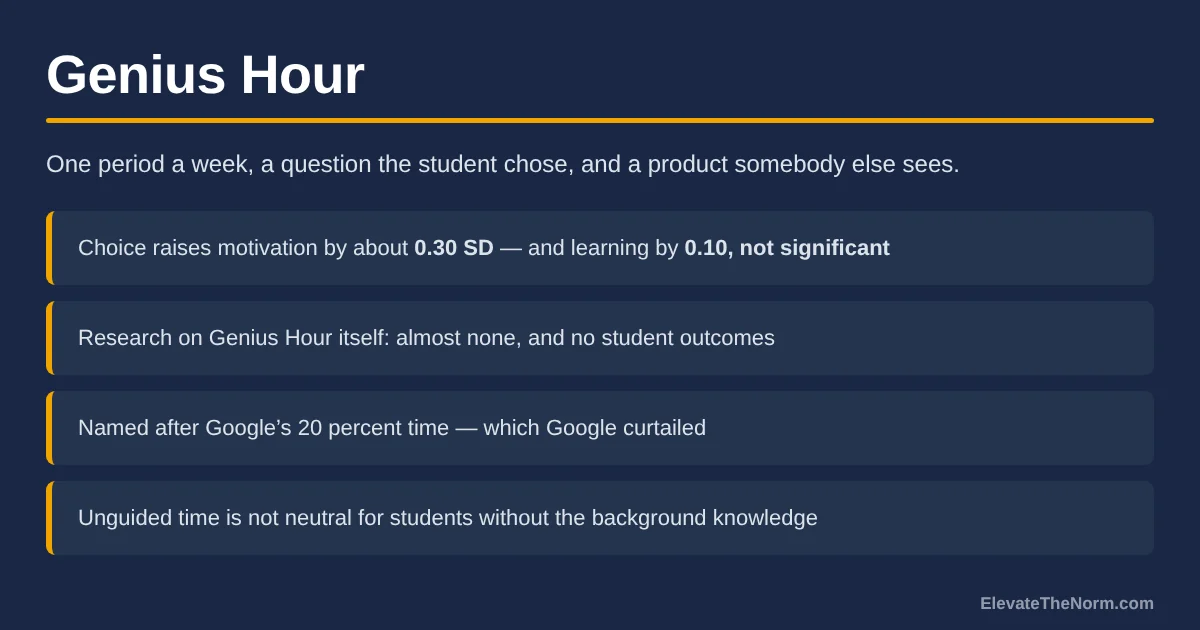
Genius Hour is a recurring block of class time, usually one period a week, in which students pursue a self-chosen inquiry and finish with a product they share publicly. It takes its name from Google’s 20 percent time. The evidence on student choice supports the motivation claim behind it. It does not support a learning claim.
Key Takeaways
- Genius Hour is a time structure, not a lesson. Students choose the question, plan the work, pick the product format and share it with an audience. The teacher coaches rather than instructs.
- Choice reliably raises motivation and does not reliably raise learning. Across 41 studies, choice produced an effect of about 0.30 standard deviations on intrinsic motivation — roughly 0.21 to 0.24 once publication bias was corrected for — but only 0.10 on subsequent learning, which was not statistically significant.
- The moderators are awkward for anyone selling this. In that same meta-analysis the effect was stronger for instructionally irrelevant choices than for instructionally relevant ones, stronger with two to four choices than with many, and stronger when no reward followed.
- Research on Genius Hour itself is close to nonexistent. The most-cited study is a four-year qualitative case study of one school’s teachers. It reports teacher perceptions, not student outcomes — and those teachers largely did not adopt the practice in their own classrooms afterwards.
- Unstructured discovery fails students who lack the background knowledge for it. The cognitive-load literature is clear that minimal guidance works mainly for learners who already have prerequisite knowledge and prior structured experience. That is an argument for scaffolding Genius Hour, not for skipping it.
Genius Hour is one of the easiest ideas in teaching to fall in love with and one of the easiest to run badly. Hand thirty teenagers an hour and the instruction “work on something you care about” and you will get three students who do something remarkable, a dozen who research a hobby for six weeks and produce a slideshow, and a handful who spend the semester deciding. That spread is not a discipline problem. It is what the research would predict.
This guide covers what Genius Hour is, what the evidence does and does not support, and how to structure it for grades 6–12 so the hour produces something. The timings and steps below are compiled from the sources at the end and from the structures those sources describe; read them as recommendations rather than as a record of any one classroom.
What Is Genius Hour?
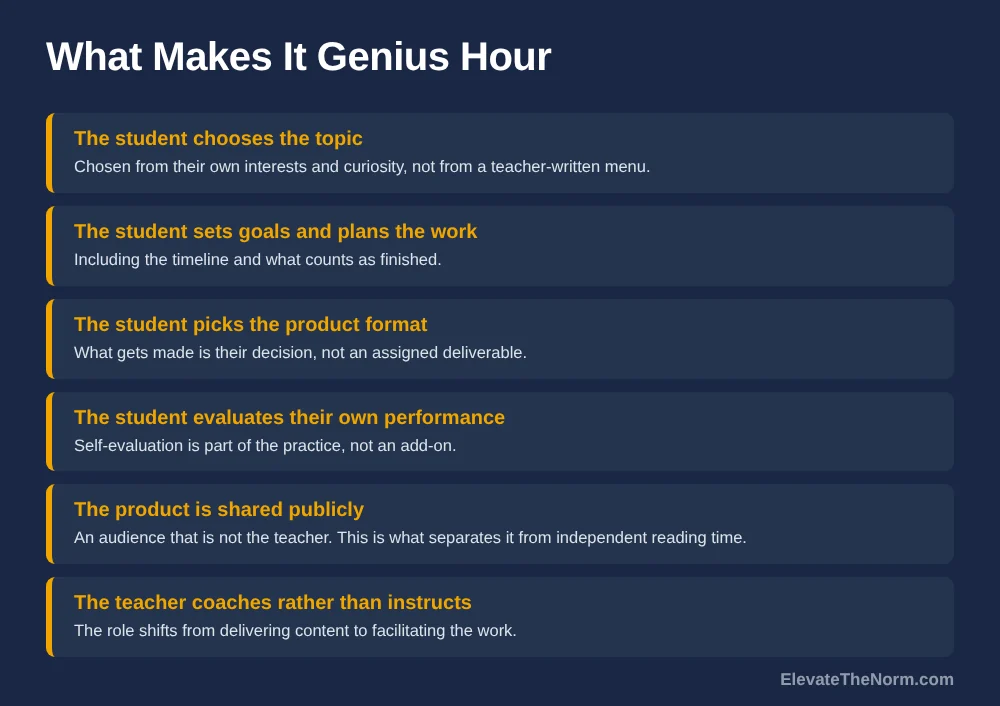
Genius Hour is a protected, recurring block of class time in which students pursue a question or project they chose themselves, set their own goals, decide the format of the final product, and present it to an audience. The teacher’s role shifts from delivering content to coaching the work.
The Association for Middle Level Education’s research-to-practice summary describes the common features as student-chosen topics, student-set goals and plans, student-selected product formats, student self-evaluation, and a teacher acting as facilitator. It also ties the practice to authentic achievement: students construct original knowledge, apply disciplined inquiry, and share a public product. The last of those three is what separates Genius Hour from independent reading time.
Where the name comes from, and why that matters
Genius Hour borrows its logic from Google’s 20 percent time, the policy that let engineers spend a day a week on their own projects. Quartz reported in 2013 that the policy had become “as good as dead” in practice: engineers now needed management approval, managers were reportedly discouraged from granting it, and productivity targets assumed full-time work on primary responsibilities. Google never formally ended it; it was curtailed. The same report credits 20 percent time with incubating Gmail, AdSense, Google News, Google Talk and Google Transit.
That history is worth knowing before you pitch this at a department meeting, because both halves of it are true. The structure produced genuinely valuable things, and the organization that invented it let it die under production pressure. A school year has the same pressure, and it arrives in February.
How Genius Hour differs from the other choice structures
“Give students choice” covers at least four different structures that cost different amounts and do different jobs. They are not interchangeable, and picking the wrong one for what you actually want is the most common mistake here.
| Structure | Who picks the topic | Typical length | Public audience? | Best when you want |
|---|---|---|---|---|
| Genius Hour | The student, with few limits | One period a week, ongoing | Yes, it is the point | Self-direction and a reason to come to school |
| Choice board | The teacher writes the options; the student picks | One unit or one week | Usually no | Differentiated practice on content you must cover |
| Project-based learning unit | The teacher sets the driving question; students choose approach and product | Two to six weeks | Yes | Standards covered through the project itself |
| Independent study or capstone | The student, inside a negotiated contract | A term or a year | Usually yes | A single sustained piece of work from an older student |
If what you need is coverage of required content, you want a choice board or a project-based learning unit, not Genius Hour. Genius Hour deliberately does not promise standards coverage, and pretending it does is how it gets cancelled.
Does the Research Support Genius Hour?
Not directly. There is almost no research on Genius Hour specifically, and the single most-cited study examines teachers’ perceptions at one school rather than student outcomes. The supporting evidence is indirect: it comes from the literature on choice and autonomy, which is strong on motivation and weak on learning.
The study everyone cites is LeGeros, Bishop, Netcoh and Downes, published in RMLE Online in 2022. I was able to read the abstract and the citation record but not the full text, which sits behind a paywall this site cannot reach. The AMLE summary of it, which I did read in full, describes it as a qualitative case study drawing on interviews with 17 teachers and one administrator over four years at a school running a school-wide Genius Hour.
What the abstract itself says is specific and should temper anyone’s enthusiasm. Teachers saw Genius Hour as building student self-direction and as engaging students through relationships and choice. They valued watching personalized learning work. And then logistical, personal and curricular concerns kept them from using the practice widely in their own classrooms. Teachers in that study also questioned whether Genius Hour should be the norm for all instruction, and said students need exposure beyond their own interests.
That is the most useful finding in the Genius Hour literature, and it is not a finding about students. A school ran this well enough that its teachers admired it, and most of them still did not take it into their own rooms. Any plan that does not account for why should expect the same result. The AMLE summary names the constraints the teachers raised: mandated curricula, and the question of breadth.
The honest summary of the evidence base, then: few studies exist, the best one measures teacher perception, and nobody has shown that Genius Hour raises achievement. That does not make it a bad idea. It makes it a practice you adopt for reasons other than test scores, and you should say so out loud rather than borrow a research claim it has not earned.
What Does the Evidence on Student Choice Actually Say?
Choice produces a reliable, modest gain in intrinsic motivation and no reliable gain in learning. In a meta-analysis of 41 studies, choice moved intrinsic motivation by about 0.30 standard deviations but moved subsequent learning by only 0.10, which was not statistically significant.
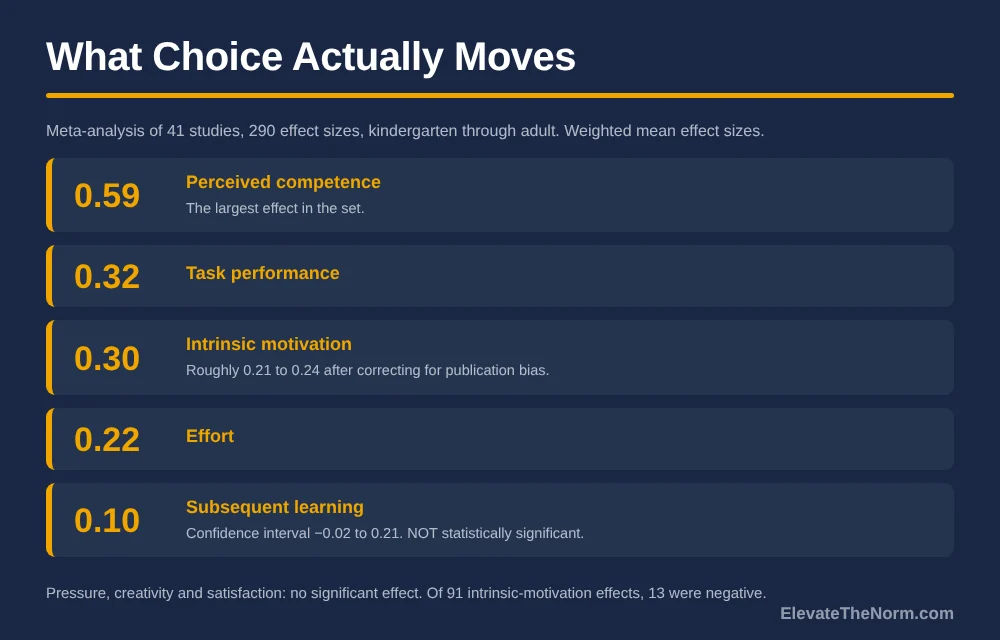
Patall, Cooper and Robinson’s meta-analysis in Psychological Bulletin pulled 290 effect sizes from 41 studies across kindergarten through twelfth grade, college and general adult samples. Their results, as weighted mean effect sizes:
- Intrinsic motivation: 0.30 (fixed effects), 0.36 (random effects). After a trim-and-fill correction for publication bias it shrank to roughly 0.21 to 0.24.
- Perceived competence: 0.59. Task performance: 0.32. Effort: 0.22.
- Subsequent learning: 0.10, confidence interval −0.02 to 0.21. Not significant.
- Pressure or tension, creativity and satisfaction: no significant effect. Of the 91 overall intrinsic-motivation effects, 13 were negative.
Four of their moderators matter for how you build Genius Hour, and three of them cut against the obvious design:
- The effect was stronger for instructionally irrelevant choices — things like the fantasy setting of a task — than for instructionally relevant ones. The motivational payoff of choice is not mainly coming from the academic weight of the decision.
- Two to four successive choices beat more. More options is not more motivation.
- No reward afterwards beat a reward. Attaching a prize to self-chosen work reduced the effect.
- The effect was stronger for children than for adults, which is in Genius Hour’s favour for grades 6–12 — though the samples here were North American and excluded students identified with learning disabilities or behavioural disorders, so the finding does not automatically travel to every student in your room.
Read together with the null result on learning, this is a specific brief rather than a blank cheque. Choice buys engagement, the engagement is real, and it does not convert into measured learning on its own. The choice continuum is the piece worth reading next, because the question is not whether to give students choice but how much and over what.
Why Does “Just Let Them Explore” Fail?
Because searching for information consumes working memory without necessarily building long-term knowledge, and students who lack background knowledge in a field have nothing to search with. Minimally guided instruction works best for learners who already have prerequisite knowledge and prior structured experience.
Kirschner, Sweller and Clark’s 1 2006 analysis in Educational Psychologist is the standard statement of this and it is worth reading even if you disagree with it. Their argument rests on cognitive architecture: working memory holds only a handful of novel items and loses unrehearsed information within about 30 seconds, so a learner hunting for a solution can spend an hour of effort and store almost nothing. They cite the worked-example effect — novices who study worked examples outperform those who solve the equivalent problems — replicated many times since the mid-1980s.
Two of their concessions are the design brief for Genius Hour, and they get quoted far less often than the title:
- The expertise reversal effect. The advantage of heavy guidance fades, and eventually reverses, as a learner gains knowledge in the area. Guidance becomes redundant for someone who knows the terrain.
- Discovery works under conditions. They cite work finding discovery learning succeeds when students have the prerequisite knowledge and prior structured experience, and note that the most effective teachers observed in discovery classrooms provided considerable scaffolding.
So the question is not whether a student should be allowed to direct their own inquiry. It is whether they have enough knowledge of the thing to direct it yet, and what you put in place while they build that. One finding in their review is worth sitting with: in a review of roughly 70 studies on how learner aptitude interacts with instruction, lower-aptitude learners in unguided conditions sometimes scored lower on the posttest than on the pretest. An unscaffolded hour is not neutral for the students who need the most help.
That is also the practical answer to the colleague who says Genius Hour is a free period. They are right about the version with no scaffolding. The fix is the scaffolding, and it is specific.
How Do You Run Genius Hour in Grades 6–12?
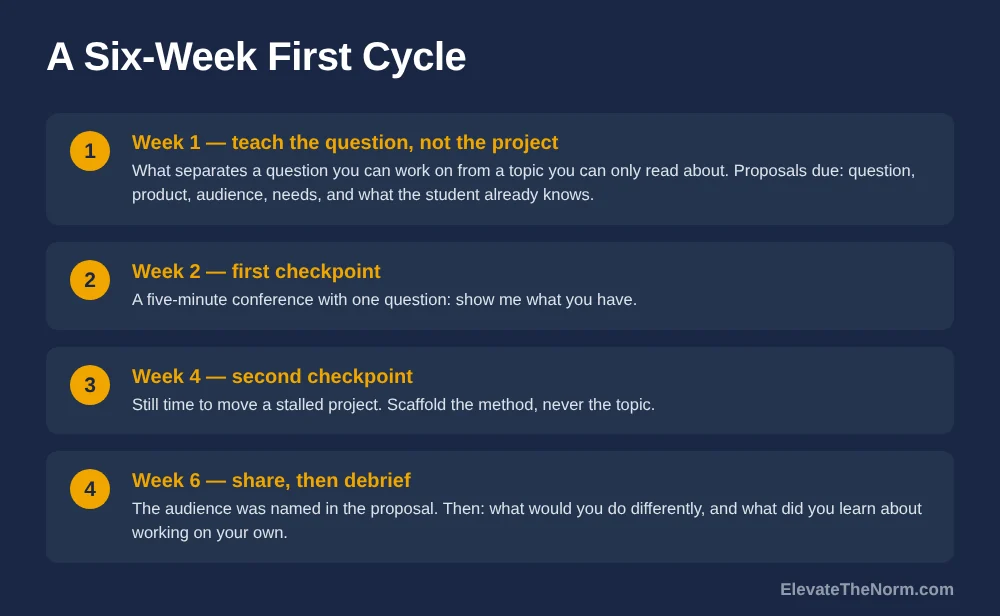
Protect one period a week, cap the first cycle at six weeks, require a proposal before any work starts, and build in checkpoints and a public share. The scaffolding goes in the first two weeks and at every checkpoint — not into the student’s topic, which stays theirs.
- Pick the slot and defend it. One period a week, same day, on the calendar for the whole cycle. This is the step that fails. Google’s version died because the time became negotiable, and February will make yours negotiable too unless it is already scheduled.
- Run a short cycle first, not an open-ended one. Six weeks with a fixed share date beats “all year.” A deadline is the only thing that converts an interest into a product, and a short first cycle lets you run a second one having learned something.
- Teach the question before the project. Spend the first session on what separates a question you can work on from a topic you can only read about. The guide to writing driving questions is the tool for this; the same test applies. “Sharks” is a topic. “Why do shark attack numbers keep rising when shark populations are falling?” is something a student can actually do.
- Require a one-page proposal and approve it. The question, what they will make, who will see it, what they need, and what they already know about it. That last line is the one that catches the student with no background knowledge in the area, which is exactly the student the cognitive-load research says will struggle most. Approving proposals is also how you keep two to four real options in play rather than infinite ones.
- Put checkpoints at weeks two and four. A checkpoint is a five-minute conference with one question: show me what you have. Checkpoint evidence is what tells you a project has stalled while there is still time to move it.
- Scaffold the method, never the topic. Teach how to find a source, how to draft a request for an interview, how to build a simple plan with dates. These are transferable and they are what the students who struggle are actually missing. Their subject stays theirs.
- Write the limits into the proposal form. Nothing that happens off campus, nothing that requires money, nothing involving tools or chemicals outside a supervised lab, and no outside contact that does not go through you — if a student wants an interview, you send the first email and you are copied on the rest. These are not obstacles to student ownership; they are the conditions under which a school can let a fourteen-year-old do real work at all, and stating them up front is faster than refusing projects one at a time.
- Fix the audience in advance. A product with no audience quietly becomes a slideshow for the teacher. Another class, a parent evening, a display, a short talk to a club — name it in the proposal. What makes work feel real is mostly who sees it.
- End with a debrief, then run it again. What would you do differently; what did you learn about working on your own. Self-evaluation is part of the practice as AMLE describes it, and the second cycle is always better than the first.


How Do You Grade Genius Hour?
Grade the process, not the topic or the polish. Score the proposal, the checkpoints, the evidence of work and the share — things every student can meet regardless of what they chose. Attaching a competitive prize to self-chosen work is the one thing the research specifically warns against.
Grading the product is tempting and it is unfair in a predictable direction. A student who builds a working circuit, a student who writes a 2,000-word history of a local building and a student who makes a short documentary have not produced comparable artefacts, and a single quality scale between them is really a scale of who had resources at home. Grading the process keeps the bar identical.
Four things are fair to score: a proposal that meets its requirements, checkpoints met with evidence, a reflection that names a specific change in approach, and a share delivered to the stated audience. Notice that a student whose project fails can score full marks on all four, which is the point. The failure is information if the process was real.
Who gets Genius Hour, and what it must not require
Two access questions decide whether this is a good practice or a nice thing some students get. The first is which classes it runs in. If self-directed inquiry time exists in the honors sections and the on-level sections get worksheets, the school has not adopted Genius Hour — it has made self-direction a reward for students who already had it. The students most likely to benefit from practice at directing their own work are the ones least likely to be handed the chance.
The second is money. No project may require a student to spend anything. If a proposal needs materials, the school supplies them or the project changes, and the student is never the one who has to say which situation they are in. The same applies to the share: if the audience is a parent evening, the students whose families cannot attend need a second route to an audience, not an exemption. Real-world work cannot depend on a ZIP code and neither can this.
How to say no to a proposal without killing it
You will reject proposals, and how you do it is the whole thing. A rejection that lands as “your interest is not serious” costs you that student for the rest of the cycle. The version that works is to reject the question and keep the subject: the topic is fine, the question as written can be answered in one search, bring me a harder one by Thursday. That is a revision note, not a verdict, and it is the same move you would make on a weak thesis statement.
It also gives you something concrete to look for when you ask whether this is working. Self-direction is visible in small, checkable things: a student who revises a question without being told to, who shows up at a checkpoint with a plan that has changed since the last one, who asks for a specific resource rather than for help in general. Those are the indicators worth recording, because they are what you will be asked to show at the end of a pilot.
On the reward finding: Patall and colleagues found choice’s motivational effect was stronger when no reward followed. That is a direct argument against a Genius Hour competition with a winner. If you want extrinsic stakes, the grade for completing the process is enough. A trophy for best project converts a self-chosen inquiry into someone else’s contest.
What Does Genius Hour Actually Cost?
About 18 periods a year for one period a week, plus the planning and conference time that makes it work. In the one multi-year study available, logistical, personal and curricular concerns were enough to stop most of the teachers who admired it from adopting it themselves.
One period a week across a semester is roughly 18 class periods. That is a real number and it comes out of something. Before starting, it is worth being able to say which unit gets compressed and whether you are willing to defend that choice in March, because the request to suspend Genius Hour for test review is coming and it will be reasonable.
The hidden cost is conference time. Six checkpoint conversations across thirty students twice a cycle is 60 short conferences, and the model does not work without them. The AMLE summary of the research recommends a school-wide rather than single-classroom approach and a multi-year commitment, partly for this reason: the load is more survivable when it is shared and the structure is not one teacher’s experiment.
There is one cost worth naming that nobody advertises. If you run Genius Hour and your colleagues do not, students will compare the two and you will be asked why other classes are not like yours. That is a good problem and it is still a problem, and it is part of why the research points at doing this as a school rather than alone.
Is Genius Hour Worth It? My Take
Worth running, not worth overselling. The honest case for Genius Hour is that it gives students practice at directing their own work, which is a thing schools claim to value and rarely assess. The dishonest case is that it raises achievement, and the evidence does not support that.
I want to be careful here, because the easiest thing to do in an article like this is to claim a practice as my own. I have not run a Genius Hour. The closest thing I have built is a mock election project, and it is worth saying what the difference is: that was my structure with real roles inside it for students. It started with one class and grew to the whole school, and I built it with my instructional coach rather than on my own — I did not know of anybody near me doing it at the time. Genius Hour hands over the structure too, which is a bigger step than handing over the roles inside one.
What makes me take it seriously anyway is a position I have argued on this site for a long time: if a student can fail badly enough in my room for it to matter, that is usually my planning, not their character. Applied here, that rules out the version of Genius Hour where you hand over an hour and find out in week six that eleven students have nothing. The proposal, the checkpoints and the fixed share date are not bureaucracy. They are the planning that makes the freedom survivable, and they are the difference between treating students as capable and treating them as a test.
The other thing I would hold to is the part about keeping your word. If you tell a class Thursday is theirs, Thursday has to be theirs, including the Thursday you are behind. Students track that with great precision. A Genius Hour that gets cancelled twice has taught them something more durable than anything in their projects.
Where Genius Hour Goes Wrong
- The time becomes negotiable. This is how Google’s version ended and it is the most common failure in classrooms. Two cancellations and it is over.
- No proposal gate. Without one, the students who most need direction get the least, and you find out in week five.
- No audience. A public product with no public is a slideshow, and students know the difference immediately.
- It is sold on achievement. Promise test gains and the first round of data will end the programme. Promise self-direction and name how you will see it.
- Research becomes reading about a hobby. The fix is the question, not the topic — a question that cannot be answered by a single search. The driving question test applies.
- It is graded on polish. Which grades resources at home. Grade the process.
What to Do Next
If you want to try this, do not start with an hour. Start with a six-week cycle, one period a week, a required proposal and a fixed date when students present to somebody who is not you. Put the share date on the calendar first and work backwards. Then run it a second time, because the first cycle teaches you where your students need scaffolding and the second is where they get it. If a student’s cycle turns into something a six-week window cannot hold, that is the point where it becomes a capstone, and scoping a long independent project is a different job with its own checkpoints.
If what you actually need is required content taught through student work, that is a different structure and it is better documented: start with the seven steps of project-based learning or with a choice board for a single unit.
Sources
- Patall, E. A., Cooper, H., & Robinson, J. C. (2008). The effects of choice on intrinsic motivation and related outcomes: A meta-analysis of research findings. Psychological Bulletin, 134(2), 270–300. 41 studies, 290 effect sizes, kindergarten through adult. North American samples; students identified with learning disabilities or behavioural disorders were excluded. Read in full.
- Kirschner, P. A., Sweller, J., & Clark, R. E. (2006). Why minimal guidance during instruction does not work. Educational Psychologist, 41(2), 75–86. Read in full. Note that this is an argumentative review rather than a systematic meta-analysis, several of its key sources come from the authors’ own cognitive-load tradition, and its conclusions are strongest for novice learners.
- LeGeros, L., Bishop, P., Netcoh, S., & Downes, J. (2022). Informing the implementation of personalized learning in the middle grades through a school-wide Genius Hour. RMLE Online, 45(1), 1–22. Abstract and citation record read; the full text was not reachable from here. The sample detail — 17 teachers and one administrator over four years — comes from the AMLE summary below, not from the paper itself.
- Virtue, D. C. (2022, March 14). Research to practice: Implementing genius projects in the middle grades. Association for Middle Level Education. A summary rather than a primary study, used here for the description of common features and for its account of LeGeros et al. Read in full.
- Google’s “20% time,” which brought you Gmail and AdSense, is now as good as dead. Quartz, 2013. Reporting, based on an anonymous former employee and public statements; Google did not comment and never formally acknowledged the change. Read in full.
What is Genius Hour in simple terms?
A protected block of class time, usually one period a week, in which students work on a question or project they chose themselves and finish by sharing it with an audience. The teacher coaches instead of teaching content. It takes its name and its logic from Google’s 20 percent time policy for engineers.
Does Genius Hour improve student achievement?
There is no evidence that it does. Research on Genius Hour specifically is very limited, and the most-cited study reports teacher perceptions at a single school rather than student outcomes. The broader meta-analysis on student choice found a significant effect on motivation but no significant effect on subsequent learning.
How long should Genius Hour be?
One class period a week is the common pattern, and a first cycle of about six weeks with a fixed share date works better than an open-ended commitment. One period a week runs to roughly 18 periods a semester, so decide in advance which content gets compressed.
How do you grade Genius Hour?
Grade the process: a proposal that meets its requirements, checkpoints met with evidence, a reflection naming a specific change in approach, and a share delivered to the stated audience. Grading the finished product penalises students with fewer resources at home, and a competitive prize works against the motivation the structure relies on.
What do you do about students who never pick a topic?
Treat it as a scaffolding problem rather than a motivation one. A required one-page proposal with a line for what the student already knows about the subject surfaces them in week one. Offering two to four concrete starting options is also supported by the research, which found choice worked better with a few options than with many.
Is Genius Hour the same as project-based learning?
No. In project-based learning the teacher sets the driving question and the project covers required standards. In Genius Hour the student sets the question and the structure makes no promise about standards coverage. Use project-based learning when content must be covered and Genius Hour when self-direction is the goal.
Does Genius Hour work for students who struggle academically?
Only with scaffolding. The cognitive-load research finds that minimally guided instruction works mainly for learners who already have prerequisite knowledge, and that lower-aptitude learners in unguided conditions sometimes performed worse afterwards than before. Scaffold the method, the proposal and the checkpoints rather than the student’s topic.
How do I convince an administrator to allow Genius Hour?
Do not sell it on test scores, because the evidence will not support that and the first data review will end it. Ask for a short pilot cycle with a fixed share date, name what you will show them at the end, and state which content is being compressed. Research recommends a school-wide approach over a single classroom.