By Clay Shumate
Philosophical chairs is a whole-class discussion structure built on one debatable statement. Students who agree sit on one side of the room, students who disagree sit on the other, and anyone may change seats the moment an argument persuades them. The rule that does the real work is smaller than the furniture: summarize the last speaker before you answer them.
Key Takeaways
- The rules are published, free, and more demanding than the seating chart. The AVID handout lists eight rules of engagement, and two of them carry the structure: summarize the previous speaker before you respond, and after you speak, three other people on your side have to speak before you go again.
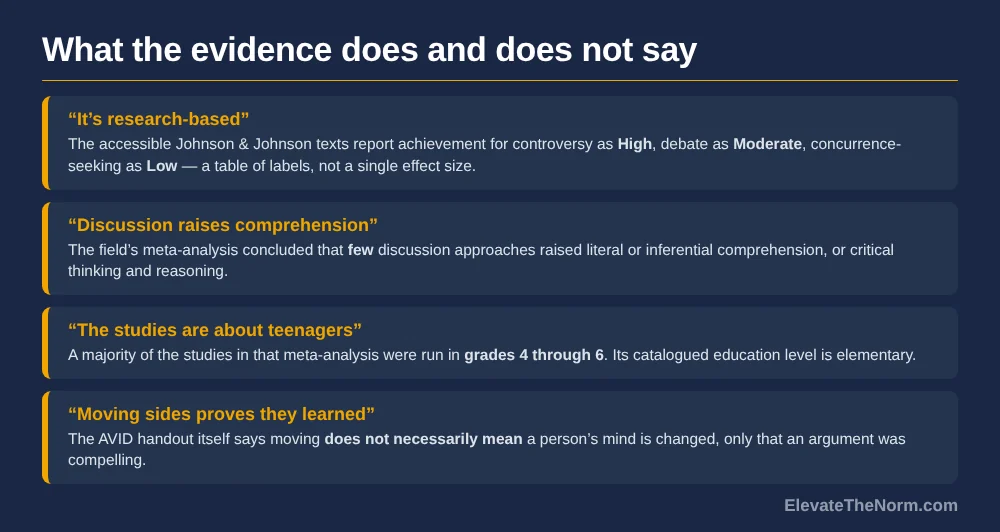
- There is no effect size for philosophical chairs. The academic controversy work everyone points to reports its achievement comparison as a table of labels — High for controversy, Moderate for debate, Low for concurrence-seeking — with no number attached in either accessible text.
- The discussion research that does carry numbers is mostly elementary. The field’s meta-analysis says a majority of its studies were run in grades 4 through 6, and its own conclusion is that few discussion approaches raised literal or inferential comprehension, or critical thinking and reasoning.
- The strongest secondary evidence is about climate, not format. In 2,811 American 14-year-olds, an open classroom climate predicted appreciation of political conflict (.15) and informed voting (.14), and partly compensated for low socioeconomic status — but the author says plainly he cannot tell which way the arrow points.
- Switching sides is not evidence of learning. The AVID handout says so itself: moving does not necessarily mean a student’s mind changed, only that an argument was compelling enough to sway opinion.
What is philosophical chairs?
Philosophical chairs is a discussion structure in which a single debatable statement divides the room physically. Students who agree sit on one side, students who disagree sit facing them, a neutral mediator sits between, and students may change seats at any point in the period when another side’s argument moves them.
The structure is a practitioner tradition rather than a research program, and it is worth being precise about where it comes from. The most widely used strategy page for it, published by the K20 Center in 2020, attributes the strategy to a single source: McAndrews, S. (2013), AVID Elementary: Foundations Implementation Resource. That is an elementary AVID publication, and the same page lists the strategy as suitable from preschool through twelfth grade. Nobody is hiding anything — but a teacher who has been told this is a rigorous secondary structure should know the citation underneath it.
The fuller procedural version comes from AVID’s own handout, which sets out eight rules of engagement, a mediator role, an optional undecided section, and a closing round. That handout makes no research claims at all.
What are the rules of philosophical chairs?
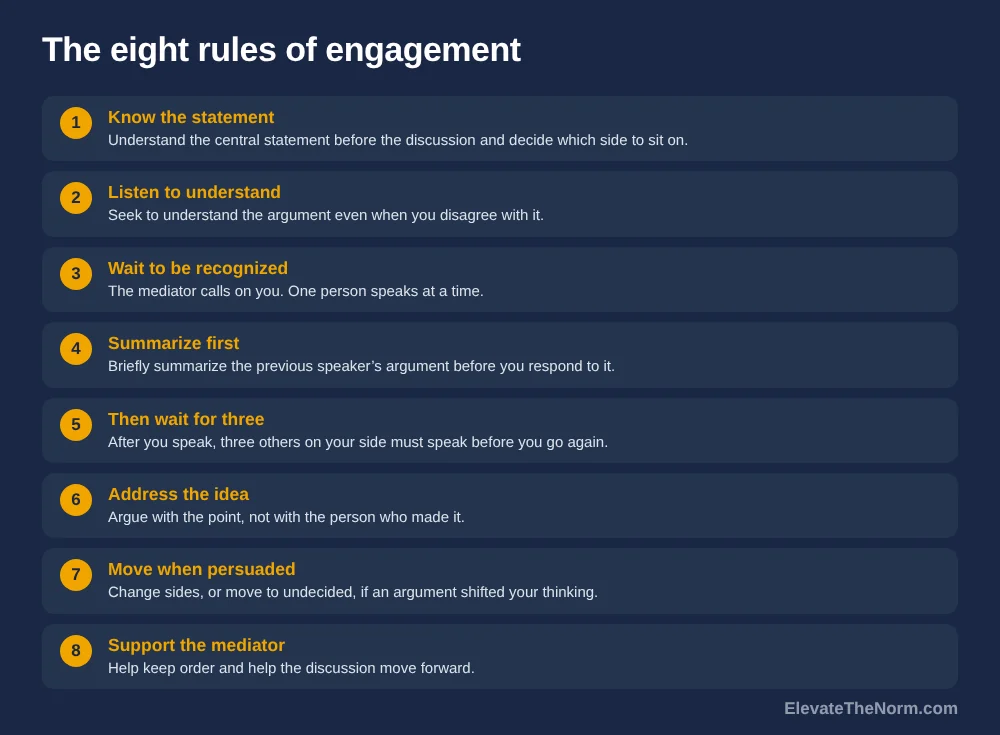
Eight rules, and most teachers only enforce the first three. The two that actually change what happens in the room are rules four and five.
- Understand the central statement before the discussion, and decide which side to sit on.
- Listen carefully and seek to understand an argument even when you disagree with it.
- Wait for the mediator to recognize you. Only one person speaks at a time.
- Briefly summarize the previous speaker’s argument before you respond to it.
- After you have spoken, wait until three other people on your side have spoken before you speak again.
- Address the ideas, not the person stating them.
- Keep an open mind, and move to the other side or the undecided section if an argument shifted your thinking.
- Support the mediator by helping keep order and keeping the discussion moving.
Rule four is the whole thing. A student who has to restate your point before answering it cannot have spent your turn loading their own. It is the same requirement that sits underneath accountable talk and underneath every protocol that gets teenagers to build on each other instead of taking turns announcing. Rule five is the one that stops three confident kids from owning the period, and it is the first rule to get quietly dropped when the clock is tight.
How do you run philosophical chairs, step by step?
Nine moves, inside one class period. The setup takes about five minutes if students have done it before, and considerably longer the first time, because the first time you are teaching the rules, not the content.
- Write the statement on the board and leave it there. One claim, phrased so a reasonable person could land on either side.
- Give students the text or the evidence first. AVID’s version has students read a short article and build a two-column list of points for and against before anyone speaks. Skipping this is what turns the period into an opinion swap.
- Arrange the chairs facing each other, roughly half the room each way, with a seat between for the mediator.
- Have students sit according to their position. If a student cannot choose, AVID’s instruction is to sit with the side they agree with most, even without full agreement.
- Take the mediator seat yourself the first several times. The handout is explicit that in the middle grades the teacher almost always supplies the topic and runs the discussion, and that by the junior and senior years students should be writing the statement and mediating it.
- Call on the agree side first, then alternate. Enforce the summary rule from the first speaker, out loud, every time, until it stops needing enforcing.
- Let students move whenever they want. Movement can go back and forth, and it can happen mid-sentence from someone else.
- Close with a final statement from each side, and if the clock allows, a round where each student names their current position and which argument was the most convincing one they heard. That second question is the one worth protecting.
- Leave time to write. AVID’s own evaluation note is to reserve time at the end of the period for reflection, started in class and finished at home if needed. A discussion nobody writes down is a discussion you cannot grade or revisit.
Two optional pieces are worth knowing. You can seat three or four students as observers who take notes instead of arguing and debrief the class at the end — useful for the student who will not speak in week one. And once a class is fluent, you can add an undecided section in the middle, on the condition that everyone still sitting there has to choose a side before the period ends.
Is philosophical chairs research based?
Not in the way the phrase usually implies. There is no randomized trial of philosophical chairs, no effect size for it, and the handouts that teach it make no research claims. What exists is evidence about a close cousin, and evidence about classroom discussion generally, and both come with real limits.
The cousin is structured academic controversy, David and Roger Johnson’s format in which pairs argue one side, then argue the other, then drop advocacy and build a joint position. It is the thing people mean when they say philosophical chairs is research-based, and it is a different activity — it is run in fours, it requires you to argue the position you rejected, and it ends in agreement rather than in a count of who moved.
Reading the Johnsons’ own accessible write-ups is instructive. Their 1988 Educational Leadership article says structured controversy produces greater mastery and retention, better generalization, higher-quality decisions and more creative insight than concurrence-seeking, debate and individualistic learning — and gives not one number. Their 1997 chapter summarizes achievement across the four conditions in a table reading High, Moderate, Low, Low. Both point back to a 1985 study in the American Educational Research Journal as the source. That paper is paywalled and was not read for this article, so no sample size or figure from it appears here.
Both texts also carry a caveat worth more than the claims. The 1988 article says positive outcomes “do not automatically appear every time students disagree intellectually,” and the 1997 chapter lists the conditions controversy depends on: a cooperative context, heterogeneous participants, information actually distributed among them, social skills, and rational argument. Run philosophical chairs without those and you are not running a weaker version of the research. You are running something the research did not study.
What does the research on classroom discussion actually show?
Mixed results, on younger students than the people quoting it usually mention. The standard reference is Murphy and colleagues’ 2009 meta-analysis of classroom discussion in the Journal of Educational Psychology, and its abstract is blunter than its reputation.
Several discussion approaches produced large increases in student talk and matching reductions in teacher talk, plus substantial improvements in text comprehension. Then this: few approaches to discussion were effective at increasing students’ literal or inferential comprehension, or their critical thinking and reasoning. Effects were moderated by study design, by the outcome measure, and by student academic ability. And on population: while the ages were wide, a majority of the studies were conducted with students in fourth through sixth grade. ERIC catalogues the whole thing under elementary education.
That is not a reason to skip discussion. It is a reason to stop quoting a number at it. The one that circulates most is a 0.86 effect size for argumentation and classroom discussion on Visible Learning MetaX — and that page pools five meta-analyses covering computer-supported collaborative argumentation, science argumentation and text-comprehension discussion, which are not the same construct. Its own table footer reports the average as 0.79 while the headline reads 0.86. A figure that contradicts itself on its own page is not a figure to put on a slide for your department.
The most useful secondary evidence is a different kind. Campbell’s analysis of the 1999 civic education study looked at 2,811 American fourteen-year-olds in 124 schools, measuring how far students felt free to disagree with teachers, express minority opinions, and hear several sides of an issue. A one-standard-deviation rise in that climate predicted a .15 gain in appreciation of conflict and .14 in informed voting intent, against a smaller .06 for civic knowledge — about two percentage points on a 49-item test.
Two honest caveats travel with it. The design is cross-sectional and the author says so: it remains unclear whether perceiving a lot of discussion produces engagement, or whether engaged adolescents perceive more discussion. And the compensation finding — that an open climate narrows the gap for students with lower expected education — held for appreciation of conflict and voting, at −.04 on both interactions, and did not hold for civic knowledge. The honest version is that giving teenagers somewhere to argue well may matter most for the students who get the fewest chances elsewhere, and that this is a correlation with a plausible story attached, not a settled result.
How is philosophical chairs different from a debate or a Socratic seminar?
A debate assigns you a side and declares a winner. A Socratic seminar has no sides at all. Philosophical chairs sits between them: you pick your own side, you are expected to change it if the argument earns it, and nobody wins.
| Structure | Who picks the position | Can you change it? | How it ends | Best for |
|---|---|---|---|---|
| Philosophical chairs | The student | Yes, at any moment, by moving | Final statements; no winner | A single contested claim students already have evidence about |
| Classroom debate | Assigned by the teacher | No — you argue your side regardless | A judged result | Building argument construction and rebuttal under pressure |
| Socratic seminar | Nobody — there are no sides | Not applicable | Open; often a written reflection | Opening up a difficult text rather than resolving a question |
| Structured academic controversy | Assigned, then reversed | Required — you must argue the other side too | A joint position the group agrees on | Forcing genuine perspective-taking in groups of four |
| Four corners | The student | Yes, but usually once | A quick count and a reason | A fast read of where a class stands before you teach |
The practical consequence is about what you are assessing. If you want to see whether a student can build a case on demand, run a classroom debate and assign the sides. If you want to see whether a student can be moved by evidence, philosophical chairs is the only one of the five that makes that visible, because changing your mind is the designed behavior. A Socratic seminar is a different job again — it belongs to the text, not to the question.


What makes a good philosophical chairs statement?
A statement works when a reasonable, informed person could sit on either side of it, when the evidence to argue it is already in students’ hands, and when nobody in the room is the subject of the debate. Most failed philosophical chairs periods were lost at the statement, not during the discussion.
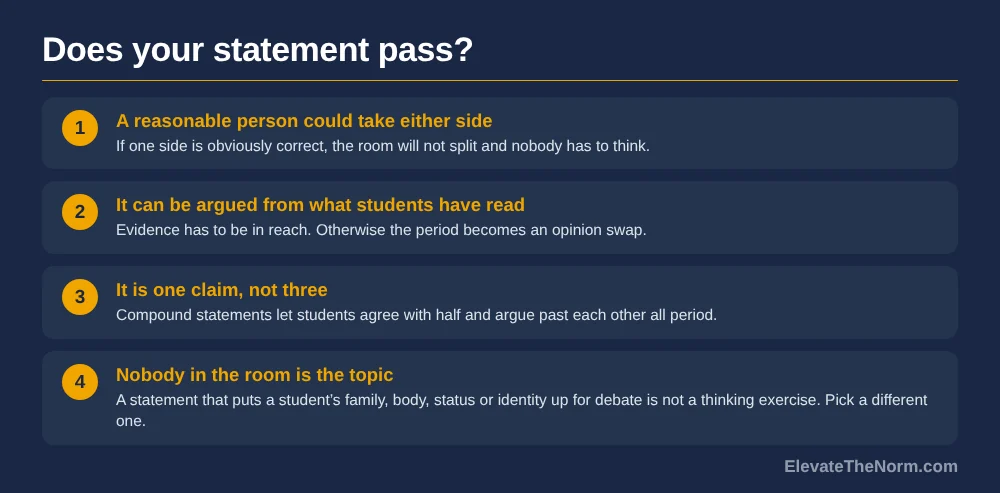
The fourth test is the one that needs saying out loud. AVID’s own handout ships with a list of sample topics, and some of them put a student’s family, legal status, body or beliefs up for a show of hands by their classmates. In a grades 6–12 room, somebody in those chairs is living the topic. The exercise asks them to sit on a side while peers argue against their life, and no amount of structure makes that a thinking task. Pick a different statement. There are plenty that are contested without being personal — whether a historical decision was justified, whether a policy achieved what it promised, whether a character in the text was right.
A few that work, and work for a reason:
- “The Marshall Plan was a humanitarian act.” Both sides are defensible from the same documents, which is the whole point.
- “A government should be able to compel citizens to serve in a war it declares.” Abstract enough that nobody has to defend their own family, concrete enough to argue.
- “Our school should grade on effort as well as accuracy.” Students have direct evidence, and you will learn something about your own classroom expectations that you cannot learn any other way.
Why won’t students switch sides?
Because in most classrooms changing your mind in public has only ever been punished. A teenager who moves chairs is announcing, in front of thirty peers, that they were wrong a minute ago. The structure cannot fix that on its own, and the teacher’s framing is what decides it.
Three things help, none of them complicated. Name movement as the goal in the first thirty seconds, every time, before anyone has a position to defend. Praise the argument that caused a move rather than the person who moved, which keeps the spotlight off the student who conceded. And run the closing round where every student names the most convincing argument they heard from the other side, whether or not they moved — that gives a student a way to acknowledge a good point without having to get out of their chair to do it.
It is also worth saying the quiet part: a class that never moves is not necessarily failing. The AVID handout notes that moving does not necessarily mean a person’s mind is changed, only that an argument was compelling enough to sway opinion. The reverse holds too. A student who stays put and can now state the opposing case accurately has done the work the exercise exists for.
How do you grade philosophical chairs?
Grade the written reflection, not the talking. Participation grades in a discussion reward the students who were already comfortable speaking and punish the ones the structure is supposed to help, which inverts the reason you ran it.
What a reflection can fairly ask for is specific and checkable: state your position now, state the strongest argument from the side you did not take, say whether and why you moved, and cite one piece of evidence from the reading. That is four lines and it tells you more than a tally of who spoke. The second item is the one to weight — a student who can state the opposing case accurately has demonstrated the perspective-taking the whole structure is built to produce.
If you want a live record, the observer seats do it better than a clipboard. Rotate who sits there, and the student who has not spoken all semester gets a way in that is not speaking.
What goes wrong with philosophical chairs?
Four failures account for nearly all of it, and three of them happen before the discussion starts.
- No evidence in the room. If students have not read anything, they argue from what they already believed when they walked in, and the loudest prior wins. The reading is not a warm-up, it is the fuel.
- The summary rule gets dropped. It slows the period down, so it is the first thing to go, and the moment it goes you have two monologue lines facing each other. Enforce it even when it costs you three speakers.
- The statement had an obvious answer. One side ends up with four students and the room learns that disagreement is a performance.
- Somebody’s life was the topic. This is the one that does lasting damage to the trust in a room, and it is entirely avoidable at the planning stage.
A fifth, subtler one: running it too often. Used monthly it is an event students prepare for. Used weekly it becomes the thing you do when the unit plan ran thin, and teenagers can tell the difference immediately. For the ordinary Tuesday, a 90-second structured pair buys more talk per minute than a whole-class format ever will.
Clay’s take: the structure is a delivery system for one rule
I have read the sources for this one twice, because the gap between how confidently philosophical chairs is recommended and what is actually published underneath it is wider than usual. The most-cited strategy page traces to an AVID elementary resource. The research everyone gestures at belongs to a different activity and reports its achievement finding as a word in a table. The meta-analysis with real numbers is mostly fourth through sixth grade and concluded that few discussion approaches moved comprehension or reasoning at all.
None of that makes it a bad use of a period. It makes the usual justification for it wrong. The case for philosophical chairs is not that a study says it raises achievement. The case is that it is the only common classroom structure whose designed outcome is a student publicly changing position because of evidence, and that teenagers almost never see an adult model that, let alone get asked to do it.
If I had to defend one element of it, it would not be the chairs. It would be rule four. Make a sixteen-year-old restate an opponent’s argument before answering it and you have taught something that outlasts the unit, whether or not anybody moves seats. You can enforce that rule on a Tuesday with no furniture rearrangement at all, and it belongs in every discussion you run, not just this one.
What to do next
Pick one statement from a unit you are already teaching — one where the text you have assigned genuinely supports both sides — and run it the way AVID describes, with the reading first and the two-column list before anyone speaks. Take the mediator seat yourself. Enforce the summary rule out loud from the first speaker, and accept that the first run will feel slow, because you are teaching a procedure rather than the content.
Then close with the written reflection and read the second question first: the strongest argument from the side they did not take. That is where you will find out whether the period was worth it. If most of the class can state the opposing case accurately, run it again next month. If they cannot, the problem was the statement or the evidence, and both are fixable before you blame the structure.
Frequently Asked Questions
What is philosophical chairs in simple terms?
It is a whole-class discussion where one debatable statement splits the room. Students who agree sit on one side, students who disagree sit facing them, and a mediator between the sides calls on speakers who alternate. Students may change seats whenever an argument persuades them, and the discussion ends with final statements rather than a winner.
How long does philosophical chairs take?
AVID’s handout says the discussion usually runs one class period. Expect the first run to take longer in real terms, because you are teaching the eight rules as well as the content. Budget time at both ends: reading and building a pros and cons list before anyone speaks, and a written reflection after the final statements.
Is philosophical chairs the same as structured academic controversy?
No, and the difference matters because the research belongs to the second one. Structured academic controversy runs in groups of four, requires each pair to argue the opposing position after arguing their own, and ends in a joint position the group agrees on. Philosophical chairs is whole-class, self-selected, and ends without agreement.
Is there research proving philosophical chairs works?
Not for philosophical chairs specifically. No randomized trial or effect size for it exists, and the AVID and K20 handouts make no research claims. The Johnson and Johnson academic controversy work reports achievement as High, Moderate and Low in a table rather than as numbers, and the main classroom-discussion meta-analysis was mostly conducted in grades 4 to 6.
What grade levels is philosophical chairs for?
The format holds across grades, with the teacher’s role shrinking as students get older. AVID’s handout says that in the middle school years the teacher almost always supplies the topic and mediates, and that by the junior and senior years students should be writing the central statement and running the discussion themselves.
How do you include quiet students in philosophical chairs?
Use the observer seats. AVID’s version allows a few students to take notes on the quality of arguments instead of participating, then debrief the class at the end. That gives a reluctant speaker a real job and a real product. The closing round, where every student names the most convincing argument they heard, also gives everyone one short scripted turn.
What topics should you avoid in philosophical chairs?
Any statement that puts a student in the room up for debate: a classmate’s family, immigration status, body, faith or identity. Somebody in a grades 6 to 12 classroom is living most of those topics, and asking them to sit on a side while peers argue against their life is not a thinking exercise. Contested historical, policy and literary questions work without that cost.
Should philosophical chairs be graded?
Grade the written reflection rather than the talking. A participation grade rewards students who were already comfortable speaking and penalizes the ones the structure is meant to help. A four-part reflection works well: your position now, the strongest argument from the other side, whether and why you moved, and one piece of evidence from the reading.
Sources
- K20 Center. Philosophical Chairs. University of Oklahoma K20 Center, published 16 September 2020. Strategy page. Source of the five-step procedure, the agree/disagree seating, the elbow-partner pros and cons chart, the listed PreK–12 grade range, and the strategy’s sole attribution to McAndrews, S. (2013), AVID Elementary: Foundations Implementation Resource, AVID Press. The page cites no research.
- AVID. Philosophical Chairs. Handout distributed via Pasco County Schools. Full text (PDF). Source of the eight rules of engagement, the mediator role, the seven procedural steps, the observer option, the undecided section and its closing condition, the one-class-period duration, the middle-versus-upper-grades guidance, the end-of-period reflection instruction, and the statement that moving “does not necessarily mean that a person’s mind is changed.” No author or date is printed on the document, and it makes no research citations.
- Johnson, D. W., & Johnson, R. T. Critical Thinking Through Structured Controversy. Educational Leadership, May 1988, pp. 58–64. Full text (PDF). Source of the directional claims for structured controversy against concurrence-seeking, debate and individualistic learning, and of the caveat that positive outcomes “do not automatically appear every time students disagree intellectually.” The article reports no effect sizes, sample sizes or study populations.
- Johnson, D. W., & Johnson, R. T. Academic Controversy: Increase Intellectual Conflict and Increase the Quality of Learning. Chapter 10 in Campbell, W. E., & Smith, K. A. (Eds.), New Paradigms for College Teaching, Interaction Book Company, 1997. Full text (PDF). Source of the High / Moderate / Low / Low achievement table across controversy, debate, concurrence-seeking and individualistic efforts, and of the five conditions controversy depends on. Also reports no numbers. Both Johnson texts point to a 1985 study in the American Educational Research Journal as their evidence base; that paper is paywalled, was not read for this article, and nothing is cited from it here.
- Murphy, P. K., Wilkinson, I. A. G., Soter, A. O., Hennessey, M. N., & Alexander, J. F. Examining the effects of classroom discussion on students’ comprehension of text: A meta-analysis. Journal of Educational Psychology, Vol. 101, No. 3 (2009), pp. 740–764. ERIC record. Abstract and catalogue record read; the full text was not reachable. Source of the finding that few approaches raised literal or inferential comprehension or critical thinking and reasoning, that effects were moderated by design, outcome measure and student academic ability, and that a majority of studies were conducted with students in fourth through sixth grade.
- Campbell, D. E. Voice in the Classroom: How an Open Classroom Climate Fosters Political Engagement Among Adolescents. Political Behavior, 2008. DOI 10.1007/s11109-008-9063-z. Full text (PDF). Source of the 2,811 students in 124 schools from the 1999 IEA Civic Education Study, the six-item climate index, the coefficients of .06 for civic knowledge, .15 for appreciation of conflict and .14 for informed voting, the two-percentage-point reading of the knowledge result, the −.04 interactions with expected education, and the author’s own statement that it remains unclear which way the relationship runs.
- Visible Learning MetaX. Argumentation / Classroom discussion. Influence page. Source of the 0.86 weighted mean effect size drawn from five meta-analyses, 165 studies and 169 effects, and of the discrepancy with the 0.79 shown in the same page’s own total row. Cited here as an example of a pooled figure mixing distinct constructs, not as support for a claim.