By Clay Shumate
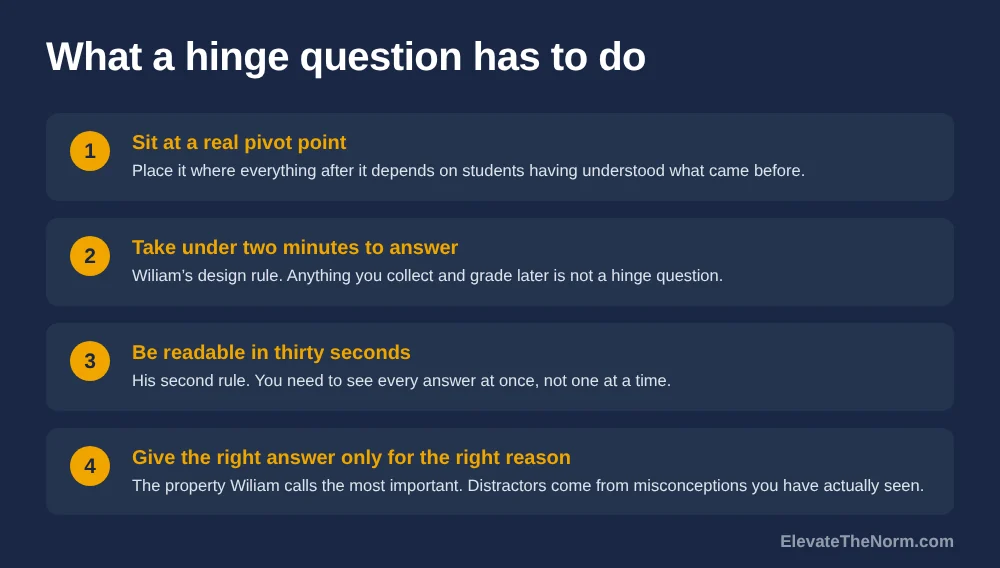
A hinge question is a single question asked mid-lesson, built so that wrong answers point to specific misconceptions and the teacher can decide on the spot whether to move on or go back. Dylan Wiliam, who named them, says students should answer in under two minutes and the teacher should read the room in thirty seconds.
Key Takeaways
- The whole design rests on one principle. In Wiliam’s own article the fourth and, he says, most important property is to “design hinge questions that elicit the right response for the right reason.” A question students can get right by accident tells you nothing.
- There is no 80 percent rule, and Wiliam never wrote one. His article gives no threshold at all — only that if “most students have understood well enough” the teacher may go on, and if “few students have understood” the teacher is likely to review. Any specific percentage you have been given came from somewhere else.
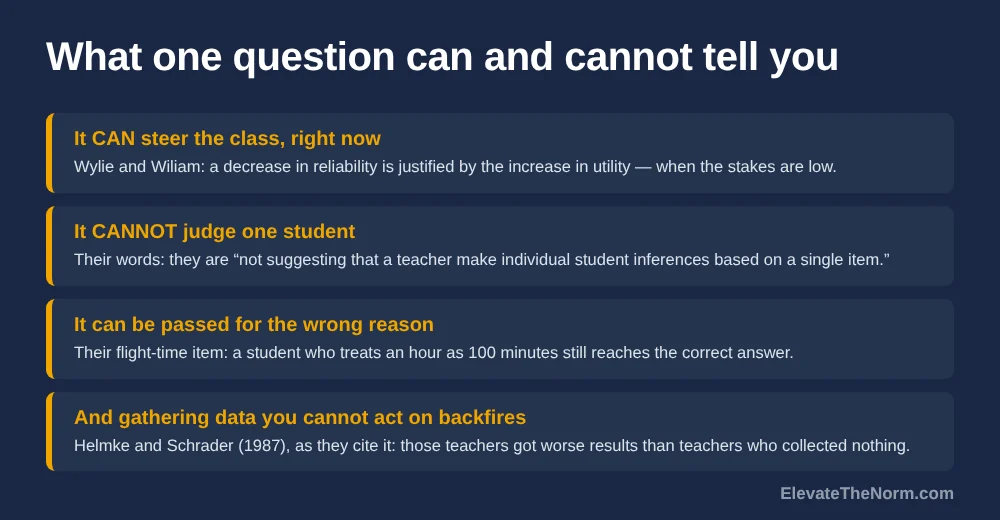
- One item is weak evidence about one student, and that is accepted on purpose. Wylie and Wiliam (2006) state it outright: “We are not suggesting that a teacher make individual student inferences based on a single item.” Their argument is that “a decrease in reliability is justified by the accompanying increase in utility” when the stakes are low.
- The famous formative-assessment effect size is called an urban legend by researchers. Briggs and colleagues (2012) use exactly that phrase for “the ‘urban legend’ of a 0.40 to 0.70 effect size.” The best available meta-analysis puts the average nearer 0.20.
- Collecting the information is not the hard part. Acting on it is. Wylie and Wiliam cite Helmke and Schrader (1987) for a finding worth sitting with: teachers who gathered achievement information but could not act on it got worse results than teachers who never gathered it.
What is a hinge question?
A hinge question is a question placed at the point in a lesson where everything after it depends on students having understood what came before. Wiliam describes it as “using specific kinds of questions — what I call hinge questions — to quickly assess students’ understanding of a concept before moving on.” Based on what comes back, “the teacher either moves on or goes back to review the material.”
The name is the mechanism. The lesson hinges there. If half the room is carrying a misconception into the next twenty minutes, those twenty minutes are wasted, and the question exists so you find that out while you can still do something about it.
Wiliam is candid about the novelty: “There’s nothing new in this idea, but it turns out that it’s rather difficult to do well.” Every teacher already stops and checks. The claim is about the design of what you stop and ask.
How is a hinge question different from an exit ticket or a cold call?
Timing and consequence. A hinge question is asked mid-lesson and changes what happens in the next five minutes; an exit ticket is read after the students have gone and changes tomorrow. A cold call samples one student’s thinking; a hinge question samples everyone’s at once. They are different instruments for different decisions, and the site has separate pages on what belongs on an exit ticket and what the research says about cold calling.
| Check | When | Who it samples | What it changes | Main weakness |
|---|---|---|---|---|
| Hinge question | Mid-lesson, at the pivot point | Every student, simultaneously | The next five minutes of this lesson | One item; low reliability for any individual |
| Exit ticket | Last three minutes | Every student | Tomorrow’s lesson | Too late to rescue today |
| Cold call | Any time | One student | Attention, and one data point | Tells you almost nothing about the class |
| Quiz or unit test | After the teaching | Every student | Grades, and possibly re-teaching | Carries stakes, so it changes behavior |
The distinction that matters most is stakes. Wiliam’s defense of a one-item check is that “the decision here is not high-stakes” — you are deciding whether to spend five more minutes on something, not whether a student passes. That logic collapses the moment the question is graded. If you need the formative and summative distinction in one line, this is it.
What makes a hinge question good?
Wrong answers have to mean something specific. Wiliam’s stated aim is that “the aim is always to have students with the right thinking and students with the wrong thinking give different answers,” and the wrong options are supposed to be designed, not padding: “the incorrect responses — what test developers call distractors — are so plausible that they’re attractive to students with incomplete understandings.”
His method for getting there is to work backwards from what students actually believe: “one of the best ways to develop such questions is to start from the partial or incomplete understandings that students have and generate questions that help identify which students have which misconceptions.” He notes the uncomfortable corollary, which is that deep subject knowledge is not enough — experts “often find it difficult to generate good distractors” because they do not know the difficulties students have.
ETS research on diagnostic item design points at the same target with more precision. Edith Aurora Graf’s 2008 report describes the ideal as a “semi-dense” item, where “a one-to-one correspondence between each option and each cognitive rule” holds — and immediately calls it “an ideal that is difficult to achieve in practice.” Her worked seventh-grade circle-area item is the clean version: one distractor for confusing circumference with area, another for confusing radius with diameter.
One more design trick from Wiliam is worth stealing. If more than one option can be correct and you do not say how many, “the chances of a student getting the correct response by guessing drop markedly.” Wylie and Wiliam put numbers on it with a six-option living-things item: guessing success falls to “less than 2%, compared with approximately 17%” for a traditional single-answer item.
How long should a hinge question take?
Two minutes for students to answer and thirty seconds for you to read the class. Those are Wiliam’s two design rules, stated plainly: “teachers should design the question so that it takes students no more than two minutes to respond,” and “they should be able to collect and interpret all the student responses in 30 seconds or less.”
Be clear what those numbers are. They are design rules offered by the person who coined the term, with no research cited for either figure. They are not findings. They are useful anyway, because they rule out almost everything teachers normally call a check: a short-answer prompt you collect and read later is not a hinge question, and neither is anything that needs a grading pass.
The thirty-second rule is really a rule about display. Something has to let you see thirty-two answers at once — lettered cards held up on a count, fingers, mini whiteboards, a show of hands by option. Wylie and Wiliam describe exactly this: a set of lettered cards, A through H, that students hold up on cue. The technology is irrelevant; the simultaneity is the point, because sequential answers leak information and burn the thirty seconds.
Simultaneity has a cost nobody in these sources addresses, and a teenager will notice it before you do. If thirty-two cards go up at once, students can see each other’s. A fifteen-year-old who is unsure will read the room and copy, which destroys your data, or hold up the wrong answer in public, which is a worse thing to ask of her than the information is worth. None of the research below deals with this. The practical answers are all imperfect — whiteboards held low and angled toward the front, a count where everyone reveals on three, or simply saying out loud that this one is not graded and that a wrong card is the most useful thing in the room. Decide which you are using before you need it.
Writing one is the expensive part. Wiliam reports that teacher groups “typically take more than an hour to design one good question” — an observation he offers without a citation, so treat it as his experience rather than a measurement. It still sets expectations honestly: this is a technique you build a small bank of over a semester, not one you improvise every period.
What percentage of the class has to get it right before you move on?
There is no established threshold, and the source most often credited with one does not contain it. Wiliam’s article gives no percentage anywhere. Its guidance is qualitative: if “most students have understood well enough the matter at hand, the teacher may go on,” and if “few students have understood, the teacher is likely to review the material.”
That matters because a specific number — usually 80 percent — gets repeated in training materials as though it were a research finding with an author. If you are told the research says 80 percent, ask which study. It is not in the article that named the technique, and the one-item reliability argument below is a reason to doubt that any precise cut-off could be justified from a single question.
Wiliam does give an asymmetry to decide with, and it is more useful than a percentage. “Assuming students do know something when they actually don’t” is, he writes, “far more serious than assuming they don’t know something when, in fact, they do.” Wylie and Wiliam agree: “if, as we believe, false positives are more serious than false negatives.” When you are genuinely unsure, the error that costs less is going back.
Can you really learn anything from one question?
About the class, yes. About one student, no, and the people who designed the technique say so first. Wylie and Wiliam’s ETS paper concedes that “it is undisputable that the reliability of a single item is less than the reliability of a testlet,” that “the reliability of a single item would not support high stakes instructional decision-making for an individual,” and that they are “not suggesting that a teacher make individual student inferences based on a single item.”
Their trade is explicit: “a decrease in reliability is justified by the accompanying increase in utility,” on three conditions — that the consequences of misclassification are low, the question gives “good cover of the domain,” and “both correct and incorrect answers are interpretable.” Break any of those and the trade stops being worth it.
Their flight-time item shows the failure mode better than any warning could. Two flights leave Newtown for Oldtown; the first leaves at 9:05 and arrives at 10:45; the second leaves at 2:15; when does it land? A student who treats an hour as a hundred minutes still reaches the right answer, so the item cannot separate them. Changing the first arrival to 10:55 would. That is the real craft of this technique, and it is also why Graf’s report warns that in mathematics items “may be susceptible to backsolving” and that “a response (whether or not it is correct) may reflect a guess rather than a firmly held belief.”
Wiliam accepts the criticism and then narrows it: a single question would be a problem “if teachers were going to make high-stakes decisions,” but “the decision here is not high-stakes.” He also concedes the thing no design can fix: “no matter how well we design our questions, students will sometimes get them right for the wrong reasons and get them wrong for the right reasons.”
Does formative assessment actually work?
Probably yes, and far less dramatically than the number everyone quotes. If you have heard that formative assessment produces gains of 0.4 to 0.7 standard deviations, that figure is not supported, and the researchers who looked at it hardest call it “the ‘urban legend’ of a 0.40 to 0.70 effect size.”
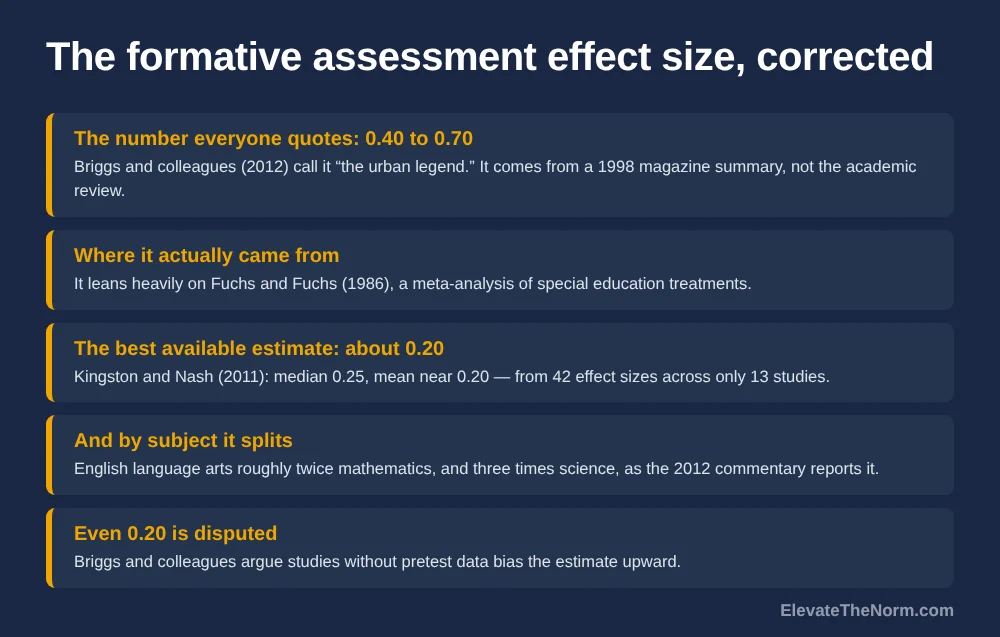
The provenance is worth knowing. Briggs, Ruiz-Primo, Furtak, Shepard and Yin (2012) trace the range to the popular Phi Delta Kappan summary of Black and Wiliam’s 1998 review rather than the review itself, note that the values “rely heavily on a 1986 article by Fuchs and Fuchs, which focused on special education treatments,” and point out that Black and Wiliam had said in the academic version that differences among studies were “so great as to make” a meta-analysis meaningless. The commentary adds that they “signaled their enthusiasm for large effects by picking .7 to illustrate.”
The replacement number is smaller. Kingston and Nash’s 2011 meta-analysis derived 42 effect sizes from 13 studies and reported a median of 0.25 and an overall mean of about “0.20 SD units.” Thirteen studies is not a deep literature. Their moderator result is also uncomfortable for a social studies or science teacher: as the commentary reports it, the average effect in English language arts was “about twice as large as the average for Mathematics and three times as large as the average for Science.”
And Briggs and colleagues are not endorsing 0.20 either. They argue the estimate is biased by studies lacking pretest data — on one dataset “the effect size is -0.14 with the pretest adjustment but -0.32” without it — and that combining effects “does nothing to guarantee that the estimates are not biased by threats to internal validity.” Where they agree with Kingston and Nash is the sentence that should govern this whole field: “the hype and marketing of formative assessment has greatly outstripped the empirical research base.”
Note what none of this says. No study shows that hinge questions specifically raise achievement; Wiliam’s article reports no outcome study, and Wylie and Wiliam’s paper reports design logic with no classroom data at all. The honest position is that this is a sensible technique resting on a research base that has been oversold, which is a different thing from a technique that does not work. The same caution applies to every number in the formative-assessment strategy lists floating around.
How do you write a hinge question for your own class?
Start from the mistakes you already see, not from the standard. Six steps:
- Find the hinge. Name the one idea in the lesson that everything afterwards depends on. If nothing in the next twenty minutes breaks when students misunderstand, you do not need a hinge question there.
- Write down the three wrong answers you hear every year. These become the distractors. This step is why the technique is hard for a first-year teacher and easy for a fifth-year one: it runs on accumulated knowledge of how students get it wrong.
- Build the question so each wrong answer is reachable by exactly one mistake. Graf’s one-to-one ideal. You will not always manage it; get as close as the content allows.
- Attack your own question. Can a student reach the key by a wrong route, the way the flight-time item lets them? If so, change a number or a word until they cannot.
- Decide how you will see every answer at once. Cards, fingers, whiteboards — pick one and teach it before you need it, so the thirty seconds is spent reading, not explaining the routine.
- Decide in advance what each outcome means. Write down what you will do if nearly everyone is right, if nearly everyone is wrong, and if the room splits. This is the step that separates a hinge question from a check you run and then ignore.
What do you do when the class is split?
Let the disagreement do the teaching. Wiliam’s advice for a roughly even split is that “the teacher may either arrange for students to discuss their responses with their neighbors or conduct a whole-class discussion,” and that the teacher can steer it by choosing who speaks — “the teacher might first ask a few of the students who thought A was the correct response for the reason for their choice.”
Wylie and Wiliam list the same moves at the extremes. If everyone is right, “the teacher can move on.” If nobody is, the teacher “might decide to re-teach the concept using another approach” — another approach, not the same explanation louder. And at any point, “the teacher can always ask students to explain their answer if further insight into their thinking is needed.”
Two cautions. Asking a teenager to defend an answer in front of the room only works if being wrong is survivable in that room, which is a classroom-culture question before it is an assessment question. And Graf’s report flags the student the data cannot help you with: “a student who responds inconsistently may require individual attention from the teacher.” A hinge question is a class-level instrument. Individual diagnosis is a separate job, and closer to progress monitoring than to anything you can do in thirty seconds.
Where I land on it
Hinge questions are one of the few techniques whose cost and benefit are both small and both real. Nobody has shown they raise test scores, the broader formative-assessment evidence has been inflated for twenty-five years, and the design work is genuinely hard. Weigh that against what it replaces — “any questions?” followed by silence, which is not a check of anything — and my reading is that it is clearly worth building a handful per unit.
The finding that should stay with you is the one buried in a 1987 citation: teachers who collected achievement information but could not act on it got worse outcomes than teachers who never collected it. That is a warning about every data practice schools run, and hinge questions are the smallest possible version of doing it right — information you gather at the exact moment you can still use it, about a decision that is yours to make.
Start with one. Pick the lesson you teach every year where the same misconception shows up on the test, and write the question that would have caught it in October. That single question is worth more than a binder of strategies, and your students get a period of their lives back.
Frequently Asked Questions
What is a hinge question in teaching?
A hinge question is a single question asked at the point in a lesson where everything afterwards depends on students having understood what came before. Dylan Wiliam describes it as a quick assessment of students’ understanding of a concept before moving on, after which the teacher either continues or goes back to review. Its distinguishing feature is that wrong answers identify specific misconceptions.
Who came up with hinge questions?
Dylan Wiliam named them. In his 2015 article he writes of “what I call hinge questions” and credits no earlier source for the term, while adding that “there’s nothing new in this idea, but it turns out that it’s rather difficult to do well.” The underlying design work on diagnostic items is older and includes Sadler’s distractor-driven assessment research.
How many hinge questions should a lesson have?
Usually one, and some lessons need none. The question belongs at a genuine pivot point, so if nothing in the rest of the lesson breaks when students misunderstand, there is no hinge to check. Wiliam reports that teacher groups typically take more than an hour to design one good question, which makes a small bank built across a semester more realistic than one per period.
Do hinge questions have to be multiple choice?
No, but the format has to let you read the whole class in about thirty seconds, which rules out most open responses. Multiple choice is the common solution because the options can be built from known misconceptions. Letting more than one option be correct without saying how many is a useful variant: Wylie and Wiliam report it drops guessing success from roughly 17 percent to under 2 percent.
Should hinge questions be graded?
No. Wiliam’s defense of drawing a conclusion from one item rests entirely on the decision being low-stakes, and a single question is not reliable enough to judge an individual student. Wylie and Wiliam state plainly that they are not suggesting teachers make individual inferences from one item. Attaching a grade breaks the logic and changes how students answer.
What if students can see each other’s answers?
It is a real problem and none of the research addresses it. Simultaneous display is what makes the thirty-second read possible, and it also lets an unsure student copy or feel exposed. Practical fixes are partial: whiteboards angled toward the front, a count where everyone reveals together, and saying out loud that the check is ungraded. Decide which you are using before the lesson.
Does formative assessment really have an effect size of 0.7?
No. Researchers writing in Educational Measurement: Issues and Practice in 2012 call the 0.40 to 0.70 range an urban legend, trace it to a popular magazine summary rather than the academic review, and note it leans on a 1986 special-education meta-analysis. The best available estimate, from Kingston and Nash in 2011, is a median of 0.25 and a mean near 0.20, from only 13 studies.
Sources
- Wiliam, D. (2015, September 1). Designing Great Hinge Questions. Educational Leadership, 73(1). ASCD. Article. Source of the definition, the two-minute and thirty-second design rules, the “right response for the right reason” principle, the false-positive asymmetry, the split-class guidance and the seventh-grade semicircle example. It reports no outcome study: nothing here shows that hinge questions raise achievement. The two-minute and thirty-second figures are offered as design rules with no research cited, and the claim that teacher groups take over an hour to write one good question carries no citation either. The page is marked a premium resource, so access may vary.
- Wylie, C., & Wiliam, D. (2006, April). Diagnostic Questions: Is There Value in Just One? Paper presented at the annual meeting of the American Educational Research Association and the National Council on Measurement in Education, San Francisco. Educational Testing Service. PDF. Source of the reliability-for-utility trade, the three conditions attached to it, the flight-time and living-things items, the guessing figures and the Helmke and Schrader (1987) finding. This is an unpublished conference paper that reports no classroom data — no sample size, no grade levels, no response distributions — so it supports claims about design reasoning and not about effectiveness. Its first page states that limited distribution does not constitute publication.
- Briggs, D. C., Ruiz-Primo, M. A., Furtak, E., Shepard, L., & Yin, Y. (2012). Meta-Analytic Methodology and Conclusions about the Efficacy of Formative Assessment. Educational Measurement: Issues and Practice. Pre-print. Source of the “urban legend” characterisation of the 0.40–0.70 range, its provenance in the 1998 Phi Delta Kappan summary and the Fuchs and Fuchs (1986) special-education meta-analysis, the Kingston and Nash figures, the subject-area moderator result and the pretest-bias illustration. The Kingston and Nash (2011) numbers here are reported as this commentary reports them; that meta-analysis was not opened directly. The version read is a pre-print, so the published text may differ, and the authors dispute the 0.20 estimate as well as the 0.40–0.70 one.
- Graf, E. A. (2008, February). Approaches to the Design of Diagnostic Item Models. ETS Research Report RR-08-07. Educational Testing Service. PDF. Source of the “semi-dense” one-to-one ideal and its difficulty, the seventh-grade circle-area and eighth-grade coordinate items, the backsolving and guessing cautions, and the note on inconsistent responders. It is a conceptual review aimed at large-scale and research assessment, not at teachers writing classroom checks, and it reports no percentage of students selecting any distractor and no item statistics.
- What is not cited, and why. Kingston and Nash (2011) and Black and Wiliam (1998) were not opened from this session; both are reported only as the 2012 commentary above describes them, and no figure attributed to either is presented as read directly. Sadler (1998) on distractor-driven assessment and Osborne (2011) are named because Wiliam’s article names them, not because they were read. Helmke and Schrader (1987) is likewise reported as Wylie and Wiliam cite it. No number in this article comes from a source that was not opened.