By Clay Shumate
Experiential learning activities put students inside the subject instead of in front of it. The 30 ideas below follow Kolb’s experiential learning cycle — act, observe, reflect, conceptualize, apply — and are built for grades 6–12 classrooms with limited budgets, real schedules, and students who will check out the moment an activity feels pointless. Every one of them can run in a public school without special funding, a field trip bus, or a rewritten master schedule. If you teach the older end of that range, the high-school version of this deals with scheduling and credit directly.
Key Takeaways
- An experience is not the same thing as experiential learning. The difference is the reflection and conceptualization that follow.
- Kolb’s cycle has four stages: concrete experience, reflective observation, abstract conceptualization, and active experimentation. Activities that skip stages produce fun, not learning.
- A meta-analysis of 62 studies found that service-learning — one category of experiential activity — improved academic achievement by an effect size of 0.43, the strongest of any outcome measured.
- Most activities below require no budget, no technology, and no administrative approval beyond what a classroom teacher already has.
- Partner and group work is the default format for experiential learning — not an add-on. Students learn from each other during the experience, not just during the debrief.
The Difference Between an Experience and Experiential Learning
A student who watches a documentary has had an experience. A student who watches a documentary, writes down what surprised them, connects those surprises to a concept from class, and then uses that concept to analyze a second documentary has done experiential learning. The difference is not the activity — it is what happens after the activity.
David Kolb formalized this in 1984 with a four-stage cycle that still holds up: concrete experience (do something), reflective observation (think about what happened), abstract conceptualization (connect the experience to a principle or theory), and active experimentation (apply the principle to a new situation). John Dewey made the same point forty-six years earlier in Experience and Education (1938): “The belief that all genuine education comes about through experience does not mean that all experiences are genuinely or equally educative.” Dewey called experiences that do not lead to learning “miseducative” — and he was talking about exactly the kind of activity that keeps students busy without making them think.
Every activity in this article is designed to complete the full cycle. If you strip out the reflection or the conceptualization step to save time, you have a field trip, not a lesson.
How Kolb’s Cycle Works in a Real Classroom
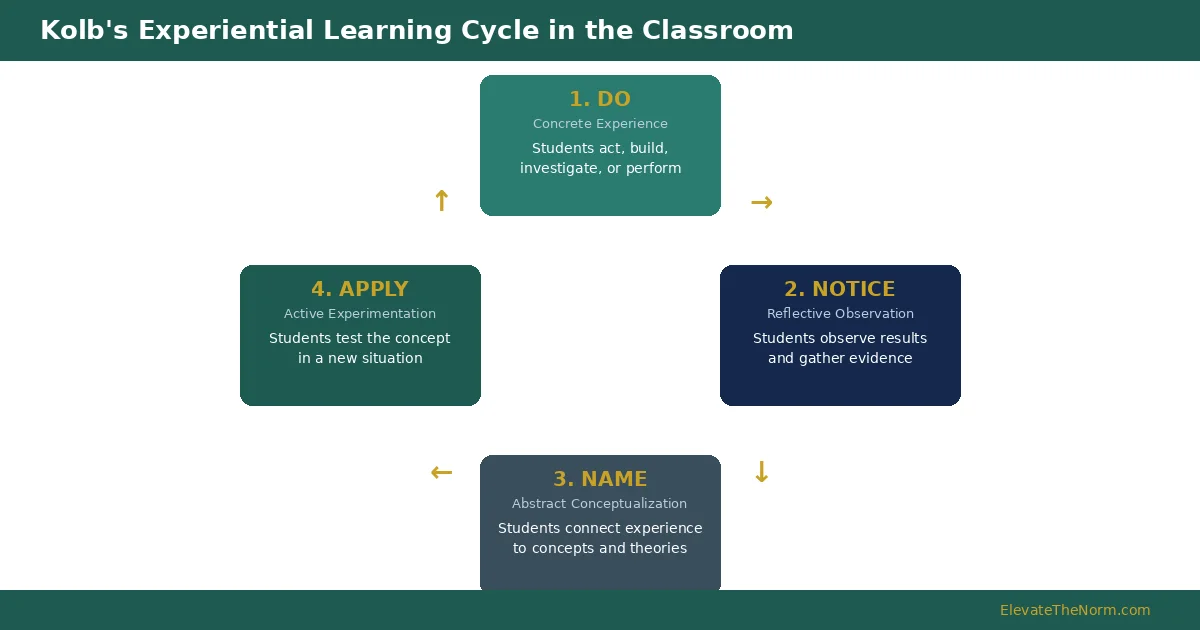
Here is the cycle in plain terms, because the academic language makes it sound more complicated than it is:
- Do. Students participate in an activity, investigation, simulation, or task. They are inside the experience, not watching it.
- Notice. Students observe what happened — what worked, what surprised them, what went wrong. This is not a grade. It is data collection about their own experience.
- Name. Students connect their observations to a concept, theory, or principle. This is the bridge between “that was interesting” and “here is what it means.”
- Try again. Students apply what they named to a new situation. This is the test of whether they actually learned something transferable or just had a one-time experience.
In my room, the tables are pushed together in groups, and students are almost always working alongside somebody. That is not a choice I made to be trendy — it is the structure experiential learning requires. When students do something and then need to reflect on what happened, the reflection is richer when they can talk through it with a partner who was in the same experience and noticed different things. Partner work is the default condition of the room, not a reward for finishing early, and that matters for every activity below. The experience happens collaboratively; the reflection deepens because of it.
30 Experiential Learning Activities for Grades 6–12
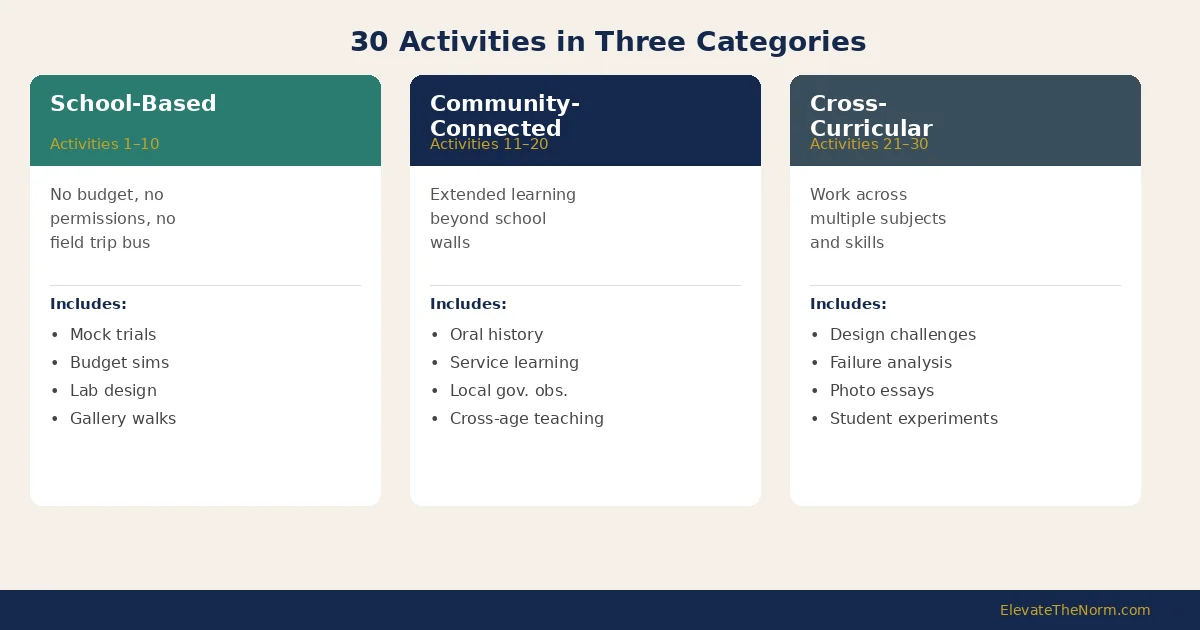
These are organized by type: school-based activities that need nothing beyond your classroom, community-connected activities that extend learning outside the building, and cross-curricular activities that work in multiple subjects. Budget notes are included where relevant.
School-Based Activities (No Special Permissions Needed)
1. Mini Mock Trial. Students take roles — prosecution, defense, witnesses, judge, jury — in a simplified trial based on a historical event, a literary conflict, or a current ethical question. The experience is arguing a position under rules. The reflection is: “What evidence was most persuasive, and why did the jury weigh it that way?” Runs in one to two class periods.
2. Budget Simulation. Give each group a fixed income and a list of expenses for a household — rent, food, transportation, insurance, taxes. They allocate, make trade-offs, encounter unexpected expenses (car repair, medical bill), and rebuild their plan. The conceptualization: what does this reveal about economic decision-making, poverty, or policy? Cost: zero. A printed handout is all you need.
3. Primary Source Investigation. Place three to five primary sources on a table — documents, photographs, maps, or objects. Students examine them physically (or high-quality printouts), generate questions, and build a hypothesis about what they reveal. The reflection compares their hypothesis to the textbook account. A history teacher’s bread and butter, and it works in science (lab observation logs) and English (author manuscripts, historical editions) just as well.
4. Peer Teaching Rounds. Each student or pair prepares a five-minute lesson on one section of a unit. They teach it to a rotating group of classmates, receive written feedback, revise, and teach it again. The experience is teaching — which forces deeper understanding than listening ever does. The reflection: “What question from your students made you realize you did not understand this as well as you thought?”
5. Data Collection and Analysis. Students collect real data — classroom survey results, school lunch waste measured by weight, hallway traffic patterns, library usage statistics — then analyze it using methods from the curriculum. The experience is measurement. The conceptualization is: “What does this data actually tell us, and what does it not tell us?” This is project based learning in miniature.
6. Fishbowl Debate. A small group discusses a debatable question in the center of the room while the rest of the class observes, takes notes, and tags in to replace a speaker. The experience is both performing and observing. Reflection prompt: “What did you notice about how the conversation changed when a new voice entered?”
7. Lab Design Challenge. Instead of following a pre-written lab procedure, students receive a question and design their own procedure, predict outcomes, run the experiment, and compare results to predictions. The teacher provides safety parameters and materials — students provide the method. Works in any science class and teaches the difference between following instructions and doing science.
8. Role-Play Negotiation. Assign students roles in a historical or contemporary negotiation — treaty talks, labor disputes, environmental policy. They research their position, negotiate with opposing parties, and attempt to reach an agreement. Reflection: “What did you have to give up, and why? What would have changed if you had different information?” One class period, no budget.
9. Gallery Walk With Feedback. Students display their work — drafts, diagrams, solutions, prototypes — and classmates circulate, leaving specific written feedback using structured prompts. The experience is both creating and evaluating. The reflection: “What feedback surprised you? What will you change, and what will you keep?” Gallery walks teach respect in the classroom through practice, not a poster. What makes the written feedback specific enough to act on is the part worth deciding before students reach the first station.
10. Simulation of Scarcity. Give groups limited resources (paper, tape, time) to complete a task that requires more than they have. Watch how they allocate, trade, cooperate, or compete. Debrief with the question: “What does this show about how people behave when resources are scarce?” This is economics, psychology, and history in one forty-minute block.
Community-Connected Activities
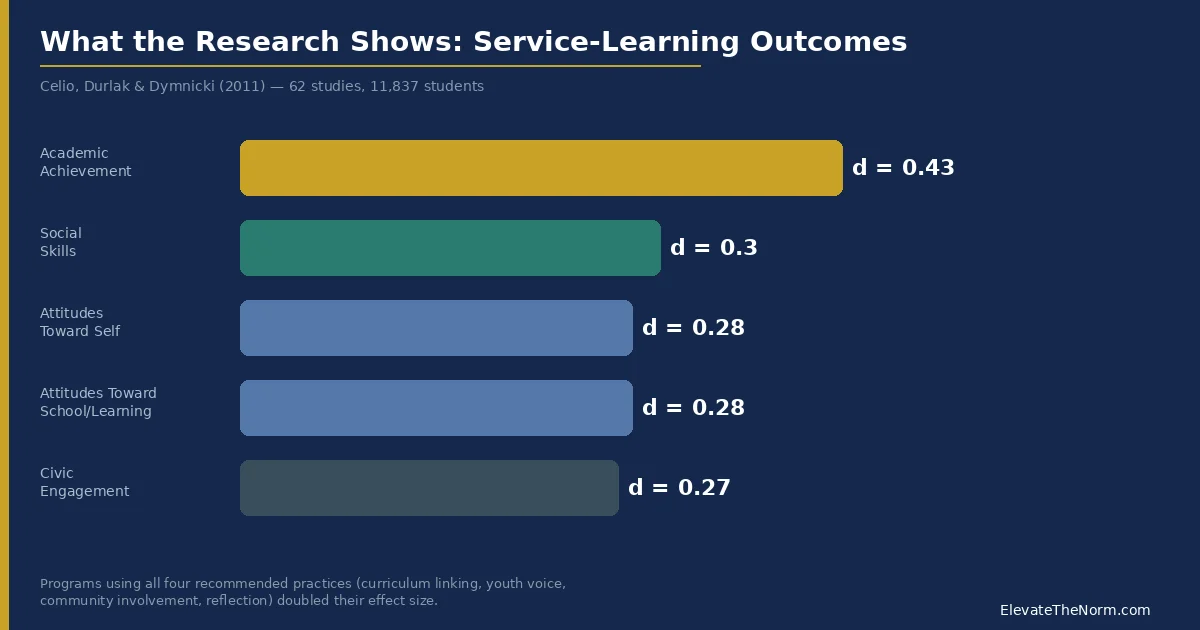
11. Community Problem Investigation. Students identify a real problem in their school or neighborhood — a safety concern, an access issue, an environmental hazard — research it, interview stakeholders, and propose a solution they present to an actual decision-maker (principal, city council member, local business owner). The service-learning research is strong here: Celio, Durlak, and Dymnicki (2011) reviewed 62 studies involving 11,837 students and found an effect size of 0.43 for academic achievement — the largest of any outcome category they measured. Programs that incorporated structured reflection doubled their effect.
12. Oral History Project. Students interview a community member — a grandparent, a veteran, a local business owner, a longtime resident — about a topic connected to the curriculum. They record, transcribe, and analyze the interview against historical or sociological sources. The experience is the conversation. The conceptualization: “How does one person’s story confirm or complicate what the textbook says?”
13. Environmental Audit. Students measure something real — water quality in a nearby stream, energy usage in the school building, waste generated by the cafeteria over a week — and compare their findings to published standards or benchmarks. The product is a written report with recommendations presented to administration or a community group. Works in science, math, and social studies.
14. Job Shadow Reflection. If your school allows it, students spend a half-day observing a professional in a field connected to the curriculum. The activity is not the shadow itself — that is just the experience. The learning happens in the structured reflection afterward: “What skills did you see this person use? Which ones are you already building in this class? Which ones surprised you?” Not every school can do this, but the schools that can should.
15. Community Mapping. Students map resources, hazards, demographics, or services in their neighborhood using walking surveys, public data, or online tools. The product is a visual map with analysis. The conceptualization: “What patterns do you see, and what might cause them?” This teaches geography, data literacy, and civic awareness simultaneously.
16. Public Service Announcement Production. Students research a public health or safety issue, create a thirty-to-sixty-second video or audio PSA, and share it with a real audience (school announcements, a local nonprofit, social media with school approval). The experience is production. The reflection: “What choices did you make about what to include and what to leave out? How did your audience change your message?”
17. Small Business Plan. Students develop a simple business plan for a product or service that addresses a real need in their community. They research costs, identify customers, create a marketing pitch, and present to a panel that includes at least one real business owner or community member. No actual money changes hands — the value is in the planning and the presentation to a real audience.
18. Local Government Observation. Students attend (in person or via livestream) a city council meeting, school board meeting, or county commission session. They take notes on how decisions are made, who speaks, what evidence is presented, and how the process compares to what they learned in class. Reflection: “What surprised you about how this process actually works?” This is civics as experience, not vocabulary.
19. Service-Learning Project. Students identify a community need, plan a service response, carry it out, and reflect on what they learned about the issue and about themselves. This is different from community service because the learning is explicit — tied to curriculum standards, assessed, and reflected on. Celio et al. found that programs using four recommended practices (curriculum linking, youth voice, community involvement, reflection) yielded effect sizes of 0.35, compared to 0.17 for programs using none.
20. Cross-Age Teaching. High school students design and deliver a lesson to elementary or middle school students on a topic from the curriculum. The experience forces them to simplify, explain, and anticipate misconceptions — skills that require deep understanding. The reflection: “What question from a younger student exposed a gap in your own understanding?”
Cross-Curricular Activities
21. Design Challenge. Give groups a problem (build a bridge from paper that holds a textbook, design a water filtration system from household items, create a container that keeps an egg intact from a second-floor drop) and limited materials. The experience is building and testing. The reflection: “What did your first failure teach you that led to your second design?” Engineering, physics, and teaching responsibility through consequential tasks.
22. Socratic Seminar on a Controversial Question. Students prepare evidence on a debatable topic — historical, scientific, ethical, or literary — and discuss it in a structured circle. The experience is sustained, evidence-based conversation. The conceptualization: “Where did you change your mind, and what evidence made you do it?” Works in every subject that asks debatable questions, which is all of them.
23. Process Journal. Students keep a running journal during a multi-day activity or project, documenting decisions, setbacks, changes in thinking, and reflections. The journal itself becomes the conceptualization artifact — a record of learning over time, not just the final product. Pair with project based learning ideas to give students ownership of the process, not just the outcome.
24. Simulation of a Historical Event. Assign students roles within a historical event — the Constitutional Convention, a UN Security Council debate, the Montgomery Bus Boycott planning meetings — and run a compressed simulation. Students must research their historical figure’s actual positions and argue from evidence. The reflection connects the simulation to the outcomes: “What decisions could have gone differently, and how would history have changed?”
25. Measurement Lab. Students measure something real using disciplinary tools — pH, temperature, distance, weight, density, sound levels, population counts — and use the data to answer a question. The experience is measurement and observation. The conceptualization: “What did the data show that you did not expect? What would you measure next?” This is how science and math become tangible.
26. Ethical Dilemma Discussion. Present students with a genuine ethical dilemma — medical triage, resource allocation during a disaster, whistleblowing, journalistic responsibility — and have them work through it in small groups using a structured framework (stakeholder analysis, consequence mapping, principled reasoning). The experience is the moral reasoning. The reflection: “Where did your group disagree, and what value was each person prioritizing?”
27. Recipe Scaling and Cooking. Students scale a recipe up or down for a different number of servings, calculate costs per serving, and (if facilities allow) prepare the food. Math, nutrition, chemistry, and real world learning in one activity. The reflection: “What math did you actually use, and how was it different from doing a worksheet problem?” Even without a kitchen, the scaling and cost analysis are worthwhile on their own.
28. Photo Essay. Students use phone cameras to document a theme — “systems in our school,” “geometry in our neighborhood,” “evidence of change over time” — and curate their photos into a narrative with captions that connect observations to course concepts. The experience is seeing. The conceptualization is framing what they see in disciplinary language.
29. Failure Analysis. Give students a case study of a real engineering failure, a business collapse, a policy disaster, or a historical miscalculation. They analyze what went wrong, identify the decision points where a different choice could have changed the outcome, and present their findings. The experience is forensic thinking. The reflection: “What is the difference between a mistake and a systemic failure?” This pairs directly with the site’s core belief that learning from mistakes is how people grow — but only if they understand what actually went wrong.
30. Student-Designed Experiment. Students choose a question, design an experiment or investigation, carry it out, analyze results, and present findings to the class. The teacher provides the framework (hypothesis, method, data collection, analysis, conclusion) and the safety boundaries. Students provide everything else. This is the capstone version of experiential learning — students own every stage of the cycle, and the teacher’s job is to keep the guardrails in place while the students do the driving.
What the Research Says About Experiential Learning Outcomes
The evidence base for experiential learning is substantial, but it is important to be honest about what it shows and what it does not.
Morris (2020) conducted a systematic review of Kolb’s model and found that while the four-stage cycle remains the most widely used framework for experiential learning, its effectiveness depends entirely on implementation — particularly the reflection and conceptualization stages. Activities that skip those stages consistently produce weaker outcomes. The cycle is not optional, and Kolb himself argued this: “Learning is the process whereby knowledge is created through the transformation of experience.”
The Celio, Durlak, and Dymnicki (2011) meta-analysis remains the strongest quantitative evidence for service-learning specifically. Across 62 studies and 11,837 students, service-learning produced significant gains in academic achievement (d = 0.43), social skills (d = 0.30), attitudes toward self (d = 0.28), attitudes toward school (d = 0.28), and civic engagement (d = 0.27). The academic achievement effect was notably the largest — a finding the authors called “probably the most important for educators.” This is not a soft skill gain masquerading as rigor. Students who did service-learning learned more content, measured by the same assessments their peers took.
Research on simulation-based learning in secondary education, reviewed across 145 studies, found that simulations produce strong overall effects on achievement across disciplines. Students who learned through simulations showed better problem-solving abilities compared to traditional methods, improved collaboration skills, and rated simulations as the most effective learning method compared to lectures and case studies. However, the research is clear that effectiveness depends on instructional design, not just the tool — a poorly designed simulation is no better than a poorly designed lecture.
The honest summary: experiential learning works when it includes all four stages of the cycle, when reflection is structured rather than optional, and when the teacher stays involved throughout. It does not work when “experiential” is used as a synonym for “fun” or when the reflection step is cut because the bell is about to ring.
Making It Work: Practical Considerations
Most of these activities require no budget. A few need minimal supplies (printed handouts, poster paper, tape). The community-connected activities may require coordination with administrators, parents, or community partners, but none of them require spending money the school does not have.
Time is the real constraint. A full experiential learning cycle — do, reflect, conceptualize, apply — takes longer than a lecture-and-worksheet class. That is a fact, not an objection. The research consistently shows that the time invested produces stronger learning outcomes, which means the apparent time cost is actually a time savings: students who understand a concept through experience need less reteaching than students who memorized it from a slide.
For teachers working within tight pacing guides, start with activities that fit inside a single period (1–10 on the list above) and expand as you learn what your students can handle. The community-connected activities (11–20) require more planning but produce deeper engagement. The cross-curricular activities (21–30) are where experiential learning becomes genuinely student centered — students are not just experiencing content, they are experiencing the process of learning itself.
One final note: student responsibility in the classroom is not something you can lecture into existence. It is built through activities where students have real decisions to make and real consequences to learn from — consequences bounded by planning and presence, not by manufactured stakes designed to punish mistakes. These thirty activities are how that happens.
Frequently Asked Questions
What is the difference between experiential learning and hands-on learning?
Hands-on learning means students are physically doing something — building, measuring, manipulating materials. Experiential learning includes hands-on work but adds structured reflection, conceptualization, and application. A student who builds a bridge out of paper has done hands-on learning. A student who builds it, analyzes why it failed, connects that analysis to engineering principles, and redesigns it has done experiential learning. The reflection and conceptualization stages are what separate the two.
How do I fit experiential activities into a packed curriculum?
Start with single-period activities from the school-based list. Many of them replace a lecture and worksheet with a more effective learning experience that covers the same content. The time investment pays off in reduced reteaching — students who learn through experience retain more than students who memorize from slides. If your pacing guide is truly immovable, use experiential activities for the concepts students struggle with most. That is where the return on time is highest.
Do experiential learning activities work for students who struggle academically?
The research says yes. The Celio et al. meta-analysis found that service-learning programs using structured reflection and curriculum linking — two features that directly support struggling learners — produced the strongest results. Experiential activities provide multiple entry points (visual, kinesthetic, verbal, social) that traditional instruction often does not. That said, struggling students need more scaffolding, not less — provide clearer task cards, shorter rotations, and more frequent check-ins during the experience phase.
What if my school does not allow field trips or community partnerships?
Activities 1 through 10 require nothing beyond your classroom. Simulations, mock trials, data collection, design challenges, and gallery walks all create experiential learning inside the building. Community connections enrich the work but are not required for it. Many of the community-connected activities (oral history, local government observation via livestream, community mapping using public data) can be adapted to work within school walls if your district restricts off-campus activities.
How do I grade experiential learning activities?
Grade the products the cycle produces, not the experience itself. Reflection journals, analysis papers, design reports, presentation rubrics, and peer feedback forms all generate gradeable artifacts. Do not grade participation in the experience — that turns a learning activity into a compliance check. Grade what students demonstrate they learned from the experience, which is visible in the reflection and application stages.
Are experiential learning activities appropriate for every subject?
Yes, though the format varies. Science uses labs and investigations. History uses primary sources and simulations. Math uses data collection and measurement. English uses discussion protocols and creative production. The common thread is the cycle: do something, reflect on it, connect it to a concept, and apply it to a new situation. Any subject that asks students to think — which is all of them — can use experiential learning.
How do I manage behavior during experiential activities?
Structure prevents most behavior problems. When students know what they are doing, how long they have, and what they will produce, off-task behavior drops. Circulate constantly — your physical presence in the room is your primary management tool. Set expectations before the activity starts, not during it. Use a two-minute check at the beginning to catch confusion early. If a specific group is off task, redirect quietly and individually rather than stopping the whole class. The teacher’s job during experiential learning is to move, listen, and intervene surgically.
Sources
- Kolb, D. A. (1984). Experiential Learning: Experience as the Source of Learning and Development. Prentice-Hall.
- Dewey, J. (1938). Experience and Education. Kappa Delta Pi/Macmillan.
- Celio, C. I., Durlak, J., & Dymnicki, A. (2011). “A Meta-Analysis of the Impact of Service-Learning on Students.” Journal of Experiential Education, 34(2), 164–181. https://doi.org/10.1177/105382591103400205
- Morris, T. H. (2020). “Experiential Learning — A Systematic Review and Revision of Kolb’s Model.” Interactive Learning Environments, 28(8), 1064–1077. https://doi.org/10.1080/10494820.2019.1570279
- SmartSims. (2024). “Simulation-Based Learning in Secondary Education: What the Research Shows.” https://www.smartsims.com/news/simulation-based-learning-secondary-education-research/
- Baeten, M., Dochy, F., Struyven, K., Parmentier, E., & Vanderbruggen, A. (2023). “Student-Centered Education: A Meta-Analysis of Its Effects on Non-Academic Achievements.” SAGE Open, 13(2). https://doi.org/10.1177/21582440231168792
About Clay Shumate
Clay Shumate is a certified secondary Social Studies teacher in the public schools of West Alabama, with seven years of classroom experience, a B.A. in History, and an M.Ed. in Secondary Education. He writes about project-based learning, student responsibility, respect, and practical ways to hold young people to a higher standard while giving them room to learn from mistakes. He is a member of the Society of Professional Journalists and writes to its Code of Ethics; this site’s editorial standards and corrections policy are published in full. More about Clay.