By Clay Shumate
Restorative practices in schools are structured ways of responding to harm that require a student to face what happened, hear who it affected, and do something about it. They are not the opposite of accountability. Done well they are harder on a student than a suspension, because a suspension asks nothing of anyone. Done badly they ask nothing either.
Key Takeaways
- Restorative practices are a response system, not a mood. They run on a continuum from a two-sentence affective statement to a formal conference, and most of the work is the informal end.
- The suspension evidence is genuinely strong. Almost every study finds exclusionary discipline goes down, and the one large randomized trial found the racial discipline gap narrowed too.
- The academic evidence is not. That same trial found achievement did not improve, and got worse in grades 6–8 — the exact band most of this site’s readers teach.
- Partial implementation is close to useless. Researchers reviewing failed rollouts concluded that doing some of it looked about the same as doing none of it.
- Restoration does not replace safety procedures. Weapons, assault, threats, abuse disclosures, and anything your code of conduct defines as mandatory still go through the office, every time.
- A single teacher can still use most of this. The repair conversation works in one classroom without a district initiative, a consultant, or a budget line.
What restorative practices in schools actually are
The International Institute for Restorative Practices defines restorative practices as “a social science that studies how to build social capital and achieve social discipline through participatory learning and decision-making” (Wachtel, 2016). Strip the academic phrasing and it means this: you deal with problems with students rather than to them or for them.
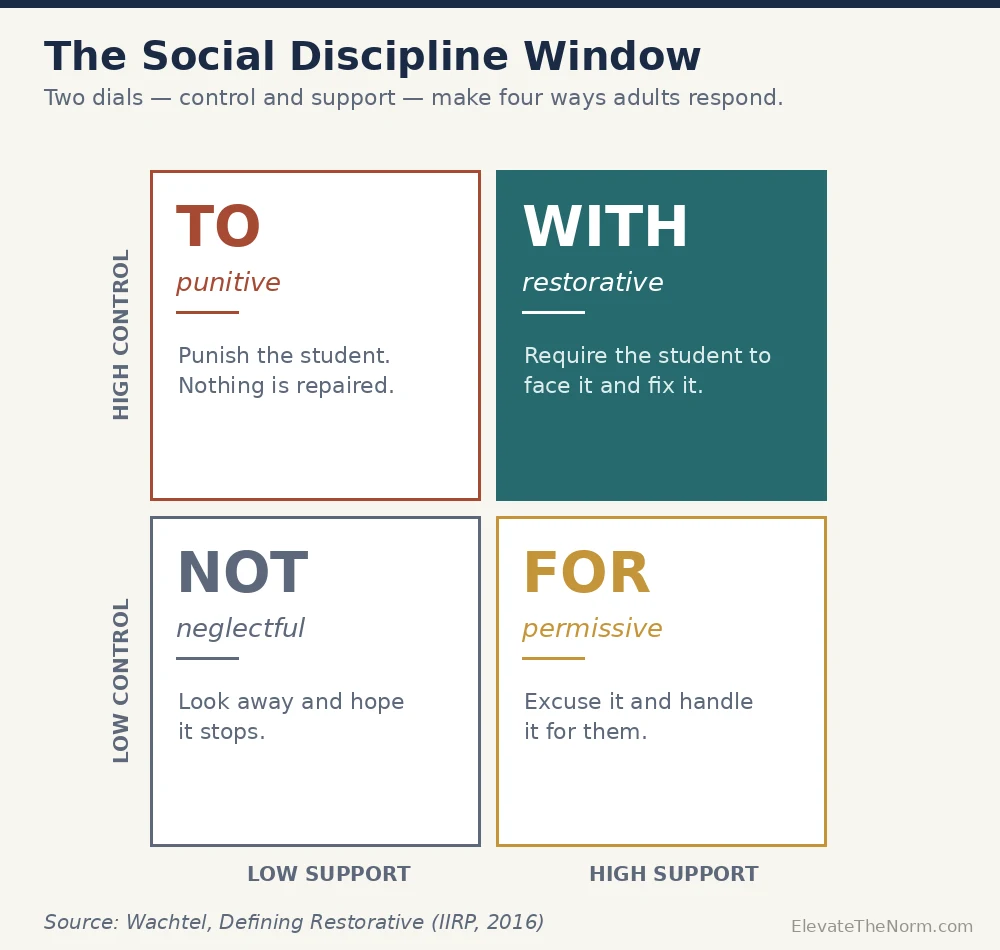
Wachtel’s “social discipline window” is the clearest picture of that idea. Cross high and low control with high and low support and you get four quadrants. TO is high control and low support — punitive. FOR is low control and high support — permissive, doing everything for the student. NOT is low control and low support, which is neglect. WITH is high control and high support, and that is the restorative quadrant.
That last point is where most staff-room arguments about restorative practice go wrong. People hear “restorative” and picture the FOR box: a teacher who lets things slide, a school where nothing happens after a fight. The framework says the opposite. High control stays. What changes is that the student is required to participate in fixing it instead of just absorbing a penalty.
The continuum, from two sentences to a formal conference
Restorative practice is not one event. Wachtel describes a continuum that runs from informal to formal: affective statements, affective questions, small impromptu conferences, groups and circles, and formal conferences. The formal end — the circle with a facilitator and a signed agreement — is the part that gets photographed for district newsletters. It is also the rarest and the most expensive.
The informal end is where a classroom teacher lives. An affective statement is one sentence naming the effect of a behavior: “When you talk over her, she stops offering answers, and I lose the best thinker in the room.” An affective question asks the student to do that work instead: “Who else is affected when this table doesn’t finish?” Neither takes more than fifteen seconds, and neither requires anyone’s permission. For the two-part shape, the worked rewrites and an honest account of how thin the evidence for them actually is, see a closer look at the smallest restorative move.
What the research on restorative practices actually shows
Short version: strong and consistent evidence that suspensions fall, promising evidence on racial discipline gaps, weak evidence on climate, and one real warning sign on middle-school achievement. Anyone who tells you the research is settled in either direction has not read it.
Suspensions go down, and the discipline gap narrows
WestEd’s research review found reductions in exclusionary discipline in nearly every study it examined (Fronius, Darling-Hammond, Persson, Guckenburg, Hurley & Petrosino, 2019). The strongest single piece of evidence is a randomized controlled trial that RAND ran across 44 Pittsburgh schools over the 2015–16 and 2016–17 school years (Augustine et al., 2018). Average suspension rates dropped. The gap between Black and white students narrowed, and so did the gap between lower- and higher-income students. Teachers rated school climate better.
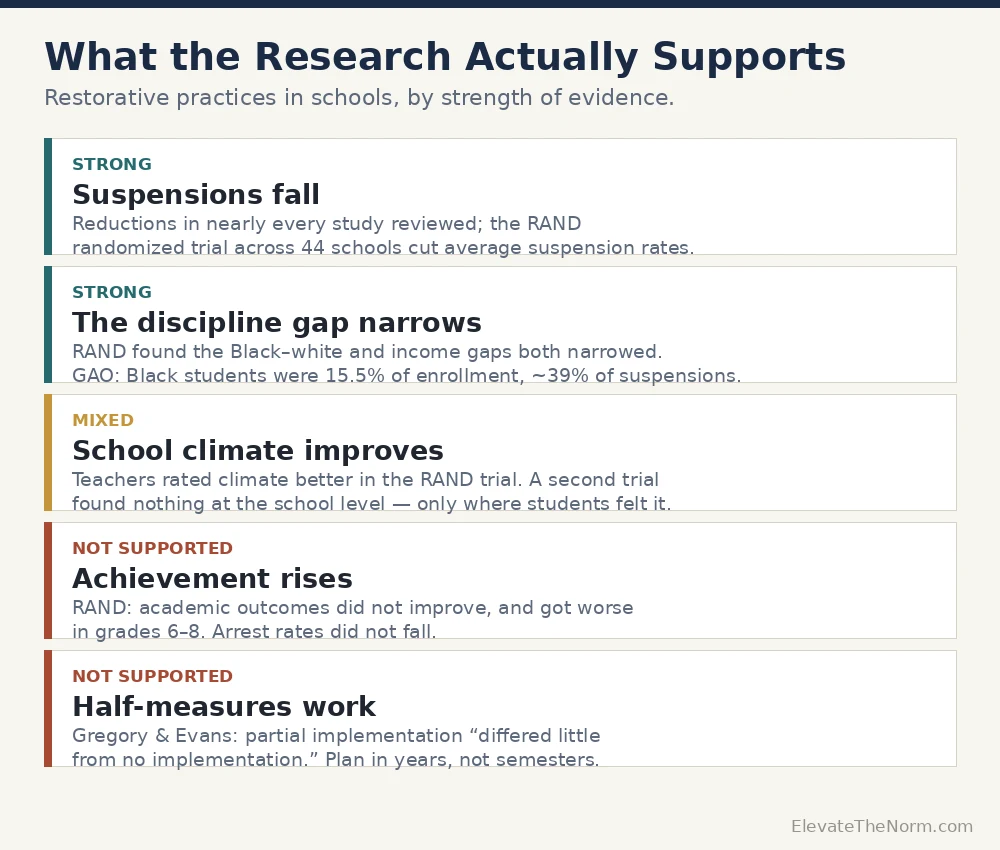
That matters because the disparities are real and documented. The Government Accountability Office found that Black students made up 15.5 percent of public school enrollment but about 39 percent of students suspended from school in 2013–14 (GAO-18-258, 2018). Boys and students with disabilities were also disciplined out of proportion to their share of enrollment. Any approach that shrinks that gap without lowering the standard deserves a serious look.
The grades 6–8 result nobody quotes
The same RAND trial found that academic outcomes did not improve — and that they got worse in grades 6–8. Arrest rates did not fall either. RAND did not explain the middle-grades result, and neither will I; a single trial in one district is not a verdict. But if you teach middle school, that is the finding most directly about your students, and you will not usually hear it from a vendor.
A second randomized trial, run across 13 middle schools with about 2,771 students over two years, found no significant effects at the school level at all (Acosta, Chinman, Ebener, Malone, Phillips & Wilks, 2019). What it did find is more interesting: students who reported actually experiencing restorative practices showed better school connectedness, peer attachment, and social skills, and less cyberbullying victimization. Assignment to the program did nothing. Exposure to the practice did something. That is a fidelity finding wearing a null result’s clothes.
Half-implemented is barely different from not implemented
Reviewing what goes wrong in restorative rollouts, Anne Gregory and Katherine Evans concluded that partial implementation “differed little from no implementation” (Gregory & Evans, 2020). They name the common failure patterns: top-down mandates that contradict restorative values, a narrow focus on student behavior while adult behavior stays the same, inadequate training — the “train and hope” approach — and short, under-resourced initiatives. They argue meaningful change should be measured over three to five years, not one.
Read that next to the two trials and a pattern shows up. The program that was implemented deeply moved suspensions. The program that was assigned but not really lived produced nothing. This is not a practice that rewards a one-day August in-service.
What restorative practices cannot replace
A repair conversation is not a substitute for a mandatory procedure, and treating it as one puts students at risk and puts you in real trouble. Your school’s code of conduct and your state’s law decide these, not you and not a circle.
- Weapons, credible threats, and anything your district defines as a mandatory referral or reportable offense.
- Assault, sexual harassment, and hazing — these have investigation and notification requirements attached to them.
- Any disclosure of abuse or neglect. You are a mandated reporter and that obligation does not pause for a restorative process.
- Situations where a student who was harmed does not want to sit down with the student who harmed them. Requiring that is not restoration; it is a second harm.
- Documentation. If the incident requires a written referral, write it. A repair conversation can happen alongside the paperwork, not instead of it.
This is also where restorative practice and ordinary classroom consequences that teach rather than humiliate meet. Restoration answers “what do we do about the harm.” It does not answer “what does the handbook require.” Both questions have to get answered.


What one teacher can do without a schoolwide program
Most of the informal continuum needs nothing but your own consistency. You cannot run a whole-school initiative from one room, but you can run the conversation, and the conversation is the part the research suggests students actually have to experience for anything to change.
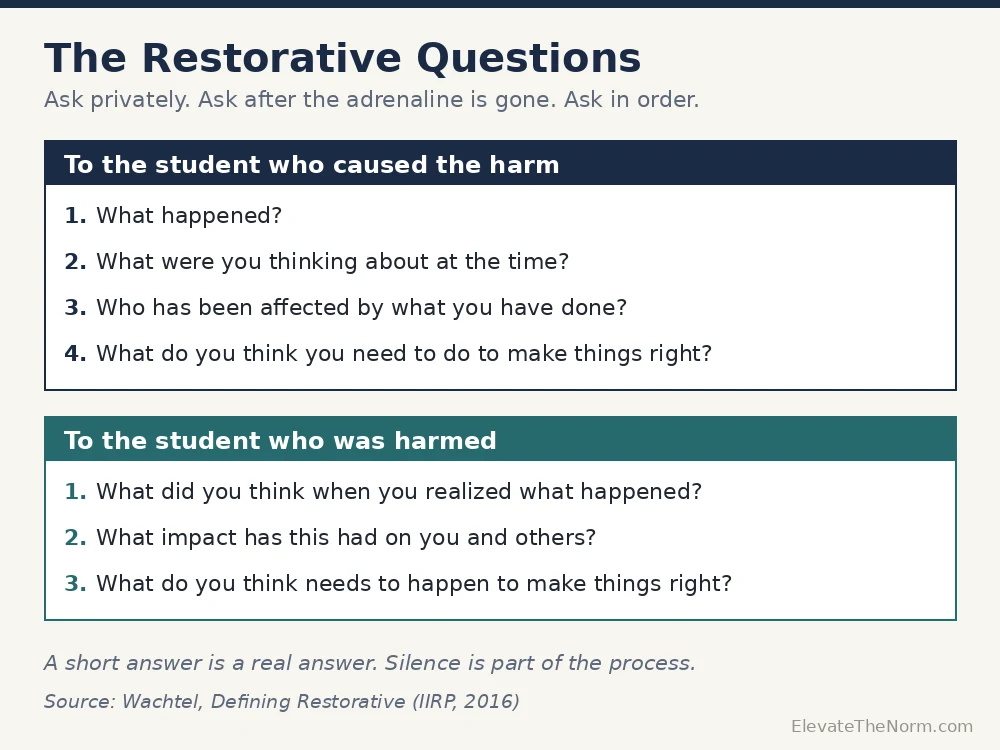
Wachtel’s restorative questions are the script, and they are short enough to memorize. For the student who caused harm: What happened? What were you thinking about at the time? Who has been affected by what you have done? What do you think you need to do to make things right? For the student who was harmed: What did you think when you realized what happened? What impact has this had on you and others? What do you think needs to happen to make things right?
Four things make that script work with teenagers rather than sound like a booklet. Ask it privately, not in front of the room. Ask it after the adrenaline is gone, usually the next period or the next day. Ask the questions in order and let the silence sit. And accept a short answer — a fourteen-year-old saying “I wasn’t thinking, I was just mad” is a real answer, not a dodge. This is the same principle behind holding students accountable while still giving them another chance: the goal is a student who can name the harm, not a student who performs remorse well.
A response ladder that keeps restoration in proportion
The most common mistake is using a heavy tool on a light problem. A circle for a missed deadline wastes a period and teaches students that the process is theater. Match the response to the size of the harm.
| Situation | Restorative response | Time cost |
|---|---|---|
| Side conversation, phone out, off task | Affective statement — name the effect, move on | 15 seconds |
| Group member coasting on a project | Affective question to the group, not the individual | 1 minute |
| Rudeness to you or to another student | Small impromptu conference, privately, next day | 4–5 minutes |
| Conflict between two students that is still live | Separate conversations first; joint only if both agree | 10–15 minutes |
| Harm affecting the whole class | Circle, with a plan and a follow-up date | Half a period |
| Anything in the mandatory-referral list above | Office referral first; repair later, if at all | Follow policy |
Notice that the top three rows cover most of a school year. That is deliberate. Restorative practice at the classroom level is mostly small, fast, and unremarkable, which is exactly why it is sustainable — the same reason consequences that connect naturally to the behavior outlast elaborate point systems. When a repair conversation ends with a concrete student commitment, a student accountability sheet gives that agreement a trackable written form for the follow-up conversation.
How to tell whether it is actually working
Suspension counts are the easiest number to move and the easiest to fake. A school can cut suspensions by simply declining to write referrals, which improves the spreadsheet and makes teachers feel abandoned. Watch these instead:
- Repeat incidents involving the same student. If repair is working, the second conversation should be about something different than the first.
- Whether the harmed student came back. Restoration that only serves the student who caused the harm is not restoration.
- Teacher referral rates. If referrals collapse while classroom complaints rise, staff have stopped reporting, not stopped having problems.
- Who is still being removed. Run the disparity numbers by race, disability status, and grade level. That is the whole point of the intervention.
- Whether adults changed anything. Gregory and Evans are blunt that initiatives focused only on student behavior fail. If nothing about adult practice looks different, nothing has been implemented.
None of that requires a data dashboard. A page in a notebook and a willingness to look honestly will do, which is the same standard I would apply to any discipline approach that promises firm standards without shame.
Where this leaves you
Restorative practices in schools are worth using, and they are worth using honestly. The evidence that they reduce suspensions and narrow discipline gaps is about as good as school-level evidence gets. The evidence that they raise achievement is not there, and in the one rigorous trial that looked, middle-grades achievement went the wrong way. Both of those sentences are true at once, and a teacher can hold both.
So start where the evidence is strongest and the cost is lowest. Learn the seven restorative questions. Use affective statements this week instead of the sigh and the raised eyebrow. Keep writing the referrals your handbook requires. If your school is considering a formal rollout, ask the two questions Gregory and Evans would ask: how many years is the plan, and what is changing about adult practice? If the answers are “one” and “nothing,” the money is better spent elsewhere. And whatever the program, the floor stays the same — respect in the classroom has to run both directions before any of this works.
Printables for this
The repair conversation is the hard part to hold onto in the moment, so I wrote mine down. Restorative Conversation Scripts is the follow-up conversation, laid out line by line, and Behavior Reflection Sheets is the written half at two levels. Both are written for teenagers rather than third graders.
Frequently Asked Questions
Are restorative practices just a way to avoid disciplining students?
No. In the framework restorative practice comes from, the restorative response is the high-control, high-support quadrant — the same firmness as a punitive response, with the addition of support and a requirement that the student help repair the harm. A student who has to face the person affected and agree to a fix is doing more work than a student sent home for a day, not less.
Do restorative practices actually reduce suspensions?
Yes, and this is the best-supported claim in the whole field. A WestEd review found reductions in exclusionary discipline in nearly every study examined, and a randomized controlled trial across 44 Pittsburgh schools found average suspension rates fell while the gaps between Black and white students and between lower- and higher-income students both narrowed.
Do restorative practices improve grades or test scores?
The evidence says no. The Pittsburgh randomized trial found academic outcomes did not improve, and that they got worse in grades 6–8. Arrest rates did not fall either. Restorative practice should be adopted for the discipline and climate outcomes it can support, not sold as an achievement strategy.
When should a teacher not use a restorative approach?
Whenever school policy or state law requires something else. Weapons, credible threats, assault, sexual harassment, hazing and any disclosure of abuse go to the office and follow mandated procedures. Also skip it when the student who was harmed does not want to sit down with the student who harmed them — requiring that meeting is a second harm, not a repair.
How long does a repair conversation take?
Usually four or five minutes, held privately and after the adrenaline has worn off — typically the next period or the next day. Most classroom-level restorative work is much shorter than that: a one-sentence affective statement naming the effect of a behavior takes about fifteen seconds and covers the majority of daily incidents.
Can one teacher use restorative practices if the school has no program?
Yes, for the informal end of the continuum. Affective statements, affective questions and small impromptu conferences need nothing but your own consistency. Schoolwide circles, formal conferences and any change to the discipline code are administrative decisions. Notably, a second randomized trial found that program assignment predicted nothing while students’ actual experience of restorative practice predicted better connectedness and social skills — which suggests one teacher’s practice is not wasted.
What is the difference between restorative practices and restorative justice?
Restorative justice is the older criminal-justice concept: responding to an offense by addressing harm and involving those affected. Restorative practices is the broader school-and-community application, and it includes the everyday preventive side — circles, affective language, relationship-building — not just what happens after something goes wrong. In schools the two terms are often used interchangeably.
Sources
- Augustine, C. H., Engberg, J., Grimm, G. E., Lee, E., Wang, E. L., Christianson, K., & Joseph, A. A. (2018). Can Restorative Practices Improve School Climate and Curb Suspensions? An Evaluation of the Impact of Restorative Practices in a Mid-Sized Urban School District. RAND Corporation, RR-2840-DOJ.
- Fronius, T., Darling-Hammond, S., Persson, H., Guckenburg, S., Hurley, N., & Petrosino, A. (2019, March). Restorative Justice in U.S. Schools: An Updated Research Review. WestEd Justice & Prevention Research Center.
- Gregory, A., & Evans, K. R. (2020, January). The Starts and Stumbles of Restorative Justice in Education: Where Do We Go from Here? National Education Policy Center, University of Colorado Boulder.
- Acosta, J., Chinman, M., Ebener, P., Malone, P. S., Phillips, A., & Wilks, A. (2019). Evaluation of a Whole-School Change Intervention: Findings from a Two-Year Cluster-Randomized Trial of the Restorative Practices Intervention. Journal of Youth and Adolescence, 48, 876–890.
- U.S. Government Accountability Office. (2018, March). K-12 Education: Discipline Disparities for Black Students, Boys, and Students with Disabilities. GAO-18-258.
- Wachtel, T. (2016). Defining Restorative. International Institute for Restorative Practices.
About Clay Shumate
Clay Shumate is a certified secondary Social Studies teacher in the public schools of West Alabama, with seven years of classroom experience, a B.A. in History, and an M.Ed. in Secondary Education. He writes about project-based learning, student responsibility, respect, and practical ways to hold young people to a higher standard while giving them room to learn from mistakes. He is a member of the Society of Professional Journalists and writes to its Code of Ethics; this site’s editorial standards and corrections policy are published in full. More about Clay.