By Clay Shumate
Early finisher activities are what a student does with the minutes between finishing the assigned work and the end of the period. In grades 6–12 the question is not which activity is fun enough. It is what the activity teaches the room about finishing early. Hand out more work and students learn to work slower; hand out nothing and you lose the minutes. Everything below is built on that one trade.
Search for this and you get kindergarten centers, art-room doodle bins and first-grade challenge cards. Very little of it survives contact with a fifteen-year-old who has worked out that being done means being handed another worksheet.
Key Takeaways
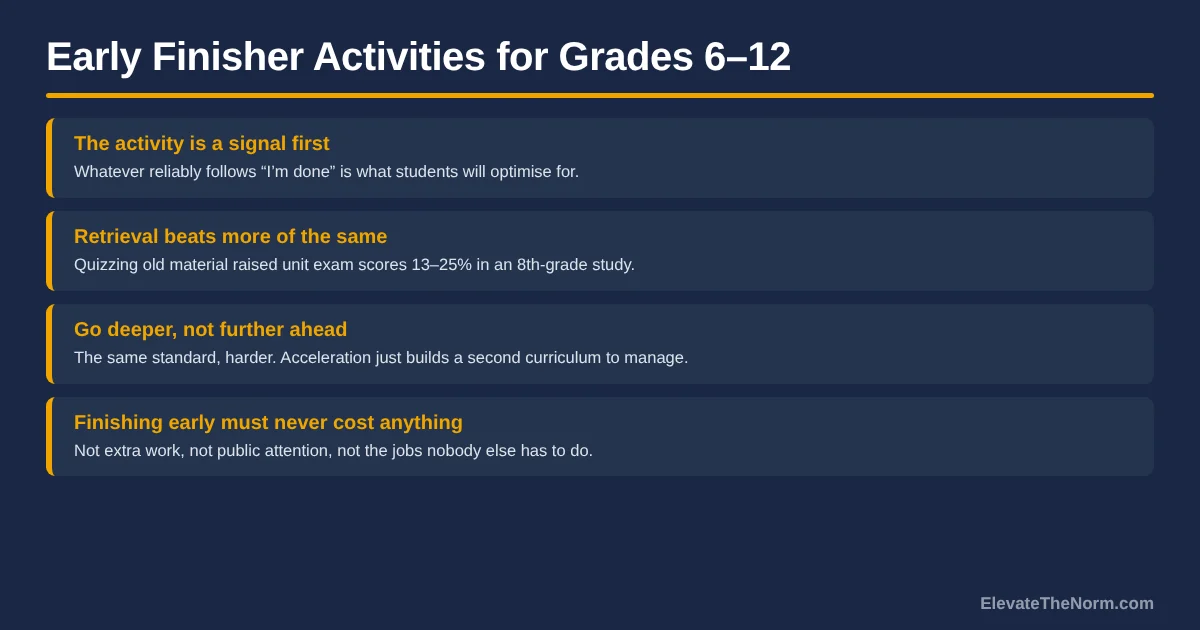
- The activity is a signal before it is a task. Whatever reliably follows “I’m done” is what students will optimise for. Design the signal first and the activity second.
- Use the minutes for retrieval, not new content. Quizzing on material already taught produced 13–25% gains on unit exams in an eighth-grade science classroom, and practice testing is one of only two techniques a major review rated high utility.
- Going deeper beats going further. Pushing an early finisher into next week’s content creates a second, invisible curriculum you then have to manage.
- A standing menu beats daily invention. Choice reliably lifts motivation — but the same meta-analysis found no significant effect on learning, so build the menu for willingness, not for test scores.
- Never make finishing early cost anything. Not more work, not public attention, not a job nobody else has to do.
What Are Early Finisher Activities?
Early finisher activities are planned, low-supervision tasks a student moves to independently after completing the assigned work, before the class has moved on together. In a secondary classroom they usually need to work in gaps of three to twelve minutes, require no new instruction, make no noise that disrupts students still working, and need no grading from you.
This is the operational end of differentiation rather than differentiation itself. Deciding how to vary a task by readiness is a planning question; deciding what a student does in the nine minutes after they finish it is a routine question. They are related and they are not the same job, and conflating them is why early finisher advice so often arrives as a lesson-planning project nobody has time for.
That list of constraints is the whole design problem. Most published ideas fail at least two of them. Anything that needs you to explain it, mark it, or supervise it is not an early finisher activity — it is a second lesson you are now teaching to one student while twenty-nine others work.
Why This Changes After Elementary School
An elementary teacher with one class of twenty-four can keep a physical bin of activities, knows every child’s reading level, and has the same students all day. None of that is true in a middle or high school room. You may see 150 students across five or six sections, in periods short enough that ten minutes is a fifth of the class, and you will never have the same ten minutes free twice.
The second difference matters more, and almost nothing written about early finishers acknowledges it. Teenagers read incentives accurately and act on them. A nine-year-old handed a bonus puzzle is usually pleased. A sixteen-year-old handed a bonus puzzle does the arithmetic: working efficiently produced more work, so next time, work slower. You are not managing boredom. You are setting the price of finishing.
This is the same reason the usual advice about keeping students busy stops working somewhere around sixth grade, and it is why a routine that students can see the logic of does more for you than any individual activity. The ones that hold up are the ones a student would still choose if nobody were watching.
How Much Time Is Actually in Play?
Less than the productivity advice implies, and more than you would guess from any single lesson.
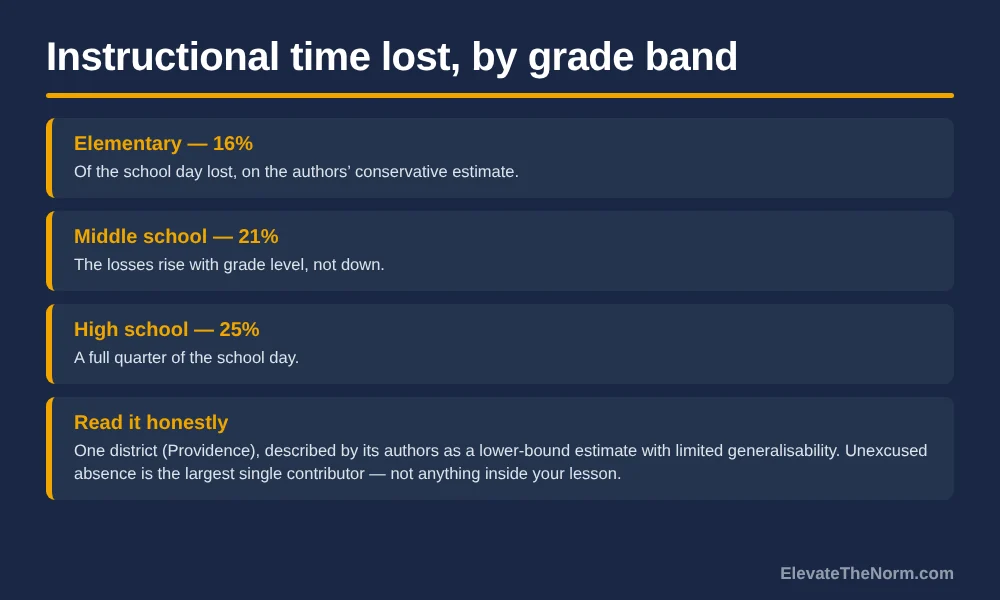
Matthew Kraft and Sarah Novicoff’s 2024 analysis of Providence Public Schools estimated that students lose 16 to 25 percent of the school day, rising by grade band: 16 percent for the average elementary student, 21 percent in middle school and 25 percent — a full quarter — in high school. Two honest caveats belong with those numbers. The largest single contributor is unexcused student absence, not anything happening inside your lesson. And the authors call their own figure a lower-bound estimate from one district with, in their words, “limited generalizability.”
Their paper also cites other researchers’ estimates that off-task behaviour, transitions and wait time together occupy 17 to 29 percent of instructional time. That is the range closest to the early finisher problem — but it is a figure Kraft and Novicoff are reporting from other studies rather than measuring themselves, it bundles three different things together, and no part of it is specifically “students who finished early.” Anyone quoting you a clean number for that is estimating.
What you can say defensibly: the dead minutes are a real and measurable share of the week, they are worse in secondary than in elementary, and the portion you personally control is smaller than the headline. That is still worth planning for. It is not worth a system so elaborate it costs more time than it recovers — and the same arithmetic applies to the minutes lost moving a class from one task to the next.
The One Rule: Finishing Early Can Never Cost a Student
If you take one thing from this, take this. Every early finisher system succeeds or fails on whether students believe that working well is safe.
Three things make finishing early expensive, and all three are common:
- More of the same. Another page of the problems they just demonstrated they can do. This is the most common response and the most costly one, because it is transparently a penalty for competence.
- Public attention. “Marcus is finished — everyone else needs to hurry up.” You have just made finishing early a social liability and told the rest of the room they are behind.
- Unpaid labour. Handing out papers, tidying, tutoring a classmate who has not asked for help. Occasionally fine and genuinely useful; as a default it means the fastest workers do the chores.
The alternative is not a reward system. It is predictability. Students should be able to state, without asking, what happens when they finish — and it should be the same thing on Monday as on Thursday. Respecting students mostly comes down to doing exactly what you said you would do, every time, and an early finisher routine is an unusually visible test of it. If you promise that finishing early buys you a free read and then fill the time with a worksheet twice, the routine is finished.
The useful question is not “what do I give them?” but “what do I want students to conclude about finishing early?” Answer that and the activity list mostly writes itself. This is the same logic that makes a written plan for how the room runs more useful than a list of rules.
Early Finisher Activities That Hold Up in Grades 6–12
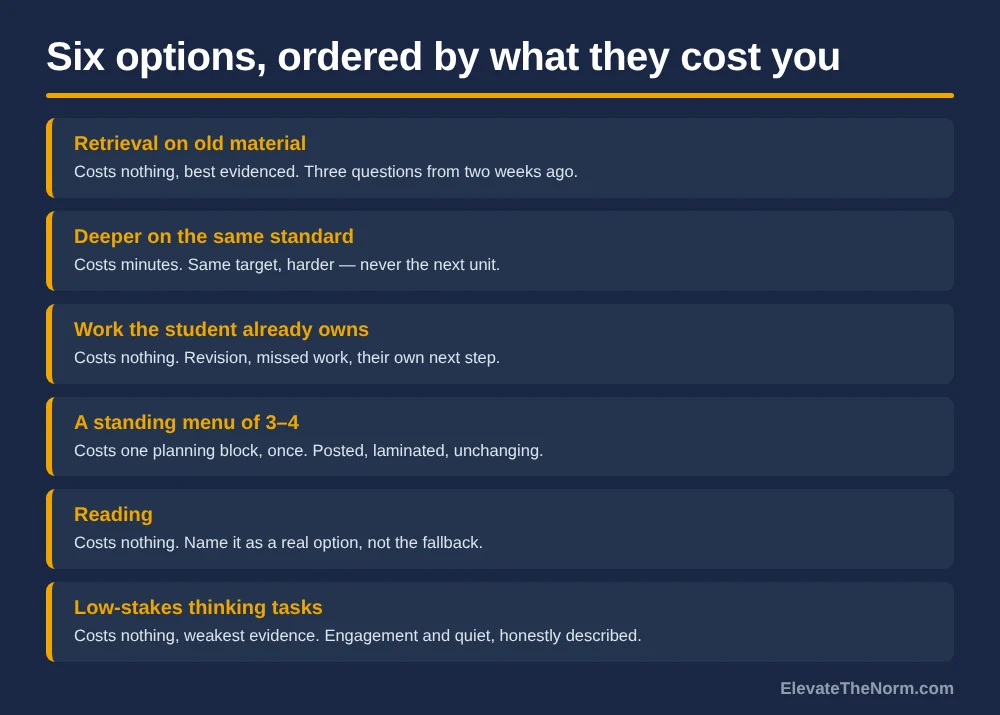
Ordered by what they cost you, cheapest first. The first three cost nothing once set up, which is the only reason they survive a real February.
1. Retrieval on old material — costs nothing, pays the most
Have the student answer three or four questions about material from two or three weeks ago, not from today. This is the single best-evidenced use of the time, and the evidence is from the right age group. In an eighth-grade science classroom, McDaniel and colleagues found that quizzing on previously taught content produced 13 to 25 percent gains on summative unit exams compared with content that was not quizzed, and the advantage persisted on cumulative semester and end-of-year exams. Review quizzing — close to the exam rather than immediately after the lecture — produced the largest gains.
A broader review by Dunlosky and colleagues rated only two of ten study techniques as high utility: practice testing and distributed practice. Both are exactly what a three-minute retrieval card is. Summarising, highlighting and rereading were rated low utility, which rules out most of what students do voluntarily with spare minutes. The same authors are careful to say these techniques “will not be a panacea” and will benefit only students motivated and able to use them — so this is a strong default, not a guarantee.
The practical objection is where the questions come from, and the answer has to be “not from you, daily.” Build one stack per unit as you teach it — four index cards, three questions each, written once while the material is fresh — and then reuse the stack for the rest of the term. A system that needs you to generate questions in the moment is a system you will stop using in week three.
Keep it ungraded and keep it short. The point is the act of retrieving, and the moment it carries a grade it becomes an assessment you have to mark. If you already run a recall task at the start of the period, the early finisher version is the same instrument pointed at a different gap in the lesson. If you want a stack you did not have to write, I give away a free five-day warm-up sampler for grades 6–12 that works the same way in the spare minutes.
2. Going deeper on the same standard — costs minutes
Not the next unit. The same target, harder. If the task was identifying a claim, the extension is to find the weakest evidence supporting it and say why. If the task was solving for x, the extension is to write a problem whose answer is seven and explain how they built it.
Depth keeps everyone on the same destination, which is the thing that makes it manageable. Acceleration creates a second curriculum: a student three sections ahead is now a planning problem for the rest of the term, and you will be the one reconciling it.
3. Work the student already owns — costs nothing
Revising a graded piece against the rubric. Finishing something missed during an absence. Writing the next step on a goal they set earlier. None of this requires you to invent anything, and all of it is work the student has a reason to care about because it is already theirs.
This is the most under-used option in secondary classrooms and the easiest to defend to anybody who asks what a student was doing. It also pairs naturally with pulling a few students for a short booked session, because it gives the rest of the room something legitimate to be getting on with.
4. A standing menu of three or four options — costs one planning block, once
A posted, laminated, unchanging list. Three or four choices, not twelve. Students pick without asking. The menu is the system; the items on it matter less than the fact that it never changes and never has to be re-explained.
Four is roughly the right number for a reason covered in the next section, and the list should include at least one option that is clearly not more work.
Worth letting the class fill one of the slots. Not all four — you need the retrieval option on there and students will not choose it — but handing over one line costs you nothing, tells you what they actually consider worth doing with eight minutes, and makes the menu something they had a hand in rather than another posted rule.
5. Reading — costs nothing, and say it plainly
A book, an article, anything of their choosing. This is a legitimate use of eight minutes and it is worth announcing as such rather than treating it as what happens when you have run out of ideas. The honest framing is that nothing on this list is better for a student who has already demonstrated the standard.
Two practical notes. Keep a shelf of anything readable in the room, because the student who has nothing to read is the student who has no option three. And whatever students bring is subject to the same materials expectations as anything else in your building — worth knowing your school’s position before you make reading a standing option rather than after.
Where it goes wrong is leaving it unnamed. If reading is the fallback nobody mentions, students read it as the teacher giving up. If it is option three on a posted menu, it is a choice.
6. Low-stakes thinking tasks — costs nothing, weakest evidence
Puzzles, logic problems, a discussion prompt to write on, a challenge card. Genuinely useful for the student who is done, restless and not going to read. Put them last because the evidence that they produce learning is thin — their case is engagement and quiet, which is a real benefit honestly described rather than dressed up as rigour. I sell a print-and-go set of early finisher and brain break cards in my No-Prep Sub Plans, Early Finishers & Brain Breaks bundle for teachers who would rather not build the stack themselves.
What Not to Hand Them
More of the work they just finished. It is the default, it is understandable on a Tuesday, and it is the one thing on this page that actively trains students to slow down.
There is relevant evidence, with a population caveat that matters on a secondary site. In a study reported by Reis and Renzulli, teachers across 27 districts eliminated 40 to 50 percent of the standard curriculum for students who had already mastered it. Post-test scores in science, maths, social studies and spelling were no different from the control group, and in language arts the compacted students scored significantly higher. Removing work from students who already knew the material cost them nothing.
The caveat: that sample was 465 teachers in grades 2 through 6. Only the top of that band overlaps with this site’s readers, and the study was about formally compacting a curriculum, not about what to do with a spare eight minutes. It does not transfer directly. What it does establish is that the instinct behind “more practice can’t hurt” is wrong often enough to stop treating it as obviously safe. The same researchers also noted that many replacement activities their teachers used were not advanced enough to be worth the swap — which is the risk on this page too.
Two more to avoid. Anything that needs new instruction, because you will be teaching it one-to-one while the class works. And anything you have to grade, because a system that generates marking will be abandoned by October.


Does Giving Them a Choice Actually Help?
Yes for motivation, and — stated plainly, because most articles on this topic imply otherwise — no for learning.
Patall, Cooper and Robinson’s meta-analysis of 41 studies found choice had a positive effect on intrinsic motivation, with a weighted average of d = 0.30 (0.36 under a random-effects model). The effect was stronger when two to four successive choices were offered, stronger when no reward followed, and stronger for children than for adults — which means the benefit is probably smaller for your seniors than the headline figure suggests.
The finding worth knowing: the effect of choice on subsequent learning was not significant (d = 0.10, with a confidence interval crossing zero). Thirteen of the ninety-one motivation effect sizes were negative. So build the menu because it makes students more willing to use the time and less likely to read the time as a penalty. Do not claim it raises test scores, because the best available synthesis does not support that.
Practically: three or four options, no points attached, and do not keep adding to the list.
Setting It Up So It Runs Without You
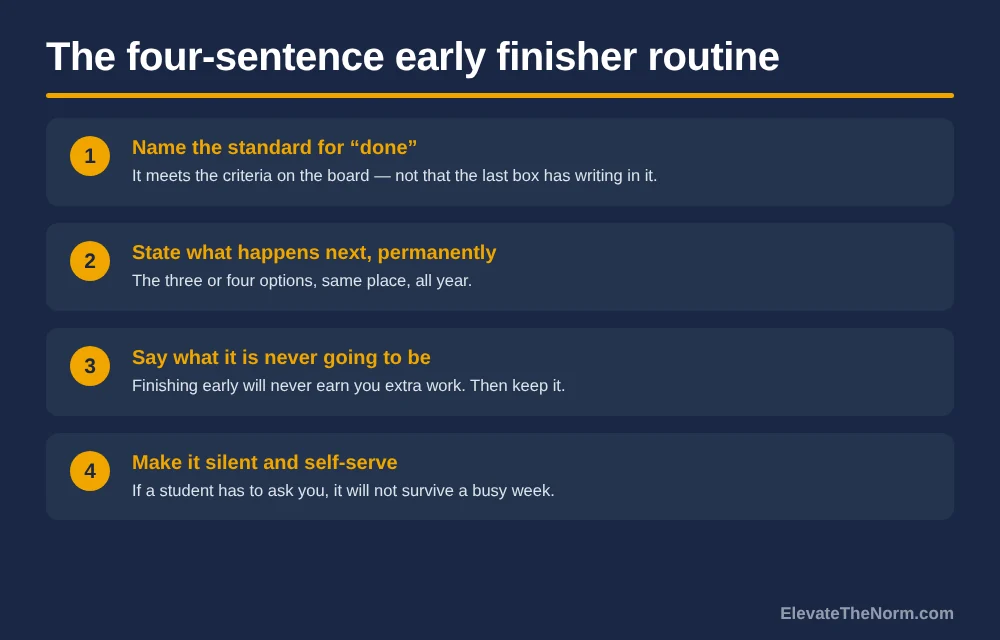
The system is four sentences, posted where students can see it.
- Name the standard for “done.” Done means it meets the criteria on the board, not that the last box has writing in it.
- State what happens next, permanently. The three or four options, in the same place, all year.
- Say what it is never going to be. Telling a class outright that finishing early will never earn them extra work is worth more than any activity on the menu, and you then have to keep it.
- Make it silent and self-serve. If a student has to ask you, it will not survive a week when you are busy.
Two things that decide whether it holds. Phones. In a secondary room, “finished early” means phone unless you have said otherwise, and a menu that ignores that is a menu competing with a device and losing. Whatever your school’s policy is, the early finisher routine has to state its own position explicitly, because silence reads as permission. And the posted menu is your answer to a walkthrough. A room where six students are doing six different quiet things looks like drift to anyone standing in the doorway for ninety seconds; a laminated list on the wall is what makes it legible as a routine rather than a loss of control.
What If They Finished Early Because They Rushed?
Then the problem is the definition of “done,” not the activity, and no menu fixes it.
The gate goes before the menu. If “done” means meets the posted criteria, a rushed paper is not done, and the student’s early finisher activity is the work itself. That conversation is short and it is not a reprimand: this does not meet the third criterion yet, have another look. Rushing is usually a rational response to a system in which finishing fast is rewarded and quality is not checked — which is the same mechanism as before, pointed the other way.
The case that matters more, and the one most advice misses entirely: a student can arrive at “done” because they got stuck and quietly gave up. That looks identical to finishing early from across the room. It is the reason the gate is worth checking rather than assuming, and the response is not the menu — it is the two minutes of help the student did not ask for. A routine that cannot tell mastery from surrender will reliably reward the wrong one.
If a student genuinely finishes good work early and often, that is information. It may mean the task is too easy for them, and the answer is a conversation about the course, not a sixth item on the menu.
Where the Evidence Runs Out
Honestly: there is no body of research on early finisher activities as such. Nobody has run a controlled trial on what secondary students should do with nine spare minutes.
What exists is evidence about the components — retrieval practice, distributed practice, choice, curriculum compacting — mostly gathered in other settings and for other purposes, and in two of the four cases in samples younger than this site’s readers. The recommendations above are those findings applied by reasoning, and the reasoning is visible so you can disagree with it. The claim that the signal matters more than the activity is an argument from how incentives work, not a measured result.
Treat the retrieval recommendation as well supported, the menu as reasonable and low-risk, and the rest as practice worth trying rather than settled.
What to Do Next Week
Write three options on a piece of paper and post it. Make one of them retrieval questions from two weeks ago, one of them work the student already owns, and one of them reading. Tell the class, once, that finishing early will never produce extra work.
Then keep that promise for a month and watch two things. Whether the pace of the room changes — students stop stalling when stalling stops paying. And who is using the menu, because that is the equity question in this whole topic. Early finishers are disproportionately students who arrived already knowing more, so a routine that quietly hands the best minutes of the week to the students with the most prior knowledge widens a gap rather than closing one. If the same six names are always on option one, the honest read is that the task is too easy for them and too hard for everyone else, and that is a problem with the lesson rather than the menu.
Different problem, same two minutes. When the whole class needs the reset rather than the fast finishers, see what a brain break looks like with 14- to 18-year-olds — and why the dance video is the fastest way to lose them.
Frequently Asked Questions
What are early finisher activities?
Early finisher activities are planned, low-supervision tasks a student moves to independently after completing the assigned work, before the class moves on together. In grades 6 through 12 they need to work in gaps of roughly three to twelve minutes, require no new instruction from the teacher, stay quiet enough not to disturb students still working, and generate nothing the teacher has to grade. Most published ideas fail at least two of those four constraints.
What should early finishers do in middle school and high school?
The best-evidenced option is retrieval practice on material taught two or three weeks earlier, because quizzing previously taught content raised unit exam scores by 13 to 25 percent in an eighth-grade science study. After that: going deeper on the same standard rather than moving ahead to new content, finishing or revising work the student already owns, and reading. Keep the whole list to three or four standing options rather than inventing something each day.
Should early finisher work be graded?
No. A grade turns the task into an assessment the teacher has to mark, and any early finisher system that generates marking gets abandoned within a few weeks. It also changes what the activity signals: work that counts is work, and students who notice that finishing early produces more graded work will simply finish later. Keep it ungraded and keep it short.
How many options should an early finisher menu have?
Three or four. The meta-analysis on choice found the motivational benefit was strongest when two to four successive choices were offered, and a longer list costs more to maintain without adding anything. One of the options should be clearly not more work. Letting the class choose what goes in one of the slots is worth doing, though the retrieval option should not be the one put to a vote.
What do I tell a parent who asks why their child spent ten minutes reading?
The honest answer is usually the best one: their child met the standard for the assignment before the period ended, and rather than being given repetitive extra practice they already demonstrated they do not need, they read. If a parent pushes further, the useful information is whether this happens often. A student who regularly finishes good work early is telling you the task is not demanding enough for them, and that is a conversation about the course rather than about the ten minutes.
What if a student finishes early because they gave up rather than because they understood?
This is the case most advice misses, and from across the room it looks identical to genuine early finishing. It is the reason done should mean meets the posted criteria rather than has writing in every box. When a student has stopped because they are stuck, the response is not the activity menu, it is two minutes of help they did not ask for. A routine that cannot tell mastery from surrender will reliably reward the wrong one.
Do early finisher activities widen the gap between students?
They can, and it is worth watching for. Students who finish early are disproportionately students who arrived already knowing more, so a routine that gives the best spare minutes of the week to that group can widen a gap rather than close it. The practical check is who is actually using the menu. If it is the same few names every time, the likeliest explanation is that the task is too easy for them and too hard for the rest, which is a problem with the lesson rather than with the menu.
Can students use their phones when they finish early?
That depends on your school policy, but the routine has to state its own position out loud either way. In a secondary classroom, finished early means phone unless something else has been established, so silence on the question reads as permission. A menu that does not address phones is competing with a device and losing.
Sources
- Kraft, M. A., & Novicoff, S. (2024). Time in School: A Conceptual Framework, Synthesis of the Causal Research, and Empirical Exploration. EdWorkingPaper No. 22-653, Annenberg Institute, Brown University. Estimated that students in the Providence Public School District lose 16–25% of the school day — 16% in elementary, 21% in middle and 25% in high school — with unexcused student absence the largest single contributor. The authors describe this as a lower-bound estimate from a single district and state that their case-study results likely have “limited generalizability.” The separate 17–29% figure for off-task behaviour, transitions and wait time combined is their summary of other researchers’ estimates, not their own measurement, and is not specific to students who finish early. https://www.edworkingpapers.com/ai22-653
- McDaniel, M. A., Agarwal, P. K., Huelser, B. J., McDermott, K. B., & Roediger, H. L. (2011). Test-Enhanced Learning in a Middle School Science Classroom: The Effects of Quiz Frequency and Placement. Journal of Educational Psychology, 103(2), 399–414. Eighth-grade science classes; multiple-choice quizzes with feedback on some unit content and not others, allowing a within-class comparison. Quizzing produced 13–25% gains on summative unit examinations, review quizzing close to the exam produced the largest gains, and the advantage persisted on cumulative semester and end-of-year exams. https://doi.org/10.1037/a0021782
- Dunlosky, J., Rawson, K. A., Marsh, E. J., Nathan, M. J., & Willingham, D. T. (2013). Improving Students’ Learning With Effective Learning Techniques: Promising Directions From Cognitive and Educational Psychology. Psychological Science in the Public Interest, 14(1). Of ten study techniques reviewed, only practice testing and distributed practice received a high utility rating; summarisation, highlighting and underlining, and rereading were rated low utility. The authors caution that the techniques “will not be a panacea” and will benefit only students who are motivated and capable of using them. Cited here from the Association for Psychological Science’s published summary of the report, which was the version read; the full monograph was not accessed. https://www.psychologicalscience.org/news/releases/which-study-strategies-make-the-grade.html
- Patall, E. A., Cooper, H., & Robinson, J. C. (2008). The Effects of Choice on Intrinsic Motivation and Related Outcomes: A Meta-Analysis of Research Findings. Psychological Bulletin, 134(2), 270–300. 41 studies, 290 effect sizes from 46 samples. Choice had a positive effect on intrinsic motivation (weighted average d = 0.30, 95% CI 0.25–0.35 fixed-error; d = 0.36 random-error), strongest when two to four successive choices were offered, when no reward followed, and for children rather than adults. The effect on subsequent learning was not significant (d = 0.10, 95% CI −0.02 to 0.21), and 13 of the 91 intrinsic-motivation effect sizes were negative. https://pubmed.ncbi.nlm.nih.gov/18298272/
- Reis, S. M., & Renzulli, J. S. (2005). Curriculum Compacting: An Easy Start to Differentiating for High-Potential Students, reporting the technical results of Reis et al. (1992). 27 school districts and 465 teachers, randomly assigned to treatment or control. Where 40–50% of the standard curriculum was eliminated for students who had already mastered it, post-test scores did not differ from controls in science, mathematics concepts, mathematics computation, social studies or spelling, and were significantly higher in language arts. The sample was grades 2 through 6, so only the top of that band overlaps with secondary classrooms, and the study concerned formal curriculum compacting rather than short in-period extension tasks. The authors also noted that many replacement activities their teachers used were not advanced enough to suit high-ability students. https://gifted.uconn.edu/schoolwide-enrichment-model/curriculum_compacting