By Clay Shumate
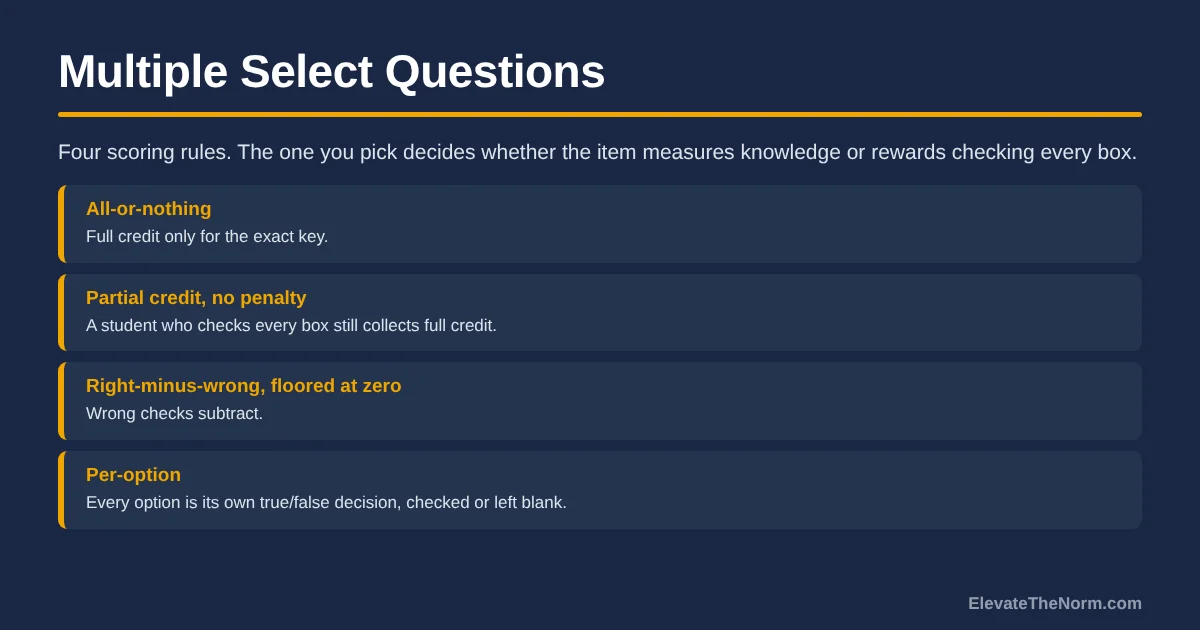
A multiple select question lists several options and asks students to choose every correct one (“select all that apply”), so more than one answer can be right. Score it with right-minus-wrong partial credit floored at zero, or tell students exactly how many to pick. Plain partial credit with no penalty rewards students who check every box.
Key Takeaways
- Multiple select means more than one correct answer. Students check every option that’s right, not just the best one.
- The scoring rule changes the grade more than the question does. A study that ran 41 scoring methods on the same exam data found scores ranging from 0.02 to 0.98 depending on the method.
- Partial credit with no penalty is the easiest rule to game. A student who checks every box gets full credit.
- Big tests handle this two ways. Texas STAAR caps how many boxes a student can check; the NCLEX subtracts a point for each wrong selection and never goes below zero.
- Each option should stand alone as clearly true or clearly false. If an option is “sort of” right, the item can’t be scored fairly.
What is a multiple select question?
A multiple select question (also called “select all that apply,” multiple response, or checkbox question) gives students a stem and a set of options, and any number of those options can be correct. Students mark every option they think is right and leave the rest blank.
There are two common versions, and the difference matters for scoring:
- Open count (“select all that apply”). Students aren’t told how many answers are correct. This is the harder version and the one most likely to be gamed.
- Fixed count (“select two,” sometimes called Pick-N). Students are told how many to choose. Researchers who compared item types describe Pick-N as asking students to select the true options when the number of true options is disclosed.
A close cousin is the multiple true-false item, where students mark each statement true or false separately. It forces a decision on every option instead of just checking some.
How is multiple select different from multiple choice?
| Multiple choice | Multiple select | |
|---|---|---|
| Correct answers | Exactly one | One or more |
| Usual control | Radio button (circle) or one letter circled | Checkboxes (squares) or several letters circled |
| Chance of a blind guess being fully right (5 options) | 1 in 5 | 1 in 31 if any non-empty combination is allowed and the count is hidden |
| Partial credit possible? | No | Yes, depending on the rule you choose |
| Best for | One best answer, cause and effect, a single definition | Concepts with several features, sorting examples from non-examples, checking for a full set of reasons |
The guessing number is plain counting. Five options that can each be checked or not checked give 32 combinations; take away the empty one and 31 remain. Only one of those is the full key. That’s why all-or-nothing multiple select can give a student with real partial knowledge the same zero as a student who guessed.
How do you score multiple select questions fairly?
There are four scoring rules worth knowing. Here’s what each does, then a worked example so you can see the differences side by side.
- All-or-nothing. Full credit only for the exact key. Simple, strict, and it gives no credit for partial knowledge.
- Partial credit, no penalty. One point for each correct option checked. Wrong checks cost nothing.
- Right-minus-wrong (plus/minus), floored at zero. One point for each correct option checked, minus one for each wrong option checked. If the result is negative, the item scores zero.
- Per-option. Each option is its own true/false decision. A student earns credit for every correct option checked and every wrong option left blank.
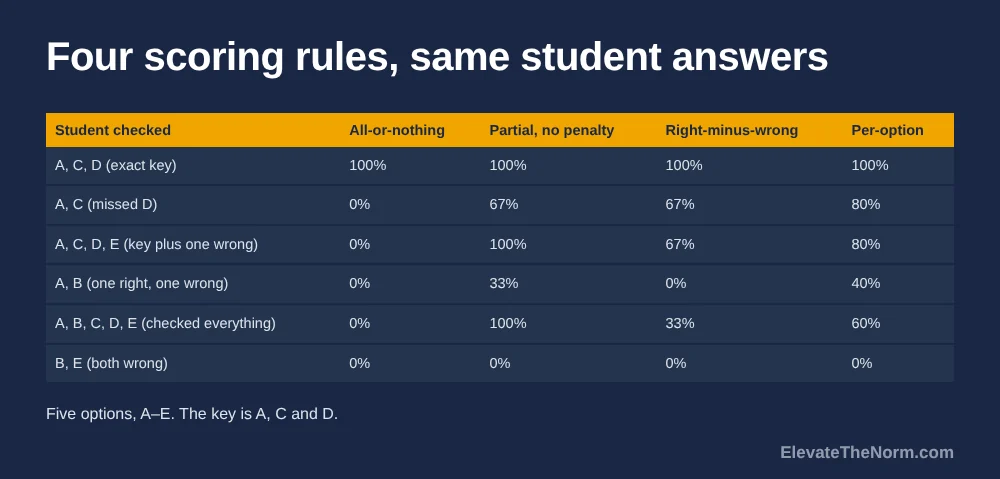
Worked example. Five options, A through E. The key is A, C, and D. Here’s how six different student responses score under each rule, shown as a percent of the item’s points.
| Student checked | All-or-nothing | Partial, no penalty (out of 3) | Right-minus-wrong, floor 0 (out of 3) | Per-option (out of 5) |
|---|---|---|---|---|
| A, C, D (exact key) | 100% | 3 = 100% | 3 = 100% | 5 = 100% |
| A, C (missed D) | 0% | 2 = 67% | 2 = 67% | 4 = 80% |
| A, C, D, E (key plus one wrong) | 0% | 3 = 100% | 3 − 1 = 2 = 67% | 4 = 80% |
| A, B (one right, one wrong) | 0% | 1 = 33% | 1 − 1 = 0 = 0% | 2 = 40% |
| A, B, C, D, E (checked everything) | 0% | 3 = 100% | 3 − 2 = 1 = 33% | 3 = 60% |
| B, E (both wrong) | 0% | 0 = 0% | 0 − 2, floored = 0% | 0 = 0% |
Look at the “checked everything” row. Under partial credit with no penalty, a student who knows nothing and checks all five boxes earns 100%. That rule only works if you also tell students how many to select and block them from choosing more. Per-option scoring is kinder, but it hands out 60% to the same check-everything response and 40% to a student who got just one of three right. Right-minus-wrong with a zero floor sits in the middle: it rewards partial knowledge and makes over-checking cost something.
One more point from the research. Kanzow and colleagues (2023) applied 41 different scoring methods to two kinds of multiple-select items from a dental school’s exams and found scores ranging from 0.02 to 0.98 depending on the method. Their discussion advises against methods that can produce negative scores and says results should only be interpreted in light of the scoring method used. In plain terms: decide the rule before the test, tell students what it is, and use the same rule all year.
Whatever you pick, check what your quiz platform does with checkbox questions by default, because its setting may not match the rule you announced.
How do standardized tests handle multiple select questions?
Two large testing programs publish how they do it, and they show the two main fixes for the guessing problem.
- Texas STAAR (redesigned question types). The Texas Education Agency’s guide to new question types for mathematics says multiselect questions are worth up to 2 points, with 1 point for a partially correct response and 0 if both parts are missing or wrong. It also says students can’t select more than the specified number of answers. That’s the fixed-count fix: cap the boxes, then partial credit can’t be gamed by over-checking. The guide notes its information was subject to change after the Spring 2022 field test, so check TEA’s current materials for your subject.
- NCLEX (Next Generation NCLEX for nurses). NCSBN presentations describe a plus/minus rule (one point for each correct response, minus one for each incorrect response) for items where candidates can choose any number of options, and a 1/0 rule (no deduction) for items that tell candidates to select a set number. One presentation states that if the result is negative, the score is set to 0. That’s the open-count fix: let students check freely, but make wrong checks cost.
If your state test uses multiselect items, look up its item specifications or released items so students practice under the same rules they’ll see in spring.
How do I write a good multiple select question?
Most of the standard multiple-choice item-writing rules carry over. Haladyna, Downing, and Rodriguez (2002) built a set of 31 multiple-choice item-writing guidelines from a review of 27 testing textbooks and 27 research studies and reviews, aimed at classroom tests. A Penn State summary of an earlier Haladyna and Downing taxonomy includes rules that matter even more here: keep options homogeneous and similar in length, avoid “all of the above” and “none of the above,” avoid negative wording, avoid words like “always” and “never,” and base wrong options on common student errors. Add these for multiple select specifically:
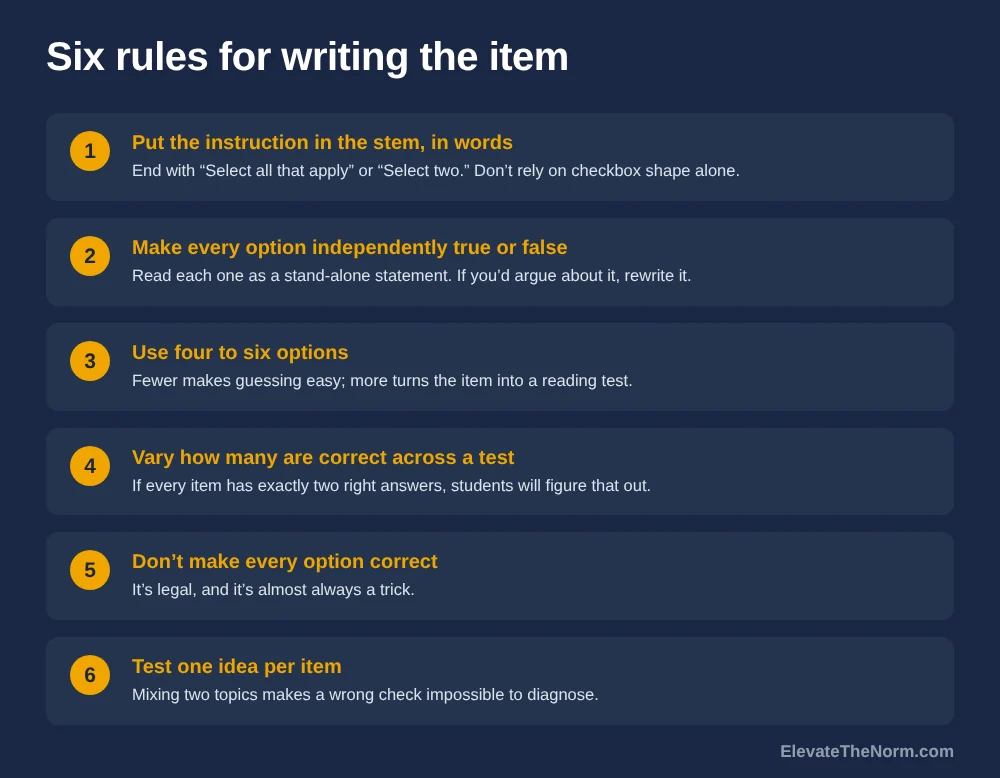
- Put the instruction in the stem, in words. End the stem with “Select all that apply” or “Select two.” Don’t rely on checkbox shape alone.
- Make every option independently true or false. Read each one as a stand-alone statement. If you’d argue about it, rewrite it.
- Use four to six options. Fewer makes guessing easy; more turns the item into a reading test.
- Vary how many are correct across a test. If every item has exactly two right answers, students will figure that out.
- Don’t make every option correct. It’s legal, but it’s almost always a trick. Use it rarely or not at all.
- Test one idea per item. Mixing two topics in one option set makes a wrong check impossible to diagnose.
Ready-to-copy examples (answer keys checked):
- Civics. Which of these powers does Article I, Section 8 of the U.S. Constitution give to Congress? Select all that apply. A. Declare war. B. Veto bills. C. Coin money. D. Appoint federal judges. E. Regulate commerce with foreign nations. Key: A, C, E. (The veto and judicial appointments belong to the President, with judges confirmed by the Senate.)
- Science. Which of these elements are noble gases? Select all that apply. A. Helium. B. Nitrogen. C. Neon. D. Argon. E. Oxygen. Key: A, C, D.
- Weak version to avoid. “Which of the following were important about the Civil War? Select all that apply.” Every option is defensible, so there’s no fair key. Replace “important” with a checkable fact, such as which states seceded before the attack on Fort Sumter.
Multiple select items work well as a quick check during a lesson, too. Put one on the board as part of your checking for understanding routine and have students hold up fingers for each option they’d check. For more quick-check formats, see this list of formative assessment strategies.
How do I make multiple select questions accessible?
- Group the checkboxes properly online. W3C’s Web Accessibility Initiative tutorial recommends wrapping related checkboxes in a fieldset with a legend that names the group, so screen reader users know the options belong together. It also warns that screen readers announce legends inconsistently, so keep the legend short and make each checkbox label make sense on its own.
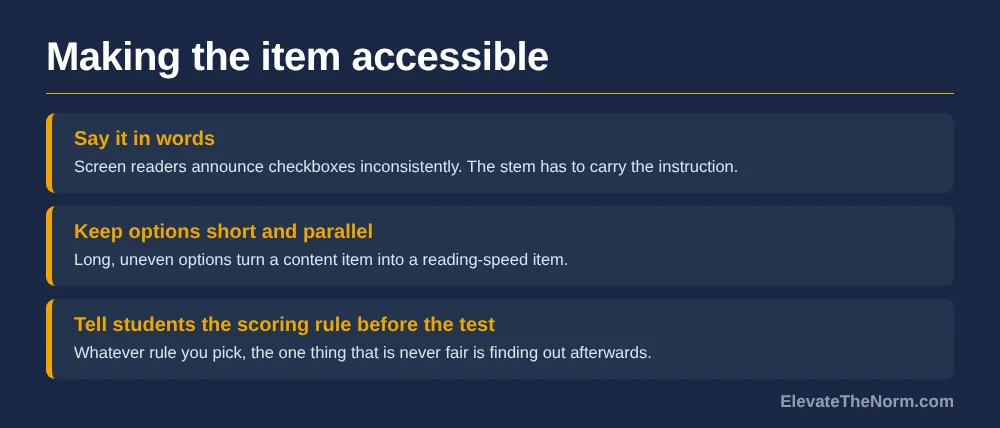
- Say “select all that apply” in the stem. A student using a screen reader, or a student who just doesn’t notice square versus round boxes, needs the instruction in words.
- Keep options short. Multiple select already asks students to hold several decisions in mind. Long options pile reading load on top of content.
- On paper, give each option its own line and its own box. Separate lines make each mark easier for the student to check and easier for you to score.
- Check IEP and 504 accommodations. If a student’s plan reduces answer choices, a fixed-count version of the item is often the cleanest fit.
Clay’s take: Pick one rule and tell students before the test
For classroom tests, right-minus-wrong with a zero floor is the best default for open-count items. It gives credit for what a student knows, it makes “check everything” a losing strategy, and it never takes points away from other questions. If your platform can’t do that, switch to fixed count (“select two”) and use partial credit. Either way, print the rule at the top of the test and keep it the same all year. A scoring rule students understand is part of the test corrections conversation later, because they can see exactly why an item lost points. And keep multiple select in its lane: it’s good at checking whether students know a full set of features, but it won’t show reasoning the way a short constructed response does, so balance it against higher depth of knowledge tasks.
What the research on multiple select questions does not settle
Be careful how far you push the item-writing evidence. Haladyna, Downing and Rodriguez (2002) built their guidelines from a review of testing textbooks and research on multiple-choice items, and the authors are explicit that many of their rules rest on expert consensus rather than on experimental comparison. Very few of those studies tested select-all-that-apply items specifically. So treat the six rules below as well-grounded craft advice that transfers, not as findings with effect sizes attached.
The scoring question is where the gap matters most. There is no agreed answer in the measurement literature about which of the four rules is fairest, and reasonable testing programs use different ones. What is not in dispute is the arithmetic in the table: under partial credit with no penalty, a student who checks every box collects full credit for the key while knowing nothing. If you use that rule, you are not measuring what you think you are measuring.
What to do next week
Pull the last test you gave that had a select-all item on it and score that item four ways. It takes about ten minutes with a class set and it is the fastest way to see whether your current rule is doing anything. Look in particular at the students who checked everything, because that row is the diagnostic one.
Then pick one rule and put it in writing on the test itself, above the first select-all item, in the same words you will use when a student asks. Right-minus-wrong floored at zero is the usual compromise: it credits partial knowledge, and it takes away the incentive to check every box. Whatever you choose, the one thing that is never fair is a student finding out the rule after the grade is posted.
Frequently Asked Questions
What is a multiple select question?
A multiple select question gives students a stem and several options, and more than one option can be correct. Students mark every option they believe is right, which is why it’s often labeled select all that apply. Some versions tell students how many to pick, such as select two; others leave the number open, which makes guessing harder.
What is the difference between multiple choice and multiple select?
A multiple choice question has exactly one correct answer, and students pick one option. A multiple select question can have several correct answers, and students check every one that applies. Multiple select usually uses checkboxes instead of radio buttons and can be scored with partial credit, while multiple choice is scored right or wrong.
How should I score a select all that apply question?
For open-count items, right-minus-wrong is a solid default: add a point for each correct option checked, subtract one for each wrong option checked, and set any negative result to zero. If you tell students how many answers to select, simple partial credit works. Avoid partial credit with no penalty on open-count items, since checking every box earns full credit.
Should multiple select questions get partial credit?
Usually, yes. All-or-nothing scoring gives a student who knows two of three answers the same zero as a student who guessed. Partial credit is fairer as long as wrong selections cost something or the number of selections is capped. Research comparing many scoring methods shows the choice changes scores a lot, so announce your rule ahead of time.
How many options should a multiple select question have?
Four to six options works for most secondary classrooms. With fewer than four, students can reason their way to the key too easily; with more than six, the item starts measuring reading stamina instead of content. Vary the number of correct options across a test so students can’t predict that every item has exactly two right answers.
Do state tests use multiple select questions?
Some do. The Texas Education Agency’s guide to redesigned STAAR question types describes multiselect items worth up to two points, with one point for a partially correct response, and says students can’t select more than the specified number. Check your own state’s item specifications or released items to see which formats and scoring rules apply.
Can a multiple select question have only one correct answer?
Yes. In an open-count select all that apply item, one correct answer is allowed, and including a few of these keeps students from assuming there are always at least two. Use it on purpose, not by accident, and make sure the stem still says select all that apply so students aren’t misled about the format.
Sources
- Kanzow, P., Schmidt, D., Herrmann, M., Wassmann, T., Wiegand, A., & Raupach, T. (2023). Use of multiple-select multiple-choice items in a dental undergraduate curriculum: Retrospective study involving the application of different scoring methods. JMIR Medical Education. Used for the 41-method comparison, the 0.02 to 0.98 score range, the Pick-N and multiple true-false definitions, and the advice against negative scores.
- Texas Education Agency. (n.d.). Accompanying guide to new question type samplers: Mathematics. Used for STAAR multiselect point values, partial credit, and the cap on selections.
- Dickison, P. (2021). Next Generation NCLEX update [Presentation]. NCSBN. Used for the plus/minus and 0/1 partial-credit scoring descriptions and the worked plus/minus example.
- Houchen, B. (2021). Next Generation NCLEX updates [Presentation]. NCSBN. Used for when each NCLEX scoring rule applies and the rule that negative results score zero.
- Haladyna, T. M., Downing, S. M., & Rodriguez, M. C. (2002). A review of multiple-choice item-writing guidelines for classroom assessment. Applied Measurement in Education, 15(3), 309–333. Used (abstract only) for the 31-guideline taxonomy and the evidence base behind it.
- Schreyer Institute for Teaching Excellence, Penn State. (n.d.). Multiple-choice item-writing rules. Used for the option-writing rules, summarized from Haladyna and Downing (1989).
- W3C Web Accessibility Initiative. (2026). Grouping controls. Used for the fieldset and legend recommendation and the screen reader caveat.