By Clay Shumate
Classroom jobs are recurring duties students hold all term — tech, attendance, absent work, supplies, the board. In middle and high school they work as a way to hand over real operational responsibility, not as a behavior reward. No study has tested them in a secondary classroom, so run them for the responsibility, and judge them on whether the room runs without you.
Key Takeaways
- Nobody has studied this in a secondary classroom. Every source read for this article that describes classroom jobs in grades 6–12 is a teacher describing their own practice. None reports a comparison group, a measured outcome, or a single study.
- The adjacent evidence is modest and often misquoted. The largest middle-school engagement meta-analysis — 79 studies, 158 effect sizes, grades 5–9 — puts overall engagement at g = 0.37, and autonomy specifically at only g = 0.26. US studies in it averaged g = 0.24.
- Competence beat autonomy in that analysis, by a lot. Feeling capable scored g = 0.56 against autonomy’s 0.26. If a job makes a student feel useless in public, handing them the choice does not rescue it.
- Handing students the doing does not automatically teach them more. In a two-group comparison where one group ran an experiment themselves and the other watched a demonstration, knowledge gains were statistically indistinguishable (p > .05). Only enjoyment moved.
- Classroom-management effect sizes shrink when you read the footnote. The Campbell systematic review reports a classroom-level d = 0.80 — and says plainly that it corresponds to a student-level effect of roughly 0.18 to 0.22.
What are classroom jobs in a secondary classroom?
Classroom jobs are standing duties individual students hold over a long stretch — a quarter, a semester, a year — that keep the room running. They are not one-off helping, and they are not the task roles you hand out inside a group activity. A student with a classroom job owns a function: the tech, the absent-work file, the supplies, the whiteboard, the attendance.
That is the distinction that gets lost. Group work roles last forty minutes and exist to distribute labor inside one task. A classroom job lasts a semester and exists to transfer a piece of the room’s operation to a teenager permanently. Different object, different payoff, different failure modes.
The word “jobs” also carries elementary baggage that gets this dismissed in secondary buildings before anyone looks at it. A laminated chart with clothespins and a line-leader is not what is being described here. A fifteen-year-old who is the only person in the building besides you who knows where the loaner chargers are is.
Do classroom jobs actually work?
Nobody knows, because nobody has tested it. That is the honest answer and it should be the first thing anyone tells you. Three detailed accounts of secondary classroom-job systems were read for this article, and between them they cite zero studies and report zero measured outcomes.
What they do offer is something a study would not: detailed, specific descriptions of systems that experienced teachers have run for years and kept running. That is worth reading. It is just not evidence of effect, and the people describing them are careful enough not to claim it is. In Sarah Gonser’s Edutopia piece, the middle school teacher running the largest system says she ended up with “a stronger classroom community of students who really feel like they belong.” That is her observation of her own room. No one measured it.
One principal quoted in that article says there is “lots of research showing that kids learn best from each other, and from teaching something to a peer.” No source is given, and the claim is doing a lot of work. Treat it the way you would treat any uncited claim in a staff meeting.
What does the adjacent evidence actually support?
Three bodies of research sit next to classroom jobs without landing on them. Read honestly, they argue for running a job system modestly and for a specific reason — not for expecting it to move achievement.
| Evidence | What it covers | The number | The catch |
|---|---|---|---|
| Aker & Ellis (2019) meta-analysis | Middle school science engagement, grades 5–9, 79 studies, N = 53,971 | Overall g = 0.37 [0.30, 0.42]. Autonomy 0.26, competence 0.56, relatedness 0.34 | Engagement was self-reported in every study. The authors state causality “was not established.” Published studies averaged 0.40, unpublished ones 0.15 |
| Oliver et al. (2011) Campbell review | Teacher classroom-management practices, 12 studies, K–12 | Classroom-level d = 0.80, which the authors say equals about 0.18–0.22 per student | Eight of the twelve studies were K–6, seven of twelve came from one research group evaluating its own program, and no included intervention assigned students jobs |
| Ou et al. (2021) | Grades 4–5, students running an experiment vs. watching a demonstration | Knowledge: no difference, F(1,80) = 0.365, p > .05. Enjoyment: higher, η² = 0.118 | Primary-age, out-of-school summer camp, one project, and the “flow” outcome was self-reported on a five-point scale |
The third row is the one that should change what you expect. Researchers took two groups of students, gave one the hands-on doing and let the other watch, and the difference in what they learned was indistinguishable from zero. The students who did it themselves enjoyed it more. That is a real finding and it is not nothing — but if your pitch for classroom jobs is that students learn more by doing, that study is a caution sitting directly in the path.
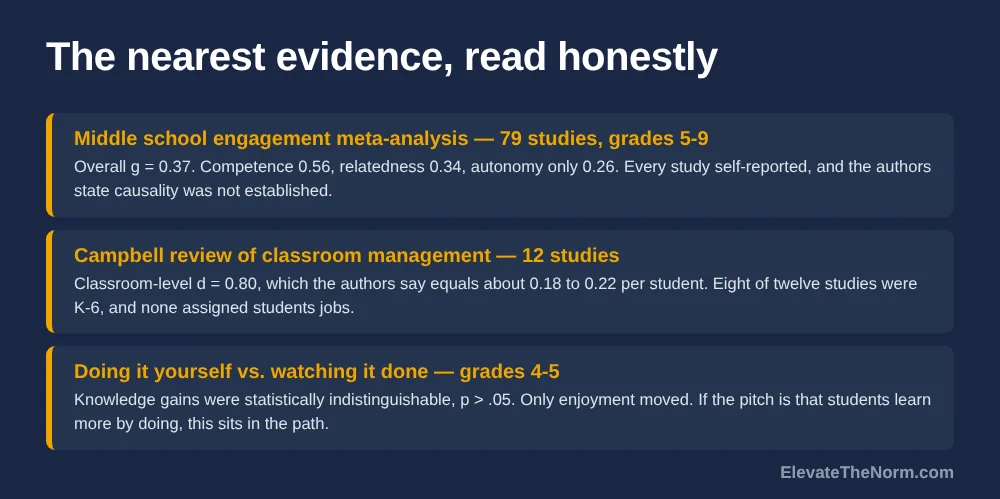
The first row carries the most useful number in this article. In that meta-analysis, competence — students feeling capable at what they are doing — was associated with more than twice the engagement that autonomy was. Giving a teenager a choice of job is the autonomy half. Making sure they are visibly good at it is the competence half, and it is the one that appears to carry the weight. A job a student fumbles in front of the room every day is a job that is costing them something.
Which classroom jobs work in middle and high school?
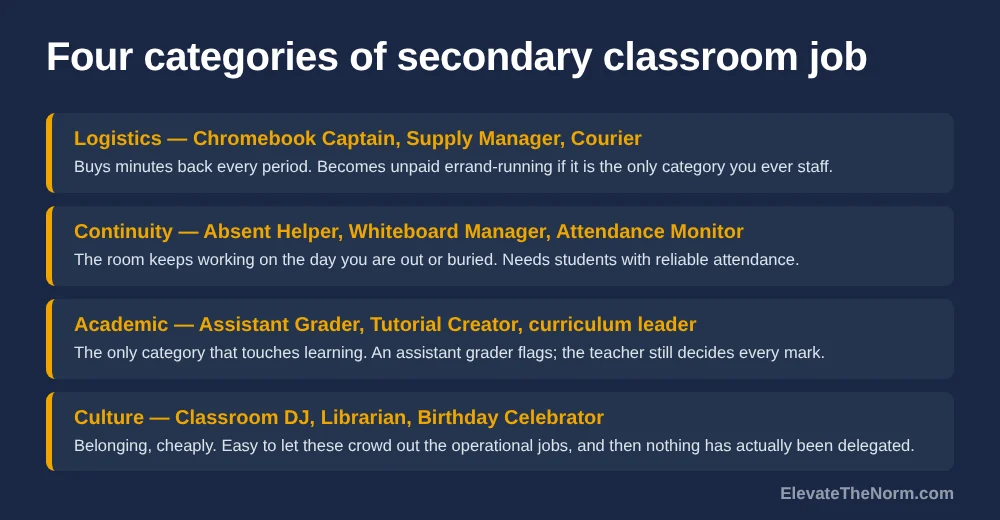
The jobs that survive in secondary rooms are the ones that solve a problem the teacher actually has. Every job in the table below is drawn from a documented secondary program, not invented for this article.
| Category | Real examples | What it buys you | Failure mode |
|---|---|---|---|
| Logistics | Chromebook Captain, Supply Manager, Courier, Binder Keeper | Minutes back every period, and a student who knows the system better than a substitute would | Becomes unpaid errand-running if that is all you ever assign |
| Continuity | Absent Helper, Whiteboard Manager, Attendance Monitor, Drill Assistant | The room keeps working on the day you are out or buried. The absent-work pile stops being yours | Needs reliable attendance; the one teacher-written caution is that a Drill Assistant should be “rarely absent” |
| Academic | Assistant Grader, Tutorial Creator, curriculum leader | The only category that touches learning. A student who builds a tutorial has to understand the thing first | Privacy and fairness limits — an assistant grader flags, the teacher decides. Never let a student assign a classmate’s grade |
| Culture | Classroom DJ, Birthday Celebrator, Librarian, Athletic Trainer (runs a movement break) | Belonging, cheaply. These are the jobs students want and the ones that make the system feel like theirs | Easy to let these crowd out the first three categories, and then nothing operational is actually delegated |
The academic row needs a boundary drawn hard. In the documented system, an assistant grader flags mistakes for the teacher to review — the teacher still grades. A student handling another student’s graded work raises obvious privacy questions, and the safe version keeps a student away from anything with a classmate’s name and score on it. Objective-answer checking against a key, with the teacher entering every mark, is a line that holds.
At the far end, one New York high school runs student “curriculum leaders” who co-plan and sometimes teach lessons. Those students apply, get about ten hours of paid summer training, and attend two planning sessions a week with the teacher. That is a serious program with a real budget behind it, and it is included here as the upper bound of what this idea can become — not as something to start in February.
Where should you draw the line on what a student job can touch?
At student records, at grades, and at anything safety-critical. Those three lines are not in any of the teacher-written sources, and they should be, because two of the documented jobs walk right up to them.
- Attendance is a legal record, not a classroom chore. One documented job has a student recording attendance, tardies and early dismissals on official documents, and reporting absences to another student. Who was absent is education-record information about a classmate, and attendance data gets used in truancy proceedings. Have the student prompt you — “three empty seats, row two” — and enter it yourself. The time you save is the same; the record stays yours.
- A student never determines another student’s grade. Flagging a likely mistake for you to check is fine. Scoring, entering, or handling a paper with a classmate’s name and grade on it is not, and there is no version of a classroom job that makes it fine.
- Nothing safety-critical during a drill or an emergency. A documented Drill Assistant closes blinds, helps line students up, and takes attendance outside. Helping is fine. Being depended on in a lockdown is not, because the entire point of a drill is that the adult is accountable for every body in the room. Build the job so that if that student is absent, or frozen, nothing fails.
These are not reasons to skip classroom jobs. They are the three places where “give teenagers real responsibility” runs into obligations that are genuinely yours and cannot be delegated, and a system that respects them is easier to defend to an administrator or a parent who asks.
How do you set up a classroom job system?
Start late, start small, and make students apply. The documented programs agree on those three things more than they agree on anything else.
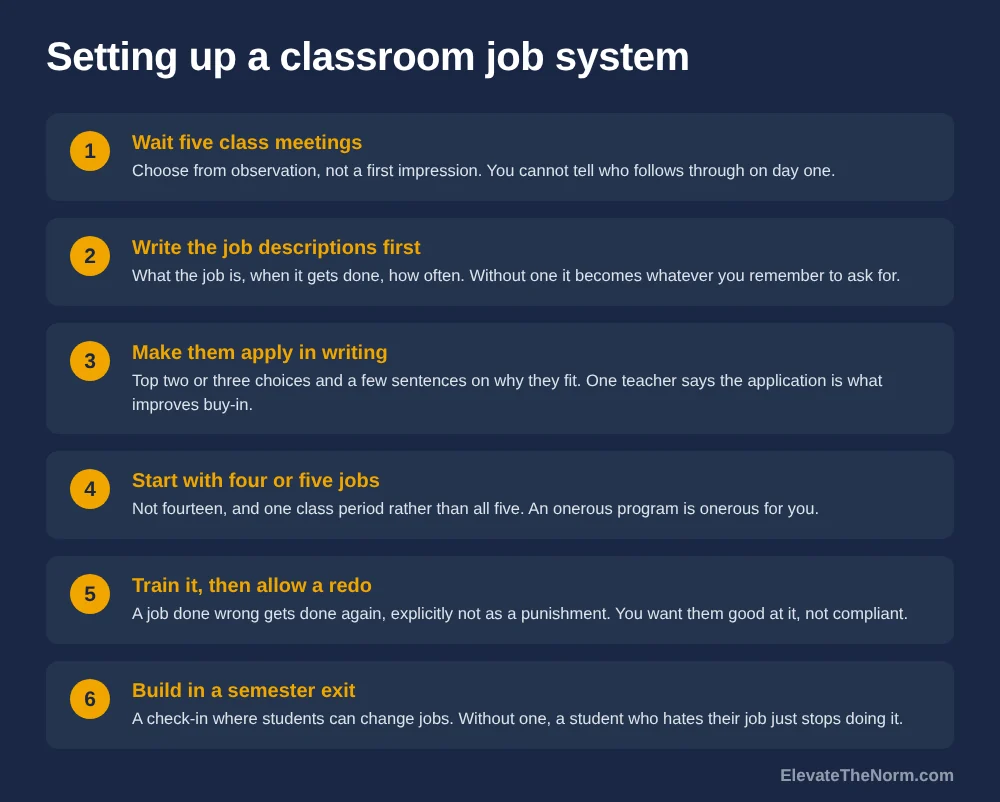
- Wait at least five class meetings before you assign anything. The teacher running the largest documented system waits that long deliberately, so she is choosing from observation rather than from a first impression. You cannot tell who will follow through on day one.
- Write the job descriptions before you advertise them. Each one says what the job is, when it gets done, and how often. A job without a written description becomes whatever you remember to ask for.
- Make them apply, in writing, for their top two or three. A few sentences on why they fit. One teacher says the application is what “improves buy-in,” and it costs you a single form. It also tells you something about students you would not otherwise learn.
- Start with four or five jobs, not fourteen. The published advice is to ease in and cap the number so the program does not become onerous — and the person who has to run an onerous program is you.
- Train the job, then let them redo it. The documented practice is that a job done wrong gets done again, explicitly “not as a punishment.” That is the competence half of the research in practice: you are not looking for compliance, you are making sure they end up good at it.
- Build in an exit. One documented system runs a check-in at the semester where students can change jobs. Without that, a student who has quietly hated their job since September has no honorable way out, and the job just stops getting done.
Notice what is not on that list: a reward. None of these steps depends on paying students or grading them, and the systems that work seem to run on the job being real rather than on what the student gets for it. That is worth testing against your own room before you build an economy around it.
Should students be paid or graded for classroom jobs?
Not graded. A classroom job is not academic evidence, and a grade that moves because a student forgot to update the whiteboard is a grade that no longer means what the gradebook says it means. Keep behavior and academic evidence separate, which is the same principle that governs every other procedure in the room.
Payment is a genuine fork, and the documented programs go both ways. One pays in classroom currency every time the job is performed. Another appears to pay nothing at all and runs on the application process and the job itself. The high school curriculum-leader program pays students hourly out of the school budget, which is a different thing entirely — that is employment, not a motivational device.
My read is that the no-payment version is the one that matches what a job is supposed to teach. The moment the duty has a price, the student is entitled to decide whether the price is worth it, and some days it will not be. That is a reasonable trade for a worker and the wrong lesson for a classroom — and it quietly converts “this room needs you” into “this room will compensate you.” If you are already running a classroom economy for other reasons, folding jobs into it is defensible. Starting an economy to make jobs work is solving the wrong problem.
Why do classroom job systems fail in secondary?
Four ways, and all four are predictable enough to design around.
- The jobs are not real. If the room runs identically whether or not the job gets done, students work that out in about two weeks. Teenagers are good at detecting manufactured responsibility and they resent it, correctly. Only delegate something you would otherwise have to do yourself.
- The teacher keeps doing the job anyway. This is the most common failure and the hardest to fix, because it feels like helpfulness. The second you update the whiteboard yourself because it is faster, the Whiteboard Manager’s job has been retired and nobody told them.
- One absence breaks it. With five class periods and one holder per job, any absence takes a function offline. The documented fix is a designated substitute — one student able to cover most other jobs — which is cheaper than it sounds.
- It becomes a reward for the compliant. If the same four students hold every job, you have built a merit system, not a responsibility system, and the students who would benefit most from being needed are the ones watching. Rotating at the semester is the minimum correction.
That last one deserves more weight than it usually gets. The student who is disengaged, behind, or quietly written off is exactly the student for whom being the only person who knows how the loaner chargers work might matter. Handing every job to the reliable kids is the path of least resistance and it wastes the main thing the system is good for.
Clay’s take
I would not sell this to an administrator on achievement, because the evidence is not there and pretending otherwise is how good practices get discredited two years later. The strongest honest claim is narrower: giving teenagers real operational responsibility is consistent with what this site argues everywhere else, and the nearest research says the engagement return is real but modest — around a quarter of a standard deviation, self-reported, in studies that do not establish causality.
What I would defend is the principle underneath it. If you believe responsibility is something students develop by carrying it rather than something they earn the right to carry, then a room where the adult does every operational task is a room with no practice field. The job is the practice field. That argument does not need an effect size, and it does not get one from this literature.
The part I would hold teachers to is follow-through, because this is a system that dies from the adult’s end, not the students’. If you tell a student the absent-work file is theirs and then quietly rebuild it yourself every Friday, you have taught them that your word about their responsibility is provisional. Respecting students is mostly a matter of doing exactly what you said you would do, every time, and a classroom job is a standing promise that you will not take the thing back.
What to do next
Write down every operational task you did yourself last week — passing papers, chasing absent work, setting up the cart, updating the board, hunting for a charger. Circle the three that genuinely do not require your professional judgment. Those are your first three jobs, and you now have job descriptions, because you just described them.
Then wait. Give it five class meetings, put the three descriptions on a form, and let students apply. Start one period, not all five. At the end of the quarter the question to ask is not whether students liked it — they will say yes — but whether any of those three tasks came back to you. If they all did, the system is not running, whatever the chart on the wall says. If one of them has genuinely left your plate, that is the one to build on, and the wider set of leadership roles is the next place to look.
Frequently Asked Questions
What are good classroom jobs for middle school students?
The jobs that survive in middle school are the ones that solve a problem the teacher actually has. Documented examples include Chromebook Captain, Supply Manager, Absent Helper, Whiteboard Manager, Attendance Monitor, Classroom DJ and Librarian. The test is simple: if the room would run identically without the job being done, it is not a real job and students will work that out quickly.
Do classroom jobs work in high school?
They are used in high school, including a New York program where student curriculum leaders co-plan and sometimes teach lessons after about ten hours of paid summer training. But no study has tested classroom jobs in any secondary classroom. Every detailed account available is a teacher describing their own practice, with no comparison group and no measured outcome.
Is there research showing classroom jobs improve behavior or achievement?
No direct research exists. The nearest evidence is adjacent: a meta-analysis of 79 middle school studies puts overall engagement at g = 0.37 and autonomy at 0.26, all self-reported, with the authors stating causality was not established. A Campbell review of classroom management reports a classroom-level d of 0.80 that equals roughly 0.18 to 0.22 per student, and none of its included interventions assigned student jobs.
Should you pay students for classroom jobs?
Documented programs go both ways: one pays in classroom currency each time a job is performed, another runs on the application process alone, and one high school pays curriculum leaders hourly from the school budget. The case against payment is that once the duty has a price, students are entitled to decide the price is not worth it. If you already run a classroom economy, folding jobs in is defensible; starting one to make jobs work is not.
How many classroom jobs should I start with?
Four or five, not fourteen. The published advice is to ease in and cap the number so the program does not become onerous, and the person who has to run an onerous program is the teacher. Start with one class period rather than all five, and add jobs only once the first few are genuinely off your plate.
How do you assign classroom jobs fairly?
Have students apply in writing for their top two or three choices and explain why they fit, and wait at least five class meetings so you are choosing from observation rather than a first impression. Rotate at the semester with a check-in where students can change jobs. If the same few reliable students hold every job, the system has become a merit reward rather than a responsibility structure.
Can a student help grade papers as a classroom job?
Only with a hard boundary. In the documented system an assistant grader flags mistakes for the teacher to review, and the teacher still grades. Keep students away from anything carrying a classmate’s name and score, limit the work to checking objective answers against a key, and enter every mark yourself. A classroom job should never let one student determine another student’s grade.
Isn’t a classroom job just a student doing the teacher’s work?
It is the teacher’s work, and that is the point only if the task is genuinely operational rather than instructional. Passing papers, tracking supplies and updating the board require no professional judgment, and a student who owns one gains a standing role in how the room runs. The fair objection is time: a job should cost a student seconds at the edges of a period, never minutes of instruction, and no job should be large enough that a student is choosing between it and their own learning.
Sources
- Aker, L. B., & Ellis, A. K. (2019). A Meta-Analysis of Middle School Students’ Science Engagement. International Dialogues on Education, 6(1), 9–24. Full text. 79 studies, 158 effect sizes, combined N = 53,971, participants aged 10–15. Source of the overall g = 0.37 and the autonomy, competence and relatedness figures. Important limits the authors state: engagement was measured by student self-report in every study, causality “was not established by this study,” and published studies averaged g = 0.40 against g = 0.15 for unpublished ones. US studies averaged 0.24 and middle-school-only samples 0.16. Classroom jobs were not a coded category.
- Oliver, R. M., Wehby, J. H., & Reschly, D. J. (2011). Teacher classroom management practices: Effects on disruptive or aggressive student behavior. Campbell Systematic Reviews, 2011:4. Full text. 12 included studies. Source of the classroom-level d = 0.80 and d = 0.71 figures and the authors’ own statement that these correspond to student-level effects of about 0.18 and 0.22. Eight of the twelve studies were K–6 and seven of the twelve came from a single research group evaluating its own program. No included intervention assigned students classroom jobs, and the outcome measured was disruptive behavior only.
- Ou, C.-y., Xu, S.-R., Lu, C.-T., Zhou, S.-N., & Xiao, H. (2021). The effects of autonomy-supportive and controlling teaching behaviors on primary students’ STEM learning performance and flow experience. Journal of Baltic Science Education, 20(6), 942–955. Full text. 82 students analyzed, grades 4–5, a voluntary summer camp in Guangdong, China. Source of the finding that students who ran the experiment themselves and students who watched a demonstration did not differ on knowledge, F(1,80) = 0.365, p > .05, while the enjoyment subscale differed at η² = 0.118. Cited here as primary-age, out-of-school evidence, not as a secondary classroom result.
- Gonser, S. (2026, February 6). Why Middle (and High) School Students Should Have Class Jobs. Edutopia. Article. Source of the five-class-meetings rule, the written application, the advice to limit the number of jobs, the named job list, and the Brooklyn Preparatory High School curriculum-leader program including its roughly ten hours of paid summer training and two weekly planning sessions. Cites no research and reports no measured outcomes; the community claim quoted in this article is one teacher’s observation of her own classroom.
- Gonzalez, J. (2021, February 7). Classroom Jobs — interview with Thom Gibson. Cult of Pedagogy. Article and transcript. Source of the top-three application, the per-job checklists, the designated substitute role, the assistant grader who flags rather than grades, and the practice of having a job redone “not as a punishment.” Cites no studies. Gibson is a middle school STEM teacher describing his own system.
- Howard, M. Classroom Jobs Descriptions and Application Form, adapted with permission from Martha Larkin, shared by Edutopia. PDF. Source of the fourteen named job descriptions, the semester check-in, the caution that a Drill Assistant should be “rarely absent,” and the only classroom-currency payment model found in any source read for this article.
- Yalçın, A., & Güleç, S. (2022). The Effect of Responsibility-Based Activities in Social Studies Course on Gaining the Value of Responsibility to Students. European Journal of Educational Sciences, 9(2), 74–89. Full text. Read and deliberately not used as support. It is the closest study by title, but its “responsibility-based activities” are value-education lessons rather than assigned duties, the sample was 37 grade-5 students in Turkey, the outcomes were a researcher-built test and a self-report scale, and no effect sizes were printed. Listed here so nobody mistakes it for evidence that classroom jobs build responsibility.
- What is not cited, and why. A US dissertation on classroom-assigned tasks could not be retrieved and is not cited. No number in this article comes from a source that was not opened and read, and no effect size is attributed to classroom jobs themselves, because no study of them exists.