By Clay Shumate
A KWL chart is a three-column chart — Know, Want to know, Learned — that students fill in before and after reading. In grades 6–12 it earns its place as a diagnostic, not as a comprehension treatment. No US secondary trial of it exists, and the federal practice brief for grades 4–12 recommends activating prior knowledge in under five minutes without ever naming KWL.
Key Takeaways
- KWL is forty years old and still has no strong secondary study behind it. The four studies read for this article were conducted in Kuwait, Indonesia and Thailand. The closest one to a grades 6–12 classroom is a single grade-8 class comparison in Indonesia that never printed an effect size.
- The federal brief for grades 4–12 recommends what KWL does without recommending KWL. Boardman and colleagues tell teachers to “activate prior knowledge by previewing text before reading” and to use graphic organizers — and never name KWL, K-W-L or a Know-Want-Learned chart anywhere in the document.
- Five minutes is the cap, and most KWL lessons blow through it. That same brief states plainly that “previewing should not take longer than five minutes, especially if a teacher has limited time with students.”
- An open K column is the exact practice the brief warns against. It says to “avoid soliciting guesses from students without guidance or feedback.” A board filling up with unchecked claims about a topic students have not read about yet is that warning in action.
- The L column is the only part that closes a loop, and it is the part that gets cut. Nothing in the chart forces anyone to go back and correct what was wrong in the K column, which is where almost all of its instructional value sits.
What is a KWL chart?
A KWL chart is a three-column chart a student completes around a reading: what they Know about the topic, what they Want to know, and, after reading, what they Learned. The first two columns are filled in before the text is opened. The third is filled in after.
It comes from Donna Ogle, in a 1986 article in The Reading Teacher called “K-W-L: A teaching model that develops active reading of expository text.” Two things in that title matter and get dropped. It was built for expository text — textbooks, articles, informational writing, not novels. And Ogle framed it as a way for teachers to become more responsive to what students already know and want, which makes it a tool for the teacher as much as a worksheet for the student.
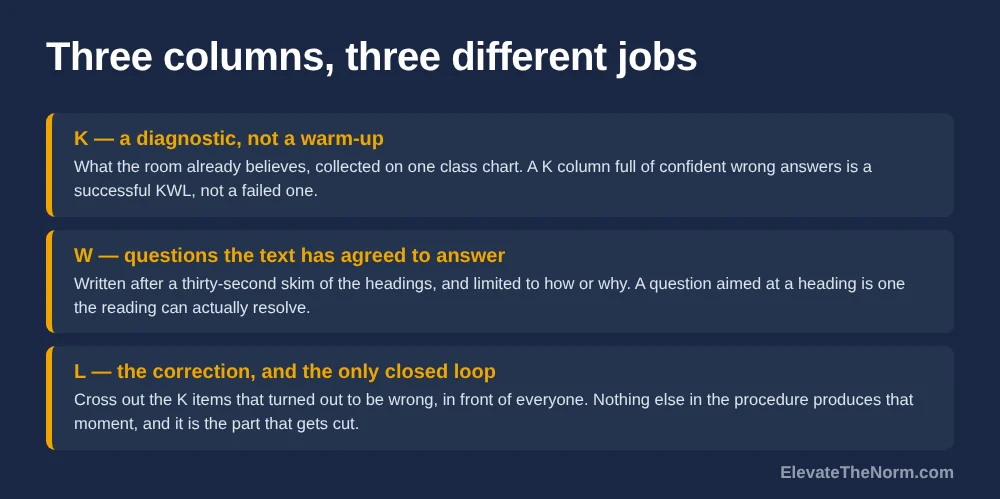
That distinction is worth holding onto, because it changes what a good KWL looks like. If the chart is a worksheet, the goal is filled boxes. If it is a diagnostic, the goal is finding out what the room believes before you teach into it — and a K column full of confident wrong answers is a successful KWL, not a failed one.
Does the research say KWL charts work?
Not in a way that transfers to a US secondary classroom. KWL is one of the most widely used reading procedures in American schools and one of the least tested. Every study read for this article was conducted outside the United States, mostly with students learning English as a foreign language, and none of them used a design strong enough to carry a causal claim.
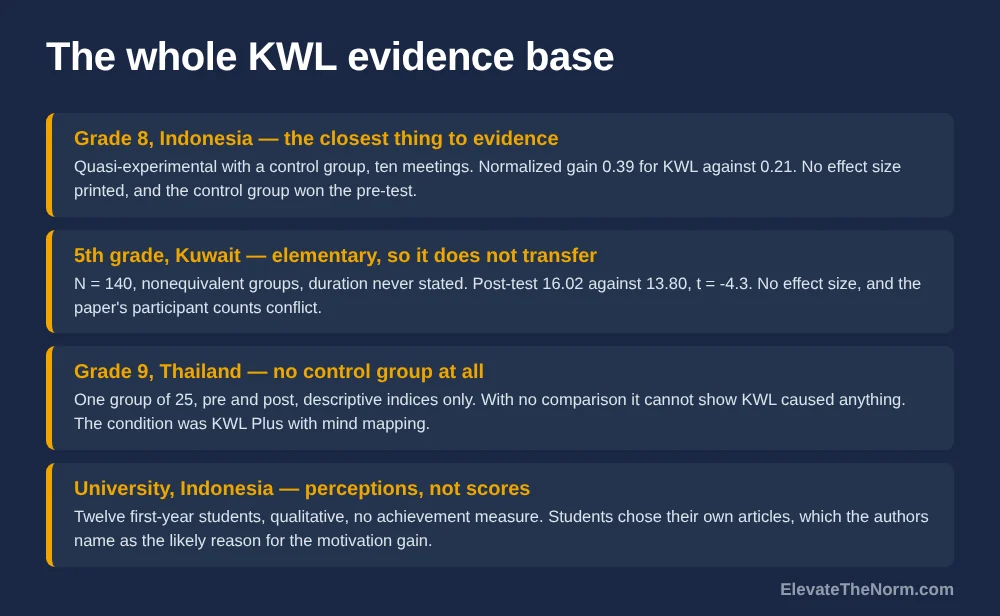
| Study | Population | Design | What it found |
|---|---|---|---|
| Panjaitan & Situmorang, Indonesia | Grade 8, one junior high school, about 68 students analyzed | Quasi-experimental, control group, 10 meetings over four weeks | Normalized gain 0.39 for KWL vs 0.21 for conventional teaching. No t, p or effect size printed; the control group started higher on the pre-test |
| AlAdwani et al. (2022), Kuwait | 5th grade EFL, two public schools, N = 140 | Quasi-experimental, nonequivalent groups, duration never stated | Post-test 16.02 vs 13.80 out of an unstated maximum, t = −4.3, p < .001. No effect size. Elementary, so it does not speak to secondary |
| Charusapsodsai & Intasena (2024), Thailand | Grade 9, one school, N = 25, convenience sample | One group, pre/post, no control group | Descriptive indices only, plus a 4.85/5 satisfaction score. With no comparison group this cannot show KWL caused anything |
| Diasti et al. (2023), Indonesia | University first-years, N = 12 | Qualitative, student perceptions, no achievement measure | Students said it helped them set goals and monitor reading. They also chose their own articles, which is a plausible reason on its own |
Read that table the way a teacher should read it. The grade-8 Indonesian study is a real comparison with a real control group, and its gain difference goes the right way. It is also one school, one teacher’s implementation, a sample size the paper reports three different ways, and a pre-test the control group won. The Thai grade-9 study has no comparison group at all, so it cannot tell you whether KWL beat doing nothing. The Kuwaiti study is fifth grade. The university study measured what twelve students said, not what they scored.
There is also a quiet circularity in this literature. The 2024 Thai paper cites the 2022 Kuwaiti paper as support for KWL’s effectiveness. They are not independent confirmations of each other — the newer one leans on the older one, and the older one is a fifth-grade EFL study that printed no effect size.
None of this means KWL does not work. It means nobody has run the study that would tell you, and anybody quoting you a clean number for it is rounding somebody else’s estimate. That is a different sentence from “it doesn’t work,” and the difference matters when you are deciding what to do Tuesday.
What does the evidence for grades 6–12 actually support?
It supports the two things KWL is made of, without supporting KWL. The strongest adolescent-specific document read for this article is Effective Instruction for Adolescent Struggling Readers, a practice brief by Boardman, Roberts, Vaughn, Wexler, Murray and Kosanovich for the Center on Instruction, covering reading “occurring between fourth and 12th grades.”
It has a heading called “Activate Prior Knowledge.” It has a heading called “Use Graphic Organizers,” which it defines as “visual representations that help students identify, organize, and remember important ideas,” and recommends using before, during and after reading. A KWL chart is a graphic organizer used before and after reading, so the family it belongs to is endorsed. The procedure itself is never named — not as KWL, not as K-W-L, not as a Know-Want-Learned chart, nowhere in the document or its reference list.
Four lines in that brief should change how you run one.
- “Previewing should not take longer than five minutes, especially if a teacher has limited time with students.” A KWL that eats fifteen minutes of a fifty-minute period has stopped being a preview.
- “Avoid soliciting guesses from students without guidance or feedback.” This is the open K column, described precisely. Unguided guessing is not activation.
- “Struggling readers may not automatically access prior knowledge that supports the new information.” The students whose K column comes back empty are not refusing to participate. They may not be able to retrieve what they do know without a prompt narrow enough to hook it. And from a fifteen-year-old’s side of the desk, being asked what you know about something you know nothing about is not a neutral request — it is a public invitation to look stupid. A student who writes nothing has usually made the safer choice.
- It recommends “giving students ample background knowledge before asking them to read texts that present new information.” Note the direction. Sometimes the right move is not to ask what they know — it is to tell them what they need.
That last point is the one most likely to improve a lesson tomorrow. Activating prior knowledge is useful when there is prior knowledge to activate. On a unit students have no purchase on at all, a KWL chart spends five minutes discovering an emptiness you could have filled in those same five minutes. We make the same argument about whether to build background before a close reading, and the answer is the same here.
Why does the W column break down?
Because you are asking students to generate questions about a text they have not read, and then grading the chart on whether the boxes are full. A student who knows nothing about the topic has no basis for a question worth asking, so they write something safe and generic, and the column fills up without anybody learning anything.
Three failure modes show up over and over, and all three have fixes that cost nothing.
- Questions the text will never answer. “What was it like to live then?” is a fine human question and a dead end for a two-page reading. Fix: have students skim the headings and subheadings first, then write questions. A question aimed at a heading is a question the text has agreed to answer.
- Yes-or-no questions. They are the fastest way to fill a box and the least useful thing in it. Fix: require that every question start with how or why. Two of those beat six of the other kind.
- Questions nobody returns to. If the W column is never read again, writing it was decoration. Fix: pick two questions from the class list, write them on the board, and make answering them the exit task. Now the column has consequences.
Teenagers are quick to spot a task with no consequences, and they are right to be. If the questions they write are never used, they will write whatever fills the space fastest, and that is a rational response to the assignment rather than a motivation problem. This is the same dynamic that makes performative annotation so easy to fake.
What happens to the L column?
It gets skipped, and skipping it removes the only part of the chart that does real instructional work. The L column is where a student finds out that something they wrote confidently in the K column twenty minutes ago was wrong. Nothing else in the procedure produces that moment.
Here is the version worth running. Do not just ask what they learned. Ask three things, in this order:
- Which of our K items turned out to be wrong? Cross it out on the class chart, in front of everyone. This is the whole point and it takes ninety seconds.
- Which of our W questions did the text answer? Write the answer next to the question.
- Which of our W questions did the text not answer, and where would you look? This is the one that treats them like people who can go find out, and it is the natural bridge into the next day’s reading.
Crossing out a wrong K item in public only works in a room where being wrong is survivable. If a student thinks a crossed-out line is a mark against them, they will stop volunteering anything in the K column, and the diagnostic dies. The chart depends on the culture, not the other way around.
How do you run a KWL chart in one fifty-minute period?
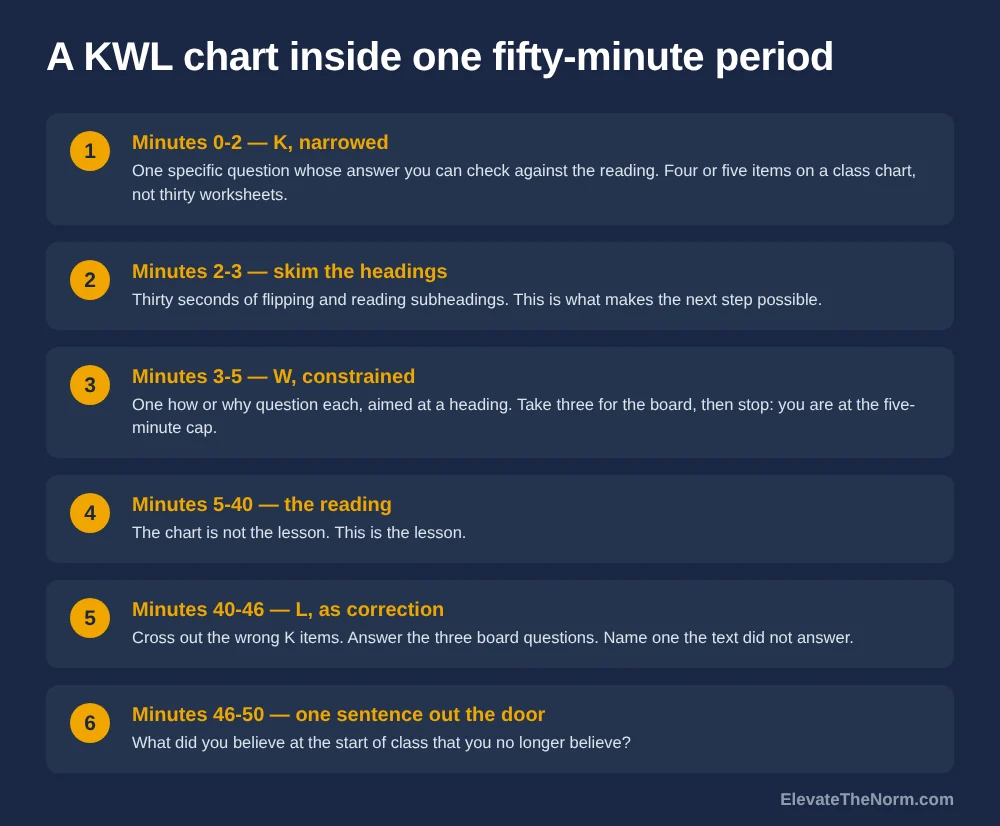
Keep the front end under five minutes, spend the time on the reading, and protect four minutes at the end for the L column. Here is the shape that fits a real period.
- Minutes 0–2 — K, narrowed. Not “what do you know about the Industrial Revolution.” Ask one specific question whose answer you can check against the reading. Collect four or five items on a class chart, not individual worksheets.
- Minutes 2–3 — skim the headings. Thirty seconds of flipping and reading subheadings. This is what makes the next step possible.
- Minutes 3–5 — W, constrained. Each student writes one how or why question aimed at a heading they just saw. Take three for the board. Stop there; you are at the five-minute cap.
- Minutes 5–40 — the reading and the actual work. The chart is not the lesson. This is the lesson.
- Minutes 40–46 — L, as correction. Cross out the wrong K items. Answer the three W questions on the board. Name one the text did not answer.
- Minutes 46–50 — one sentence out the door. “What did you believe at the start of class that you no longer believe?” Collect it. That single sentence tells you more about the period than a completed three-column worksheet.
One class chart beats thirty worksheets for a different reason than time. On a class chart, a wrong K item belongs to the room, so crossing it out costs nobody anything personally. On a worksheet, it belongs to one student.
When should you use something else instead?
Often. KWL is one pre-reading tool with one shape, and the shape fits a narrow case: expository text, on a topic students have some real purchase on, where you want to know what they believe before you teach.
| Use this | When | Front-end time | Main drawback |
|---|---|---|---|
| KWL chart | Informational text, topic students have some footing on, you want a diagnostic | 5 minutes if disciplined | Student-generated questions are often unanswerable by the text |
| Anticipation guide | The text argues something, or students hold a common misconception you can name in advance | 3–5 minutes | You have to write the statements, which takes real prep time |
| Straight preview | Students have little or no background on the topic | 2–3 minutes | No diagnostic; you learn nothing about what the room believes |
| Front-load the background | The topic is genuinely new and the reading assumes knowledge they do not have | 5–10 minutes | Costs reading time, and you are telling rather than asking |
An anticipation guide is the sharper instrument when you already know the misconception. You write the statement, students commit to agree or disagree, and the disagreement is the lesson. A KWL finds out what they think; an anticipation guide tests what you suspect. For vocabulary-heavy readings, a four-box word card does more than either.
Does KWL work better for English learners?
That is where almost all of the evidence comes from, which cuts both ways. Three of the four studies above were conducted with students learning English as a foreign language, and the fourth was in a Thai school. So the honest statement is that the research base for KWL is mostly a research base about language learners — and the reason is not hard to guess. A chart that separates what you know from what you want to ask gives a student a frame to write in when the language itself is the obstacle.
What that does not license is the reverse claim. None of those studies compared English learners to native speakers, so none of them shows KWL works better for one group than the other. And an EFL classroom in Kuwait or Indonesia is not an English-language-learner’s seat in a US social studies class, where the content load and the pace are different problems. Use the structure if the frame helps a student get started. Do not tell a colleague the research says it is an EL strategy, because that is not what these four papers tested.
Should a school require KWL charts in lesson plans?
No. Requiring a named procedure that has no secondary evidence base turns a five-minute diagnostic into a compliance item, and compliance items get performed rather than used. If a walkthrough rubric has a box for “activates prior knowledge,” that box is defensible — the practice brief for grades 4–12 recommends it by name. A box for “KWL chart” is not, because the same brief never mentions one.
For anyone doing observations, the useful question is not whether the chart appeared. It is whether the front end stayed inside five minutes, and whether anything in the last ten minutes of the period referred back to what students wrote at the start. A room where the chart went up and was never mentioned again scored a completed KWL and taught nothing with it. That is the failure worth naming in a post-observation conversation, and it costs a teacher nothing to fix.
One more thing worth deciding at the building level: a KWL does not have to be a per-reading ritual. Running one chart across a whole unit — opened on day one, corrected on the last day — costs five minutes a unit instead of five minutes a period, and the L column gets more to work with. If a department wants the structure, that is the version that survives a real semester.
Clay’s take
My read on the evidence is that KWL survives on being easy to explain rather than on anything it has been shown to do. Forty years, no US secondary trial, and the one federal brief written for grades 4–12 endorses the mechanism without naming the method. That is not a scandal. It is a reminder that the staples of this profession get passed along because they are teachable in a ten-minute faculty meeting, not because somebody tested them on fifteen-year-olds.
What I would defend is the diagnostic. If I want to know what a room of teenagers already believes about a topic before I open my mouth, a narrowed K column gets me that in two minutes, and the L column gives me a way to show them their own thinking changed. That is worth two minutes. What I would not defend is the three-column worksheet as an end in itself, graded on completion, with questions nobody returns to. That version asks students to perform participation, and teenagers can tell the difference between a task that matters and a task that fills a square.
The honest summary is narrower than what you will read elsewhere: use it where there is something to diagnose, cap it at five minutes, and spend your effort on the L column, because that is the only column that changes anybody’s mind.
What to do next
Pick one informational reading you are already assigning this week. Write a single narrow K question whose answer appears in the text, and time yourself: if the K and W columns take longer than five minutes, cut them, not the reading. Protect six minutes at the end and spend them crossing out wrong K items in front of the class. Then ask for one sentence on the way out: what did you believe at the start of class that you no longer believe?
If the chart is already part of your routine and it feels dead, check the W column first. Read the questions your students wrote last time and count how many the text could possibly have answered. If the answer is most of them, the procedure is fine and the texts may be too long. If the answer is almost none, the fix is the thirty-second heading skim before anybody writes a question. And if your students are strong readers who do not need the scaffold, the study-skills evidence points at better uses of those minutes.
Used as a diagnostic, a KWL chart is one instance of a wider move: finding out what students know before you teach. That move has its own research literature, and it is thinner than its popularity suggests. Pre-assessment in grades 6–12: what the evidence shows covers why two widely cited articles report the same study differently, what secondary classrooms actually have to go on, and the conditions under which the time is worth spending.
Frequently Asked Questions
What is a KWL chart used for?
A KWL chart is used to find out what students already know about a topic, what they want to find out, and what they learned after reading. It comes from Donna Ogle’s 1986 article in The Reading Teacher and was built for expository text such as textbooks and articles, not for fiction. Its most defensible use in grades 6-12 is as a quick diagnostic before teaching, not as a graded worksheet.
Is there research proving KWL charts work?
No strong research for US secondary students. The four studies read for this article came from Indonesia, Kuwait and Thailand. The closest to a secondary classroom is a grade-8 Indonesian comparison that reported a normalized gain of 0.39 for KWL against 0.21 for conventional teaching, but printed no effect size and had a control group that scored higher on the pre-test. One grade-9 study had no control group at all.
Are KWL charts just for elementary students?
They are used most often in elementary classrooms, and some of the research is elementary, but nothing about the procedure is age-bound. The adjustment for grades 6-12 is to narrow the K question so answers can be checked against the text, require how or why questions in the W column, and use the L column to correct what was wrong in K rather than to list what was covered.
How long should a KWL chart take in class?
Under five minutes for the K and W columns. The federal practice brief for grades 4 to 12 states that previewing should not take longer than five minutes, especially when a teacher has limited time with students. Reserve about six minutes at the end of the period for the L column, which is where the chart does its real work.
What do you do when students write nothing in the K column?
Narrow the question, and consider teaching the background instead of asking for it. The same federal brief notes that struggling readers may not automatically access prior knowledge that supports new information, and recommends giving students ample background knowledge before asking them to read texts presenting new material. An empty K column is often a signal to front-load, not a motivation problem.
What is the difference between a KWL chart and an anticipation guide?
A KWL chart asks students to generate what they know and want to know, so it discovers what the room thinks. An anticipation guide gives students teacher-written statements to agree or disagree with, so it tests a misconception you already suspect. Use KWL when you want a diagnostic, and an anticipation guide when you can name the misconception in advance and have prep time to write the statements.
Should you grade a KWL chart?
Grade it for completion at most, and preferably not at all. A chart graded on full boxes teaches students to fill boxes, which is how the W column fills with yes-or-no questions nobody returns to. If you want an accountable product, grade the one sentence students write on the way out naming something they believed at the start of class and no longer believe.
Sources
- Ogle, D. M. (1986). K-W-L: A teaching model that develops active reading of expository text. The Reading Teacher, 39(6), 564–570. Abstract and citation via Reading Rockets. The 1986 article itself was not reachable and was not read for this piece. Only the abstract was read, which is the source of the expository-text framing and of Ogle’s stated purpose of helping teachers respond to what students know and want. The column-by-column procedure described here is the standard form of the chart, presented without attribution to the original paper rather than as a quotation from a source nobody on this end has opened.
- Boardman, A. G., Roberts, G., Vaughn, S., Wexler, J., Murray, C. S., & Kosanovich, M. (2008). Effective Instruction for Adolescent Struggling Readers: A Practice Brief. Portsmouth, NH: RMC Research Corporation, Center on Instruction. Full text. Read in full. Source of the five-minute previewing cap, the warning against soliciting unguided guesses, the note that struggling readers may not automatically access relevant prior knowledge, the recommendation to supply ample background before reading, and the graphic-organizer definition. It never names KWL — its evidence base is adolescent struggling readers, including students with learning disabilities, and it assigns no formal evidence grades.
- Panjaitan, N. B., & Situmorang, R. The Effectiveness of K-W-L Technique to Increase Students’ Reading Comprehension Achievement Through Reading Descriptive Text for Grade 8 of SMP Negeri 1 Cisarua. Universitas Advent Indonesia, pp. 35–44. Full text. Treatment ran February 2014 across ten meetings. The journal name and year are not printed in the retrieved text, so they are not stated here. The paper reports its sample as 38/36, then 34/38, then 68 total, and prints no t, p or effect size despite claiming significance.
- AlAdwani, A., AlFadley, A., AlGasab, M., & Alnwaiem, A. F. (2022). The Effect of Using KWL (Know-Want-Learned) Strategy on Reading Comprehension of 5th Grade EFL Students in Kuwait. English Language Teaching, 15(1), 79–91. Full text. Fifth grade, so cited here as elementary EFL evidence only. The paper’s participant counts conflict between its text and its first table, it reports no effect size, and its abstract calls KWL the “most important predictor” of comprehension without printing any regression to support that.
- Charusapsodsai, K., & Intasena, A. (2024). Integrating KWL Plus Technique with Mind Mapping to Develop Reading Comprehension Skills of Thai 9 Graders. Higher Education Studies, 14(4), 235–240. Full text. One group of 25, no control group, descriptive indices only. The paper describes its result as an “82% increase in learning progress”; that figure is a ratio index rather than a score gain, so it is not repeated as a percentage here. The condition was KWL Plus combined with mind mapping, not KWL alone.
- Diasti, K. S., Murniati, C. T., & Hartono, H. (2023). The implementation of KWL strategy in EFL students’ reading comprehension. Journal of English Teaching, 9(2), 176–185. Full text. Twelve first-year university students, qualitative, no achievement measure. Source of the student-perception findings on goal setting and monitoring. Students selected their own reading passages, which the authors themselves name as the likely reason for the reported motivation gain.
- What is not cited, and why. Several widely circulated KWL claims were traced to practice-oriented articles with no data behind them, and a 2013 critique of KWL charts could not be retrieved. No effectiveness number in this article comes from a source that was not opened and read, and no effect size is quoted for KWL because none of the four studies printed one.