
You recover from teacher burnout by changing the job, not by toughening up. Subtract a recurring demand, get real mental distance from work on ordinary weeknights, make one specific ask of the person who can grant it, and give it months rather than a long weekend. Recovery is slow, uneven, and mostly structural.
That is not the answer most of us want. The one we want is a habit — a morning routine, a hard stop at 4:00 — because a habit is something you can start on Monday without asking anybody for permission. The research is not especially kind to that hope, and it is not useless either. This page is about the difference, and about what moves once you are past the point where prevention advice helps.
Key Takeaways
- Recovery is a different problem from prevention. Prevention keeps the tank from emptying. Recovery starts after it is empty, and advice for one is often useless for the other.
- Summer does not do the work. In a Dutch study tracking employees ten times around a long vacation, well-being peaked on the eighth day away and had entirely faded by the first day back.
- Detachment is the best-supported off-job lever. A meta-analysis of 91 samples and 38,124 employees found mentally switching off from work tracked lower exhaustion, less fatigue and better sleep — though the data are correlational.
- Subtract before you add. Burnout is a mismatch between demands and resources. Ending one recurring demand moves that equation further, and costs less, than adding one more practice to an already full life.
- Give it months, and expect an uneven line. In a Swedish follow-up of people treated for clinical exhaustion, recovery was long and fluctuating, and about a third still met the criteria six to ten years later.
- Programs aimed at the individual teacher help a little. Across 23 controlled trials the overall effect was d = 0.18 — small, real, and close to zero on the cynicism dimension.
- No web page can tell you what you have. If it follows you home into sleep, appetite, and things that have nothing to do with school, that is a conversation with a person.
Free Download · 2-page PDF
The Teacher Burnout Recovery Plan
A demand audit on page one, the four recovery experiences and a check-back log on page two, and a place to write the one specific ask. A planning worksheet — not a screening tool, not a score, and nothing on it can tell you what you have.
Free. No email address required. Designed for grades 6–12. Browse every printable in Your Free Library.
How Do You Actually Recover From Teacher Burnout?
You change the demands, the resources, or both — and then you wait longer than you think you should have to. There is no version of this where the job stays identical and you come back different.
The reason is in the definition. The World Health Organization calls burn-out “a syndrome conceptualized as resulting from chronic workplace stress that has not been successfully managed,” and says plainly that it is not classified as a medical condition and refers specifically to the occupational context. It is a work problem. Christina Maslach, whose framework has organized this field for forty years, puts the mismatch in six places a job and a person come apart: workload, control, reward, community, fairness and values. Her conclusion after decades of it is blunt: organizational intervention can be more productive than individual intervention.
Which puts a teacher in an awkward spot. The biggest levers belong to the building, and you still have to do something on Monday. So the honest framing is not “seven habits that will fix you.” It is: here is the part of the equation you can reach, roughly what it is worth, and what to ask someone else for.
Why Didn’t the Summer Fix It?
Because time off restores you and then hands you straight back to the thing that emptied you. Vacation works while you are on it. It is not a treatment for the conditions you return to.
One study makes this uncomfortably concrete. De Bloom, Geurts and Kompier tracked 54 Dutch employees at ten points around a long vacation — before, during, the first day back, and weekly for a month after. Health and well-being climbed during the break and peaked on the eighth day. Then, in the authors’ own words, “on the first day of work resumption, positive vacation effects on H&W have already entirely faded out.”
Two caveats, because this gets repeated badly. That was 54 people in mixed occupations, not teachers, and a study that small should move your expectations rather than settle anything. And “faded out” does not mean the break was pointless — it means the gain was a state, not a cure. So if you rested all summer and walked back into October feeling exactly the same, nothing is wrong with you. You rested. You did not change anything that was doing the draining.
How Long Does Recovery From Teacher Burnout Take?
Nobody can give you a number, and anybody who does is guessing. What the research supports is a direction: months rather than weeks, uneven rather than steady, with setbacks that are part of the shape instead of evidence you failed.
The closest thing to a long view comes from Sweden, where severe stress-related exhaustion is a clinical diagnosis in its own right. Aronsson and colleagues interviewed 38 people six to ten years after they were treated at a stress rehabilitation clinic. They described what the paper calls a long and ongoing process where recovery activities are needed every step of the way — a fluctuating path, not a ramp. And approximately one third of the participants still fulfilled the criteria for exhaustion disorder at that follow-up.
Read that carefully, because it is easy to misread toward despair. Those 38 people had a clinical diagnosis severe enough to land them in a rehabilitation program — not the same condition as the occupational burnout the WHO describes, and not a forecast for a teacher who is exhausted in April. It is a small, self-selected Swedish sample and the authors call their own figure tentative. What it is good for is this: if even the severe end takes years and wobbles, a six-week timeline from a blog post is a made-up number.
The practical version: judge the change by whether the demand actually went away, not by how you feel on any given Thursday. Feelings lag structure by a long way.
Which Recovery Steps Actually Have Research Behind Them?
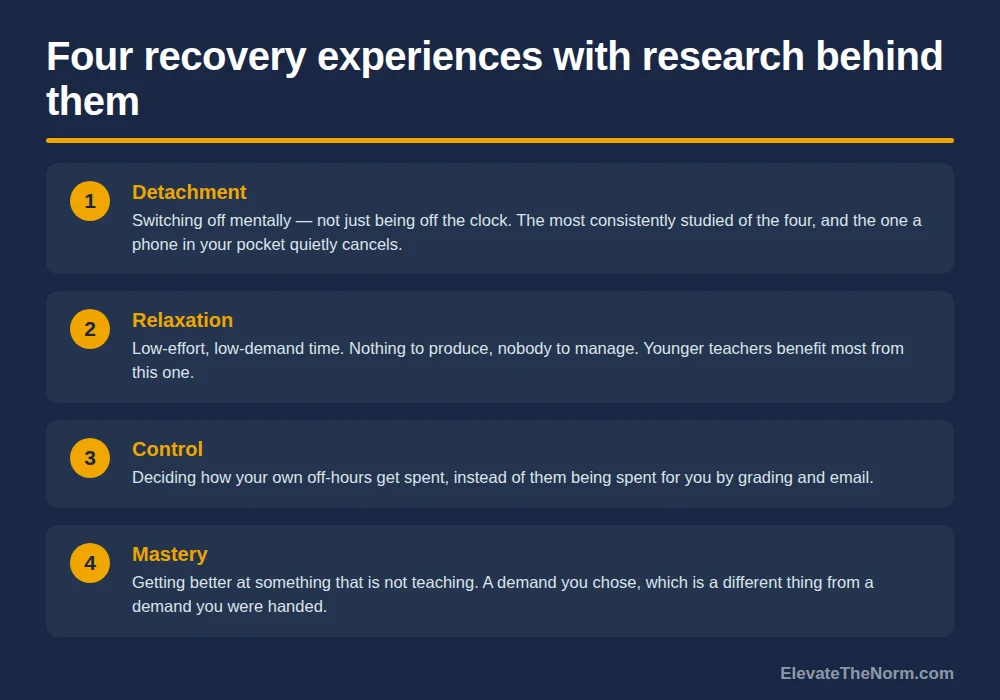
Four off-job experiences come up again and again: detachment, relaxation, control and mastery. Detachment — mentally switching off from work, not merely being off the clock — has the strongest track record of the four.
Wendsche and Lohmann-Haislah pooled 91 independent samples covering 38,124 employees and found detachment from work correlated at r = −0.36 with burnout-related exhaustion, −0.42 with fatigue, and 0.30 with sleep. Those are not small numbers for this literature.
They are also not proof, and the authors say so. The evidence is mostly self-reported and individual-level, longitudinal data remain rare, and there is a reverse reading nobody has ruled out: exhausted people may simply find it harder to stop thinking about work. Detaching may be partly a symptom of being okay rather than the cause of it. Treat it as a strong lead, not a prescription.
The teacher-specific data is thinner but it exists. Virtanen, De Bloom and Kinnunen surveyed 909 Finnish teachers and principals on six off-job experiences. Detachment, relaxation, control and mastery all tracked higher vitality; younger teachers got more out of relaxation, older teachers more out of control and mastery. One caveat that matters: that study measured vitality, life satisfaction and work ability, not burnout. It tells you what feeds teachers, not what cures exhaustion.
What this looks like in an actual week, for a secondary teacher:
- Detachment. The school email app is the whole ballgame here. Not a policy, not a boundary speech — the notification badge. If there is one change on this page with evidence behind it that costs nothing and requires nobody’s permission, it is taking work email off the device you look at in bed. If you are worried about being unreachable, check how your building actually contacts staff in an emergency — it is a phone call or an alert system, not your inbox.
- Relaxation. Low effort, nothing to produce, nobody to manage. Grading in front of the TV is not this. Neither is scrolling the teacher side of the internet, which is mostly work with a different font.
- Control. One block of time per week that you decide the use of, in advance, and that does not get donated to grading when Thursday arrives.
- Mastery. Getting better at something that is not teaching. A demand you chose is a completely different animal from a demand you were handed, even when it is harder.
What Should You Subtract First?
The one recurring demand that costs you the most hours and that you have some standing to end, shrink, or hand back. One. Not five.

The logic: if burnout is a mismatch between demands and resources, there are two sides to push on. Everybody pushes the resource side, because that is where self-care advice lives. But adding a practice to a life that is already overfull is itself a demand, and the demand side is usually cheaper to move.
Start with an honest list of the five things that cost you the most hours this month. Not the five that annoy you — different list, and only one of them matters here. The duty you volunteered for in August. The grading practice you invented three years ago that no policy requires. The committee. The thing you do every Sunday because you always have.
Two guardrails on that list, because the wrong subtraction costs more than it saves. Some duties are contractual or assigned, and a teacher cannot simply end one — those belong in the ask, not on the chopping block. And the thing you cut should not be the thing students depend on most. If feedback is what is eating your weekends, the move is a lighter version of feedback, not less of it: shorter comments, more of it in class, fewer things graded to the same depth. Cutting the practice is fine. Cutting what the practice was for is how a recovery plan turns into a year your students pay for.
Then circle exactly one and write the ask so it can be answered. “I need help” is unanswerable, so it does not get answered. “I’m stepping back from the data committee for this semester” names the thing, the scope and the end date, and an administrator can say yes or no to it in ten seconds. Ask early in a semester rather than in week fifteen; a principal can usually re-cover a role in August or January and usually cannot in April. A specific ask also survives the meeting it was made in, which a vague one never does.
Some of what drains a teacher is not a committee at all — it is friction built into the ordinary day. A classroom that runs on established routines costs less to operate than one re-decided every hour, and family contact hurts less on a rotation you set rather than a queue that sets you. Those are demands you can quietly lower without asking anyone.
And then protect the gap. An hour you free up gets refilled inside two weeks unless something is already sitting in it when it opens. That is where the four recovery experiences go. Subtraction without a plan for the space is just a shorter path back to the same place.
What If Nothing About the Job Can Change?
Then you work the small levers honestly, and you stop grading yourself on an outcome you do not control. Some buildings will not move. Pretending otherwise is its own kind of exhaustion.
It is also worth saying that this advice is not equally available. Detachment, control and mastery all assume some discretionary hours, and a teacher carrying a second job or caring for a parent has fewer of them than the person writing the advice usually imagines. If that is you, the subtraction step is not one option among several — it is the only lever on the page that does not cost you time you do not have.
The individually-aimed programs do help, a little. Iancu and colleagues pooled 23 controlled trials of interventions built to reduce teacher burnout and found an overall effect of d = 0.18 — statistically significant and genuinely small. On the cynicism dimension it was d = 0.03, which is nothing. Programs running under a month were the least effective of all. So: mindfulness training, coaching, peer groups are real, modest and slow — worth doing if a longer program is on offer, not worth believing in as a substitute for a workload change.
Two things that are free and are not nothing. The first is community, one of Maslach’s six areas and the one teachers lose first — the planning period you used to spend with a colleague becomes one you spend catching up, and the isolation arrives on schedule. Eating lunch with one adult, on purpose, twice a week is smaller than any intervention a study measures and it is the one I would put money on. Twenty-two minutes and a duty schedule is not much to work with, I know. Do it on the two days you have and let it be unimpressive.
The second is refusing to read the meaning of the work off how you currently feel. Reduced efficacy is a dimension of burnout, which makes the sense that nothing you do lands a symptom rather than an assessment. Keep some record of the work that is not your own memory of it, because your memory is currently a hostile witness. Written reflection is one way to do that — not as a wellness ritual, but as evidence.


How Do You Keep It From Coming Back by October?
You make the change structural rather than motivational. Anything that depends on you continuing to feel like doing it will not survive the first bad week.
The vacation research is the warning here. A state fades. A structure does not. “I will stop checking email at night” is a state. Deleting the mail app is a structure. “I’ll try to get out by 4:30” is a state; having somewhere you have to be at 5:00 twice a week is a structure — and it need not cost anything. Picking somebody up, a standing walk, a shift at something you already do. What makes it work is that another person notices when you are not there. The question to ask of any recovery plan is simple: what happens to this in week six, when I feel exactly the way I feel right now?
Then put one date on the calendar, six weeks out, to check whether the demand you removed actually stayed removed. It very often has not — things you hand back have a way of walking home with you, and the check-back is the only reliable way to notice.
Once you are through it, the work turns into the ordinary, unglamorous business of not getting back here — measuring workload before it becomes a crisis, contacting families before the conference, and taking the day when you need the day rather than after you needed it.
When Recovery Is the Wrong Word
When it has stopped being about work. Burn-out, in the WHO’s definition, refers specifically to phenomena in the occupational context and should not be applied to describe experiences in other areas of life. That sentence is doing real work.

If the flatness follows you home — into sleep, into appetite, into things you used to enjoy that have nothing to do with a classroom — that is outside what the word covers, and outside what any article can sort out. That is a doctor or a counselor. Not because something is wrong with you in a way that needs whispering about, but because the two things need different help and only a person can tell them apart.
I want to be direct about the limits of this page and every page like it. There is no checklist here you can score, and there should not be. A list of symptoms on a website is not a screening instrument and it is not the Maslach Burnout Inventory. The worksheet linked above is a planning tool; it returns no number.
One more thing that belongs on a page like this. Nothing here treats students as the problem. The research puts burnout in job conditions — workload, control, reward, community, fairness, values — and a class of teenagers is not a condition, it is the reason the job exists. A group that can tell their teacher is running on empty is reading the room accurately, not doing something wrong, and what they are owed does not change while an adult is recovering. The whole point of getting the demand off your plate is being able to give them the thing you came here to give them.
And one thing this page will not say: that pushing through it is admirable. It is not. Exhaustion is not a credential and enduring more of it does not make anybody a better teacher.
What to Do This Week
Four things, in order, none of which require becoming a different person.
- Take the school email app off your phone — or at minimum off the phone you look at after nine. This is the cheapest evidence-backed change on the page.
- Write the five things that cost you the most hours. Honest hours, not annoyance. Twenty minutes with a pen.
- Circle one and write the ask in one sentence — the thing, the person who can grant it, the end date. Send it this week, while you can still see the list.
- Put a check-back on the calendar six weeks out. One line: did the demand stay gone, and what moved into the gap?
And one more thing worth saying plainly. Burnout is a persuasive liar about the value of your work — and if you are still working out whether that is what this is, the three symptoms and what separates them from a hard stretch are laid out separately — reduced efficacy is a symptom of the condition, not a verdict on your teaching. Your students are still getting something from you that will never show up on a test. You are just not currently in a position to see it. And if what you want is a checked list of where you can actually go, and what each one costs, that is a separate page.
Before you go: grab the free Teacher Burnout Recovery Plan (PDF) — ElevateTheNorm.com branded, printable, no email required.
Frequently Asked Questions
How long does it take to recover from teacher burnout?
There is no established timeline, and any specific number you are given is a guess. What the research supports is a direction rather than a date: months rather than weeks, and an uneven line rather than a steady climb. The longest view available comes from Sweden, where Aronsson and colleagues interviewed 38 people six to ten years after treatment for clinical exhaustion disorder and described a long, fluctuating process in which recovery activities were needed at every stage — with about a third still meeting the diagnostic criteria at follow-up. That was a small, self-selected clinical sample and not a forecast for a teacher who is exhausted in April, but it is the reason nobody honest will promise you a six-week turnaround.
Can you recover from teacher burnout without leaving teaching?
Yes, but not by leaving everything exactly as it is. Burnout is defined as a mismatch between what a job demands and the resources available to meet it, so something has to move on one side or the other. Ending or shrinking one recurring demand, buying back one block of time you control, or getting one specific request granted all change the equation. Deciding to try harder does not change it, and neither does a summer. Most teachers who recover do it inside the profession, and they do it by changing the shape of the job rather than by changing themselves.
Will a summer off cure teacher burnout?
No — it restores you and then hands you back to the conditions that emptied you. In a Dutch study that measured 54 employees at ten separate points around a long vacation, health and well-being peaked on the eighth day away and, in the authors’ words, had entirely faded out by the first day back at work. That was a small study in mixed occupations rather than teaching, so treat it as a strong hint rather than a law. But it matches what most teachers already notice: you come back in August genuinely better, and by late September you cannot find the difference. Rest is necessary. It is not the change.
What is the single most effective thing a teacher can do on their own?
Get real mental distance from work on ordinary weeknights — what the research calls psychological detachment. A meta-analysis of 91 samples covering 38,124 employees found detachment correlated at r = −0.36 with burnout-related exhaustion, −0.42 with fatigue, and 0.30 with sleep. The practical version is unglamorous: take the school email app off the phone you look at in bed. Two honest caveats. The evidence is largely self-reported and cross-sectional, so it shows association rather than cause, and exhausted people plausibly find detaching harder in the first place. It is the best-supported lever a teacher owns alone, which is not the same as a cure.
What should I do if my principal says no to the ask?
Ask what would make it a yes, and ask when. A no with a reason and a date is workable; an unanswered request is the thing that actually corrodes trust. If the answer is a flat no with nothing behind it, you are back to the levers you control alone — detachment, one protected block of time, one colleague you eat lunch with — and to being honest with yourself that the building is not going to move this year. That is worth knowing clearly rather than discovering slowly. Ask early in a semester, too: a role can usually be re-covered in August or January and usually cannot be in April.
Does recovering from burnout mean cutting back on what students get?
It should not, and a plan that does is the wrong plan. The distinction worth holding is between a practice and what the practice was for. If feedback is eating your weekends, the move is a lighter version of feedback — shorter comments, more of it delivered in class, fewer assignments graded to the same depth — not less feedback. Students are not the demand to subtract. The reason to get a committee or a duty off your plate is to be able to do the actual teaching well, and a class can tell the difference between a teacher who has less to give and a teacher who has decided to give less.
My child’s teacher seems burned out. What actually helps?
Send the message when something goes right, not only when something goes wrong — recognition and collegial support are two of the six areas where a job and a person come apart, and families are one of the few outside parties who can move them. Raise workload, staffing or coverage concerns with the principal rather than with the teacher, because that is where those decisions live. What does not help is asking a teacher directly whether they are burned out; it puts a professional in the position of discussing their own well-being with a family, which is not a fair thing to ask of them.
Is burnout the same as being tired, or the same as depression?
Neither, and a web page cannot sort out which one you are dealing with. The World Health Organization defines burn-out as an occupational phenomenon resulting from chronic workplace stress that has not been successfully managed, states that it is not classified as a medical condition, and says it refers specifically to the work context and should not be applied to other areas of life. Ordinary tiredness lifts with rest. If the flatness follows you home into sleep, appetite, or things you used to enjoy that have nothing to do with school, that is outside what the word covers and it is a conversation with a doctor or a counselor. No article, checklist or online quiz is a screening instrument, and none of them can give you an answer.
And if the honest answer after all of this is that you are not staying, that is a real option and it deserves real information rather than a slogan. Here is what the federal follow-up data says about where teachers who leave actually go — including the two things that usually get worse, not better.
Sources
- World Health Organization, “Burn-out an ‘occupational phenomenon’: International Classification of Diseases” (28 May 2019) — the ICD-11 definition, the statement that burn-out is not classified as a medical condition, and the restriction of the term to the occupational context.
- Maslach, C. (2017). “Finding solutions to the problem of burnout.” Consulting Psychology Journal: Practice and Research, 69(2), 143–152 — the six Areas of Worklife, and the argument that organizational intervention can be more productive than individual intervention.
- Wendsche, J., & Lohmann-Haislah, A. (2016). “A meta-analysis on antecedents and outcomes of detachment from work.” Frontiers in Psychology, 7, 2072 — 91 samples, 38,124 employees; detachment correlated r = −0.36 with burnout-related exhaustion, −0.42 with fatigue and 0.30 with sleep. The authors note the data are largely self-reported and individual-level, that longitudinal studies remain rare, and that heterogeneity was moderate to high.
- Virtanen, A., De Bloom, J., & Kinnunen, U. (2020). “Relationships between recovery experiences and well-being among younger and older teachers.” International Archives of Occupational and Environmental Health, 93(2), 213–227 — 909 Finnish teachers and principals, mean age 51. Detachment, relaxation, control and mastery were associated with higher vitality. The outcomes measured were vitality, life satisfaction and work ability — not burnout.
- De Bloom, J., Geurts, S. A. E., & Kompier, M. A. J. (2013). “Vacation (after-) effects on employee health and well-being, and the role of vacation activities, experiences and sleep.” Journal of Happiness Studies, 14(2), 613–633 — 54 Dutch employees measured on ten occasions; health and well-being peaked on the eighth vacation day and, in the authors’ words, had “already entirely faded out” by the first day of work resumption. A small, mixed-occupation sample, not teachers.
- Iancu, A. E., Rusu, A., Maroiu, C., Pacurar, R., & Maricuțoiu, L. P. (2018). “The effectiveness of interventions aimed at reducing teacher burnout: A meta-analysis.” Educational Psychology Review, 30(2), 373–396 — 23 controlled trials; overall d = 0.18, depersonalization d = 0.03, and the weakest results for programs lasting under one month.
- Aronsson, I., Stigsdotter Neely, A., Boraxbekk, C.-J., Eskilsson, T., & Gavelin, H. M. (2024). “‘Recovery activities are needed every step of the way’ — exploring the process of long-term recovery in people previously diagnosed with exhaustion disorder.” BMC Psychology, 12(1), 248 — 38 Swedish participants interviewed six to ten years after stress rehabilitation; a long, fluctuating recovery, with approximately one third still fulfilling the criteria for exhaustion disorder at follow-up. Qualitative, small, self-selected, and a clinical population rather than ordinary occupational burnout; the authors call the figure tentative.
Every link above was opened and checked on September 23, 2026. Where a figure could not be read verbatim in the source document, it is not quoted here. This article describes burnout as an occupational condition; it is not medical advice, it is not a diagnosis, and nothing on this page or in the linked worksheet is a screening instrument.