
Teacher burnout has three symptoms, not a long list: exhaustion that sleep doesn’t fix, a growing distance from the students and the work, and a creeping sense that nothing you do matters. The World Health Organization defines it that way, and the definition is occupational. Ordinary tiredness lifts on a break. Burnout is still there Monday.
Most articles about this hand you twenty bullet points and a score at the bottom. That is the wrong shape for the problem. The research behind the word is narrow, the boundary between burnout and ordinary exhaustion is genuinely blurry, and the boundary between burnout and something that needs a doctor is not a thing a web page gets to rule on. So this page does the narrow thing: what the three symptoms are, what they look like in a middle or high school classroom, where the honest limits of the word sit, and what to do with whatever you just recognized.
Key Takeaways
- Three symptoms, not twenty. Exhaustion, mental distance or cynicism, and reduced professional efficacy. Everything else on the usual lists is downstream of those three.
- The tell is what a break does. Tiredness responds to a weekend. WHO defines burn-out as chronic workplace stress “that has not been successfully managed” — the stress is ongoing, so the symptoms come back with the job.
- It is an occupational condition, and WHO says so explicitly. Burn-out “is not classified as a medical condition” and “should not be applied to describe experiences in other areas of life.” If it followed you home into everything, the word has stopped fitting.
- You can have one symptom without the others. Maslach and Leiter describe in-between profiles — exhausted but not cynical, cynical but not exhausted. Exhaustion alone is not the whole thing.
- The overlap with depression is real and unresolved. A review of 92 studies found exhaustion correlating with depressive symptoms about as strongly as with the other burnout dimensions.
- There is no validated cutoff. Burnout inventories “lack a clinically validated threshold or cutoff values” — which is why no quiz can tell you what you have.
- Common, and not fixed. In RAND’s nationally representative 2025 survey, 53% of teachers reported burnout — down from 60% the year before.
Free Download · 2-page PDF
The Teacher Burnout Noticing Sheet
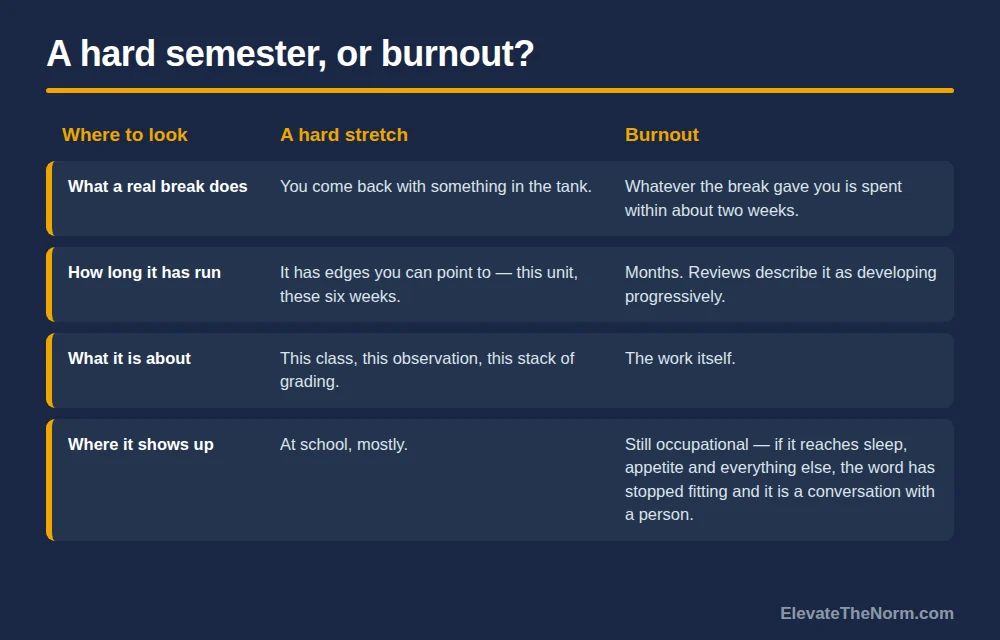
Page one: the three symptoms, and a four-row table for telling a hard semester from something that is not lifting. Page two: the three-column noticing sheet with room to write, and the one-sentence ask. It returns no score, it is not a screening instrument, and nothing on it can tell you what you have.
Free. No email address required. Designed for grades 6–12. Browse every printable in Your Free Library.
What Are the Symptoms of Teacher Burnout?
Three: energy depletion or exhaustion, increased mental distance from the job along with cynicism or negativism about it, and reduced professional efficacy. That is the entire official list, and it is worth knowing that it is that short.

The wording comes straight out of the ICD-11, where the World Health Organization added burn-out in 2019 as an occupational phenomenon. Christina Maslach, whose research framework the WHO definition is built on, has described the same three as “an overwhelming exhaustion, feelings of cynicism and detachment from the job, and a sense of ineffectiveness and lack of accomplishment.” Same three things, different words. The full definitional picture — the three dimensions and who actually holds the levers on each of them — sits on the pillar page for this series.
Notice what is not on the list. Not headaches. Not Sunday night dread. Not snapping at your own kids. Those things are real and they travel with burnout constantly, but they are correlates and consequences, not the definition. Keeping that straight matters, because a list of thirty symptoms will always describe you on a bad week in February, and the three-item list will not.
Is This Teacher Burnout, or Is It Just a Hard Semester?
If you are in your first year, read this section with the year-one caveat in mind: a first year is genuinely harder than the same job later, for reasons that have nothing to do with you. The clearest practical test is what a genuine break does to it. Regular exhaustion is a debt. You pay it down over a long weekend, a Thanksgiving break, ten days in July, and you come back with something in the tank. Burnout does not behave like a debt, because the thing generating it is still running.
That is written into the definition rather than being an add-on to it. The WHO calls burn-out a syndrome “resulting from chronic workplace stress that has not been successfully managed.” Chronic and unmanaged. If your hundred-and-fifty-student load, your three preps, your duty schedule and your fourth-period class are identical on August 15 and identical again on January 5, then whatever a break gave you gets spent in about nine days and you are back where you started. Teachers notice this and misread it as a personal failure — everyone else came back rested, what is wrong with me — when it is arithmetic.
Two rough markers, offered as rough markers and not as criteria. Duration: a hard stretch has edges you can point to, while reviews describe burnout as something that “develops progressively and can eventually become chronic.” And scope: a hard stretch is about this unit, this class, this observation. Burnout is about the work.
What Do the Three Symptoms Look Like in a 6–12 Classroom?
Mostly they look like competence. That is the part nobody warns you about. A burned-out secondary teacher is very often still on time, still covering the standards, still getting decent evaluation scores. The symptoms are interior before they are visible, which is why colleagues miss them and why you can miss them in yourself.
Exhaustion in a secondary building is rarely dramatic. It is sitting in your car in the lot for six minutes before you can make yourself walk in. It is the plan for fifth period being “whatever I did fourth period.” It is grading with the television on because the silence makes it worse, and it is a bone-level reluctance to open your email after 4:00. Physically, the research associates burnout with insomnia, chronic fatigue, headaches, gastric trouble and more frequent infections — so the endless February cold is not nothing.
Mental distance and cynicism is the symptom that costs students the most, and it is the one that feels most like a personality change. It sounds like these kids instead of my kids. It is finding a student’s excuse annoying before you have finished hearing it. It is writing the referral instead of asking the question, because the question takes eleven minutes you do not have — and to be clear, plenty of referrals are exactly the right call; the symptom is the shift in your own pattern, not the paperwork. The way teachers most often describe this stage is the same each time: becoming a person they do not like, at work, on purpose, because it is the only way they can see to get through the day.
Reduced professional efficacy is the quietest and the meanest. It is the thought that the unit you spent a weekend building landed nowhere, that the kid you kept after class is going to fail regardless, that your good years were earlier. Those are the symptom talking, and it is worth naming loudly that it lies. Reduced efficacy is a feature of the condition, not an assessment of your teaching, and burned-out teachers routinely rate their own work far below what anyone observing it would say.
That cuts one way only, and the distinction matters if you work with a coach. “The symptom is lying” is not a reason to wave off real feedback about your instruction. Sometimes a unit did land nowhere and there is something to fix. The difference is specificity: an accurate judgment is about one lesson and comes with a next move, while the symptom is global, permanent and has nothing attached to it.
One practical note on the exhaustion piece. A large share of a secondary teacher’s daily fatigue is decision fatigue rather than effort — a hundred small rulings about bathroom passes, late work, seating, phones and volume, made fresh every period. Routines that make most of those decisions in advance do not cure burnout, but they take a real load off the part of you that is most depleted.
Can You Have One Symptom and Not the Others?
Yes, and this is one of the more useful things the research has to say. Burnout is not a switch. Maslach and Leiter describe a set of profiles between full engagement and full burnout: people who score high on exhaustion alone are overextended; people high on cynicism alone are disengaged. Only the profile that is high on all three is burnout as the framework defines it.
That distinction has teeth on a Tuesday. If you are wiped out but you still light up when third period walks in, you are in a different situation from the colleague who has plenty of energy and no patience left. Both need something. They do not need the same thing, and advice written for one tends to insult the other.
The mixed picture shows up in teacher samples too. In a Finnish study of 149 subject teachers, about 70% landed in a profile the authors called engaged-burnout — moderate engagement sitting right alongside elevated exhaustion, cynicism and inadequacy, with the remaining 30% highly engaged and low on all three. Caveats belong with that number: 149 teachers in one metropolitan area, mostly high school, cross-sectional, self-reported, and Finland is not the United States. It is not a prevalence estimate. What it shows is that caring about the work and being depleted by it coexist routinely — worth knowing if you have been treating your own enthusiasm as proof you must be fine.
Are Teacher Burnout Symptoms the Same Thing as Depression?
No — but the honest answer is that the line is contested, and anyone who tells you it is clean is overselling. This is the single most important thing on this page and the part most articles skip.
The standard distinction is the one Maslach and Leiter give: burnout is “job-related and situation-specific, as opposed to depression, which is more general and context-free.” Burnout is about the work. Depression is about everything. That is a real difference and it is usually the right frame.
Now the contrary evidence, which Rule 4 of this site says gets reported rather than buried. Bianchi, Schonfeld and Laurent reviewed 92 studies — 67 cross-sectional with 58,785 participants and 25 longitudinal with 36,334 — and found the exhaustion dimension correlating with depressive symptoms about as strongly as it correlates with the other burnout dimensions. In several of the studies they cite, exhaustion tracked depression more closely than it tracked reduced personal accomplishment, which is not what you would expect if burnout were one tidy construct. In one of their own samples, up to 90% of people identified as burned out also met criteria for a provisional depression diagnosis. Their conclusion is that evidence for burnout being clearly distinct from depression is inconsistent, and that the absence of agreed diagnostic criteria for burnout is a large part of why.
Other researchers push back and argue burnout holds up as its own construct. That argument is live and it is not settled. What it means for you is simple and it is not a hedge: the question “is this burnout or is it depression?” cannot be answered by reading a web page, including this one. It is answered by a person with training, in a room, who can ask follow-up questions. If what you are feeling shows up in your sleep, your appetite, your relationships, or in things you used to enjoy that have nothing to do with school, that is not a signal to read more articles. Talk to your doctor or a counselor.
How Common Are These Symptoms Among Teachers?
Common enough that feeling this way says very little about you personally. In RAND’s State of the American Teacher survey, fielded to the American Teacher Panel between late January and early March 2025 with 1,419 nationally representative K–12 public school teachers, 53% reported feelings of burnout — down from 60% in 2024. Frequent job-related stress ran higher still, at 68% of female teachers and 46% of male teachers. That 53% is not the same number as the ones in the headlines, and it is worth seeing exactly how the four best-known figures differ before you repeat any of them.
Read that number with its measurement attached, because this is where burnout statistics go wrong. RAND did not administer a clinical instrument. Teachers were counted as reporting burnout if they agreed with at least two of four statements about enthusiasm and satisfaction at work — a reasonable survey approach, and not the same as a score on the Maslach Burnout Inventory, which is not a diagnosis either. Any “half of teachers are burned out” headline carries an invisible asterisk about what got measured, and the drop from 60% to 53% in one year is a reminder that these figures move.
Why You Cannot Diagnose Yourself From a Symptom List
Because the instruments the field actually uses do not have a validated line to cross. A 2022 review of burnout theory and measurement puts it plainly: most instruments “lack a clinically validated threshold or cutoff values for burnout diagnosis.” There is no blood test. There is no number that flips you from not-burned-out to burned-out.

This is why there is no burnout quiz on this site and will not be one. A ten-question widget that returns “You are moderately burned out” is inventing a threshold the research has not established, attaching it to your name, and sending you off with a label instead of a next step. Christina Maslach has said for years that burn-out “has become a popular term rather than a theoretical or clinical term” and that it is “most properly applied to the workplace.” Her read on what helps is blunt: situational solutions generally work better than individual ones — it is usually more productive to change the conditions than to counsel the person inside them.
So what is a symptom list for? Noticing. It is a vocabulary for something you have been carrying without a name, and a starting point for a specific conversation — with a doctor, a counselor, a spouse, a department head who can move one thing on your plate. That is useful. It is just not a diagnosis, and it should not pretend to be one.


What Should You Do With What You Just Recognized?
Write it down in three columns, then take one column to one person. Not a score. A description specific enough that somebody can act on it.
Here is the whole framework. It takes about fifteen minutes and it is deliberately boring.
- Three columns on one page: Exhaustion, Distance, Efficacy. One per symptom. Nothing else on the page — no scale, no total. Keep it on paper and off the school network; this is yours, and a district device is not a private place to write it.
- Under each, write what you have actually noticed in the last month, in concrete terms. Not “I’m tired.” “I have not planned anything new since September.” Concrete is what makes the next steps possible.
- Put a rough start date on each column. Three weeks and eight months are different problems with different answers.
- Ask which column is heaviest. If it is Distance, the load is relational and the fix usually involves people. If it is Exhaustion, it is demands and time. If it is Efficacy, some of it is the symptom lying, and some of it is a real feedback problem worth fixing.
- Name the one condition sitting behind the heaviest column — the duty, the caseload, the prep, the committee, the one class with no support in it.
- Take that one thing to one person who can move it, in one sentence, with an end date. “Can someone else take morning duty through the end of the semester?” is a request. “I’m drowning” is not, and it puts the burden of inventing a solution on whoever hears it.
- Set a check-back six weeks out. One line: did it change, and what moved into the gap?
Two honest limits on that framework. It is a noticing tool, not an instrument, and it does not return a result. And it assumes there is somebody who can actually grant the ask — which is often not true. The assistant principal you hand it to may have no more control over your caseload than you do — though the levers a school leader actually holds are more numerous than most teachers assume, and if the person above you is itself the condition, the one-sentence ask has nowhere to land. That is a real dead end and it deserves saying rather than glossing. What is left when it happens is still not nothing: your association or union representative, a colleague outside your building, your district’s employee assistance program if it has one, and a doctor. Those are all people, and people are the point.
It is also worth knowing what those individual asks look like from the other end. One teacher describing one duty is a scheduling problem. Nine teachers in the same building describing the same three conditions is a staffing and workload finding, and it is the only version of this that a principal or a central office can actually act on at scale. Writing yours down specifically is what turns a mood into data somebody can use.
Where you go from here depends on where you are. If most of what you recognized is still mild and intermittent, you are on the prevention side of this, and the things that keep the tank from emptying in the first place are the right reading. If you are past that — if a summer already failed to fix it — then the honest answer is months of structural change rather than a better morning routine, and the sooner you start the shorter it runs. And whichever it is, keeping a short written record of your own weeks is how most teachers notice any of this before it gets loud, because the drift from my kids to these kids is nearly impossible to see from inside it and obvious on a page from six months ago.
Last thing, and it is the point of the page. Recognizing yourself in a symptom list is not a verdict on whether you are good at this. It is information about the fit between a person and a set of working conditions. That fit changes when somebody describes the problem precisely enough that it can be worked on. You are allowed to be the person who does that.
Before you go: grab the free Teacher Burnout Noticing Sheet (PDF) — ElevateTheNorm.com branded, printable, no email required, and not a screener.
Frequently Asked Questions
What are the first signs of teacher burnout?
Usually exhaustion, and usually the kind that a weekend no longer clears. It tends to show up before the other two symptoms and it is the one people notice first in themselves. What follows, often by months, is mental distance — finding that you have less patience than you used to, that students have quietly become “these kids” rather than “my kids.” Reduced professional efficacy, the sense that none of it is working, usually arrives last. There is no fixed order and plenty of teachers never develop all three. Maslach and Leiter describe in-between patterns specifically: high exhaustion on its own is what they call the overextended profile, and high cynicism on its own is the disengaged profile. Neither is the full thing, and both are worth taking seriously.
How do I know if it is burnout or just a hard semester?
Ask what a real break does to it. Ordinary exhaustion is a debt you can pay down over a long weekend or a summer; you come back with something in the tank. Burnout does not behave that way, because the WHO defines it as chronic workplace stress that has not been successfully managed — the source is still running, so whatever the break gave you is gone within a couple of weeks. Two softer markers: a hard stretch has edges you can point to, while burnout has usually been building for months; and a hard stretch is about this unit or this class, while burnout is about the work itself. These are rough guides for noticing, not criteria for deciding.
Is there a reliable teacher burnout test or quiz?
No, and that is a statement about the science rather than about the quizzes. A 2022 review of burnout measurement found that most instruments “lack a clinically validated threshold or cutoff values for burnout diagnosis.” There is no agreed number that separates burned out from not burned out. Even the Maslach Burnout Inventory, the most widely used research instrument, is a research measure and not a diagnosis. A web quiz that returns “you are moderately burned out” has invented a threshold that the field has not established. That is why this site publishes no burnout quiz. The free worksheet linked on this page is a noticing sheet — it returns no score and it is not a screening instrument.
When are these symptoms a reason to see a doctor or a counselor?
When they stop being about work. The WHO is explicit that burn-out “refers specifically to phenomena in the occupational context and should not be applied to describe experiences in other areas of life.” So if what you are feeling shows up in your sleep, your appetite, your relationships, or in things you used to enjoy that have nothing to do with school, the word has stopped fitting and the next step is a person rather than an article. The research supports taking that seriously: a review of 92 studies found the burnout–depression boundary to be genuinely blurry, with one sample finding that up to 90% of people identified as burned out also met criteria for a provisional depression diagnosis. No page can tell you which you have. A clinician can ask follow-up questions, and that is the whole difference.
Can a teacher be burned out and still be good at the job?
Routinely, and this is why burnout goes unnoticed in buildings for years. A burned-out secondary teacher is very often still on time, still covering the standards, and still getting solid evaluation scores. Reduced professional efficacy is a symptom — a feeling about your work — and it is frequently far harsher than anything an observer would say. In one Finnish study of 149 subject teachers, around 70% fell into a profile the authors named engaged-burnout: genuine engagement sitting right next to elevated exhaustion and cynicism. That was a small cross-sectional sample from one country and not a prevalence figure, but it makes the point that caring about the work and being depleted by it are not opposites.
How does teacher burnout affect students in the classroom?
The dimension that reaches students most directly is mental distance, because it changes how many follow-up questions get asked. A depleted teacher is likelier to process the behavior than the reason behind it — the eleven-minute conversation is the first thing to go when there is nothing left. Students often read that shift as being disliked, which is rarely what is happening. Parents who notice it are not imagining things, and it is a workload and staffing problem rather than a character problem. The clearest thing a family can do is raise the specific change they have noticed with the school rather than with the teacher alone, because the conditions behind it are usually set above the classroom.
If my teacher seems burned out, is that my fault as a student?
No. Burnout is defined as a mismatch between what a job demands and the resources available to meet it — class sizes, preps, duties, support, time — and none of those are set by students. A teacher who is short with the room is almost never short with you specifically. You are also not responsible for managing an adult’s workload, and you should not take that on. What is fair to expect is that you still get taught well and treated decently, and if that is genuinely not happening, telling a counselor or another trusted adult in the building is the right move. That is not tattling. It is information the school needs and cannot get any other way.
What should an administrator do with a teacher describing these symptoms?
Treat the description as information about working conditions, not as a performance conversation. The research consistently points at the job rather than the person: Christina Maslach’s own conclusion after decades of this work is that situational solutions generally work better than individual ones, and that it is more productive to change conditions than to counsel the person inside them. Practically, that means asking which specific demand is heaviest and whether any part of it can be moved, reassigned or ended with a date attached. It also means noticing patterns: one teacher describing one duty is a scheduling problem, while nine teachers describing the same three conditions is a staffing finding. A wellness newsletter does not change the equation. A removed duty does.
Naming it is the first question. What to do about it is the second, and for some people that question ends with leaving. If you are there, the federal data on where teachers go next is a better starting point than a list of career ideas — not least because most of them do not leave K–12 at all. If you came looking for a number rather than a description, the instruments themselves are worth a look first.
Sources
- World Health Organization, “Burn-out an ‘occupational phenomenon’: International Classification of Diseases” (ICD-11, QD85) — the three dimensions quoted in this article, the statement that burn-out “is not classified as a medical condition,” and the restriction that it “should not be applied to describe experiences in other areas of life.”
- Maslach, C., & Leiter, M. P. (2016). “Understanding the burnout experience: recent research and its implications for psychiatry.” World Psychiatry, 15(2), 103–111 — the three dimensions as “an overwhelming exhaustion, feelings of cynicism and detachment from the job, and a sense of ineffectiveness and lack of accomplishment”; the intermediate profiles (overextended, disengaged); and the distinction that burnout is “job-related and situation-specific, as opposed to depression, which is more general and context-free.”
- Bianchi, R., Schonfeld, I. S., & Laurent, E. (2015). “Burnout–depression overlap: A review.” Clinical Psychology Review, 36, 28–41 — 92 studies (67 cross-sectional, 58,785 participants; 25 longitudinal, 36,334). Emotional exhaustion shows moderate-to-high correlations with depression, in several studies exceeding its correlation with reduced personal accomplishment; in one of the authors’ samples up to 90% of people identified as burned out met criteria for a provisional depression diagnosis. This is the contrary evidence to the standard distinction, and other researchers dispute it; the debate is unresolved.
- Edú-Valsania, S., Laguía, A., & Moriano, J. A. (2022). “Burnout: A Review of Theory and Measurement.” International Journal of Environmental Research and Public Health, 19(3), 1780 — burnout “develops progressively and can eventually become chronic”; the associated physical correlates (insomnia, chronic fatigue, headaches, gastric alterations, increased vulnerability to infections); and the statement that most instruments “lack a clinically validated threshold or cutoff values for burnout diagnosis.”
- Steiner, E. D., Levine, P. R., Doan, S., & Woo, A. (2025). Teacher Well-Being, Pay, and Intentions to Leave in 2025: Findings from the State of the American Teacher Survey. RAND, RR-A1108-16 — American Teacher Panel, fielded late January to early March 2025, 1,419 nationally representative K–12 public school teachers. 53% reported feelings of burnout, down from 60% in 2024; frequent job-related stress ran at 68% of female and 46% of male teachers. Burnout here was measured by agreement with at least two of four statements about enthusiasm and satisfaction — a survey measure, not a clinical instrument.
- Salmela-Aro, K., Hietajärvi, L., & Lonka, K. (2019). “Work Burnout and Engagement Profiles Among Teachers.” Frontiers in Psychology, 10, 2254 — 149 subject-matter teachers across 22 schools in metropolitan Helsinki, 76% high school. Latent profile analysis produced an engaged-burnout profile (~70%) and a highly engaged profile (~30%). The authors note the small sample, self-report measures, one scale with low reliability, and a cross-sectional design that rules out causal claims. It is not a prevalence estimate for U.S. teachers.
- Martin, G. (2013). Interview with Christina Maslach. California Magazine, Cal Alumni Association, 26 December 2013 — “‘Burnout’ has become a popular term rather than a theoretical or clinical term”; “from my perspective, it is most properly applied to the workplace”; and her position that situational solutions generally work better than individual ones.
Every link above was opened and checked on September 23, 2026. Where a figure could not be read verbatim in the source document, it is not quoted here. This article describes burnout as an occupational condition. It is not medical advice, it is not a diagnosis, and neither this page nor the linked worksheet is a screening instrument.
Recognising the symptoms is one question; where the load is coming from in the first place is a different one, with different evidence behind it — including what the national surveys establish and what they quietly do not.