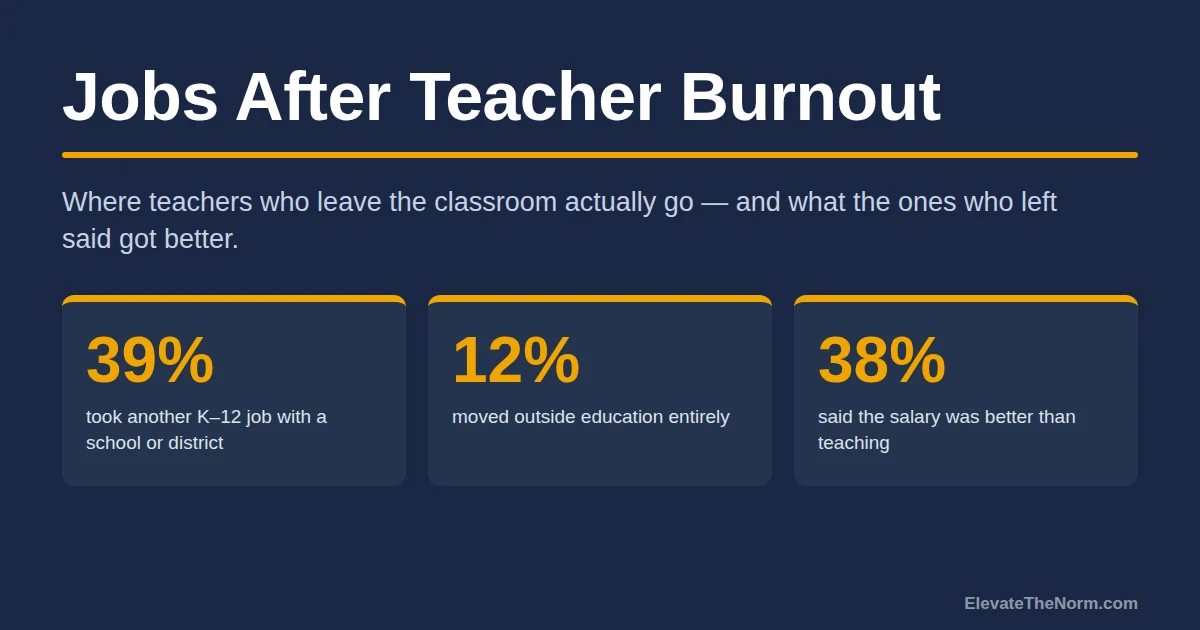
Most teachers who leave the classroom do not leave education. In the federal follow-up survey, 39 percent of former public school teachers were working for a school or district in K–12 in a job that was not regular classroom teaching, while about 12 percent had moved outside education entirely. What most of them said got better was time and control. What usually did not was pay or job security.
This page is about a decision adults make with real consequences, so it does not push. It will not tell you to quit and it will not tell you to stick it out. Both of those are cheap advice from someone who does not have to live in your house. What it will do is put the actual numbers in front of you — where teachers go, what improves, what gets worse, and how many people who say they are leaving are still there a year later — and give you a way to test a job before you take it. If you are earlier in this than that, start with what the word means and who holds the levers, or with the recovery side of this, written for people who are staying.
Key Takeaways
- The most common destination is another job in K–12. Among former public school teachers, 39 percent were working for a school or district in a K–12 role that was not classroom teaching. Only about 12 percent were working outside education.
- Time and control improve. Money and security usually do not. Of former teachers who were working, 65 percent said work–life balance was better than in teaching and 60 percent said autonomy was better — but only 38 percent said salary was better, and only 21 percent said job security was.
- Nobody can promise you that leaving fixes burnout. The research overwhelmingly measures plans to leave, not what happens afterward. That gap is real and this article does not paper over it.
- Burnout is a property of working conditions. A review of the measurement literature puts it flatly: it is “not a personal problem, but a consequence of certain characteristics of the work activity.” A new job with the same conditions is a new job with the same conditions.
- Planning to leave is not leaving. In a study of 7,714 teachers, nearly three-fourths of those who said they planned to leave or retire were still in the same school the next year. Thinking hard about it is normal. It is not a commitment you have already made.
- Do not research your exit on a school device or account. Those belong to your employer. Use your own phone and your own email.
Free Download · 2-page PDF
The Leaving Decision Worksheet
Page one: the six conditions that produce burnout, side by side — the job you have against the job you are considering, with the blanks marking the questions to ask in the interview. Page two: which condition is actually broken, what would have to change for staying to win, the four boring things to do before you resign, and who to talk to first. It returns no score and it is not a screening instrument.
Free. No email address required. Designed for grades 6–12 educators.
Where do teachers actually go after burnout?
Mostly into other jobs in K–12 education. The National Center for Education Statistics runs a Teacher Follow-up Survey that tracks a national sample of teachers into the next school year. The 2021–22 round covered roughly 10,300 current and former teachers, including about 4,100 who had left, with data collected from January to July 2022. Eight percent of public school teachers had left the profession — a rate unchanged since it was last measured a decade earlier.
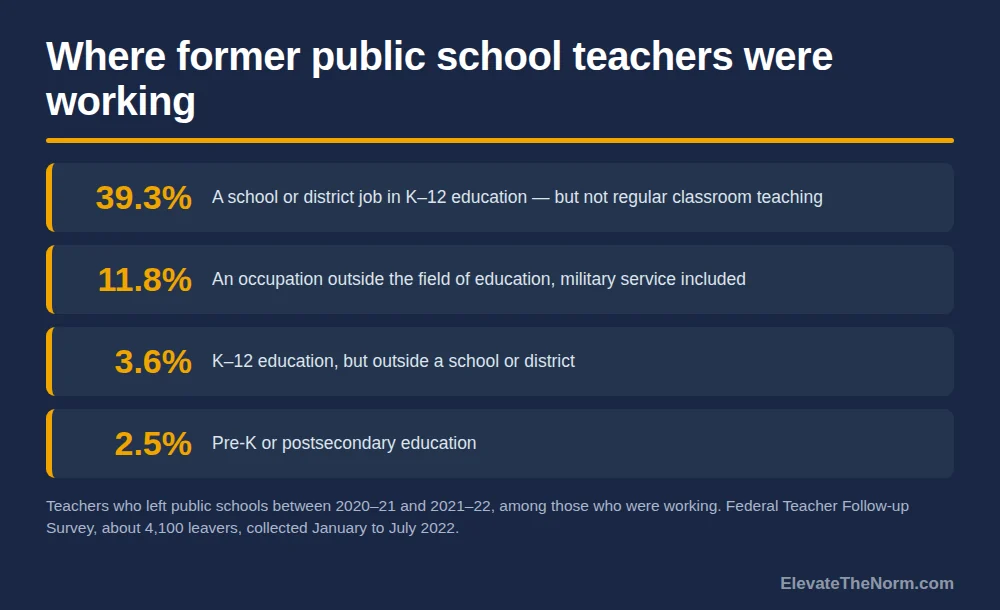
Of the former public school teachers who were working, 39.3 percent held a job with a school or district in K–12 education that was not regular classroom teaching. Another 3.6 percent were in K–12 education outside a school or district, and 2.5 percent had moved into pre-K or postsecondary education. Just 11.8 percent were working outside education, military service included.
That single comparison — roughly three in ten staying inside K–12 for every one who leaves education — is the thing most articles on this keyword get backwards. The standard piece is a list of ten careers for former teachers, heavy on instructional design and corporate training. Those jobs exist and people take them. They are not where most people go.
The survey does not publish job titles inside that 39 percent, so treat the following as examples rather than as data: instructional coaching, curriculum and assessment work, interventionist and MTSS roles, media and library positions, counseling if you hold or can add the certification, and district-office work in professional learning or scheduling. The honest summary is that the exit most teachers take is lateral, not away — the same building or the same district, a different set of demands.
Do teachers who leave say the new job is better?
On most measures yes, but not on the two people worry about most. The same survey asked former teachers who were working to compare their current position with teaching, one aspect at a time. The pattern in the answers is consistent enough to plan around.

Better in the current position: balance of personal life and work, 65 percent. Autonomy or control over their own work, 60 percent. Professional prestige, 59 percent. Manageability of workload, 58 percent. Opportunities for advancement, 54 percent. General work conditions, 50 percent.
And then the other end. Intellectual challenge, 45 percent. Salary, 38 percent. Job security, 21 percent.
Read those two low numbers carefully, because they are the price. Roughly three in five former teachers did not say they were making more money. Roughly four in five did not say their new job was more secure. Teaching, for all of it, is a job with tenure structures, a salary schedule you can read years in advance, and a public pension. Very little outside it works that way, and the people who left are telling you so.
What they are also telling you is that the thing burnout takes from you — hours, control over your own day — is the thing that most reliably comes back. If your honest answer to “what do I want” is my evenings rather than more money, the data is on your side. If it is more money, the data is thinner than the career-change articles suggest.
Does leaving actually fix burnout?
Nobody can honestly tell you that it does. This is the most important sentence on this page and it is the one you will not find in a listicle. The burnout literature is enormous, and it is almost entirely about what predicts intending to leave. A 2025 National Academies paper reviewing burnout’s consequences says the research “has most commonly documented a relationship between burnout and… plans to leave their job,” and adds that because most of the underlying studies are neither longitudinal nor randomized, the results are “limited to describing associations.”
So the field can tell you that burned-out people want out. It is much quieter on whether the ones who got out felt better afterward. Anyone who tells you a career change cures burnout is telling you something the evidence does not currently support.
What the evidence does support is a reason to be careful about which job you take next. A 2022 review of burnout theory and measurement states the core finding of fifty years of work in one line: burnout is “not a personal problem, but a consequence of certain characteristics of the work activity.” Individual factors moderate it. Organizational factors generate it.
Follow that through and the implication is uncomfortable. If burnout is produced by unmanageable workload, no control, no recognition, a bad community, unfairness and a values mismatch, then walking those six conditions into a new building does not leave them behind. It relocates them. A district office job with a worse workload than your classroom is not an escape. Neither is a startup that expects sixty hours.
That is why the framework further down this page is about conditions rather than job titles. A job title tells you almost nothing about whether you will be well in it.
How many teachers who plan to leave actually leave?
Far fewer than say they will. Researchers at CALDER followed 7,714 teachers across 35 low-performing Michigan districts from 2018–19 through 2021–22, matching what teachers said on a survey against what they actually did the next year. Of the teachers who reported plans to leave the profession or retire, nearly three-fourths were still in the same school the following year. Of those planning to transfer, about two-thirds stayed put. That is a specific sample — districts already flagged as low-performing, where turnover pressure runs high — so the exact fractions should not be read as a national rate. The direction is the durable part: stated intentions badly overstate actual exits.
The intention is not meaningless — teachers who said they planned to leave were about three times more likely to do so than teachers who said they planned to stay, 30 percent against 10 percent. But it is a weak predictor in the other direction too: only 46 percent of the teachers who actually left Michigan public education had said beforehand that they planned to.
Two things follow, and they point in opposite directions on purpose.
First, if you have been thinking about leaving, you are in enormous and entirely ordinary company, and you have not committed to anything. Most people who sit where you are sitting in March are back in the same room in August. That is not weakness and it is not a failure of nerve. It is what a hard decision looks like while it is being made.
There is also a third group the numbers do not describe. Plenty of teachers would leave and cannot — a spouse tied to the area, insurance that covers somebody else, a mortgage, a pension eight years out, one district within driving distance. If that is you, an article about jobs after teaching is not much use to you, and the honest thing is to say so rather than pretend the door is open. What is still available is the audit below, run against the job you already have, and the case for holding the line where you are — and asking for one specific condition to change instead of asking for everything to be different.
Second, and it is worth saying plainly to anyone who manages teachers: a survey that says a third of your staff is leaving is not a prediction that a third of your staff is leaving. It is a measurement of how bad the conditions feel right now. Those are different problems with different answers — and the second one is not the easier problem. A third of a staff reporting that they want out is a serious reading on working conditions whether or not those people go, and it stays serious after they stay.
How do you test a job before you take it?
Interview the conditions, not the title. The six features of a job that produce burnout — workload, control, reward, community, fairness and values — are the areas of worklife that Christina Maslach’s research identified, and they are the spine of every page in this series. Because they are features of a job, you can ask about all six directly in an interview, and the answers will tell you more than any description of the role. Here is the audit, in the order it is worth running.
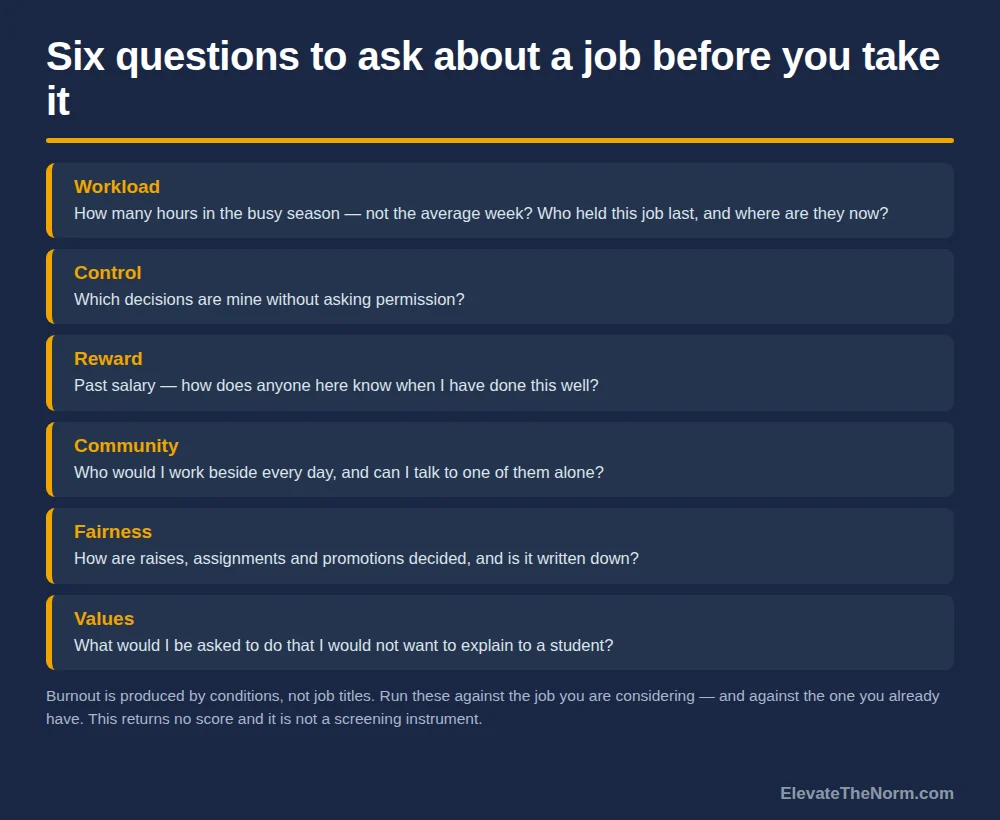
- Workload. How many hours does this actually take in the busy season, not the average week? Who did this job last and where are they now? A role nobody has held for more than eighteen months is telling you something.
- Control. What decisions are mine without asking? Teaching gives you more autonomy inside four walls than most people realize. Plenty of jobs give you less.
- Reward. Past salary — how does anyone here know when I have done well? If the answer is vague, the recognition will be too.
- Community. Who would I work with day to day, and do they like each other? Ask whether you can talk to one of them without the hiring manager in the room. If the answer is no, that is data.
- Fairness. How are raises, assignments and promotions decided, and is that written down anywhere? “We handle it case by case” is an answer.
- Values. What would I be asked to do here that I would be uncomfortable explaining to a student? If nothing comes to mind, good. If something does, believe it.
You will not get honest answers to all six. You will get honest answers to some, and the pattern of what people dodge is information in itself. Run the same six questions against your current job while you are at it. Sometimes the audit says the problem is one condition, not six, and that one is fixable where you are — which is the case an administrator can be asked to answer before you go anywhere.


What do the adjacent jobs actually pay?
About the same as teaching, with the growth and the pay pulling in opposite directions. The Bureau of Labor Statistics puts the median annual wage for high school teachers at $72,040 as of May 2025, with employment projected to show little or no change from 2025 to 2035.
Instructional coordinators — the curriculum, assessment and professional-learning roles that sit closest to the 39 percent above — had a median of $77,440 in May 2025. That is real money over a career. But the same source projects 2 percent growth over the decade, slower than average, and notes that public school instructional coordinators are required to hold a master’s degree in education or curriculum and instruction and typically need several years of experience as a teacher or instructional leader. It is a promotion-shaped job with few openings.
Training and development specialists, the most common corporate landing spot, had a median of $69,280 and are projected to grow 11 percent, much faster than average, with a bachelor’s degree typically sufficient to enter.
Put those together honestly. The adjacent job that pays more than teaching is barely growing and wants credentials you may need to go get. The one that is growing quickly pays less than the classroom median. That is the shape of the trade, and it matches what leavers reported: only 38 percent said the money was better.
Two practical notes that cost nothing. Keep your certificate current even if you are leaving — renewal is cheap and rebuilding a lapsed license is not. And check what your state retirement system does with a partial year of service before you set a resignation date, because the arithmetic sometimes favors a specific month.
What should you do next?
Do the boring, private, reversible things first, in this order.
Move the search off your employer’s property. Your school email, your district laptop and your school Google account belong to the district, not to you. Applications, resignation drafts and searches for “jobs after teaching” do not belong on any of them. Use your own phone, your own email address, your own machine. This is not paranoia; it is the same advice anyone would give about any employer.
Write down which of the six conditions is actually broken. Not “I am done.” Which one. A blank reflection page is as much structure as this needs. People who can name it sometimes discover the problem is a schedule or a duty rather than a profession, and that is a much smaller thing to fix. People who name all six have learned something too.
Talk to an actual person. Someone who left, someone who stayed, and — if what you are carrying is heavier than a job problem — a doctor or a counselor. This page cannot tell you whether you are burned out, and neither can any checklist, quiz or article, including the worksheet below; if you have not yet worked out whether what you are carrying is burnout or an ordinary hard stretch, that is a different question with a different answer. Burnout is an occupational condition described by researchers, not a diagnosis you can give yourself from a web page, and the measurement instruments used to study it do not have clinically validated cutoff scores. If you are wondering whether what you are feeling is something more than exhaustion, that question belongs to a person who can ask you follow-up questions.
Then decide on your own clock. The people who leave well tend to leave with a destination, a date and their certificate intact. Some people do not get that choice — health, a family emergency, or a situation that has stopped being safe can end a year in March, and none of that is bad planning or a character problem. But when the timing is genuinely yours, the calendar is one of the few parts of this you control. You are allowed to take a year to decide, and the evidence says most teachers in your position do exactly that. You are also allowed to go. Neither one of those is the brave choice and neither one is quitting. Nobody in your building gets a medal for outlasting the job, and nobody should have to.
One last thing, and it is the part students actually see. Leaving well means leaving the person who follows you something to work with: notice where you can give it, plans and passwords handed over, grades current, a word to the kids who will wonder where you went. Teenagers read how adults exit a room, and they read it accurately. Going is allowed. Disappearing is a different thing, and it is the only version of this that costs somebody else.
Before you go: grab the free Leaving Decision Worksheet (PDF) — ElevateTheNorm.com branded, printable, no email required, and not a screener.
Frequently Asked Questions
Is it normal to think about leaving teaching?
Yes, and thinking about it is not the same as doing it. Researchers who followed 7,714 teachers across 35 Michigan districts found that nearly three-fourths of those who reported plans to leave the profession or retire were still in the same school the next year. Nationally, 8 percent of public school teachers actually left between 2020-21 and 2021-22, a rate unchanged from a decade earlier. Far more people consider it than go. You have not committed to anything by wondering.
What jobs do most former teachers actually take?
Most stay in K-12. Among former public school teachers who were working, 39.3 percent held a job with a school or district in K-12 education that was not regular classroom teaching, while only 11.8 percent had moved outside education entirely. The federal survey does not publish titles inside that 39 percent, but the roles that sit there are things like instructional coaching, curriculum and assessment, intervention and MTSS work, media and library positions, and district-office professional learning. The typical exit is lateral, not away.
Will I make more money if I leave the classroom?
Probably not, and the data on this is clearer than most career-change advice admits. Only 38 percent of former teachers said salary was better in their current position than in teaching. For reference, the Bureau of Labor Statistics put the May 2025 median at $72,040 for high school teachers, $77,440 for instructional coordinators, and $69,280 for training and development specialists. The adjacent job that pays more is projected to grow 2 percent over the decade and usually requires a master’s degree plus teaching experience. The one growing quickly pays less than the classroom median.
Does leaving teaching cure burnout?
Nobody can honestly promise that. The burnout literature overwhelmingly measures intentions to leave rather than what happens afterward, and a 2025 National Academies review says the underlying studies are mostly neither longitudinal nor randomized, so results are limited to describing associations. What is well established is that burnout comes from conditions of the work rather than from the person, which means a new job carrying the same workload, the same lack of control and the same values mismatch is likely to reproduce it. That is the argument for auditing the conditions of the next job rather than its title.
Is student behavior the reason teachers burn out and leave?
No. This one matters, and the answer is not a soft one. Burnout is an occupational condition produced by how a job is structured — workload, control, recognition, community, fairness and values. Those are set by schedules, staffing, policy and budgets, which are adult decisions made by adults. Students are not the cause, and a student who is worried that a favorite teacher is exhausted because of their class is worrying about something that is not theirs to carry.
Is it bad for students when a teacher leaves?
Turnover is genuinely disruptive, and it is fair for a family to care about it. But the cause of turnover is working conditions, not articles about working conditions, and a teacher grinding through exhaustion for another two years is not a good outcome for students either. The thing that protects students is a teacher who either gets the conditions fixed or leaves well — with notice, with plans and grades handed over, and with a word to the kids about where they went. The version that costs students is the one where an adult disappears without any of that.
How do I know if I am burned out or just tired?
You cannot settle that from a web page, and this one will not pretend otherwise. The instruments researchers use to study burnout do not have clinically validated cutoff scores, so no checklist, quiz or article — including the worksheet on this page — can return a verdict. What a page can do is describe what the three symptoms look like in a classroom so you have better words for it. If what you are carrying feels heavier than a job problem, or has lasted past the breaks that usually help, that question belongs to a doctor or a counselor who can ask you follow-up questions.
Can I use my school computer to apply for other jobs?
Don’t. Your school email address, your district laptop and your school-issued accounts belong to your employer, and in most districts the acceptable-use policy says so explicitly. Job applications, resignation drafts, and searches about leaving should live on your own phone, your own machine and a personal email address. This is not about hiding wrongdoing — there isn’t any — it is the same basic advice anyone would give about any employer.
Sources
- Taie, S., & Lewis, L. (2024). Teacher Attrition and Mobility: Results From the 2021–22 Teacher Follow-up Survey to the National Teacher and Principal Survey (NCES 2024-039). U.S. Department of Education, National Center for Education Statistics — the source of every attrition and destination figure on this page. Roughly 10,300 current and former teachers, about 4,100 of them leavers, collected January to July 2022, weighted to be nationally representative. Table A-8 carries the destination split; Table A-9 carries the nine aspect-by-aspect comparisons with teaching. Percentages here are reported as the tables give them.
- Institute of Education Sciences (2024). “Eight Percent of Public School Teachers Left Teaching in 2021, a Rate Unchanged Since Last Measured in 2012.” — the department’s own summary of the report above, used to confirm the headline figures independently of the PDF tables. Note that the rounded numbers in the press release differ by a point from the underlying tables in one or two places; where they do, this article uses the rounded figure both routes agree on.
- Harbatkin, E., Nguyen, T., Strunk, K. O., Burns, J., & Moran, A. (2024). “Should I Stay or Should I Go (Later)? Teacher Intentions and Turnover in Low-Performing Schools and Districts Before and During the COVID-19 Pandemic.” CALDER Working Paper No. 302-0724 — 7,714 teachers in 35 Michigan Partnership districts, 2018–19 through 2021–22, matching survey responses to administrative records of who actually moved. This is a working paper, not a peer-reviewed article, and the districts were selected for low performance, so read the fractions as a description of that context rather than a national rate.
- Lai, A. Y., Wee, K. Z., Sullivan, E. E., Stephenson, A. L., & Linzer, M. (2025). “Job Burnout: Consequences for Individuals, Organizations, and Equity.” Appendix C in Impact of Burnout on the STEMM Workforce: Proceedings of a Workshop. National Academies Press — the source for the honest limit stated in this article: burnout research “has most commonly documented a relationship between burnout and… plans to leave their job,” and because most studies are neither longitudinal nor randomized, the findings are “limited to describing associations.” It does not establish that leaving resolves burnout, and this article does not claim it does.
- Edú-Valsania, S., Laguía, A., & Moriano, J. A. (2022). “Burnout: A Review of Theory and Measurement.” International Journal of Environmental Research and Public Health, 19(3), 1780 — burnout is “not a personal problem, but a consequence of certain characteristics of the work activity,” and the measurement instruments “lack a clinically validated threshold or cutoff values for burnout diagnosis.” Both statements are load-bearing here: the first is why this page audits conditions, the second is why it refuses to tell you whether you are burned out.
- U.S. Bureau of Labor Statistics, Occupational Outlook Handbook: High School Teachers — median annual wage $72,040 in May 2025; employment projected to show little or no change from 2025 to 2035.
- U.S. Bureau of Labor Statistics, Occupational Outlook Handbook: Instructional Coordinators — median annual wage $77,440 in May 2025; 2 percent projected growth 2025–2035, slower than average; a master’s degree in education or curriculum and instruction is required in public schools, and several years of experience as a teacher or instructional leader is typical.
- U.S. Bureau of Labor Statistics, Occupational Outlook Handbook: Training and Development Specialists — median annual wage $69,280 in May 2025; 11 percent projected growth 2025–2035, much faster than average; a bachelor’s degree is typically the entry-level requirement.
Every link above was opened and read on September 24, 2026. Where a figure could not be confirmed in the source document itself, it is not quoted here. This article describes burnout as an occupational condition. It is not medical advice, it is not a diagnosis, and neither this page nor the linked worksheet is a screening instrument. Nothing here is financial, legal or career advice about your particular situation — retirement and certification rules vary by state, and those questions belong to your own retirement system and certification office.