
By Clay Shumate
There is no free, national, teacher-only burnout support group you can look up and walk into this week. What exists is five different things that all get called support, and they answer different problems. The most useful one for most teachers is already paid for, sitting in a benefits packet nobody opens.
If you have already spent an evening on this and turned up nothing but listicles, that is not a failure on your part. The help is genuinely not indexed, and knowing that in advance saves the evening.
Every organisation below was checked before it was listed: what it is, who it is for, what it costs, where it stops. If you want the word defined first, start with what the word actually covers before you go looking for a room. If you want the work of getting back on your feet rather than a place to go, what recovery consists of once you have found the right room. One thing up front: a support group is not treatment. It is a room with people in it — worth a lot, and not the same as care.
Key takeaways
- The one route almost every teacher already has is the employee assistance programme — free, confidential, short-term counselling and referral, already bought by the employer. Most teachers do not know the number.
- The largest teacher-specific support network in the country does not publish where its meetings are and says so outright. Its free national video meetings run quarterly.
- The free 24/7 confidential helpline for education staff does exist — in the United Kingdom. Not here. That absence is a funding decision, not a fact of nature.
- In the one randomised trial behind any of this, the employer gave people an hour on the clock every two weeks. Protected paid time was part of the intervention, not a nicety.
- Across 23 controlled trials of teacher-burnout interventions the pooled effect was small — d = 0.18, and essentially nothing on depersonalisation. Nobody should promise you more.
- Sort by the problem, not the label. Talking privately, talking to a peer, changing the job and getting clinical help are four needs, and only two are answered by a group.
The Teacher Burnout Support Finder
Two printable pages. Page one is a write-in contact sheet for the four different needs that all get called support — talking privately, talking to a peer, getting something about the job changed, and getting clinical help — with room to fill in the real names and numbers for your own district. Page two is the checked national list: what each option actually is, what it costs, and where it stops. It is not a screening instrument and it returns no score. Free. No email address required. Designed for grades 6–12.
Download the free PDFIs there a teacher burnout support group I can actually join?
Probably not a local one you can find by searching. A national one by video, yes, four times a year. That gap is the real answer, and worth knowing before you spend an evening looking for something that is not indexed.
The best-known teacher-specific network in the country is Happy Teacher Revolution, a Baltimore-founded organisation built on trained facilitators running peer meetings inside their own schools. It is real and active, and its own FAQ states that “HTR meetings are kept within their own communities and are not publicly listed. This is by design.” There is a decent reason for it — a room where staff talk honestly about a hard year is not something you advertise — but for a teacher searching at ten at night the network is invisible.
What is open: the same organisation runs free quarterly Zoom meetings open to everyone, with sign-up on its site. What costs money: leading meetings at your own school requires its certification course, listed at $597 for twelve hours of asynchronous training. No certification is needed to attend a meeting. It is needed to run one.
What are the five kinds of support, and what does each one cost?
Five categories, three of them free at the point of use. They are not interchangeable. An employment route, a peer route and a clinical route answer different questions, and the common mistake is taking a problem to the wrong one.

1. Your employer’s employee assistance programme
Check this one first. The federal Office of Personnel Management defines an employee assistance programme as “a voluntary, work-based program that offers free and confidential assessments, short-term counseling, referrals, and follow-up services to employees who have personal and/or work-related problems.” Free to you, already bought. Usually a number on the benefits page, the back of an insurance card, or one email to whoever handles benefits.
It is not long-term therapy. Short-term means a set number of sessions, then a referral onward. It is still the fastest route most teachers have to actually talking to somebody.
If you are reading this from a district office, the cheapest item on this page is making that number easier to find — on the staff landing page, in the first email of the year, on the back of the badge. Every teacher who cannot find the number is a service you are paying for and not delivering.
2. A teacher-specific peer group
Happy Teacher Revolution, above: free quarterly national video meetings, local meetings unlisted, $597 to certify to lead one. Alongside it, the informal version — a department, a grade-level team, a counterpart teaching the same course elsewhere. That is a peer group whether anyone calls it one — and if you are the only person in the building teaching your course, which plenty of secondary teachers are, it may not exist for you at all. That is the situation the free quarterly video meeting is actually for, along with your subject association and a counterpart at another school. In year one it is also most of the support that exists.
3. Your union or professional association
This varies so much by state that no page can tell you what yours has. What can be said is what the largest one publishes. The National Education Association’s own educator mental-health page lists AbleTo, a digital programme through member benefits, then points readers outward — a federal helpline, a mindfulness trainer, a state affiliate’s webinars, a third-party list. It does not list a dedicated support group for educators. Worth knowing before assuming your dues cover one. Ask your local rep; some state affiliates do more than the national page shows.
4. A general peer support group
Free, national, and not about teaching. NAMI Connection is a peer-led group for adults 18 and over living with mental health conditions, “free of cost to participants,” led by people with mental health conditions, and explicit that “no specific medical therapy or treatment is endorsed.” Many meet virtually and are open nationwide; NAMI runs a locator. DBSA runs online groups for people living with depression or bipolar disorder and states “all DBSA online support groups are free of charge” — registration required.
Read the eligibility honestly: both are for people with a mental health condition. Burnout as the research uses the word is occupational rather than a diagnosis, so whether these are the right room is a question for somebody who can assess it — not for a web page.
5. A referral line
The SAMHSA National Helpline, 1-800-662-HELP (4357), is a free, confidential treatment referral and information service, 24 hours a day, 365 days a year, in English and Spanish. It does not counsel you; it tells you what exists near you. 988, the Suicide and Crisis Lifeline, is free and confidential by call, text or chat around the clock, and is not only for suicidal crisis: its site says it is for anyone “facing mental health struggles, emotional distress, alcohol or drug use concerns, or just need someone to talk to,” and that “the 988 Lifeline is for everyone.”
Why is there no free national helpline for American teachers?
Because nobody built one. That is the whole answer, and it is easiest to see next to a country that did.
In the United Kingdom a charity called Education Support runs a helpline on 08000 562 561. Qualified counsellors, 24 hours a day, free from UK landlines and mobiles, support in over a hundred languages, and eligibility about as wide as it gets: “any serving, former or retired member of staff who has worked in any part of the education sector.” Former. Retired. Any part of the sector.
American teachers cannot use it — it is funded for UK education staff — and it is named here so nobody reading this thinks what they want is unreasonable. A free, round-the-clock, confidential line answered by somebody who understands what a school is has been built and run for years. It is on the other side of an ocean.
What exists here is general rather than educational: 988, the SAMHSA line, and whatever your employer bought. Those are real and worth using. But if you have wondered why this search turns up listicles instead of a phone number — there is no phone number to find.

Do support groups actually reduce burnout?
A facilitated small group on paid time has the best evidence in this area, and it is still thin. All three findings are below, including the two that cut against the idea.
The strongest design is not from education. West and colleagues (2014), in JAMA Internal Medicine, randomised 74 practising physicians at one institution into a facilitated small-group curriculum — one hour every two weeks, built on reflection, community building and meaning in work — or a control arm. Depersonalisation fell significantly at three months and at twelve; empowerment and engagement rose and held for a year. And the institution provided protected time for the meetings. That is not a footnote. It is part of what was tested.
So the honest reading is not join a group. It is give people an hour on the clock, every two weeks, with a facilitator and a structure — a scheduling decision, and not one a teacher can make. It belongs to whoever builds the calendar and signs off the release time. A group meeting at 4:15 on your own time after a full teaching day is a different intervention from the one that worked, and nobody has tested it.
One practical consequence, for anyone thinking of starting one. The person who facilitates the group must not be the person who evaluates the people in it. A principal who runs a staff support group becomes the administrator who knows which teachers are struggling, and that knowledge does not stay put — it turns up in next year’s master schedule, in who gets the hard section, in a renewal conversation. Nobody has to intend it. A department chair, coach or counsellor with no evaluative role over the group is the cleaner choice, and facilitating is a learnable skill rather than a personality trait: the curriculum that worked was structured, not improvised. And it is not a substitute: a facilitated hour offered instead of fixing the schedule will be read as exactly that.
Now the parts that go the other way. Iancu and colleagues (2018) pooled 23 controlled trials of teacher-burnout interventions. The overall effect was small but significant, d = 0.18. Exhaustion and personal accomplishment moved similarly; the effect on depersonalisation was d = 0.03, indistinguishable from nothing. Mindfulness-based programmes did show significant effects on exhaustion and accomplishment, and anything running under a month showed the smallest effects. The breakdown by intervention type sits behind a paywall, so this page claims no separate effect size for peer or group formats. It does not have one.
On changing the organisation instead of the teacher, the Cochrane review by Naghieh and colleagues (2015) found only four eligible studies covering 2,199 teachers and rated the evidence low to very low quality for attrition, reporting bias and underpowered designs. Verbatim: “We found low-quality evidence that organisational interventions lead to improvements in teacher wellbeing and retention rates. We need further evaluation.”
A structured group with real time behind it is a reasonable bet. Anybody telling you a support group fixes burnout has gone past the evidence.
Can a support group make things worse?
It can, in two specific ways, and neither has been measured. That is not an argument against going. It is an argument for knowing which room you are in.
The first is confidentiality. A group organised by your school, in your building, with your administrator’s knowledge, is a room where you describe your own difficulty inside your employer’s house. Usually nothing comes of it. But a teacher who is not tenured, or up for a renewal decision, is weighing something real, and pretending otherwise would be dishonest. Two rules: do not say anything in that room you would not put in writing, and do not research any of this on a district device or account. A work laptop is not a private place to type “I am not coping.” If the honest version cannot be said in the building, that is what the outside routes are for.
The second is structure. The trial that worked had a curriculum, a facilitator and an end time. A standing group with none of those is a venting session, and whether that helps or hurts has not been tested in teachers. Complaining about a genuinely bad schedule is accurate description, not weakness, and nobody should be told to stop. The question after the hour is whether you left with anything — a next step, a name, one thing to try — or only with the hour gone.

Which one fits the problem you actually have?
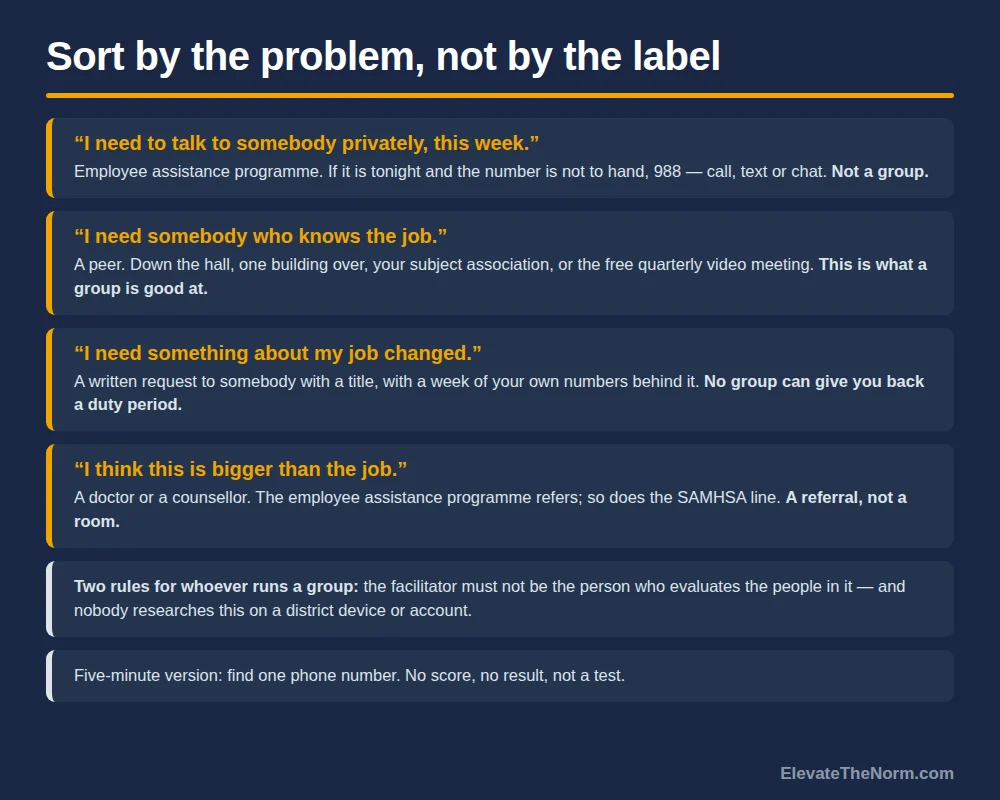
Sort by the problem, not the label. Four needs get bundled under “support” and only two are answered by a group. This takes five minutes. It is not a test and there is no score.
- “I need to talk to somebody this week, privately.” The employee assistance programme — free, confidential, short-term counselling and a referral onward. If it is tonight and the number is not to hand, 988 takes calls, texts and chats at any hour. Not a group.
- “I need somebody who knows what a Tuesday in a 6–12 building is like.” A peer. Usually down the hall or one building over; the national version is the free quarterly video meeting. This is what a support group is genuinely good at, and nothing else substitutes for it.
- “I need something about my job to change.” A support group is the wrong tool. No group can give you back a duty period. That is a written request to somebody with a title, and it lands better with a week of your own numbers behind it than with a description of how you feel.
- “I think this is bigger than the job.” A doctor or a counsellor, and the route is a referral rather than a room. The employee assistance programme refers; so does the SAMHSA line, free, in English or Spanish, at any hour.
And if reading a four-way sort is already more than you have in you this week, do the five-minute version instead: find one phone number. Not a group, not a programme, not a plan. The employee assistance number, written down somewhere that is not a school device. That is the whole task, and it is worth more than an evening of searching.
Two of the four are not support groups, and that is the point. Most of the frustration teachers report comes from taking a structural problem into a room with no authority to solve it, then concluding support groups do not work. They work at what they do.
Wherever you write this down: keep it on paper, off the school network, and put no student’s name and no colleague’s name on it. A private note about your own workload that starts listing other people is a different document, with different consequences.
A word for any student who has ended up on this page. Nothing here is about you. The hours in a teacher’s day, the number of students in a room and whether there is an hour anywhere for an adult to talk to another adult are all decisions made by adults, usually before the school year started. Student behaviour is not why teachers burn out, and a teacher looking for support is a teacher doing the sensible thing rather than a teacher failing at something.
When the answer is a person, not a group
Some of this is not an occupational problem, and a group is not built to tell the difference. Neither is this page.
Burnout in the research literature is a condition of the job — exhaustion, distance from the work, a collapsed sense of getting anywhere. It is not a clinical diagnosis, and there is no validated cut-off in it that a person crosses on a Tuesday. No checklist can tell you whether what you have is burnout, depression, grief, exhaustion from something at home, or several at once; the symptoms overlap enough that the distinction is hard even with training.
So if you are not sleeping, not eating, not able to make yourself get out of the car in the parking lot, or having thoughts of hurting yourself, the next step is not a Thursday meeting. It is your doctor, a counsellor, or 988 — free, confidential, and in its own words for everyone rather than only for people in crisis. That is a conversation with a person, not a result from a page, and reaching it early is not an overreaction.
What to do next
Three things in this order, and the first takes five minutes.
Find your employee assistance programme number today. Benefits page, insurance card, or one email to whoever handles benefits. Write it somewhere that is not a district device. You are not calling today; you are making sure that the day you want to, the number exists and you know where it is.
Pick one person. Not a group, not a programme — one colleague whose job is close enough to yours to understand it. That is the peer support that actually gets used, and it requires nobody’s certification.
And if what you need is the job changed, write the ask down. The version of this written before it gets bad is worth reading too, because the cheapest support group is the one you never end up needing. And if you arrived at that question by way of an online quiz, it is worth knowing what those scores are actually built on.
Want it as a printable? Download The Teacher Burnout Support Finder (2 pages, free, no email required) and fill in the four numbers for your own district before you need them.
Frequently asked questions
Is there a free teacher burnout support group I can join near me?
Probably not one you can find by searching, and that is not your fault. The largest teacher-specific network in the United States, Happy Teacher Revolution, states on its own FAQ that its meetings \u003cstrong\u003eare not publicly listed, and calls that a design decision\u003c/strong\u003e. What is open to anyone is its free quarterly national Zoom meeting. Beyond that, the free options are not teacher-specific: NAMI Connection and DBSA run free peer groups for adults living with mental health conditions, and your employer\u0026rsquo;s assistance programme offers free confidential short-term counselling. The free national helpline for education staff that this search is really looking for exists in the United Kingdom, not here.
Where do I find my employee assistance programme number?
Three places, in order of speed: your district\u0026rsquo;s benefits page on the staff intranet, the back of your health insurance card, and a one-line email to whoever handles benefits in the district office. It takes about five minutes and you do not have to explain why you are asking. Write the number somewhere that is not a school device, so that the day you want it, it already exists.
Is the employee assistance programme confidential from my principal?
It is designed to be. The federal Office of Personnel Management describes an employee assistance programme as \u003cstrong\u003e\u0026ldquo;a voluntary, work-based program that offers free and confidential assessments, short-term counseling, referrals, and follow-up services\u0026rdquo;\u003c/strong\u003e. But programmes are run by outside providers under contracts that differ, so the honest answer is to ask the provider directly what, if anything, goes back to the employer — and to ask the provider rather than your district. That is a reasonable question and a good provider will answer it plainly.
Do teacher burnout support groups actually work?
The best evidence is real and it is modest. A randomised trial of 74 physicians (West and colleagues, 2014) found that a facilitated small group meeting one hour every two weeks \u003cstrong\u003ewith employer-provided protected time\u003c/strong\u003e significantly reduced depersonalisation at three and twelve months. Across 23 controlled trials of teacher-burnout interventions the pooled effect was \u003cstrong\u003ed = 0.18, small but statistically significant\u003c/strong\u003e, with essentially no effect on depersonalisation (d = 0.03). A Cochrane review of organisational changes found only four eligible studies and rated the evidence low to very low quality. So: worth doing, and nobody should promise you it fixes burnout.
Should my principal run the staff support group?
No. \u003cstrong\u003eThe person who facilitates the group should not be the person who evaluates the people in it.\u003c/strong\u003e A principal who runs it becomes the administrator who knows which teachers are struggling, and that knowledge does not stay put — it shows up in next year\u0026rsquo;s master schedule, in who gets the hard section, and in renewal conversations. Nobody has to intend that for it to happen. A department chair, an instructional coach or a counsellor with no evaluative role over the group is the cleaner choice.
Is a support group the same thing as therapy?
No, and the good ones say so themselves. NAMI states that in its groups \u003cstrong\u003e\u0026ldquo;no specific medical therapy or treatment is endorsed\u0026rdquo;\u003c/strong\u003e. A peer group is people with similar experience talking to each other, which is genuinely valuable and is not clinical care. Nothing on this page or in any group diagnoses anything: burnout as the research uses the word is an occupational condition, and there is no validated cut-off in that literature that a person crosses. If the question is whether something clinical is going on, that is a doctor or a counsellor.
Should I be worried if my child\u0026rsquo;s teacher is using a support group?
No. A teacher who uses support is doing the sensible thing, and it is a better sign than the alternative. Two requests, though, if you are a parent reading this. \u003cstrong\u003eDo not ask your child whether their teacher seems stressed\u003c/strong\u003e — that puts a child in the middle of an adult\u0026rsquo;s working conditions, and they are not in a position to judge it. And a teacher\u0026rsquo;s apparent state is not material for the class group chat. If you are genuinely concerned about a classroom, the useful question to the school is about staffing and coverage, not about the person.
Is it my fault that my teacher needs support?
\u003cstrong\u003eNo.\u003c/strong\u003e If you are a student who found this page, nothing on it is about you. How many hours are in a teacher\u0026rsquo;s day, how many students are in a room, how much is graded outside the school day and whether there is an hour anywhere for one adult to talk to another are all decisions made by adults, usually before the school year started. Student behaviour is not why teachers burn out, and an adult\u0026rsquo;s working conditions are not a student\u0026rsquo;s to manage.
Sources
- West, C. P., Dyrbye, L. N., Rabatin, J. T., et al. (2014). Intervention to promote physician well-being, job satisfaction, and professionalism: a randomized clinical trial. JAMA Internal Medicine. 74 practising physicians at one institution, randomised; a facilitated small-group curriculum meeting one hour every two weeks, with institution-provided protected time. Depersonalisation fell significantly at 3 and 12 months; empowerment and engagement rose and held for 12 months. The JAMA full text could not be opened from this session, so the trial details above are taken from The Hospitalist’s report of it and attributed to that summary rather than to a reading of the original. Physicians, not teachers, and a small single-site sample — the authors say so themselves. the-hospitalist.org
- Iancu, A. E., Rusu, A., Măroiu, C., Păcurar, R., & Maricuțoiu, L. P. (2018). The effectiveness of interventions aimed at reducing teacher burnout: a meta-analysis. Educational Psychology Review, 30(2). 23 controlled trials (19 journal articles, 4 unpublished dissertations). Overall d = 0.18 (SE = 0.05, p < .001); depersonalisation d = 0.03 (SE = 0.06, p > .05). Mindfulness interventions showed significant effects on exhaustion and personal accomplishment; interventions under one month showed the smallest effects. Read via the published abstract in the ERIC record; the breakdown of effect sizes by intervention type is behind a paywall and no peer-group-specific effect size is claimed on this page. eric.ed.gov
- Naghieh, A., Montgomery, P., Bonell, C. P., Thompson, M., & Aber, J. L. (2015). Organisational interventions for improving wellbeing and reducing work-related stress in teachers. Cochrane Database of Systematic Reviews, CD010306. Four studies, 2,199 teachers. Evidence rated low to very low quality throughout, for attrition bias, reporting bias, underpowered studies and confounded individual-level components. Authors’ conclusion, verbatim: “We found low-quality evidence that organisational interventions lead to improvements in teacher wellbeing and retention rates. We need further evaluation of the effects of organisational interventions for teacher wellbeing.” Read in full from the University of Greenwich open repository. gala.gre.ac.uk
- US Office of Personnel Management. What is an Employee Assistance Program (EAP)? The definition quoted on this page, including “free and confidential assessments, short-term counseling, referrals, and follow-up services.” opm.gov
- Happy Teacher Revolution. FAQs and Revolutionary Certification Program. Source of the free quarterly Zoom meetings open to everyone, the statement that “HTR meetings are kept within their own communities and are not publicly listed. This is by design,” and the $597 certification price. Checked 2026-09-24. happyteacherrevolution.com
- National Education Association. Mental Health Resources from NEA and Our Partners. Lists AbleTo through member benefits and points readers to outside resources. Cited on this page for what it does not contain — a dedicated support group for educators — rather than as evidence of anything about burnout. Checked 2026-09-24. nea.org
- National Alliance on Mental Illness. NAMI Connection. Peer-led support group for adults 18 and over living with mental health conditions, “free of cost to participants,” led by people with mental health conditions, and stating that “no specific medical therapy or treatment is endorsed.” Checked 2026-09-24. nami.org
- Depression and Bipolar Support Alliance. DBSA Online Support Groups. “All DBSA online support groups are free of charge”; registration required; for people living with depression or bipolar disorder. Checked 2026-09-24. dbsalliance.org
- Substance Abuse and Mental Health Services Administration. National Helpline, 1-800-662-HELP (4357). Free, confidential treatment referral and information service, 24 hours a day, 365 days a year, in English and Spanish. Only the page’s own summary description was readable from this session, so nothing beyond it is claimed here. samhsa.gov
- 988 Suicide & Crisis Lifeline. Free and confidential, 24/7/365, by call, text or chat, and explicitly not limited to suicidal crisis: for anyone “facing mental health struggles, emotional distress, alcohol or drug use concerns, or just need someone to talk to,” because “the 988 Lifeline is for everyone.” 988lifeline.org
- Education Support (United Kingdom). Education Support helpline. 08000 562 561; qualified counsellors; 24 hours a day; free from UK landlines and mobiles; support in over 100 languages; open to “any serving, former or retired member of staff who has worked in any part of the education sector.” A UK service, not available to teachers in the United States — named on this page as the contrast, not as a resource to call. Checked 2026-09-24. educationsupport.org.uk
Every organisation listed on this page was opened and read on 2026-09-24. Where a source could not be opened directly, the page says which summary was read instead rather than citing the original as though it had been.
About Clay Shumate
Clay Shumate is a certified secondary Social Studies teacher in the public schools of West Alabama, with seven years of classroom experience, a B.A. in History, and an M.Ed. in Secondary Education. He writes about project-based learning, student responsibility, respect, and practical ways to hold young people to a higher standard while giving them room to learn from mistakes.