The Elevate Blog banner: Real Classrooms. Practical Ideas. Higher Expectations. Three students climb a rocky ridge at sunrise, each pulling the next one up, toward a teacher reaching down to help.

Tag: classroom culture frameworks

  • Customizable Classroom Culture Frameworks: Where to Find Them

    Customizable Classroom Culture Frameworks: Where to Find Them

    By Clay Shumate

    Customizable classroom culture frameworks are easiest to find at the Center on PBIS, which posts a free Word plan template you fill in for your own room. Responsive Classroom books ($35) and the CHAMPS book ($55) give you structures to adapt, Teachers Pay Teachers covers posters and trackers, and Elevate the Norm’s grades 6–12 files are free and editable.

    Key Takeaways

    • The Center on PBIS posts a free Word plan template for classroom PBIS with a behavior matrix, lesson plans, prompts, and a plan for praise and corrections that each teacher fills in.
    • Responsive Classroom and CHAMPS are sold as books you adapt rather than fill-in templates: about $35 per Responsive Classroom book and $55 for CHAMPS.
    • Teachers Pay Teachers is best for ready-made posters, trackers and contracts, not for choosing a classroom culture framework; Google Apps and Microsoft files are usually editable, PDFs usually aren’t.
    • Customize a framework’s words, routines, acknowledgments, attention signal and format, but keep direct teaching of expectations, frequent praise, a correction plan and consistent follow-through.
    • A teacher can build a working customized classroom culture framework in one school week starting from the free PBIS template.

    A customizable classroom culture framework is a behavior and community system that gives teachers a proven structure but leaves the expectation wording, routines and rewards for the teacher to write. This page lists where to get frameworks you can actually change, what each one lets you change, and which parts you shouldn’t touch no matter which you pick. If you’re still choosing between the big programs, start with the classroom culture frameworks Q&A hub. If you’re ready to spend money, see our buyer’s guide with verified prices.

    Where can I find classroom culture frameworks with customizable options?

    Classroom culture frameworks with customizable options are available free from the Center on PBIS, as adaptable books from Responsive Classroom and CHAMPS, as teacher-made files on Teachers Pay Teachers, and through district or state PBIS teams. Start with the free federal materials, then add a book or a teacher-made kit only if you need more structure. Here are the main sources, from most flexible to least.

    SourceCostGradesHow editableBest for
    Classroom PBIS (Center on PBIS)Free downloadK–12Word template and blank matrixBuilding your own plan from a proven skeleton
    Responsive Classroom books$34.80–$35 per bookPreK–8 (most titles)Practices you adapt; not a fill-in templateDaily routines and teacher language
    CHAMPS (Safe & Civil Schools)$55 bookK–8 (secondary version is a separate book)Decision guide you work throughExpectations for every activity and transition
    Teachers Pay TeachersFree to a few dollars per fileAnyDepends on file formatReady-made posters, contracts and trackers
    District or state PBIS templatesUsually free to staffVariesVariesMatching what your building already uses
    Elevate the Norm (this site)Free, no email6–12Editable filesSecondary recognition and routines
    Teacher Emergency Toolkit (paid)Paid TPT bundles6–12Editable documentsBehavior documentation and parent contact

    Is there a free classroom culture framework I can customize?

    Classroom PBIS is a free classroom culture framework built to be filled in by the teacher. The Center on PBIS, developed under a U.S. Department of Education grant, posts its classroom materials as direct downloads. The most useful one for customizing is the Creating Effective Classroom Environments Plan Template, a Word document with sections for:

    • a classroom matrix that defines expected behaviors for each routine
    • lesson plans for teaching those behaviors
    • prompts and reminders for the behavior you want
    • plans for praise and for corrections

    The Classroom PBIS page also links a guide to creating a classroom teaching matrix, a de-escalation practice brief, and a piece explaining why clip charts aren’t a PBIS practice. The core research guide, Supporting and Responding to Students’ Social, Emotional, and Behavioral Needs, is now in its Version 2 edition.

    PBIS tells you what has to be in a plan. It doesn’t tell you what your expectations are called or what your acknowledgment looks like. That’s the part you write. Our Responsive Classroom vs PBIS comparison covers how Classroom PBIS fits with other programs.

    Which paid classroom culture frameworks give you room to adapt?

    Responsive Classroom and CHAMPS are the paid classroom culture frameworks with the most room to adapt, because both come as books you adapt, not scripts you read. Neither one hands you a fill-in-the-blank form the way PBIS does, but both are designed around teacher decisions.

    Responsive Classroom

    The Center for Responsive Schools sells its practices through books. The First Six Weeks of School is $35 and written for PreK–5. For middle school, The Responsive Advisory Meeting Book is $34.80. You adapt the routines, like the meeting structure and modeling steps, to your schedule. It also sells Quick Coaching Guides on 30 topics for teachers who want a structured self-review.

    CHAMPS

    CHAMPS (3rd edition) is $55 from Ancora Publishing. It walks you through decisions about expectations for each activity: conversation level, help, the activity itself, movement and participation. Randy Sprick has described it as flexible enough that teachers don’t have to change their personalities, and as the K–8 approach, with Discipline in the Secondary Classroom as its high school counterpart (Instructional Coaching Group interview).

    Are Teachers Pay Teachers classroom management kits worth using?

    Teachers Pay Teachers classroom management kits are useful for materials, not for the framework itself. TPT’s free classroom management category lists more than 70,000 results. There’s no filter labeled “editable,” so filter by format instead: Google Apps or Microsoft files are usually the ones you can change, while PDFs usually aren’t.

    Use TPT to save time on posters, sign-out sheets, behavior trackers and contracts once you’ve decided what your system is. Don’t use it to decide what your system is. A clip chart from one seller, a ticket system from another and a contract from a third don’t add up to a framework.

    Should I check my district’s PBIS template before building my own?

    Teachers in a school that runs PBIS should start from the schoolwide matrix, because the classroom plan should use the same expectation words as the hallway posters. Otherwise students hear two systems. Ask your PBIS coach or assistant principal for the schoolwide matrix and build your classroom version off it.

    Many states support schools through a PBIS network. In Alabama, for example, the state department of education partnered with the University of Alabama’s positive behavior supports office to expand PBIS training and support (University of Alabama News). The Center on PBIS describes coaching at the state, district and school levels (Center on PBIS, Coaching), so there may be someone local who will review your plan for free. More on that in frameworks with ongoing coaching.

    What parts of a classroom culture framework should you customize?

    The parts of a classroom culture framework to customize are the expectation language, the routines, the acknowledgments, the attention signal and the format, so they fit your students and your schedule. These parts are meant to change:

    • The words. Three to five expectations, in language your students would actually say. High schoolers will roll their eyes at elementary phrasing.
    • The routines. Entry, transitions, turning in work, group work, the last two minutes. Write them for your room. See classroom routines and procedures.
    • The acknowledgment. Tickets, class points, a call home, a privilege. Pick what your students value and what you can afford.
    • The attention signal. Any signal works if it’s taught and used the same way every time. Some options are in classroom attention getters.
    • The format. A one-page plan beats a binder you never open. A model is in what a classroom management plan looks like.
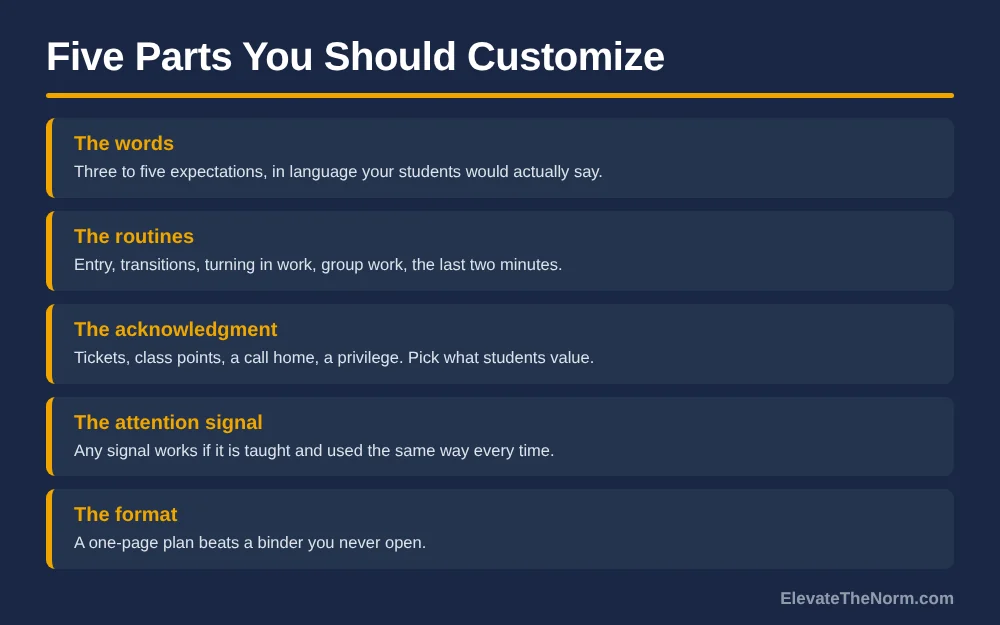
    Five parts of a classroom culture framework to customize: the words, the routines, the acknowledgment, the attention signal, and the format.
    The five parts of a classroom culture framework that are meant to change.

    What parts of a classroom culture framework should you not customize?

    Every classroom culture framework depends on teaching expectations directly, praising often, planning corrections and following through every time, so don’t cut those parts. They show up across all the programs above.

    • Teaching the expectations like content. The PBIS template includes lesson plans for a reason. Posting rules isn’t teaching them.
    • More praise and more chances to respond. In a randomized trial of 102 middle school teachers, CHAMPS teachers praised more and gave more opportunities to respond, and their students spent more time on task (IES, CHAMPS evaluation). If your version drops those, it isn’t really the same approach anymore.
    • A plan for corrections. The PBIS template pairs praise with corrections. A positive system with no follow-through falls apart. See classroom consequences.
    • Consistency. You can change your system at the semester, but not every week.
    • Criteria announced in advance. If students don’t know what earns recognition, the reward feels random.
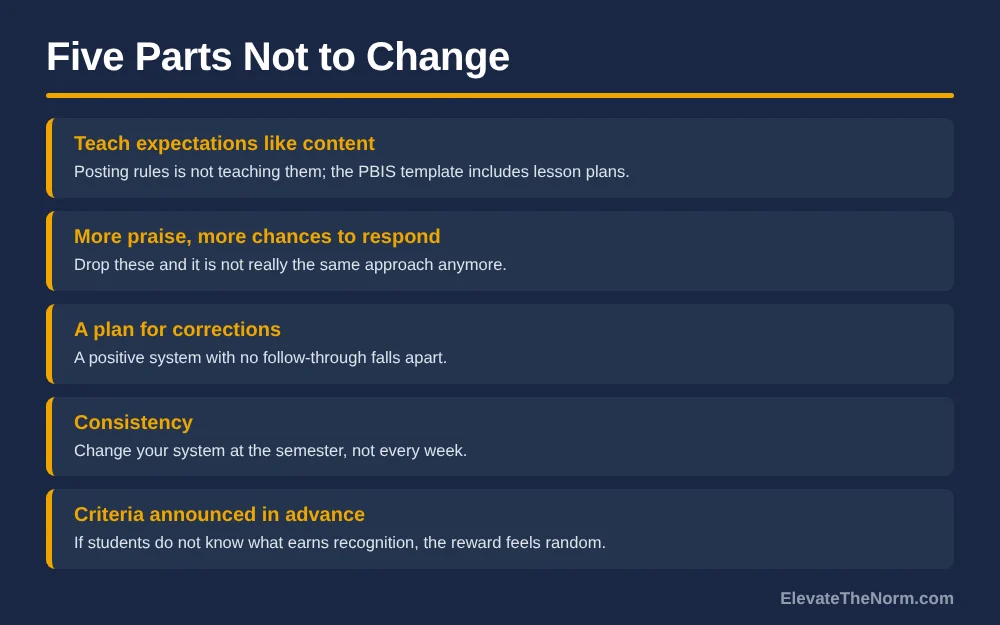
    Five parts not to change: teaching expectations, more praise and chances to respond, a plan for corrections, consistency, criteria announced in advance.
    The parts that make a framework work, no matter which one you pick.

    Where does Elevate the Norm fit among customizable frameworks?

    Elevate the Norm is a free grades 6–12 classroom culture framework whose materials you can download and edit. Disclosure: it’s this site’s own framework, built by Clay Shumate, a certified 6–12 social studies teacher. It hasn’t been independently evaluated.

    • Customizable pieces: three recognition tiers (Immediate Recognition, Student of the Week, Student of the Month) where you set the criteria, and the prizes. Criteria are announced in advance and judged on consistency and self-improvement, not perfection. Prizes run well under a hundred dollars a year for one teacher.
    • Fixed pieces: follow-through. You do exactly what you say, positives can be removed after repeated warnings, and serious discipline goes to administration.
    • A transition system you can tune: the class-vs-class 3-2-1-Done points method, written up in classroom attention getters, including the note that student buy-in took about six weeks in its most recent year.

    All classroom files are on the free resource library with no email gate. The same teacher also sells a paid option, the Teacher Emergency Toolkit on TPT, with editable de-escalation scripts, behavior and MTSS documentation, and parent communication templates. You don’t need it to use the free framework.

    How do you build a custom classroom culture framework in one week?

    A teacher can build a custom classroom culture framework in five school days by starting from the free PBIS plan template and adding one piece each day.

    1. Day 1: Download the PBIS plan template. Copy your school’s expectation words if it has them.
    2. Day 2: Fill in the matrix for your five most common routines.
    3. Day 3: Write one short lesson for each expectation.
    4. Day 4: Pick your acknowledgment and your correction steps, and write them down.
    5. Day 5: Grab any TPT or Elevate the Norm files you need for posters and trackers, then teach it.

    Then check one number every few weeks, like how many corrections you give in a period. Clear expectations are covered in classroom expectations for grades 6–12.

    Clay’s take, as a grades 6–12 classroom teacher: start with the free PBIS template and your school’s own expectation words, and only reach for a book or a TPT kit once you know what your system is. A short plan you actually follow beats a polished one you don’t.
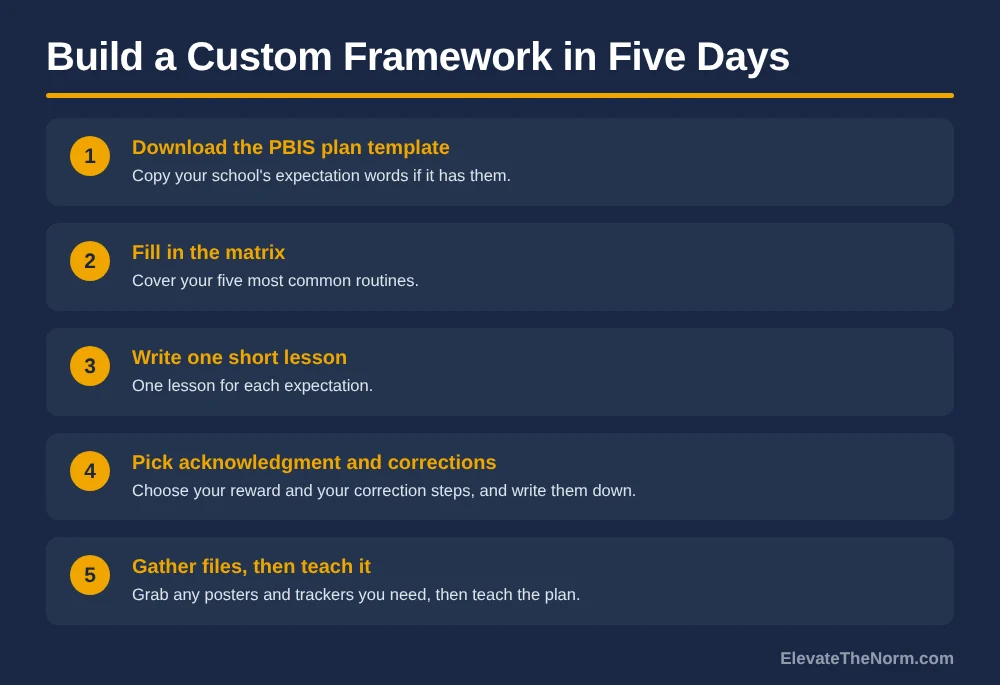
    Five steps to build a custom framework in a week: download the PBIS template, fill in the matrix, write lessons, pick acknowledgment and corrections, teach it.
    A five-day plan for building your own classroom culture framework.

    Frequently Asked Questions

    What is the best free customizable classroom culture framework?

    Classroom PBIS from the Center on PBIS is the best free customizable classroom culture framework. Its Creating Effective Classroom Environments Plan Template is a Word document with a behavior matrix, lesson plans for teaching expectations, prompts and reminders, and a plan for praise and corrections. The teacher fills in every section, so the expectations and acknowledgments match that teacher’s own students and schedule.

    Can I customize Responsive Classroom or CHAMPS?

    Yes, both Responsive Classroom and CHAMPS can be customized, because each comes as a book that guides teacher decisions rather than a script. Responsive Classroom books cost about $35, and The First Six Weeks of School is written for PreK–5. The CHAMPS book is $55 from Ancora Publishing and walks a teacher through expectations for each classroom activity.

    Are Teachers Pay Teachers classroom management kits editable?

    Some Teachers Pay Teachers classroom management kits are editable and some are not. TPT has no filter labeled editable, so filter by format instead: Google Apps and Microsoft files are usually the ones a teacher can change, while PDFs usually are not. The free classroom management category alone lists more than 70,000 results, so the format filter saves real time.

    What parts of a classroom culture framework should stay the same?

    The parts of a classroom culture framework that should stay the same are direct teaching of expectations, frequent specific praise, plenty of chances for students to respond, a written plan for corrections, consistent follow-through and criteria announced in advance. In a randomized trial of 102 middle school teachers, CHAMPS teachers praised more and gave more chances to respond, and their students spent more time on task.

    Is there a free customizable classroom culture framework for high school?

    Yes. Classroom PBIS is free and works from kindergarten through grade 12, so a high school teacher can fill in its plan template for a secondary room. Elevate the Norm, this site’s own grades 6–12 approach, also offers free editable files with no email gate, though it has not been independently evaluated. CHAMPS points high school teachers to its separate secondary book.

    How long does it take to build a customized classroom culture framework?

    A teacher can build a working customized classroom culture framework in about one school week. Download the PBIS plan template, fill in the matrix for your five most common routines, write one short lesson per expectation, choose your acknowledgment and correction steps, then gather posters and trackers and teach it. After that, check one number, such as corrections per period, every few weeks.

    Should my classroom framework match my school’s PBIS system?

    Yes, a classroom framework should match the school’s PBIS system when the school runs one. Using the same expectation words as the hallway posters keeps students from hearing two different systems. Ask the PBIS coach or an assistant principal for the schoolwide matrix and build the classroom version from it. A local coach may also review the plan for free.

    Will students take a teacher-made framework seriously?

    Students take a teacher-made classroom framework seriously when the expectations use words they would actually say, the recognition criteria are announced in advance, and the teacher follows through every time. High schoolers tune out elementary phrasing and rewards that feel random. A short, plainly worded system that stays consistent through the semester earns more trust than a binder of rules that changes weekly.

    Sources

    How is this page kept accurate?

    Prices and product details come from each publisher’s own site, so confirm them before you buy. Elevate the Norm and the Teacher Emergency Toolkit are labeled as this site’s own work wherever they appear. Corrections follow the editorial standards and corrections policy.

    About Clay Shumate

    Clay Shumate is a certified secondary Social Studies teacher in the public schools of West Alabama, with seven years of classroom experience, a B.A. in History, and an M.Ed. in Secondary Education. He writes about project-based learning, student responsibility, respect, and practical ways to hold young people to a higher standard while giving them room to learn from mistakes. He is a member of the Society of Professional Journalists and writes to its Code of Ethics; this site’s editorial standards and corrections policy are published in full. More about Clay.

  • Best Classroom Culture Frameworks for a Positive Classroom Environment

    Best Classroom Culture Frameworks for a Positive Classroom Environment

    By Clay Shumate

    The best classroom culture frameworks for a positive classroom environment are Classroom PBIS and CHAMPS for predictable routines and more praise than correction, Responsive Classroom and Developmental Designs for belonging, and restorative practices for repairing relationships. No single framework covers all four ingredients, so most teachers do best pairing one structure framework with one community routine.

    Key Takeaways

    • A positive classroom environment has four measurable ingredients: strong teacher-student relationships, more specific praise than correction, predictable routines, and students feeling they belong.
    • In a BYU study of 28 middle school classrooms, class-wide on-task behavior rose 60–70% once teachers praised at least as often as they reprimanded.
    • CHAMPS and Classroom PBIS make a classroom predictable by spelling out expectations for each activity and teaching them like content.
    • Responsive Classroom and Developmental Designs build belonging through a regular advisory-style meeting where students greet each other and share.
    • Restorative practices improved staff-student relationships in RAND’s Pittsburgh study, but grades 6–8 saw no drop in suspensions, so restorative work fits best beside a framework that handles routines and praise.

    A positive classroom environment is a room where students trust the teacher, hear more praise than correction, know what to do in each activity, and feel they belong. “Positive” gets used loosely, so this page defines it first and then matches frameworks to each piece. This page is a companion to two narrower guides: the best framework for student engagement and top-rated frameworks for middle school. The full list lives in the classroom culture frameworks Q&A hub.

    What makes a classroom environment positive, in measurable terms?

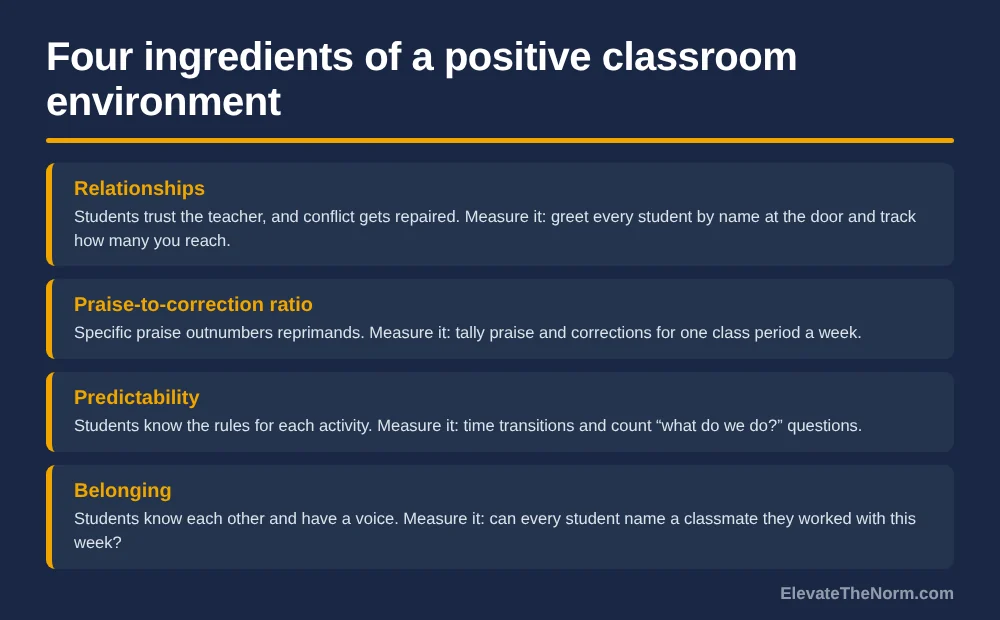
    A positive classroom environment has four ingredients you can count or observe: relationships, the praise-to-correction ratio, predictability and belonging. The Center on PBIS describes the goal as classrooms that are “predictable, positive, effective, and equitable,” where students feel a sense of belonging (Center on PBIS, Classroom PBIS). Broken into pieces a teacher can check:

    IngredientWhat it looks likeA simple way to measure it
    RelationshipsStudents trust the teacher; conflict gets repairedGreet every student by name at the door; track how many you reach
    Praise-to-correction ratioSpecific praise outnumbers reprimandsTally praise and corrections for one class period a week
    PredictabilityStudents know the rules for each activityTime how long transitions take; count “what do we do?” questions
    BelongingStudents know each other and have a voiceCan every student name a classmate they’ve worked with this week?

    The measurement ideas are ours, not from any one framework. They’re meant to be quick enough to do during a real school day.

    Graphic listing the four ingredients of a positive classroom environment — relationships, praise-to-correction ratio, predictability and belonging — each with a simple way to measure it.
    The four ingredients of a positive classroom environment and a quick way to measure each one.

    Which frameworks build teacher-student relationships best?

    Restorative practices and short relationship routines such as Establish-Maintain-Restore and positive greetings at the door build teacher-student relationships most directly.

    • Establish-Maintain-Restore: a three-hour training on building, keeping and repairing relationships. In a randomized trial with 20 middle school teachers and 190 students, relationship quality, engaged time and disruptive behavior all improved significantly (Duong et al., School Psychology Quarterly, 2018). The sample was small, so read the effect sizes cautiously.
    • Positive greetings at the door: middle school teachers randomly assigned to greet students at the door saw more engaged time and less disruption, and rated the strategy feasible (Cook et al., 2018).
    • Restorative practices: in RAND’s Pittsburgh study, 63% of surveyed staff said their relationships with students improved, and suspension days fell 36% in program schools versus 18% elsewhere. Results in grades 6–8 were weaker, with no change in suspensions and lower academic results (EdSource on the RAND study).

    More on this in building relationships with students and restorative practices in schools.

    What praise-to-correction ratio makes a classroom feel positive?

    A positive classroom needs at least one specific praise for every correction, and researchers suggest 2:1 or higher. The praise-to-correction ratio is the easiest of the four ingredients to measure.

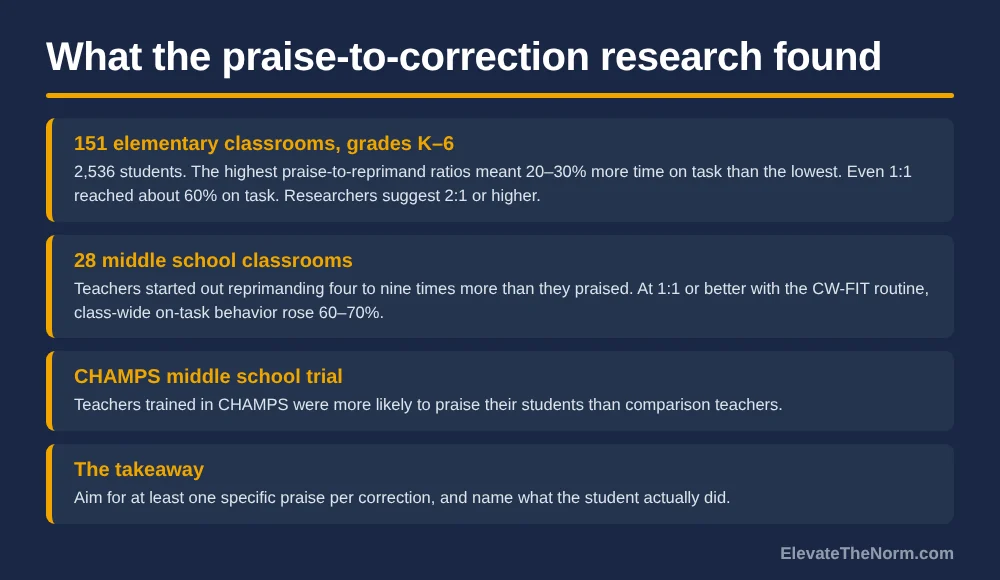
    • In 151 elementary classrooms (grades K–6, 2,536 students), students in classes with the highest praise-to-reprimand ratios stayed on task 20–30% longer than those with the lowest. Even 1:1 reached about 60% on-task, and the researchers suggest 2:1 or higher (Caldarella et al., Educational Psychology, 2020).
    • In 28 middle school classrooms, teachers began reprimanding four to nine times more than they praised. After reaching at least 1:1 with the CW-FIT routine, class-wide on-task behavior rose 60–70% (BYU, Journal of Positive Behavior Interventions).

    The frameworks that build this in most directly are CHAMPS, where the “S” stands for Success and recognizing good behavior (LiveSchool), and PBIS, which includes acknowledgment systems. In the CHAMPS middle school trial, trained teachers praised students more often than controls (IES). Praise works best when it names what the student did. See motivating students for examples that don’t sound canned to teenagers.

    Graphic summarizing praise-to-correction research: 151 elementary classrooms, 28 middle school classrooms using CW-FIT, and the CHAMPS middle school trial, with the takeaway to aim for at least one specific praise per correction.
    What the praise-to-correction research found, from elementary and middle school classrooms.

    Which frameworks make a classroom predictable?

    CHAMPS and Classroom PBIS make a classroom most predictable, because both frameworks make expectations explicit and teach them like content.

    CHAMPS spells out, for each activity, whether students can talk, how they get help, what the task is, whether they can move, what participation looks like and how success is recognized. PBIS uses a classroom teaching matrix that lists expectations by routine, and the Center on PBIS publishes planning tools for it for free (Center on PBIS). Responsive Classroom’s middle school advisory also makes predictability a goal: the first week of Responsive Advisory Meeting focuses on predictability, safety and belonging (RAM grades 6–8, first ten days).

    A predictable room isn’t a rigid one. A predictable room is one where students don’t have to guess. Our guides on routines and procedures and classroom expectations show how to set this up in grades 6–12.

    Which frameworks build a sense of belonging in the classroom?

    Responsive Classroom and Developmental Designs build belonging best, because both frameworks run a regular meeting where students greet each other and share.

    • Responsive Classroom: Responsive Advisory Meeting follows arrival, announcements, acknowledgments and an activity, with partner sharing built in every day (Responsive Classroom). Its broader secondary practices include Investing Students in the Rules, which gives students a hand in setting norms (Responsive Classroom secondary practices).
    • Developmental Designs: from the Origins Program, built around the Circle of Power and Respect, an advisory format with a greeting and an activity, and skills like cooperation, empathy and assertion (MiddleWeb).
    • Restorative circles also give students voice, though their main job is repair.

    Responsive Classroom’s randomized trial was in grades 2–5 and found gains only where teachers used it faithfully (AERA). We didn’t find a randomized trial of Developmental Designs.

    How do the frameworks compare across all four ingredients?

    No single classroom culture framework covers relationships, praise, predictability and belonging equally, which is why combining two frameworks usually works best.

    FrameworkRelationshipsPraise ratioPredictabilityBelongingLevel
    Classroom / schoolwide PBISModerateStrong (acknowledgment)Strong (teaching matrix)ModerateSchool or classroom
    CHAMPSModerateStrong (more praise in trial)Strong (per-activity rules)LightClassroom
    Responsive ClassroomStrongModerate (teacher language)ModerateStrong (advisory meeting)Classroom
    Developmental DesignsStrongNot a focusModerateStrong (Circle of Power and Respect)Advisory
    Restorative practicesStrong (repair)Not a focusLightModerate (circles)Schoolwide
    Elevate the Norm (this site’s own)ModerateStrong (recognition tiers)Moderate (3-2-1-Done)LightClassroom, grades 6–12

    The ratings are our editorial judgment based on each framework’s published components, not scores from a study. Some good pairings:

    • CHAMPS + Responsive Advisory Meeting: structure plus community, a natural fit for middle school.
    • PBIS + restorative practices: a schoolwide system plus a way to repair harm.
    • Any framework + greetings at the door + a praise tally: cheap, and both have middle school evidence.

    Clay’s take, as a grades 6–12 classroom teacher: start with the praise tally. It’s the cheapest ingredient to measure, it has middle school evidence behind it, and the same tally shows you whether the room is actually changing.

    How can a teacher start building a positive environment this week?

    A teacher can start building a positive classroom environment by picking one ingredient, measuring it for a week, then adding a framework that targets it. No schoolwide adoption is needed to begin.

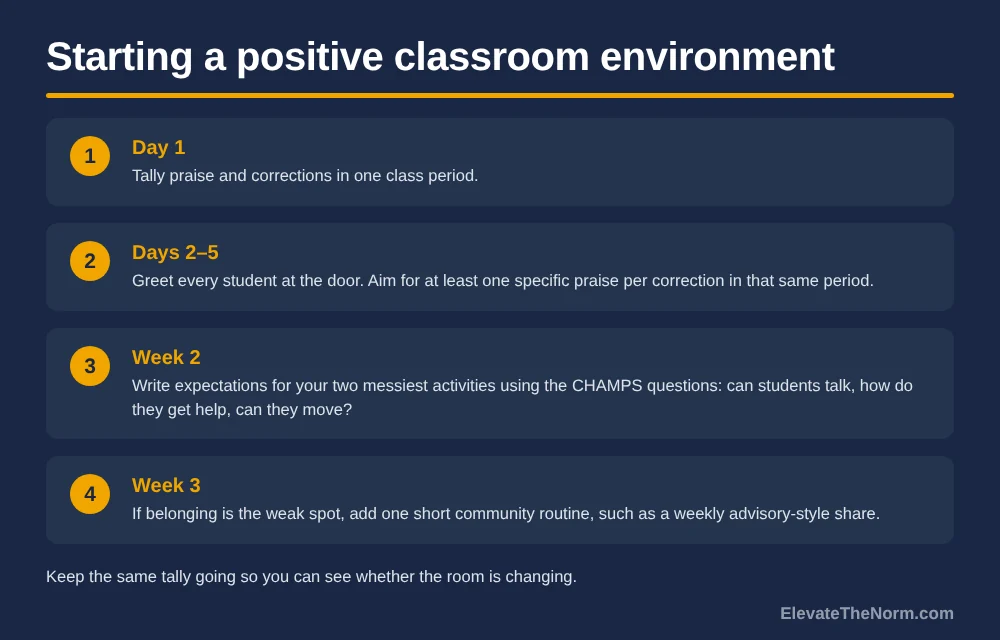
    1. Day 1: tally praise and corrections in one class period. For reference, the middle school teachers in the CW-FIT study started at four to nine reprimands per praise.
    2. Days 2–5: greet every student at the door and aim for at least one specific praise per correction in that same period.
    3. Week 2: write down expectations for your two messiest activities, using the CHAMPS questions: can students talk, how do they get help, can they move?
    4. Week 3: add one short community routine, such as a weekly advisory-style share, if belonging is the weak spot.

    Keep the same tally going so you can see whether the room is actually changing. New teachers can find a fuller starting plan in what a classroom management plan looks like.

    Four-step graphic: day 1 tally praise and corrections, days 2 to 5 greet students and aim for one praise per correction, week 2 write CHAMPS-style expectations, week 3 add a community routine.
    A three-week starting plan for a positive classroom environment.

    Where does Elevate the Norm fit in a positive classroom environment?

    Elevate the Norm is strongest on the praise ingredient and is built for grades 6–12. Disclosure: Elevate the Norm is this site’s own framework, created by Clay Shumate, a certified 6–12 social studies teacher, and it hasn’t been independently evaluated.

    • Praise with clear criteria: three recognition tiers (Immediate Recognition, Student of the Week, Student of the Month) announced in advance and judged on consistency and self-improvement, not perfection.
    • Predictable transitions: the 3-2-1-Done class-vs-class point system, where each class starts the week at zero and earns points for getting quiet quickly.
    • Respect both ways: student communication is channeled constructively rather than suppressed, and the teacher follows through on exactly what was announced. More on the thinking behind it on what we believe.

    Elevate the Norm is lighter on belonging routines, so pairing it with an advisory meeting or circles makes sense. Free materials, no email gate: resource library.

    Frequently Asked Questions

    What is a positive classroom environment?

    A positive classroom environment is a room where teacher-student relationships are strong, specific praise outnumbers correction, routines are predictable, and students feel they belong. The Center on PBIS describes the goal as classrooms that are predictable, positive, effective and equitable. Each of those four ingredients can be checked during an ordinary school day, for example by tallying praise and corrections for one class period.

    Which framework is best for a positive classroom environment?

    No single classroom culture framework covers everything. Classroom PBIS and CHAMPS are strongest for predictability and praise, Responsive Classroom and Developmental Designs are strongest for belonging, and restorative practices are strongest for repairing relationships after conflict. Most teachers get the best result pairing one structure-focused framework with one community routine, such as CHAMPS with an advisory meeting.

    What is a good praise-to-correction ratio in the classroom?

    A good praise-to-correction ratio is at least one specific praise for every correction, and researchers suggest 2:1 or higher. In 151 elementary classrooms, the highest ratios meant 20–30% more time on task than the lowest. In 28 middle school classrooms, reaching at least 1:1 raised class-wide on-task behavior 60–70%.

    How can I measure whether my classroom is positive?

    A teacher can measure a positive classroom with four quick checks. Tally praise and corrections for one class period a week. Time transitions and count how often students ask what to do. Track how many students you greet by name at the door. Then check whether every student can name a classmate they worked with that week.

    Do restorative practices create a positive classroom environment?

    Restorative practices help most with relationships. In RAND’s Pittsburgh study, 63% of surveyed staff said their relationships with students improved, and suspension days fell 36% in program schools versus 18% elsewhere. Results in grades 6–8 were weaker, with no change in suspensions, so restorative work fits best beside a framework that handles routines and praise.

    Can one teacher build a positive classroom environment without a schoolwide framework?

    Yes. Several of the best-supported moves work in a single classroom. Positive greetings at the door and the Establish-Maintain-Restore relationship training were both tested with individual middle school teachers, CHAMPS is a classroom-level system, and the Center on PBIS publishes free Classroom PBIS planning tools. A praise tally costs nothing and shows within a week whether the room is changing.

    Do these classroom culture frameworks work in high school?

    The evidence for these classroom culture frameworks comes mostly from younger grades. The CHAMPS trial, the greetings-at-the-door study and the Establish-Maintain-Restore trial ran in middle schools, and Responsive Classroom’s randomized trial ran in grades 2–5. The classroom-level studies cited on this page did not test high school classrooms, so high school teachers should treat the results as promising rather than proven.

    Will teenagers think classroom praise is babyish?

    The praise studies cited on this page measured how often teachers praised, not how teenagers felt about it. This site’s advice for older students is to make praise specific: name exactly what the student did, such as using a strong source or making a quick transition, instead of a vague “good job.” In 28 middle school classrooms, praising at least as often as correcting was linked to 60–70% more on-task behavior.

    Sources

    How is this page kept accurate?

    Study figures on this page come from the original papers or official summaries linked inline and listed under Sources, and the comparison ratings are labeled as editorial judgment. Elevate the Norm is identified as this site’s own framework wherever it appears. Corrections follow the editorial standards and corrections policy.

    About Clay Shumate

    Clay Shumate is a certified secondary Social Studies teacher in the public schools of West Alabama, with seven years of classroom experience, a B.A. in History, and an M.Ed. in Secondary Education. He writes about project-based learning, student responsibility, respect, and practical ways to hold young people to a higher standard while giving them room to learn from mistakes. He is a member of the Society of Professional Journalists and writes to its Code of Ethics; this site’s editorial standards and corrections policy are published in full. More about Clay.

  • What Makes Elevate the Norm Different From Other Frameworks

    What Makes Elevate the Norm Different From Other Frameworks

    By Clay Shumate

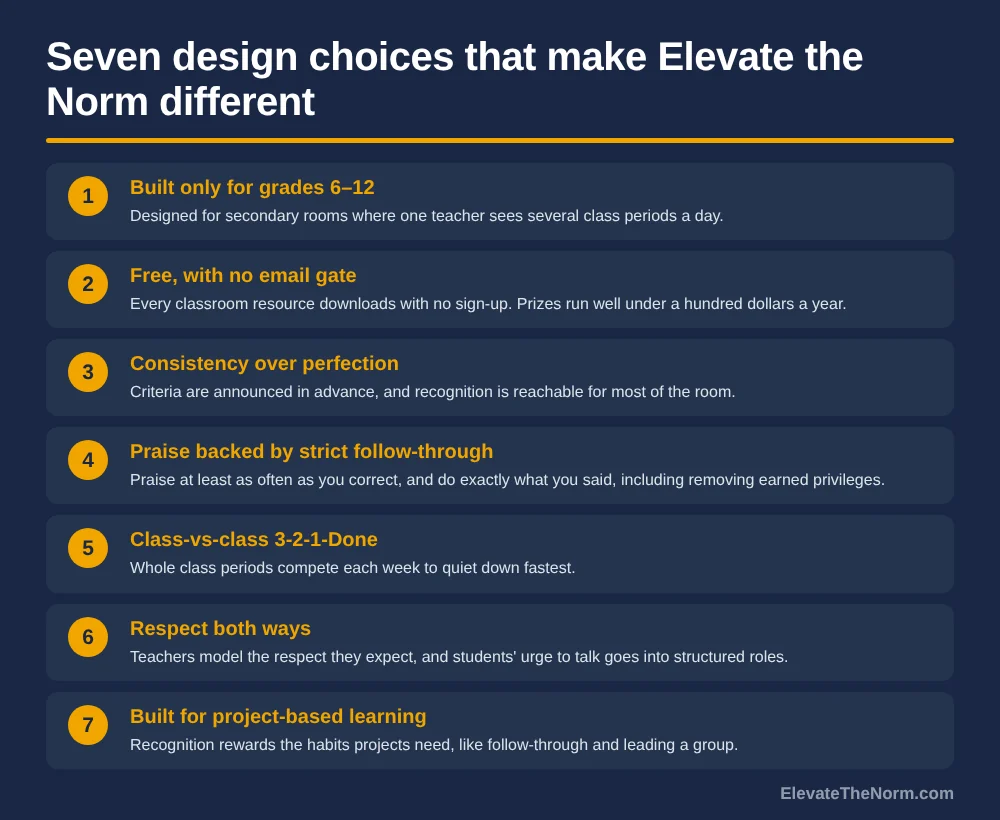
    What makes Elevate the Norm different from other frameworks is seven design choices. It’s built only for grades 6–12, it’s free with no email gate, it rewards consistency over perfection, it pairs praise with strict follow-through, it uses class-vs-class 3-2-1-Done for transitions, it runs respect both ways, and it fits project-based learning. It hasn’t been independently evaluated.

    Key Takeaways

    • Elevate the Norm is a free classroom culture framework built only for grades 6–12, while the biggest PBIS and Responsive Classroom trials ran in elementary schools.
    • Elevate the Norm announces recognition criteria in advance and rewards consistency, because a study of 15,329 students in grades 6–12 found surprise perfect-attendance awards were followed by about 8.3% more absences.
    • In a BYU study of 28 middle school classrooms, class-wide on-task behavior rose 60–70% when teachers praised at least as often as they reprimanded.
    • A brief exercise that encouraged teachers to keep relationships positive during discipline cut suspension rates in five middle schools from 9.6% to 4.8%, the research behind Elevate the Norm’s “respect both ways” rule.
    • Elevate the Norm has not been independently evaluated; the research cited here supports its individual design choices, not the framework itself.

    Elevate the Norm is this site’s own classroom culture framework, built by one secondary teacher for grades 6–12. This page explains why each piece of it is built the way it is and what research it draws on. It isn’t a product comparison. For a side-by-side table against PBIS, Responsive Classroom, CHAMPS and others, see Elevate the Norm vs other classroom culture frameworks. For the full set of framework questions, start at the classroom culture frameworks hub.

    What are Elevate the Norm’s design choices, in one table?

    Elevate the Norm’s design choices each answer a specific problem secondary teachers run into, and most connect to a published finding. The table gives praise and follow-through separate rows because they draw on different research.

    Design choiceProblem it addressesResearch it lines up with
    Secondary-first (grades 6–12)Most frameworks were built and tested in elementary schoolsMajor trials of PBIS and Responsive Classroom ran in elementary grades
    Free, no email gateCost and sign-up walls stop individual teachersDesign value, not a research claim
    Recognition for consistency, criteria announcedSurprise awards for perfection can backfireRobinson et al., 2019
    Specific praise in front of correctionTeachers tend to reprimand far more than they praisePraise-to-reprimand ratio studies, 2020
    Class-vs-class 3-2-1-DoneSlow quieting and transitionsTeam-based group contingencies (Good Behavior Game)
    Follow-through and remediationPositive systems that never enforce lose credibilityClassroom PBIS: predictable, consistent responses
    Respect both waysPunitive spirals with older studentsOkonofua, Paunesku & Walton, 2016
    Built for PBL and student leadershipBehavior systems designed for rows, not group workKnowledge in Action AP trial

    Why build a framework only for grades 6–12?

    Elevate the Norm is built only for grades 6–12 because most well-known classroom culture frameworks started in elementary schools, and secondary classrooms work differently. The biggest PBIS trial ran in 37 elementary schools (Bradshaw et al., 2012). Responsive Classroom’s main trial covered grades 2–5 (Rimm-Kaufman et al., 2014). Conscious Discipline is written for PreK–5 (Conscious Discipline).

    A secondary teacher may see five or six groups a day, has no single homeroom to build community in, and teaches students who expect a say. The Center on PBIS makes the same point about high schools: students expect input on decisions that affect them, so systems need student voice built in (High School PBIS). Elevate the Norm’s recognition and point systems are designed to run across several class periods without a homeroom.

    Numbered graphic of Elevate the Norm's seven design choices: built only for grades 6–12, free with no email gate, consistency over perfection, praise backed by strict follow-through, class-vs-class 3-2-1-Done, respect both ways, and built for project-based learning.
    The seven design choices that make Elevate the Norm different from other classroom culture frameworks.

    Why is everything free with no email gate?

    Elevate the Norm is free with no email gate because the teacher most likely to need a classroom system is often the one with no budget and no schoolwide support. Every classroom resource is on the free resource library, with no sign-up. Prizes run well under a hundred dollars a year for one teacher, paid out of pocket.

    To be transparent: the same teacher sells a separate paid product, the Teacher Emergency Toolkit on TPT, listed on the store page. It covers things like de-escalation scripts and behavior documentation. The framework doesn’t require it.

    Why recognize consistency instead of perfection?

    Elevate the Norm recognizes consistency instead of perfection because awards for rare perfection can signal that the behavior isn’t the norm, and in one large study that backfired. In a field experiment with 15,329 students in grades 6–12, students who got a surprise award for past perfect attendance were absent about 8.3% more the next month. The researchers think the award told students that perfect attendance wasn’t expected of everyone, and that they’d already outperformed their peers (Robinson, Gallus, Lee & Rogers, Organizational Behavior and Human Decision Processes, 2019).

    Elevate the Norm’s three tiers, immediate recognition, Student of the Week and Student of the Month, work the other way around:

    • Criteria are announced in advance, so nothing is a surprise.
    • Students are judged on consistency and self-improvement, not a perfect record.
    • Recognition is framed as something most students in the room can reach, not a prize for a rare few.

    The study looked at attendance awards, not classroom recognition, so this is a design that’s consistent with the finding, not proof that the tiers work.

    Graphic summarizing a study of 15,329 students in grades 6–12 where surprise perfect-attendance awards were followed by about 8.3% more absences, and how Elevate the Norm announces criteria in advance and rewards consistency instead.
    Why Elevate the Norm rewards consistency instead of perfection, and the limit of the evidence behind it.

    How much praise does Elevate the Norm call for?

    Elevate the Norm calls for more specific praise than correction, because classroom studies show students stay on task more as the praise-to-reprimand ratio rises. In 151 K–6 classrooms, researchers found no single ideal praise-to-reprimand ratio but a steady linear relationship: the higher the ratio, the more students were on task (Caldarella et al., Educational Psychology, 2020, via Education Week).

    It holds for older students. In 28 middle school classrooms, teachers began by reprimanding four to nine times as often as they praised. When they praised at least as often as they reprimanded, class-wide on-task behavior rose 60–70%, and high-risk students gained a full letter grade (BYU, Journal of Positive Behavior Interventions). That’s why immediate recognition is the first tier, not an extra.

    Why use class-vs-class competition for transitions?

    Elevate the Norm uses class-vs-class competition for transitions because team-based contingencies turn quieting down into a shared goal instead of a teacher-versus-student standoff. In 3-2-1-Done, each class period starts the week at zero. If the class is quiet on 3, 2, 1 or “done,” it earns 3, 2, 1 or 1 point, and it loses a point for each second past “done.” The weekly winner gets a small snack or drink and 15–20 minutes of its own time at a low murmur. The full method is in classroom attention getters.

    The closest researched cousin is the Good Behavior Game, where teams win small prizes for keeping rule-breaking under a set limit. Blueprints rates it “Promising,” with long-term benefits concentrated among highly aggressive first-grade boys and mixed results in independent evaluations (Blueprints for Healthy Youth Development). That’s elementary evidence, and 3-2-1-Done pits whole classes against each other instead of teams within one room, so treat the link as a family resemblance.

    One honest note: in its most recent year, students took about six weeks to buy in, double the usual three.

    Is Elevate the Norm just rewards?

    Elevate the Norm is not just rewards. Positive reinforcement only works if the teacher does exactly what they say, including taking earned privileges away after repeated warnings. Elevate the Norm calls that “remediation.” Serious discipline goes to administration, not the classroom point system. The Center on PBIS describes effective classrooms as “predictable” and consistent for the same reason (Classroom PBIS). More detail in positive discipline for teens and classroom consequences.

    What does “respect both ways” mean in Elevate the Norm?

    In Elevate the Norm, “respect both ways” means teachers model the respect they expect, and students’ urge to talk is channeled into structured roles instead of shut down. The research case here is strong. In a randomized field experiment in five middle schools, a brief online exercise that encouraged teachers to value students’ perspectives and keep relationships positive during discipline cut year-long suspension rates in half, from 9.6% to 4.8% (Okonofua, Paunesku & Walton, PNAS, 2016). That’s what the framework means by respect running both directions. See respect in the classroom.

    Why design it around project-based learning?

    Elevate the Norm is designed around project-based learning because group projects need students who can lead and manage themselves, and many behavior systems assume rows and silence. In a randomized trial across 68 schools, AP U.S. Government and AP Environmental Science students taught with the Knowledge in Action project-based approach were about 8 percentage points more likely to score a 3 or higher (College Board research brief). Elevate the Norm’s recognition criteria reward the habits projects depend on, like follow-through and leading a group. See the project-based learning guide and student leadership activities.

    What are Elevate the Norm’s limitations?

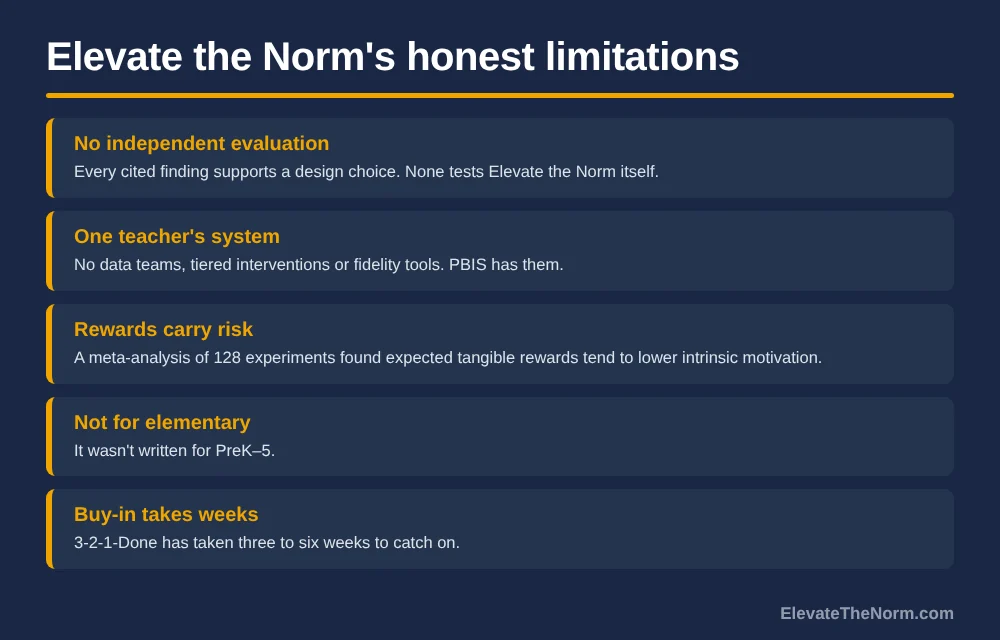
    Elevate the Norm’s main limitations are that it hasn’t been independently tested, it’s one teacher’s classroom system rather than a schoolwide one, and it uses tangible rewards that some research cautions against.

    • No independent evaluation. Every finding above supports a design choice; none tests Elevate the Norm itself.
    • One teacher’s system. It doesn’t give a school data teams, tiered interventions or fidelity tools. PBIS does. See classroom culture frameworks vs PBIS.
    • Rewards carry risk. A meta-analysis of 128 experiments found expected tangible rewards tend to lower intrinsic motivation, while positive verbal feedback tends to raise it (Deci, Koestner & Ryan, Review of Educational Research, 2001). Keeping prizes small and leading with words is how the framework tries to manage that, but it’s a real tension.
    • Not for elementary. It wasn’t written for PreK–5.
    • Buy-in takes weeks. 3-2-1-Done has taken three to six weeks to catch on.
    Graphic listing five limitations of Elevate the Norm: no independent evaluation, one teacher's system, rewards carry risk, not for elementary, and buy-in takes weeks.
    Elevate the Norm’s honest limitations, as listed on this page.

    Clay’s take, as a grades 6–12 classroom teacher: lead with specific words, keep the prizes small, and do exactly what you said you’d do. The research behind each piece is real; the framework as a whole still hasn’t been tested, and this page won’t pretend otherwise.

    The principles behind all of this are on the what we believe page.

    Frequently Asked Questions

    What makes Elevate the Norm different from PBIS?

    PBIS is a schoolwide, three-tier system run by a team that uses data to plan supports. Elevate the Norm is a classroom culture framework one teacher can run alone in grades 6 to 12. The two can work together: a teacher in a PBIS school can use Elevate the Norm as the classroom acknowledgment system while the school keeps its tiers and data teams.

    Has Elevate the Norm been studied?

    No. Elevate the Norm hasn’t been independently evaluated, and no claim on this site says it has. Its design choices line up with published research on praise-to-reprimand ratios, the timing of awards and empathic discipline, and each study is linked on this page. That research supports individual design choices, not the framework as a whole.

    Why does Elevate the Norm reward consistency instead of perfection?

    A field experiment with 15,329 students in grades 6 to 12 found that surprise awards for past perfect attendance were followed by about 8.3% more absences the next month. The researchers think the award signaled that perfect attendance wasn’t expected. Elevate the Norm announces criteria in advance and rewards consistency to avoid that effect, though the study looked at attendance, not classroom recognition.

    What is 3-2-1-Done?

    3-2-1-Done is Elevate the Norm’s class-vs-class point system for quieting down. Each class period starts the week at zero, earns 3, 2 or 1 point for being quiet by that count or 1 point on done, and loses a point for each second past done. The weekly winner gets a small snack or drink and 15 to 20 minutes of its own time at a low murmur.

    Does Elevate the Norm cost anything?

    No. Every Elevate the Norm classroom resource is free on this site’s resource library, with no email gate or sign-up. Prizes cost one teacher well under a hundred dollars a year, paid out of pocket. The same teacher sells a separate paid Teacher Emergency Toolkit on TPT, but the framework doesn’t require it.

    Can Elevate the Norm be used in elementary school?

    Elevate the Norm wasn’t written for PreK to 5 and isn’t recommended there. Its recognition tiers, point systems and student roles assume secondary students who rotate through several class periods and expect a say in decisions. Elementary teachers have frameworks built for their grades, including Responsive Classroom, whose main trial covered grades 2 to 5, and Conscious Discipline, written for PreK to 5.

    How long does it take students to buy into Elevate the Norm?

    Buy-in to 3-2-1-Done has taken three to six weeks. Three weeks is typical, and in its most recent year students took about six. Teachers starting Elevate the Norm should plan for a slow first month and keep following through on points and privileges the whole time, because positive systems that never enforce lose credibility with students.

    Do classroom rewards hurt student motivation?

    Expected tangible rewards can lower intrinsic motivation, according to a meta-analysis of 128 experiments by Deci, Koestner and Ryan, while positive verbal feedback tends to raise it. Elevate the Norm tries to manage that tension by leading with specific praise and keeping prizes small, but the tension is real and the framework hasn’t been tested on it.

    Sources

    How is this page kept accurate?

    Study figures come from the original papers or official summaries linked inline. Elevate the Norm is labeled as this site’s own framework wherever it appears, and no claim here says it has been tested. Corrections follow the editorial standards and corrections policy.


    About Clay Shumate

    Clay Shumate is a certified secondary Social Studies teacher in the public schools of West Alabama, with seven years of classroom experience, a B.A. in History, and an M.Ed. in Secondary Education. He writes about project-based learning, student responsibility, respect, and practical ways to hold young people to a higher standard while giving them room to learn from mistakes. He is a member of the Society of Professional Journalists and writes to its Code of Ethics; this site’s editorial standards and corrections policy are published in full. More about Clay.

  • Top-Rated Classroom Culture Frameworks for Middle School, Ranked

    Top-Rated Classroom Culture Frameworks for Middle School, Ranked

    By Clay Shumate

    The top-rated classroom culture frameworks for middle school, ranked on grades 6–8 evidence and fit, are CHAMPS, PBIS, Responsive Classroom’s middle school practices, Developmental Designs, Teach Like a Champion and restorative practices. CHAMPS is the only one with a middle school randomized trial. Most middle schools do best pairing one schoolwide system with one classroom routine.

    Key Takeaways

    • CHAMPS ranks first for grades 6–8 because it’s the only framework here tested in a middle school randomized trial: 102 teachers and 1,450 students in nine Missouri middle schools.
    • PBIS is the schoolwide system the other frameworks plug into, but its biggest randomized trial ran in elementary schools.
    • Responsive Classroom and Developmental Designs both offer advisory routines built for middle level, and neither has a middle school randomized trial.
    • Restorative practices had mixed middle school results in RAND’s Pittsburgh study: in grades 6–8, suspensions didn’t change and academic results got worse.
    • Three short routines with middle school trials, the CW-FIT praise routine, Establish-Maintain-Restore and positive greetings at the door, fit inside any of these frameworks.

    “Top-rated” here doesn’t mean popular or best-reviewed. It means ranked on evidence and on fit for how middle school actually runs. For every framework across all grades, see the classroom culture frameworks Q&A hub.

    How were these middle school frameworks ranked?

    Each middle school framework on this list was scored on four questions, with evidence from grades 6–8 weighted most.

    1. Middle school evidence: Has it been tested in grades 6–8, and how strong was the study?
    2. Built for middle level: Does it plan for students who change rooms every period and teachers who see 100+ students a day, or was it written for one self-contained elementary class?
    3. Adolescent fit: Does it respect a 12- to 14-year-old’s need for peer connection, voice and dignity, or will it feel babyish?
    4. Can one teacher start it? Some need a whole-school decision. Others work in one room on Monday.

    A framework with strong elementary research but no middle school study ranks below one tested in grades 6–8. We left out anything we couldn’t verify.

    What are the top-rated classroom culture frameworks for middle school?

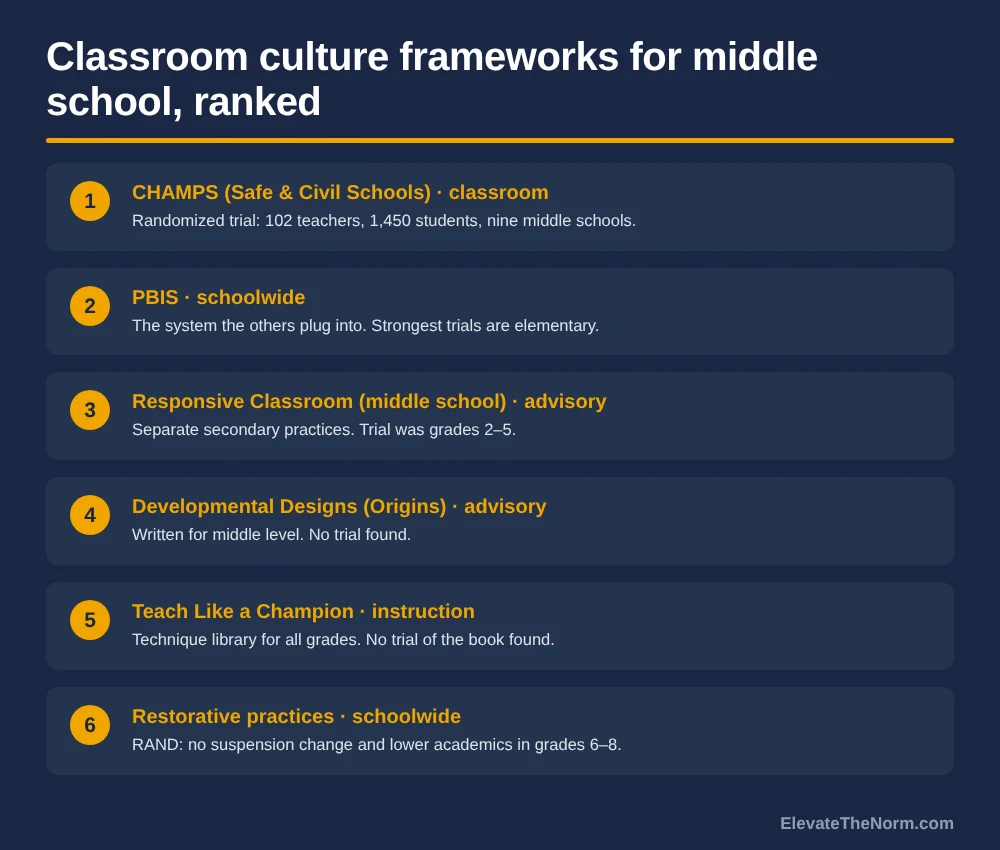
    The top-rated classroom culture frameworks for middle school are, in order, CHAMPS, PBIS, Responsive Classroom’s middle school practices, Developmental Designs, Teach Like a Champion and restorative practices, ranked on grades 6–8 evidence first.

    RankFrameworkLevelMiddle school evidenceBuilt for grades 6–8?
    1CHAMPS (Safe & Civil Schools)ClassroomRandomized trial, 102 teachers, grades 6–8Used across grades; tested in middle school
    2PBISSchoolwideStrongest trials are elementaryK–12 framework
    3Responsive Classroom (middle school)Classroom / advisoryTrial was grades 2–5Yes, separate secondary practices
    4Developmental Designs (Origins)Advisory / classroomNo trial foundYes, middle level
    5Teach Like a ChampionInstructionNo trial of the book foundNo, all grades
    6Restorative practicesSchoolwideRAND study: no suspension change, lower academics in grades 6–8No, K–12

    1. CHAMPS (Safe & Civil Schools)

    Best for: a middle school teacher who wants more time on task and calmer transitions. CHAMPS is Randy Sprick’s proactive, positive approach to classroom management, part of his Safe & Civil Schools materials (University of Kansas Center for Research on Learning). The acronym stands for Conversation, Help, Activity, Movement, Participation and Success: for each activity, students know whether they can talk, how to get help, what the task is, whether they can move, what participation looks like and how success is recognized (LiveSchool).

    Numbered graphic ranking six classroom culture frameworks for middle school: 1 CHAMPS, 2 PBIS, 3 Responsive Classroom middle school practices, 4 Developmental Designs, 5 Teach Like a Champion, 6 restorative practices, each with its level and middle school evidence.
    The six classroom culture frameworks for middle school, ranked by grades 6–8 evidence and fit.

    It ranks first because of the evidence. In a randomized trial with 102 teachers and 1,450 students in nine Missouri middle schools, teachers trained in CHAMPS praised more and gave more opportunities to respond. Their students were more focused, completed more classwork and spent more time on schoolwork (IES). The catch: teachers got three days of training plus monthly coaching. Reading the book alone isn’t the same thing.

    2. PBIS

    Best for: a middle school choosing one behavior system for every adult in the building. PBIS is a three-tier framework: universal supports for everyone, targeted help for students at risk, and intensive individual support (Center on PBIS). Its big randomized trial ran in 37 elementary schools and found a 33% drop in the odds of an office referral (Johns Hopkins). It ranks second because it’s the system the other frameworks plug into, not because it has middle school trial data. It doesn’t tell a teacher what to do at 10:14 on a Tuesday; CHAMPS or Responsive Classroom fills that gap.

    3. Responsive Classroom (middle school)

    Best for: a school that wants a daily advisory routine for belonging. Responsive Classroom has a separate set of secondary practices: Responsive Advisory Meeting, Brain Breaks, Investing Students in the Rules, Active Teaching, Student Practice, Small Group Learning and Independent Practice (Responsive Classroom). An advisory meeting runs arrival, announcements, acknowledgments and a short activity, and its first two weeks focus on predictability, safety and belonging (RAM grades 6–8 first ten days).

    Its randomized trial was in grades 2–5 and found gains only where teachers used it faithfully (AERA). That’s why it sits below CHAMPS for middle school. More in Responsive Classroom vs PBIS.

    4. Developmental Designs (Origins)

    Best for: a middle school building an advisory program from scratch. Developmental Designs comes from the Origins Program, founded by Linda Crawford, and it’s aimed at middle level schools. Its advisory guide is written for grades 5–9 and is built on two formats, the Circle of Power and Respect and a shorter Activity Plus Advisory, plus seven target skills: cooperation, communication, assertion, responsibility, engagement, empathy and self-control (MiddleWeb review). It’s designed for this age group from the ground up, which is its biggest strength. We didn’t find a randomized trial, so it ranks below the three above.

    5. Teach Like a Champion

    Best for: teachers who want concrete instructional techniques rather than a behavior system. Doug Lemov’s Teach Like a Champion 3.0 lays out 63 techniques and covers student engagement, trust, respect, accountability and excellence (Jossey-Bass, 2021, via Porchlight Books). It’s a technique library, not a middle school framework, and we found no trial of the book as a whole. Many of its ideas overlap with the moves that worked in the CHAMPS trial, like getting every student to respond.

    6. Restorative practices

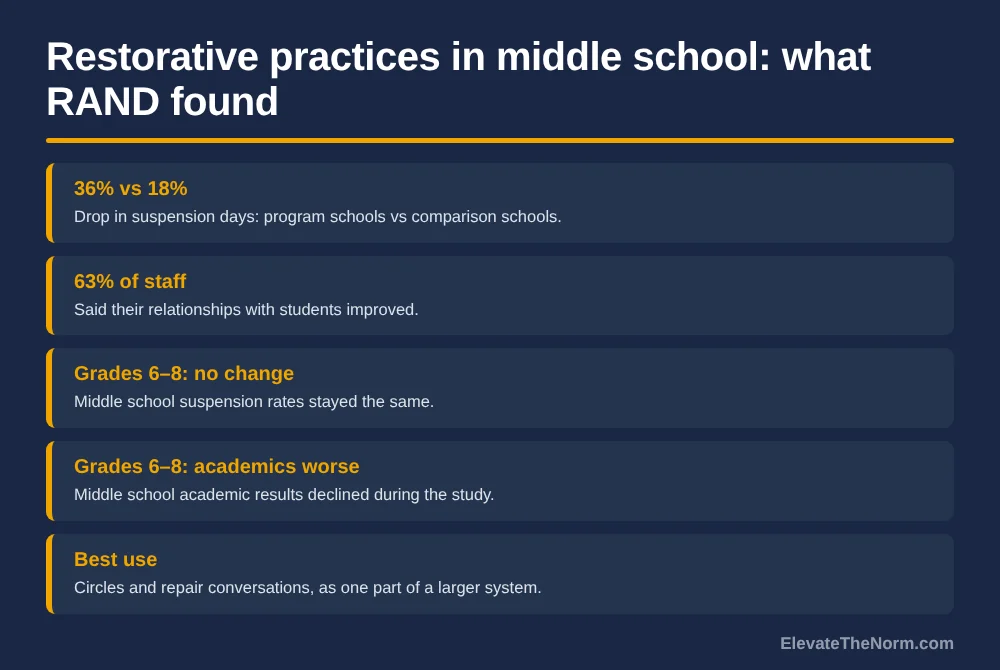
    Best for: repairing harm after conflict, as one part of a larger system. RAND’s Pittsburgh study found suspension days fell 36% in program schools versus 18% elsewhere, and 63% of staff said relationships with students improved. But in grades 6–8, suspensions didn’t change and academic results got worse (EdSource on the RAND study). That’s the reason it ranks last for middle school. It’s still useful for circles and repair conversations. See restorative practices in schools.

    Graphic summarizing RAND's Pittsburgh restorative practices study: suspension days fell 36% in program schools vs 18% in comparison schools, 63% of staff reported better relationships, and in grades 6–8 suspensions did not change and academic results got worse.
    What RAND’s restorative practices study found for middle school.

    Clay’s take, as a grades 6–12 classroom teacher: pair one schoolwide system with one classroom routine. If your school already runs PBIS, keep it and use CHAMPS or an advisory routine inside it rather than stacking a second schoolwide program on top.

    Are there smaller routines worth adding in middle school?

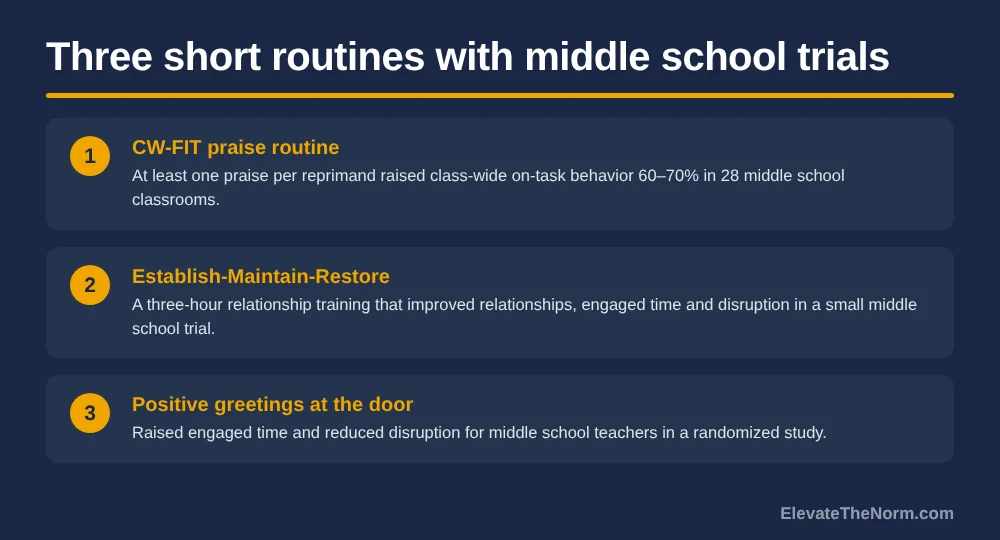
    Three short classroom routines have middle school trials and fit inside any of the six frameworks: the CW-FIT praise routine, Establish-Maintain-Restore relationship training, and positive greetings at the door.

    • CW-FIT (praise routine): in 28 middle school classrooms, getting to at least one praise per reprimand raised class-wide on-task behavior 60–70% (BYU).
    • Establish-Maintain-Restore: a three-hour relationship training that improved relationships, engaged time and disruption in a small middle school trial (Duong et al., 2018).
    • Positive greetings at the door: raised engaged time and reduced disruption for middle school teachers in a randomized study (Cook et al., 2018).
    Numbered graphic of three short routines with middle school trials: the CW-FIT praise routine, Establish-Maintain-Restore relationship training, and positive greetings at the door.
    Three short routines with middle school trials that fit inside any framework.

    If engagement is your main concern, our evidence breakdown is in the best classroom culture framework for student engagement.

    Why do middle schoolers need a different framework than elementary students?

    Middle schoolers need a different classroom culture framework because the school day and the student are both different: a middle school teacher sees several groups for under an hour each, and 12- to 14-year-olds care more about peers and fairness. A self-contained elementary teacher can build community in a morning meeting with the same 25 kids all day. A middle school teacher may see five or six groups, each for under an hour. Frameworks that assume one homeroom don’t transfer cleanly, which is why advisory-based models like Responsive Advisory Meeting and Developmental Designs exist.

    Middle schoolers also care a lot about peers and fairness. Generic praise and prize charts can feel childish. The routines that held up in middle school trials were specific and frequent: naming exactly what a student did, and giving everyone a chance to answer. Our guides on respect in the classroom and classroom management for new teachers go further on this.

    Where does Elevate the Norm fit?

    Elevate the Norm is this site’s own free grades 6–12 classroom approach, so it’s labeled rather than ranked, and it hasn’t been independently evaluated. It was built by Clay Shumate, a certified 6–12 social studies teacher. It belongs in the “one teacher can start it Monday” group alongside CHAMPS, and it works inside a school’s PBIS system.

    • Three recognition tiers (Immediate Recognition, Student of the Week, Student of the Month) with criteria announced in advance and judged on consistency and self-improvement, not perfection.
    • A 3-2-1-Done class-vs-class point system for quieting down, which suits middle schoolers’ competitive streak. Buy-in usually takes about three weeks; in its most recent year it took about six.
    • Respect both ways, with student talk channeled constructively instead of shut down.

    Materials are free with no email gate at the resource library. A paid option from the same teacher, the Teacher Emergency Toolkit on TPT, includes de-escalation scripts and behavior documentation (store).

    Frequently Asked Questions

    What is the best classroom management framework for middle school?

    CHAMPS has the strongest middle school evidence of the major classroom culture frameworks. In a randomized trial with 102 teachers and 1,450 students in nine Missouri middle schools, students of CHAMPS-trained teachers were more focused, finished more classwork and spent more time on schoolwork. Teachers got three days of training plus monthly coaching. Pair CHAMPS with PBIS if the school wants one schoolwide system.

    Does Responsive Classroom work for middle school?

    Responsive Classroom has a separate set of middle school practices built around Responsive Advisory Meeting, Brain Breaks and investing students in the rules. Its randomized trial followed students in 24 schools from second grade through fifth grade and found gains only where teachers used the practices faithfully. The middle school version is designed for adolescents but hasn’t been tested in its own trial.

    What is Developmental Designs?

    Developmental Designs is a middle level approach from the Origins Program, founded by Linda Crawford. Its advisory guide, written for grades 5–9, centers on the Circle of Power and Respect and a shorter Activity Plus Advisory format, and it targets seven skills including cooperation, responsibility and self-control. It’s built for this age group, but no randomized trial of it was found.

    Do restorative practices work in middle school?

    Restorative practices had mixed middle school results. In RAND’s study of Pittsburgh schools, suspension days fell 36% in program schools versus 18% elsewhere, but in grades 6–8 suspensions didn’t change and academic results got worse. Restorative practices still help with circles and repair conversations after conflict when they’re used as one part of a larger behavior system.

    Can one middle school teacher use a framework without the whole school?

    One middle school teacher can run CHAMPS, a praise routine like CW-FIT, positive greetings at the door or Elevate the Norm in a single classroom without waiting for a schoolwide decision. PBIS and restorative practices work best when the whole building adopts them, because both are designed as schoolwide systems rather than one-room routines.

    Is PBIS enough on its own in middle school?

    PBIS sets schoolwide expectations and three tiers of support, but it doesn’t tell a middle school teacher what to do minute to minute in a class period. Its largest randomized trial ran in 37 elementary schools, where it cut the odds of an office referral by 33%. Most middle schools add a classroom routine such as CHAMPS or an advisory model on top of it.

    How much training does CHAMPS take to get the trial results?

    In the middle school trial that put CHAMPS first on this list, teachers received three days of training plus monthly coaching. That support was part of what was tested. Reading the CHAMPS book alone is a different, untested experience, so a school expecting results like the trial’s should plan for training and follow-up coaching, not just a book order.

    Will middle schoolers think these frameworks are babyish?

    Middle schoolers can find generic praise and prize charts childish, which is why fit for 12- to 14-year-olds is one of the four ranking criteria here. The routines that held up in middle school trials were specific and frequent: naming exactly what a student did and giving every student a chance to respond. Advisory models also build in peer connection and student voice.

    Sources

    How is this page kept accurate?

    This middle school framework ranking is based on the studies and publisher pages linked inline and in the Sources list, and it will be updated if new middle school trials are published. Elevate the Norm is labeled as this site’s own framework and is not ranked. Corrections follow the editorial standards and corrections policy. For what a positive room looks like in measurable terms, see frameworks for a positive classroom environment.

    About Clay Shumate

    Clay Shumate is a certified secondary Social Studies teacher in the public schools of West Alabama, with seven years of classroom experience, a B.A. in History, and an M.Ed. in Secondary Education. He writes about project-based learning, student responsibility, respect, and practical ways to hold young people to a higher standard while giving them room to learn from mistakes. He is a member of the Society of Professional Journalists and writes to its Code of Ethics; this site’s editorial standards and corrections policy are published in full. More about Clay.

  • Elevate the Norm vs Other Classroom Culture Frameworks

    Elevate the Norm vs Other Classroom Culture Frameworks

    By Clay Shumate

    Elevate the Norm is a free classroom approach built by one teacher for grades 6–12 only. Against other classroom culture frameworks like PBIS, Responsive Classroom, CHAMPS and restorative practices, it’s narrower, cheaper and untested. Pick it for a no-cost recognition and transition system in one secondary classroom. Pick PBIS for a whole school and CHAMPS for middle school trial evidence.

    Key Takeaways

    • Elevate the Norm is free, written only for grades 6–12, and has not been independently evaluated.
    • PBIS is the pick for a whole school: the framework is free, and a randomized trial in 37 elementary schools found students 33% less likely to get an office referral.
    • CHAMPS has the strongest secondary evidence of these frameworks: a randomized study of 102 middle school teachers and 1,450 students.
    • Responsive Classroom and Conscious Discipline fit PreK–5 teachers better than any framework built for secondary grades.
    • The biggest hidden cost in every classroom culture framework is staff time, not books or training fees.

    Full disclosure up front: Elevate the Norm is this site’s own framework. That’s exactly why this page puts it in a table next to programs with bigger research bases and says plainly where each one wins. Every price and study below links to its source. For the full list of frameworks, see the classroom culture frameworks Q&A hub. If you want the reasoning behind Elevate’s design rather than a side-by-side, read what makes Elevate the Norm different.

    How does Elevate the Norm compare side by side?

    Elevate the Norm is the only one of these seven that’s free, built only for grades 6–12, and written by a single classroom teacher, and it’s also the only one with no independent evaluation.

    FrameworkGrade bandCost to startCore mechanismEvidence baseRewards philosophy
    Elevate the Norm (this site)6–12 onlyFree; prizes well under a hundred dollars a year for one teacherThree recognition tiers, class-vs-class 3-2-1-Done points, firm follow-throughNone independent; built on cited researchAnnounced, earned recognition for consistency
    PBISK–12, with a high school trackFree framework; staff time and trainingSchoolwide three-tier system, taught expectations, data teamsRandomized trials (elementary)Acknowledgment systems, often tokens
    Responsive ClassroomElementary roots, middle school version addedBooks $31–$35Daily meetings, Interactive Modeling, teacher languageRandomized trial, grades 2–5Reinforcing language over tokens
    Conscious DisciplinePreK–5Paid books and trainingAdult self-regulation, School FamilyQuasi-experimental, Pre-KConnection before consequences
    CHAMPSK–12Paid book and trainingClear expectations for each activity, praise, opportunities to respondRandomized trial, grades 6–8Specific praise plus planned reinforcement
    Teach Like a ChampionNot grade-specificBook $37 listNamed teaching techniques for routines, engagement and rigorObservation of effective teachers; no program trial foundHigh expectations and precise praise
    Restorative practicesK–12, whole schoolVaries by training providerCircles, repairing harm, relationshipsRandomized trial (RAND), mixed resultsRelationship and repair, not rewards

    Sources: Center on PBIS; High School PBIS; Responsive Classroom bookstore; Responsive Classroom middle school expansion; Conscious Discipline; CHAMPS K–12 session listing (Region 11 ESC); Teach Like a Champion 3.0 listing; RAND restorative practices trial. Prices change, so confirm current prices with each publisher.

    Which frameworks are built for middle and high school?

    PBIS, CHAMPS and Elevate the Norm cover high school; Responsive Classroom reaches middle school; Conscious Discipline stops at grade 5.

    PBIS has a dedicated high school track that adds student voice, department-wide consistency and extra freshman-year support (Center on PBIS). CHAMPS training is offered for elementary, middle and high school teachers (Region 11 ESC). Responsive Classroom spent about thirty years in elementary schools before building a middle school version (Responsive Classroom). Conscious Discipline lists its market as early childhood and PreK–5 (Conscious Discipline).

    Elevate the Norm is the narrowest: it was written for grades 6–12 and nothing else. That’s a strength if you teach teenagers and a dealbreaker if you don’t. If you’re in an elementary building, stop here and look at the other six.

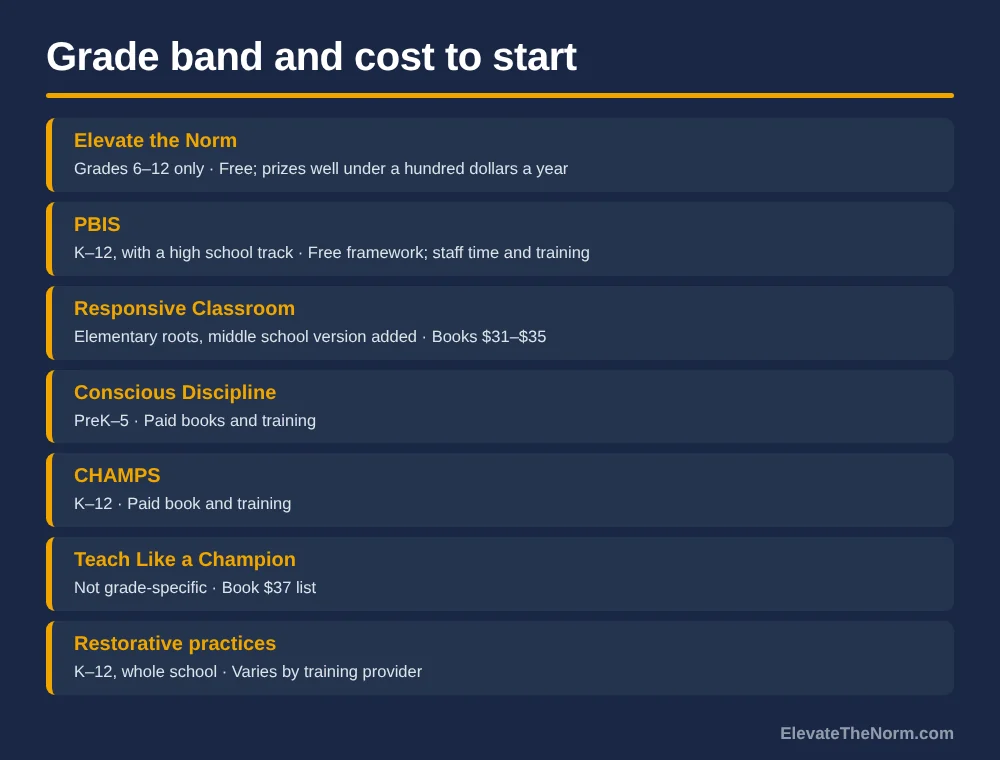
    Graphic comparing grade band and cost to start for seven classroom culture frameworks: Elevate the Norm (grades 6–12, free), PBIS, Responsive Classroom, Conscious Discipline, CHAMPS, Teach Like a Champion and restorative practices.
    Grade band and starting cost, Elevate the Norm vs other classroom culture frameworks.

    How much does each one cost?

    PBIS and Elevate the Norm cost nothing to adopt; the rest run from a $31 book to paid multi-day training.

    • Free: PBIS (framework and Center on PBIS materials) and Elevate the Norm (every classroom resource on the free resource library, no email required).
    • A book to start: Responsive Classroom titles list at $31.20–$35.00 at the publisher’s bookstore. Teach Like a Champion 3.0 lists at $37.00.
    • Book plus training: CHAMPS, Conscious Discipline and restorative practices are usually adopted through paid workshops or district contracts. We couldn’t confirm a current public list price for training, so ask the provider for a quote.

    The hidden cost in every framework is staff time. The Center on PBIS says plainly that PBIS isn’t something you learn in a one-day training; it’s an ongoing commitment that involves teams, data and coaching (Center on PBIS). Elevate the Norm is cheap partly because it asks less: one teacher, one room, no team.

    What does each framework actually ask a teacher to do every day?

    Classroom culture frameworks split into four types: systems (PBIS, restorative practices), teacher-technique playbooks (CHAMPS, Teach Like a Champion), community practices (Responsive Classroom, Conscious Discipline), and recognition systems (Elevate the Norm).

    • PBIS: teach three to five schoolwide expectations, acknowledge them, and use data to decide which students need Tier 2 or Tier 3 support.
    • Restorative practices: build relationships through circles and respond to harm by repairing it. RAND’s trial studied the whole-school model from the International Institute for Restorative Practices (RAND).
    • CHAMPS: define expectations for every activity and transition, praise specifically, and give more chances to respond.
    • Teach Like a Champion: a catalog of named techniques Doug Lemov observed in highly effective teachers (Education Week).
    • Responsive Classroom: morning or advisory meetings, modeling routines before expecting them, and precise teacher language.
    • Conscious Discipline: adults practice self-regulation first, then teach children the skills of discipline.
    • Elevate the Norm: immediate recognition, Student of the Week and Student of the Month on criteria announced ahead of time; the 3-2-1-Done class-vs-class point system for quieting and transitions; and strict follow-through, including removing positives after repeated warnings.

    Which framework has the strongest evidence?

    PBIS, Responsive Classroom, CHAMPS and restorative practices each have a randomized trial; Elevate the Norm has none. The largest studies found the following.

    • PBIS: In 37 elementary schools and 12,344 children, students in schoolwide PBIS schools were 33% less likely to get an office referral, with no significant difference in suspensions (Bradshaw, Waasdorp & Leaf, Pediatrics, 2012).
    • Responsive Classroom: In 24 schools and 2,904 students in grades 2–5, schools using it didn’t outperform controls overall, but teachers who used the practices faithfully saw gains of 0.26 in math and 0.30 in reading (Rimm-Kaufman et al., 2014).
    • CHAMPS: A randomized study of 102 middle school teachers and 1,450 students found CHAMPS teachers praised more and gave more chances to respond, and their students spent more time on schoolwork (IES). It’s the strongest secondary evidence on this list.
    • Restorative practices: Pittsburgh’s randomized trial found larger drops in suspensions and better teacher-rated climate, but academic outcomes didn’t improve and got worse in grades 6–8 (RAND, 2018).
    • Conscious Discipline: one quasi-experimental study of 1,386 Pre-K students, from an unpublished manuscript (CASEL).
    • Teach Like a Champion: the techniques come from observing effective teachers; we didn’t find a randomized trial of the program as a whole.
    • Elevate the Norm: no independent study. Its design choices line up with published research on praise and awards, which we cover in what makes Elevate the Norm different, but lining up with research isn’t the same as being tested.
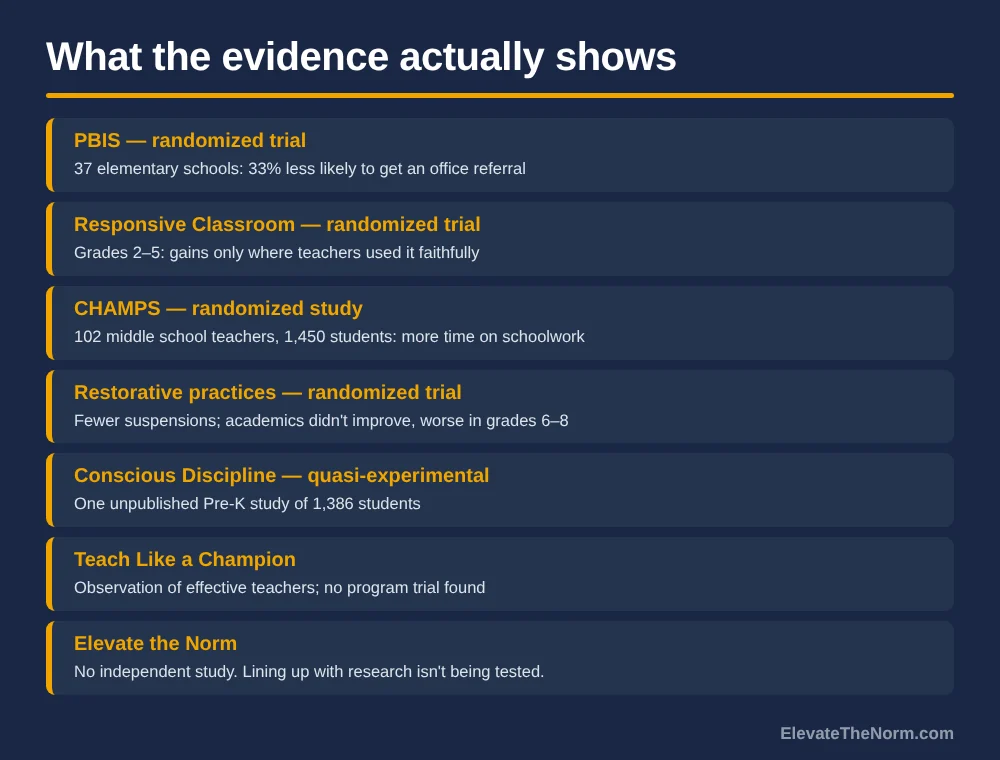
    Graphic summarizing the evidence behind seven classroom culture frameworks: randomized trials for PBIS, Responsive Classroom, CHAMPS and restorative practices, a quasi-experimental Pre-K study for Conscious Discipline, and no independent study for Elevate the Norm.
    What the largest studies found for each framework.

    How do their views on rewards differ?

    Responsive Classroom and restorative practices avoid token rewards, PBIS often uses them, and Elevate the Norm uses small, announced rewards tied to consistency.

    Responsive Classroom’s own explainer says tokens and prizes can produce short-term compliance but may build dependence on outside incentives, and it favors reinforcing teacher language instead (Responsive Classroom, 2025). PBIS doesn’t require tokens but is often run with tickets or points. The Center on PBIS also warns against clip charts and recommends equitable acknowledgment systems (Classroom PBIS).

    Elevate the Norm sits in the middle. It uses real prizes, but the criteria are posted in advance and judged on consistency and self-improvement, not perfection. If you’re firmly in the no-rewards camp, Responsive Classroom or restorative practices will fit your beliefs better.

    When is another framework the better choice?

    Another classroom culture framework is the better choice whenever your situation is anything other than one secondary teacher with no budget.

    • You’re choosing for a whole school: PBIS. Elevate the Norm can sit inside it but can’t replace it. See classroom culture frameworks vs PBIS.
    • You teach PreK–5: Responsive Classroom or Conscious Discipline. Compare them in Responsive Classroom vs PBIS vs Conscious Discipline.
    • Your district wants trial evidence for middle school: CHAMPS.
    • You’re a newer teacher who wants concrete moves for instruction, not just behavior: Teach Like a Champion.
    • Your main problem is suspensions and repairing harm: restorative practices, with eyes open about the academic results. Background in restorative practices in schools.
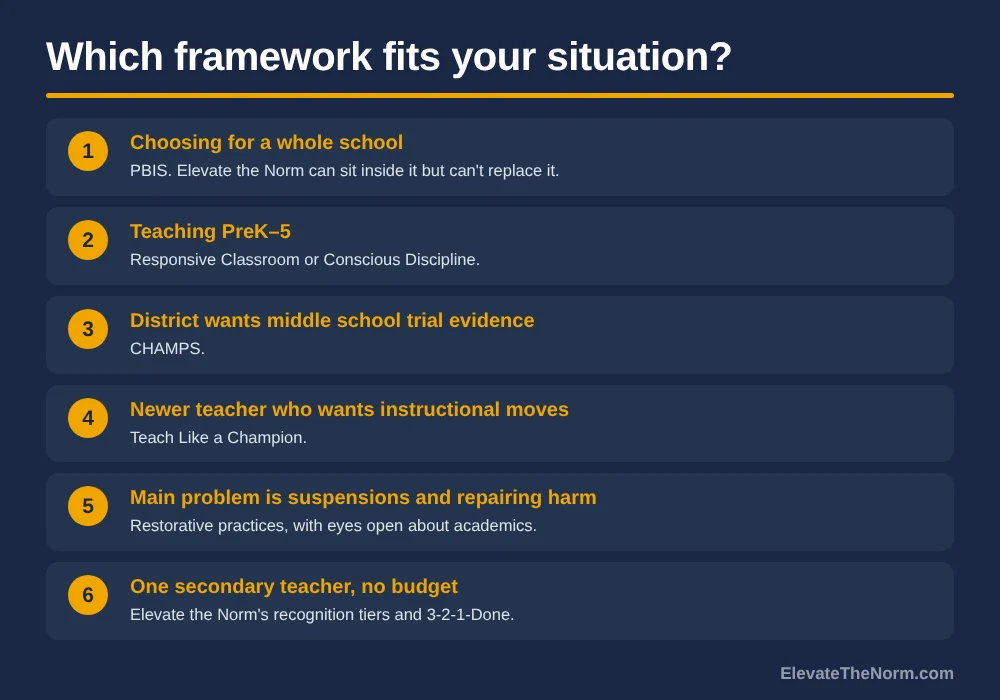
    Numbered graphic matching six situations to a classroom culture framework: PBIS for a whole school, Responsive Classroom or Conscious Discipline for PreK–5, CHAMPS for middle school trial evidence, Teach Like a Champion for newer teachers, restorative practices for suspensions, and Elevate the Norm for one secondary teacher with no budget.
    Pick a framework by situation, not by brand.

    Where does Elevate the Norm fit?

    Elevate the Norm fits a grades 6–12 teacher who wants a free recognition and transition system that works alone or inside PBIS. Again: it’s this site’s own framework, built by Clay Shumate, a Class A certified 6–12 social studies teacher, and it hasn’t been independently evaluated.

    • Free and open: every classroom resource is on the resource library with no email gate. A separate paid option from the same teacher, the Teacher Emergency Toolkit on TPT, is listed on the store page; nothing in the framework requires it.
    • Honest about time: 3-2-1-Done took about six weeks for students to buy in during its most recent year, double the usual three.
    • Not soft: do exactly what you say, remove positives after repeated warnings, and send serious discipline to administration. More in positive discipline for teens.
    • Built for project-based learning and student leadership; see student leadership activities.

    Clay’s take, as a grades 6–12 classroom teacher: if you’re one secondary teacher with no budget and no schoolwide system, start with Elevate the Norm’s recognition tiers and 3-2-1-Done. If your school already runs PBIS, keep PBIS and use Elevate inside it as your classroom acknowledgment system.

    The values behind it are on the what we believe page.

    Sources

    Frequently Asked Questions

    Is Elevate the Norm evidence-based?

    Elevate the Norm is not evidence-based in the formal sense, because no independent study has evaluated it. Its design lines up with published research on praise and awards, and every claim on this site links to a source. Lining up with research isn’t the same as being tested, so treat it as a promising classroom approach, not a proven program.

    Is Elevate the Norm free?

    Yes. Every Elevate the Norm classroom resource is free on the resource library, with no email gate. The only ongoing cost is prizes, which run one teacher well under a hundred dollars a year. The Teacher Emergency Toolkit on TPT is a separate paid product from the same teacher, and nothing in the framework requires it.

    Can I use Elevate the Norm with PBIS?

    Yes. PBIS is a schoolwide system and Elevate the Norm is a single-classroom approach, so the two don’t compete. Elevate’s recognition tiers can serve as your classroom acknowledgment system inside PBIS, as long as your recognition criteria match the schoolwide expectations your building already teaches. Elevate the Norm can sit inside PBIS, but it can’t replace it.

    Does Elevate the Norm work in elementary school?

    Elevate the Norm wasn’t built for elementary school. It was written for grades 6 to 12 and nothing else, and it hasn’t been tried or studied with younger children. Elementary teachers will find better fits in Responsive Classroom, Conscious Discipline or Classroom PBIS, which were designed with younger students in mind.

    Which classroom framework has the best research for middle school?

    CHAMPS has the strongest middle school evidence of the major classroom culture frameworks. A randomized study of 102 middle school teachers and 1,450 students found CHAMPS teachers praised more and gave more chances to respond, and their students spent more time on schoolwork. PBIS and Responsive Classroom also have randomized trials, but those were run in elementary schools.

    Which classroom culture framework is best for a whole school?

    PBIS is the best fit for a whole school. It’s a free, schoolwide three-tier framework with taught expectations, data teams and a dedicated high school track. The Center on PBIS is clear that it takes ongoing teams, data and coaching rather than a one-day training, so budget staff time even though the framework itself costs nothing.

    Do classroom culture frameworks use rewards?

    Classroom culture frameworks differ on rewards. Responsive Classroom and restorative practices avoid token rewards and lean on teacher language and repair. PBIS doesn’t require tokens but is often run with tickets or points, and the Center on PBIS warns against clip charts. Elevate the Norm uses small real prizes with criteria posted in advance and judged on consistency, not perfection.

    Do restorative practices improve academic results?

    Not in the largest trial. RAND’s randomized study in Pittsburgh found restorative practices cut suspensions more than in comparison schools and improved teacher-rated climate, but academic outcomes didn’t improve and got worse in grades 6–8. Restorative practices are a reasonable choice when suspensions and repairing harm are the main problem, as long as you watch academic results closely.

    How is this page kept accurate?

    This page is kept accurate by taking prices from publisher or retailer listings and study figures from the original papers or official summaries linked inline; prices change, so confirm them with each publisher. Elevate the Norm is labeled as this site’s own framework everywhere it appears. Corrections follow the editorial standards and corrections policy.
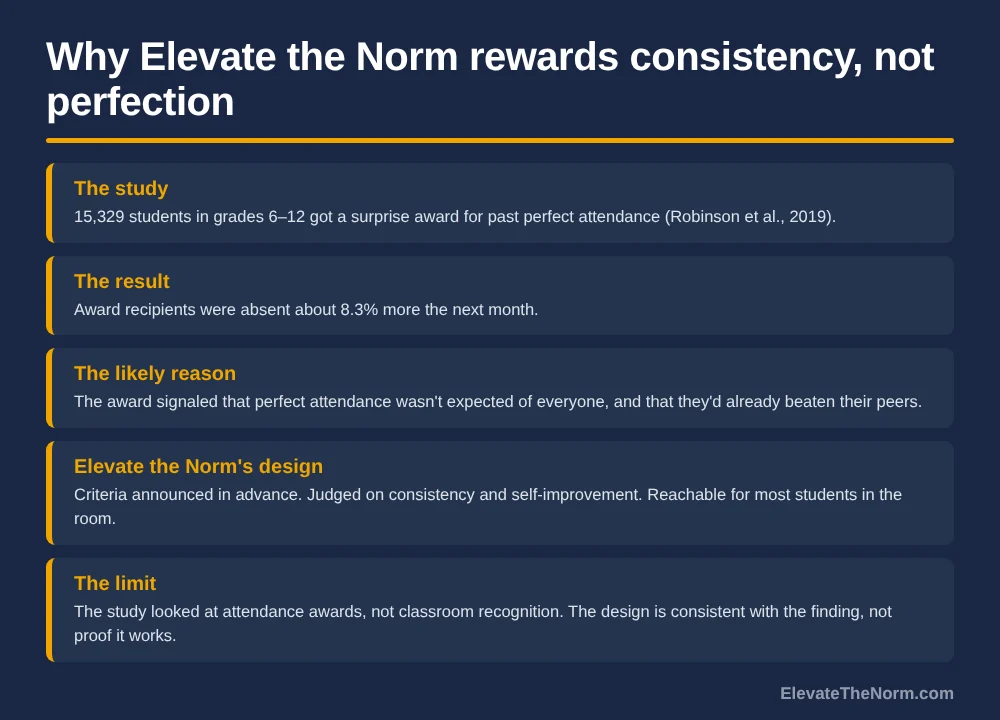

    About Clay Shumate

    Clay Shumate is a certified secondary Social Studies teacher in the public schools of West Alabama, with seven years of classroom experience, a B.A. in History, and an M.Ed. in Secondary Education. He writes about project-based learning, student responsibility, respect, and practical ways to hold young people to a higher standard while giving them room to learn from mistakes. He is a member of the Society of Professional Journalists and writes to its Code of Ethics; this site’s editorial standards and corrections policy are published in full. More about Clay.

Teacher Emergency Toolkit — practical resources, real classroom support. Shop on TPT.Teacher Emergency Toolkit — practical resources, real classroom support. Shop on TPT.