The Elevate Blog banner: Real Classrooms. Practical Ideas. Higher Expectations. Three students climb a rocky ridge at sunrise, each pulling the next one up, toward a teacher reaching down to help.

Tag: Conscious Discipline

  • Conscious Discipline vs Responsive Classroom: Which Should a School Buy?

    Conscious Discipline vs Responsive Classroom: Which Should a School Buy?

    By Clay Shumate

    Conscious Discipline vs Responsive Classroom comes down to grade band and the problem you’re solving. Buy Conscious Discipline for a PreK–5 school where adult stress and student dysregulation are the issue. Buy Responsive Classroom for a K–8 school that needs daily routines and community. Both are CASEL SELect programs, and training, not books, is most of the cost.

    Key Takeaways

    • Conscious Discipline is written for PreK–5 schools, Head Start and early childhood; Responsive Classroom’s training covers prekindergarten through grade 8.
    • Conscious Discipline starts with adult self-regulation, while Responsive Classroom starts with daily practices such as Morning Meeting and Interactive Modeling.
    • Responsive Classroom’s strongest evidence is a 24-school randomized trial in grades 2–5; Conscious Discipline’s is a quasi-experimental study of 1,386 Pre-K students.
    • In one public 2024 district quote for Conscious Discipline, books were about 4% of a $75,700 total; training and coaching were the rest of the cost.
    • Either program needs about three years of follow-through, and the Responsive Classroom trial found gains only where teachers actually used the practices.

    Conscious Discipline is an adult-first social-emotional learning and classroom management program for early childhood through grade 5. Responsive Classroom is a set of daily teaching practices, such as Morning Meeting, teacher language and logical consequences, for elementary and middle school.

    We cover the three-way comparison with PBIS briefly in Responsive Classroom vs PBIS vs Conscious Discipline. This page goes deeper on the purchase decision: what each one actually costs to own, who it’s built for, and what you need in place before you sign a quote. For every framework we cover, see the classroom culture frameworks Q&A hub.

    How do Conscious Discipline and Responsive Classroom compare at a glance?

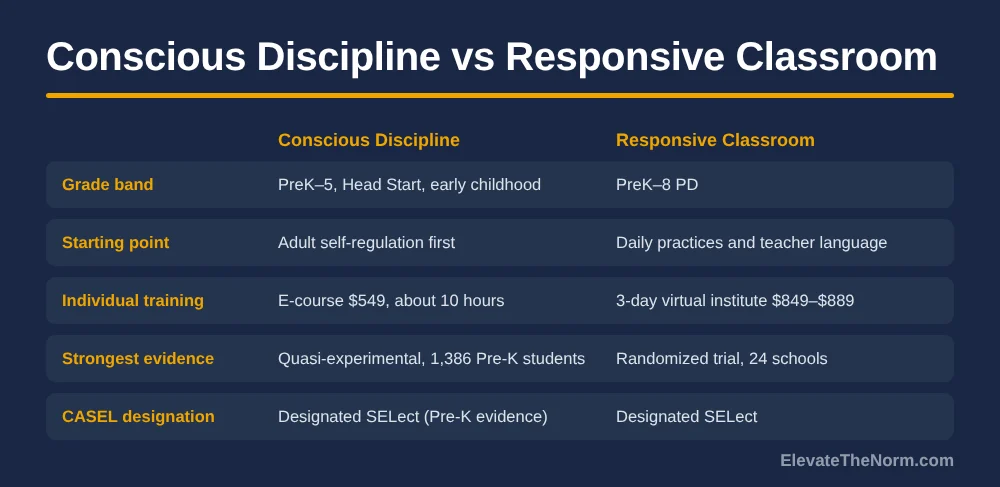
    Conscious Discipline and Responsive Classroom differ most on grade band, starting point and evidence. Conscious Discipline serves PreK–5 and starts with the adult; Responsive Classroom reaches grade 8, starts with daily routines and has a randomized trial behind it.

    Conscious DisciplineResponsive Classroom
    PublisherConscious Discipline, founded by Dr. Becky BaileyCenter for Responsive Schools
    Grade bandPreK–5 schools, Head Start and early childhoodPreK–8 PD; CASEL lists K–6 programming
    Starting pointAdult self-regulation first, then the School FamilyDaily classroom practices and teacher language
    Core book$44 ($29 with the e-course)$29.70–$35 per title
    Individual trainingE-course $549, about 10 hours, 2 CEUs available3-day live-virtual institute $849–$889 per seat
    Onsite trainingQuoted; one public 2024 quote ran $5,420 per onsite dayQuoted; prices not posted
    Strongest evidenceQuasi-experimental study, 1,386 Pre-K studentsRandomized trial, 24 schools, grades 2–5
    CASEL designationDesignated SELect; evidence shown for Pre-KDesignated SELect; evidence shown for grades 1–4

    Sources linked in each section below.

    Comparison table of Conscious Discipline and Responsive Classroom on grade band, starting point, individual training price, strongest evidence, and CASEL designation; both are designated SELect
    The two programs side by side on grade band, approach, training price, evidence, and CASEL status.

    What is the core difference between Conscious Discipline and Responsive Classroom?

    Conscious Discipline changes the adult first. Responsive Classroom changes the daily routine first.

    Conscious Discipline’s implementation plan spends its whole first year on adult social-emotional learning, starting with a 10-hour online course for teachers and leaders, before moving to classroom implementation and schoolwide teams in years two and three (CASEL program profile). The idea is that a calm, regulated adult can teach a dysregulated child to calm down, and a stressed adult can’t.

    Responsive Classroom gives teachers concrete practices to use tomorrow: Morning Meeting, Interactive Modeling, specific teacher language and logical consequences. Its books are built around those routines, from The First Six Weeks of School to 80 Morning Meeting Ideas (CRS bookstore).

    Neither is wrong. The question is where your school is stuck. If teachers know the routines but lose their cool under pressure, Conscious Discipline speaks to that. If classrooms lack predictable structure and community, Responsive Classroom does.

    Which grades are Conscious Discipline and Responsive Classroom built for?

    Conscious Discipline is built for early childhood through grade 5. Responsive Classroom’s training reaches prekindergarten through grade 8.

    • Conscious Discipline lists its audience as PreK–5 schools, Head Start, early childhood centers and districts (Conscious Discipline, About).
    • Responsive Classroom says its PD supports educators from prekindergarten through eighth grade (Responsive Classroom PD), and its live-virtual institutes include a separate Course for Secondary Educators alongside the elementary course (CRS institute listing).

    For a K–8 building, that difference alone may decide it. For grades 9–12, neither is a natural fit.

    How much do Conscious Discipline and Responsive Classroom really cost a school?

    For both Conscious Discipline and Responsive Classroom, books are the smallest cost. Training, coaching and staff time make up the real budget. Here’s what we could verify for each layer.

    Cost layerConscious DisciplineResponsive Classroom
    BooksBuilding Resilient Classrooms $44 listFirst Six Weeks $35; Power of Our Words $34.80; Interactive Modeling $31.20
    Online courseIndividual e-course $549 for one year, 10 video sessions, book included; team and site licenses start at $1,0993-hour live-virtual leadership seminars listed at $219–$259 per seat
    Institutes7-day national institute (per CASEL profile)3-day live-virtual institute $849–$889 per seat; full training is a 3-day core plus 3-day advanced course
    Onsite training1–2 day onsite courses; one 2024 district quote listed eight onsite days at $43,360Onsite courses and one-day workshops, priced by request
    CoachingSame quote: three coaching days $11,760; 24 hours of virtual consultation $10,080One-day consultant observation and feedback visit, priced by request
    Ongoing resourcesPremium Resources Membership from $179.99 per userKaleidoscope observation tool, included for one year with school and district course packages

    Sources: CD e-course; CD team registration; CD premium membership; CD training descriptions; Crowley ISD quote, Aug. 2024; CRS leadership seminar; CRS PD overview; CRS onsite services.
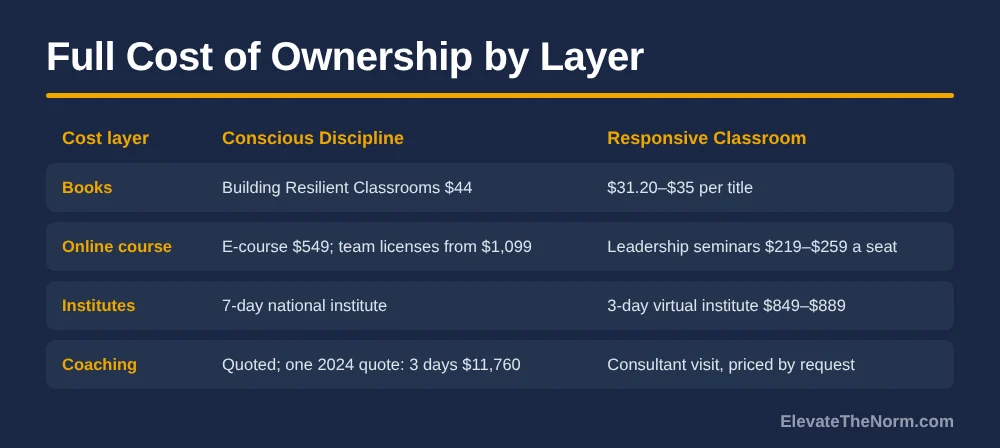
    Table of four cost layers for Conscious Discipline and Responsive Classroom: books, online course, institutes, and coaching, with verified prices
    Verified prices by cost layer for each program.

    A worked example

    That Texas district quote is the clearest public example we found. It totaled $75,700: $67,400 for training (eight onsite days, three coaching days, 24 virtual consultation hours and travel) and $8,300 for implementation tools (80 books, several e-course licenses and shipping). Books were about 4% of the total. Responsive Classroom doesn’t publish onsite pricing, but sending 20 teachers to a 3-day virtual institute at the 10-plus seat rate of $849 would run $16,980 before books or follow-up.

    Ask any vendor for a written multi-year quote, and price substitute coverage for training days. That cost often doesn’t appear on the quote.

    Does Conscious Discipline or Responsive Classroom have stronger research?

    Responsive Classroom has the stronger research, a 24-school randomized trial. Conscious Discipline’s best study is a quasi-experimental evaluation of Pre-K students, though CASEL designates both programs SELect.

    • Responsive Classroom: a three-year randomized controlled trial followed 2,904 children in 24 schools from the end of grade 2 through grade 5. Schools assigned to the program didn’t outperform control schools overall, but teachers’ use of the practices was linked to higher math (.26) and reading (.30) achievement, and to a much larger math effect (.89) for students who started low (Rimm-Kaufman et al., AERJ, 2014). CASEL designates it SELect, its highest level (CASEL Program Guide).
    • Conscious Discipline: the evaluation in CASEL’s profile is a quasi-experimental 2012–13 study of 1,386 Pre-K students, cited as an unpublished manuscript. Students showed greater growth in social skills, classroom behavior and school readiness than a comparison group, and teachers were rated higher on positive discipline and emotional climate (CASEL program profile). CASEL’s Program Guide also designates Conscious Discipline SELect, with programming for grades Pre-K–5 and evidence shown only for Pre-K (CASEL Program Guide). We found no randomized trial.

    The Responsive Classroom finding cuts both ways for a buyer: the program worked where teachers actually used it, and didn’t where they didn’t. Budget for fidelity, not just enrollment.

    How long does it take to implement Conscious Discipline or Responsive Classroom?

    Plan on about three years to implement either Conscious Discipline or Responsive Classroom. Conscious Discipline’s published model is a three-year schedule: year one on adult SEL, then classroom implementation and an internal schoolwide team, with optional coaching after year one (CASEL). Responsive Classroom’s full teacher training is six days, a three-day core course and a three-day advanced course that can run consecutively or across the year (CRS). Its trial ran three years.

    What should a school check before buying Conscious Discipline or Responsive Classroom?

    Before buying Conscious Discipline or Responsive Classroom, a school should settle seven things: grade band, the real problem, fit with existing systems, three-year cost, staff time, a fidelity check and two outcome measures.

    1. Grade band. PreK–5 only? Either works. Grades 6–8 included? Responsive Classroom is the one that reaches them.
    2. The real problem. Write one sentence. “Adults escalate” points to Conscious Discipline. “Classrooms lack routines and community” points to Responsive Classroom.
    3. Existing systems. If you run PBIS or MTSS, ask each vendor how it fits. Conscious Discipline offers sessions called “Beyond Behavior Charts: Tier 1 Strategies” and “Embedding Conscious Discipline into MTSS and Schoolwide Systems,” and Responsive Classroom offers a course called “Teaching Children to Care Within a Multi-Tiered System of Support.”
    4. Three-year money. Get years two and three in writing, including coaching.
    5. Staff time. Count substitute days and meeting time, not just registration.
    6. Fidelity check. Ask what observation tool comes with it, and who will use it.
    7. Two measures. Pick them now, such as office referrals and observed on-task time, and check them each quarter.

    Clay’s take: As a grades 6–12 teacher, I haven’t run either program in my own room, so this is a judgment on the numbers above, not a classroom story. Pick the one that matches your grade band and your real problem, then put the money into coaching and three years of follow-through. The Responsive Classroom trial only paid off where teachers actually used the practices.

    Tight on money? Our guide to the best classroom culture framework for elementary schools on a tight budget lays out free and under-$100 options, including how far either book gets you without training.
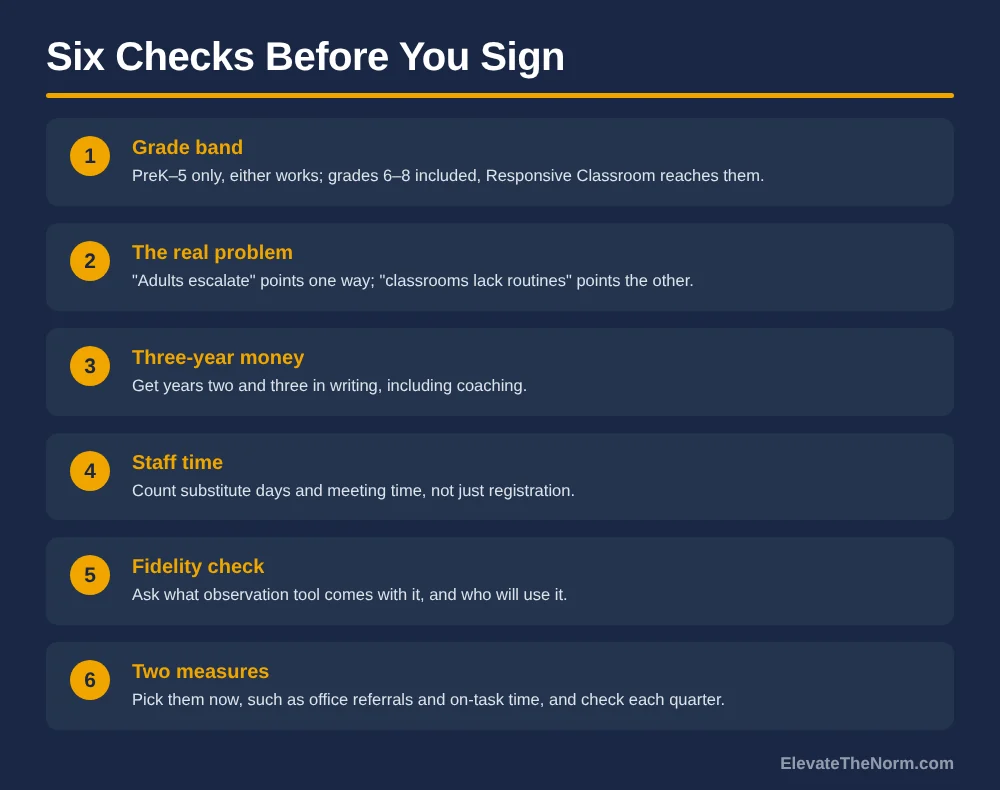
    Six numbered checks a school should make before buying either program: grade band, the real problem, three-year money, staff time, fidelity check, two measures
    Six of the seven checks above; the graphic leaves out fit with existing systems.

    Where does Elevate the Norm fit next to Conscious Discipline and Responsive Classroom?

    Elevate the Norm fits only schools that include grades 6–12. Elevate the Norm is this site’s own free positive-reinforcement approach for middle and high school, built by Clay Shumate, a certified 6–12 social studies teacher. It hasn’t been independently evaluated. It uses three recognition tiers with criteria announced in advance and a class-vs-class 3-2-1-Done system for transitions, and the materials are free with no email gate on the resource library. For a PreK–5 purchase, it isn’t a substitute for either program above. See restorative practices in schools and classroom management strategies for the secondary side.

    Frequently Asked Questions

    Is Conscious Discipline or Responsive Classroom better?

    Conscious Discipline and Responsive Classroom are each better for a different school. Conscious Discipline fits PreK–5 schools where adult stress and student dysregulation are the main problem, because it starts with teachers’ own self-regulation. Responsive Classroom fits K–8 schools that need predictable daily routines and community, and it has a 24-school randomized trial behind it.

    How much does Conscious Discipline cost a school?

    Conscious Discipline lists individual pieces online, such as a $44 core book and a $549 one-year e-course that includes the book. Onsite training and coaching are quoted. One public 2024 Texas district quote totaled $75,700, and about $67,400 of that was onsite training, coaching days, virtual consultation and travel.

    How much does Responsive Classroom training cost?

    Responsive Classroom’s three-day live-virtual institute is listed at $849 to $889 per seat, depending on how many seats a school buys. Three-hour leadership seminars are listed at $219 to $259 per seat. Onsite courses and consultant visits are priced by request, and core books run about $30 to $35 each.

    Can a school use Conscious Discipline and Responsive Classroom together?

    A school can borrow ideas from both Conscious Discipline and Responsive Classroom, but buying both doubles the training bill and gives staff two sets of language for the same moments. Most schools are better served by choosing one program, funding its coaching, and implementing it well for about three years before adding anything else.

    Does Conscious Discipline or Responsive Classroom work in high school?

    Neither Conscious Discipline nor Responsive Classroom is built for grades 9–12. Conscious Discipline targets PreK through grade 5, and Responsive Classroom’s professional development covers prekindergarten through grade 8, with a separate course for secondary educators. A high school looking for a classroom culture approach should compare options designed for older students instead.

    How long does it take to implement Conscious Discipline or Responsive Classroom?

    Plan on about three years for either program. Conscious Discipline publishes a three-year model that spends year one on adult social-emotional learning, then moves to classroom implementation with an internal schoolwide team. Responsive Classroom’s full teacher training is six days, a three-day core course and a three-day advanced course, and its main trial ran three years.

    Do Conscious Discipline and Responsive Classroom fit with PBIS or MTSS?

    Both Conscious Discipline and Responsive Classroom offer training aimed at schools that already run tiered systems. Conscious Discipline offers sessions on embedding the program into MTSS and schoolwide systems, and Responsive Classroom offers a course called Teaching Children to Care Within a Multi-Tiered System of Support. Ask each vendor how its program maps onto your existing tiers before signing.

    How will a school know if Conscious Discipline or Responsive Classroom is working?

    A school will know if Conscious Discipline or Responsive Classroom is working by choosing two measures before training starts, such as office referrals and observed on-task time, and checking them every quarter. It should also check fidelity, because the Responsive Classroom trial found gains only in classrooms where teachers actually used the practices.

    Sources

    How is this page kept accurate?

    Prices come from each publisher’s site, and the district figures come from a public 2024 board document. Study details come from the original papers or CASEL summaries linked inline. Corrections follow the editorial standards and corrections policy.

    About Clay Shumate

    Clay Shumate is a certified secondary Social Studies teacher in the public schools of West Alabama, with seven years of classroom experience, a B.A. in History, and an M.Ed. in Secondary Education. He writes about project-based learning, student responsibility, respect, and practical ways to hold young people to a higher standard while giving them room to learn from mistakes. He is a member of the Society of Professional Journalists and writes to its Code of Ethics; this site’s editorial standards and corrections policy are published in full. More about Clay.

  • Best Classroom Culture Frameworks to Buy: 2026 Prices Compared

    Best Classroom Culture Frameworks to Buy: 2026 Prices Compared

    By Clay Shumate

    Short answer: The best classroom culture frameworks to buy are Responsive Classroom for PreK–8 routines, CHAMPS for middle school, Teach Like a Champion for K–12 instructional culture, and Conscious Discipline for PreK–5. Books run $35–$55 and workshops $219–$1,050 a seat. PBIS costs nothing to adopt, and one book plus the free PBIS template covers most of what paid programs teach.

    Key Takeaways

    • PBIS materials are free from the Center on PBIS, so a school can adopt PBIS without buying anything.
    • Single framework books cost $35 to $55: about $35 for Responsive Classroom, $45.22 for Teach Like a Champion 3.0 and $55 for CHAMPS.
    • CHAMPS has a randomized trial with 102 middle school teachers, and that trial paid for workshops and monthly coaching, not just the book.
    • Teach Like a Champion whole-staff training is the most expensive option listed, at $16,000 remote or $31,000 plus travel in person.
    • Conscious Discipline is built for early childhood through grade 5, so it is a poor fit for a high school purchase.

    A classroom culture framework is a shared system for teaching expectations, building relationships and responding to behavior the same way every day. This guide lists what each program actually sells, what you get for the money, and what it works out to per teacher. Every price links to the publisher or a retailer. Prices change, so confirm before you submit a purchase order. For free options you can adapt yourself, see customizable classroom culture frameworks. For the full list of frameworks, see the classroom culture frameworks Q&A hub.

    What do the main classroom culture frameworks cost?

    Classroom culture framework books run $35–$55, workshops run $219–$1,050 per person, and whole-staff training runs from about $1,000 to $31,000. PBIS materials are free.

    FrameworkBookIndividual trainingWhole-staff optionGrade fit
    Responsive Classroom$34.80–$35$259 one-day virtual; $889 three-day courseOnsite by quote; seat discounts at 5+ and 10+PreK–8; secondary course 6–12
    Conscious DisciplineIncluded with e-course$549 e-course (1 year)Team license from $1,099 (75+ accounts)Early childhood–grade 5
    CHAMPS$55Virtual courses (price not posted)Consultants and coaches by quoteK–8; separate secondary book
    Teach Like a Champion$45.22$68 online modules; $500–$1,050 train-the-trainer$16,000 remote or $31,000 in personK–12
    PBISFree guidesFree online materialsState and district networksK–12
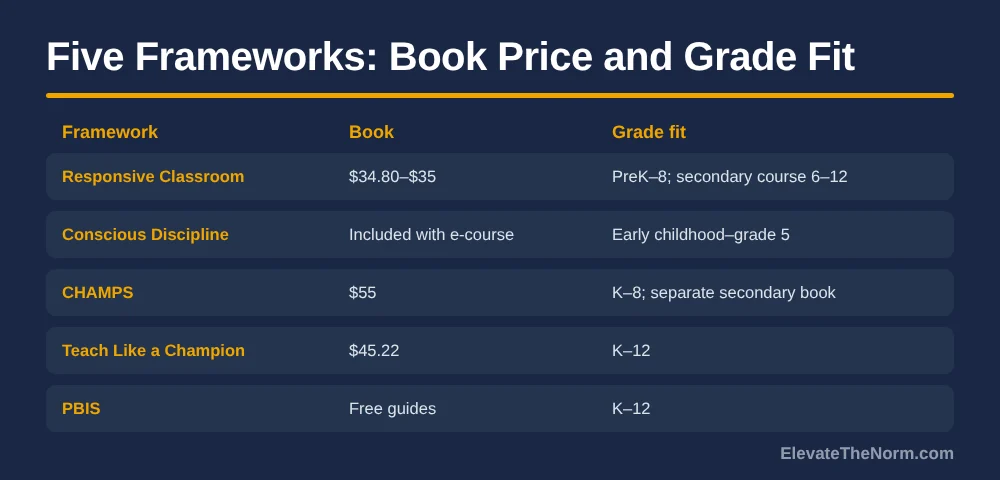
    Table of five classroom culture frameworks (Responsive Classroom, Conscious Discipline, CHAMPS, Teach Like a Champion, PBIS) with book price and grade fit
    Book price and grade fit for the five classroom culture frameworks compared in this guide.

    Is Responsive Classroom worth buying?

    Responsive Classroom is worth buying if you teach PreK–8 and want daily routines and teacher language more than a reward system. Here’s what the money buys:

    • Books: The First Six Weeks of School (3rd ed., PreK–5) is $35. The Responsive Advisory Meeting Book for middle school is $34.80.
    • One-day virtual workshop: a live-virtual day with “Classroom Management That Works” was listed at $259 a seat for 1–4 seats, $229 for 5–9 and $219 for 10 or more (Center for Responsive Schools).
    • Three-day course: live-virtual institutes were listed at $889 a seat, dropping to $849 at 10 or more (CRS). The secondary course for grades 6–12 runs 21 hours and includes a resource book, Yardsticks (5th ed.), and a one-year Fly Five license for grades 6–8 or a high school toolkit for 9–12 (course sheet).
    • Onsite training and consultant visits: priced by quote (On-Site Services).

    What you don’t get: a token or points economy. Responsive Classroom leans on teacher language instead. We compare that choice in Responsive Classroom vs PBIS vs Conscious Discipline.

    What do you get when you buy Conscious Discipline?

    Conscious Discipline is an adult-first program for early childhood through grade 5, sold mainly as a $549 individual e-course and as team licenses from $1,099. The individual e-course gives one year of access. It includes 10 video sessions with Dr. Becky Bailey (about 10 hours), video FAQs, a downloadable workbook, printables, and a copy of the Conscious Discipline textbook. CEUs are available separately. Purchases are non-refundable.

    A team license starts at $1,099, with tiers from 75 to 750 user accounts and 1-, 3- or 5-year terms. Onsite and virtual trainings led by certified instructors are quoted on request (Conscious Discipline training).

    Buy it if you work with young children or a staff that needs help with its own stress responses. Skip it for a high school, since it names PreK–5 and early childhood as its audience.

    Is CHAMPS a good buy for middle school?

    CHAMPS is a good buy for middle school: the book is $55, and CHAMPS has a randomized trial run in middle schools. The CHAMPS book (3rd ed.) is $55 from Ancora Publishing. Coaching CHAMPS, for coaches and administrators, is $75 on the same page.

    In a federally funded randomized trial with 102 middle school teachers and 1,450 students, teachers got three days of CHAMPS workshops plus monthly coaching for a year. They praised more and gave more opportunities to respond, and their students spent more time on schoolwork. Communication scores improved on the state test, with no difference in math on that test (IES).

    Notice what that trial paid for: the workshop and the coaching, not just the book. CHAMPS is written for K–8. Its high school counterpart is a separate book, Discipline in the Secondary Classroom (Instructional Coaching Group).

    What does Teach Like a Champion cost?

    Teach Like a Champion 3.0 costs $45.22 as a book, but Teach Like a Champion whole-staff training is the most expensive option on this list, at $16,000 to $31,000. Teach Like a Champion is a set of instructional techniques, and its “Building Strong Classroom Cultures” workshop is the culture piece.

    • Book: Teach Like a Champion 3.0 is $45.22 at School Specialty (list $60.29).
    • TLAC Online: 41 self-paced modules, $68 for a single user and down to $38 per account at 251 or more (TLAC pricing sheet).
    • Train-the-trainer seats: the remote Building Strong Classroom Cultures series was $500 a person (TLAC) and the two-day in-person version was $1,050 (TLAC). An optional implementation toolkit license is $1,000 per school.
    • Direct-to-teacher training: $16,000 for a five-session remote series, or $31,000 plus travel for two in-person days, with a peak-season surcharge in summer (pricing sheet).

    Do you need to buy anything for PBIS?

    PBIS requires no purchase, because the Center on PBIS gives its classroom guides and plan template away free. The Center on PBIS posts its classroom guides, a teaching matrix guide and an editable plan template for download (Classroom PBIS). Your costs are staff time, team meetings and whatever you spend on acknowledgments. Coaching usually comes through state and district networks (Center on PBIS, Coaching).

    What does each option cost per teacher?

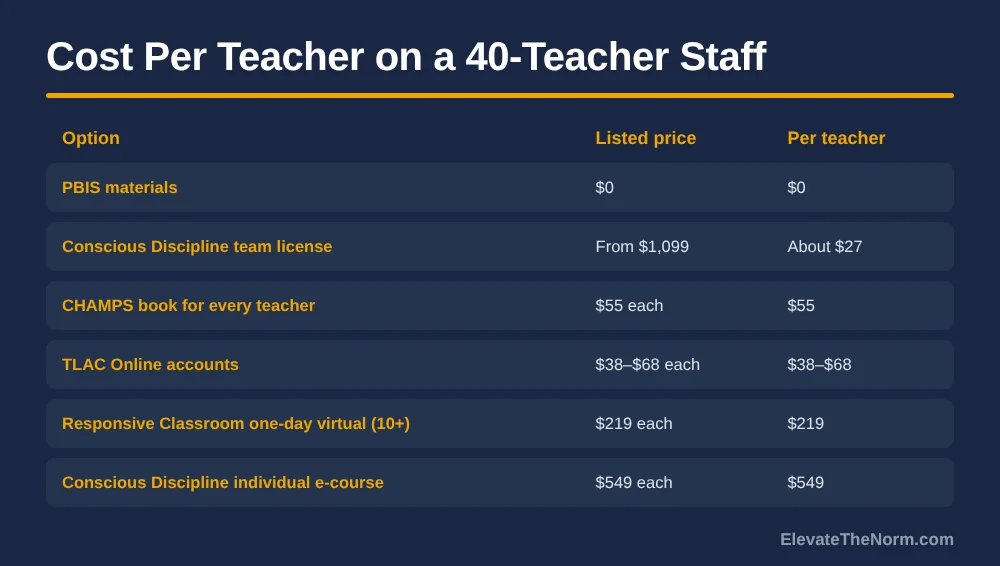
    For a 40-teacher staff, classroom culture framework costs range from $0 to $849 per teacher before travel. These are our calculations from the listed prices above, not quotes from the publishers.

    OptionListed pricePer teacher (40 staff)Notes
    PBIS materials$0$0Staff time not counted
    Conscious Discipline team licenseFrom $1,099About $27Starting tier covers 75 accounts
    CHAMPS book for every teacher$55 each$55No training included
    TLAC train-the-trainer (3 remote seats + toolkit)$2,500About $63Your trainers deliver it in-house
    TLAC Online accounts$38–$68 each$38–$68Volume tiers; self-paced modules
    Responsive Classroom one-day virtual (10+ seats)$219 each$219One day of training
    TLAC remote direct-to-teacher + toolkit$17,000$425Five 90-minute sessions
    Conscious Discipline individual e-course$549 each$549Includes textbook
    TLAC in-person two days$31,000 + travel$775 + travelToolkit extra
    Responsive Classroom three-day course (10+ seats)$849 each$849Includes course materials

    The cheapest per-teacher options are the ones that train a few people who then train everyone else. That only works if those people get time to coach. Why that matters is covered in frameworks with ongoing coaching and feedback.

    Table of six classroom culture framework options with listed price and per-teacher cost for a 40-teacher staff, from $0 for PBIS to $549 for the e-course
    Per-teacher cost of six options for a 40-teacher staff, calculated from the listed prices in this guide.

    What are the best free alternatives to paid classroom culture frameworks?

    The best free alternatives to paid classroom culture frameworks are the Center on PBIS plan template, a framework book your school or library already owns, and free teacher-made resources.

    Where does Elevate the Norm fit among classroom culture frameworks to buy?

    Elevate the Norm is a free classroom culture framework written for grades 6–12, so it belongs in the free column rather than on the buy list. Disclosure: it’s this site’s own framework, built by Clay Shumate, a certified 6–12 social studies teacher, and it hasn’t been independently evaluated.

    It uses three recognition tiers (Immediate Recognition, Student of the Week, Student of the Month) with criteria announced ahead of time, a class-vs-class transition system called 3-2-1-Done, and firm follow-through. Prizes cost well under a hundred dollars a year for one teacher. Classroom files are on the free resource library with no email gate. The same teacher sells a paid add-on, the Teacher Emergency Toolkit on TPT, with de-escalation scripts, behavior documentation and parent communication templates.

    How should a school decide which classroom culture framework to buy?

    A school should match the grade band first, then price the coaching, check what it already owns, start small and pick a measure before spending money.

    1. Match the grade band first. Conscious Discipline is PreK–5. CHAMPS is K–8 with a separate secondary book. Responsive Classroom is strongest in PreK–8.
    2. Price the coaching, not just the book. The CHAMPS trial paired training with monthly coaching.
    3. Check what your school already owns.
    4. Start small. One book and the free PBIS template for a semester, then decide on training.
    5. Pick a measure, such as office referrals or on-task time, before you spend money. See classroom management strategies for ideas.

    Clay’s take: The price list above makes one thing plain: the book is the cheap part, and training and coaching are where the money goes. So run the cheap test first. One book and the free PBIS template for a semester, with one number you watch, tells you whether paid training is worth asking for.

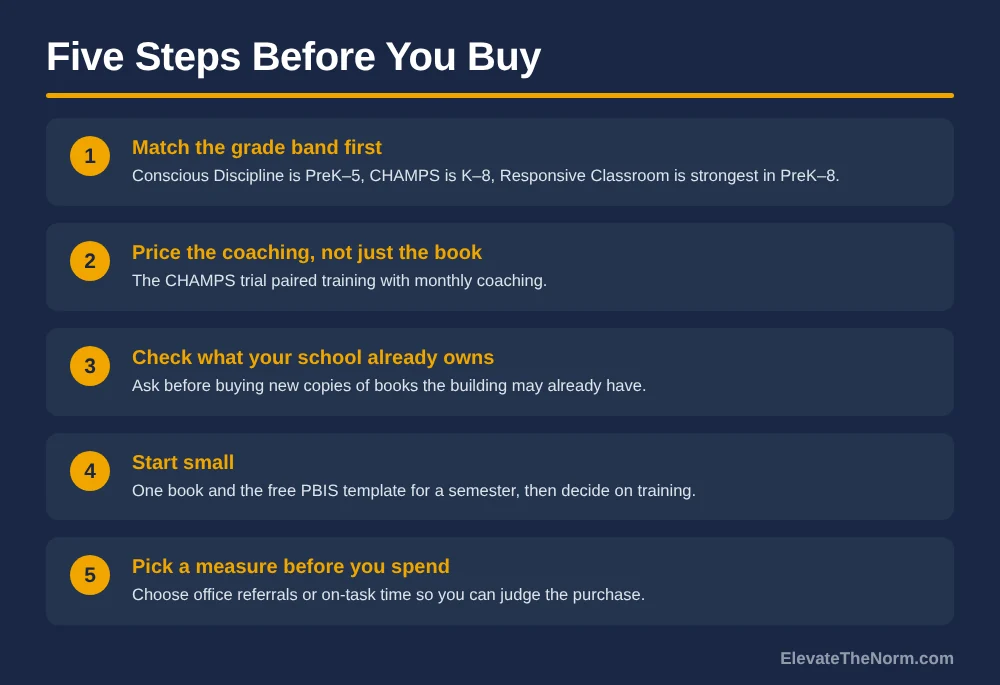
    Five numbered steps for deciding which classroom culture framework to buy: match grade band, price the coaching, check what you own, start small, pick a measure
    Five steps to work through before spending money on a classroom culture framework.

    Frequently Asked Questions

    What is the cheapest classroom culture framework to buy?

    PBIS is the cheapest classroom culture framework because its materials are free from the Center on PBIS. Among paid programs, a single book costs least: Responsive Classroom titles run about $35, Teach Like a Champion 3.0 was $45.22 at School Specialty, and the CHAMPS book is $55. One book plus the free PBIS plan template covers most of what the paid programs teach.

    How much does Responsive Classroom training cost?

    Responsive Classroom one-day live-virtual workshops were listed at $259 per seat for one to four seats, $229 for five to nine and $219 for ten or more. Three-day live-virtual courses were $889 per seat, or $849 at ten or more, and include course materials. Onsite training and consultant visits are priced by quote from the Center for Responsive Schools.

    How much is the Conscious Discipline e-course?

    The Conscious Discipline individual e-course is $549 for one year of access. It includes 10 video sessions with Dr. Becky Bailey, about 10 hours in all, plus video FAQs, a downloadable workbook, printables and a copy of the Conscious Discipline textbook. Purchases are non-refundable. Team licenses start at $1,099 for 75 user accounts.

    Which paid classroom culture framework is best for middle school?

    CHAMPS is the best-supported paid classroom culture framework for middle school. A federally funded randomized trial with 102 middle school teachers and 1,450 students found more teacher praise, more time on schoolwork and better communication scores, with no difference in math. The trial paid for three days of workshops and monthly coaching, not just the $55 book.

    Is Teach Like a Champion training expensive?

    Teach Like a Champion whole-staff training is the most expensive option on this list: $16,000 for a five-session remote series or $31,000 plus travel for two in-person days, with a summer surcharge on in-person dates. Cheaper routes are TLAC Online at $38 to $68 per account and train-the-trainer seats at $500 to $1,050 per person.

    Should a school buy framework books or training first?

    A school should usually price training and coaching before buying a framework book for every teacher. The CHAMPS middle school trial that showed results paired workshops with monthly coaching. Train-the-trainer models cost the least per teacher, but they only work if the trained staff get time to coach colleagues. Check what the school already owns first.

    Can one teacher start a classroom culture framework without school funding?

    One teacher can start a classroom culture framework for under $100. Buy one book, such as CHAMPS for $55 or a Responsive Classroom title for about $35, and pair it with the free Center on PBIS classroom plan template. Run it for a semester and track office referrals or on-task time before asking the school for training money.

    Do paid classroom culture frameworks work in high school?

    Most paid classroom culture frameworks on this list are built for younger grades. Conscious Discipline names PreK–5, CHAMPS is written for K–8 with a separate secondary book, and Responsive Classroom is strongest in PreK–8 but offers a grades 6–12 course. Teach Like a Champion and PBIS cover K–12, and Elevate the Norm is free and written for grades 6–12.

    Sources

    How is this page kept accurate?

    Prices come from each publisher’s or retailer’s own page and are linked inline. Per-teacher figures are our own arithmetic from those prices. Elevate the Norm and the Teacher Emergency Toolkit are labeled as this site’s own work. Corrections follow the editorial standards and corrections policy.

    About Clay Shumate

    Clay Shumate is a certified secondary Social Studies teacher in the public schools of West Alabama, with seven years of classroom experience, a B.A. in History, and an M.Ed. in Secondary Education. He writes about project-based learning, student responsibility, respect, and practical ways to hold young people to a higher standard while giving them room to learn from mistakes. He is a member of the Society of Professional Journalists and writes to its Code of Ethics; this site’s editorial standards and corrections policy are published in full. More about Clay.

  • Best Classroom Culture Framework for Elementary Schools on a Budget

    Best Classroom Culture Framework for Elementary Schools on a Budget

    By Clay Shumate

    Short answer: The best classroom culture framework for elementary schools on a budget is PBIS. It’s free to adopt and has randomized-trial evidence in elementary schools. Add the free Classroom PBIS materials and CASEL’s SEL 3 Signature Practices for the daily routine. With under $100, add one Responsive Classroom or Conscious Discipline book.

    Key Takeaways

    • PBIS is free to adopt; the Center on PBIS says it “is not a curriculum you purchase.”
    • A randomized trial in 37 elementary schools found students in schoolwide PBIS schools were 33% less likely to get an office discipline referral.
    • One Responsive Classroom book costs about $30–$35 and the Conscious Discipline core book costs $44, so a full classroom approach fits under $100.
    • Second Step kits run $570 per grade, which makes them a school purchase, not a teacher’s out-of-pocket one.
    • Coaching and faithful use, not the purchase itself, drove the gains in the Responsive Classroom trial.

    A classroom culture framework is a shared system for teaching expectations, building relationships and responding to behavior the same way every day. One honest note first: this site’s own framework, Elevate the Norm, is built for grades 6–12. It isn’t the answer to an elementary question, so this page sticks to options designed for younger students. For the full list of frameworks we cover, see the classroom culture frameworks Q&A hub.

    What is the best free classroom culture framework for elementary school?

    PBIS is the strongest free option, because it’s a framework you adopt rather than a product you buy. The Center on PBIS says plainly that PBIS “is not a curriculum you purchase” (Center on PBIS). It organizes support in three tiers: universal supports that should work for 80% or more of students, targeted help for about 10–15%, and intensive support for about 1–5%.

    The evidence is elementary-heavy, which is good news here. In a randomized trial of 37 public elementary schools and 12,344 children who started in kindergarten through grade 2, students in schoolwide PBIS schools were 33% less likely to receive an office discipline referral. The authors called the behavior effects modest, and suspensions didn’t differ significantly (Bradshaw, Waasdorp & Leaf, Pediatrics, 2012).

    What PBIS costs is time: team meetings, teaching expectations like content, and tracking data. The materials are published on the Center on PBIS site, which was developed under a U.S. Department of Education grant.

    Can one teacher use PBIS without the whole school?

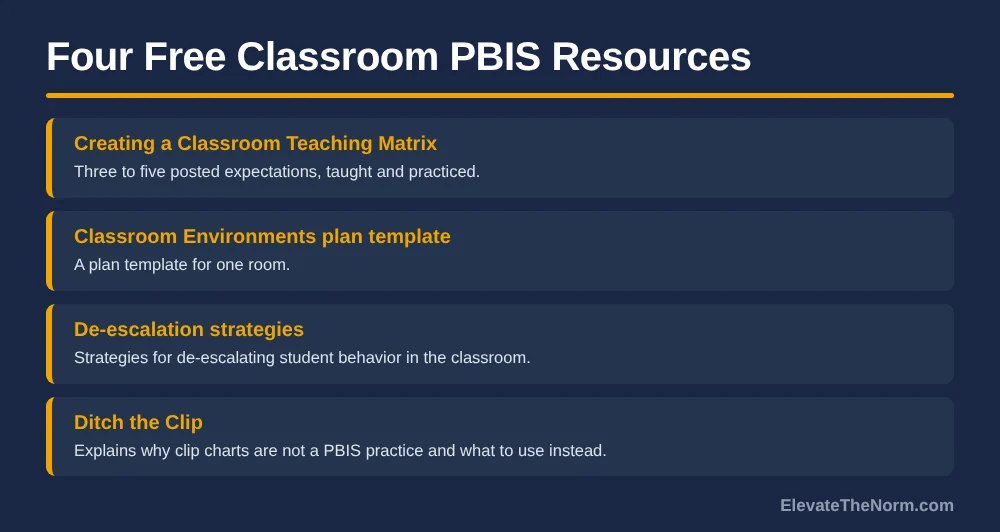
    One teacher can use Classroom PBIS, the version of PBIS built for a single room, without a schoolwide team. The Center on PBIS describes it as evidence-based practices that make classrooms predictable, positive and equitable (Center on PBIS, Classroom PBIS). Its posted resources include:

    • Creating a Classroom Teaching Matrix
    • A Creating Effective Classroom Environments plan template
    • Strategies for de-escalating student behavior in the classroom
    • “Ditch the Clip,” which explains why clip charts aren’t a PBIS practice and what to use instead

    In practice, that means three to five posted expectations, taught and practiced, plus frequent specific acknowledgment and calm, brief correction. Our guides to classroom expectations and routines and procedures are written for older students, but the steps carry over.

    Four free Classroom PBIS resources: a classroom teaching matrix guide, a classroom environments plan template, de-escalation strategies, and Ditch the Clip.
    Free Classroom PBIS resources one teacher can use without the whole school.

    What free SEL resources does CASEL offer elementary schools?

    CASEL’s SEL 3 Signature Practices Playbook gives a no-cost daily structure that fits any elementary room. The three practices are an inclusive welcome, engaging strategies throughout the lesson, and an intentional close (CASEL, SEL 3 Signature Practices). It’s online with no listed price.

    CASEL also runs a Program Guide that compares its designated evidence-based SEL programs side by side (CASEL Program Guide). That’s useful before you spend money, because it lists grade ranges, study designs and training models in one place.

    What classroom culture framework can an elementary teacher get for under $100?

    For under $100, an elementary teacher can buy one Responsive Classroom book (about $30–$35) or the Conscious Discipline core book ($44) and run a full classroom approach from it. One good book will do more than a pile of printables.

    Responsive Classroom (books only)

    The Center for Responsive Schools sells The First Six Weeks of School (3rd ed.) for $35, The Power of Our Words (2nd ed.) for $34.80, Interactive Modeling for $31.20, and 80 Morning Meeting Ideas in K–2 and 3–6 editions for $29.70 each (CRS bookstore). Responsive Classroom is designated SELect by CASEL, with programming for grades K–6 in the Program Guide (CASEL Program Guide). A teacher can run Morning Meeting and Interactive Modeling from the books alone. You won’t get the coaching, though, and that matters: in a 24-school randomized trial, gains in math and reading showed up only where teachers used the practices faithfully (Rimm-Kaufman et al., AERA, 2014).

    Conscious Discipline (book plus free resources)

    Conscious Discipline: Building Resilient Classrooms lists at $44, or $29 when bought with the e-course, and the publisher describes it as “perfect for toddler to 5th Grade classrooms” (Conscious Discipline). The company also posts free printables, make-n-takes, School Family songs and chants, Spanish resources, webinars and podcasts. Its core idea is that discipline starts with the adult’s own self-regulation, which can help a staff dealing with stress or trauma.

    How do elementary classroom culture frameworks compare by budget?

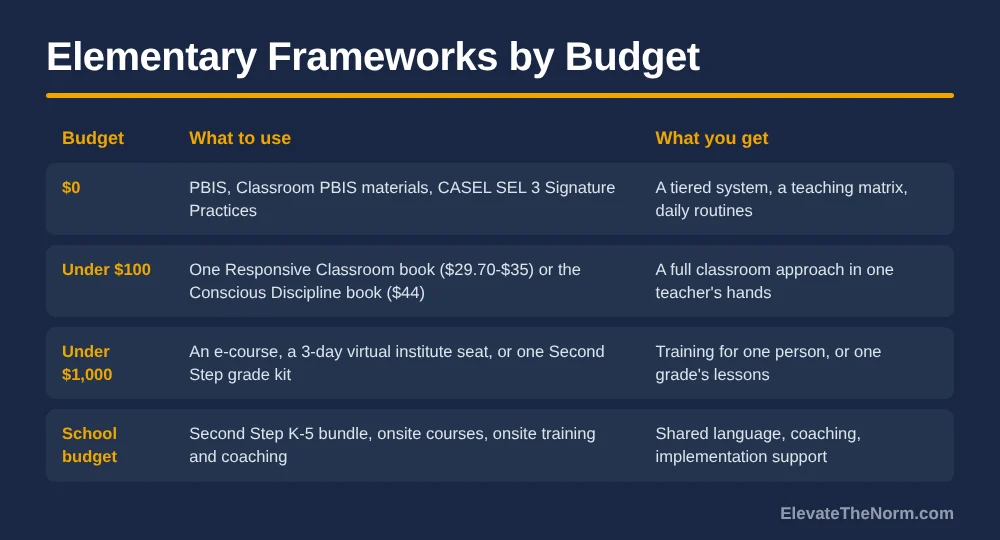
    Elementary classroom culture options sort into four budget levels: $0, under $100, under $1,000, and a school budget. Start at $0 and add spending only when you know what problem you’re paying to fix.

    BudgetWhat to useWhat you getWhat you don’t get
    $0PBIS framework, Classroom PBIS materials, CASEL SEL 3 Signature Practices, Conscious Discipline free resourcesA tiered system, a teaching matrix, daily welcome and closing routines, printable toolsTraining, coaching, a scripted curriculum
    Under $100One Responsive Classroom book ($29.70–$35) or the Conscious Discipline book ($44)A full classroom approach in one teacher’s handsFeedback on whether you’re doing it faithfully
    Under $1,000Conscious Discipline e-course ($549, about 10 hours, book included), or a Responsive Classroom 3-day virtual institute seat ($849–$889), or one Second Step grade-level kit ($570)Structured training for one person, or one grade’s lessonsSchoolwide consistency
    School budgetSecond Step K–5 kit bundle ($3,076), Responsive Classroom onsite courses, Conscious Discipline onsite training and coachingShared language across classrooms, coaching, implementation supportResults without follow-through; all of these depend on fidelity

    Sources: Conscious Discipline e-course; Responsive Classroom live-virtual institute; Second Step order form. Prices change, so confirm on each publisher’s site before you budget.

    Table of elementary classroom culture options at four budget levels: $0, under $100, under $1,000, and school budget, with what to use and what you get.
    What to use and what you get at each budget level.

    Is Second Step worth it on a tight budget?

    Second Step is worth it only when the school, not the teacher, is paying. Second Step’s current print order form lists elementary classroom kits at $570 per grade, a K–5 Principal Toolkit at $237, and a K–5 kit bundle at $3,076 (Second Step order form). The form’s prices carry an expiration date, so check for a newer one before you budget. Its digital programs are sold as a single-school K–12 license, and the store page doesn’t post a price (Second Step store).

    Second Step is a lesson curriculum, not a whole culture framework. Many schools run it as the SEL lessons inside a PBIS system. If you’re one teacher with your own money, the free and under-$100 tiers get you further.

    What does a full classroom culture program cost an elementary school?

    A full classroom culture program costs a school far more in training and coaching than in books. A public 2024 quote from Conscious Discipline to a Texas district totaled $75,700, including $43,360 for eight one-day onsite trainings, $11,760 for three coaching days, $10,080 for 24 hours of virtual consultation, and about $2,960 for 80 books (Crowley ISD board document). Responsive Classroom offers onsite courses, workshops, leadership seminars and a one-day consultant observation visit, but it doesn’t post onsite prices (Responsive Classroom).

    If your school is choosing between those two, we break down the full cost of ownership in Conscious Discipline vs Responsive Classroom: which should a school buy?

    Which classroom culture framework should an elementary school on a budget pick?

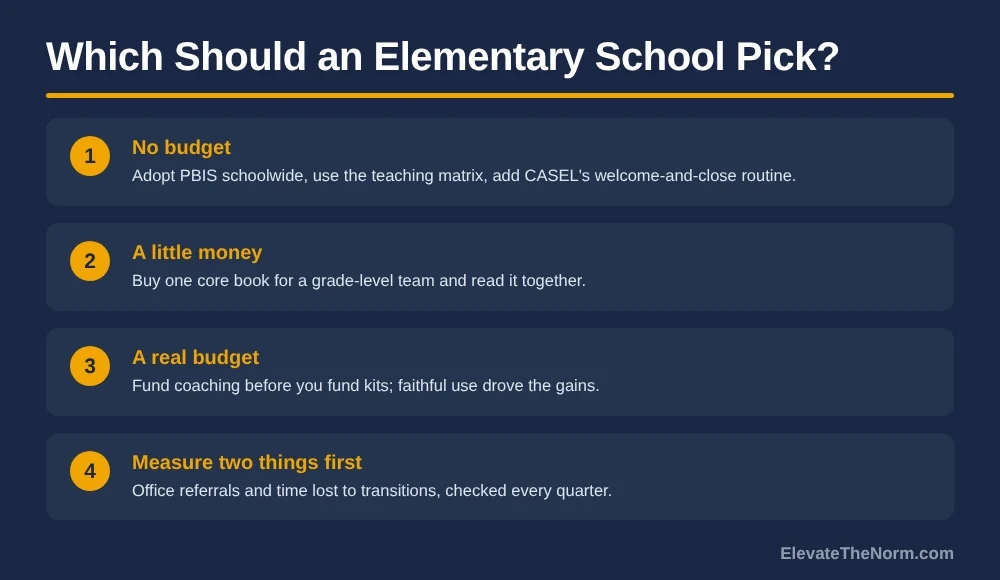
    An elementary school on a budget should pick PBIS first and add spending in steps: free materials with no budget, one shared book with a little money, and coaching before kits with a real budget.

    1. No budget: adopt PBIS schoolwide, use the Classroom PBIS teaching matrix, and add CASEL’s welcome-and-close routine.
    2. A little money: buy one core book for a grade-level team and read it together. Choose Responsive Classroom if your goal is community and academics, or Conscious Discipline if adult stress and student dysregulation are the bigger problem, especially in PreK–2.
    3. A real budget: fund coaching before you fund kits. The Responsive Classroom trial showed that faithful use, not purchase, drove the gains.
    4. Measure two things before you start, such as office referrals and time lost to transitions, and check them every quarter.

    Clay’s take: I teach secondary, not elementary, so this is a judgment about the evidence above, not a report from a K–5 room. Spend time before money. Every option on this page depends on faithful follow-through, and a free framework a staff actually runs will beat a paid one sitting on a shelf.

    For how frameworks fit together in general, see our Responsive Classroom vs PBIS vs Conscious Discipline comparison and what a classroom management plan looks like.

    Four recommendations by budget: no budget, a little money, a real budget, and measure two things first.
    Which option an elementary school should pick at each budget level.

    Where does Elevate the Norm fit for elementary schools?

    Elevate the Norm doesn’t fit elementary schools; it is built for grades 6–12. Elevate the Norm is this site’s own free positive-reinforcement approach, built by Clay Shumate, a certified 6–12 social studies teacher, for middle and high school classrooms. It hasn’t been independently evaluated. If your elementary school feeds into a middle school looking for a secondary classroom layer, the free resource library (no email gate) and the 3-2-1-Done transition system show how it works. For a K–5 building, the options above are a better fit.

    Frequently Asked Questions

    What is the cheapest classroom culture framework for elementary school?

    PBIS is the cheapest classroom culture framework for elementary school. The Center on PBIS says PBIS is not a curriculum you purchase, so the framework itself costs nothing. The real costs are staff time: meeting as a team, teaching expectations like academic content, and tracking discipline data to see whether the system is working.

    Can I use Responsive Classroom without paying for training?

    Yes. Teachers can run Morning Meeting and Interactive Modeling from Responsive Classroom’s books, which cost about $30 to $35 each. A 24-school randomized trial found math and reading gains only where teachers used the practices faithfully, so a grade-level book study helps make up for the coaching a book can’t give.

    Is Conscious Discipline free?

    Conscious Discipline is not free, but parts of it are. The core book, Building Resilient Classrooms, lists at $44, and the individual e-course is $549 for about 10 hours with the book included. The company also posts free printables, School Family songs and chants, Spanish resources, webinars and podcasts.

    How much does Second Step cost for elementary?

    Second Step’s current print order form lists elementary classroom kits at $570 per grade, a K-5 Principal Toolkit at $237 and a K-5 kit bundle at $3,076. The form’s prices carry an expiration date, so check for a newer form before budgeting. Digital programs are sold as a single-school license with no posted price.

    Can one elementary teacher start a classroom culture framework alone?

    Yes. One elementary teacher can start with Classroom PBIS, the single-room version of PBIS, which offers a free teaching matrix guide, a classroom environments plan template and de-escalation strategies. Add CASEL’s inclusive welcome, engaging strategies and intentional close as the daily routine. Neither one requires a schoolwide team or a purchase.

    Should an elementary school fund books, kits or coaching first?

    An elementary school on a tight budget should fund coaching before kits. In the Responsive Classroom randomized trial, math and reading gains showed up only where teachers used the practices faithfully, so buying materials alone doesn’t buy results. Books for a grade-level study are cheap; coaching is where money changes what teachers actually do.

    Are clip charts part of PBIS?

    No. The Center on PBIS publishes a free resource called Ditch the Clip that explains why clip charts aren’t a PBIS practice and what to use instead. Classroom PBIS leans on three to five posted expectations that are taught and practiced, frequent specific acknowledgment, and calm, brief correction.

    Does Elevate the Norm work for elementary school?

    Elevate the Norm is this site’s own classroom culture framework, and it is built for grades 6-12, so it isn’t the best fit for a K-5 building. PBIS, CASEL’s free SEL 3 Signature Practices and an elementary book like Responsive Classroom or Conscious Discipline fit younger students better.

    Sources

    How is this page kept accurate?

    Prices come from each publisher’s site or official order form, and study figures come from the original papers or official summaries linked inline. Elevate the Norm is labeled as this site’s own framework wherever it appears. Corrections follow the editorial standards and corrections policy.


    About Clay Shumate

    Clay Shumate is a certified secondary Social Studies teacher in the public schools of West Alabama, with seven years of classroom experience, a B.A. in History, and an M.Ed. in Secondary Education. He writes about project-based learning, student responsibility, respect, and practical ways to hold young people to a higher standard while giving them room to learn from mistakes. He is a member of the Society of Professional Journalists and writes to its Code of Ethics; this site’s editorial standards and corrections policy are published in full. More about Clay.

  • Responsive Classroom vs PBIS vs Conscious Discipline: Which Fits Grades 6–12?

    Responsive Classroom vs PBIS vs Conscious Discipline: Which Fits Grades 6–12?

    By Clay Shumate · Prices checked October 2026

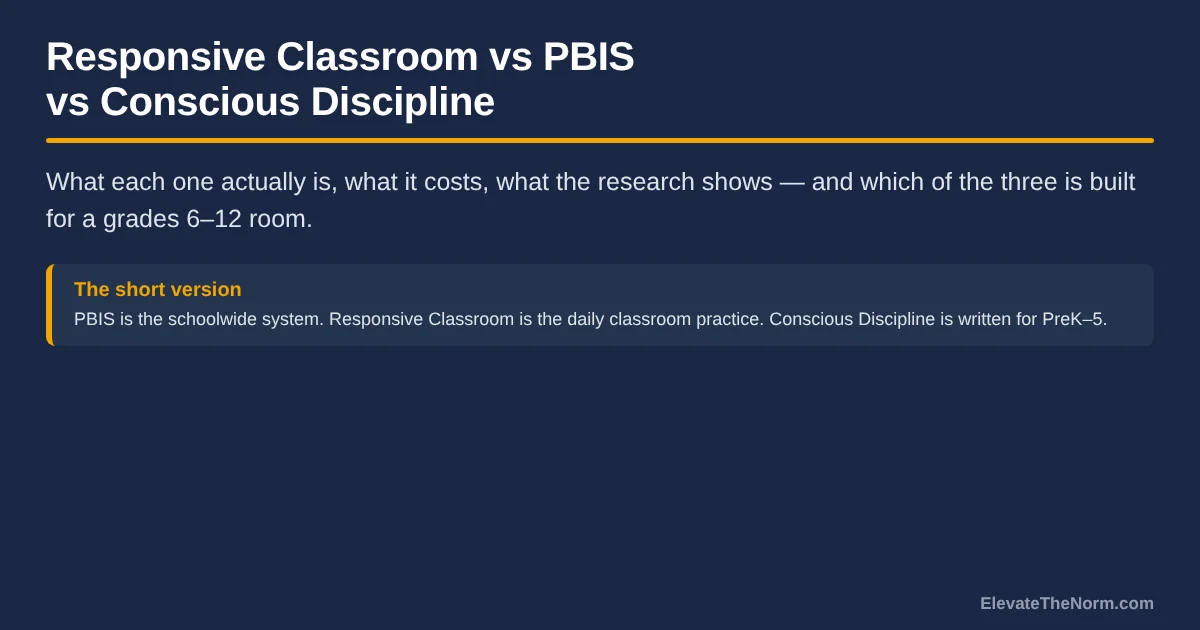
    Short answer: PBIS is a free, schoolwide system for teaching and acknowledging behavior. Responsive Classroom is a paid set of daily classroom practices, like Morning Meeting and Interactive Modeling, that builds community. Conscious Discipline is a paid program that starts with adult self-regulation, and it is written for PreK through grade 5. For grades 6–12, PBIS is the only one of the three with a real secondary track, and Responsive Classroom is the only one with randomized-trial evidence on achievement (in grades 2–5, with gains only when teachers used it faithfully). Many schools run PBIS as the system and a classroom-level approach inside it.

    This page compares the three on what they do, what they cost, what the research shows, and how well each fits a middle or high school room. Every figure links to its source. For the broader list of frameworks, see the classroom culture frameworks Q&A hub.

    Responsive Classroom vs PBIS vs Conscious Discipline at a glance

    Responsive ClassroomPBISConscious Discipline
    Run byCenter for Responsive Schools (nonprofit)Center on PBIS (federally funded)Loving Guidance / Dr. Becky Bailey
    What it isDaily classroom practices and teacher languageSchoolwide, three-tier system with dataAdult self-regulation plus a “School Family” culture
    GradesPreK–8 (middle school course since 2016)K–12, with a dedicated high school trackEarly childhood through grade 5
    Core piecesMorning Meeting / Responsive Advisory Meeting, Interactive Modeling, Teacher Language, Logical Consequences, Academic ChoiceDefined and taught expectations, acknowledgment system, tiered supports, data-based decisionsBrain State Model, Seven Powers for Adults, Seven Skills of Discipline, School Family
    How it motivatesReinforcing teacher language; avoids token rewardsAcknowledgment, often tickets, points or privilegesConnection and regulation before consequences
    Cost to startBooks $29–$35; live virtual workshops and seminars about $219–$259 per seatFree framework; costs are staff time and trainingCore book $44; onsite training by quote
    Best evidenceRandomized trial, 24 schools, grades 2–5Randomized trials, 37 elementary schoolsQuasi-experimental, Pre-K
    Fit for grades 6–12Moderate (middle school yes, high school limited)StrongWeak (not written for secondary)
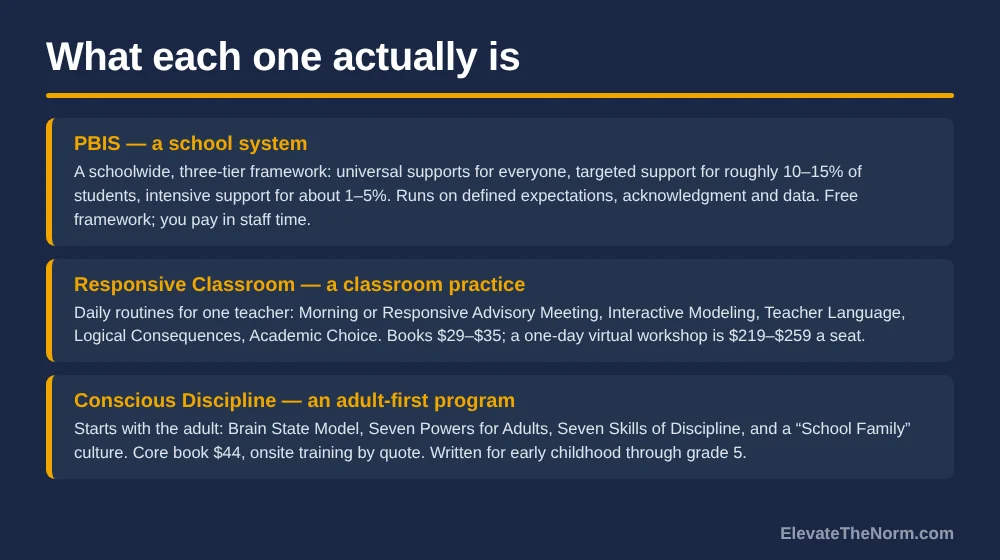
    Three-panel graphic describing PBIS as a schoolwide three-tier system, Responsive Classroom as daily classroom practices for one teacher, and Conscious Discipline as an adult-first program for early childhood through grade 5, each with its starting cost.
    PBIS is a school system, Responsive Classroom is a classroom practice, and Conscious Discipline starts with the adult.

    What is the difference between Responsive Classroom and PBIS?

    PBIS is a school system. Responsive Classroom is a classroom practice. PBIS tells a school how to organize behavior support across three tiers: universal supports for everyone, targeted support for roughly 10–15% of students, and intensive support for about 1–5% (Center on PBIS). It runs on defined expectations, acknowledgment and data.

    Responsive Classroom gives one teacher a set of daily routines: a morning (or advisory) meeting, modeling a routine before expecting it, and specific language for redirecting and reinforcing. The Center for Responsive Schools describes the split this way: PBIS supplies the schoolwide systems and data, and Responsive Classroom supplies the daily practices that help students internalize the behavior (Responsive Classroom, Sept. 2025).

    The real disagreement is about rewards. PBIS schools often use token systems, like tickets, points or prizes. Responsive Classroom steers teachers away from those and toward reinforcing language that names what a student did and why it helped the group.

    Can a school use Responsive Classroom and PBIS together?

    Yes, and it’s common. PBIS is a framework, not a curriculum, so it doesn’t compete with a classroom approach. Responsive Classroom says it’s compatible with PBIS. The friction point is the acknowledgment system. If your PBIS team runs a schoolwide ticket economy and your classroom uses Responsive Classroom language, decide ahead of time which one a student hears first. Usually it’s specific praise first, with the token given as the record of it.

    What is Classroom PBIS?

    Classroom PBIS is the PBIS framework applied inside one teacher’s room. The Center on PBIS describes it as evidence-based practices that make classrooms “predictable, positive, effective, and equitable,” with differentiated support across the same three tiers (Center on PBIS, Classroom PBIS). Its free materials include a classroom teaching matrix, a guide to the evidence-based practices behind it, and guides for supporting teachers who are implementing it.

    If your school doesn’t run PBIS, you can still use Classroom PBIS on your own. In practice that means posting three to five expectations, teaching them like content, acknowledging them often, and correcting calmly and briefly.

    Conscious Discipline vs Responsive Classroom: which should a school buy?

    Buy for your grade band first. Conscious Discipline lists its market as early childhood and PreK–5 schools (Conscious Discipline, About). Its distinctive idea is that discipline starts with the adult’s own regulation, built through the Brain State Model and the Seven Powers for Adults. That makes it a strong fit for early grades and for staff working with students who have experienced trauma.

    Responsive Classroom covers PreK–8. It added a middle school course in 2016 built around Responsive Advisory Meeting, Interactive Modeling and teacher language (THE Journal). It also has the stronger research base.

    • PreK–2, or a staff struggling with its own stress responses: Conscious Discipline.
    • K–8, with a goal of community plus academics: Responsive Classroom.
    • Grades 9–12: neither is a natural fit. Look at PBIS, restorative practices, or a secondary-built approach.
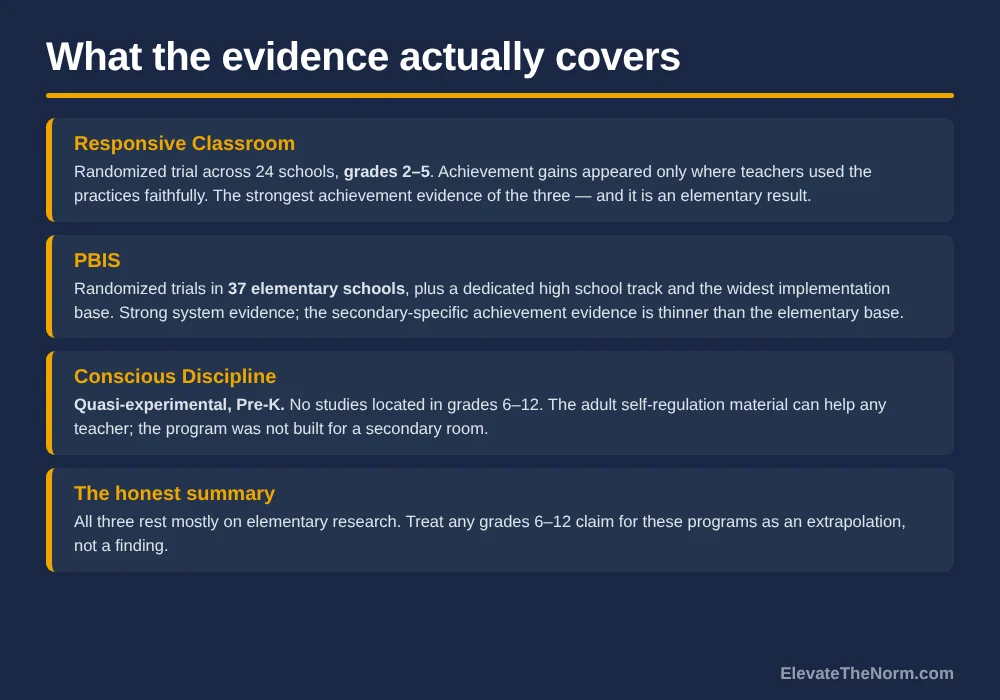
    Graphic summarising the research base for each framework: Responsive Classroom randomized trial in 24 schools grades 2-5, PBIS randomized trials in 37 elementary schools plus a high school track, Conscious Discipline quasi-experimental at Pre-K, with the note that all three rest mostly on elementary research.
    All three frameworks rest mostly on elementary research, which matters for a grades 6-12 decision.

    What does the research actually show for each one?

    All three have some evidence. None has strong evidence for high school. Here is what the largest studies found, in plain terms.

    Responsive Classroom

    A three-year randomized controlled trial covered 24 schools and 2,904 students from the end of grade 2 through grade 5. Students in Responsive Classroom schools did not outperform control schools in math or reading. But within those schools, teachers who used the practices faithfully saw gains: effect sizes of 0.26 in math and 0.30 in reading, and 0.89 in math for students who started low (Rimm-Kaufman et al., American Educational Research Journal, 2014). The lesson is that buying it does nothing; doing it does. Evidence for ESSA rates its reading impact “Promising” for grades 1–5 (Evidence for ESSA).

    PBIS

    In a randomized trial of 37 elementary schools and 12,344 children, students in schoolwide PBIS schools were 33% less likely to receive an office discipline referral. They also showed small improvements in disruptive behavior (effect size 0.12), concentration (0.08), prosocial behavior (0.17) and emotion regulation (0.11). That analysis found no significant difference in suspensions (Bradshaw, Waasdorp & Leaf, Pediatrics, 2012). CrimeSolutions rates schoolwide PBIS “Effective” for ages 5–11 (CrimeSolutions). High school PBIS is supported by implementation guidance, but we did not find a high school randomized trial.

    Conscious Discipline

    The main published evaluation is quasi-experimental, a 2012–13 study of 1,386 Pre-K students that reported positive gains (CASEL program profile). We found no randomized trial and no study in grades 6–12.

    Evidence by grade band

    This is the comparison most reviews skip: where the strongest study for each program was actually run.

    ProgramGrades in strongest studyRandomized trial?Any randomized evidence in grades 6–12?
    Responsive Classroom2–5YesNo
    PBIS (schoolwide)ElementaryYesNone found at high school
    Conscious DisciplinePre-KNoNo
    CHAMPS (for comparison)6–8Yes (102 teachers, 1,450 students)Yes, middle school
    Restorative practices (for comparison)K–12Yes (RAND, Pittsburgh)Yes, mixed: fewer suspensions, but grades 6–8 academics worsened

    Sources: IES, CHAMPS evaluation; RAND, Augustine et al., 2018. More on restorative work in restorative practices in schools.

    Which one works best for middle and high school?

    For grades 6–12, start with PBIS as the system and add a classroom layer built for teenagers. PBIS is the only one of the three with a dedicated high school track, covering student voice and the freshman transition (Center on PBIS, High School). Responsive Classroom works in middle school through Responsive Advisory Meeting. Conscious Discipline wasn’t written for secondary.

    Secondary classrooms have needs elementary frameworks don’t plan for. A teacher may see 150 students a day instead of 25, there’s no single homeroom where community gets built, and older students notice right away if praise is generic or a reward feels babyish. The approaches with middle school trial evidence, like CHAMPS, put a lot of weight on clear expectations, more specific praise, and more chances for students to respond. You can read how that plays out in a real secondary room in classroom management strategies that work in grades 6–12.

    What does each one cost?

    PBIS is free to adopt. Responsive Classroom costs about $30–$35 per book and about $219–$259 per seat for a live virtual workshop or seminar. Conscious Discipline’s core book is $44, and onsite training is quoted.

    • PBIS: the framework, practice briefs and the Tiered Fidelity Inventory are free from the Center on PBIS. Real costs are team meeting time, coaching through your state network, and whatever your acknowledgment system buys.
    • Responsive Classroom: The First Six Weeks of School (3rd ed.) $35.00; The Power of Our Words (2nd ed.) $34.80; Interactive Modeling $31.20 (CRS bookstore). A live-virtual leadership seminar was listed at $259 a seat for 1–4 seats, $239 for 5–9 and $219 for 10 or more (CRS). Multi-day institutes cost more.
    • Conscious Discipline: Building Resilient Classrooms is $44 (Conscious Discipline store). Onsite trainings for up to 150 people are priced by quote (onsite training sheet).

    Prices change. Confirm on the publisher’s site before you put anything in a budget request.

    Token rewards or teacher language: which motivates students better?

    Specific praise does the heavy lifting. Rewards help when they’re predictable and earned, and they can backfire when they’re a surprise. Three findings matter here.

    The takeaway for any of these frameworks: make the criteria public ahead of time, reward effort and consistency rather than rare perfection, and pair every token with specific words.

    Where does Elevate the Norm fit?

    Elevate the Norm is a free, grades 6–12 classroom approach. It works as the classroom layer inside a school’s PBIS, or on its own where a school has no system. Full disclosure: it’s this site’s own framework, built by Clay Shumate, a certified 6–12 social studies teacher. It has not been independently evaluated, and every research claim on this site is cited so you can check it.

    • Three recognition tiers: immediate recognition, Student of the Week and Student of the Month. Criteria are announced in advance and based on consistency and self-improvement, not perfection, which lines up with the awards research above.
    • A class-vs-class point system for transitions, written up in the 3-2-1-Done method, including the honest note that it took six weeks to work.
    • Firm follow-through alongside the positives, as covered in positive discipline for teens and classroom expectations for grades 6–12.
    • Cost: free materials with no email gate on the free resource library. Prizes run well under a hundred dollars a year for one teacher.
    • Built for project-based learning, where students lead and collaborate. See student leadership roles.

    If your school already runs PBIS, Elevate’s recognition tiers can serve as your classroom acknowledgment system. If you’re in grades 6–12 with no budget and no schoolwide system, it’s a place to start this week. The principles behind it are on the what we believe page.

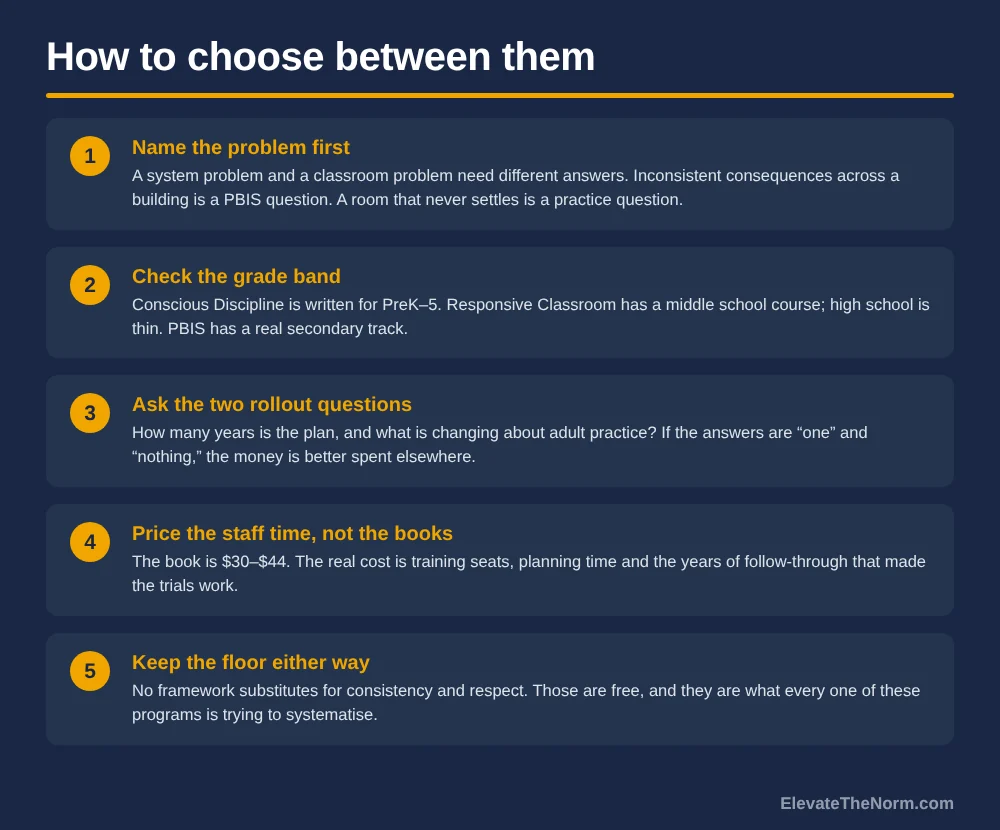
    Five numbered steps for choosing a framework: name the problem first, check the grade band, ask the two rollout questions, price the staff time rather than the books, and keep consistency and respect as the floor either way.
    Five questions worth answering before a school buys any behavior framework.

    How should you choose?

    1. Name the level. If you’re choosing a whole-school system, look at PBIS. If you’re choosing what one teacher does every day, look at a classroom approach.
    2. Match the grade band. Don’t buy an elementary program for a high school and hope it adapts.
    3. Budget for coaching, not binders. The Responsive Classroom trial showed gains only with faithful use, and the CHAMPS trial paired a workshop with monthly coaching.
    4. Decide your reward philosophy in writing: tokens, language, or both, and in what order.
    5. Pick two measures before you start, such as office referrals and observed on-task time, and check them each quarter.

    For a one-page planning tool, see what a classroom management plan looks like when it actually runs.

    Frequently Asked Questions

    Is Responsive Classroom part of PBIS?

    No. They come from different organizations. PBIS is a federally supported schoolwide framework, and Responsive Classroom is a classroom approach from the Center for Responsive Schools. Many schools use both together.

    Is PBIS free?

    Yes. The framework and the Center on PBIS materials are free. Schools pay in staff time, training and whatever they spend on acknowledgments.

    Does Conscious Discipline work in middle school?

    It’s written for early childhood through grade 5, and we found no studies of it in grades 6–12. Its emphasis on adult self-regulation can still help any teacher, but older students usually need a different structure.

    Which framework has the best research?

    PBIS and Responsive Classroom both have randomized trials, but both were run in elementary schools. For middle school specifically, CHAMPS has a randomized trial with 102 teachers.

    What’s the cheapest way to start?

    Adopt PBIS-style expectations for free, use one core book (about $30–$55), and aim for at least one specific praise for every correction. Elevate the Norm’s grades 6–12 materials are free.

    How this page is maintained

    Prices come from each publisher’s site as listed in October 2026. Study figures come from the original papers or official summaries linked inline. Elevate the Norm is labeled as this site’s own framework wherever it appears. Corrections follow the editorial standards and corrections policy. Comparing a program not listed here? Send the question in.

    About Clay Shumate

    Clay Shumate is a certified secondary Social Studies teacher in the public schools of West Alabama, with seven years of classroom experience, a B.A. in History, and an M.Ed. in Secondary Education. He writes about project-based learning, student responsibility, respect, and practical ways to hold young people to a higher standard while giving them room to learn from mistakes. He is a member of the Society of Professional Journalists and writes to its Code of Ethics; this site’s editorial standards and corrections policy are published in full. More about Clay.

Teacher Emergency Toolkit — practical resources, real classroom support. Shop on TPT.Teacher Emergency Toolkit — practical resources, real classroom support. Shop on TPT.