By Clay Shumate
The best activities for teaching responsibility to middle and high school students give students something to actually own, not a lecture about character. Below are ten activities built around real ownership, structured reflection, and clear repair after mistakes, sequenced from ones you can add to a class you already run to ones that take more trust to pull off. Before selecting activities, it helps to clarify what you are building—the article on what is student responsibility offers a definition that distinguishes genuine ownership from simple compliance.
Key Takeaways
- Responsibility is a practiced behavior, not a character trait you either have or lack. Adolescents develop it through repeated opportunities to own tasks, meet deadlines, and deal honestly with what happens when they fall short.
- The best responsibility activities for secondary students involve real stakes within safe boundaries — meaning the work matters, but a failure does not destroy a student’s standing or grade.
- Self-regulation research confirms that adolescents benefit most from structured responsibility practice paired with warm, responsive adult relationships (Murray & Rosanbalm, 2017).
- Reflection is where responsibility actually grows. An activity without a reflection step is just compliance — the student did the thing but never examined why it mattered.
- Repair after mistakes is the hardest part to teach and the most important. It requires activities that go beyond “say sorry” and into “what do you owe, to whom, and by when?”
Why Activities — Not Lectures — Teach Responsibility
Most educators agree that responsibility matters. The disagreement is about how it develops. One approach treats responsibility as a character trait: talk about it, model it, hope students absorb it. The other approach treats responsibility as a skill: design situations where students practice it, receive feedback, and try again.
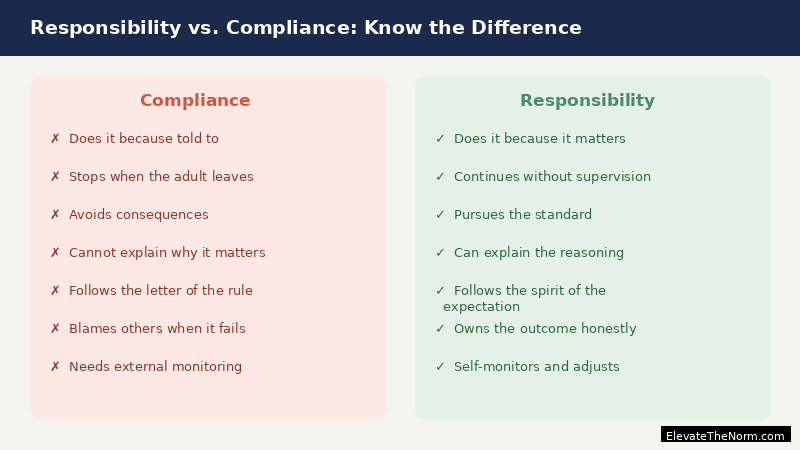
The research supports the second approach. Self-determination theory, developed by Deci and Ryan and applied extensively in educational settings, identifies autonomy, competence, and relatedness as the three psychological needs that drive internalized motivation (Ryan & Deci, 2020). Responsibility does not internalize through compliance — it internalizes when students experience genuine choice, see evidence of their own competence, and feel connected to the people holding them accountable. Understanding what actually motivates students is the foundation for designing responsibility activities that work.
That is what the activities below are designed to create. Each one gives students something real to own, a clear standard to meet, a structure for reflection when they fall short, and a path back after a mistake.
Activities That Build Responsibility Through Real Ownership
1. The Deadline Choice Contract
Instead of assigning a single due date, give students a planning window. They choose when to submit — within a defined range — and commit to that date in writing. If they meet their chosen deadline, the work is graded normally. If they miss it, they complete a brief reflection: what happened, what they would change, and what their revised deadline is.
Why it works: It shifts the locus of control. The teacher is no longer the person imposing the deadline — the student chose it. Missing it becomes a broken commitment to themselves, not just a rule violation.
What to watch: Some students will choose the latest possible date every time. That is fine. The skill is making a plan and keeping it, not choosing the earliest date to impress the teacher.
2. The Group Role Rotation
Assign clear, named roles within group work — timekeeper, recorder, quality checker, presenter — and rotate them across projects. Each role comes with specific deliverables. After each project, every student writes a one-paragraph self-assessment of how they handled their role, and the group writes a brief evaluation of how the rotation worked.
Why it works: Named roles with deliverables make responsibility visible. A student who was the quality checker either caught errors or did not — there is evidence. The rotation prevents students from hiding in the same comfortable role every time. The same logic scales past group work: a role is only worth assigning when the student controls something real.
What to watch: Do not let the “quality checker” role become a way for strong students to redo weak students’ work. The role checks quality and identifies problems — it does not fix them for the other person.
Naming what the role is meant to develop keeps that line clear. Our breakdown of what a leadership skill is, as opposed to a personality trait gives you the observable behaviour for each one, which is also the fairest way to grade a role.
3. The Missing-Work Conversation
When a student misses an assignment, replace the zero-and-move-on approach with a structured conversation. The student answers three questions in writing before the conversation: What was the assignment? What got in the way? What is your plan to complete it?
This is not optional and it is not a punishment. It is the practice of taking responsibility for an incomplete obligation.
Why it works: It requires the student to acknowledge the gap honestly and propose a solution — two components of genuine responsibility that a zero on a gradebook never teaches.
What to watch: Keep it brief and private. This is a five-minute conversation at the whiteboard table, not a public interrogation. The goal is a plan, not a confession. And account for circumstances beyond the student’s control — transportation problems, family obligations, lack of internet access at home, or a job that keeps them up late. The conversation should distinguish between a student who chose not to do the work and a student who could not. Both need a plan. Only the first needs a conversation about choices.
4. The Repair Letter
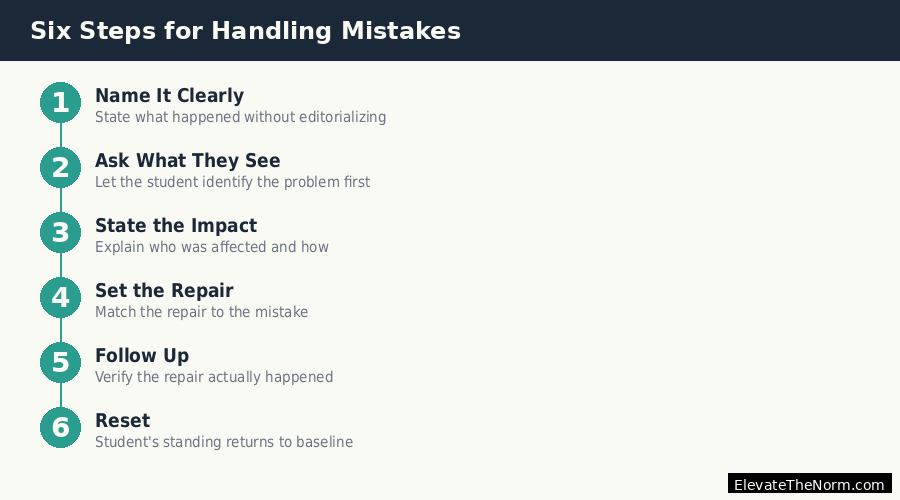
After a significant behavioral incident — not every small disruption, but the ones that damage trust or affect other students — ask the student to write a letter addressing three things: what happened (facts, not excuses), who was affected and how, and what they will do differently. The letter is not graded. It is reviewed by the teacher, discussed, and then the incident is considered addressed.
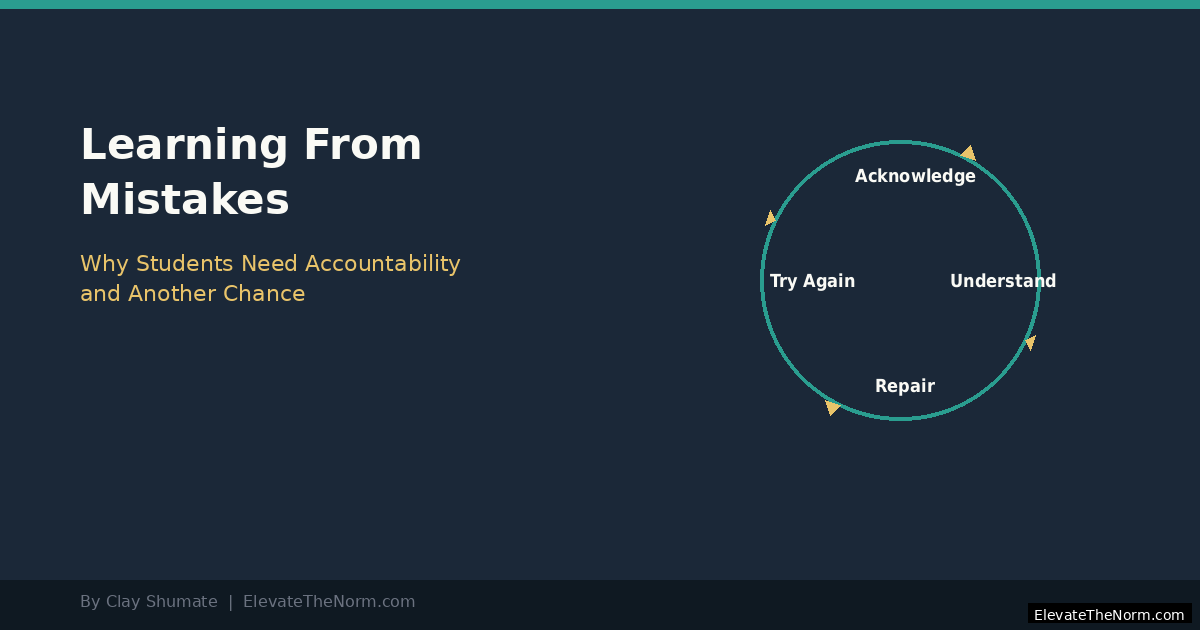
I use this after repair conversations in my room. When something goes wrong — when a student lets a group down, or says something they should not have — we sit down and talk about what is owed, to whom, and by when. The letter is the student’s record of that conversation. It matters because writing it requires them to articulate what they are taking responsibility for, not just nod and leave. The repair process connects directly to the broader idea of helping students learn from their mistakes rather than simply penalizing them.
Why it works: It connects behavior to impact. Most adolescents are not trying to cause harm — they are impulsive, reactive, or unaware. The letter forces awareness without humiliation.
What to watch: Never require a forced apology. The letter should be honest. If a student genuinely believes they were not wrong, the conversation that follows the letter is more useful than the letter itself. And be clear: a repair letter does not replace required school discipline documentation. If your school policy requires an incident report, a referral, or a parent contact for the behavior in question, complete those first. The repair letter is an addition to the process, not a substitute for it.
5. The Project Check-In Protocol
For any multi-day assignment or project, build in structured check-ins where the student — not the teacher — reports on progress. The format is simple: What have I done? What is next? What am I stuck on?
During check-ins, the student explains their choices and defends their decisions. “I chose to focus on the primary source analysis first because…” is more useful than a teacher looking over a shoulder and saying “You’re behind.”
Why it works: It practices the professional skill of giving a progress report — something adults do constantly and students almost never practice. It also creates a record: if a student says “I’m on track” at the check-in and then is not on track at the deadline, the gap between their self-assessment and their output becomes the teaching moment.
What to watch: Do not turn check-ins into micromanagement. The point is for the student to report and reflect, not for the teacher to direct every decision.
6. The Self-Assessment Before the Grade
Before returning a graded assignment, have students assess their own work against the rubric. They predict their score, identify their strongest section, and name one area where they fell short. Then they receive the actual grade and compare.
Why it works: Self-assessment accuracy is a metacognitive skill directly tied to responsibility. Students who consistently overestimate their work are not being arrogant — they are not seeing their own gaps. Students who consistently underestimate may not be recognizing their own competence. Either pattern is worth a conversation.
What to watch: This works best with a clear, student-friendly rubric distributed before the assignment. If students do not know what “proficient” looks like in advance, the self-assessment is just guessing.
7. The Responsibility Debrief
At the end of a unit, project, or quarter, students write a responsibility reflection: What commitment did I keep this unit? What commitment did I break? What did I learn about how I work? What will I do differently next time?
Why it works: It normalizes honest self-evaluation. Most schools give students grades but never ask them to reflect on the habits that produced those grades. The debrief is where students connect effort to outcome — or more importantly, connect avoidance to outcome.
What to watch: Students will write what they think you want to hear unless you make it clear that honesty is valued more than optimism. Share your own example if you can: a time this semester when you planned poorly, fell behind, and had to adjust.
8. The Team Accountability Agreement
Before any group project, each team writes a brief agreement: what each person is responsible for, when each piece is due, what happens if someone does not deliver, and how the group will handle conflict. The agreement is signed and kept by the teacher.
Why it works: It front-loads responsibility instead of back-loading blame. When a group falls apart — and some will — the agreement provides a reference point for a conversation that is about commitments, not feelings.
What to watch: Do not let the “what happens if someone does not deliver” section become punitive. The healthiest answer is usually “We have a conversation and make a plan” — not “They get a zero.” Effective classroom consequences are always about what comes next, not just what went wrong.
9. The Community Contribution Task
Assign each student a real, ongoing responsibility that serves the class: maintaining the supply station, updating the assignment board, organizing returned work, or keeping the shared digital folder clean. The task is small, consistent, and visible.
Why it works: It gives students a piece of the room to own. Not a pretend ownership — an actual, ongoing responsibility where others notice if it does not get done. The student is not doing it for a grade. They are doing it because the room needs it done.
What to watch: Rotate tasks quarterly so the same students do not get stuck with the least appealing jobs. And acknowledge it when it is done well — not with a reward, but with a thank-you that names what they contributed.
10. The Second-Chance Plan
When a student bombs an assignment or test, offer a structured second attempt. The catch: before they can redo the work, they must complete a responsibility plan. What happened the first time? What will they do differently? What specific support do they need? They submit the plan, the teacher approves it, and then they redo the work.
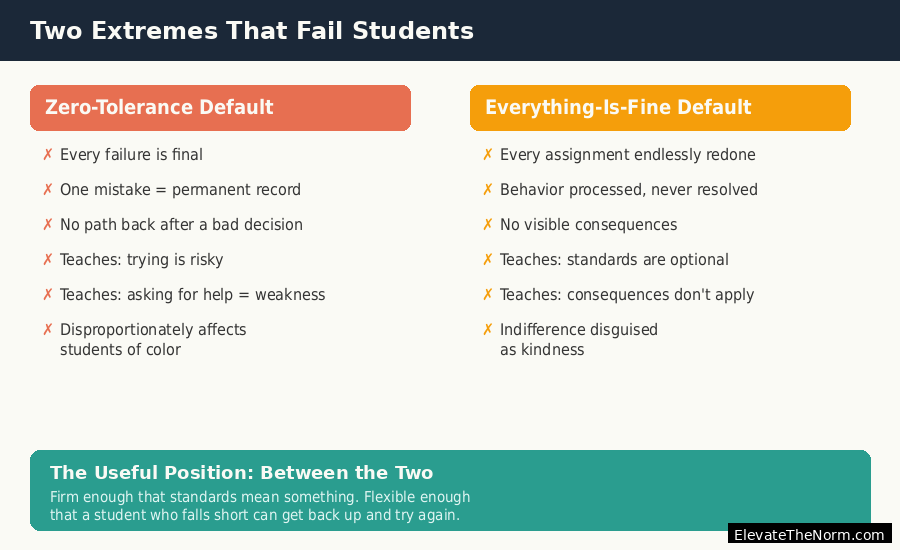
Why it works: It separates the failure from the identity. “You failed this assignment” is a fact. “You are a failure” is a conclusion students draw when there is no path forward. The second-chance plan keeps the standard high — you still have to meet it — while making the path back visible.
What to watch: Set a clear window for the redo. “Whenever you get around to it” is not a plan — it is an invitation to never complete it. A deadline on the redo teaches the same skill as the original deadline.
How Responsibility Activities Fail (and How to Prevent It)
The most common failure is not the activities themselves — it is the gap between the activity and the follow-through.
Responsibility activities fail when teachers assign them but do not follow up on the reflections. They fail when the consequences for not completing a responsibility task are identical to the consequences for not completing any other assignment — a zero in the gradebook. And they fail when the activities are age-inappropriate, making teenagers feel like they are being managed rather than developed.
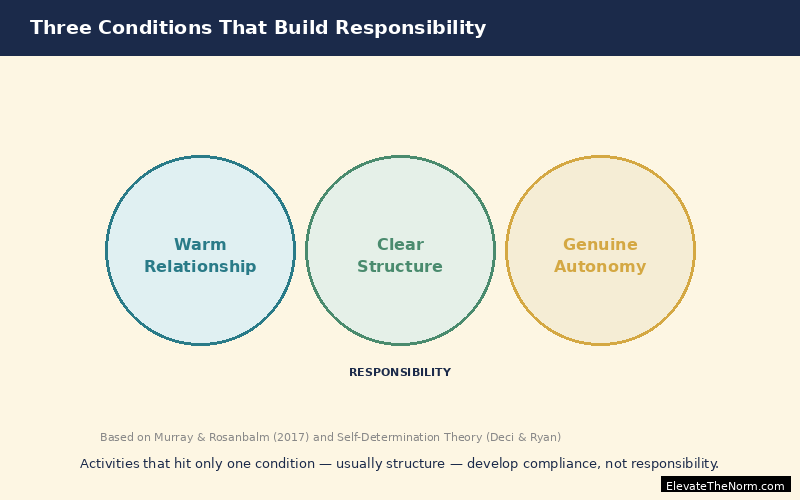
Research on adolescent self-regulation confirms that young people build responsibility most effectively when three conditions are present: a warm relationship with the adult holding them accountable, a structured environment where classroom expectations are clear, and genuine autonomy within those structures (Murray & Rosanbalm, 2017). Activities that check all three boxes develop responsibility. Activities that hit only one — usually structure — develop compliance.
Before You Start: Tell Families What You Are Doing
Responsibility activities work best when families understand the framework. Early in the year — ideally before the first missed assignment or behavioral conversation — communicate to parents and guardians what your classroom responsibility process looks like: that students will be asked to reflect on missed work rather than simply receive zeros, that repair conversations focus on what is owed rather than punishment, and that second chances come with plans attached. A family that understands the system can reinforce it. A family that encounters it only when their child is in trouble will question it.
What Teaching Responsibility Actually Looks Like Day to Day
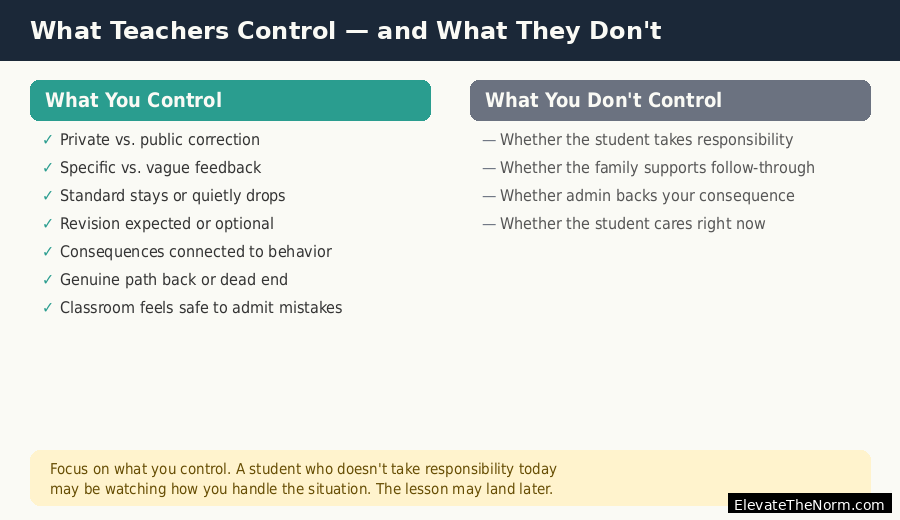
It looks like follow-through. It looks like a teacher who says “I will check your progress on Thursday” and then checks on Thursday. It looks like a room where a student who missed a deadline has a conversation — not a lecture, not a zero entered silently — about what happened and what comes next.
It also looks like grace. Not the kind of grace that eliminates standards, but the kind that maintains them while holding the door open. A student who writes an honest responsibility reflection about why they did not finish a project — and then finishes it — has learned more about responsibility than a student who met every deadline without ever having to recover from a miss.
The goal is not to produce students who never fail. It is to produce students who know what they owe when they do. For a deeper look at how teaching responsibility connects to broader classroom culture, and the research behind why student responsibility is a skill rather than a trait, those articles explore the framework in more detail.
At what age should responsibility activities start in school?
Responsibility activities should be developmentally appropriate at every grade, but the version described here — involving self-assessment, planning, written reflection, and repair — is designed for grades 6–12. Middle schoolers can handle simpler versions (the community contribution task, the group role rotation). High schoolers can handle the full range, including the deadline choice contract and the second-chance plan. The key is matching the complexity of the activity to the student’s capacity for abstract thinking and self-reflection.
How do you teach responsibility without making it feel like a punishment?
By separating the activity from consequences. A repair letter is not a punishment — it is a process for honest self-examination. A second-chance plan is not a penalty — it is a structured path to improvement. The tone of the teacher matters more than the structure of the activity. If you approach a responsibility conversation with curiosity (“What happened?”) rather than judgment (“Why didn’t you…?”), students are more likely to engage honestly.
What if a student refuses to participate in a responsibility activity?
Start with a private conversation. Ask what is getting in the way. Sometimes refusal is about the activity; sometimes it is about something else entirely. If the student still refuses after the conversation, document the refusal and follow your classroom or school procedure — but do not abandon the expectation. The activity stands. The student may need more time, a different format, or a different adult to have the conversation with.
Do responsibility activities work for students with IEPs or behavioral plans?
Yes, with modifications. Consult the IEP or 504 plan first — some students have specific accommodations around deadlines, reflection activities, or self-assessment that must be followed. The principles of responsibility still apply: students with behavioral plans deserve the same expectation of honest self-assessment, repair, and follow-through. The accommodations adjust the how, not the whether.
How do you grade responsibility?
Most of these activities should not carry a traditional grade. Grading a reflection on what went wrong creates an incentive to lie. The activities that are graded — the project, the assignment, the group work — carry grades based on the quality of the academic work. The responsibility activities support the academic work but are evaluated through conversation, not points.
Can these activities backfire?
Yes, if they are applied inconsistently. If one student writes a repair letter and another student who did the same thing does not, the first student learns that the system is arbitrary. Consistency across students is non-negotiable. The activities also backfire if the teacher does not follow through — assigning a responsibility reflection and then never reading it teaches students that the activity is busywork.
How many of these activities should a teacher use at once?
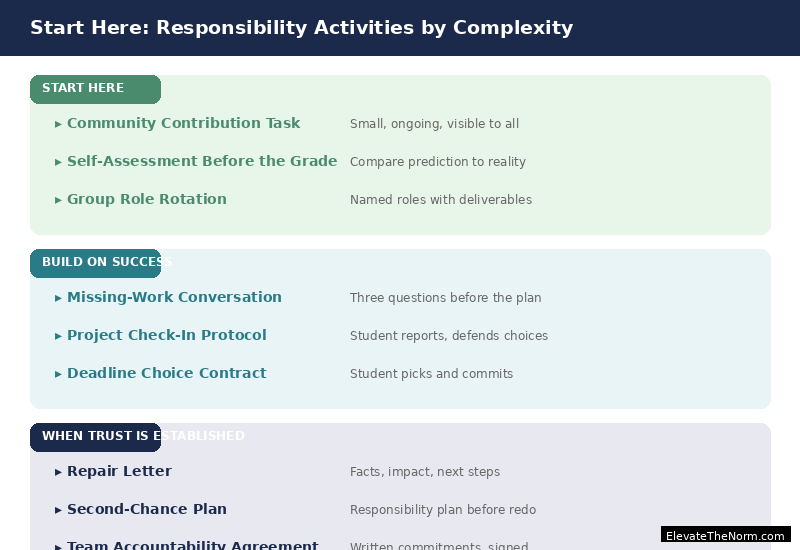
Start with two or three. The deadline choice contract, the self-assessment before the grade, and the project check-in protocol are a strong starting combination because they integrate into work you are already assigning. Add the repair letter and the responsibility debrief as you get comfortable. Trying all ten at once will overwhelm you and your students.
Sources
- Deci, E. L., & Ryan, R. M. (2000). “The ‘What’ and ‘Why’ of Goal Pursuits: Human Needs and the Self-Determination of Behavior.” Psychological Inquiry, 11(4), 227–268.
- Murray, D. W., & Rosanbalm, K. (2017). Promoting Self-Regulation in Adolescents and Young Adults: A Practice Brief. OPRE Report #2015-82. Administration for Children and Families, U.S. Department of Health and Human Services. https://fpg.unc.edu/sites/fpg.unc.edu/files/resources/reports-and-policy-briefs/Promoting%20Self-Regulation%20in%20Adolescents%20and%20Young%20Adults.pdf
- Niemiec, C. P., & Ryan, R. M. (2009). “Autonomy, Competence, and Relatedness in the Classroom: Applying Self-Determination Theory to Educational Practice.” Theory and Research in Education, 7(2), 133–144. https://journals.sagepub.com/doi/10.1177/1477878509104318
- Ryan, R. M., & Deci, E. L. (2020). “Intrinsic and Extrinsic Motivation from a Self-Determination Theory Perspective: Definitions, Theory, Practices, and Future Directions.” Contemporary Educational Psychology, 61, 101860. https://www.sciencedirect.com/science/article/abs/pii/S0361476X20300254
- IRIS Center. (2003). Establishing Classroom Norms and Expectations. Peabody College, Vanderbilt University. https://iris.peabody.vanderbilt.edu/case-study/establishing-classroom-norms-and-expectations/
- Guay, F. (2022). “Applying Self-Determination Theory to Education: Regulations Types, Psychological Needs, and Autonomy Supporting Behaviors.” Canadian Journal of School Psychology, 37(1), 75–92. https://journals.sagepub.com/doi/10.1177/08295735211055355
About Clay Shumate
Clay Shumate is a certified secondary Social Studies teacher in the public schools of West Alabama, with seven years of classroom experience, a B.A. in History, and an M.Ed. in Secondary Education. He writes about project-based learning, student responsibility, respect, and practical ways to hold young people to a higher standard while giving them room to learn from mistakes. He is a member of the Society of Professional Journalists and writes to its Code of Ethics; this site’s editorial standards and corrections policy are published in full. More about Clay.