
By Clay Shumate
An interactive read aloud is a planned lesson in which the teacher reads a text to the class, stops at chosen points to model thinking, and has students talk about what they hear. It works in any grade. The planning takes minutes: pick one purpose, mark three or four stops, and end with a question worth answering.
Key Takeaways
- An interactive read aloud differs from a plain read aloud in one way: students do thinking and talking during the reading, not only after it.
- A study of expert teachers found seven shared practices, starting with text choice and rehearsal and ending with a link to student reading or writing.
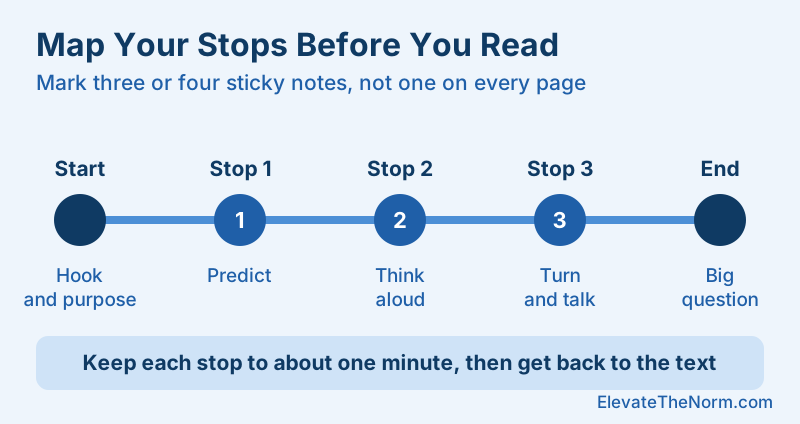
- Three or four planned stops are enough. Stopping on every page breaks the story and tires students out.
- Reading aloud is not only for young children. A 12-week study of 12- and 13-year-olds reported strong gains for poorer readers when teachers read whole novels aloud at a quicker pace.
- Sharing a whole book in a public video is a copyright question, not a teaching one. Ask the publisher first.
Most teachers already read aloud. Fewer plan for what students are doing while the words go by. That gap decides whether a read aloud becomes a lesson or a quiet break with a book in it.
This guide covers how to do a read aloud from choosing the text to the closing question. It includes a lesson plan outline, question stems, classroom management moves, and what changes from kindergarten through high school. Most of this site is written for grades 6–12, so the older grades get real attention here, because that is where the read aloud tends to disappear.
What is an interactive read aloud?
An interactive read aloud is a teacher-led reading of a text with planned pauses for questions, connections, and student responses, while the teacher models fluent reading and thinking. That is close to how Douglas Fisher and Nancy Frey describe it in ASCD’s Educational Leadership.
If you are asking the simpler question, what is a read aloud, it is any time an adult reads a text out loud to students. The word interactive adds a job for the listeners. Students predict, explain, argue, and turn to a partner, so the teacher is no longer the only person thinking in the room.
The text does not have to be a picture book. It can be a novel chapter, a news article, a speech, or a primary source. What makes it interactive is the talk, not the format of the book.
How is it different from shared reading or a plain read aloud?
The difference is who does the work. In a plain read aloud, students mostly listen. In an interactive read aloud, the teacher still does the reading, but students share the thinking. In shared reading, students also see the text and read along.
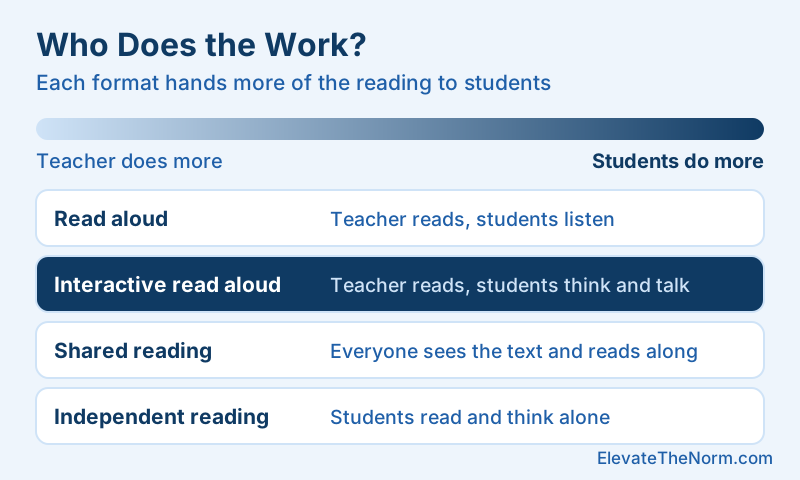
| Format | Who reads | Can students see the text? | Best used for |
|---|---|---|---|
| Plain read aloud | Teacher | Sometimes | Enjoyment and hearing a fluent reader |
| Interactive read aloud | Teacher | Sometimes | Comprehension, vocabulary and discussion on a text above reading level |
| Shared reading | Teacher and students | Yes | Fluency, print skills and close study of a short text |
| Independent reading | Student | Yes | Stamina, choice and practice |
None of these replaces the others. An interactive read aloud lets a whole class work on a text that many could not yet read alone, which is a form of scaffolding that you can remove over time.
What are the benefits of reading aloud?
The benefits of reading aloud include exposure to more words, a model of fluent reading, background knowledge, and shared access to harder texts. The gains are tied to how the text is discussed, not only to the reading itself.
The 1985 report Becoming a Nation of Readers called reading aloud to children “the single most important activity” for building the knowledge needed for reading success, as Fisher and Frey recount. The word interactive matters here. Lea McGee and Judith Schickedanz summarize the research plainly: growth is linked to how often children take part in analytic talk, so simply reading aloud is not enough.
Two pieces of data are worth knowing, and each has limits.
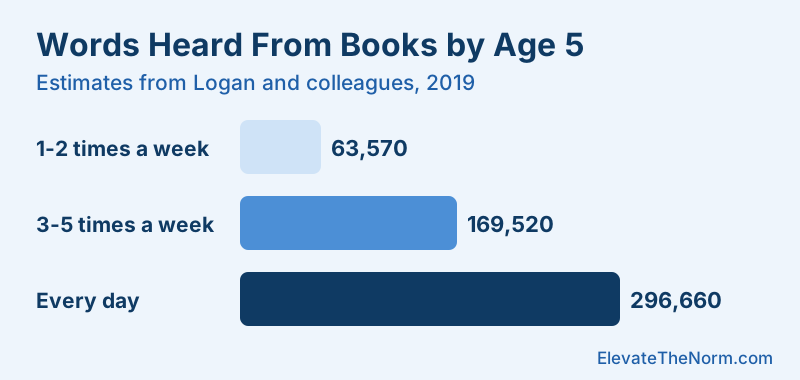
Young children hear far more book words when they are read to often. Jessica Logan and colleagues at Ohio State counted the words in popular children’s books and estimated how many words a child would hear by age 5. These are calculations from word counts, not measures of what any one child learned.
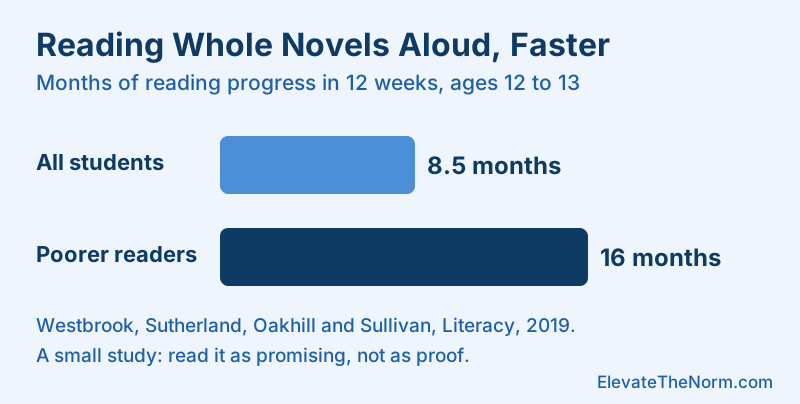
Older students can gain too. In the “Just Reading” study, published in Literacy, 20 English teachers in southern England read two whole challenging novels aloud at a quicker pace over 12 weeks with students aged 12 and 13. Students made an average of 8.5 months of progress on standardized comprehension tests, and poorer readers made about 16 months. It is one small study, so read it as promising, not as proof.
For very young children, the What Works Clearinghouse rated a related method, dialogic reading, as having potentially positive effects on oral language for children with disabilities. That rating rests on a small evidence base of 52 children aged three to six, so it should not be stretched to older grades.
How do you do an interactive read aloud?
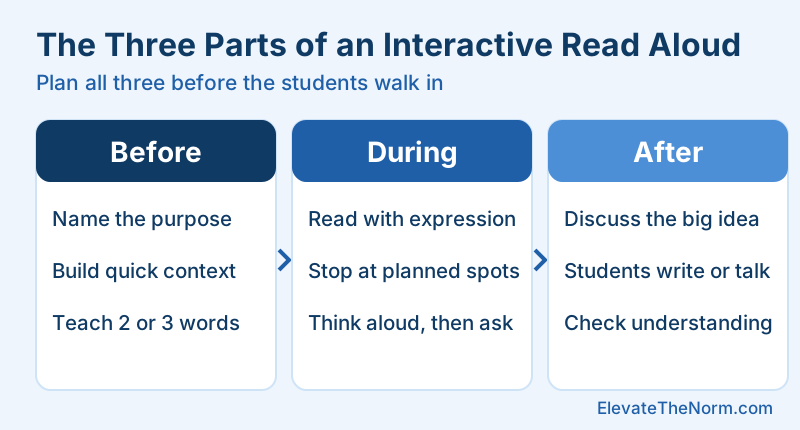
To do an interactive read aloud, choose a text, read it yourself first, set a purpose, teach a few words, read with expression, stop at planned points, and finish with discussion and a short written response. The steps below build on the practices found in expert classrooms.
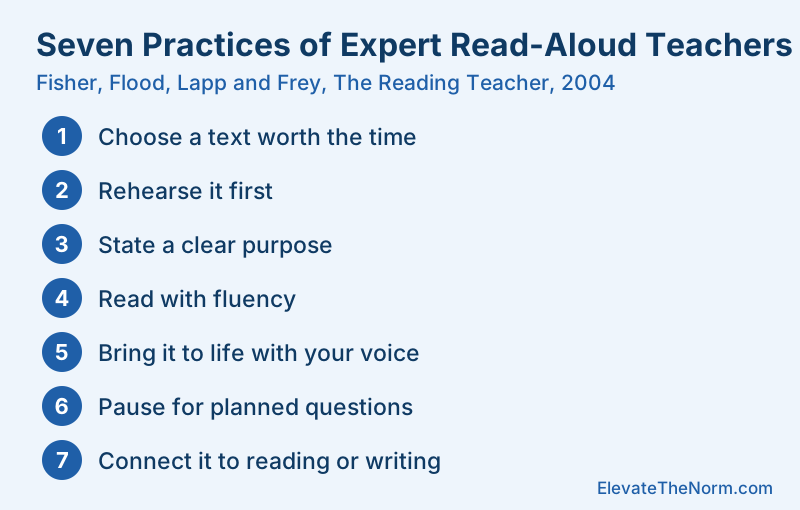
Those seven come from Fisher, Flood, Lapp and Frey’s 2004 study in The Reading Teacher, which observed 25 teachers recommended as experts and then 120 other teachers. Here is how to turn them into a plan.
- Choose a text worth the time. Pick something that fits your students and your unit, and that gives them something to argue about. A read aloud text can sit above their independent reading level, because you are carrying the decoding.
- Read it yourself first. Rehearsal is what lets you look up from the page. It also shows you where students will get lost.
- Name one purpose. Say it out loud: “Today, listen for how the narrator’s opinion changes.” One purpose beats four.
- Teach two or three words. Choose words the text depends on. Use a sentence, a gesture, or a picture, and keep moving. A fuller vocabulary routine can come later, and a Frayer Model suits the one concept the unit leans on.
- Read with expression. Change your pace and volume. Slow down for what matters. Fluent reading is part of the lesson, not decoration.
- Stop at planned points. Think aloud first, then ask. A think-aloud can be one sentence: “I’m thinking she said that because she’s scared.”
- Get every student talking. A quick think-pair-share at a stop gives everyone a turn, not only the three students who always raise a hand.
- End with a task. Ask students to apply what they heard in a short piece of writing, a discussion, or a comparison with another text.
What goes in a read aloud lesson plan?
A read aloud lesson plan needs the text, one purpose, two or three vocabulary words, three or four marked stops with a question for each, and a closing task. It should fit on one page. If it takes more than that, the plan is doing too much.
Use this outline as a starting point. The minutes are a suggestion for a 20-minute block, so adjust them for your class.
| Part | Minutes | Teacher | Students |
|---|---|---|---|
| Hook and purpose | 2 | Connects to the unit, states what to listen for | Predict in a sentence |
| Words | 2 | Teaches two or three key words | Repeat and use one word |
| Reading with stops | 10 | Reads, thinks aloud and asks | Turn and talk at each stop |
| Big question | 3 | Poses one open question | Discuss with evidence from the text |
| Exit task | 3 | Collects responses | Write one short answer |
Here is how the same outline looks with real texts.
| Grades | Text | Purpose | Sample stop | Closing task |
|---|---|---|---|---|
| K–3 | Duck for President by Doreen Cronin | Follow how a character’s goal changes | “Is this job what Duck expected? How do you know?” | Draw and label the job Duck likes least |
| 6–8 | A short news article on a local issue | Separate facts from opinions | “Who is being quoted here? Who is missing?” | One-sentence summary in your own words |
| 9–12 | The Gettysburg Address | Track why Lincoln repeats key words | “Why start with 1776 instead of the battle?” | Write a claim about Lincoln’s purpose |
Reading a picture book more than once can pay off with younger students. McGee and Schickedanz describe a three-read routine for preschool and kindergarten: introduce the story’s problem on the first read, go deeper on characters’ thoughts on the second, and let children help reconstruct the story on the third. Their claims for it rest mostly on classroom experience, so treat it as a useful routine rather than a tested one.
Which read aloud strategies get the best discussion?
The read aloud strategies that build discussion are the think-aloud, the wait after a question, partner talk before whole-class talk, and open questions that move from noticing to judging. Yes-or-no questions usually end the conversation they were meant to start.
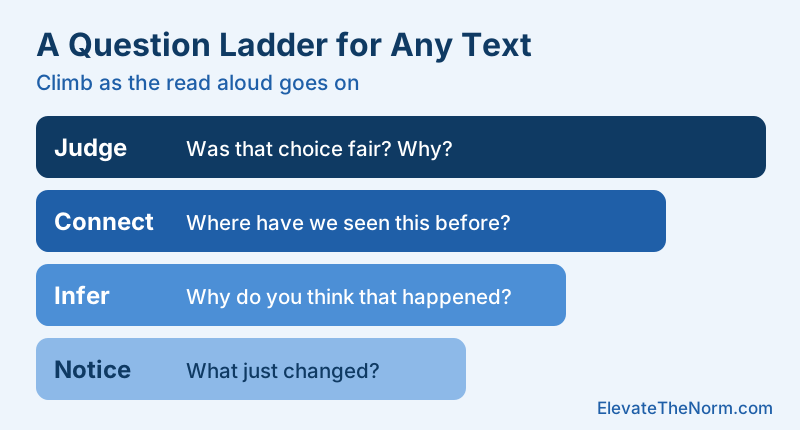
Plan your questions the way you plan your stops. A good set usually includes one for each rung, and the closing question should have more than one defensible answer. Questions like that are also the heart of strong student discourse, and they make the jump to a Socratic seminar feel natural with older students.
Calling on students matters as much as the question. Cold calling done kindly keeps everyone listening, especially when students have just rehearsed with a partner. If you want more ideas, Bell to Bell has a low-pressure version that fits this kind of stop.
How do you keep a read aloud from falling apart?
Give students a listening job, teach the routine before you need it, and keep each stop to about a minute. Most read aloud behavior problems come from students having nothing to do.
- Teach the routine. Practice how students move, sit, and turn to a partner. It belongs with your other classroom routines and procedures.
- Use one signal. Pick an attention getter that brings the room back after partner talk.
- Give hands a task. Students can sketch, take a tally, or jot a word. Older students can use annotation that forces a thought if they have a copy.
- Plan for the talkers. Partner stops give a chatty group a place to put that energy, and these strategies for a talkative class help when it runs over.
What are good read aloud activities for after the reading?
Good read aloud activities ask students to use what they heard. An exit ticket, a one-pager, a gallery walk, or a short written claim all work, and each should take less time than the reading itself.
| Activity | Time | What it shows you |
|---|---|---|
| ELA exit ticket | 3 minutes | Whether students caught the main point |
| One-pager | 20 minutes | How students connect ideas, quotes and images |
| Gallery walk | 15 minutes | How the class responds to several ideas |
| Choice board | Varies | What students choose to do with a text |
A listening task is also a chance to gather real data. These formative assessment strategies for listening pair well with a read aloud, and these quick listening checks take almost no prep. For a next-day warm-up, pull from the free ELA bell ringer library or build one around your text with the Bell Ringer Creator. For a broader look at the options, the guide to checking for understanding covers more.
How does an interactive read aloud change by grade?
The routine stays the same from kindergarten through high school. What changes is the text, the length of the reading, and the kind of thinking you ask for.
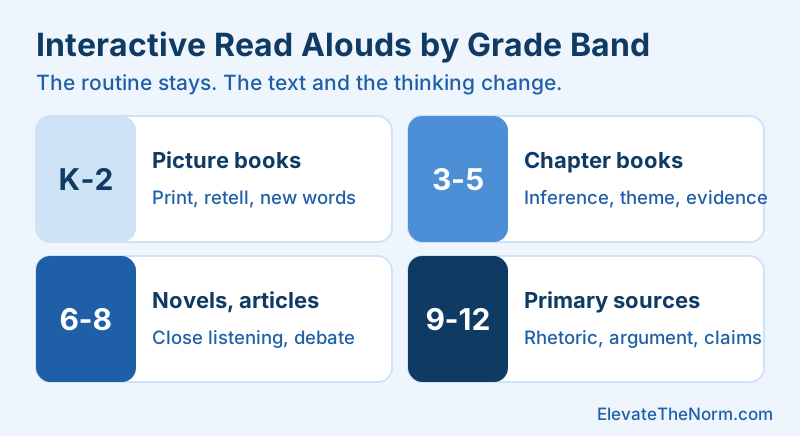
Interactive read aloud in K–2
Keep the book visible and the turns short. Fisher and Frey also recommend print referencing for primary students, such as pointing out a word, a letter, or the direction of print. Retelling and new words are the main goals.
Interactive read aloud in grades 3–5
Move into chapter books and nonfiction. Ask students to back up an answer with something they heard, and carry a question from one day’s reading to the next.
Interactive read aloud in middle school
Reading aloud does not make the lesson childish. It gives every student the same text at the same time, including students who read below grade level. For English learners, add a word bank and sentence frames, and use exit tickets built for English learners. The guide to differentiated instruction strategies has more options.
Interactive read aloud in high school
Read the hard opening of a novel, a court opinion, or a speech aloud, then release students to continue. In history, a teacher’s voice can make an old document clear enough for students to question it. That fits naturally with primary source analysis and leads into teaching a document-based question. For a ready warm-up, try these primary source bell ringers. You can then check what stuck with a unit test from the free Midterm Maker.
Can a read aloud work on a sub day?
Yes, if the plan is written out. Give the substitute the text, the marked stops, and the exact questions, and keep the closing task simple.
A scripted read aloud is one of the calmer options for a day you are out. Pair the steps in this guide with the sub plans template or the ready-made ELA sub plans and social studies sub plans on SubstitutePlans.com. For anything unplanned, keep emergency sub plans in the folder. The guide on writing sub plans that hold up covers the rest.
What are the most common read aloud mistakes?
The most common mistakes are stopping too often, asking too many low-level questions, skipping the rehearsal, and ending when the text ends.
- Too many stops. McGee and Schickedanz warn against turning a read aloud into a barrage of questions. Protect the flow of the text.
- Asking only recall questions. “What color was the barn?” tells you little. Ask why.
- Reading cold. You will miss the best stops and stumble on hard words.
- Answering your own question. Wait longer than feels comfortable, and let a partner conversation carry some of the load.
- No follow-up. Without a closing task, you cannot tell who understood.
Can you post a read aloud video online?
Reading a book live to your own class is one thing. Recording a whole copyrighted book and posting it publicly is another, so get written permission from the publisher first.
Some publishers offered temporary permissions in the past, and those may have ended. For example, Simon & Schuster’s online read aloud guidelines state that the permission was valid through June 30, 2023, and they banned monetizing the videos. Check the publisher’s current policy for your specific book. This is general information, not legal advice. Public domain texts, like the Gettysburg Address, avoid this problem.
What to do next
Pick one text you already plan to teach next week. Read it once, write one purpose, and mark three stops with sticky notes. Then add one closing question and one short task. That is a complete interactive read aloud, and the second one will take half the time.
When you want more, the free Elevate the Norm resource library has ungated classroom tools, and the Bell to Bell library gathers free guides in one place. You can grab 1,000 free bell ringers, swap ideas in the Daily Bell Ringers Facebook group, or browse ready-to-print resources in the Teacher Emergency Toolkit store, including Duck for President activities for grades K–3. Students who finish early can reread the text with a task from these early finisher activities.
Frequently Asked Questions
What is an interactive read aloud?
An interactive read aloud is a lesson in which a teacher reads a text out loud and stops at planned points to model thinking and get students talking. Students predict, explain and discuss during the reading, not only after it.
How long should an interactive read aloud last?
No set length is required. About 15 to 20 minutes is a workable plan for many classes, with younger students needing shorter sessions. Keep each stop to about a minute so the text keeps moving.
How many stops should a read aloud have?
Three or four planned stops work well for most texts. No research sets a fixed number, but too many questions can break up the story. Choose the moments where students need to think, not every page.
Are read alouds good for middle and high school?
Yes. Reading aloud gives a whole class access to a hard text and models fluent reading. One 12-week study of students aged 12 and 13 reported strong gains for poorer readers when teachers read whole novels aloud, though it was a small study.
What is the difference between a read aloud and shared reading?
In a read aloud, the teacher does the reading and students listen and respond. In shared reading, students can see the text and read along with the teacher, so they practice the reading itself.
What makes a good interactive read aloud book?
A good book fits your students, ties to your purpose, and gives them something to discuss. It can sit above their independent reading level because the teacher handles the decoding. Read it yourself first to be sure.
Can I post a video of myself reading a book?
Get written permission from the publisher before you post a whole copyrighted book publicly. Past permissions may have ended, so check the current policy for that book. Public domain texts avoid this problem. This is general information, not legal advice.
Sources
- Fisher, D., & Frey, N. (2025). A Better Way to Read Aloud. Educational Leadership, 82(6). ASCD. Carries the citation to Becoming a Nation of Readers.
- Fisher, D., Flood, J., Lapp, D., & Frey, N. (2004). Interactive read-alouds: Is there a common set of implementation practices? The Reading Teacher, 58(1). Read through the published summary and the ASCD article above.
- McGee, L. M., & Schickedanz, J. A. (2007). Repeated Interactive Read-Alouds in Preschool and Kindergarten. The Reading Teacher, 60(8), 742–751.
- Westbrook, J., Sutherland, J., Oakhill, J., & Sullivan, S. “Just reading”: The impact of a faster pace of reading narratives on the comprehension of poorer adolescent readers in English classrooms. Literacy, 53(2), 60–68.
- Logan, J. and colleagues (2019). Reported in Ohio State’s summary of the million word gap study. Journal of Developmental and Behavioral Pediatrics.
- What Works Clearinghouse (2010). Dialogic Reading intervention report, children with disabilities. Institute of Education Sciences.
- Simon & Schuster. Online Read Aloud Guidelines.
About Clay Shumate
Clay Shumate is a certified secondary Social Studies teacher in the public schools of West Alabama, with seven years of classroom experience, a B.A. in History, and an M.Ed. in Secondary Education. He writes about project-based learning, student responsibility, respect, and practical ways to hold young people to a higher standard while giving them room to learn from mistakes. This site’s editorial standards and corrections policy are published in full. More about Clay.

