Sub plans are the instructions you leave so someone else can run your class for a day. Good ones do three jobs: they keep students safe, they keep students doing real work, and they tell a stranger what normal looks like in a room they have never seen. Most sub plans only try to do the second job, and that is why most sub days go sideways.
This guide covers what to put in sub plans for grades 6–12, how to write the day so a substitute can actually follow it, the difference between emergency sub plans and the ones you write for a planned absence, and what to do about the days no substitute shows up at all. If you want the other side of the door — what the person walking in can and cannot control — that is in the guide to running a room that isn’t yours.
Key Takeaways
- Sub plans are written for a stranger, not for you. Anything that only makes sense if you know the room has to be spelled out.
- Write the day in minutes. Start and stop times for each task turn a vague plan into one a substitute can enforce.
- Emergency sub plans are a different document. They stand alone, they are built at the start of the year, and anyone in the building can run them.
- Report the absence early. In one large district’s data, substitute coverage rose sharply for every hour a job was posted ahead of time through the first day.
- Plan for no sub at all. When an absence goes uncovered, students are often split into other rooms or a colleague gives up a planning period. The plan has to work for them too.
- Make the work count. Students can tell a holding pattern from a real assignment, and they act accordingly.
What Should Sub Plans Include?
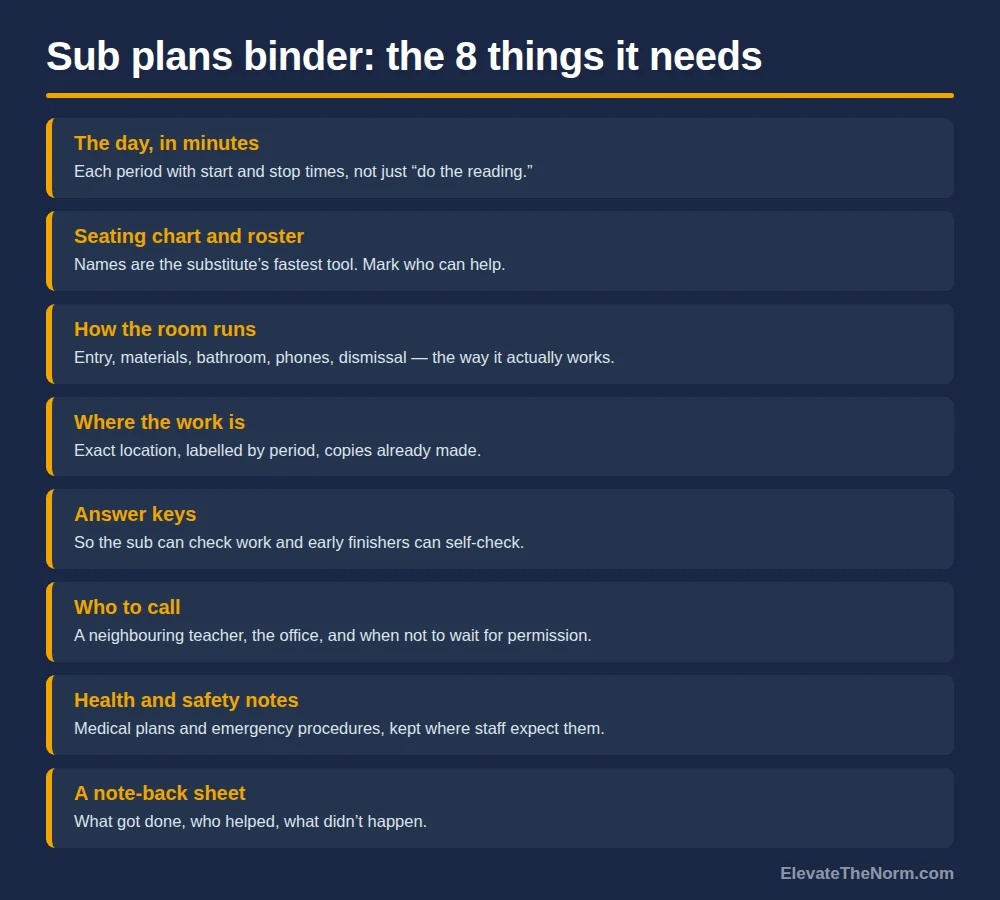
Sub plans should include the schedule written in minutes, a seating chart and roster, how the room normally runs, the exact location of every copy, answer keys, the names of people to call, the health and safety information your school requires you to share, and a sheet for the substitute to write back on. That is the binder. The lesson is only one part of it.
Think about what a substitute actually needs at 7:40 in the morning. Not your philosophy of teaching. They need to know where the copies are, what happens when the bell rings, and who to send for when something goes wrong. A plan that says “students will continue their reading” tells them nothing about any of that.
The day, in minutes
Each period gets a start time and a stop time for every task. “8:05–8:15: bell work on the board. 8:15–8:40: reading and questions 1–6. 8:40–8:50: turn in to the tray by the door.” Times give the substitute something to point at. A posted time is easier to hold students to than an adult’s opinion about when they should be done.
Seating chart and roster
A substitute who can use names is in a different room than one who can’t. Keep the seating chart current and mark two or three students per class who can answer a question about where things are. Pick them for reliability, not for being your favorites. A seating chart built for the room you actually have does double duty here.
How the room runs
Entry, materials, phones, restroom passes, dismissal. Write down how these work in your room, not how they work in the handbook. If students pick up their own folders at the door, say so. If phones go in a pocket chart, say where it is. Most of what a substitute reads as students “getting away with something” is students following a routine nobody told the sub about. Your routines and procedures are the thing being handed over.
Where the work is, and the keys
Copies made, labeled by period, in one place, named in the plan. Answer keys in the same folder. Keys let the substitute check work and let students who finish early check their own, which keeps the last fifteen minutes from turning into the loudest fifteen minutes of the day.
Who to call, and the private information
Name the teacher next door and the number for the office. Say plainly that if something is unsafe, the substitute does not need anyone’s permission to call for help. Health plans and emergency procedures belong in the binder only in the form your school requires. Do not leave copies of individual student plans loose on a desk; follow your building’s procedure for what a substitute is given and where it is kept.
Write Sub Plans to the Minute
My own rule for running a room is short: “Taking control of a classroom is done by organization to the minute and then you pause. Be confident.” The posted times are the setup. The pause is the enforcement. You lay out the plan, stop talking, and let the silence do its job.
A substitute cannot borrow your confidence, and they do not have your history with the class. What they can borrow is your organization. If the plan is written to the minute, the substitute does not have to invent authority. They read the time, point at the board, and wait. The plan carries the weight a stranger’s voice cannot.
That is also why vague plans fail even with a strong substitute. “Work on the project” leaves the adult in the room arguing about what counts as working. “Draft paragraph two, due in the tray at 9:20” does not. If you have never written the room down this way, a written classroom management plan is the document to start from.
Emergency Sub Plans vs. Planned-Absence Sub Plans
Emergency sub plans are the ones you build before you need them. They stand alone, they do not depend on yesterday’s lesson, and anyone in the building can run them cold. Planned-absence sub plans are written the week you know you’ll be out and continue the unit students are already in.
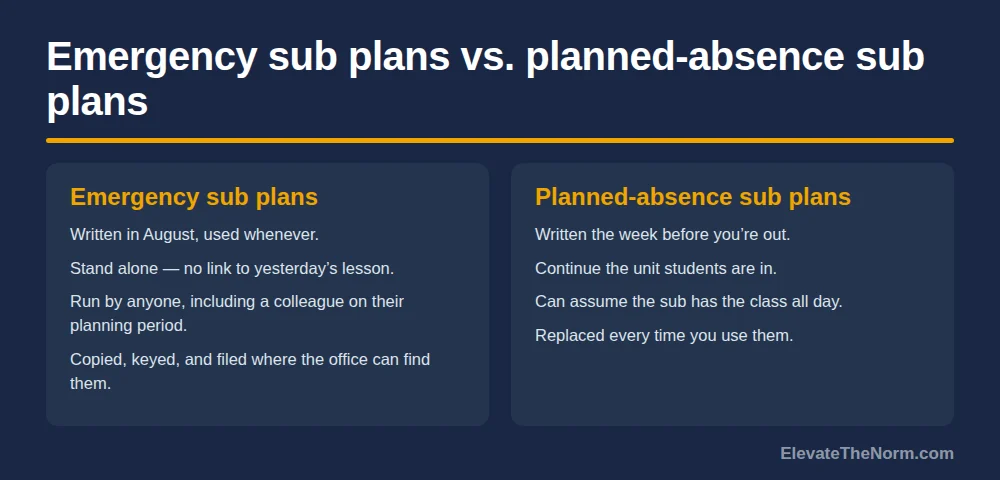
The emergency folder is the one that matters most, because it is the one you can’t write when you need it. You wake up sick at 5:30. Your kid has a fever. There is a family emergency two hours away. Nobody is writing a lesson plan in those moments, and nobody should have to.
Three rules make emergency sub plans work:
- Standalone. No reference to “where we left off.” The work makes sense on any day of the year.
- Keyed and copied. A full class set for each day, with an answer key, already in the folder.
- Findable. The office knows where the folder is. So does the teacher next door. Tell them both.
Three days is the right number for most secondary teachers. One day runs out the first time you’re out twice in a month, and five days is a lot to build before the year has started.
I write these for my own room and put them on TPT. The Any-Day Emergency Sub Plan Card is free: one page any adult can run, in any subject. If you teach social studies, Emergency Sub Plans World History is five strange-but-true readings with questions and answer keys, written so a substitute can hand them out without knowing the content. The same format covers Civics Sub Plans Vol. 1 for government classes and Renaissance Sub Plans. For a full ancient-to-medieval sequence, the Ancient & Medieval Sub Plans Bundle covers Egypt, Greece, Rome, and the Middle Ages in one folder.
Out the week of Halloween? Halloween Sub Plans are five spooky history readings a substitute can run cold, so the sub day isn’t a word search.
Subject-Neutral Sub Plans That Still Count
Not every emergency day can be a content day. Sometimes the substitute is covering three different preps, or the class is being split into other rooms. That is when subject-neutral work earns its place. The test is simple: would a reasonable student see it as real work, and would you actually look at it when you got back?
Work that passes that test:
- A current events read. One article, one set of questions that work on any article. Current Events Weekly Templates give you 36 lenses that work on any article, and the Current Events Weekly Routine Bundle adds bell ringers, a journal, and a quiz.
- Study and organization skills. Note-taking, test prep, and planning a long assignment are useful in every subject. The Study Skills, Test Prep & Executive Functioning Bundle is built for middle and high school.
- Self-checking challenge work for early finishers. Early Finishers Activities for Middle School are 45 cards students check themselves, so the substitute never needs a key.
- A planned break. A short, structured movement break at the halfway point of a long block is easier for a substitute to run than a room that has been sitting for 80 minutes. Brain Breaks for Middle & High School are 60 no-supply cards and slides.
What fails the test: a movie with no task, a word search, or a packet nobody collects. Students read those as a day off, and the substitute pays for it.
Behavior and Logistics: What the Substitute Needs to Know
Tell the substitute what normal looks like, so they can tell when something isn’t. If partner talk is how your room works, say so, or a quiet-room substitute will spend the day fighting your design. If one class needs a seating change after lunch, write it down. If a student has a plan for stepping out when they need to, put it in the binder the way your school requires.
Then give them something to say when a student pushes back. Most substitutes have a few phrases they lean on; it helps to leave a few that match how your room already talks. The free 5 De-escalation Scripts You Can Use Today fit on one page in the binder. If you want the full set for yourself, De-escalation Strategies for Teachers has 100 scripts for middle and high school.
Finally, leave clear limits. Name the two or three things a substitute should write down and leave for you, rather than handle on the spot. That protects students from a stranger making a big call on a single day, and it protects the substitute from having to.
When to Write Sub Plans, and When to Report the Absence
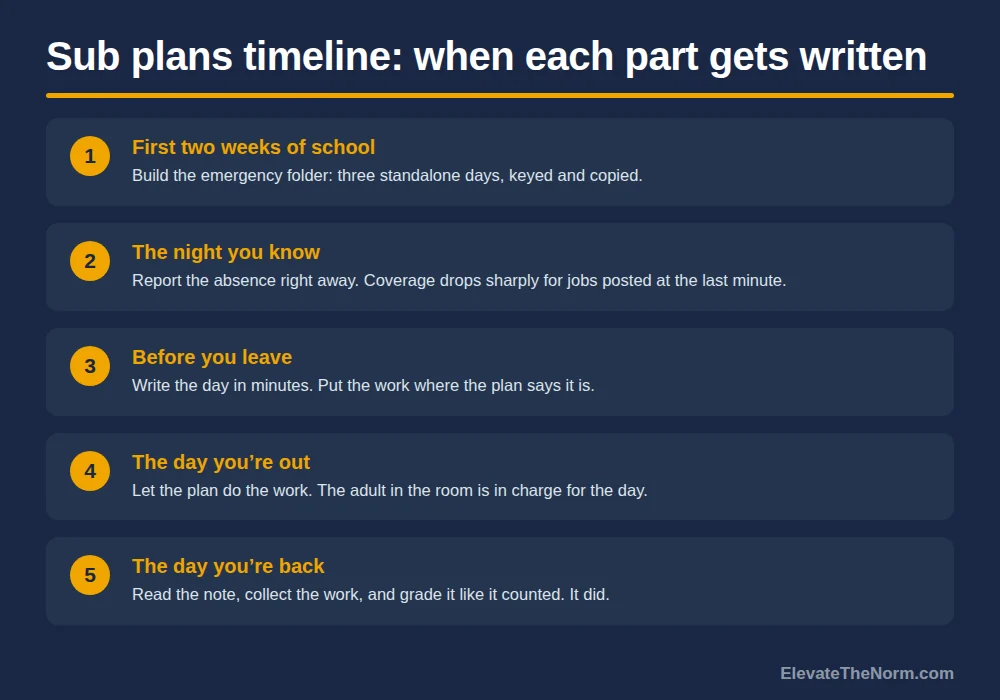
Build the emergency folder in the first two weeks of school, while you still have the energy and before you need it. Look at it again at the start of each grading period and swap anything that has gone stale.
When you know you’ll be out, report it right away. In a study of a large West Coast district, Brookings researcher Jing Liu and colleagues found that how early a substitute job was posted was one of the strongest predictors of whether it got filled. Coverage climbed quickly for each hour of notice through the first 24 hours, and jobs posted at the last minute were the least likely to be covered. A plan that never gets a substitute to read it is a plan for whoever ends up in your room instead.
Plan for the Day No Substitute Comes
Uncovered absences are not rare. In the same district data, teachers were out about 11.8 days a year, and roughly one of those days went without a substitute. When that happened, students were split into other classrooms about 37 percent of the time, a teacher gave up a planning period about 35 percent of the time, and an administrator covered about 12 percent of the time.
The same study found that schools serving more disadvantaged students had systematically lower substitute coverage, and that substitutes often cited student behavior when they named the schools they avoided. Reporting from 2024 citing federal survey data put the share of public schools that had difficulty finding substitutes at 35 percent in 2023–24. Read honestly, that is not a reason to blame anyone. It is a reason to write plans that a colleague can run in another room, with your students sitting in the back of a class that isn’t theirs.
That means one more rule for emergency sub plans: they have to work for 25 minutes in someone else’s room. A one-page reading with questions does. A lab, a discussion, or anything that needs your projector does not.
What Students Should Be Doing, and Why It Matters
Students behave differently on a sub day for reasons that make sense. The adult is new, the routine is off, and the day looks like it might not count. Responding to that isn’t a character flaw. It’s a reasonable read of what they’ve been handed.
The fix is on our end. Leave work that is clearly real, collect it, and tell them in the plan that you will read it. Then do. If the work is graded, grade it the way you would on any other day. Don’t punish a whole class for what the substitute’s note says a few students did; deal with those students individually, the way you would if you had been there.
Families notice this too. If a sub day turns into a grade, a student should be able to explain to a parent what the assignment was and why it counted. If you get questions, clear parent-teacher communication is easier when the work was clearly worth doing.
Review Sub Plans Like the Person Reading Them
Before you file it, read the plan as a stranger would. Could someone who has never been in your building find the copies? Could they start class without asking anyone? Could a colleague run the same pages in their room? Could a student tell what they are being graded on? If any answer is no, that is the line to fix.
Build Sub Plans Once
The point of all this is that the hard thinking happens once. A good emergency folder is built in August and keeps paying for itself every time life gets in the way. A good binder template means the planned-absence day takes twenty minutes to write instead of an evening.
If you would rather start with everything already built, The Teacher Emergency Kit Ultimate Bundle puts 64 resources for grades 6–12 in one download. If you’re buying during a sitewide sale, the TPT sale guide explains how the discounts stack. Free printables for the rest of the classroom are in the free resource library.
Frequently Asked Questions
What should be included in sub plans?
A minute-by-minute schedule for each period, a seating chart and roster, how routines like entry, phones, and dismissal work, where the copies and answer keys are, who to call for help, the health and safety information your school requires, and a sheet for the substitute to leave notes on. The lesson itself is only one part.
What are emergency sub plans?
Emergency sub plans are standalone lessons you prepare before you need them, usually at the start of the year. They don’t depend on where the class left off, they come copied with answer keys, and they are kept where the office and a neighboring teacher can find them. Three days is a practical number for most secondary teachers.
How detailed should sub plans be?
Detailed enough that someone who has never been in your building could run the day without asking anyone. Use start and stop times for each task, name exactly where materials are, and spell out routines that students already know but a substitute doesn’t.
Should sub plan work be graded?
If you want students to take it seriously, yes. Collect it, read it, and grade it the way you would on any other day. Work that is never collected teaches students that sub days don’t count.
What if no substitute is available?
Plan for it. When an absence goes uncovered, students are often split into other classrooms or a colleague covers on a planning period. Emergency sub plans should work in 25 minutes in someone else’s room, which means short readings with questions rather than labs or discussions.
Can a substitute show a movie?
Only with a task attached and only if your school allows it. A video with a set of questions that gets collected is work. A movie with nothing attached tells students the day doesn’t count, and the substitute usually pays for that.
How early should I report an absence?
As early as you can. In one large district’s data, coverage rose sharply with each hour of notice through the first 24 hours, and last-minute postings were the least likely to be filled.
Sources
- Liu, J. (2020). America faces a substitute teacher shortage—and disadvantaged schools are hit hardest. Brookings Institution, Brown Center Chalkboard. Read the analysis — source for the 11.8 days of average absence, the share of uncovered absences and how they were covered, the effect of posting time on coverage, and the lower coverage rates in disadvantaged schools. Data from one large urban district on the West Coast, 2011–12 to 2017–18; it describes associations in that district, not a national rate.
- DiFurio, D. (2024). Substitute teachers keep schools running. Here are the best ways schools can attract more amid the shortage. Stacker, with HeyTutor. Read the article — source for the 35% of public schools reporting difficulty finding substitutes in 2023–24 (attributed there to NCES School Pulse Panel data) and for the finding that substitutes rank solid lesson plans highest when choosing an assignment (from Red Rover’s 2023 survey of about 4,000 substitutes). This is a secondary summary; the NCES and Red Rover figures are cited as reported there.