Academic honesty means the work you hand in represents what you actually did and actually understand, and that anyone whose thinking you used gets credited. That is the whole definition. What makes it hard in grades 6–12 is not that students disagree with it — most of them do not — but that nobody has ever told them precisely where the line falls, and it moves between classrooms.
Schools tend to treat academic honesty as a rule to be enforced. It works far better as a thing to be taught, because the evidence on why students cheat points almost entirely at pressure, confusion and exhaustion rather than at character.
This guide is written for middle and high school, not for universities, and it takes the AI question seriously without pretending the world started in 2023.
Key Takeaways
Cheating is near-universal and long predates AI. McCabe’s surveys of more than 70,000 high school students found 64 percent admitted cheating on a test and 95 percent admitted some form of it.
ChatGPT did not change the numbers. Stanford researchers surveying 40 high schools found rates held at 60–70 percent — the same as the year before ChatGPT existed.
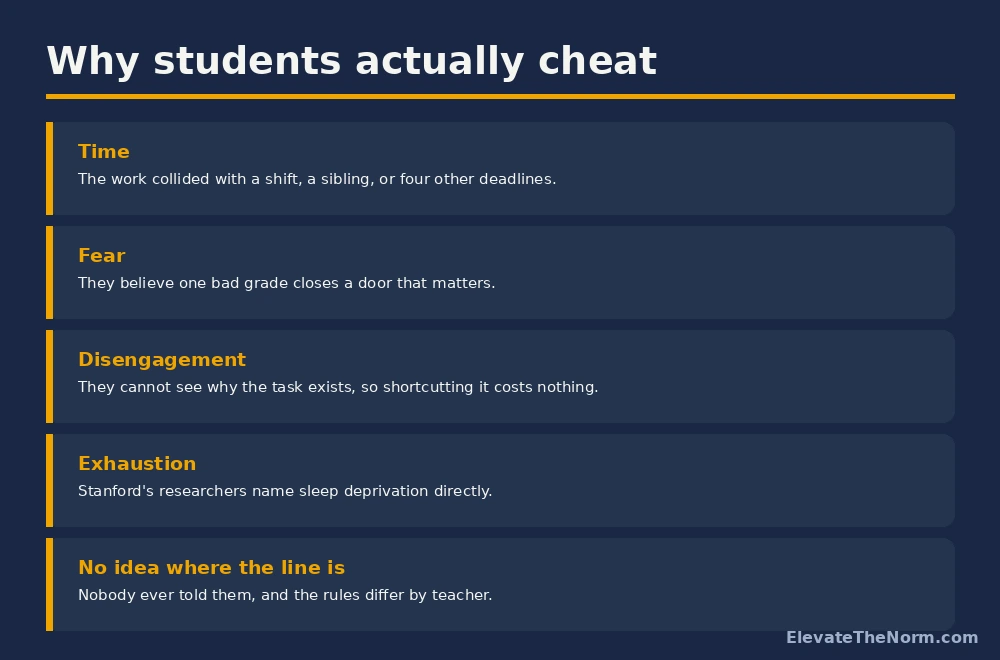
The causes are mundane. Time, fear, disengagement, exhaustion, and genuinely not knowing where the line is.
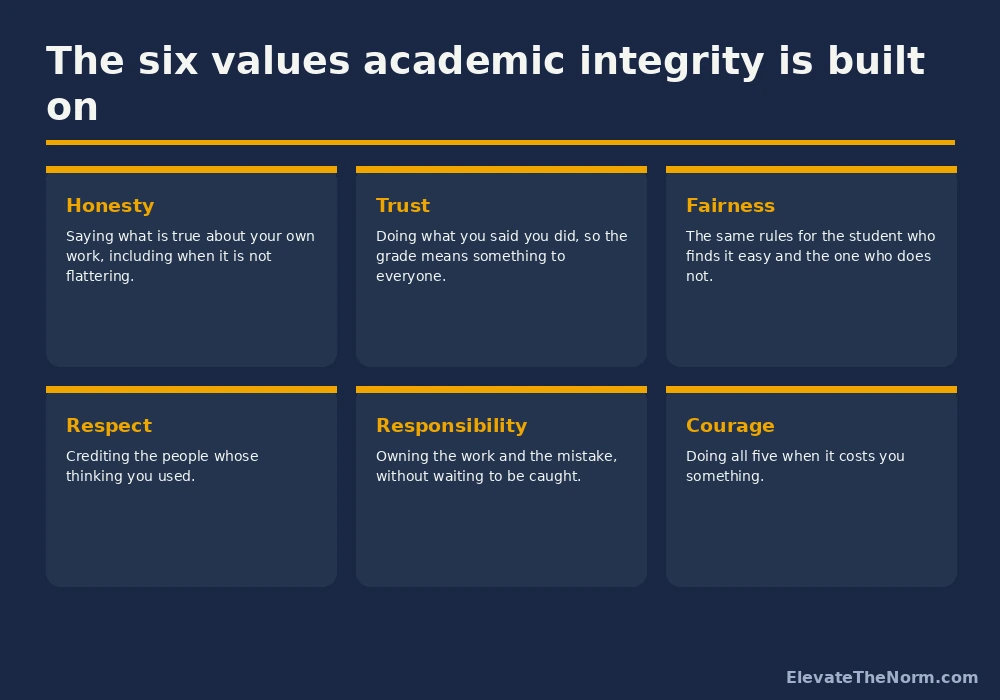
Integrity has six named values — honesty, trust, fairness, respect, responsibility and courage. Courage is the one schools leave out.
Teach the line explicitly, per assignment. “Ask me” has to be a real, safe option or students will guess.
A policy nobody can recite is not a policy. If your students cannot state the rule for your class, you do not have one.
What Is Academic Honesty?
Academic honesty is the practice of representing your own work accurately and crediting the work of others. Academic integrity is the broader commitment that makes it possible — the set of values a school and its students agree to hold, including when holding them is inconvenient.
The International Center for Academic Integrity names six. Courage is the one schools skip.
Five of those six get printed in handbooks. The sixth rarely does, and it is the one that actually costs a teenager something. Courage is what a student needs to hand in an unfinished assignment rather than a copied finished one, in a building where the finished one is safer. If your academic honesty policy demands courage from students without offering them a survivable way to be honest, you have written a rule that punishes the value you claim to want.
That is a design problem, not a student problem, and it is fixable.
How Common Is Cheating, Really?
Common enough that any policy assuming otherwise is fiction. The International Center for Academic Integrity reports Donald McCabe’s surveys of more than 70,000 high school students across two dozen schools: 64 percent admitted cheating on a test, 58 percent admitted plagiarism, and 95 percent admitted participating in some form of cheating.
Sit with that last number before designing a consequence ladder around it. A policy built on the idea that cheating is what a few dishonest students do is a policy built on a false premise.
What AI did and did not change
The expected answer was that generative AI would send those numbers up. It did not.
Denise Pope and Victor Lee of Stanford’s Graduate School of Education surveyed students across 40 high schools in autumn 2023 and found cheating rates essentially unchanged, at 60 to 70 percent — the same range as autumn 2022, before ChatGPT was widely available. Pope said she had expected higher numbers and was surprised. Lee reported that students found the output underwhelming: “It just sounds very sterile and vanilla to them.”
Pope’s summary of the cause is the sentence worth pinning above a department meeting: when students do cheat, it is typically for reasons that have very little to do with their access to technology.
This is a survey of self-reported behaviour at one point in time, so it is a snapshot rather than a settled law, and the tools have kept changing since. But it is the best evidence available on the specific question everyone was asking, and it points away from detection software and toward assignment design.
Why Students Actually Cheat
Five reasons cover almost all of it, and only one of them is about wanting to get away with something.
Stanford’s researchers found the reasons had very little to do with access to technology.
Pope named disengagement, feeling undervalued and sleep deprivation among the drivers. Add time pressure and simple confusion about the rules and you have the set.
Notice what this means practically. Four of the five are things a teacher has some control over. Assignment design, deadline stacking, whether a single grade is allowed to feel catastrophic, and whether the rules were ever stated — those are adult decisions. The fifth, exhaustion, is largely outside your control, but knowing it is in the mix should change how you read a 2 a.m. submission.
None of this means the behaviour is acceptable or that consequences disappear. It means a school that responds to cheating only with detection and punishment is treating the symptom, and the numbers above suggest how well that has worked so far.
Where the Line Actually Falls
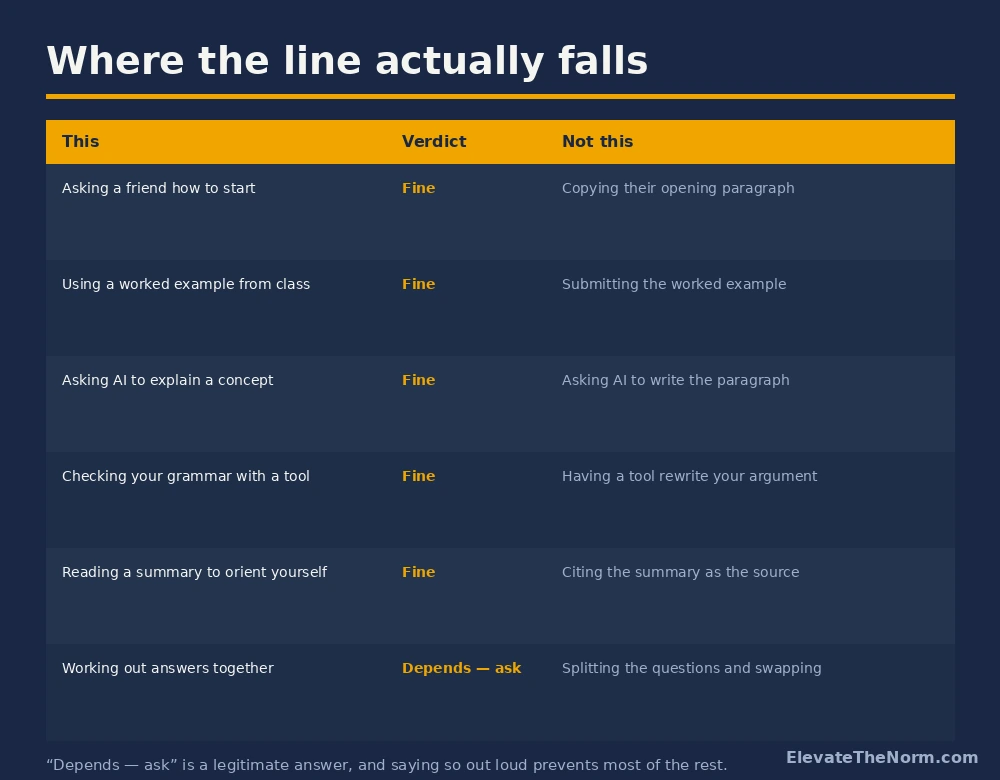
Most students are not choosing to cheat. They are guessing, because the same action is encouraged in one room and punished in the next, and nobody has written it down.
Most students are not choosing to cheat. They are guessing where the line is.
The useful principle underneath the table: help with your thinking is fine, substitution for your thinking is not. A friend explaining how to start, a worked example, a tool that explains a concept — all of those leave the thinking with the student. A copied paragraph, a rewritten argument, a split-and-swap worksheet do not.
That principle handles AI without needing a separate AI policy. “Did the tool help you think, or did it think instead of you?” is answerable by a thirteen-year-old, and it will still be answerable when whatever replaces today’s tools arrives.
The row marked “depends — ask” matters as much as the clear ones. Collaboration is genuinely ambiguous, it varies by assignment, and students need a safe way to check. If asking gets a student a suspicious look, they will stop asking and start guessing, and you have chosen the worse outcome.
If you want the longer version of that table, eighteen real situations sorted by category works through the ones that come up weekly — reused essays, invented sources, shared worksheets — including what fabrication actually means and the five that depend entirely on what you said beforehand.
How to Teach It Instead of Just Enforcing It
Six moves, none of which require a new school-wide policy.
State the rule per assignment, not per year. One line at the top of the task: what help is allowed here. It takes ten seconds and removes most of the guessing.
Make “ask me” genuinely safe. Answer the question plainly, without an eyebrow. A student checking the line is doing exactly what you asked for.
Teach citation as crediting people, not as formatting. Middle schoolers grasp “say whose idea it was” long before they grasp a style guide.
Stop stacking deadlines. Look at what else your students have due that week. Time pressure is a cause, and it is partly yours.
Design tasks that are harder to substitute. Work grounded in this class, this discussion, this local question is difficult to outsource and more interesting anyway.
Separate the honesty conversation from the grade conversation. A student who admits copying and gets both a zero and a referral has learned that honesty is the expensive option.
The last one is where most policies quietly fail, and it connects directly to whether a student has a route back after a mistake. If there is no survivable path, the rational move for a frightened fifteen-year-old is to deny it.
What Academic Honesty Is Not
It is not a detection problem. Detection tools produce false positives, fall hardest on students who write unusually, and do nothing about the five causes above.
It is not a character verdict. With 95 percent of students admitting some form of it, treating an incident as evidence of a bad kid is statistically indefensible.
It is not the same conversation as a school discipline referral. Some incidents require formal procedures. Most do not, and running everything through the formal route guarantees students stop telling you the truth.
It is not a university policy shrunk down. Thirteen-year-olds are still learning what counts as their own idea. Expecting undergraduate judgment from them and then punishing its absence is unfair.
It is not solved by banning tools. The Stanford numbers are the argument: rates did not move when the tools arrived, and they will not move when the next ones do.
What to Do Next
Pick your next assignment and write one line at the top stating exactly what help is allowed on it. Say it out loud when you set the task, and say that asking is fine. That single habit removes more academic dishonesty than any detection tool available to a secondary teacher, because it removes the guessing that produces most of it.
Then look at what happens in your room when a student is caught. If the honest route costs them more than the dishonest one, fix that before you fix anything else. When a violation does need a formal response, having a consistent process for responding to an academic integrity violation keeps it fair and keeps it out of the realm of mood.
What is the difference between academic honesty and academic integrity?
Academic honesty is the behaviour — your work represents what you actually did, and you credit the people whose thinking you used. Academic integrity is the wider commitment that makes the behaviour possible, which the International Center for Academic Integrity frames as six values: honesty, trust, fairness, respect, responsibility and courage. In practice, honesty is what a student does on a Tuesday and integrity is the culture that makes doing it survivable.
Is using AI cheating?
It depends entirely on what it replaced. The workable test is whether the tool helped you think or thought instead of you. Asking a model to explain a concept you did not follow in class is help. Asking it to produce the paragraph you were assigned to write is substitution. That distinction handles the tools we have now and the ones arriving next, which is why it is better than a rule naming specific products. The essential part is stating which you mean on each assignment rather than leaving students to guess.
Did AI make cheating worse in high schools?
The best evidence available says no. Stanford researchers surveying 40 high schools in autumn 2023 found cheating rates of 60–70 percent, essentially unchanged from autumn 2022 before ChatGPT was widely used. That is self-reported survey data at one point in time rather than a settled finding, and the tools keep changing. But it is a strong signal that the drivers are pressure and disengagement rather than opportunity.
How should a teacher respond the first time a student is caught?
Privately, quickly, and with the conversation separated from the penalty. Find out what actually happened — a copied paragraph at midnight and a smuggled answer key are different situations with different causes. Follow whatever your school’s policy requires, because you do not get to skip that, but do not let the formal process be the whole response. A student who is never asked why will learn only to be more careful next time.
Should a first offence go on a permanent record?
That is a school policy question rather than a teacher one, and the answer will be set above you. What is worth arguing for internally is proportionality. A system where a thirteen-year-old’s first misunderstanding of collaboration rules carries the same permanent weight as deliberate, repeated fraud will make students and families fight every accusation, which costs everyone more than it saves.
How do I teach citation to students who find it pointless?
Drop the style guide at first and teach it as crediting a person. “Whose idea was this, and did you say so?” is the whole concept, and middle schoolers get it immediately because they already care intensely about who gets credit for things. Formatting is a separate, smaller skill you can layer on afterwards. Starting with the punctuation is why so many students think citation is an arbitrary hoop.
What if the whole class is doing it?
Then treat it as a design problem, because it is one. Widespread copying on a particular task usually means the task was too long for the time given, too disconnected from anything that happened in class, or too easy to substitute. Change the assignment before escalating the enforcement. Punishing thirty students for a structural problem is both unjust and ineffective.
Sources
International Center for Academic Integrity. Facts and statistics.Read the page — the source for Donald McCabe’s high school survey figures (more than 70,000 students; 64 percent cheating on a test, 58 percent plagiarism, 95 percent some form). ICAI attributes the high school figures to McCabe’s work rather than to a single dated publication.
International Center for Academic Integrity. The fundamental values of academic integrity.Read the page — honesty, trust, fairness, respect, responsibility and courage.
Bay, J. (2024, February 6). High school cheating increase from ChatGPT? Research finds not so much. The 74. Read the article — reporting on Denise Pope and Victor Lee’s Stanford Graduate School of Education survey across 40 high schools. The Stanford survey itself was not read directly; this article is the source for the figures and quotations given above.
Every link above was checked on September 12, 2026. Where a finding is reported through journalism rather than read in the original study, the text says so.
About Clay Shumate
By Clay Shumate — Clay Shumate is a certified secondary Social Studies teacher in the public schools of West Alabama, with seven years of classroom experience, a B.A. in History, and an M.Ed. in Secondary Education. He writes about project-based learning, student responsibility, respect, and practical ways to hold young people to a higher standard while giving them room to learn from mistakes. He is a member of the Society of Professional Journalists and writes to its Code of Ethics; this site’s editorial standards and corrections policy are published in full.
Classroom routines and procedures are the taught, repeated ways a room handles its ordinary business — entering, getting materials, asking for help, moving between tasks, handing work in, leaving. In grades 6–12 they are worth explicit teaching for one reason: every minute a class spends negotiating a procedure is a minute nobody is learning anything, and there are a lot of those minutes.
The word “taught” is doing the work in that sentence. Most secondary teachers have a set of procedures. Far fewer have taught them the way they would teach content — named, demonstrated, practised, and re-taught weeks later when they slip.
This is the part of classroom management with the most evidence behind it and the least glamour attached to it.
Key Takeaways
Structure is one of five evidence-based features of classroom management identified in the standard review of this literature — alongside explicitly teaching and reviewing expectations.
Routines are held with reminders, not consequences. If forgetting a pencil costs a mark, you have a discipline system, not a routine.
Teach them like content. Name it, show it, practise it, remind it. The practice step is the one everybody skips.
Re-teach at the start of every term, not just in August. Routines decay. Planning for the decay is cheaper than reacting to it.
Twelve routines cover most secondary rooms. More than that and nobody remembers them, including you.
Be honest about the evidence. About half the studies in the main review are more than twenty years old, and the authors say they do not know how these practices should vary by school level.
What Classroom Routines and Procedures Actually Are
A procedure is how something gets done. A routine is that procedure once it has been practised enough that nobody thinks about it. The gap between the two is entirely teaching time, and the mistake is assuming teenagers skip that gap because they are old enough to have worked it out.
They have worked something out. They have worked out what the previous four teachers wanted, and those four all wanted different things. A fourteen-year-old moving through six rooms a day is running six different operating systems. Assuming they will intuit yours is not high expectations — it is just an unwritten test.
This is also why routines are not the same thing as rules. Rules say what is forbidden. Routines say what happens. A room that has taught and modelled what it expects of students but has no routines will still lose ten minutes a period to logistics.
What the Research Supports
The standard reference is Simonsen, Fairbanks, Briesch, Myers and Sugai’s review in Education and Treatment of Children, which screened the literature for practices meeting a real evidentiary bar — sound design, empirical validation, clear procedures, replication across sites, and evidence of sustainability — and identified twenty practices across five critical features.
Two of those five features are what this article is about: maximise structure, and post, teach, review, monitor and reinforce expectations. Not post. Post and teach and review and monitor. The verbs are the finding.
Parsonson’s review in Kairaranga lands in the same place from the behaviour-analysis side, listing clear consistently applied rules and predictable routines among the antecedent strategies that reduce disruption — the ones that work by preventing the problem rather than responding to it. The same paper reports that teacher greetings and brief small talk raised on-task behaviour from around 45 percent to around 75 percent, which is a striking figure for something that costs nothing and takes place before the lesson starts.
The caveats, stated by the authors themselves
Simonsen and colleagues note that roughly half the studies in their review were conducted twenty or more years ago, and that the literature does not tell us how these practices should be adjusted across school levels, ability levels or demographic contexts. That last gap is the one that matters here: this is a grades 6–12 site, and the evidence base does not cleanly separate a seventh grader from a second grader.
So the honest position is that structure and explicitly taught expectations are about as well supported as anything in classroom management, and that the specific shape they should take in a secondary room is professional judgment rather than settled science.
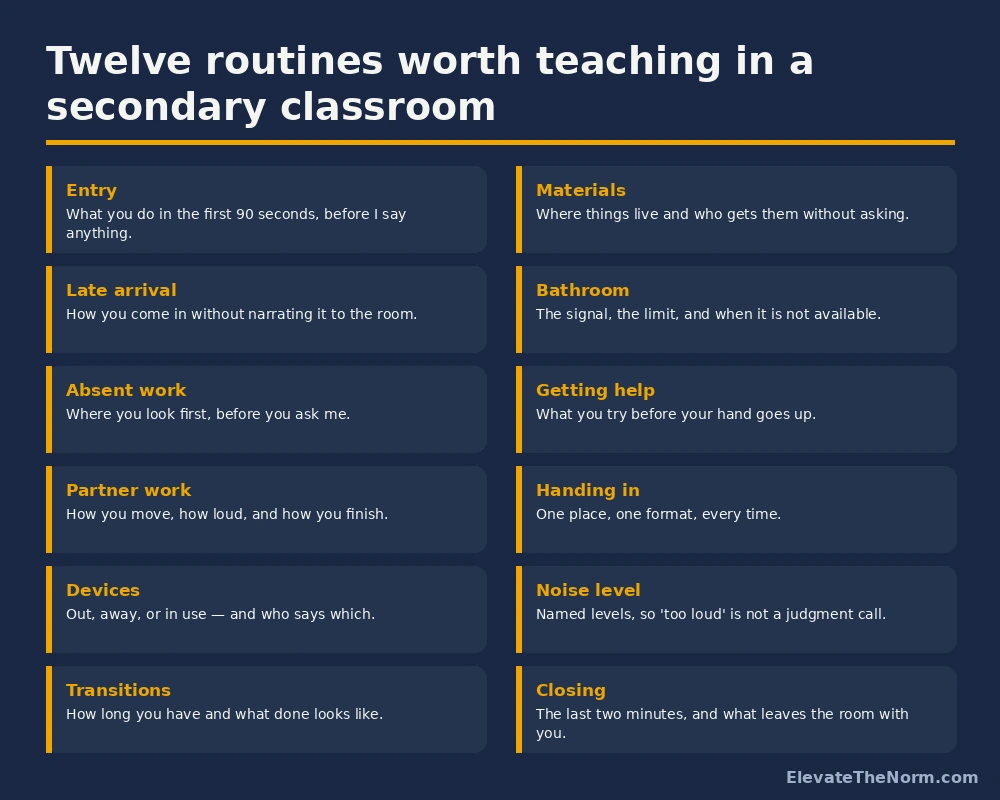
Twelve Classroom Routines Worth Teaching
Twelve is not a target to hit. It is roughly what a secondary room actually needs, and going much past it means nobody remembers any of them, including you.
Twelve is not a target. It is the list most secondary rooms actually need.
The Indiana classroom management primer for middle and secondary teachers, written by Mary Ellen Adams and Pamela Ray, names a similar core: arriving, submitting work, group work, restroom, getting supplies, and getting help from the teacher. Their instruction is to put routines in writing and teach them, at the start of each term, with periodic review.
Three on the list above are worth singling out because secondary teachers most often leave them implicit.
Getting help. “What do you try before your hand goes up?” If you have never answered that out loud, half your class is waiting for you and the other half has given up. Name two or three moves — check the board, ask your partner, look at the example — and the queue at your desk halves.
Late arrival. A student who is late is already having a worse day than you are. A taught routine — come in, sit down, catch up from the board, see me at the end if it matters — removes the performance entirely. What goes on that board matters as much as the routine does: a do-now built on retrieving last week’s material settles a room as well as a word search and does something on the way. Without one, every late arrival becomes a small public event. When lateness becomes a pattern rather than a one-off, the routine needs a tardy response that escalates by pattern rather than by mood standing behind it.
Noise level. “Too loud” is a judgment you are making that students cannot predict. Named levels — silent, partner voice, group voice — turn an argument into a correction that takes one word.
The routine that pays back fastest is not on that list as a single item, because it runs through several of them. The handful of moves between activities — into the room, into group work, back out of it, and out of the door — are where the measured time actually goes, and they are worth scripting before anything else here. If you want the signal itself to carry the timing rather than your voice, a transition track students can hear is the cheapest version of that. None of it starts, though, until the room actually stops, and getting a secondary class quiet without raising your voice is worth sorting out before you script anything else.
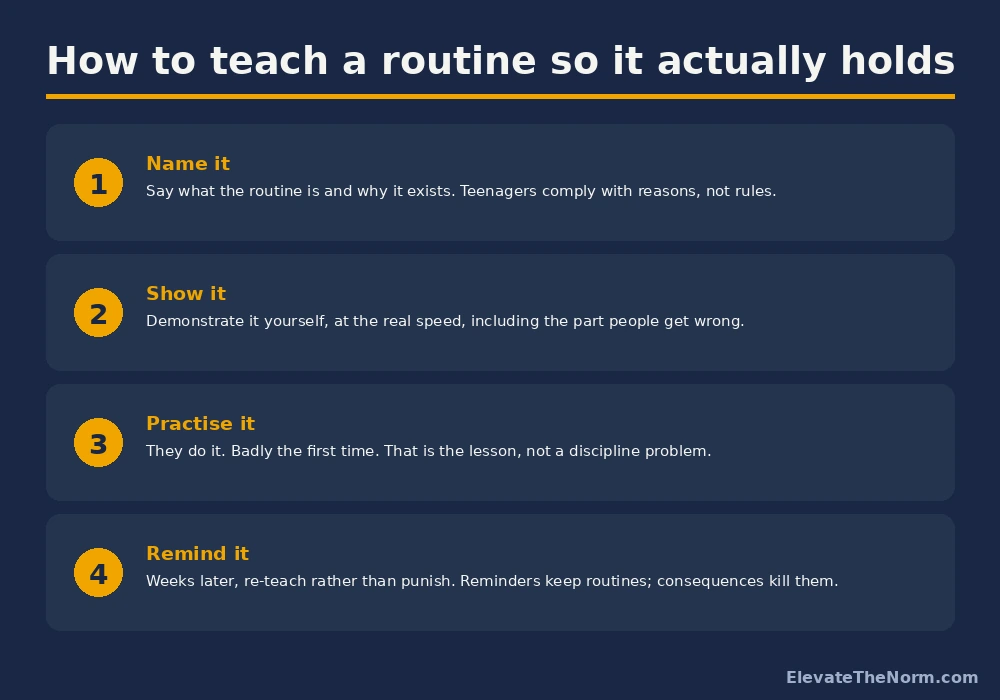
How to Teach a Routine So It Actually Holds
Four moves, in order. It takes about six or seven minutes per routine the first time and almost nothing afterwards.
Naming a routine is not teaching it. Practice is the part people skip.
Name it, with the reason. Teenagers comply with reasons far more reliably than with rules. “We hand in to one tray so that nobody’s work goes missing and I am not carrying six piles” takes four seconds and buys you the rest of the year.
Show it. Do it yourself, at real speed, including the bit people get wrong. Demonstrating the failure mode is more useful than demonstrating the ideal.
Practise it. They do it. It will be bad the first time — that is the lesson working, not a behaviour problem. This is the step that separates a room where routines hold from a room where they were announced once in August.
Remind it. Six weeks later it will have decayed. Re-teach it to the whole class rather than correcting individuals, because individual correction turns a decayed routine into a story about particular students.
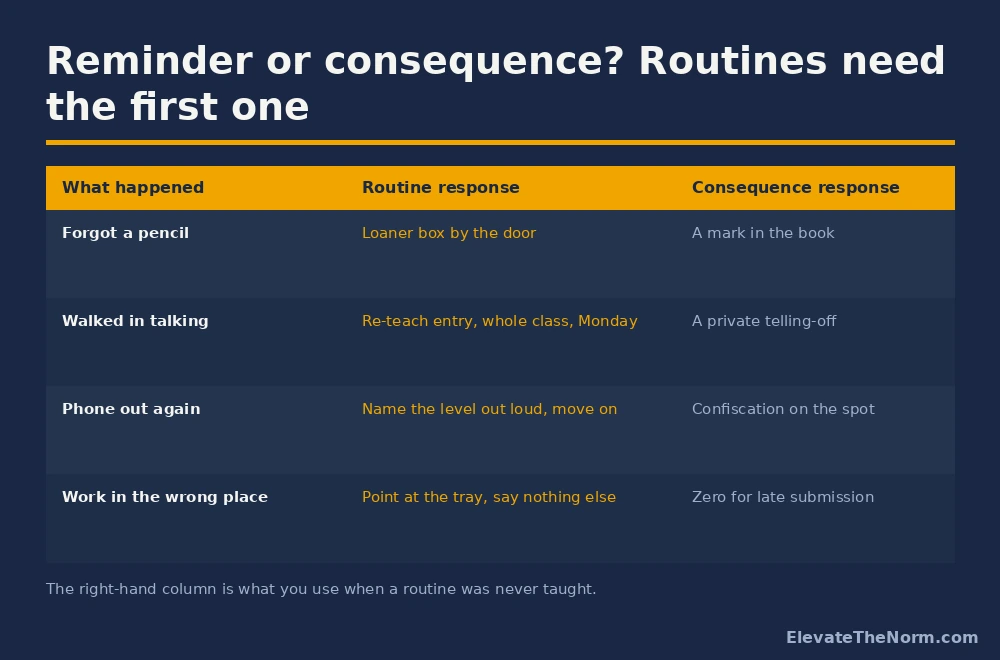
Reminders Hold Routines. Consequences Do Something Else.
This is the single most useful distinction in the article, and the Indiana primer states it directly: routines are enforced through reminders rather than consequences. Their example is the pencil — keep loaners rather than punishing the student who forgot one.
Routines are held with reminders. Consequences are for something else.
The reason is practical rather than soft. A consequence attached to a routine failure teaches students that the routine is a trap, and their attention moves from doing the thing to avoiding the penalty. A reminder keeps the routine a piece of housekeeping, which is what it is.
Consequences are still real and still necessary — for choices, for harm, for repeated refusal after the routine has genuinely been taught. That is a different system, and it is worth keeping the two apart deliberately. Consequences that teach rather than humiliate are a separate piece of work from a room that runs smoothly.
The test: if your response to a routine failure would feel strange applied to the whole class at once, it is a consequence and it does not belong here.
The Routine That Does the Most Work in My Room
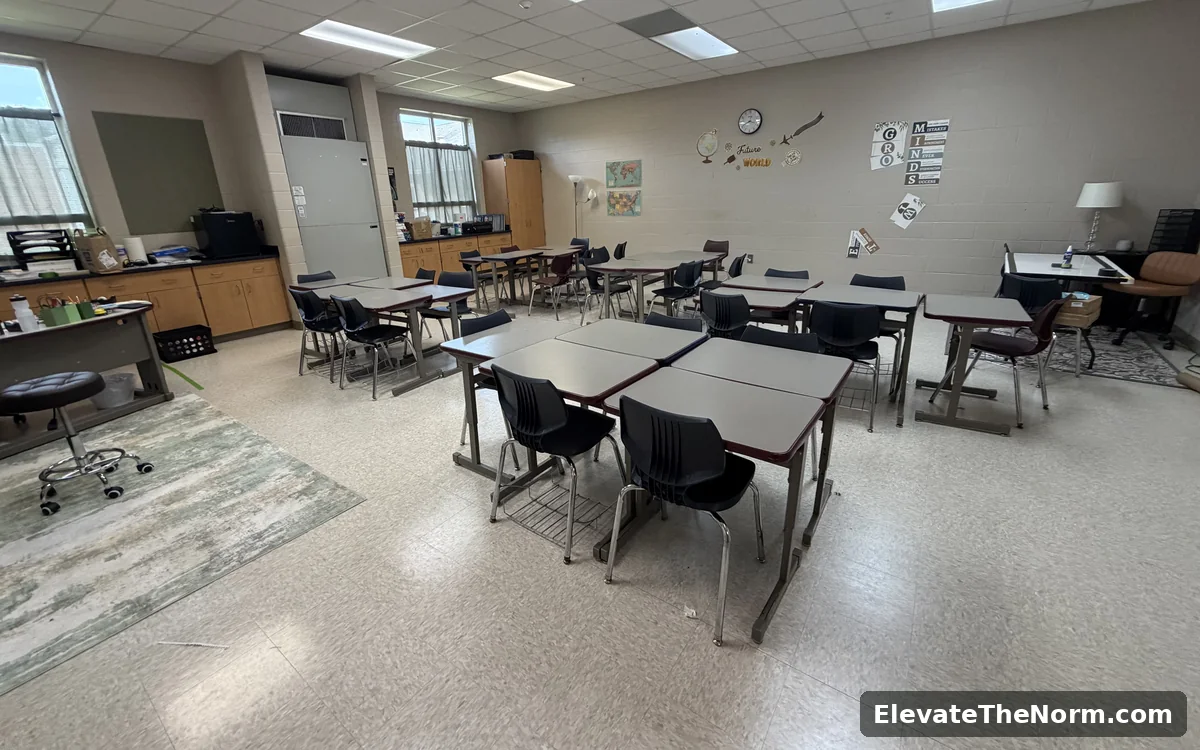
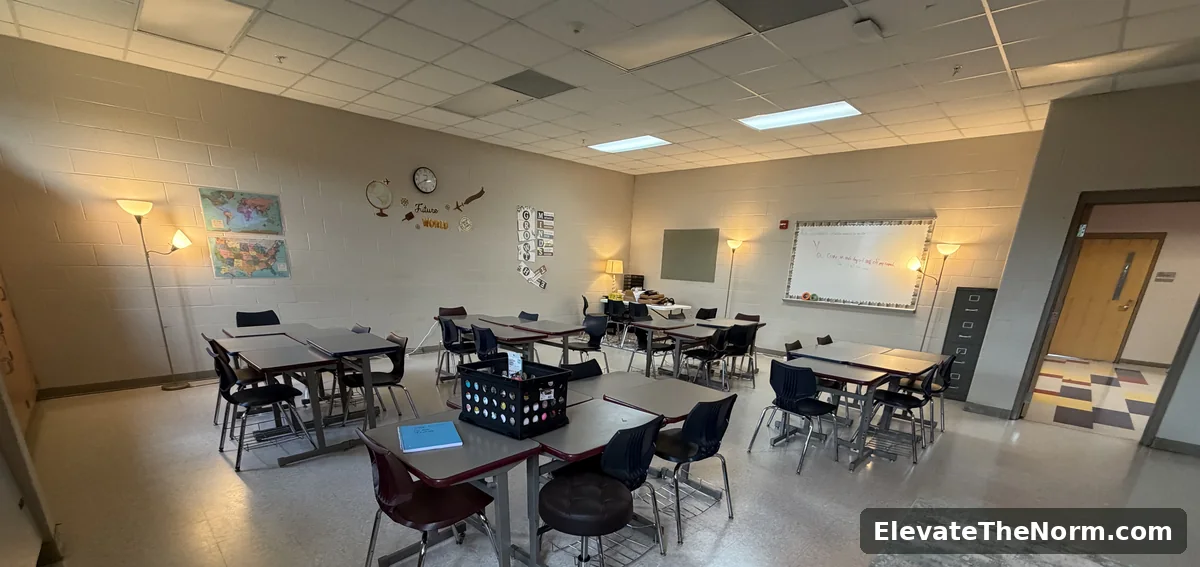
Working next to somebody is the resting state of my classroom, not a reward I hand out on a Friday. The tables are pushed together in pairs and fours and they stay that way, which means partner work needs no setup, no announcement and no transition.
That is a routine decision disguised as a furniture decision. When collaboration is the default, the only thing that ever needs announcing is silence — and silence is easy to ask for and easy to get. When rows are the default, every piece of partner work costs you ninety seconds of scraping chairs, and you start quietly avoiding it.
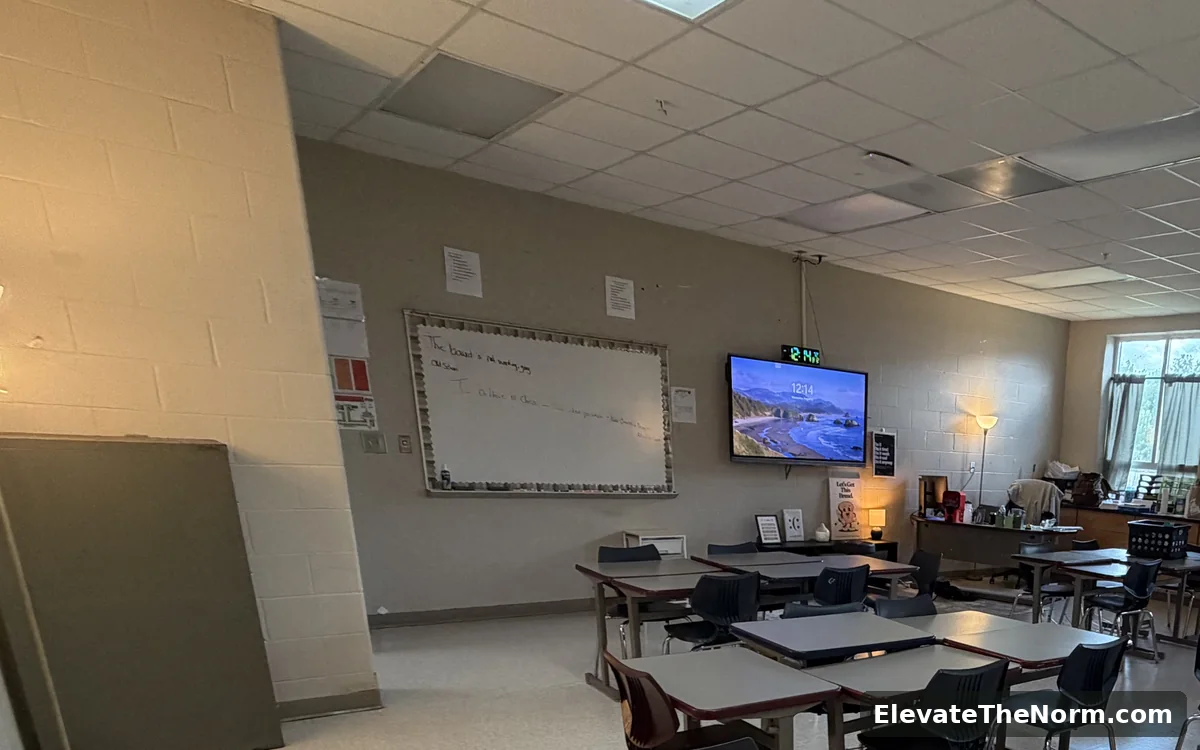
The other half of it is telling them the plan for the day down to the minute, on the board, before anything starts. Those times are a budget and a promise rather than a script — when I miss them I say so out loud and give the reason, which is the part that keeps it honest. A room that knows what is coming and roughly how long it has does not need most of the routines on that list of twelve enforced at all. They just happen.
When to Establish Classroom Routines
The first week, obviously. Less obviously: the first week of every term, and the week after any long break.
Adams and Ray put it as teaching routines at the start of each term with periodic review throughout, and that is the right cadence. Routines decay — not because students are testing you, but because six weeks is long enough to forget which of six teachers wanted which thing.
Three moments worth putting in your calendar now:
Week one of the year. Teach four or five routines properly rather than twelve badly. Entry, materials, getting help, handing in. The rest can wait.
Week one of each new term. Re-teach, do not re-announce. Fifteen minutes, whole class, no reference to anyone’s behaviour.
The day back after a long break. Assume everything has decayed and plan for it, and the day costs you nothing instead of costing you a week.
Announced but never practised. The most common failure by a distance. Saying it once is not teaching it.
Too many at once. Twelve routines in week one is twelve routines nobody retains. Four, properly, beats twelve badly.
Enforced with consequences. Turns housekeeping into a discipline system and makes the room adversarial over pencils.
Never re-taught. Then the November version gets treated as defiance rather than decay.
Inconsistent from the adult. If the tray is the routine, it is the routine on the day you are tired too.
Unexplained. A routine without a reason reads to a teenager as arbitrary, and they are not wrong.
The honest test of whether a routine has taken hold is what happens on a day when you are not there. If the room only runs because you are standing in it, the routine was never the routine — you were. That is why a day with someone else running the room tells you more about your procedures than any week you teach yourself. It is also the argument for leaving sub plans that run without you rather than a worksheet and an apology. The Tuesday after a three-day weekend tests the same routines in a different direction.
What to Do Next
Pick the single routine costing you the most time right now — for most secondary teachers it is entry or getting help — and teach it properly this week. Name it with the reason, demonstrate it including the failure mode, have the class practise it, and put a reminder in your calendar for six weeks out. If the routine you need is the one that governs reading on a screen rather than on paper, the twenty-minute digital reading routine is already scripted minute by minute and can be taught the same four ways.
One routine, taught properly, will buy back more minutes than a list of twelve announced on the first day and never mentioned again. Then do the next one next month. This is slow work, and it is the kind that compounds.
Routines are one section of something larger. If you have never written that larger thing down, the eight sections a written plan actually needs shows where routines sit relative to expectations and consequences.
Printables for this
Two of mine on TPT, both built for this. The First 10 Days procedures checklist is free and sequences which routines to teach on which day. Daily Reset Bell Ringers is the entry routine itself: 180 prompts so the first five minutes run the same way every day, which is the routine that stops the others from decaying.
If you are stocking up during a sitewide sale, the TPT sale guide explains how the discounts stack and what is worth the money.
Frequently Asked Questions
What is the difference between a classroom routine and a classroom rule?
A rule says what is not allowed. A routine says how something gets done. “No phones out” is a rule; “phones go face down in the top corner of the table unless I say otherwise” is a routine. Rules need enforcement, routines need teaching and reminders. Most secondary rooms have plenty of rules and not enough routines, which is why so much time goes on logistics.
How many routines should I actually teach?
Four or five properly in the first week, building to around a dozen over the term. Twelve announced on day one is twelve nobody remembers. Start with the ones costing you the most time — usually entry, materials, getting help, and handing work in — and add the rest as they become necessary.
Isn’t this a bit young for high school students?
The content is not young; the assumption that teenagers already know your procedures is just untested. A student moving through six rooms a day is running six different systems, none of which they chose. Teaching yours explicitly is not treating them like children — it is removing a guessing game. What would be condescending is the tone, not the practice, so teach them the way you would teach anything else to an adult: name it, give the reason, move on.
What do I do when a routine stops working in November?
Re-teach it to the whole class, without reference to anyone in particular. Routines decay on a predictable schedule and November is right on it. Treating decay as defiance is the most common way a functioning routine turns into a behaviour problem. Fifteen minutes of whole-class re-teaching costs less than a term of individual corrections.
Should students help decide the routines?
For some of them, yes, and it works better in secondary than people expect. Noise levels, how partner work ends, and what counts as a reasonable bathroom signal are all genuinely negotiable and students will hold a standard they helped set. Safety procedures, anything your school mandates, and anything involving how work is recorded are not negotiable, and pretending otherwise creates a problem later.
How do routines work if I share a room or teach on a cart?
Focus on the routines that live in people rather than furniture — entry, getting help, handing in, noise levels, closing. Anything depending on a fixed physical setup will not survive a shared room, so do not build your system on it. Write your core routines on something portable and post it in the same place every period; the consistency of the location matters more than the location itself.
Do routines actually improve learning, or just behaviour?
Honestly, the direct evidence is about behaviour and time on task rather than achievement. The reviews that support structure and explicitly taught expectations measure disruption, on-task behaviour and engagement. The learning argument is an inference: time not spent on logistics is time available for instruction. That inference is reasonable, and it is not the same thing as a study showing routines raise test scores.
Routines are also what a stranger inherits. A procedure that is obvious to your students is invisible to someone covering the class, which is why running a room that isn’t yours depends so much on what the regular teacher wrote down.
Sources
Simonsen, B., Fairbanks, S., Briesch, A., Myers, D., & Sugai, G. (2008). Evidence-based practices in classroom management: Considerations for research to practice. Education and Treatment of Children, 31(3), 351–380. Full text (PDF) — the source for the five critical features, and for the authors’ own caution that about half the reviewed studies are twenty or more years old.
Parsonson, B. S. (2012). Evidence-based classroom behaviour management strategies. Kairaranga, 13(1), 16–23. Full text (PDF) — the source for predictable routines as an antecedent strategy and for the greeting figures, which Parsonson reports from other studies rather than testing directly.
Adams, M. E., & Ray, P. (2016). A classroom management primer for middle and secondary school teachers. Indiana Commission for Higher Education. Read the primer (PDF) — the source for teaching routines at the start of each term and for enforcing them through reminders rather than consequences.
Every link above was checked on September 12, 2026. Where a figure is reported by a review rather than measured in it, the text says so.
About Clay Shumate
By Clay Shumate — Clay Shumate is a certified secondary Social Studies teacher in the public schools of West Alabama, with seven years of classroom experience, a B.A. in History, and an M.Ed. in Secondary Education. He writes about project-based learning, student responsibility, respect, and practical ways to hold young people to a higher standard while giving them room to learn from mistakes. He is a member of the Society of Professional Journalists and writes to its Code of Ethics; this site’s editorial standards and corrections policy are published in full.
Student-led conferences are meetings where the student — not the teacher — presents their own work to their family, explains what it shows, names what went wrong, and says what they plan to do next. The adults are there to listen and respond. For grades 6–12 the format works because it moves the accounting onto the person who actually did the work.
The usual conference has a structural problem nobody names: the student is the only person in the building with first-hand knowledge of what happened, and they are the one person not in the room. Two adults discuss a third party who is somewhere else, and then somebody reports back a summary.
Student-led conferences fix that. They are also more work than they look, they fail in specific and predictable ways, and the evidence behind them is thinner than the enthusiasm around them. All of that is below.
Key Takeaways
The student runs the meeting. Not a presentation about the student — a presentation by the student, from evidence they selected.
Attendance is the most reliable gain. One middle school went from 85 traditional conferences to 565 student-led ones in a single year.
The preparation is the curriculum. Four weeks of collecting, choosing, writing and rehearsing is where the learning happens. The 25 minutes is just the assessment.
Be honest about the evidence. Most of what is published is descriptive, from elementary and middle grades, and the strongest recent study explicitly did not measure achievement.
Plan for the families who do not come. A format that only works for students with an adult in the chair will quietly punish the students who need it most.
This is a writing and speaking unit. Treat it as one, mark it as one, and the workload argument mostly disappears.
What Are Student-Led Conferences?
A student-led conference is a scheduled meeting, usually 20–25 minutes, in which a student walks their family through a portfolio of their own work using a script they wrote. The teacher is in the room — often supervising several conferences at once — and speaks when asked or when something needs correcting. The student does the rest.
The biggest change is not the format. It is who has done the thinking beforehand.
Faulkner and Cook, writing for the Association for Middle Level Education, put the shift in one line from a teacher who had made the change: “It’s not me telling the parents that Johnny is failing because he won’t turn in his work.” The student says it. That sentence lands differently when it comes out of the student’s own mouth, in front of the person whose opinion they care most about.
What it is not: a showcase. If students only present their best work, you have built an awards ceremony. The format earns its keep when the folder includes the assignment that did not get done, and the student has to say why.
Why Student-Led Conferences Work — and What the Evidence Actually Shows
Start with the claim that holds up best, because it is the one with numbers attached: families turn up.
Faulkner and Cook report a school that went from 85 traditional conferences to 565 student-led conferences in the first year of the change. A research brief from The Principals’ Partnership describes Mead High School’s first round of student-led conferences, where over 98 percent of parents, 84 percent of students and 100 percent of advisors said the conferences were worthwhile.
That is a real effect and it is not trivial. A conference nobody attends teaches nobody anything — and attendance is usually downstream of whether families have heard from you before the conference, which is its own problem of short, specific, weekly contact.
Where the evidence thins out
Now the honest part. The same Principals’ Partnership brief says plainly that most of what is written about student-led conferences describes elementary or middle-level implementation, and it is a 2005 document summarising practice rather than a controlled study.
The most substantial recent study is Şişman and Bahadır’s, covering 249 students, 280 parents and 22 teachers across fourth grade through high school in a single private school. It found positive effects on responsibility, self-management, self-expression, communication and leadership — and the authors themselves note that future research should look at the effects on student achievement, which is a polite way of saying this one did not. One private school also limits how far the result travels.
So the defensible version is this. Student-led conferences reliably increase family participation, and the people who do them report gains in student ownership and communication. Whether they raise achievement is genuinely unstudied. Anyone telling you otherwise is selling something.
That is still a good enough reason to run them. Getting a fourteen-year-old to account for their own work in front of their family is worth doing whether or not it moves a test score, and it fits the same logic as raising the standard without removing grace.
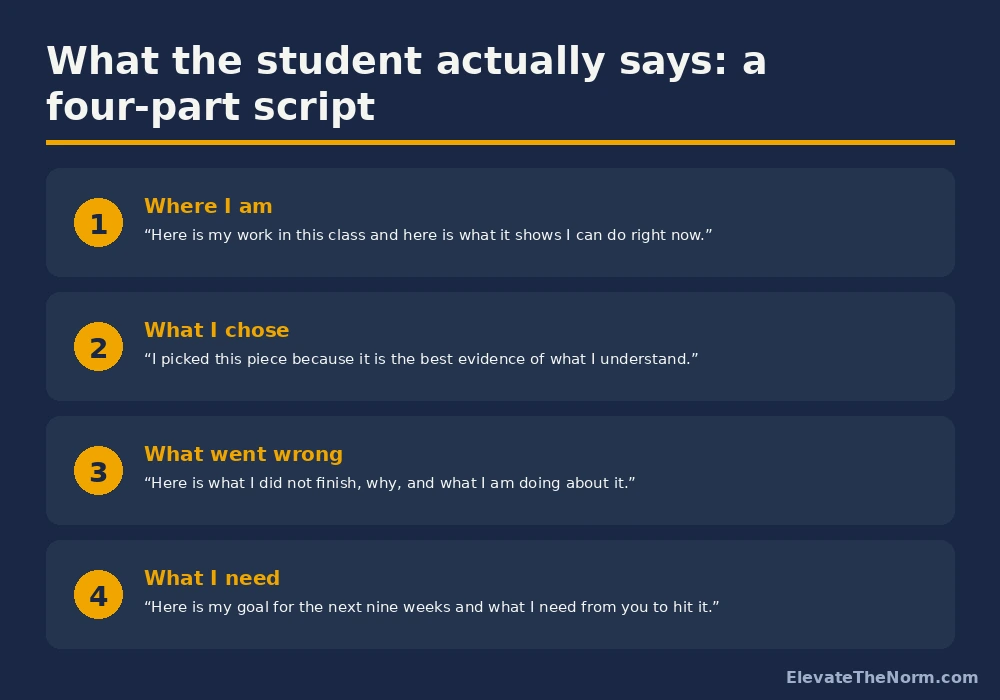
What the Student Actually Says
Give every student the same four-part spine. Without it, most of them freeze in the first minute and the parent starts asking you questions instead — and the conference quietly reverts to the old format while everyone pretends otherwise.
The script is the scaffold. Without it, most students freeze in the first minute.
The four parts, in order: where I am, what I chose and why, what went wrong, and what I need. Each one is a short paragraph the student drafts, revises and rehearses.
If your school runs traditional conferences and a full student-led format is not on the table this year, the same thinking fits on one page: a student self assessment brought into a parent teacher conference gets the student’s judgment into the room without changing who runs the meeting.
The third part is the one that matters and the one schools soften. “What went wrong” is where a student says out loud that they did not turn in three assignments in October, and then says what they are doing about it. Peter Neeves, writing in Edutopia, describes handling missing work not with punishment but with a written reflection and an assistance plan that names the underlying issue — organisation, attendance, whatever it actually is. That is the right instinct. The student still has to say it.
The fourth part keeps the meeting from ending in vague agreement. “What I need” forces a specific, checkable ask: a weekly check-in, a quieter place to work at home, a reminder on Sunday nights. Families leave with a job, which is what most of them wanted in the first place. The four parts above are one structure; there are sixteen other ways to run the meeting depending on whether your constraint is the calendar, the subject, or the families who cannot get to the building.
Who Is Doing What While the Student Talks
Everyone in the room needs a job, or the adults will invent one. The job they invent is usually talking.
The student runs the meeting and owns the account of their own term. The family member listens first and asks questions second — hand them a printed card with three prompts on the way in, or the default question becomes some version of “so are you behaving?” The three that work: what surprised you about your own work, what would you do differently, and what is one thing I could do at home that would actually help.
The teacher stays out of it unless invited, then adds one piece of context the student could not supply — nine times out of ten something the student undersold. Counsellors and administrators moving between conferences should be listening for patterns across students rather than evaluating individual ones. An instructional coach watching a colleague’s first round has one genuinely useful measurement to take: how much of the twenty-five minutes the teacher spent talking. Above a fifth of it and the thing that needs tightening is the script, not the teacher.
A Four-Week Run-Up That Fits an Ordinary Term
The preparation is the part that gets skipped and the part that decides whether this works. Four weeks, one thing per week, all of it inside lessons you were teaching anyway.
Four weeks, and the writing week is the one that does the work.
Collect. Every student starts a folder. Every graded piece goes in, good or bad, dated. No curation yet — curation is next week’s skill and doing it now defeats the point.
Choose. Two pieces of evidence per class, plus one sentence each on why that piece was chosen. Neeves describes teachers offering three eligible samples and letting the student pick one; that constraint helps students who would otherwise pick at random.
Write. Students draft the script. This is a writing lesson — audience, purpose, evidence, concision — so teach it and mark it as one. It is also the week you find out who has been quietly hiding.
Rehearse. Twice, on a partner. The first run is a disaster for almost everyone. The second is the one that works, which is the entire argument for rehearsing.
Neeves puts the whole cycle at roughly one month with benchmark dates published to staff, which matches what the four weeks above ask for. Faulkner and Cook are blunt that the first run is labour-intensive for faculty. Both are true. The second year costs a fraction of the first.
Build one adaptation in from the start rather than improvising it later: for a student who genuinely dreads speaking in front of people, let them write the conference as a letter to their family and read it aloud. The structure still does its work — evidence, an honest account of what went wrong, a stated next step — and it is a far better outcome than a student who freezes and a parent who ends up looking at you instead. Decide that in the writing week, not on the night.
If you want the forms rather than the argument, the free student-led conference toolkit has the portfolio cover sheet, the script frame and the reflection prompts, with no email required.
Watching a Student Defend Their Own Decisions
The closest thing I run to this on an ordinary week is a project check-in where the student has to defend the choices they made — not report what they did, but explain why they did it that way and why the alternative was worse.
It changes what students pay attention to. When you know you will have to justify a decision out loud to somebody who will ask a follow-up question, you make the decision differently in the first place. The check-in is not really an assessment of the work. It is the thing that makes the work get thought about.
A student-led conference is that same move, scaled up and pointed at a harder audience. A teenager explaining a rubric decision to me is practising. A teenager explaining a term’s worth of work to their own family is doing the real version, and they know the difference.
Which is also why the preparation cannot be skipped. Handing a student that audience with no script is not raising the standard — it is setting them up, and the students most likely to be embarrassed by it are the ones already having the worst term.
The Families Who Do Not Come
Plan for this before you launch, not on the night. Faulkner and Cook name it directly: not all parents attend, and schools need a contingency. If your entire format depends on an adult sitting in that chair, then the students whose families work nights, lack transport, or simply will not come get a worse version of school than everyone else — and those are frequently the students the format was supposed to help.
Workable contingencies, roughly in order of preference:
All of these depend on being able to reach the family at all, which is worth checking before conference week rather than during it — a running log of family contact will show you quickly which families you have not actually reached. If you are still deciding what to keep that log in, choosing a parent-teacher communication app is more a question of approval and student data than of features. For the families who do come, sending home the questions that are worth asking at a conference a few days early gives them something to do in the room besides listen.
A different adult from the building. A coach, a counsellor, a teacher from another department. Arrange it quietly in advance so the student is not visibly the one nobody came for.
A phone or video slot on another day. Costs nothing and solves the shift-work problem for a lot of families.
A recorded conference. The student delivers the script to camera and it goes home. Weaker, because the follow-up questions are the valuable part, but far better than nothing.
Never: skip the student. If a student prepared for four weeks, they present. The audience can change; the presentation happens.
Schedule the alternatives at the same time you schedule the main round. A contingency invented at 6pm on conference night is not a contingency, it is an apology.
Where Student-Led Conferences Go Wrong
Skipping rehearsal. The single most common failure. An unrehearsed student reads the script at the table in a monotone and everyone concludes the format does not work.
Turning it into a showcase. Best-work-only conferences are pleasant and teach nothing. The missing assignment belongs in the folder.
The teacher taking over. Usually well meant, usually triggered by a silence the teacher finds uncomfortable and the student does not. Let the pause sit.
Running it once. The first round is the expensive one. Schools that quit after year one pay the full cost and collect none of the return.
No plan for absent families. Covered above, and it is the failure with the worst distribution of harm.
Treating it as an add-on. If the preparation is not inside your teaching time, it will not survive contact with an ordinary term.
The Follow-Up Almost Nobody Runs
Six weeks after the conference, pull the students’ stated next steps back out and spend one lesson having them write a short progress note against their own commitment. Not a grade, not another form for the family — just the student, in writing, on whether they did the thing they said they would do in front of their mother.
That one lesson is most of the difference between a format and an event. The commitment was public, it was theirs, and now it has a check-in attached to it. Skip it and the conference becomes a very well-organised twenty-five minutes that nothing follows.
What to Do Next
Do not start with the whole school. Start with one section, one term, and the four-week run-up — the student-led conference template carries the readiness checklist, the portfolio planner and the script that run-up needs, free and with no email required. Tell families in writing what will be different and why, so nobody arrives expecting the usual five minutes with you. Build the alternate-audience list before you need it.
Then judge it on the thing you can actually see: whether students can account for their own work in front of somebody who matters to them. That is the skill the format teaches, it is measurable in the room, and it is worth having whether or not anyone ever proves it moves a grade. It also sits naturally alongside expecting a lot and backing it with support rather than pressure. It also pairs naturally with assigning students genuine leadership roles inside the classroom — the conference is the most visible of them, because the audience is the student’s own family.
Printables for this
Start with the free one on this site. The full conference template pack has the readiness checklist, the evidence and portfolio planner, the student script and the family follow-up agreement — a printable PDF plus an editable Word version, no email required. Two of mine on TPT go further. Parent Teacher Conference Forms has the prep sheet, the conversation script and the follow-up record for the conferences you still run the usual way. The Parent Contact Log is free and solves the problem in the contingency section above — knowing before conference week which families you can actually reach.
Frequently Asked Questions
How long should a student-led conference be?
Twenty to twenty-five minutes is the standard, and it is about right for grades 6–12. Shorter than fifteen and students rush the part where they explain what went wrong, which is the part worth having. Longer than thirty and families with several children cannot make the schedule work. If you are running several conferences at once in one room, build in five minutes of slack between slots.
What if the student is failing? Is this not humiliating?
It is the opposite, if you prepare it properly. The humiliating version is the one where two adults discuss a student’s failure while the student waits outside. In a student-led conference the student names the problem themselves, in their own words, with a plan attached. What makes it cruel is skipping the preparation — handing a struggling student that audience with no script and no rehearsal. Do the four weeks and this becomes the most useful conversation a failing student has all year.
Do student-led conferences replace traditional parent-teacher conferences?
Not necessarily, and the research summaries treat the model as a supplement rather than a straight replacement. Some parents genuinely want a private conversation with the teacher, and there are situations — a safeguarding concern, a possible referral, a dispute — that should never be run through a student. A common arrangement is student-led as the default with a signup option for a separate adults-only conversation.
How much extra work is this for teachers?
The first round is genuinely heavy; the sources describing it say so plainly. After that it drops sharply because the portfolio structure, the script frame and the schedule already exist. The way to keep it sustainable is to stop treating the preparation as extra. Collecting, selecting evidence, writing to an audience and rehearsing a spoken presentation are all things you were supposed to be teaching anyway. Run them as the unit they are and mark them.
What does the teacher actually do during the conference?
Supervise, and stay out of it. You are usually overseeing several conferences in one room, which is part of why this scales. Answer direct questions, correct anything factually wrong, and otherwise let silences happen. The most common teacher error is filling a pause that the student was about to fill themselves.
At what grade can students start leading their own conferences?
Middle school is where most of the published practice sits, and sixth or seventh grade is a reasonable starting point with a tighter script and a shorter portfolio. High school students can carry a much longer conference and a far more honest one. The evidence base skews younger — a lot of what is written describes elementary and middle-level implementation — so treat high school adaptations as your own professional judgment rather than something the literature has settled.
How do we handle a family that speaks a language other than English?
Arrange interpretation the same way your school does for any other family meeting, and arrange it in advance rather than on the night. Do not use the student as the interpreter for their own conference — it collapses the whole point, because the student ends up translating a conversation about themselves instead of leading one. If a sibling or relative normally interprets, confirm that the family actually wants that here.
Sources
Faulkner, S. A., & Cook, C. M. (2009, October). Student-led conferences: Involving the most important player. Middle Ground, Association for Middle Level Education. Read the article
The Principals’ Partnership (2005, January 31). Research brief: Student-led conferences. Sponsored by the Union Pacific Foundation. Read the brief (PDF) — the source for the Mead High School figures, and for the caution that most published material describes elementary and middle-level implementation.
Şişman, C., & Bahadır, E. The effects of student led conferences on the improvement of 21st century career and life skills. International Journal of Learning, Teaching and Educational Research. Journal record — 249 students, 280 parents and 22 teachers in one private school; the authors state that effects on achievement were not measured.
Neeves, P. (2025, December 3). How to successfully institute student-led conferences at your school. Edutopia. Read the article
ERIC Digest (1997, May). Student-led conferences at the middle level. ED407171. ERIC record
Every link above was checked on September 12, 2026. Where a figure comes from a practitioner report rather than a controlled study, the text says so.
About Clay Shumate
By Clay Shumate — Clay Shumate is a certified secondary Social Studies teacher in the public schools of West Alabama, with seven years of classroom experience, a B.A. in History, and an M.Ed. in Secondary Education. He writes about project-based learning, student responsibility, respect, and practical ways to hold young people to a higher standard while giving them room to learn from mistakes. He is a member of the Society of Professional Journalists and writes to its Code of Ethics; this site’s editorial standards and corrections policy are published in full.
A classroom seating chart is a deliberate plan for where every student sits and why — built around sightlines, access, documented needs, and the kind of work the room is doing that week. For grades 6–12 it is not a discipline tool and it is not decoration. It is the quietest piece of classroom management you own, and most of the research behind it was done on ten-year-olds.
That last part matters more than anything else in this article, so it goes near the top rather than buried in a caveat at the bottom. There is a real evidence base on classroom seating. It is genuinely useful. It is also overwhelmingly elementary, and the people quoting it at you usually do not say so.
What follows is what the research actually supports, where it stops, and how to build a chart for teenagers anyway.
Key Takeaways
Assigned beats self-selected, and it is not close. The cleanest study on this found disruptions roughly doubled in groups and more than tripled in rows when students picked their own seats — though the sample was fifth graders.
There is no best layout. Rows win for independent work. Semicircles get more questions asked. Groups support collaboration and hide free riders. Match the layout to the task, not to a philosophy.
The evidence thins out badly above age 11. The main review of this literature says so outright: one study looked at teenagers, and none went past age 15.
Documented needs are not one factor among many. If seating is written into an IEP or 504 plan, that goes on the chart before anything else does.
Change the whole room, not one student. A chart that moves for everybody is housekeeping. A chart that moves for one kid is a public verdict on that kid.
Some of the best seating in a room is not on the chart at all — and that is worth designing on purpose.
What a Classroom Seating Chart Is Actually For
A seating chart does four jobs. It puts every student where they can see and hear. It lets you reach anyone in the room quickly. It sets who talks to whom. And it removes a daily negotiation that costs you three minutes at the start of every period.
Notice what is not on that list: punishment. The moment a seating chart becomes the thing you rearrange when a student annoys you, it stops being a plan and becomes a consequence — an unpredictable, public one, applied at your discretion. That is the opposite of what a fair consequence looks like, and teenagers read it accurately and immediately.
It is also not a personality test. You will hear that certain students “are back-row kids.” They are not. They are students who were allowed to sit in the back row and found out nobody came to get them.
What the Research Actually Says — and Where It Stops
The standard reference here is Wannarka and Ruhl’s review in Support for Learning, which pulled together eight studies comparing rows, groups and semicircles. Their conclusion is refreshingly unglamorous: the nature of the academic task and the type of behaviour you want should dictate the seating arrangement. Rows produced more on-task behaviour for individual work and cut talking out of turn. Students asked their teacher significantly more questions in a semicircle than in rows. Grouped seating supported collaborative work. If you want the signs and recording sheets done, my Station Rotation Toolkit on TPT covers eight reusable stations.
Students who started with the lowest on-task behaviour improved most in rows. One special-school study in that review doubled on-task behaviour and cut the disruption rate by two thirds.
Then comes the part that rarely survives the journey into a blog post. The same authors state plainly that most of the studies they reviewed used participants aged seven to eleven, that only one examined teenagers, and that no study extended beyond age fifteen.
So when someone tells you “research shows rows increase on-task behaviour,” the honest completion of that sentence is “…in primary-aged children, mostly during independent seatwork, in studies largely conducted before your students were born.” That does not make it useless. It makes it a starting hypothesis for a fourteen-year-old rather than a finding about one.
The assigned-seating finding, with its actual numbers
The most-cited study on who chooses the seats is Bicard and colleagues in the Journal of Applied Behavior Analysis. Twenty-one fifth graders, a reversal design, four conditions crossing group-versus-rows with teacher-assigned-versus-student-selected. The results:
Condition
Student-selected
Teacher-assigned
Group seating
1.12 disruptions/min
0.47 disruptions/min
Rows
0.55 disruptions/min
0.17 disruptions/min
Roughly double in groups, more than triple in rows. The authors also say, in their own limitations, that the school was private, the group fairly homogeneous and relatively well behaved, and the tasks easy enough that academic effects may have been masked. Twenty-one ten-year-olds in one building is not a law of nature. It is one clean result pointing in an obvious direction.
Take the direction. Leave the certainty.
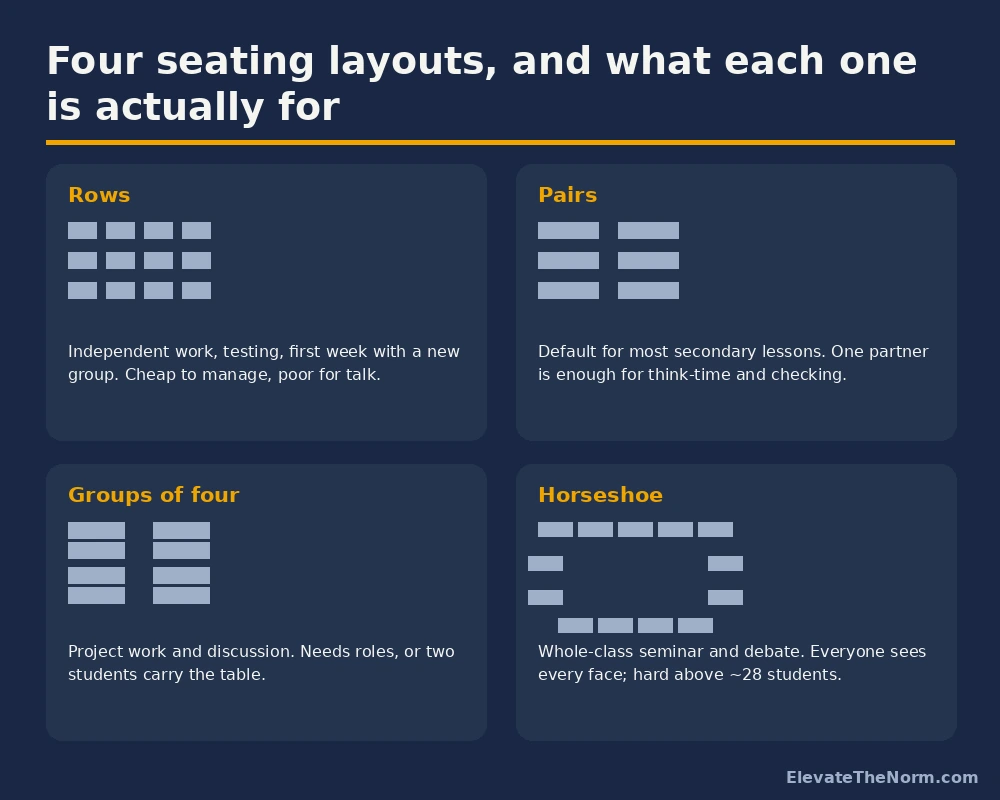
Four Layouts, and What Each One Is Actually For
Pick the layout that matches the work. If the work changes week to week, the layout should too — and saying that out loud to students is part of the job.
Each layout is good at something different. Pick the one that matches the lesson.
Rows. Independent work, testing, and the first week with a group you do not know yet. Cheap to supervise, poor for talk, and the back row disappears if you let it.
Pairs. The workhorse for most secondary lessons. One partner is enough for think-time, for checking an answer before it goes public, and for a student who will ask a neighbour what they will not ask you.
Groups of four. Project work and sustained discussion. Requires defined roles, or two students will carry the table and the other two will learn that this is available to them.
Horseshoe. Seminar, Socratic discussion, debate. Everybody can see every face, which changes the conversation completely. Gets difficult much above twenty-eight students and eats floor space.
Marx, Fuhrer and Hartig found German fourth graders asked more questions in a semicircle than in rows — a result summarised for teachers by Jo Earp alongside Robert Sommer’s older and still-correct point that there is no ideal layout for all activities. The same summary reports Gremmen and colleagues’ survey of fifty Dutch teachers: 48 percent used small groups, 40 percent used rows, and the researchers noted how little attention this gets in teacher training. That last observation is the one worth sitting with. Most of us were never taught this at all.
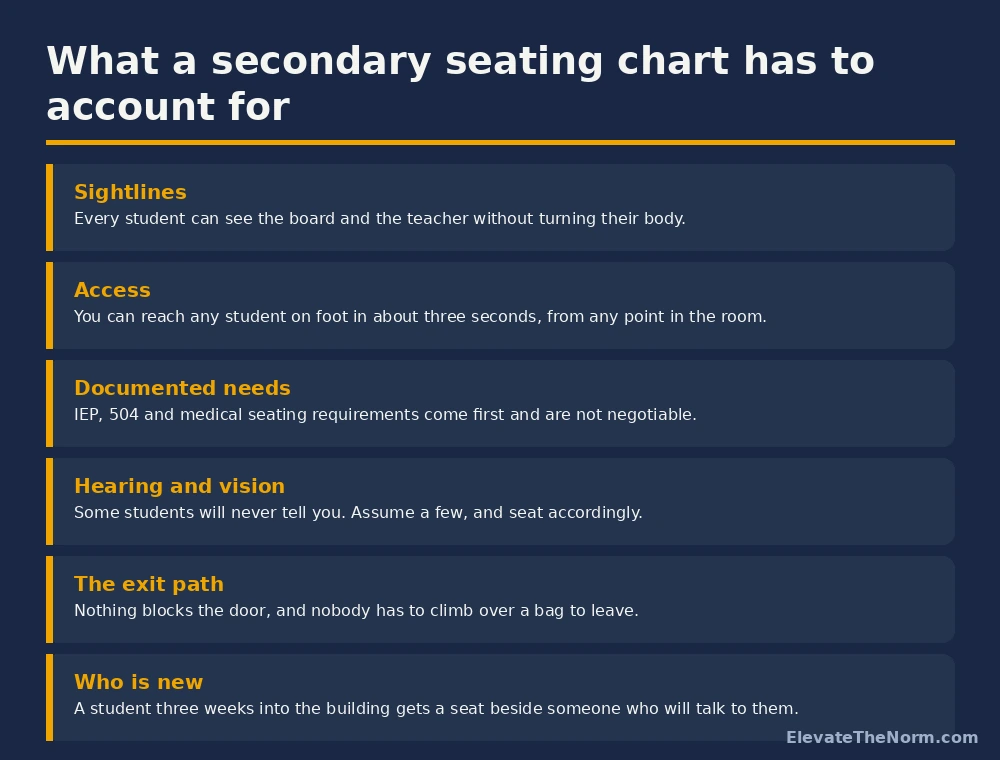
What a Secondary Seating Chart Has to Account For
Before aesthetics, before personality, before who talks to whom, six things constrain the chart. Get these right and the rest is preference.
Documented needs come first. Everything else is a judgment call.
Documented needs come first. If a student has seating written into an IEP or a 504 plan, that is not one input among six — it is already decided, and you build the rest of the chart around it. Read the plans before you draw anything. This is the one item on the list where “I forgot” is not an available answer.
Sightlines. Every student should be able to see the board and the front of the room without twisting their torso. If a student has to turn their whole body to see you, they will stop turning, and you will read that as disengagement.
Access. You should be able to reach any student on foot in about three seconds from any point in the room. Draw your actual walking paths on the chart. Most teachers discover a dead zone they have not stood in since August.
Hearing and vision you do not know about. Some students will never tell you, some have not been screened, and some were screened years ago. Assume a couple in every section and seat accordingly rather than waiting to be informed.
The exit path. Nothing blocks the door and nobody climbs over a backpack to leave. This is a safety item, not a tidiness one.
Who is new. A student three weeks into the building gets a seat beside somebody who will actually talk to them. You know who those students are. Use them on purpose.
The Best Seat in My Room Is Not on the Chart
I built a whiteboard table for small-group work and put it in a corner under a lower lamp, on a rug, with better chairs than the rest of the room has. Students ask to go there.
That was the entire point. The standard worry about a pull-aside table is that it becomes the remediation table — the place everyone can see you get sent to. The fix is not a policy about who sits there and when. The fix is making it the most desirable spot in the room, so that being invited over reads as access rather than as a verdict.
Your seating chart governs the default. It should not govern every seat in the room for every minute. Build somewhere a student can be moved to that carries no sting, and a quiet redirect stops being a public event.
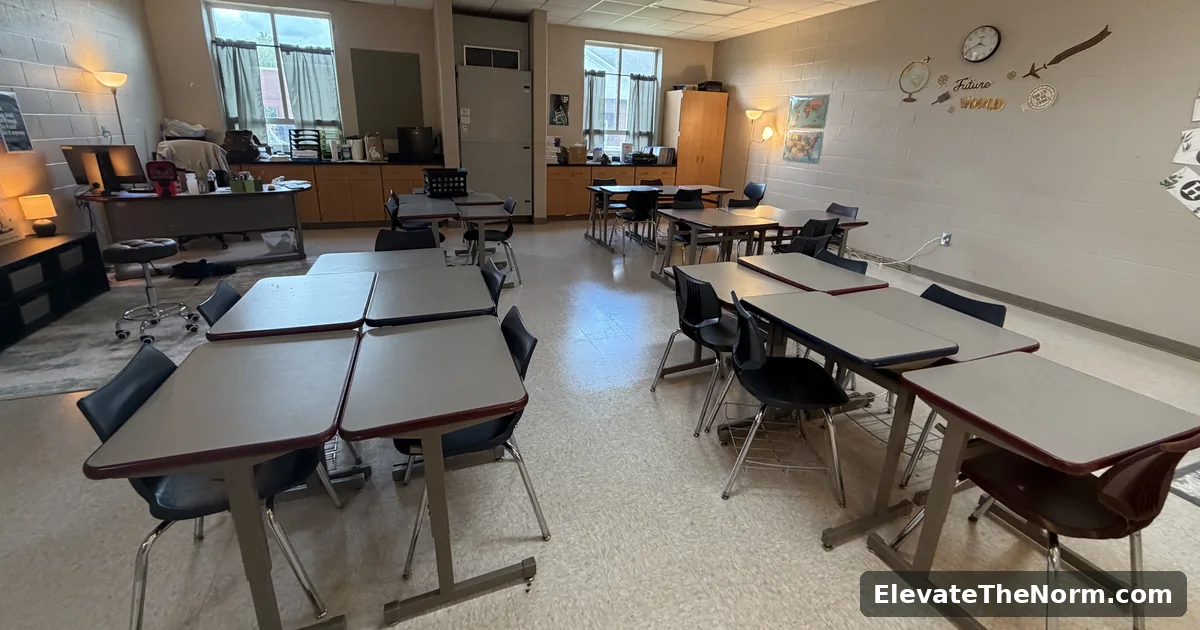
The rest of my room runs on tables pushed together in pairs and fours, which means working next to somebody is the resting state rather than a reward I hand out on Fridays. That is a choice about seating as much as it is a choice about instruction, and it connects directly to what a student-centered classroom looks like in practice.
How to Create a Classroom Seating Chart, Step by Step
Forty minutes once, then five minutes a month. Do it in this order, because each step constrains the next.
Read the plans. Pull every IEP and 504 for the section and note any seating language before you draw a single box.
Draw the room, not a grid. Door, board, windows, your desk, outlets, the cabinet everyone bumps into. The obstacles determine the layout more than the furniture does.
Pick the layout from the unit, not the month. If the next three weeks are project work, start in fours. If they are individual writing, start in pairs or rows and say why.
Place the constrained students first. Documented needs, then hearing and vision, then the newest students.
Place the rest, and keep it boring. Alphabetical inside the constraints is defensible, fast, and impossible to argue with on day one.
Walk it before you publish it. Stand at each seat. Anything you cannot see from there, they cannot see either.
Tell them the rule. “This is the chart for the next three weeks. It changes for everybody, not for one person, and I will tell you before it does.”
Step seven is the one that does the most work and takes the least time. Naming the cycle in advance removes the interpretation that any future change is aimed at somebody. If you want the printable version of the room map and the chart grid, both are on the free download page, in print and typeable form, with no email required.
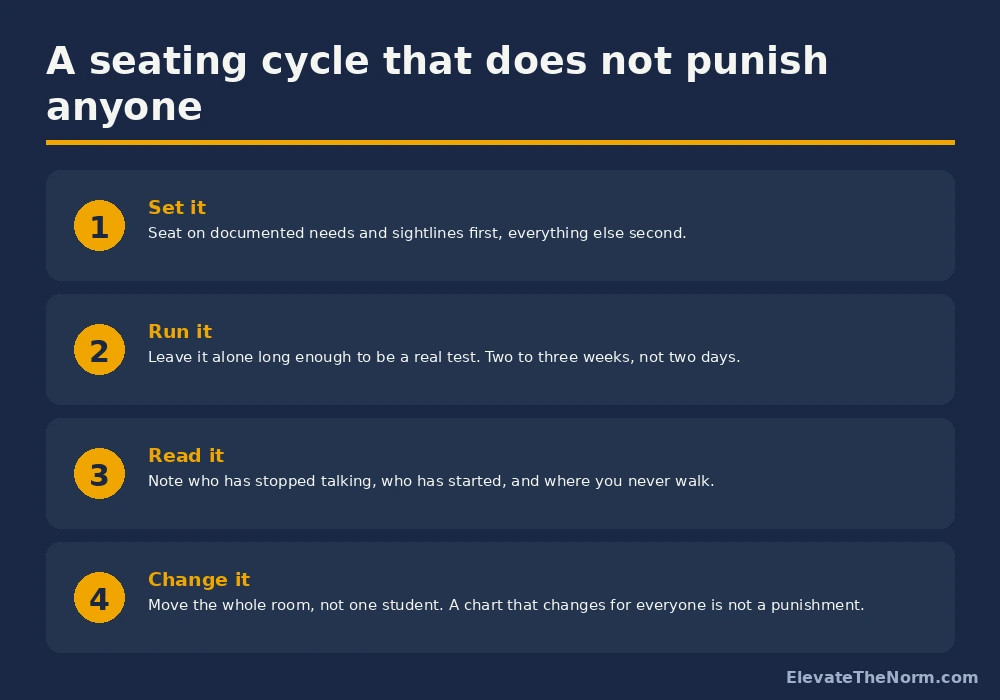
When to Change It, and How to Change It Without Punishing Anyone
Change on a cycle you announced, not on a mood. Two to three weeks is long enough to be a fair test of an arrangement; two days is not.
Move the whole room, not one student.
Between changes, pay attention to three signals. Who has stopped talking who used to talk. Who has started talking who never did. And which square metre of the room you have not walked into in a week — because somebody is sitting there, and you have quietly stopped teaching them.
When you do change it, move everybody. This is the single most useful rule in the article. A chart that reshuffles the whole room is administrative. Pulling one student to the front on a Tuesday is a sentence handed down in front of an audience, and every teenager in the room can read it. If a particular pairing genuinely is not working, you can still fix it — you just fix it inside a change that moves other people too, and you say nothing about why.
If a student asks to move, ask why before you decide. Sometimes the answer is “I can’t see,” which you want to know. Sometimes it is “my friend is over there,” which is a no, delivered without irritation. Either way, asking treats the request as reasonable, which is most of what respect in a classroom actually costs.
Five Ways Seating Charts Go Wrong in Secondary Classrooms
Using it as a consequence. Covered above, and it is the most common one. It converts a planning tool into an arbitrary punishment.
Setting it in August and never touching it. The room you planned for in August is not the room you have in November.
Letting students pick “just this once.” Fine as a genuine, announced choice. Corrosive as a drift, because the chart then only exists on days you are annoyed.
Seating by grades. A front row of high performers is visible to every student in the room and tells the rest exactly where they rank.
Forgetting the plans. A chart that ignores documented seating is not a preference you defend later. Check first.
What to Do Next
Build one classroom seating chart this week for your hardest section — the one where the room feels like it is working against you. Read the plans first, draw the actual room, pick the layout from the work you have planned for the next three weeks, and tell the class the cycle out loud on the day you launch it.
Then leave it alone long enough to find out whether it worked. The most common mistake is not choosing the wrong layout. It is changing it so often, and so obviously in response to individual students, that nobody in the room — including you — ever learns what the arrangement was actually doing.
Frequently Asked Questions
How often should I change a classroom seating chart?
Every two to three weeks is a reasonable cycle for grades 6–12, and the exact number matters far less than announcing it in advance. Two weeks is long enough to find out whether an arrangement is actually working; two days is not. The one rule worth holding is that you change the whole room rather than one student, so a change never reads as a verdict on somebody.
Should students ever choose their own seats?
As a deliberate, announced choice — sure. On a Friday, for a specific activity, because you decided to. What causes problems is drift, where the chart quietly only applies on days you are frustrated. The evidence also points one direction: in Bicard and colleagues’ study of fifth graders, disruptions roughly doubled in group seating and more than tripled in rows when students picked their own seats. That was ten-year-olds in one private school, so treat it as a strong hint rather than proof about teenagers.
What do I tell a parent who asks why their child was moved?
Tell them the truth, which should be boring: the class changes seats on a cycle, everyone moved, and the arrangement is built around sightlines, access and any documented needs. If you have been following the change-everybody rule, this conversation is genuinely easy. If you moved one student in isolation because of behaviour, it will not be, which is a good reason not to do that. Never discuss another student’s needs or plan with a parent who is not theirs.
How do I handle seating when five different sections use the same room?
Keep the furniture layout stable and change only the chart. Rearranging tables five times a day is not sustainable and you will stop doing it by October. Pick a furniture arrangement that serves the majority of your teaching — for most secondary teachers that is pairs or fours — and let each section have its own seating chart on top of it. Keep the charts somewhere you can see them in three seconds, not buried in a binder.
Does a seating chart matter if my room has tables instead of individual desks?
More, not less. Tables mean students are already positioned to talk, so who sits together does more work than it does in rows. The layout questions change — you are deciding group composition rather than distance — but sightlines, access, documented needs and the exit path are identical. A room built for collaboration still needs someone deciding who collaborates with whom.
How do I know whether the seating chart is actually working?
Watch three things across a cycle. Whether students who used to contribute have gone quiet, whether students who never contributed have started, and where in the room you have physically not walked in the past week. That last one is the most useful and the least comfortable: an area you avoid is an area whose students are getting less of you. None of this requires data collection beyond paying attention on purpose.
What should I leave for a substitute?
A current chart, clearly dated, with nothing on it that reveals a student’s plan or needs — a sub does not need to know why a seat is assigned, only that it is. Add one line saying the seats are assigned and are not up for negotiation that day. Most of what goes wrong for substitutes in a secondary room starts with students relocating in the first two minutes.
Sources
Wannarka, R., & Ruhl, K. (2008). Seating arrangements that promote positive academic and behavioural outcomes: A review of empirical research. Support for Learning, 23(2), 89–93. Full text (PDF) · ERIC record
Bicard, D. F., Ervin, A., Bicard, S. C., & Baylot-Casey, L. (2012). Differential effects of seating arrangements on disruptive behavior of fifth grade students during independent seatwork. Journal of Applied Behavior Analysis, 45(2), 407–411. Full text (PMC)
Earp, J. (2017, March 16). Classroom layout — what does the research say? Teacher Magazine, Australian Council for Educational Research. Read the summary — the source for the Marx, Fuhrer and Hartig (1999), Sommer (1977) and Gremmen et al. (2016) findings described above, which were read here as a summary rather than in the original papers.
Terada, Y. (2025, August 18). Research-based tips for optimal seating arrangements. Edutopia. Read the article
Marx, A., Fuhrer, U., & Hartig, T. (1999). Effects of classroom seating arrangements on children’s question-asking. Learning Environments Research, 2, 249–263. Journal record
Every link above was checked on September 12, 2026. Where a finding is described from a summary rather than the original paper, the Sources list says so.
About Clay Shumate
By Clay Shumate — Clay Shumate is a certified secondary Social Studies teacher in the public schools of West Alabama, with seven years of classroom experience, a B.A. in History, and an M.Ed. in Secondary Education. He writes about project-based learning, student responsibility, respect, and practical ways to hold young people to a higher standard while giving them room to learn from mistakes. He is a member of the Society of Professional Journalists and writes to its Code of Ethics; this site’s editorial standards and corrections policy are published in full.
I counted my own talk time and did not like the number. That is the honest reason this article exists.
A student centered learning classroom is a room where students do most of the thinking, talking, and deciding — and where the teacher is more present than in a lecture room, not less. The adult does not step back. The adult stops narrating and starts circulating.
Everything below is what that costs, where it breaks, and who it is hardest on.
Key takeaways
Researchers summarizing prior work across classroom, small-group, and tutoring settings put teacher talk time in the 72–88% range (Demszky et al., 2023). That is a summary of mixed settings, not a measurement of American secondary classrooms — but nobody who has measured it has come back with a low number.
In one study of 639 Czech ninth graders in language arts classes, the average student spoke for roughly 12 seconds of whole-class talk in a lesson, and 46 spoke for zero seconds (Šeďová & Sedláček, 2022).
Student-centered does not mean teacher-absent. Across 133 observed high school classrooms, autonomy support and structure were positively correlated and both predicted students’ observed behavioral engagement — complementary, not opposed (Jang, Reeve, & Deci, 2010).
Structure comes first. If your routines are not solid, build those before you release talk time. Handing over a room that has no container is not student-centered, it is unmanaged.
Talk ratio is a diagnostic, not a scoreboard. In one large elementary math dataset, baseline student talk percentages did not by themselves correlate with observation scores or value-added scores (Demszky & Hill, 2022).
One plan gets submitted. If you teach four sections of the same course, four get taught — and the four variants belong on the submitted copy, not only in your head.
Post the plan with times. Then say out loud when you change it, and why.
Lay out the plan, then pause and let the silence do the work. It is expensive — I once waited five minutes and put a section nine minutes behind — so decide in advance that you are willing to pay for it.
How much are you talking at your class?
More than most of us would guess. That is not an insult. It is close to a law of the profession.
Researchers summarizing prior work across whole-classroom, small-group, and one-to-one contexts put teacher talk time in the range of 72% to 88% (Demszky et al., 2023). That range comes from a paper about online math tutoring, so treat it as a summary of what has been measured across mixed settings rather than a number pinned to a tenth-grade history room. In a dataset of 1,660 elementary math lessons, teachers produced 87.7% of all the words spoken while taking only about half the turns (Demszky & Hill, 2022). Words, not minutes — but the two track closely enough to make the point. That study is fourth and fifth grade math, not a high school room, and I am not going to pretend otherwise.
Here is the number that got me. In a study of 639 Czech ninth graders across 32 language arts classes, the average individual student talked for about 12 seconds of whole-class discourse in a lesson. Forty-six of those students spoke for zero seconds (Šeďová & Sedláček, 2022).
Two things about that 12 seconds, because it gets misused. It measures whole-class talk. It is the strongest argument I know for not making whole-class discussion the main event — it is not a scoreboard for a room already running on partner work. And the same researchers were careful about the students who stay quiet: they treat silent thinking as a real form of participation, not as passivity. Their two highest-scoring profiles both involved a lot of talk, so talk does appear to add something. But a silent student is a question, not a verdict.
When students do talk, it is usually because they were asked a question that already had an answer. Martin Nystrand and Adam Gamoran observed 58 eighth-grade English classes and found discussion occupied “an average of less than a minute per day,” with only 12% of teacher questions authentic — questions the teacher did not already know the answer to (Nystrand & Gamoran, 1989). That is 1989, and it is fair to ask whether anything changed. Sean Kelly and colleagues checked across four studies of grades 6–12 English classrooms spanning three decades. Authentic questions ran from 18% to 35% (Kelly et al., 2018). Better. Not fixed.
My take, not a finding: most of us do not talk that much because we love the sound of it. We talk because talking is the one part of the period we can fully control, and a silent room feels like proof that we are the problem. Filling it is a nervous habit.
One warning before you go count anything. Talk ratio is a symptom, not a target. In that same elementary dataset, baseline student talk percentages did not by themselves correlate with observation scores or value-added scores (Demszky & Hill, 2022). You can hand a room to students and get thirty minutes of nothing.
There is better news on the other side of that, from the same paper the 72–88% range came from. In a randomized trial on a tutoring platform, feedback on talk time raised student talk ratios by about 13–14% — and when the feedback went to students rather than only to the tutor, student reasoning rose 24% and the number of distinct mathematical terms students used rose 18% (Demszky et al., 2023). That is 1:1 online tutoring with mostly elementary students, so hold it loosely. But it suggests the ratio is worth moving when what fills the gap is thinking, and worth nothing when it isn’t.
The harder question: whose class is it?
I catch myself saying “my class” and “my room” constantly. Every teacher does. But listen to what is buried in that phrasing. My time. My plan. My period getting derailed.
It is their education. It is their class too. Being the adult means you are responsible for the room — not that you are entitled to every decision inside it.
This is not a soft point. It is the part of adolescent development that secondary schools are worst at.
David Yeager, Ronald Dahl, and Carol Dweck argue that adult interventions with teenagers fail specifically when they ignore what adolescents want most: “traditional interventions fail when they do not align with adolescents’ enhanced desire to feel respected and be accorded status,” while approaches that give adolescents more respectful treatment from adults can produce internalized change (Yeager, Dahl, & Dweck, 2018). The National Academies put the institutional version bluntly in The Promise of Adolescence: “Requirements for stringent adherence to rule-following and conformity in secondary schools may be at odds with such self-discovery,” in a period when “optimal development is stimulated through exploration, making and learning from mistakes, and trying on identities” (National Academies of Sciences, Engineering, and Medicine, 2019).
Read that as a design constraint. A room built entirely around compliance is working against the developmental stage of everyone in it.
There is also a reason correcting a sophomore in front of thirty people lands differently than correcting an adult in a staff meeting. Leah Somerville and colleagues scanned 69 people aged 8 to 22 while they believed a peer was watching them on camera. Believing they were observed was “sufficient to induce self-conscious emotion that rose in magnitude from childhood to adolescence,” with self-reported embarrassment peaking around age 17 and matching physiological arousal (Somerville et al., 2013). That is a lab paradigm, not a classroom study, so applying it to a public redirect is my inference — but it is a short one, and it lines up with the case for handling correction quietly at close range instead of announcing it, which is the same argument as what volume actually costs you.
Quiet means volume and audience, not proximity and not secrecy. Stay at normal conversational distance, never between a student and the door, visible to the rest of the room, no contact with the student or their desk. If their body language says closeness is making it worse, back off and come back. And quiet does not mean undocumented — if you redirect the same student for the same thing three times, that goes in your log, because a pattern nobody wrote down is a pattern nobody can help with.
Separate case, and I want to be unambiguous: in an actual emergency — a fight, an injury, a lockdown — a loud, direct, unmistakable voice is exactly the right tool and you should not hesitate for a second.
What does a student centered learning classroom actually look like?
No rows. Every seat is beside somebody, before anyone walks in.
It looks busier than a lecture room and louder than most observers expect. The adult is rarely in one place. Students are working next to somebody most of the time. And there is usually a small group pulled aside getting something retaught. Choosing who sits in that group, and what you do with the eight minutes you get, is a set of decisions worth making deliberately.
I do not run a face-front, take-notes room, and I do not turn the overhead lights on. The room runs on floor lamps instead of the overhead fluorescents. There are rugs. The tables are pushed together in pairs and fours, so there is no version of my room where a student sits alone by default — every seat is beside somebody.
The whiteboard table is one I built myself. It sits in the lowest-lit corner, on a rug, with the better chairs.
That placement was deliberate, and it fixed a problem most writing about small-group instruction never mentions: a designated table where the teacher takes struggling students becomes the dumb table by the third week of school. Teenagers name things fast, and they name them cruelly. You cannot policy your way out of it.
What worked was making it the best seat in the room. Students ask to go there. When I bring a pair over, nobody reads it as a verdict, because half the class has been angling for that table since August. I also bring pairs over for reasons that have nothing to do with being stuck — to steal an approach I want everyone to see, or to argue with somebody about a claim they got right.
None of that was expensive. The lamps came from a big-box store, the rugs were cheap, and the table is a thing I made.
One practical rule that goes with all of it: when I sit down with a pair, I sit facing the room, and the conference runs five or eight minutes, not twenty. You are still the only adult responsible for everyone in there, and “I was conferencing” is not an answer anyone will accept.
Observable
Teacher-dominated room
Student-centered room
Where the teacher is
Front, mostly stationary
Moving; frequently seated with a pair or small group, facing the room
Who talks
Teacher does most of it — measured ranges run about 72–88%, which is near the profession-wide average rather than a mark of a bad room
Still a lot of teacher — but in short bursts, to fewer people at a time
Questions asked
Mostly known-answer
More authentic questions; follow-ups that build on what a student just said
What “on task” sounds like
Silence as the default and the goal
Working noise, with the teacher able to name what each group is stuck on
Who fixes a misunderstanding
Teacher, to the whole room, at the end
Teacher, to the two students who need it, right now
Where the plan lives
In the teacher’s head
On the board, with times, visible to everyone
What happens when it goes sideways
Volume goes up
Plan changes out loud, and the room is told why
Working silence and compliance silence are different things. Thirty people writing is a mode. Thirty people waiting is a symptom. Nothing in that table asks the teacher to disappear — there is no column where the adult sits down and lets it run. If you want the longer version of that argument in a project context, it is the same one I made about the teacher being more present, not less.
Is it a working room or a lost room?
I have heard teachers who had genuinely lost a class repeat the “a working room is louder” line as cover. So here is the test, and you should run it on yourself honestly, because your administrator is running it on you.
Working room
Lost room
You can stop it in under five seconds at normal volume
You have to raise your voice to be heard
You can name what every group is working on
There are groups you have not spoken to in fifteen minutes
The noise is about the task
You do not know what two of them are doing
Every student has something in front of them
Students are moving without a reason
If you are in the right-hand column, the answer is not more student-centered. It is routines and procedures first, then release.
The students this is hardest on
Overheads off, lamps on, floor kept clear enough to walk.
A louder, busier, more socially demanding room is exactly the room that is hardest for an autistic student, a student with ADHD, a student with auditory processing differences, a student with anxiety, and a student who is new and does not know anybody. If you change your room and do not plan for them, you have improved the average and hurt the specific.
Every IEP and 504 accommodation applies in a workshop room exactly as it does in a lecture room. A louder room is not a reason an accommodation lapses. It is a reason to check that it is still working. If a student’s plan calls for reduced distraction, talk to their case manager before you change the room, not after a parent calls.
What that looks like in practice:
A designated lower-stimulus seat away from the highest-traffic path, offered without a conversation about why. Some of this you can build into the room itself — I run mine on floor lamps instead of overhead fluorescents, which costs nothing and quietly helps more students than the handful who would ever have asked.
Standing permission to use noise-reducing headphones during work time, without asking each time.
The posted agenda doing double duty as the visual schedule some plans already require.
A pre-arranged, non-verbal way to take a break.
A real solo option for at least one task a week, and a private way to ask for it — a card, a form, a two-word email — that does not require negotiating in front of an audience.
You assign the pairs. Always. No student is ever asked to find a partner in front of the class, and no student is ever left standing. That single rule prevents more damage than anything else in this article. Rotate pairings on a schedule so nobody is locked in, and give students a quiet way to request a change that you honor the first time without an interrogation.
And participation is not the same thing as speaking. A written or drawn response is an equal deliverable. For a multilingual learner in the silent period, quiet is what second-language acquisition predicts, not disengagement — get their thinking in writing, with a partner, or in their first language before you conclude anything. Some students have accommodations that explicitly exempt them from required oral participation. Check before you change how you call on someone.
What the students actually decide
If I stopped here, I would have described a well-run room where a thoughtful adult makes every decision. That is better than most classes. It is not ownership, and I am not going to claim it is.
Ownership means students decide things that actually change the class — through activities for student centered learning that hand over real decisions, not cosmetic ones. Here is what I hand over, with the guardrail on each:
Students decide
I keep
The form the product takes — write it, build it, present it, record it
The criteria it is judged against, which are the same for every form
The order they work through the day’s tasks
That all of it is finished by the checkpoint
Whether a task is worth the time — answered on a Friday exit slip, anonymous
Whether I change anything, and I say so on Monday either way
Who they would work well with, submitted privately
The final pairings, and the rule that nobody is stranded
The other thing they get a real vote on is the room itself. The last one was a class pet, and they wanted one badly enough that it is now happening. I will say the quiet part, because it surprises people: high school students want a class pet. They want cheap prizes. They want to be recognized by name. They just will not show you any of that on the outside, and if you read the outside as the answer you will conclude they do not care about anything.
The Friday slip is the one that matters most and costs the least. One question: what part of this week was a waste of your time? Read two or three out loud on Monday and say what you are doing about them. A room where the adult never asks is a room the students correctly understand as not theirs.
Every class period has a shape. Second period is not fourth period, and the same lesson does not land the same way at 8:05 and 1:40. The five-minute pause I describe below is the extreme version — one section ended up nine minutes behind the others off a single decision I made on the spot. Sections drift apart whether or not you plan for it. The only question is whether you are tracking the drift.
You cannot plan for that shape in advance. You can only watch for it, and watching requires evidence. A room can look engaged and be lost. This is why three seconds of silence changes who talks, and why a check that produces something readable from every student beats scanning faces for nodding.
What I watch for, in order:
The first stall. Not the loud group — the quiet pair who stopped writing four minutes ago and have not asked for anything.
Repeat questions. If three groups ask a version of the same question, that is usually one bad instruction I gave. Before I stop the room, I ask the third group to tell me what the task is. If they can say it correctly and still cannot start, my directions were fine and the content needs reteaching — a different interruption entirely.
The energy drop. Usually two-thirds of the way through. It is predictable enough to plan a transition for.
Who I have not talked to. Not who has not addressed the room — who I personally have not had thirty seconds with this week.
That last one needs a system or it becomes a good intention. Keep the roster on a clipboard and mark a date every time you conference with a student. On Friday, look at the blank rows, not the full ones. Anybody blank for two weeks gets time the following week whether or not they look stuck. The kid who nods, writes something down, and quietly does not understand is invisible in a lecture room and invisible at a table, and she is the whole reason to keep the list.
If your room gets loud while you are learning to run it this way, that is not automatically a management failure — but “not automatically” is doing real work in that sentence, and the two-column test above is how you tell. I made the longer case in why a working room sounds louder than a quiet one.
When partner work doesn’t work
Somewhere on your schedule is the section where this falls apart. Nobody writes about that section, which is why teachers try this once, watch twenty minutes evaporate, and go back to rows.
Before you decide partner work is wrong for that section, check who is sitting with whom. Pairings are a seating decision as much as an instructional one, and building the chart deliberately — on a cycle you announce, changed for the whole room rather than one student — fixes more of this than most people expect.
What has actually helped me:
Do not start with your hardest section. Build the routine where it will work, get the language right, then carry it over.
Start short. If a section cannot hold twenty minutes, it holds eight. Build up. Eight minutes that work beat twenty that don’t.
Every pair produces something visible, with a checkpoint in the middle. “We’re thinking about it” stops being an available answer.
Every student turns in their own paper, even when the thinking was shared. Or assign the two jobs out loud before you release — one drafts, one challenges, swap at the halfway mark.
The students who cannot handle a partner yet work near your circulation path, in an assigned pair. Near you, not exiled.
Write your sub plans for a different room than the one you run. A substitute cannot circulate, pull groups, and read four sections. Leave them something structured, seat-based, and self-contained. That is not a retreat — it is the only version that is safe with an adult who does not know your students’ names.
Week two is where people quit. The first three times you run this, some of it will be wasted and you will want the microphone back. Run it anyway, and afterward tell the room specifically what worked and what you are changing tomorrow. You are training a routine, not delivering a lesson, and routines take about three weeks.
One lesson plan turned in. Four plans taught.
If you teach four sections of the same course, you do not have one lesson plan. You have four. The objective, the materials, and the assessment hold still. The delivery moves.
My take, not a finding: I have not found research testing whether varying delivery across sections of the same course improves outcomes. This is my practice and my name for it, not an evidence base. Weigh it as practitioner experience.
Write the four variants on the submitted copy — two lines each. 2nd period: 8-minute mini-lesson, pull Group C first. 4th: model 15, checkpoint at minute 25. Ninety seconds of writing keeps your plan of record accurate for an evaluator, for a substitute, and for anyone checking that an IEP’s grouping or timing requirement was actually delivered. If your school runs common pacing or an adopted program, clear the variation with your department chair first; the objective and assessment staying fixed is usually what makes it fine.
Honest cost: about ten extra minutes per section the first month, closer to three once you know your sections. That is real time out of a planning period that is already spoken for. And if you have three preps across six sections rather than four sections of one course, do not attempt this everywhere — pick the course you teach most often and let the others run as written.
Stays the same in every section
Gets modified per section
Standard and objective
Length of direct instruction before release
Core text, task, or problem set
Where the mid-period checkpoint lands in the period
What the checkpoint asks — same prompt everywhere, or the results are not comparable
Which supports are out without asking: sentence frames, a worked example left visible, chunked directions
The assessment and its criteria
How much is modeled versus attempted first
IEP and 504 accommodations — these follow the student, never the section
Which pairs get a check-in in the first five minutes
The non-negotiable expectations
Which small groups get time, and in what order
Two limits on this. Grouping changes week to week based on what the last check showed — if the same five names are in the same group in October and in March, that is not grouping, that is tracking inside your own classroom, and you built the thing you were trying to avoid. And modifying delivery never means one section gets less content. Same standard, same task, same assessment, every section. You should be able to say that out loud to a parent without hedging.
Structure itself has real evidence behind it, even if my four-plan habit does not. Brandi Simonsen and colleagues reviewed the classroom management literature and identified 20 practices with enough evidence for adoption across K–12, organized under five critical features. The first is “maximize structure,” which they define as “the amount of teacher or adult-directed activity, the extent to which routines are explicitly defined, and the design or physical arrangement of the classroom” (Simonsen et al., 2008).
Tell them the plan for the day — down to the minute
Where the plan goes up, with a clock the whole room can see.
Put the plan on the board with times attached and go over it in the first ninety seconds. Not “today we’re doing the Industrial Revolution.” Actual segments, with actual minutes.
Bell work, 5. Mini-lesson, 8. One problem together, 4. Partner work, 20. Table conferences run during partner work. Debrief, 6. Exit ticket, 2.
Those four minutes where you do one with them are the cheapest insurance in the period, and they are the first thing everybody cuts. Going straight from your model to partner work is the most common reason three groups ask the same question ten minutes later.
Those minutes are also a high school period. In a sixth- or seventh-grade room, cut partner work to eight or ten, give each student a named job, and build up. The structure holds; the block lengths don’t.
When you shorten the mini-lesson, cut in this order. First: logistics and announcements — put them on the board. The four-sentence “why this matters” preamble — make it one sentence. Vocabulary front-loading — move it into the materials where students actually hit the words. Second: your second and third examples, replaced by one fully worked example plus one partial one students finish with you. Never cut the one complete worked example or the model of what a finished product looks like. If you cannot state the objective and show one worked example in ten minutes, the task is too big for one period. The mini-lesson is not the problem.
Two things happen when you post times. Students stop wondering what is coming. And you commit to a talk budget in front of witnesses. Eight minutes means eight minutes. It is the single most effective device I have found for keeping myself from talking for thirty.
Photograph the board or paste the same agenda into your learning platform each day. Ten seconds, and it gives an absent student a way to reconstruct the period and a parent a way to see what actually happened.
The research here is real but should be stated carefully. Across 144 reported effects (N = 73,281), students who rated their teachers as clearer also reported more learning — a correlation working out to roughly 13% of the variance, and one that runs stronger for how students feel about a course than for what they can do at the end of it (Titsworth et al., 2015). That literature leans heavily on college samples and on students’ perceptions, so read it as a reason to be clear rather than a mechanism you can bank on. On routines, the IRIS Center at Vanderbilt, a federally funded teacher-training resource, advises that “predictable classroom routines can help to create a sense of calm and order and ease some students’ anxiety and related behaviors” (IRIS Center, n.d.) — practitioner guidance, not a study, and I am labeling it as such.
My take, not a finding: the posted plan is a promise. The point is not that you hit the times. It is that when you miss them, you owe the room an explanation. “We’re cutting the debrief to three minutes because the partner work was better than I planned for” costs four seconds and buys an enormous amount of credibility. Silently taking twenty minutes of their time and never mentioning it is how students learn that the schedule was never really theirs.
Organization to the minute, and then the pause
Here is the half of it nobody tells you. Once the plan is laid out, you stop talking and wait. Confidently. You do not fill the silence, and you do not raise your voice into it.
I once waited more than five minutes.
It is one of the most awkward things I have ever done. Five minutes of silence in front of a room of teenagers is far longer than it sounds — long enough that you start negotiating with yourself about whether you have made a serious mistake, and long enough that every instinct you have is screaming at you to say something and take the pressure off. I did not say anything.
That section finished the period nine minutes behind my other classes. It is the only time I have ever assigned homework.
I want both halves of that on the page, because this story usually gets told with only the first one. The pause worked. It also cost nine minutes I did not have, and the students paid part of that bill at home. If you are going to wait, decide in advance that you are willing to pay for it — and then tell the room plainly what it cost. That is the posted plan doing its actual job. The alternative is talking over them, which buys you about eleven seconds and a much larger bill later.
The wait is not theater, and it is not new. Mary Budd Rowe recorded classrooms and found teachers leave about one second after asking a question before someone has to fill it; stretching that to three to five seconds lengthens student answers, raises the number of students who volunteer, and pulls in the students rated as slower. I wrote about that at length in three seconds of silence changes who talks. Five minutes is a different animal — that is waiting for a room, not for an answer — but it runs on the same principle. Silence is a tool. Most of us are too uncomfortable to pick it up.
My take, not a finding: the confidence is the whole thing. A pause you are comfortable with reads as authority. The same pause, delivered by somebody who is visibly dying inside, reads as a teacher who has lost the room — and teenagers can tell the difference instantly. If you cannot hold thirty seconds yet, do not start with five minutes. Hold ten, then twenty, then a minute. Build it the way you would build any other routine.
Tell families before they hear it secondhand
Here is the sentence that generates every phone call: “We don’t really do anything in that class, we just work with a partner.” It will be said at somebody’s dinner table in the first two weeks, and if the first version a parent hears is from a fifteen-year-old, you are explaining your practice from behind.
Three sentences in the syllabus, on a back-to-school slide, or in one email:
This class runs as a workshop. There is direct instruction every day — usually a short mini-lesson — and then students spend most of the period working on the task with an assigned partner while I move between pairs and conference with small groups. The room is louder than a lecture room; that is intended and it is not a discipline problem. The daily plan with time blocks is posted on the board and online. Grades are based on individual work — no student’s grade depends on another student’s effort. All IEP and 504 accommodations continue exactly as written. If your student is ever lost, stuck with a partner who isn’t working, or overwhelmed by the noise, email me. Those are fixable and I want to hear about them early.
Ten minutes once. It prevents the version where you find out in a conference.
Doesn’t this just mean the teacher does less?
No, and this is the misreading that has done the most damage to the phrase “student-centered.”
Johnmarshall Reeve and Sung Hyeon Cheon draw the line directly: autonomy support and a laissez-faire style both look student-focused from a distance, but “autonomy support is a motivationally supportive approach that energizes students’ autonomy satisfaction while laissez-faire is a demotivating approach that leads to students’ autonomy frustration” (Reeve & Cheon, 2021). The difference shows the moment a student struggles. The autonomy-supportive teacher moves toward them. The laissez-faire teacher leaves them to figure it out.
The best secondary-level evidence says the same thing in its title. Hyungshim Jang, Reeve, and Edward Deci observed 133 public high school classrooms and surveyed 1,584 students in grades 9 through 11. Autonomy support and structure were positively correlated, and both predicted students’ observed behavioral engagement — though only autonomy support uniquely predicted what students said about their own engagement. The paper is called “It Is Not Autonomy Support or Structure but Autonomy Support and Structure” (Jang, Reeve, & Deci, 2010). It is observational data, so read it as “these travel together,” not “do both and engagement follows.”
From the other direction, Paul Kirschner, John Sweller, and Richard Clark’s well-known critique holds that “minimally guided instruction is less effective and less efficient than instructional approaches that place a strong emphasis on guidance of the student learning process” (Kirschner, Sweller, & Clark, 2006). Their target is minimal guidance. A workshop room with a circulating teacher, posted expectations, a worked example, and small-group reteaching is not minimally guided. A room where the adult assigns a project and sits down is. That same line runs through the evidence comparing project based and traditional learning — the project studies that hold up are the guided ones.
One more thing worth knowing before you try this. In a randomized crossover study, Harvard undergraduates in active-learning physics sections scored about half a standard deviation higher on a 12-question test given immediately afterward (+0.46 SD) — and rated their own feeling of learning more than half a standard deviation lower than students who sat through a polished lecture (−0.56 SD) (Deslauriers et al., 2019). College physics and immediate recall, not tenth-grade history, so hold it loosely. But the mechanism travels: a smooth lecture feels like learning, and the harder thing that produces learning feels worse while you are doing it.
Which means you should expect pushback — and sort it rather than dismiss it. “This is harder than watching you talk” is the work doing its job. “My partner does nothing,” “I can’t hear in here,” “I never know what my grade is based on,” “I never get help” are not complaints about rigor. Those are defect reports about your design, and if you hear the same one twice, assume it is true and go look.
A five-day audit you can start Monday
Measure before you redesign. One standing rule: nothing in this audit should create a file about a student. If a step would produce a recording, a photo, or a named list that leaves your hands, stop and check your district’s policy first.
On recording specifically — do not put your phone on the desk and record the class. Recording minors is governed by your state’s consent law, your district’s policy, and student-data rules, and a personal phone that backs up to a cloud account has just moved a recording of thirty children somewhere nobody approved. If you genuinely want audio, that is a written-approval conversation with your principal, not a Monday task.
If you currently teach mostly from the front:
Monday — count yourself, without recording. Set a silent timer to buzz every 60 seconds. At each buzz mark one tally: T if you were talking, S if a student was. Thirty tallies is a solid ratio and it captures nothing about any child. Or ask a colleague on their planning period to run a stopwatch for twenty minutes.
Tuesday — count who you heard from, in any form. On a seating chart, mark three things: spoke to the class, spoke with you one-on-one, gave you something readable in writing. All three count. The names with nothing in any column are the ones to look at — not the names with nothing in the first. Then shred the chart or file it where you keep grades. It is a diagnostic for you, never a participation grade, and some students on your roster have accommodations that make required speaking inappropriate.
Wednesday — count your questions. Two columns: questions you already know the answer to, and questions you don’t. If the second column is under about a fifth, you are at the low end of what researchers have measured in secondary English classrooms, where authentic questions ran 18% to 35% (Kelly et al., 2018). If you only run one day of this, run Wednesday — question quality has a better-established link to learning than raw talk share does.
Thursday — post the plan with times. One section. Ninety seconds to go over it. Announce every change out loud when it happens.
Friday — cut ten minutes and collect something. Move ten minutes of your talking into partner work with a written checkpoint, and collect the checkpoint. Compare that pile to the same kind of check from a lesson you taught the old way. The talk numbers tell you what changed in the room. Only the checkpoints tell you whether it was worth it.
If your room is already a workshop, the audit above measures the wrong thing — a phone on the desk in a room with twelve simultaneous conversations tells you nothing. Run this version instead: after each period, write the names of every student you actually spoke with; on Friday count who you never reached. Tally authentic versus known-answer questions at the table only. Time your mini-lesson against the number you posted. And ask one colleague for a ten-minute drop-in with a single job — can I name what each group is stuck on?
Four of those five days need no budget and no permission. Recording is the exception, and the answer in many districts will be no. That is a legitimate answer.
A note for coaches, chairs, and administrators
Do not roll this out as an initiative. Run the five days with one volunteer department, have them share their Wednesday numbers with each other and nobody above them, and let the second cohort be people who asked. Three walkthrough look-fors that work: can the teacher name what each group is stuck on, is the plan posted with times, and can two students you pick at random say what they are doing and why. Protect the planning time before you ask for the four-plan habit — if you add thirty minutes a day to a teacher’s prep without taking anything off, you will get compliance for about three weeks.
What this actually asks of you
Not to talk less for its own sake. To notice that the period belongs to thirty other people, and to build it like you believe that.
Watch how each section moves and plan for the one in front of you instead of the one you imagined in July. Put the plan where they can see it, and say something when it changes. Bring the two students who are stuck to a table and work it out with them instead of reteaching it to everyone who already has it. Assign the pairs so nobody is left standing. Ask them on Friday what wasted their time, and answer on Monday.
That last one is the difference between a room that is run well and a room that is theirs. As I have written before, the goal was never a quiet room. It was a room the students own.
Frequently Asked Questions
What is a student centered learning classroom, in one sentence?
A classroom where students do most of the thinking, talking, and deciding, while the teacher stays highly active — circulating, conferencing with pairs and small groups, and adjusting the plan in real time — rather than delivering content from the front for most of the period.
Is there a target percentage for how much a teacher should talk?
No, and be suspicious of anyone who gives you one. Prior research across mixed settings puts typical teacher talk at 72–88% (Demszky et al., 2023), so most of us have room to move. But in one large elementary dataset, student talk percentages did not by themselves correlate with observation scores or value-added scores (Demszky & Hill, 2022). Use the ratio to find where your time goes, then judge what fills the gap.
My child says they “don’t do anything” in this class. What is actually happening?
There is direct instruction every day — a short mini-lesson, a worked example, and usually one problem done together. Then students spend most of the period doing the work with an assigned partner while the teacher moves between pairs. What has changed is that the practice moved from homework into class, where an adult is standing next to it. Ask to see the posted daily agenda; it should show exactly how the period was spent.
How do I know my child gets individual attention and not just the loud kids?
Ask the teacher to check their conference log. A teacher running this well keeps a roster and marks a date each time they sit with a student, then looks at the blank rows on Friday. If your child has not had one-to-one time in two weeks, that is a fair question, and a teacher using a log can answer it with a date.
What about students with an IEP, 504, or anxiety — or a student who has nobody to work with?
Accommodations apply in a workshop room exactly as written, and a louder room is a reason to check that they are still working, not a reason they lapse. Teachers should assign every pairing so no student is ever asked to find a partner in front of the class, offer a lower-stimulus seat and headphones without a conversation, and provide a private way to request a solo task. Participation is not the same as speaking; written work counts.
Doesn’t this take more prep time?
Yes. About ten extra minutes per section the first month, closer to three once you know your sections, because only the delivery notes change. If you have three preps across six sections, do it for one course rather than all of them. On paperwork: daily checks and exit tickets are read, not graded — sort them into three stacks at the door and record only which names landed in “not yet.” Those names are tomorrow’s table conferences.
My evaluation framework rewards a quiet room. What do I do?
Start with the rubric rather than the room. Most instruments in use score student discourse, questioning, and monitoring of student learning directly, and those descriptors usually describe this practice at the top end. Use the pre-conference, name the indicators you are targeting, and tell your evaluator what to look for. Then invite them in for ten minutes on an ordinary day, before any formal observation. If your evaluator scores a fixed rubric and reads noise as off-task, run the observed lesson closer to the front and run the workshop the other four days. That is not a compromise of principle — it is knowing which day is being scored.
Does this mean I should stop giving direct instruction?
No. Minimal guidance is less effective than well-guided instruction (Kirschner, Sweller, & Clark, 2006), and the best secondary evidence says autonomy support and structure travel together rather than against each other (Jang, Reeve, & Deci, 2010). Keep the mini-lesson, the worked example, and the one you do together. Shorten them, put a time on them, and spend the reclaimed minutes at the table with students who need you.
References
Demszky, D., & Hill, H. C. (2022). The NCTE Transcripts: A dataset of elementary math classroom transcripts (EdWorkingPaper No. 22-682). Annenberg Institute at Brown University. https://files.eric.ed.gov/fulltext/ED672127.pdf
Demszky, D., Wang, R. E., Geraghty, S., & Yu, C. (2023). Does feedback on talk time increase student engagement? Evidence from a randomized controlled trial on a math tutoring platform (EdWorkingPaper No. 23-891). Annenberg Institute at Brown University. https://files.eric.ed.gov/fulltext/ED638947.pdf
Deslauriers, L., McCarty, L. S., Miller, K., Callaghan, K., & Kestin, G. (2019). Measuring actual learning versus feeling of learning in response to being actively engaged in the classroom. Proceedings of the National Academy of Sciences, 116(39), 19251–19257. https://doi.org/10.1073/pnas.1821936116
IRIS Center. (n.d.). Page 6: Create a structured classroom. In Classroom management (Part 1): Learning the components of a comprehensive behavior management plan. Peabody College, Vanderbilt University. https://iris.peabody.vanderbilt.edu/module/beh1/cresource/q2/p06/
Jang, H., Reeve, J., & Deci, E. L. (2010). Engaging students in learning activities: It is not autonomy support or structure but autonomy support and structure. Journal of Educational Psychology, 102(3), 588–600. https://eric.ed.gov/?id=EJ892818
Kelly, S., Olney, A. M., Donnelly, P., Nystrand, M., & D’Mello, S. K. (2018). Automatically measuring question authenticity in real-world classrooms. Educational Researcher, 47(7), 451–464. https://files.eric.ed.gov/fulltext/EJ1192954.pdf
Kirschner, P. A., Sweller, J., & Clark, R. E. (2006). Why minimal guidance during instruction does not work: An analysis of the failure of constructivist, discovery, problem-based, experiential, and inquiry-based teaching. Educational Psychologist, 41(2), 75–86. Open University of the Netherlands repository
National Academies of Sciences, Engineering, and Medicine. (2019). The promise of adolescence: Realizing opportunity for all youth. The National Academies Press. https://doi.org/10.17226/25388
Nystrand, M., & Gamoran, A. (1989). Instructional discourse and student engagement. National Center on Effective Secondary Schools, University of Wisconsin–Madison. https://files.eric.ed.gov/fulltext/ED319780.pdf
Šeďová, K., & Sedláček, M. (2022). How vocal and silent forms of participation in combination relate to student achievement. Instructional Science, 50, 549–567. https://doi.org/10.1007/s11251-022-09609-1
Simonsen, B., Fairbanks, S., Briesch, A., Myers, D., & Sugai, G. (2008). Evidence-based practices in classroom management: Considerations for research to practice. Education and Treatment of Children, 31(3), 351–380. https://eric.ed.gov/?id=EJ798223
Somerville, L. H., Jones, R. M., Ruberry, E. J., Dyke, J. P., Glover, G., & Casey, B. J. (2013). The medial prefrontal cortex and the emergence of self-conscious emotion in adolescence. Psychological Science, 24(8), 1554–1562. https://doi.org/10.1177/0956797613475633
Titsworth, S., Mazer, J. P., Goodboy, A. K., Bolkan, S., & Myers, S. A. (2015). Two meta-analyses exploring the relationship between teacher clarity and student learning. Communication Education, 64(4), 385–418. https://eric.ed.gov/?id=EJ1082982
Yeager, D. S., Dahl, R. E., & Dweck, C. S. (2018). Why interventions to influence adolescent behavior often fail but could succeed. Perspectives on Psychological Science, 13(1), 101–122. https://escholarship.org/uc/item/9mm4q4fb
About Clay Shumate
Clay Shumate is a certified secondary Social Studies teacher in the public schools of West Alabama, with seven years of classroom experience, a B.A. in History, and an M.Ed. in Secondary Education. He writes about project-based learning, student responsibility, respect, and practical ways to hold young people to a higher standard while giving them room to learn from mistakes. He is a member of the Society of Professional Journalists and writes to its Code of Ethics; this site’s editorial standards and corrections policy are published in full. More about Clay.
More free classroom ideas for grades 6–12, saved to boards you can browse.