By Clay Shumate
Classroom expectations are the small set of standards that govern how your room runs — how people treat each other, how work gets done, and what happens when somebody falls short. They only work when you teach them, model them, and enforce them the same way on Thursday that you did on Tuesday. Here’s a complete framework for grades 6–12, plus a sample set you can adapt.
Key Takeaways
- Keep the list short. Research supports a small number — three to five — of positively stated expectations, not a wall of rules.
- Expectations have to be taught like content: defined, modeled, practiced, and revisited. Announcing them in August is not teaching them.
- Structure is not the enemy of student freedom. A 2025 meta-analysis of 94 studies found that clear structure and support for student autonomy reinforce each other — and both raise motivation and engagement.
- Consistency is a fairness issue. Expectations enforced by mood teach students to read the teacher instead of the standard.
- The back half of the framework matters most: what happens after an expectation is broken — the consequence, the repair, and the way back.
What Classroom Expectations Are — and What They’re Not
Classroom expectations are the standards for how the room operates: how people treat each other, what prepared looks like, how work gets done, and what happens when things go wrong. They are not the same thing as procedures, and they are not a list of seventeen don’ts taped by the door.
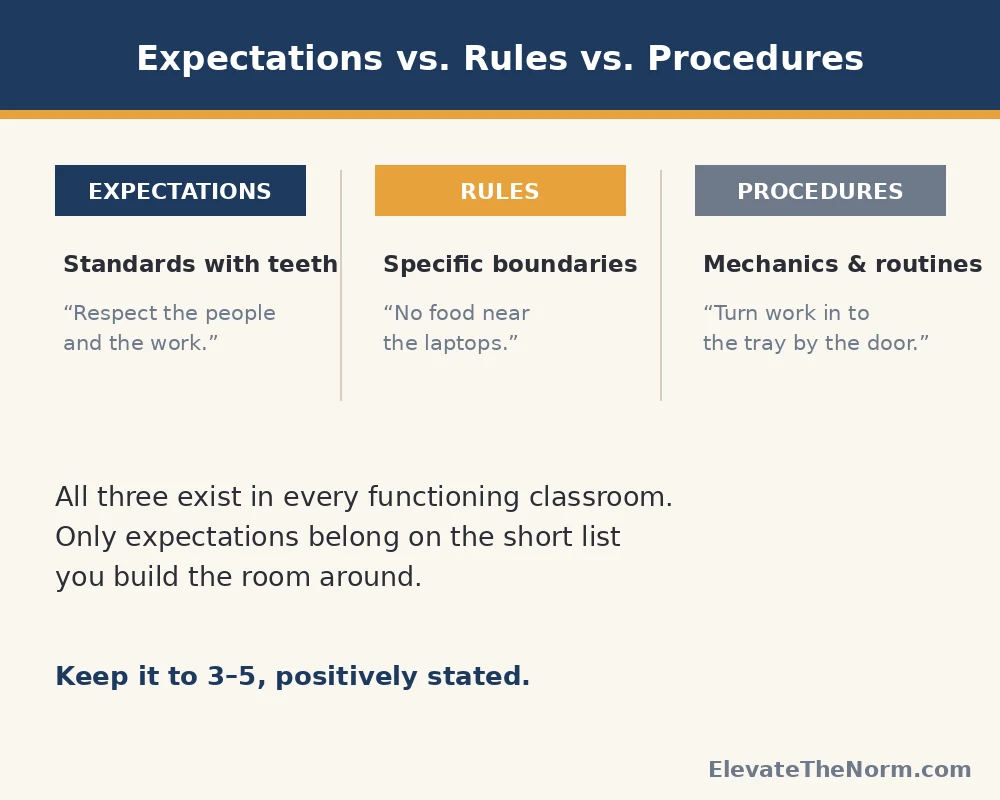
The distinction matters because teachers blur these constantly. Procedures are mechanics — how to turn in work, where to sit, what to do when you walk in. Rules are specific boundaries. Expectations sit above both: they’re the values of the room with teeth in them. “Respect the people and the work” is an expectation. “Turn your paper in to the tray by the door” is a procedure. Both matter. Only one belongs on the short list you build the room around. My free Classroom Norms Poster Set on TPT uses plain, respectful language students in grades 6–12 will not roll their eyes at.
The research here is unusually clear. A widely cited review of evidence-based classroom management practices by Simonsen and colleagues identified 20 practices with sufficient evidence behind them, grouped into five categories — and one entire category is posting, teaching, reviewing, monitoring, and reinforcing expectations. Their guidance on the list itself: keep it to a small number of positively stated expectations, broad enough to cover the behavior you actually want. Tell students what to do. Seventeen versions of what not to do is not a standard; it’s noise.
Why Clear Expectations Matter More in Grades 6–12
Because teenagers read inconsistency as unfairness, and unfairness kills buy-in faster than strictness ever will. A firm room with a predictable standard feels safe. A loose room with a random standard feels rigged.
The evidence backs the firm room. The Simonsen review found that high-structure classrooms produce more task involvement, friendlier peer interactions, more attentive behavior, and less aggression. Structure works.
Here’s where a lot of secondary teachers get stuck, though. We’re told to give students voice, choice, and ownership — and clear expectations can feel like the opposite of that. The research says the tension is imaginary. In a study of 133 public high school classrooms with 1,584 students in grades 9–11, Jang, Reeve, and Deci found that teacher structure and autonomy support were positively correlated and both predicted student engagement — complementary, not antagonistic. A 2025 meta-analysis of 94 studies in Educational Psychology Review went further: structure and autonomy support reinforce each other with a large effect size, and both raise students’ motivation, engagement, and need satisfaction. That same body of research draws the line that matters: structure is not control. Structure tells students how to succeed here. Control tells them who’s in charge. Students can smell the difference from the hallway.
In my room, the structure is visible before I say a word. The daily plan goes on the whiteboard at the front with times attached. Those times are a budget and a promise — and when I blow one, I say so out loud and say why. Predictability is a form of respect. It tells teenagers I planned for their time like it’s worth something, because it is.
Clear expectations are also the foundation everything else stands on. Teaching responsibility doesn’t work if students are guessing at the standard. Neither does anything else you care about.
Expectations set the floor. Student responsibility is what happens when students internalize that floor and hold themselves to it — not because you are watching, but because the standard is clear and they believe it applies to them.
A Practical Framework for Classroom Expectations
Five expectation areas, plus the three commitments that make them real: consequences, repair, and improvement.
1. Respect — and it runs both directions
This covers how we speak to each other, how we disagree, and how we treat each other’s time and work. The part most frameworks skip: the teacher is inside this expectation, not above it. How you correct a student in front of their peers is the most-watched respect lesson you’ll teach all year. It’s also what this site believes at the foundation: respect isn’t a reward students earn — it’s the operating condition of the room.
2. Preparation
Materials and mindset. Define what prepared actually looks like in your room, because “be prepared” means nothing until you do. In a seventh-grade room that might be: notebook, something to write with, yesterday’s exit slip. In a junior-level class it might be: annotated reading done, your section of the group work drafted, questions ready. Say it in specifics or don’t expect it.
3. Effort and participation
In a workshop-style room, participation isn’t raising your hand. Students in my room are almost always working alongside somebody, so participation means your partner can count on you — you’re carrying your share of the thinking, not just occupying the chair next to it. Define effort the same way: visible, specific, checkable by the student themselves.
4. Collaboration and technology
Set device expectations by task, always inside your school’s policy. Some work needs screens; some work needs them dark. “Use tech for the task” travels better than a blanket ban you can’t hold or a free-for-all you’ll regret. And don’t copy anyone else’s tech expectation — including mine. Align it with your building, your subject, and the rules your school already has.
5. Deadlines and quality
Deadlines in a collaborative room are commitments to other people, not just to the gradebook. The quality bar worth teaching: would you put your name on this in public? Pair the deadline expectation with an honest escape valve — renegotiate before it passes, not after. That’s not softness. That’s how deadlines work everywhere adults keep them.
The back half: consequences, repair, and improvement
An expectation with no known “what happens next” is a suggestion. So the framework has to include what follows a miss: a consequence that’s connected, proportionate, prompt, and private — the opposite of the public correction that manufactures order instead of restoring it. Then repair: what’s owed, to whom, by when. Then improvement: the expectation that the standard gets easier to hit with practice, and that being re-taught is normal, not shameful.
One boundary, stated plainly: behaviors involving safety, harassment, threats, or anything else covered by school policy go through the required reporting process every time. Classroom consequences and repair sit alongside formal procedures. They never replace them.
How to Teach Expectations Instead of Just Announcing Them
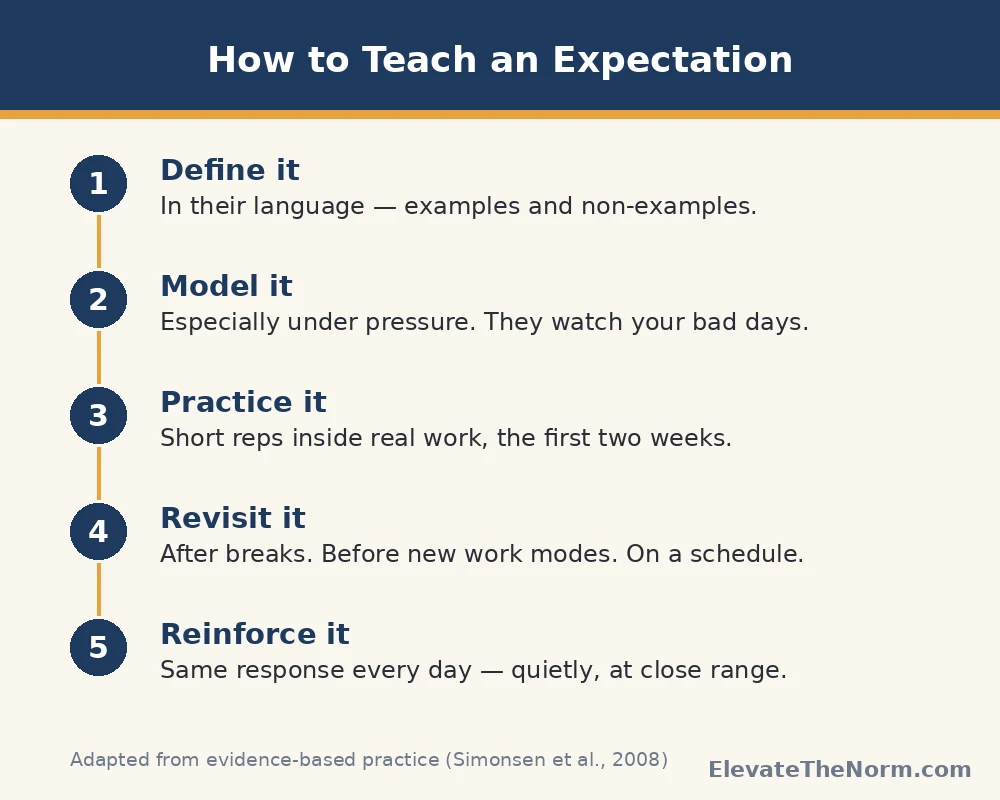
The same way you’d teach content: define, model, practice, revisit, reinforce. The place this pays off first is the transitions between activities, which is where most of a secondary lesson’s lost minutes actually go. The Simonsen review is specific about what teaching expectations means — explicit instruction with examples and non-examples, frequent review, and active supervision: the teacher moving, looking around, interacting, correcting quietly, and reinforcing what’s going right.
That last part is just a description of circulating, which is how my room runs anyway. Monitoring doesn’t look like watching from a desk. I’m moving the whole period, so when somebody drifts off an expectation, the correction happens right next to them — a few quiet words at the table, low enough that the rest of the room keeps working. The standard gets held. Nobody gets a scene.
The teaching sequence that works:
- Define it in their language. For each expectation, show what it looks like and sounds like in a real moment — and what it doesn’t. Examples and non-examples, exactly like teaching a concept.
- Model it — especially under pressure. Students learn your real expectations by watching you on a bad day. Handle your own mistakes out loud: name it, fix it, move on.
- Practice it early. The first two weeks, run short reps inside real work — a two-minute partner task where the only goal is doing it the way the room does it.
- Revisit on a schedule, not just after disasters. After every break. Before a new mode of work — labs, projects, discussions. The National Association of School Psychologists recommends teachers put reteaching on the calendar and track their own habits — like the ratio of encouragement to correction — because positive reinforcement moves behavior further than punitive correction does.
- Hold it the same way every day. Same expectation, same response, whoever the student is. If a student needs more support to hit the standard — a visual cue, a private pre-correction, a quiet re-teach — vary the support, never the standard.
Two additions that pay off. Send the expectations home in the first week, in plain language, so families hear them from you before any problem exists. And when a student keeps missing the same expectation, treat it as information: is it a skill gap, a relationship gap, or something heavier? The answer changes your move. That diagnostic work sits on top of relationships you built before anything went wrong.


A Sample Classroom Expectations Set You Can Adapt
This is a starting point, not gospel. Adapt it to your building, your students, and your policies — an expectations set only works if the person enforcing it actually believes it.
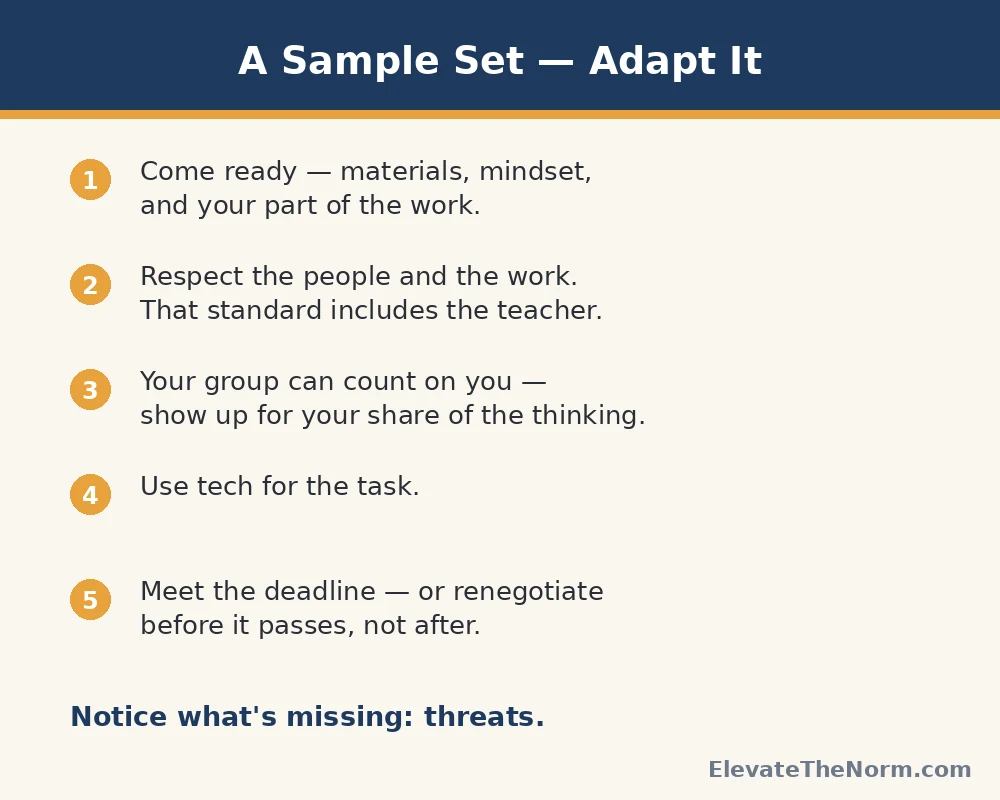
- Come ready — materials, mindset, and your part of the work.
- Respect the people and the work — in what you say and how you say it. That standard includes me.
- Your group can count on you — show up for your share of the thinking.
- Use tech for the task.
- Meet the deadline — or renegotiate it before it passes, not after.
Notice what’s missing: threats. The what-happens-next conversation is real and students deserve to know it, but it happens separately and calmly, and it always includes the way back. A list of expectations that reads like a list of warnings tells students you’re expecting the worst. They tend to oblige.
Where Classroom Expectations Fall Apart
Too many to remember. Seventeen rules function like zero rules. If students can’t recite the list, the list isn’t running the room — your mood is.
Announced once, never taught. One speech in August plus a laminated poster is decoration. Laminated is not learned.
Enforced by mood. The expectation that flexes with your energy level teaches students to scan you instead of the standard — and the students who already trust school the least pay the highest price for that unpredictability. Consistency isn’t just management. It’s fairness.
Consequences without repair. If a miss just costs and never leads anywhere, students stop investing in the standard. The path back is what makes the standard worth meeting.
Expectations for students but not the adult. You are the most-watched person in the room. A teacher who demands punctuality and starts class late, or demands respect and corrects with sarcasm, is teaching the real expectations — and they aren’t the ones on the wall.
Conclusion
Classroom expectations come down to this: a short list you actually believe in, taught like it matters, enforced the same way every day, with a real path back when somebody blows it. For a deeper look at why classroom expectations are important and the specific research on how they protect instructional time, reduce student anxiety, and build independence, that article breaks down the evidence. So start here this week. Draft three to five expectations, positively stated. Cut anything you’re not willing to enforce on your worst Tuesday. Plan how you’ll teach and model each one — with examples, non-examples, and a rep or two inside real work. Then put a reminder on your calendar for three weeks out, because you’ll need to revisit them, and that’s not failure. That’s maintenance. The room you want isn’t built by the list. It’s built by what you do about the list, every single day.
Frequently Asked Questions
How many classroom expectations should I have?
Three to five, positively stated. The research on evidence-based classroom management specifically supports a small number of broad, positive expectations rather than a long list of prohibitions. Past five, students stop remembering them and start ignoring them — and so, honestly, do teachers.
Should students help create the classroom expectations?
Their input, yes — final ownership, no. Students can genuinely shape what respect looks like in this room, refine the language, and name what a fair deadline policy feels like. That input builds real buy-in. But the teacher owns the final set and the enforcement of it. Co-created doesn’t mean committee-run, and students respect a teacher who takes their input seriously more than one who pretends the room is a democracy.
What’s the difference between expectations, rules, and procedures?
Expectations are standards for how the room operates — the values with teeth. Rules are specific boundaries, often set by school policy. Procedures are mechanics: how to enter, submit work, transition. All three exist in every functioning classroom. The mistake is putting procedures on the poster and calling them your expectations.
What do I do when a student keeps breaking the same expectation?
Privately, and as a diagnosis, not just a penalty. Figure out whether it’s a skill gap, a relationship gap, or something heavier going on — the answer changes your response. Re-teach the expectation, apply a consequence connected to the behavior, and set a repair with a path back. For persistent patterns, bring the family in with facts and a plan, and involve the counselor or administration when the situation calls for it under your school’s process.
Do the same expectations work for middle school and high school?
The same categories work; the teaching changes. Middle schoolers need more reps, shorter loops, and more explicit modeling — expect to re-teach often and treat that as normal. High schoolers need more rationale and can handle more negotiated specifics. Both deserve expectations written in adult language. Nothing loses a ninth grader faster than a poster that talks to them like they’re eight.
What about cell phones?
Set a device expectation by task — “use tech for the task” — inside whatever your school or district policy requires. Then hold it with the same calm consistency as everything else. The rooms that lose the phone war usually lose it to inconsistency and escalation, not to the phones themselves. And don’t let the phone battle become the identity of your classroom; it’s one expectation among five, not the mission.
When should I revisit or re-teach expectations?
On a schedule: after every break, before any new mode of work — labs, projects, discussions, presentations — and any time you notice slippage. Put it on the calendar at the start of the year so re-teaching is maintenance instead of a reaction. A ten-minute refresher in January is cheaper than a February you spend fighting the room.
Sources
- Simonsen, B., Fairbanks, S., Briesch, A., Myers, D., & Sugai, G. (2008). “Evidence-based Practices in Classroom Management: Considerations for Research to Practice.” Education and Treatment of Children, 31(3), 351–380. https://dropoutprevention.org/wp-content/uploads/2015/05/Simonsen_Fairbanks_Briesch_Myers_Sugai_2008.pdf
- Jang, H., Reeve, J., & Deci, E. L. (2010). “Engaging Students in Learning Activities: It Is Not Autonomy Support or Structure but Autonomy Support and Structure.” Journal of Educational Psychology, 102(3), 588–600. https://eric.ed.gov/?id=EJ892818
- Patzak, A., & Zhang, X. (2025). “Blending Teacher Autonomy Support and Provision of Structure in the Classroom for Optimal Motivation: A Systematic Review and Meta-Analysis.” Educational Psychology Review, 37, Article 17. https://link.springer.com/article/10.1007/s10648-025-09994-2
- National Association of School Psychologists. “Classroom Management: A Brief Overview.” NASP. https://www.nasponline.org/assets/documents/Resources%20and%20Publications/Handouts/General%20Resources/Classroom-Management_web-handout.Final.pdf
For ready-to-use tools built around these expectations, see the free classroom routines and procedures checklist and the free classroom transitions toolkit. Expectations tell students what the standard is; the daily procedures that carry them are covered in what to teach students about classroom routines, and when.
If you want a ready-to-print version of these expectations for your wall, see Classroom Expectations Poster for Middle and High School Students for a complete secondary poster template and introduction sequence.
If you would rather start from wording than from the framework, the collection of examples of classroom expectations gives observable, ready-to-adapt sets for a middle school room, a discussion-heavy high school course, a lab or shop, a performance class, and a one-to-one device classroom.
The framework above is built on the assumption that students can meet your expectations when those expectations are taught and held consistently. For the research behind that assumption—and specific classroom moves that translate genuine belief into practice—see the guide on high expectations for students.
About Clay Shumate
Clay Shumate is a certified secondary Social Studies teacher in the public schools of West Alabama, with seven years of classroom experience, a B.A. in History, and an M.Ed. in Secondary Education. He writes about project-based learning, student responsibility, respect, and practical ways to hold young people to a higher standard while giving them room to learn from mistakes. He is a member of the Society of Professional Journalists and writes to its Code of Ethics; this site’s editorial standards and corrections policy are published in full. More about Clay.